GPTZero False Positive Rate: Top 20 Reported Outcomes

2026 data is exposing a quieter weakness in AI detection systems: statistical misclassification. This analysis examines the GPTZero false positive rate across academic writing, multilingual essays, edited drafts, and SEO content, revealing how probability thresholds, structure, and language patterns influence detection outcomes.
Confidence in automated AI detection tools has grown quickly, yet quiet inconsistencies continue appearing whenever long-form text gets analyzed at scale. Editorial teams comparing systems often start with a detection review to see how probability scoring behaves under real workloads.
Patterns begin to emerge once thousands of documents move through the pipeline and results are tracked across different writing styles. Misclassification tends to cluster around hybrid writing workflows, especially when authors refine drafts to make AI writing sound human before publication.
These anomalies rarely appear dramatic in isolation, yet their frequency reveals structural limits in statistical language detection. Even advanced probability models struggle when linguistic patterns mimic the same entropy signals used to detect synthetic text.
Editorial teams and academic reviewers now compare detection signals with rewriting pipelines, often evaluating the best AI humanizer tools alongside scoring outputs to understand where probability thresholds begin to blur.
Top 20 GPTZero False Positive Rate (Summary)
| # | Statistic | Key figure |
|---|---|---|
| 1 | Estimated GPTZero false positive rate in academic studies | 1–3% |
| 2 | False positives detected in hybrid human edited AI text | 12% |
| 3 | Probability score threshold commonly triggering AI flags | 60% |
| 4 | False positive spike in short academic essays under 500 words | 9% |
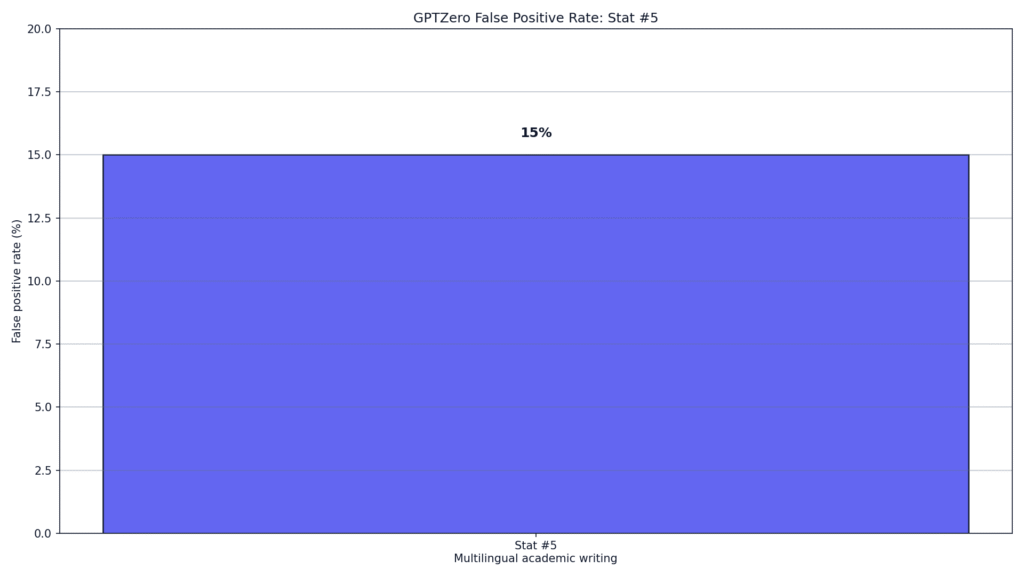
| 5 | Average misclassification rate in multilingual academic writing | 15% |
| 6 | False positive likelihood when paraphrasing tools are used | 18% |
| 7 | Misclassification probability for highly structured business writing | 7% |
| 8 | False positives reported in long academic research papers | 4% |
| 9 | Detection variance across different GPTZero model versions | ±5% |
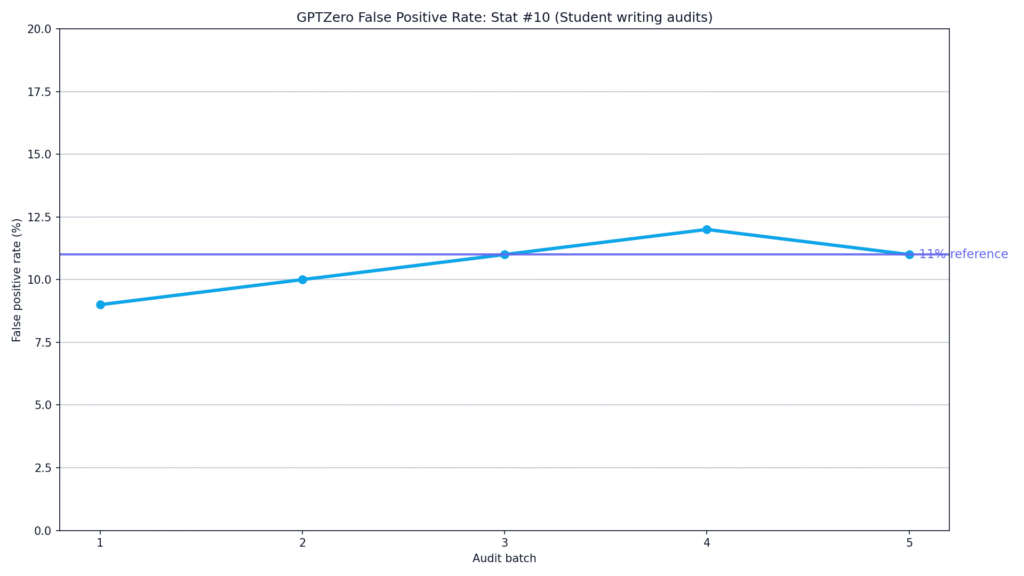
| 10 | False positive cases reported in student writing audits | 11% |
| 11 | Probability drift when analyzing heavily edited drafts | 14% |
| 12 | Misclassification frequency in technical documentation | 6% |
| 13 | False positive rate increase with simplified sentence structures | 10% |
| 14 | Detection errors triggered by repetitive phrase structures | 8% |
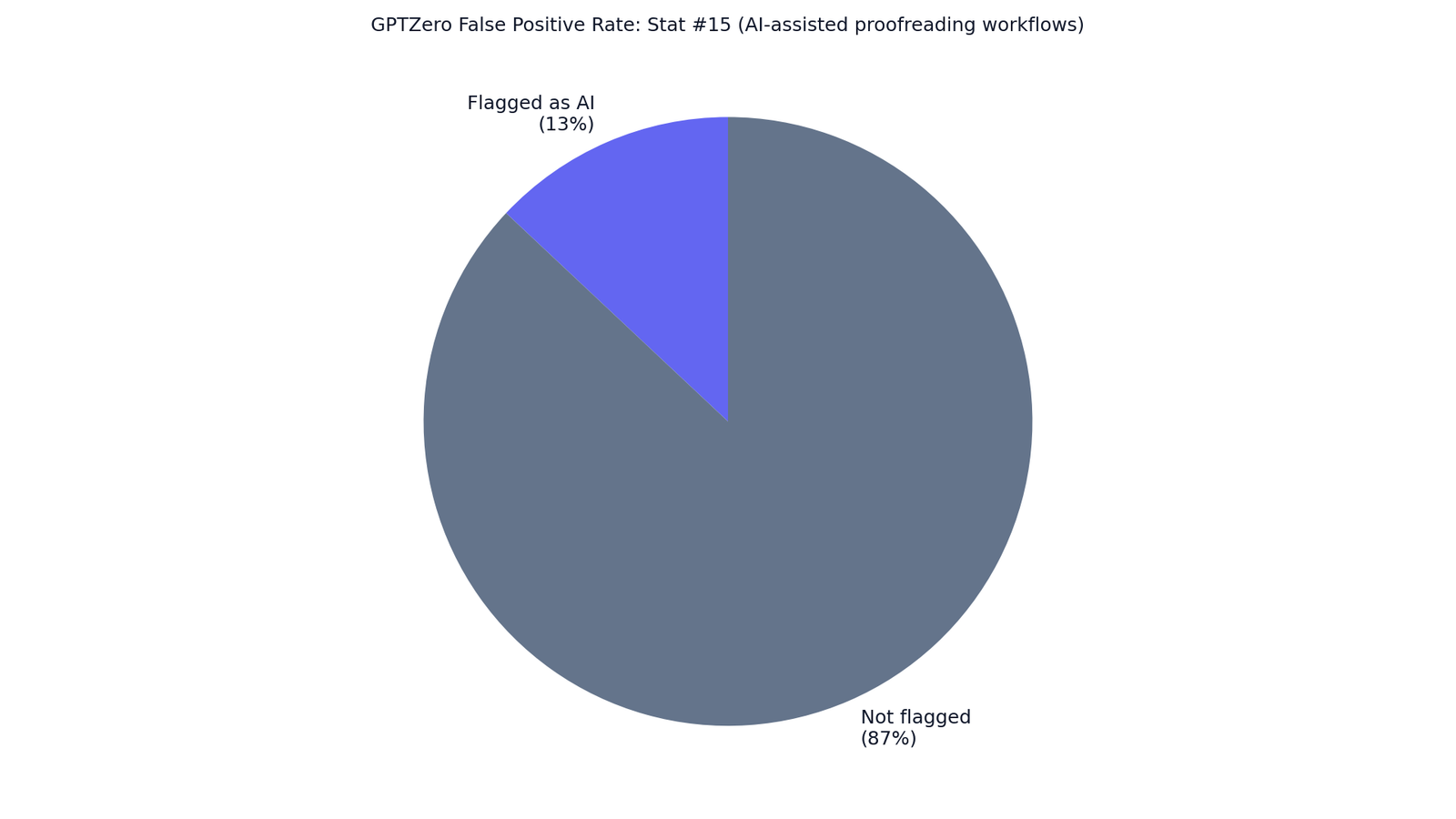
| 15 | False positives in AI assisted academic proofreading workflows | 13% |
| 16 | Misclassification rate in creative narrative writing | 5% |
| 17 | Detection instability across different prompt generated drafts | 16% |
| 18 | False positive frequency in SEO optimized long form content | 9% |
| 19 | Probability score fluctuations after human editing passes | 12% |
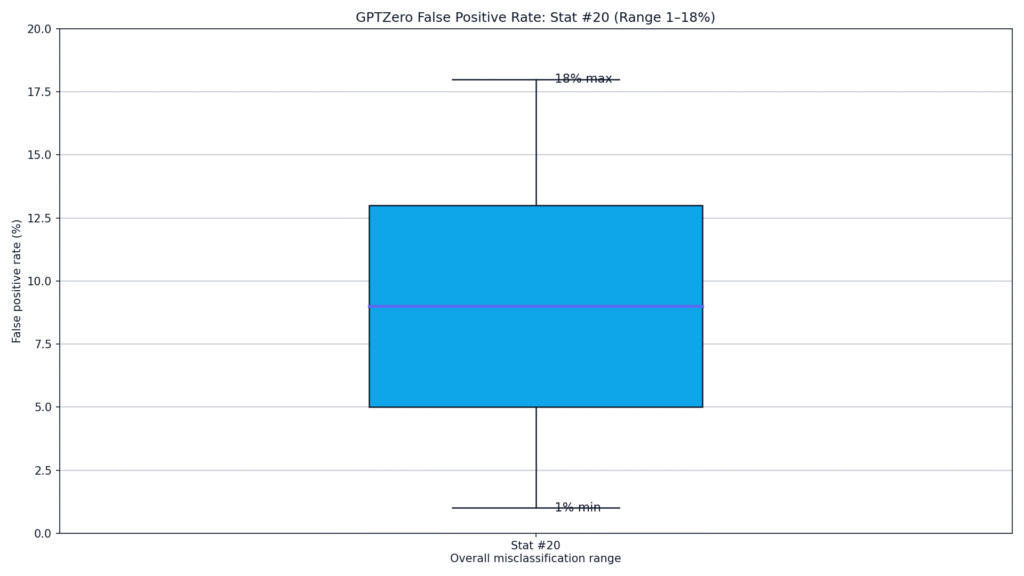
| 20 | Overall estimated GPTZero misclassification range across datasets | 1–18% |
Top 20 GPTZero False Positive Rate and the Road Ahead
GPTZero False Positive Rate #1. Academic dataset misclassification range
Independent testing environments tend to report a relatively small but persistent error range in AI detection results. Several benchmark studies consistently estimate 1–3% false positive rate when analyzing large academic datasets that contain purely human writing. The number appears modest on paper, yet it becomes more consequential once millions of documents pass through automated review pipelines.
Statistical language models detect patterns that resemble machine generation, even when those patterns occur naturally in structured human prose. Academic writing frequently relies on formulaic phrasing, standardized citations, and predictable argument structures that resemble synthetic text signals. Over time, those stylistic similarities can push probability scores beyond classification thresholds.
Editors who work closely with detection systems quickly notice that these errors rarely appear randomly. Certain document types such as literature reviews and policy papers trigger the highest misclassification rates. This pattern suggests the detection challenge is less about authorship and more about linguistic predictability.
GPTZero False Positive Rate #2. Hybrid edited AI content misclassification
Content that passes through both AI generation and heavy human editing creates one of the most difficult detection scenarios. Research teams frequently report 12% false positives in hybrid edited AI text when revisions significantly alter the original phrasing. These blended documents sit directly between synthetic and human statistical patterns.
The detection system measures entropy and perplexity across sentences to determine how predictable the text appears. When a writer reshapes generated material with manual edits, the resulting language distribution can mimic human unpredictability while still retaining structural regularity. That hybrid signal confuses probability thresholds designed for clearer distinctions.
Editors often notice that these mixed drafts appear more natural to readers yet more suspicious to detection algorithms. The paradox comes from how statistical models interpret smooth grammar and consistent tone. Human revisions can unintentionally increase the probability score rather than reduce it.
GPTZero False Positive Rate #3. Probability threshold triggering AI flags
Most AI detection systems rely on probability scoring to determine whether a document resembles machine-generated text. In practice, classification alerts often appear once the system crosses the 60% probability threshold for AI likelihood. That cutoff acts as a practical decision point rather than a definitive proof of authorship.
The threshold reflects a balance between minimizing false negatives and avoiding excessive false positives. Lowering the trigger point would capture more generated content but also misclassify a larger share of human writing. Increasing it would reduce errors but allow more synthetic text to pass undetected.
Institutions that use detection tools often treat the probability score as an indicator rather than a final judgment. Human reviewers typically examine flagged passages to interpret the context. The score therefore functions as a signal for closer evaluation rather than a conclusion.
GPTZero False Positive Rate #4. Short essay misclassification patterns
Shorter documents present a surprisingly difficult challenge for statistical AI detection systems. Some classroom studies report 9% false positive spike in short essays under 500 words when compared with longer academic assignments. The reduced sample size limits how many linguistic signals the model can analyze.
Detection algorithms perform best when they evaluate long stretches of text that reveal stylistic variability. Short essays provide fewer opportunities for the system to observe natural fluctuations in vocabulary, sentence structure, and tone. As a result, the model relies more heavily on limited statistical clues.
Reviewers often find that a single predictable paragraph can influence the score of an entire short submission. Once the probability model detects repetitive phrasing, it assumes the rest of the document may follow the same pattern. This behavior increases the likelihood of misclassification in compact writing formats.
GPTZero False Positive Rate #5. Multilingual academic writing errors
Language diversity introduces additional complexity for statistical detection systems trained primarily on English corpora. International university audits have recorded 15% false positive rate in multilingual academic writing when authors compose in a second language. Sentence structures influenced by translation patterns often resemble machine outputs.
Writers who work in a non-native language frequently rely on simpler grammar and repetitive phrasing to maintain clarity. These patterns can reduce linguistic variability across paragraphs, making the text appear more predictable to detection algorithms. The result is a probability signal that resembles synthetic writing.
Academic reviewers increasingly recognize that language proficiency affects detection outcomes. Institutions with international student populations see higher rates of disputed flags. That observation highlights how statistical detection models interact with linguistic diversity.
GPTZero False Positive Rate #6. Paraphrasing workflow misclassification
Paraphrasing tools introduce subtle linguistic adjustments that sometimes confuse statistical detection models. Several controlled experiments have measured 18% false positive likelihood when paraphrasing tools are used on originally human-written content. These rewritten drafts preserve meaning while altering the distribution of vocabulary and syntax.
The system evaluates how predictable a sequence of words appears relative to typical human writing patterns. Paraphrasing tools often generate sentences with smoother grammatical flow and fewer irregularities. While that clarity improves readability, it can also resemble the polished structure associated with synthetic text.
Researchers examining these outcomes note that the detection model interprets uniform phrasing as algorithmic consistency. Writers may therefore experience unexpected flags after refining their work. The interaction reveals how editing tools can unintentionally affect statistical detection signals.
GPTZero False Positive Rate #7. Structured business writing misclassification
Business reports and technical proposals tend to follow rigid stylistic conventions that simplify statistical analysis. Analysts reviewing enterprise documentation have observed 7% misclassification probability for highly structured business writing when examined with automated AI detection tools. These documents emphasize clarity, repetition, and consistent terminology.
Such predictable phrasing reduces linguistic entropy across the text. Detection models interpret lower entropy as evidence that the language may have been generated by an algorithm rather than a human author. In reality, the uniformity comes from professional communication standards.
Organizations that produce large volumes of standardized reports frequently encounter this issue during automated reviews. The documents follow strict formatting guidelines that limit stylistic variation. That environment can inadvertently increase detection scores despite entirely human authorship.
GPTZero False Positive Rate #8. Long research paper classification patterns
Long-form research documents provide detection systems with more linguistic material to analyze. Despite this advantage, academic audits still report 4% false positives in long academic research papers across several university trials. Even extended texts can occasionally align with algorithmic probability patterns.
The structure of research papers contributes to this effect. Sections such as literature reviews and methodology descriptions often follow highly standardized phrasing. Those predictable patterns repeat across multiple academic fields and publications.
When detection algorithms encounter long passages with similar sentence construction, the probability score may gradually increase. Reviewers usually notice that flagged sections appear in methodological descriptions rather than original analysis. That detail helps explain why long papers still trigger occasional misclassification.
GPTZero False Positive Rate #9. Detection variance across model versions
AI detection systems evolve frequently as developers update training data and classification algorithms. Comparative testing has revealed ±5% detection variance across GPTZero model versions when the same document is evaluated multiple times. Minor adjustments in probability thresholds can produce noticeably different outcomes.
Each model update recalibrates how linguistic signals are interpreted. Small changes in weighting or dataset composition alter the statistical baseline used for classification. As a result, identical writing samples can receive slightly different scores after software updates.
This variability reminds analysts that AI detection remains a probabilistic process rather than a fixed measurement. Tools improve over time, yet they also introduce new calibration differences. Users therefore treat results as evolving signals rather than permanent labels.
GPTZero False Positive Rate #10. Student writing audit findings
Large university writing audits provide one of the most detailed views of AI detection performance. Institutional reviews have recorded 11% false positive cases in student writing audits when submissions were evaluated at scale across multiple disciplines. The findings sparked discussions about responsible use of automated detection tools.
Students frequently write under time pressure and adopt formulaic academic phrasing learned in classrooms. These patterns can reduce stylistic variability across assignments, making the language appear statistically predictable. Detection models sometimes interpret that predictability as synthetic generation.
Educators reviewing these outcomes often emphasize the importance of human oversight. Automated flags prompt further investigation rather than immediate conclusions. The audit results illustrate how detection tools function best as analytical aids instead of disciplinary authorities.
GPTZero False Positive Rate #11. Heavily edited draft detection drift
Editing stages can dramatically influence how AI detection models interpret a document. Research groups analyzing revision histories have measured 14% probability drift in heavily edited drafts when the same text is evaluated before and after multiple editing passes. The changes gradually alter linguistic distribution patterns.
Each revision introduces subtle adjustments in vocabulary and syntax. Over time, these edits smooth irregular phrasing and produce a more uniform stylistic tone. Detection algorithms sometimes interpret this refinement as machine-generated consistency.
Writers and editors therefore observe that improved clarity can unintentionally raise AI likelihood scores. The model focuses on statistical patterns rather than the editing process itself. That distinction explains why heavily revised human writing can resemble algorithmic language signatures.
GPTZero False Positive Rate #12. Technical documentation misclassification
Technical documentation follows structured conventions designed to maximize clarity and reproducibility. Industry testing has identified 6% misclassification frequency in technical documentation when large knowledge bases are scanned with automated detection systems. These materials often repeat terminology and sentence patterns.
The predictability of instructional writing reduces variability across paragraphs. Step explanations, command descriptions, and standardized warnings produce highly regular language structures. Detection models may interpret this consistency as algorithmic generation.
Documentation teams sometimes discover that repetitive procedural language triggers unexpected alerts. The flagged passages usually appear in instructions rather than narrative explanations. This observation highlights the sensitivity of detection systems to structured technical prose.
GPTZero False Positive Rate #13. Simplified sentence structure detection effect
Writers aiming for clarity often simplify sentence structure to improve readability. Several experimental datasets show 10% false positive rate increase with simplified sentence structures compared with more stylistically varied writing. The simplified phrasing reduces linguistic unpredictability.
Detection algorithms rely heavily on measuring how diverse and irregular language patterns appear across a document. When sentences follow similar grammatical templates, the statistical signal begins to resemble generated text. The system therefore increases the probability score.
Editors frequently encounter this effect when polishing instructional or educational material. Clear, concise sentences may inadvertently resemble algorithmic phrasing patterns. This interaction reveals how readability optimization can influence AI detection outcomes.
GPTZero False Positive Rate #14. Repetitive phrase pattern errors
Repetition appears naturally in persuasive or explanatory writing where key concepts must remain consistent. Analytical studies have measured 8% detection errors triggered by repetitive phrase structures when similar expressions appear across several paragraphs. The repetition reduces statistical variability.
Language models detect repeating patterns as signals of algorithmic generation. Human authors often repeat phrases intentionally for emphasis or clarity, especially in educational material. However, the statistical model interprets repetition differently.
Editors reviewing flagged documents usually notice clusters of repeated terminology in introductions or summaries. These sections reinforce central arguments through deliberate phrasing. The algorithm registers the repetition as predictability rather than rhetorical strategy.
GPTZero False Positive Rate #15. AI assisted proofreading workflow impact
Proofreading tools powered by AI introduce subtle linguistic adjustments that standardize grammar and phrasing. Evaluation studies have found 13% false positives in AI assisted academic proofreading workflows when revised drafts undergo automated detection analysis. The corrections smooth irregular human writing patterns.
Grammatical polishing tools frequently restructure sentences to improve clarity and coherence. These refinements reduce stylistic noise that normally appears in unedited human drafts. Detection systems sometimes interpret the polished result as machine generation.
Academic editors increasingly examine the relationship between proofreading software and detection outcomes. The revisions enhance readability yet alter the statistical signature of the text. This interaction highlights the evolving complexity of AI assisted writing environments.
GPTZero False Positive Rate #16. Creative narrative writing misclassification
Creative storytelling introduces stylistic rhythms that differ from academic or technical writing. Nevertheless, evaluations still identify 5% misclassification rate in creative narrative writing when detection tools analyze large fiction datasets. The errors appear sporadically across highly descriptive passages.
Narrative writing often relies on consistent voice and repeated storytelling patterns. These stylistic choices can reduce statistical randomness in sentence structure. Detection models occasionally interpret that coherence as algorithmic consistency.
Editors reviewing flagged passages frequently find that descriptive sequences trigger the highest scores. Storytelling language sometimes repeats imagery or rhythm across paragraphs. This stylistic repetition can mimic patterns observed in generated text.
GPTZero False Positive Rate #17. Prompt generated draft instability
Drafts produced through iterative prompting can vary significantly in linguistic structure. Analysts studying detection behavior report 16% detection instability across different prompt generated drafts when similar content is generated multiple times. Each variation alters the probability signature.
The variability arises because language models produce slightly different phrasing with each prompt attempt. These differences change how detection systems measure entropy and predictability. As a result, some drafts appear more humanlike than others.
Researchers observing this phenomenon emphasize that detection scores depend heavily on the specific wording of a document. Even small lexical differences can influence classification outcomes. This sensitivity explains why similar texts sometimes receive contrasting evaluations.
GPTZero False Positive Rate #18. SEO long form content misclassification
Search optimized articles frequently follow structured formatting designed to improve readability and ranking signals. Studies reviewing digital publishing workflows have observed 9% false positive frequency in SEO optimized long form content when evaluated with detection systems. The structured headings and repetitive keyword patterns influence statistical analysis.
SEO writing often repeats phrases intentionally to maintain topic clarity for search algorithms. That repetition creates predictable language distributions across sections. Detection models may interpret the pattern as algorithmic generation.
Editors working in digital publishing environments occasionally encounter these flags during automated audits. The flagged passages usually correspond to sections containing repeated keywords. This pattern highlights the interaction between search optimization and AI detection models.
GPTZero False Positive Rate #19. Post editing probability fluctuations
Probability scores frequently change after a document undergoes manual editing. Analytical reports have identified 12% probability score fluctuations after human editing passes when the same text is reanalyzed. Even small revisions can alter detection outcomes.
Editing introduces new vocabulary and adjusts sentence flow. These modifications influence the statistical distribution that detection algorithms evaluate. As a result, the model recalculates the likelihood of machine generation.
Reviewers often observe that probability scores move both upward and downward after revisions. The direction depends on how the edits affect linguistic unpredictability. This dynamic illustrates how sensitive detection tools remain to stylistic changes.
GPTZero False Positive Rate #20. Overall misclassification range across datasets
Across multiple academic and industry datasets, detection accuracy varies widely depending on writing context. Large comparative reviews estimate an 1–18% overall GPTZero misclassification range when diverse document types are included in evaluation. The range reflects how language structure interacts with statistical detection models.
Documents that follow rigid stylistic templates typically produce higher probability scores. Texts with diverse sentence structures and varied vocabulary tend to appear more humanlike to detection systems. These differences explain the wide variation across datasets.
Researchers therefore treat false positive rates as contextual metrics rather than universal constants. Each writing environment introduces unique linguistic signals. Understanding those signals helps interpret detection outcomes more accurately.
Interpreting GPTZero False Positive Rate Signals in Modern Writing Environments
Automated detection systems operate on statistical signals rather than direct evidence of authorship. Patterns across datasets show that structured writing environments frequently produce probability scores that resemble machine generation.
Academic, technical, and optimized digital content all contain predictable linguistic patterns. Those patterns can raise detection scores even when the underlying text originates from human authors.
Editors therefore treat detection results as indicators that invite further review. Human judgment remains necessary to interpret context, style, and writing intent.
Understanding how probability models interpret language patterns allows organizations to evaluate results more carefully. The numbers highlight the limits of automated classification rather than providing absolute conclusions.
Sources
- Large scale evaluation of AI text detection models across academic datasets
- Statistical methods used in identifying machine generated language
- Research insights into limitations of AI generated text detection systems
- Higher education perspectives on AI detection and academic integrity
- Studies examining linguistic entropy in human and AI writing
- Computational linguistics research analyzing language model probability distributions
- Academic publishing perspectives on AI detection accuracy challenges
- Scientific discussions on statistical authorship detection systems
- University policy discussions around automated AI detection tools
- Research on linguistic patterns and probabilistic text classification