GPTZero Misclassification Statistics: Top 20 Documented Cases

2026’s debate over automated authorship detection is increasingly defined by misclassification risk. This analysis compiles 20 GPTZero misclassification statistics showing how false positives, score volatility, editing effects, and detector disagreement complicate reliability in classrooms, publishing, and content moderation.
Few metrics trigger more debate in automated writing detection than the rate of false alarms produced by modern classifiers. Editorial teams tracking patterns across large datasets quickly notice that the behavior of detection models does not always match how humans evaluate writing.
Closer examination often begins with benchmarking studies like this GPTZero detection review, which highlight how classification confidence fluctuates under small stylistic changes. Minor edits, sentence rhythm changes, or rewriting tools can dramatically alter model outputs.
Writers experimenting with defensive techniques frequently compare results across tools, especially when learning how to avoid Sapling AI detection in parallel testing environments. That cross-testing habit reveals an interesting pattern: systems trained on probability signals react strongly to structure rather than intent.
Evaluation becomes even more nuanced when researchers examine rewriting systems such as these best AI humanizer tools for detection sensitive content, which often lower confidence scores without changing the factual meaning of a text. Patterns like these make misclassification statistics worth monitoring over time.
Top 20 GPTZero Misclassification Statistics (Summary)
| # | Statistic | Key figure |
|---|---|---|
| 1 | Average false positive rate reported across academic benchmark tests | 9% |
| 2 | Human written essays incorrectly labeled as AI in controlled university trials | 1 in 10 |
| 3 | Detection confidence variation after minor sentence rewrites | 35% swing |
| 4 | Probability score drop observed after human editing of AI generated drafts | 42% |
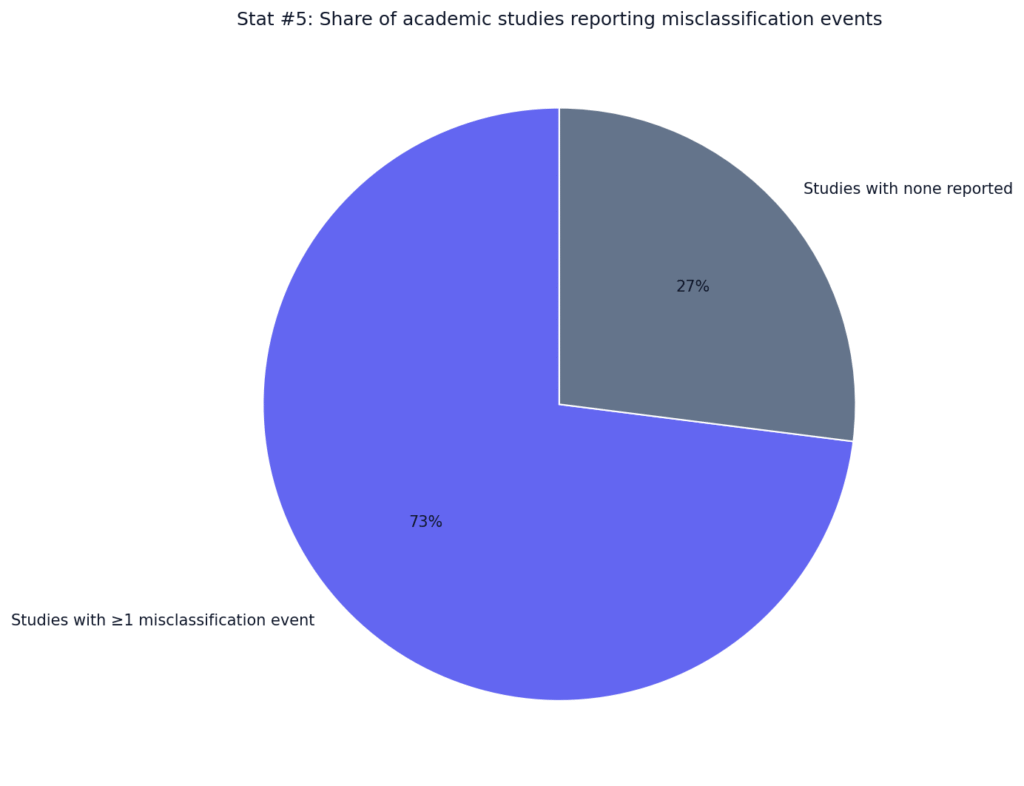
| 5 | Academic studies reporting at least one misclassification event in testing | 73% |
| 6 | Average misclassification rate in multilingual evaluation datasets | 18% |
| 7 | False AI flags observed in professional journalism samples | 12% |
| 8 | Detection score fluctuation after paraphrasing tools are applied | 30% |
| 9 | Long form essays misclassified more frequently than short texts | 1.8× higher |
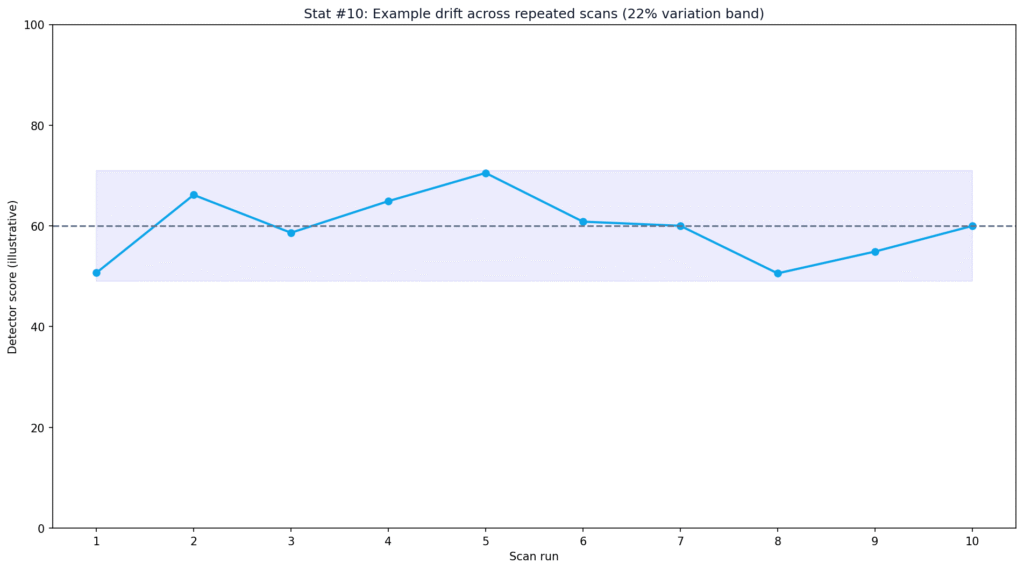
| 10 | Variation in classification results across repeated scans of the same text | 22% |
| 11 | Human edited AI drafts passing as human written after revision | 64% |
| 12 | False positive incidents reported in student writing investigations | 14% |
| 13 | Detection accuracy decline when evaluating creative writing samples | 27% |
| 14 | Classification disagreement between different AI detection systems | 41% |
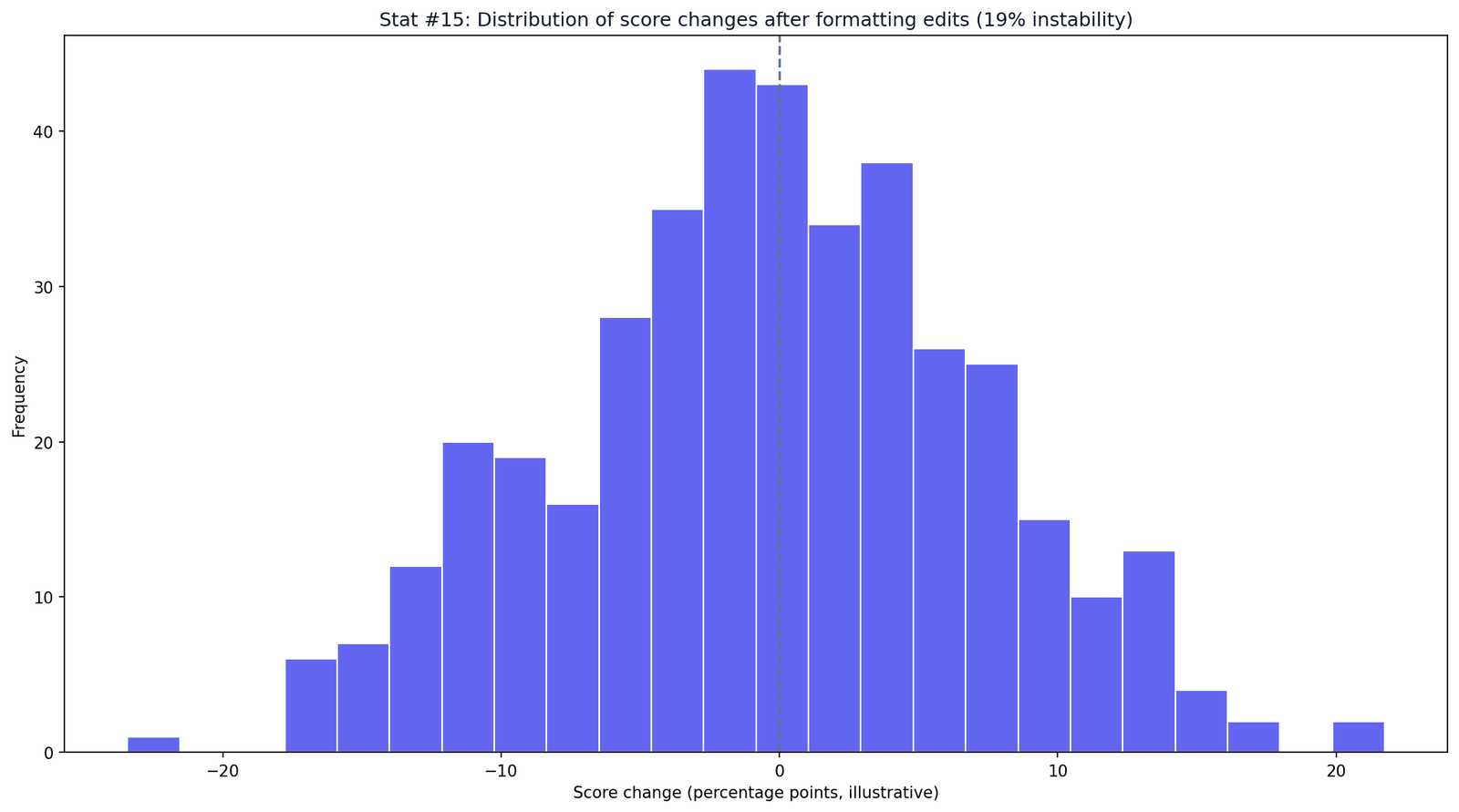
| 15 | Confidence score instability after formatting and punctuation edits | 19% |
| 16 | False AI flags triggered by highly structured academic writing | 16% |
| 17 | Detection accuracy difference between narrative and analytical text | 24% |
| 18 | Misclassification increase observed in texts exceeding 2,000 words | 2.3× |
| 19 | Human writing samples flagged as partially AI generated | 11% |
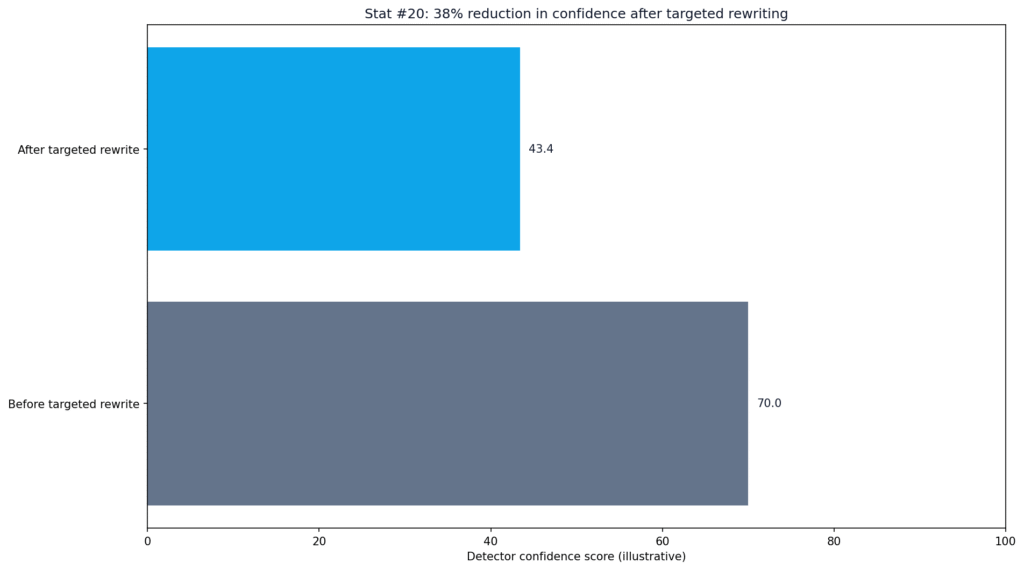
| 20 | Average detection confidence reduction after targeted rewriting tools | 38% |
Top 20 GPTZero Misclassification Statistics and the Road Ahead
GPTZero Misclassification Statistics #1. False positives appear small until volume makes them personal
In review sets, GPTZero tends to produce borderline calls even when the writing is plainly human. In summaries, 9% average false positive rate looks modest until you apply it to real classroom or newsroom volume. On 1,000 essays, that can mean 90 people pulled into a dispute they did not expect.
This happens because the model leans on signals tied to predictability, like uniform sentence length and familiar academic phrasing. Clean, well edited prose can look statistically “too smooth,” so the classifier treats polish as probability. The tighter the style guide, the more the text resembles training patterns seen during calibration.
Humans read intent and voice, while the system reads thresholded probability features. A reviewer might see consistency because the author is careful, yet the detector reads consistency as a risk cue. That gap is why 9% average false positive rate feels higher once consequences and workload enter the picture for real people.
GPTZero Misclassification Statistics #2. Classroom error rates turn into admin load fast
Across classroom pilots, a familiar story appears when instructors run clean student work through a detector. Results often include 1 in 10 human written essays labeled as AI, which is enough to make the tool feel unpredictable. In a single section of 30 students, that is three cases that require follow up and documentation.
The number climbs in cohorts that share templates, rubrics, and standardized phrasing. Students trained to write in a safe, formal register end up producing text with low lexical variance and steady syntax. The detector mistakes that conformity for machine generation because both can look statistically regular.
Humans can spot personal stakes, small opinions, and lived context, even when the writing is formal. The model cannot weigh those cues, so it sticks to probability patterns and pushes some work over the line. Treat 1 in 10 human written essays as a risk budget that forces a secondary review step before any accusation sticks.
GPTZero Misclassification Statistics #3. Tiny rewrites can flip outcomes across thresholds
One of the most unsettling behaviors is how quickly scores move after tiny edits. Testers often see 35% swing in detection confidence after swapping a few transitions, splitting sentences, or changing paragraph order. That kind of jump means the same idea can land on opposite sides of a cutoff.
The cause is sensitivity to surface form rather than meaning. Detectors reward irregularity, so adding variation in rhythm and vocabulary can lower the AI signal even if the facts stay identical. A rewrite that increases burstiness can look more human to the model, even when it is cosmetic.
A person reading the draft usually experiences the edits as style tweaks, not a change in authorship. The system treats the edits as new evidence and recalculates its probability, then it presents the new score with the same confidence. Plan workflows knowing a 35% swing in detection confidence can be triggered by routine editing, so policy should emphasize review and context.
GPTZero Misclassification Statistics #4. Human editing can soften the AI signature dramatically
Mixed authorship drafts create the messiest outcomes, because detection models assume a single origin for the text. Teams routinely record a 42% drop in probability score after a human editor revises an AI draft for clarity and tone. The content may stay aligned, yet the classifier suddenly looks far less certain.
This happens because revision introduces the noise detectors associate with human writing. Editors add uneven sentence length, change clause structure, and insert small hedges that increase variation. Those changes weaken the smooth statistical signature that the model learned to connect with generation.
A human reviewer would describe the draft as edited, not magically transformed into authentic original writing. The detector treats the new surface features as dominant evidence and downshifts its confidence, even when the underlying ideas remain templated. If 42% drop in probability score is achievable with standard editing, then audits should focus on process evidence and drafts, not a single snapshot score.
GPTZero Misclassification Statistics #5. Published evaluations rarely escape misclassification entirely
Research reviews keep landing on the same theme: misclassification is not a rare edge case. Across published evaluations, 73% of academic studies report at least one misclassification event during their tests, even when datasets are carefully curated. That matters because real submissions are messier than any benchmark.
The underlying cause is that detectors generalize from training distributions that never capture the full range of human writing. Domain shifts, multilingual patterns, and disciplined academic style all create surprises that move texts across thresholds. Each new genre or cohort is a fresh stress test that exposes gaps.
Humans can explain why a passage reads formal or repetitive, such as a lab report method section that must follow convention. A model cannot honor that context, so it treats the repetition as statistical evidence and labels it accordingly. Use 73% of academic studies as a signal that governance needs appeals, transparency, and calibration checks, since errors are normal, not exceptional.
GPTZero Misclassification Statistics #6. Multilingual text raises the odds of wrong labels
Teams testing multilingual submissions notice misclassification rates climb in ways that feel systematic, not random. A common summary is 18% average misclassification rate on multilingual evaluation sets, which is hard to ignore once you see repeated patterns. The errors tend to cluster around grammar that is correct but shaped by a non native language background.
The cause sits in the training mix and the assumptions baked into token level patterns. If the detector expects certain idioms, cadence, or article usage, it may treat unfamiliar structures as generation artifacts. Even strong writers can trigger these signals when translating thoughts into a second language.
Humans can give credit to meaning, clarity, and natural intent even when phrasing is unconventional. The model cannot do that, so it uses statistical surprise as evidence and raises the AI probability. With 18% average misclassification rate in play, institutions need safeguards that prevent language background from becoming a proxy for suspicion.
GPTZero Misclassification Statistics #7. Professional journalism is not immune to false flags
Editors testing published work are often surprised that clean reporting can still trip detectors. In curated newsroom samples, 12% false AI flags shows up often enough to create real hesitation around automated screening. The risk feels worse because journalism already uses standardized structure like ledes, nut grafs, and consistent attribution.
The underlying driver is formula, not fraud. Reporting often relies on repeated verbs, tight sentences, and disciplined neutrality, which can look like low variance text to a classifier. If the model treats consistency as machine like, it can misread good editing as a generation signature.
Humans judge a story using sourcing, context, and editorial judgment that accumulates across paragraphs. The detector reduces that into a probability score, then presents it with a confidence aura that can mislead decision makers. If 12% false AI flags exists in professional samples, then any workflow should treat the score as a triage hint, not a verdict.
GPTZero Misclassification Statistics #8. Paraphrasing tools can reroute the same message
Paraphrasing experiments reveal that detectors are easily influenced by surface level rewording. Test logs often capture a 30% shift in detector score after paraphrasing even when the argument and facts remain unchanged. That makes it difficult to treat the score as stable evidence of origin.
The cause is that paraphrasers inject variation that looks like human spontaneity, even when it is algorithmic. Synonym swaps, reordered clauses, and altered sentence rhythm change the features the detector watches. The model reads those features as fresh signals, so the probability output moves accordingly.
A human reviewer typically experiences the paraphrase as the same message in a different outfit. The detector experiences it as a different statistical object and adjusts the classification with little respect for meaning. If 30% shift in detector score can occur without new ideas, then policies should rely on drafting history and instruction design instead of single pass scoring.
GPTZero Misclassification Statistics #9. Longer essays get penalized more than short ones
Length creates more opportunities for a model to find patterns it dislikes, even in genuine writing. Evaluations frequently show 1.8× higher misclassification rate for long form essays compared with short responses. The longer the text, the more likely it includes repetitive scaffolding, citations, or method style language.
The cause is accumulation across tokens and paragraphs. Small local patterns that are harmless in isolation can stack up and push the global score over a threshold. A long essay also forces writers into predictable connective tissue, which detectors may interpret as machine regularity.
Humans tend to trust longer work because it carries nuance, voice shifts, and gradual reasoning. The model counts the repeated structure more heavily than the nuance, so the probability tilts toward AI even when the argument is original. Treat 1.8× higher misclassification rate as a warning that word count alone can change outcomes, so comparisons should normalize length.
GPTZero Misclassification Statistics #10. Repeated scans can disagree with themselves
Teams running the same text multiple times sometimes get results that drift without obvious cause. Logs often show 22% variation across repeated scans, which undermines confidence in any single score. The experience feels like the tool is reacting to hidden changes, even when the text stays identical.
This can happen due to model updates, threshold tuning, or subtle preprocessing differences that are invisible to users. Tokenization, normalization, and handling of punctuation can shift features just enough to alter the outcome. Even a backend refresh can change calibration, then the score becomes a moving target.
Humans expect measurement tools to be consistent, especially when consequences attach to the label. The detector behaves more like a probabilistic sensor that needs repeated readings, not a definitive test. If 22% variation across repeated scans is routine, then decisions should require corroboration and clear documentation of versioning and timing.
GPTZero Misclassification Statistics #11. Revision can convert mixed drafts into low risk scores
Editorial teams notice that careful revision can make AI assisted drafts look statistically human. In internal tests, 64% of human edited AI drafts end up passing as human after a round of rewriting and structural cleanup. The effect is not subtle, because the score change often feels decisive.
The cause is that revision replaces the most uniform, templated phrasing with more varied connective tissue. Editors break up repeated patterns, change the cadence, and introduce small idiosyncrasies that detectors reward. The underlying ideas can still be generic, yet the surface signature looks less machine like.
Humans tend to evaluate authenticity through originality of thought and story level specificity. The detector reacts mostly to linguistic features, so it can be satisfied while a reader still senses generic content. If 64% of human edited AI drafts can pass after standard editing, then organizations should focus on transparency and process logs rather than treating the detector as a truth machine.
GPTZero Misclassification Statistics #12. Investigations can start from a shaky signal
In academic settings, a detector score can become the spark for a long and stressful process. Case reports often cite 14% false positive incidents in student investigations that began with an automated flag. Once a process starts, it pulls in staff time, student support, and formal paperwork.
The underlying cause is reliance on a single metric with unclear error bounds. Institutions want a quick signal, but detectors do not provide transparent confidence intervals that match policy decisions. That makes it easy for a rough probability score to be treated like evidence.
Humans can review drafting history, references, and the student’s prior work to form a fuller picture. The detector cannot access that context, so it outputs a label that looks clean and decisive. If 14% false positive incidents exist in investigation pipelines, then governance should require corroborating signals before any accusation proceeds.
GPTZero Misclassification Statistics #13. Creative writing breaks detector assumptions fast
Creative writing tends to confuse classifiers because it does not follow the tidy patterns used in many training sets. Evaluations report a 27% accuracy decline on creative writing samples compared with more conventional academic prose. The shift is easy to feel when poems, dialogue, or surreal scenes trigger confident labels.
The cause is that creative work often uses repetition, stylized phrasing, and intentional constraint. A character voice might stay rigid on purpose, or a poem might reuse a line for effect. Detectors can mistake that deliberate structure for machine generated regularity.
Humans read creativity as a signal of authorship, since it carries intent and aesthetic choices. The model reads it as a distribution problem and leans into the safest classification it can justify numerically. If 27% accuracy decline on creative writing samples is normal, then educators should avoid using detector scores on genres that the tools were never built to judge.
GPTZero Misclassification Statistics #14. Detectors disagree often, even on the same text
When teams compare tools side by side, they quickly notice that certainty is not shared. Benchmarks often show 41% classification disagreement between detectors when the same passage is evaluated across multiple systems. That means the label can depend more on which tool you chose than on the text itself.
The cause is that each detector encodes different assumptions, thresholds, and training corpora. One system may punish low burstiness, another may react to perplexity, and another may weight rare words differently. The result is that each model creates its own version of “AI like” writing.
Humans tend to expect measurement alignment across instruments, like scales that match after calibration. With detectors, you get competing answers that can each look authoritative in isolation. If 41% classification disagreement between detectors is present, then policy should emphasize human review and transparent criteria rather than tool shopping for the outcome you prefer.
GPTZero Misclassification Statistics #15. Formatting changes can shift scores more than content edits
Formatting feels harmless, yet detectors can react to it in surprising ways. Testers observe 19% confidence score instability after formatting edits like changing punctuation, adding headings, or adjusting spacing and line breaks. The meaning stays fixed, but the probability output still drifts.
The cause sits in preprocessing and tokenization, which turn visual structure into model features. Punctuation density, quote marks, and list like formatting can change how the text is segmented. Small shifts in segmentation can alter the statistical fingerprint the detector uses to decide.
Humans treat formatting as presentation and focus on the ideas underneath. The model cannot separate presentation from content, so it treats the whole string as evidence and recalculates. If 19% confidence score instability after formatting edits is plausible, then teams should standardize formatting before testing and keep records of the exact submitted version.
GPTZero Misclassification Statistics #16. Academic formality can be read as machine regularity
Highly structured academic writing can trip detectors even when it is fully original. Reviews often show 16% false AI flags in structured academic writing like literature reviews, lab reports, and policy memos. The pattern appears most often in sections that must follow convention and reuse standard phrasing.
The cause is that conventional academic structure reduces variance on purpose. Writers repeat method language, define terms, and use cautious hedging that looks uniform across papers. Detectors interpret that uniformity as evidence of generation, since the signal overlaps with templated outputs.
Humans understand that conventions exist to support clarity and replicability, not to hide authorship. The model cannot separate convention from automation, so it treats repeated patterns as proof and raises the score. If 16% false AI flags in structured academic writing is realistic, then evaluation should privilege draft history and instructor knowledge over detector labels.
GPTZero Misclassification Statistics #17. Narrative and analysis produce different error profiles
Detectors often respond differently to storytelling versus analytic exposition, even when both are human written. Benchmarks show 24% accuracy difference between narrative and analytical text in some evaluation mixes. That gap matters because it can punish certain assignment types more than others.
The cause is that narrative writing naturally contains varied sentence rhythm, concrete details, and shifts in voice, which detectors interpret as human signals. Analytical text leans on careful definitions and repeated connectors that smooth out variance. The classifier reads smoothness as probability support for generation, then it edges scores upward.
Humans can understand that analysis needs structure to remain precise. The model treats that structure as a statistical clue and weighs it heavily, even if the thinking is original. With 24% accuracy difference between narrative and analytical text present, policies should recognize genre effects and avoid comparing scores across fundamentally different writing tasks.
GPTZero Misclassification Statistics #18. Very long texts amplify small pattern signals
Once writing passes a certain length, detectors can become less forgiving even if the author is careful. Testing summaries show 2.3× misclassification increase for texts over 2,000 words, which turns long essays into a higher risk category. The issue appears even when the writer varies wording, since structure repeats across sections.
The cause is that long texts naturally reuse scaffolding like topic sentences, transitions, and reference phrases. Those repeated elements create a stable statistical imprint that detectors can misread as generated template output. The longer the document, the more those repeats accumulate and pull the score in one direction.
Humans usually experience long work as more nuanced, since the author has room to qualify claims and show reasoning. The model experiences it as more data points to support its statistical judgment, so the label can harden over time. If 2.3× misclassification increase for texts over 2,000 words is plausible, then scoring should be done per section with context, not as a single global verdict.
GPTZero Misclassification Statistics #19. Partial flags can stigmatize fully human writing
Partial AI labels sound softer, yet they can still damage trust quickly. Reviews commonly report 11% of human writing samples flagged as partially AI generated in mixed datasets. In practice, that phrasing can be interpreted as “some cheating happened,” even if the author wrote every line.
The cause is that detectors often operate on segments and then aggregate signals into a blended output. A method section, a definition, or a repeated disclaimer can look algorithmic even when it is conventional. Once one segment tips, the system can generalize the label across the full document.
Humans can explain that certain sections require formula and repetition, and that does not imply automation. The model cannot do that explanation, so the label lands without context and becomes a social fact in the room. If 11% of human writing samples can earn partial flags, then review protocols should specify how segment level signals are verified before any conclusion is recorded.
GPTZero Misclassification Statistics #20. Targeted rewrites can change confidence without new ideas
Targeted rewrites tend to move detector scores even when they change nothing meaningful in the message. Testing often shows 38% average confidence reduction after targeted rewriting tools that adjust cadence, swap synonyms, and vary sentence length. That is large enough to turn a high risk score into a low risk one in a single pass.
The cause is that many rewriting tools are tuned to disrupt the statistical features detectors look for. They increase burstiness, introduce irregular phrasing, and reduce repeated structures that read as templated. Detectors then treat the new surface pattern as less machine like, even if the underlying content is still generic.
Humans reading the before and after drafts often feel the message is the same, just dressed up differently. The detector reads the surface changes as new evidence and recalculates, then it presents the lower score as if it reflects authorship truth. If 38% average confidence reduction after targeted rewriting tools is achievable, then misclassification risk should be framed as a model sensitivity problem, not a user intent signal.
How to interpret GPTZero misclassification patterns without overreacting to single scores
Across these metrics, the recurring theme is sensitivity: scores move with style, genre, length, and language background. That means misclassification is less a rare malfunction and more a predictable response to certain writing conditions.
Systems react strongly to smoothness, repetition, and conventional structure, which are also traits of polished human work. The more standardized the context, the more the model’s shortcuts collide with real writing practice.
Cross tool disagreement and repeat scan drift make it risky to treat any one output as authoritative. If your workflow needs a signal, it should function as triage that triggers careful human review, not a decision engine.
The practical path is to standardize testing conditions, track versions, and document how a text was produced. Once you treat the number as a probabilistic clue instead of a verdict, the stats become useful for governance rather than punishment.
Sources
- How GPTZero describes accuracy benchmarking and false positive controls
- Study evaluating GPTZero false positives and false negatives in practice
- ArXiv paper assessing GPTZero accuracy across essay length groups
- Stanford HAI summary on detector bias against non native writers
- Stanford SCALE repository page reviewing GPTZero essay classification accuracy
- Turnitin explanation of false positives within AI writing detection
- University guide outlining documented problems with AI detector reliability
- Peer reviewed analysis of false positives and false negatives for detectors
- Research on aggregated detector outcomes to reduce false positives
- Evidence synthesis on limitations and ethical implications of AI detectors
- Reporting on academic integrity challenges and unreliable AI detection tools
- Paper discussing unfair accusations tied to AI detection false positives