How to Avoid Sapling AI Detection: 15 Writing Improvements

Writers trying to understand how to avoid Sapling AI detection often overlook the structural patterns detectors analyze. Research summarized in the Stanford HAI AI Index Report shows detection tools rely heavily on linguistic patterns, which careful editing can disrupt.
How to Avoid Sapling AI Detection: 15 Writing Improvements
Sapling AI detection can flag text that feels structured, repetitive, or mechanically predictable even when the content itself is accurate. Many writers only discover the issue after learning that certain AI writing patterns quietly raise detection scores.
The problem rarely comes from a single sentence or paragraph. Detection signals usually accumulate through subtle signals such as uniform sentence rhythm, overly tidy phrasing, or heavy reliance on automated humanizer tools.
Once you understand the structural cues detectors analyze, improving your writing becomes much more manageable. Research across different systems, including GPTZero accuracy statistics, shows that targeted revisions consistently reduce detection scores.
| # | Strategy focus | Practical takeaway |
|---|---|---|
| 1 | Sentence rhythm variation | Break predictable sentence pacing so the text reads with a more natural flow instead of repeating the same structural cadence. |
| 2 | Organic phrasing adjustments | Rewrite overly polished or mechanical lines so they sound closer to how people naturally explain ideas. |
| 3 | Context layering | Add situational detail or subtle perspective so the writing feels grounded in real context rather than abstract explanation. |
| 4 | Structural unpredictability | Mix short, medium, and longer sentences to avoid the consistent patterns detection systems commonly flag. |
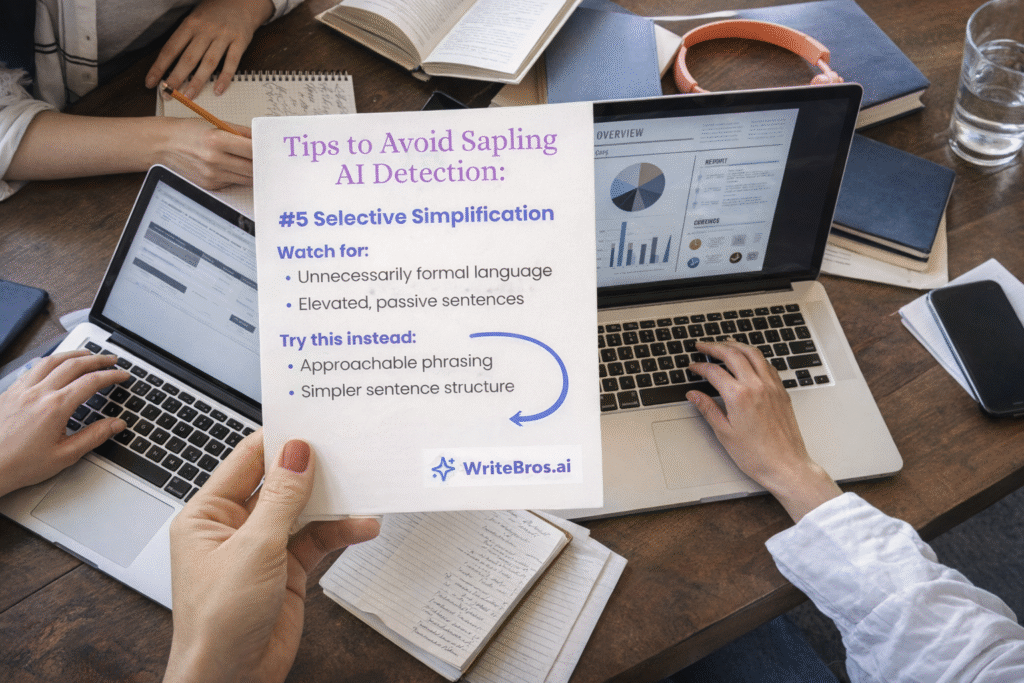
| 5 | Selective simplification | Reduce overly formal constructions that tend to appear in automated drafts. |
| 6 | Paragraph pacing control | Adjust paragraph lengths so the document does not follow uniform formatting across every section. |
| 7 | Idea expansion | Expand key thoughts with natural elaboration so the content reflects deeper reasoning. |
| 8 | Vocabulary flexibility | Replace repetitive wording with varied language that reflects human writing habits. |
| 9 | Natural transitions | Use smoother transitions between ideas rather than abrupt mechanical topic shifts. |
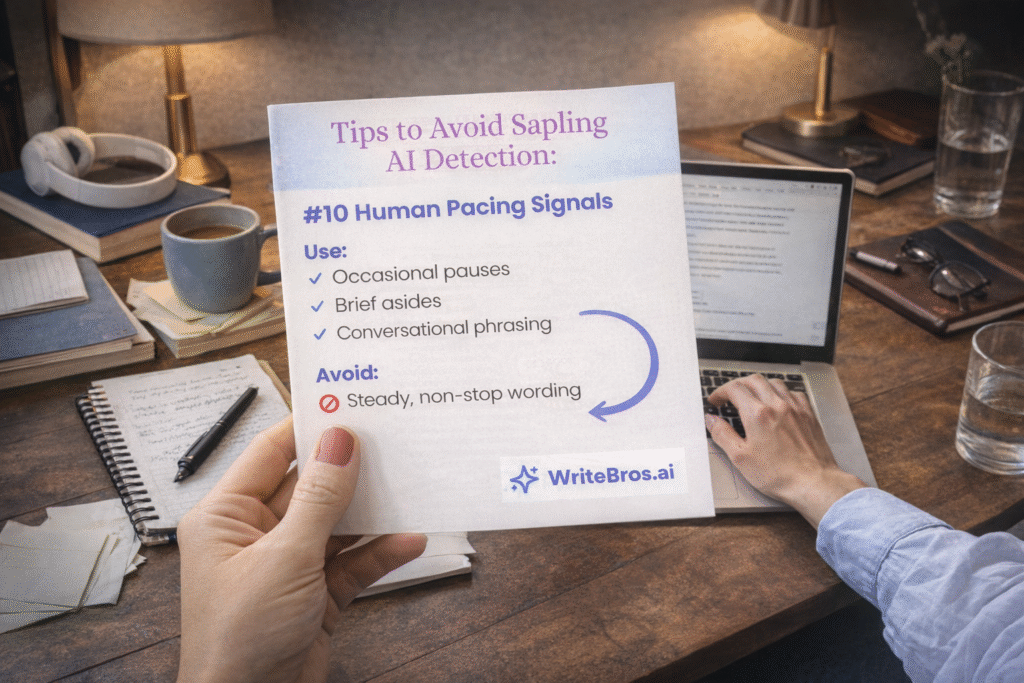
| 10 | Human pacing signals | Introduce occasional pauses or conversational phrasing that mirrors authentic writing flow. |
| 11 | Editing layer revisions | Revisit drafts after writing to reshape phrasing and structure rather than publishing the first pass. |
| 12 | Narrative framing | Frame explanations through perspective or observation so the content carries a stronger human voice. |
| 13 | Example insertion | Include brief realistic examples that add texture and variation to the structure of the content. |
| 14 | Controlled imperfection | Allow subtle irregularities in phrasing so the writing avoids sounding algorithmically optimized. |
| 15 | Final structural polish | Conduct a final pass focused on rhythm, variation, and clarity to smooth patterns detectors tend to notice. |
15 Writing Improvements to How to Avoid Sapling AI Detection
How to Avoid Sapling AI Detection – Strategy #1: Sentence rhythm variation
Writers attempting to reduce Sapling detection signals often begin by examining sentence rhythm, since highly uniform sentence length and structure frequently produce patterns that automated systems interpret as machine generated output. Adjusting rhythm means deliberately alternating sentence lengths while allowing clauses, clarifications, and transitional phrasing to expand certain thoughts naturally, rather than compressing every idea into similarly sized constructions that feel overly neat. The goal is not randomness but rather the kind of variation that appears in real writing, where explanations sometimes unfold gradually and sometimes land quickly depending on the complexity of the idea being expressed.
When readers explain an idea out loud, they rarely maintain identical sentence shapes for long stretches, and strong written communication benefits from that same organic pacing. One paragraph might open with a longer reflective statement that introduces context, while the following sentence tightens the point before expanding again into a clarifying observation that reinforces the argument. This shifting rhythm breaks the predictable cadence detectors are designed to identify, which means the text gradually reads less like an automated output and more like the natural thinking process of a person shaping ideas while writing.
How to Avoid Sapling AI Detection – Strategy #2: Organic phrasing adjustments
Automated drafts often produce lines that appear grammatically perfect yet strangely neutral, which creates phrasing that feels polished in a mechanical way rather than shaped through natural explanation. Adjusting those lines means reworking sentences so that ideas unfold with more conversational clarity, occasionally adding context, qualifiers, or transitions that mirror how people refine thoughts while communicating with others. Instead of compressing every idea into the most efficient structure possible, organic phrasing allows sentences to expand slightly so the reasoning behind a point becomes visible inside the sentence itself.
This adjustment does not require changing the meaning of the content, but rather allowing the explanation to feel less optimized and more reflective of real language habits. Writers might soften overly rigid statements, insert clarifying phrases that add nuance, or connect ideas through transitional language that signals how one observation naturally leads into the next. Over time these subtle modifications accumulate, creating a document that feels less like an algorithmically generated block of information and more like a person gradually refining a concept through thoughtful writing.
How to Avoid Sapling AI Detection – Strategy #3: Context layering
One of the most recognizable signals of automated writing is the tendency to present ideas in isolation, delivering statements that are technically correct yet disconnected from the context that normally surrounds human explanations. Context layering addresses this by embedding small pieces of situational detail, reasoning, or perspective that show how the idea fits into a broader discussion rather than appearing as a detached informational statement. These layers might include clarifications about why the point matters, how it connects to previous sentences, or what circumstances make the observation relevant.
Writers frequently add context unconsciously when describing a topic, because human communication naturally explains the background behind a thought before moving forward. That habit can be replicated during revision through small additions that expand the explanation just enough to anchor the idea in a real narrative. As those contextual cues accumulate throughout a document, the overall structure begins to resemble natural reasoning instead of the condensed informational style that automated systems commonly produce.
How to Avoid Sapling AI Detection – Strategy #4: Structural unpredictability
Detection systems rely heavily on pattern recognition, which means writing that follows consistent structural formulas across paragraphs becomes easier for algorithms to classify. Structural unpredictability involves intentionally varying the internal structure of sentences and paragraphs so that explanations evolve in slightly different ways rather than repeating identical frameworks. One section might begin with a descriptive observation that gradually narrows into a specific conclusion, while another may open with a statement before expanding into contextual explanation and clarification.
This type of variation reflects how people organize ideas naturally when thinking through a subject rather than following a strict template. The writer may explore a concept from multiple angles, rearranging emphasis or pacing depending on what feels most intuitive for that particular thought. These subtle shifts in structure disrupt repetitive patterns, gradually producing a document that feels more like an evolving conversation than a predictable informational template.
How to Avoid Sapling AI Detection – Strategy #5: Selective simplification
Many automated drafts rely heavily on formal phrasing that sounds polished but slightly distant from everyday communication, which creates language that reads as technically correct yet emotionally neutral. Selective simplification reduces that distance by replacing overly formal constructions with language that reflects how people actually explain ideas when writing for clarity rather than perfection. This might include removing unnecessary qualifiers, reshaping passive constructions into clearer expressions, or simplifying phrasing that feels artificially elevated.
The goal is not to oversimplify complex ideas but to allow the language carrying those ideas to feel more natural and approachable. When sentences become easier to follow, readers perceive the content as thoughtful communication rather than algorithmic formatting. Over the course of a document, these simplifications gradually shift the tone from mechanical precision toward authentic explanation, which helps reduce signals that automated detection systems often interpret as machine generated patterns.
How to Avoid Sapling AI Detection – Strategy #6: Paragraph pacing control
Paragraph pacing plays a surprisingly important role in detection signals because automated writing systems frequently produce blocks of text that maintain similar length and internal rhythm throughout a document. Controlling pacing means allowing paragraphs to vary naturally, with some sections expanding to fully explore a complex idea while others remain shorter when a concept can be expressed clearly without additional elaboration. This natural fluctuation reflects the way real writers organize information according to the demands of the topic rather than forcing every paragraph into a uniform structure.
Readers instinctively recognize when a piece of writing breathes with this type of variation because the pacing mirrors how ideas evolve during genuine thought. A detailed explanation may stretch across several flowing sentences before transitioning into a shorter clarification that refocuses attention on the central point. These shifts create a reading rhythm that feels intuitive rather than manufactured, which gradually distances the document from the repetitive formatting patterns commonly associated with automated text generation.
How to Avoid Sapling AI Detection – Strategy #7: Idea expansion
Automated drafts often compress information into concise statements that deliver conclusions without fully showing the reasoning behind them, which creates text that appears efficient but slightly hollow when examined closely. Expanding ideas involves allowing explanations to unfold with greater depth so that the reader can see how each conclusion emerges from the underlying logic of the argument. Writers might elaborate on a point through clarifying examples, subtle contrasts, or additional observations that illuminate the broader significance of the statement.
This expansion gives the content intellectual texture because the reasoning process becomes visible inside the paragraph rather than remaining hidden behind short declarative statements. Real writing frequently includes moments where the author pauses to explore the implications of an idea before moving forward, and replicating that habit naturally increases the complexity of sentence structures. As the explanation grows richer, the document begins to reflect authentic analytical thinking instead of the compressed informational style that detection systems frequently associate with automated writing.
How to Avoid Sapling AI Detection – Strategy #8: Vocabulary flexibility
Vocabulary repetition represents one of the most recognizable patterns produced by automated systems because algorithms often rely on consistent word choices when expressing similar ideas across multiple sentences. Introducing vocabulary flexibility helps disrupt that repetition by encouraging writers to rephrase concepts with varied language while still preserving the original meaning of the content. This might include alternating descriptive terms, restructuring phrases, or introducing subtle synonyms that better match the surrounding context of the discussion.
Human communication rarely relies on identical wording for extended stretches of text because writers instinctively search for language that fits the evolving tone of each paragraph. Allowing vocabulary to shift in this way adds nuance to the writing while preventing the mechanical repetition that detection systems often identify as a statistical pattern. Over time the document begins to sound less formulaic, since the language reflects the natural variety that appears when someone explains an idea thoughtfully across multiple paragraphs.
How to Avoid Sapling AI Detection – Strategy #9: Natural transitions
Transitions play a subtle yet powerful role in shaping how writing flows, and automated drafts frequently struggle to connect ideas in a way that feels organically developed. Strengthening transitions means allowing each sentence to guide the reader toward the next idea through logical progression rather than abrupt topic shifts that appear mechanically assembled. These connections might take the form of brief clarifying phrases that acknowledge the previous thought before expanding into the next stage of the discussion.
In authentic writing, transitions often emerge naturally as the author reflects on how one idea leads into another, which creates a narrative sense of movement within the paragraph. Instead of presenting isolated statements stacked together, the text gradually unfolds as a connected sequence of reasoning. This coherence not only improves readability but also reduces the abrupt structural breaks that automated detection systems sometimes interpret as evidence of algorithmic composition.
How to Avoid Sapling AI Detection – Strategy #10: Human pacing signals
Human pacing signals refer to subtle stylistic cues that reveal the writer’s thought process as it develops across the page, including reflective pauses, clarifying remarks, or brief expansions that emphasize a particular point. These signals help break the steady informational delivery that automated systems often produce, allowing the writing to mirror the rhythms of real communication. Rather than presenting every sentence with identical authority and certainty, the text occasionally slows down to reconsider or emphasize a thought.
Readers interpret these pacing shifts as evidence that a person is actively shaping the narrative while writing, which naturally increases the perceived authenticity of the document. A paragraph might briefly acknowledge complexity before resolving the idea, or it may introduce a reflective observation that reframes the topic from a slightly different perspective. These moments create the impression of genuine reasoning unfolding in real time, which reduces the uniformity detectors frequently associate with automated text.
How to Avoid Sapling AI Detection – Strategy #11: Editing layer revisions
Many automated outputs appear highly structured because they are produced in a single pass, delivering information without the layered refinements that occur during genuine editing. Introducing editing layers means revisiting the text multiple times with different priorities, such as adjusting rhythm during one pass, refining phrasing during another, and reconsidering structural flow during a final revision. Each layer gradually reshapes the document so that the final version reflects thoughtful iteration rather than the immediate clarity typical of machine generated drafts.
This process mirrors how experienced writers refine complex material, gradually transforming early ideas into more nuanced explanations through careful reconsideration. A sentence that once appeared overly rigid may expand into a more expressive statement, while another might become more concise after unnecessary wording is removed. As these revisions accumulate, the document begins to exhibit the subtle imperfections and variations that naturally arise during authentic writing processes.
How to Avoid Sapling AI Detection – Strategy #12: Narrative framing
Narrative framing introduces perspective into the writing, allowing ideas to emerge through observation rather than appearing as detached informational statements. Instead of presenting each concept as an isolated fact, the writer places it within a broader narrative that explains why the idea matters or how it connects to a larger theme. This framing creates a sense that the text reflects a point of view rather than a neutral sequence of informational outputs.
Human writers often organize complex explanations through storytelling structures, even when discussing technical topics. They introduce a concept, reflect on its implications, and gradually guide the reader toward a deeper understanding through layered commentary. As this narrative thread develops throughout the document, the writing begins to feel more like a guided exploration of ideas rather than the compressed informational style associated with automated text generation.
How to Avoid Sapling AI Detection – Strategy #13: Example insertion
Examples play a valuable role in human writing because they translate abstract concepts into concrete situations that readers can easily visualize. Automated drafts often omit these illustrative moments, presenting explanations that remain theoretical instead of grounded in recognizable scenarios. Inserting examples introduces variety into the text while also clarifying how a concept operates within real situations.
A writer might describe how a specific editing technique improves readability in a practical context or illustrate how a change in phrasing alters the tone of a paragraph. These small narrative moments create texture inside the explanation and allow the reader to observe the concept in action rather than interpreting it as a purely theoretical rule. Over time, the accumulation of these illustrative details contributes to a writing style that feels demonstrative and experiential rather than algorithmically assembled.
How to Avoid Sapling AI Detection – Strategy #14: Controlled imperfection
One of the defining traits of automated writing is an unusual level of structural tidiness, where sentences appear perfectly balanced and consistently optimized for clarity. Controlled imperfection introduces small irregularities that mirror the natural variability present in authentic human communication. These imperfections might include slight shifts in sentence length, occasional reflective phrases, or moments where the explanation briefly wanders before returning to the main point.
Such irregularities do not reduce the quality of the writing; instead, they create the subtle unpredictability that readers associate with genuine thought. Writers naturally explore ideas while explaining them, which sometimes produces sentences that expand unexpectedly before arriving at their conclusion. Allowing that organic variation to remain within the text softens the rigid patterns that automated detection systems often identify when analyzing writing structure.
How to Avoid Sapling AI Detection – Strategy #15: Final structural polish
The final stage of revision focuses on reviewing the entire document from a structural perspective rather than examining individual sentences in isolation. Structural polish means reading the text as a continuous narrative, paying attention to rhythm, variation, and the overall progression of ideas across paragraphs. During this pass the writer may reorganize sections, adjust transitions, or refine phrasing to ensure the writing flows naturally from beginning to end.
This holistic review allows subtle patterns to emerge that may not have been visible while editing smaller sections individually. The writer can identify repetitive phrasing, overly uniform paragraph lengths, or transitions that feel abrupt when viewed within the broader context of the article. Correcting these patterns during the final pass produces a cohesive document that reflects the layered, evolving process typical of thoughtful human writing.
Common mistakes
- Many writers attempt to solve detection issues by making superficial changes to individual words while leaving the deeper structure of the text untouched. This mistake happens because the writing still follows identical sentence rhythm, paragraph pacing, and structural templates, which detection systems can recognize even after vocabulary has been altered.
- Another common mistake involves overusing rewriting tools that promise to disguise automated content but instead introduce predictable paraphrasing patterns. These tools often restructure sentences using consistent formulas, which means the resulting text may appear even more algorithmic when evaluated through detection systems.
- Writers frequently assume that simply increasing sentence complexity will reduce detection signals, leading them to add unnecessary clauses and technical phrasing. Instead of improving authenticity, this tactic often creates dense sentences that feel artificially constructed and disconnected from natural communication patterns.
- Some people attempt to insert random variations into their writing without considering how those changes affect clarity and logical flow. Random structural disruption may remove certain patterns but it also risks creating paragraphs that feel incoherent or mechanically rearranged rather than thoughtfully composed.
- A related mistake occurs when writers rely entirely on automated drafts and attempt to repair the text afterward through quick edits. Without deeper revision that rethinks structure and reasoning, the document retains the statistical patterns that detection systems analyze during evaluation.
- Another overlooked issue involves maintaining identical paragraph structures across an entire article, which produces visual and rhythmic uniformity that algorithms easily detect. Even when the sentences themselves are revised, repeating the same paragraph patterns can still generate detection signals.
Edge cases
Detection systems do not operate identically across all contexts, which means a document that appears safe under one evaluation tool may still trigger signals within another platform. Academic writing, technical documentation, and formal policy language often contain naturally repetitive structures that resemble automated text, even when written entirely by humans. In these cases, writers must balance structural variation with the clarity required for professional communication.
Similarly, collaborative writing environments can create blended stylistic signals when multiple authors revise the same document. Sections written by different contributors may vary dramatically in rhythm, vocabulary, and narrative tone, which can confuse detection systems attempting to classify the entire text as a single writing style. Careful editing that harmonizes those sections helps maintain natural variation without introducing abrupt stylistic shifts.
Supporting tools
- Readability analysis tools help writers examine sentence length distribution, vocabulary repetition, and structural rhythm across large documents. These insights reveal hidden patterns that may not be obvious during normal editing but often influence how automated detection systems interpret the text.
- Grammar and clarity assistants provide detailed feedback on sentence structure, helping writers identify areas where phrasing becomes overly mechanical or rigid. Adjusting those sentences during revision can gradually introduce the natural flow typical of authentic writing.
- Text comparison tools allow writers to examine multiple drafts of the same content and observe how structural changes influence readability. This process makes it easier to refine rhythm and variation while preserving the meaning of the original text.
- Advanced document editors support layered revision workflows that encourage multiple editing passes focused on different aspects of writing quality. Writers can analyze pacing in one pass, refine vocabulary in another, and evaluate narrative flow during a final structural review.
- Style analysis platforms evaluate linguistic signals such as repetition frequency, syntactic patterns, and paragraph structure. These insights provide a deeper understanding of how writing patterns develop across an entire article rather than inside isolated sentences.
- WriteBros.ai offers tools designed to help writers refine automated drafts through layered editing and structural variation. The platform supports iterative rewriting workflows that focus on improving rhythm, phrasing, and narrative coherence while preserving the meaning of the original content.
Ready to Transform Your AI Content?
Try WriteBros.ai and make your AI-generated content truly human.
Conclusion
Understanding how detection systems interpret writing patterns allows authors to revise their work with greater intention and clarity. Rather than chasing quick fixes, the most reliable improvements come from thoughtful editing that reshapes rhythm, structure, and explanation so the document reflects the layered reasoning typical of real writing.
Perfect unpredictability is not the objective, and attempting to force it can create writing that feels awkward or inconsistent. Consistent practice with deliberate revisions gradually develops a natural style that balances clarity, variation, and narrative flow, producing work that reads authentically while communicating ideas effectively.
Did You Know?
If you want to avoid Sapling AI detection, it helps to remember that detectors look for consistency signals across the whole page, not just a handful of sentences that feel too polished. When every paragraph follows the same internal build, uses similar sentence spacing, and moves from point to point through identical connective phrasing, the writing can appear mathematically uniform even if the ideas are solid. That is why quick synonym swaps often disappoint, since the deeper pattern stays in place and remains easy for scoring models to quantify.
Edits that change the pace of reasoning tend to matter more because they resemble how real drafts develop through revision and reconsideration. Think of explaining one idea briefly because it is straightforward, then slowing down on the next to clarify constraints, add context, and show practical implications rather than giving both the same space. When the writing shows that uneven movement and the logic becomes more visible inside the sentences, the statistical profile often starts to match patterns associated with human drafting and real editorial decision-making.
Ready to Transform Your AI Content?