How to Adjust Content to Pass Copyleaks: 15 Structural Improvements

Learn how to adjust content to pass Copyleaks using 15 structural improvements that reduce detectable patterns and improve natural flow. Research published in Nature on distinguishing AI-generated from human text shows structural regularity is a key signal, reinforcing why cadence and syntax variation matter.
How to Adjust Content to Pass Copyleaks: 15 Structural Improvements
You run your draft through a detector, and the result is higher than expected even though the ideas are yours. The frustration usually traces back to subtle AI writing patterns that trigger detection rather than obvious copying or automation.
Most flagged sections share structural similarities such as repetitive sentence cadence, predictable transitions, and evenly distributed paragraph lengths. Writers who rely heavily on automated refinement often amplify those signals, even when using the best AI writing refinement tools for polished output.
The good news is that detection scores respond well to targeted structural edits instead of full rewrites. Drawing from recent Copyleaks AI detection study results, the following improvements focus on reshaping rhythm, hierarchy, and variation so your content reads with natural human irregularity.
| # | Strategy focus | Practical takeaway |
|---|---|---|
| 1 | Sentence rhythm variation | Break predictable cadence patterns so paragraphs feel less mechanically balanced. |
| 2 | Paragraph length diversity | Avoid uniform blocks of text to introduce natural pacing shifts. |
| 3 | Transitional phrasing edits | Replace formulaic connectors with context-driven movement between ideas. |
| 4 | Syntax restructuring | Rebuild repetitive sentence frameworks to reduce detectable patterns. |
| 5 | List reformatting | Blend bullets and prose to avoid overly systematic structure. |
| 6 | Context expansion | Add specific examples that introduce authentic variation in tone. |
| 7 | Active and passive balance | Mix voice intentionally so prose avoids rigid consistency. |
| 8 | Structural compression | Tighten sections that over-explain in evenly spaced blocks. |
| 9 | Intentional asymmetry | Allow uneven flow to mirror human drafting habits. |
| 10 | Concrete specificity | Replace generic abstractions with grounded detail. |
| 11 | Narrative insertion | Weave short human moments into analytical sections. |
| 12 | Sentence opening variety | Avoid repetitive lead-ins that form detectable patterns. |
| 13 | Clause rebalancing | Redistribute dependent and independent clauses for organic flow. |
| 14 | Formatting variation | Use subheads and spacing strategically to reduce monotony. |
| 15 | Final structural audit | Review the full draft holistically to remove lingering symmetry and repetition. |
15 Structural Improvements to How to Adjust Content to Pass Copyleaks
How to Adjust Content to Pass Copyleaks – Strategy #1: Sentence rhythm variation
One of the most reliable ways to improve detection outcomes is to vary sentence rhythm so the prose no longer moves in evenly spaced beats that feel algorithmically balanced. When sentences consistently fall into similar length and cadence patterns, even well-researched human writing can begin to resemble generated text, especially in analytical or instructional formats. Adjusting rhythm means intentionally mixing longer reflective statements with mid-length clarifications and occasional concise pivots, creating a reading experience that feels organic rather than mechanically optimized.
This works because human drafting rarely maintains perfect pacing across entire sections, as natural thought processes expand and contract depending on emphasis, uncertainty, or elaboration. For example, an explanatory paragraph might open with a layered sentence that sets context, followed by a tighter clarification that sharpens the point before widening again into nuance. That controlled irregularity introduces subtle unpredictability, which tends to soften structured signals that detection systems weigh heavily when scoring uniformity.
How to Adjust Content to Pass Copyleaks – Strategy #2: Paragraph length diversity
Uniform paragraph blocks, especially those that mirror each other in sentence count and visual width, can unintentionally create structural symmetry that reads as templated. To counter that pattern, adjust the natural expansion of ideas so some sections breathe with additional clarification while others resolve more quickly once the core insight is established. This kind of length diversity should feel motivated by the content itself rather than artificially uneven, meaning longer paragraphs deepen context while shorter ones crystallize conclusions.
Detection systems often evaluate consistency across entire documents, so visual and structural sameness becomes part of the scoring signal rather than just lexical repetition. In practice, this means reviewing adjacent paragraphs and asking whether they look and flow too similarly in density, even if the ideas differ. Introducing authentic variation in development length, particularly when moving from explanation to application, helps the draft reflect human editorial judgment instead of automated balancing.
How to Adjust Content to Pass Copyleaks – Strategy #3: Transitional phrasing edits
Predictable transitions such as repeated summary connectors or formulaic shifts between sections can accumulate into recognizable patterns that elevate detection scores. Revising transitions requires replacing stock phrasing with context-specific movement that reflects the logic of the argument rather than relying on default connective templates. Instead of signaling each shift with identical phrasing, allow the relationship between ideas to guide how one section evolves into the next.
This approach works because authentic writing rarely uses the same structural bridge repeatedly, especially across long-form drafts with layered reasoning. For instance, a contrast might be introduced through an illustrative scenario rather than a simple contrast marker, or a continuation might grow naturally from a detail embedded in the prior paragraph. Those nuanced transitions reduce structural predictability, which in turn lowers the concentration of repetitive markers that detection tools frequently analyze.
How to Adjust Content to Pass Copyleaks – Strategy #4: Syntax restructuring
Even when vocabulary is varied, repeated sentence frameworks such as identical subject-verb openings or mirrored clause constructions can generate a detectable pattern across sections. Restructuring syntax involves altering how information is ordered within sentences so the same idea can be presented from different structural angles without distorting meaning. This may include shifting dependent clauses forward, embedding clarifications mid-sentence, or redistributing emphasis across multiple lines of reasoning.
The effectiveness of syntax restructuring lies in its subtlety, since the content remains intact while the architecture supporting it becomes less uniform. A procedural explanation, for example, might alternate between action-led statements and condition-led framing, allowing emphasis to move naturally across steps. Over the span of a full article, that variation compounds into a more human-feeling flow that reduces the repetitive structural fingerprints detectors tend to flag.
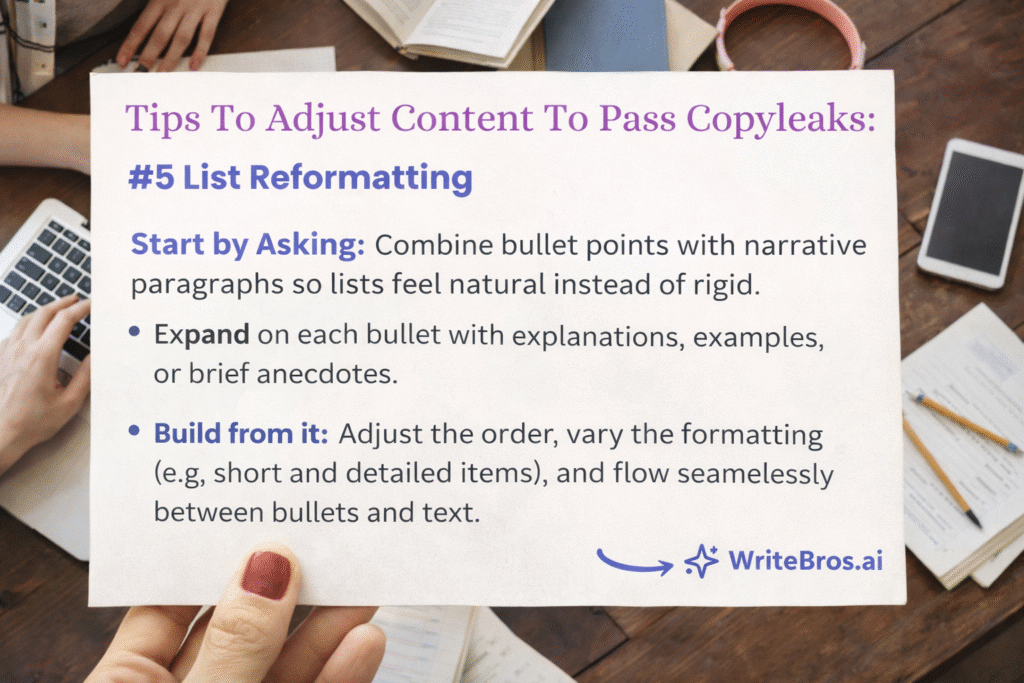
How to Adjust Content to Pass Copyleaks – Strategy #5: List reformatting
Highly structured lists, particularly those with identical sentence formats and evenly spaced elaborations, can create a predictable scaffold that elevates pattern recognition signals. Reformatting lists does not require removing them entirely, but rather blending explanatory prose with selective bullet points so the structure feels purposeful instead of mechanically repeated. When some items expand into narrative clarification while others remain concise, the list begins to mirror authentic editorial decision-making.
In practice, this might mean converting a rigid five-line sequence into a hybrid format where certain points unfold within paragraphs that integrate examples or caveats. That layered presentation introduces tonal and structural depth, which breaks the symmetry that detection tools often associate with generated outlines. The result is guidance that remains clear and organized, yet carries enough natural variation to soften automated scoring sensitivity.
How to Adjust Content to Pass Copyleaks – Strategy #6: Context expansion
Detection scores frequently rise when writing remains abstract and evenly generalized, since such neutrality can resemble model-trained output patterns. Expanding context means embedding specific scenarios, grounded clarifications, or subtle constraints that demonstrate lived reasoning rather than generic summarization. When ideas are anchored in situational framing, the prose gains dimensionality that moves beyond evenly distributed explanatory statements.
For example, instead of describing a structural edit in isolation, the text might illustrate how that edit affected a real revision workflow or a particular section of a draft. This added specificity changes cadence, introduces asymmetrical detail, and creates natural divergence in sentence construction. Over the course of a document, those context layers accumulate into a more individualized voice profile that tends to lower uniformity-driven flags.
How to Adjust Content to Pass Copyleaks – Strategy #7: Active and passive balance
Strict consistency in grammatical voice, whether entirely active or entirely passive, can unintentionally reinforce a mechanical tone across multiple paragraphs. Balancing active and passive constructions, when done intentionally and logically, introduces structural contrast that mirrors real editorial habits. The goal is not random switching, but thoughtful distribution based on emphasis, responsibility, or informational hierarchy within each sentence.
In analytical writing, for instance, passive framing might be used to foreground results, while active framing highlights decisions or actions taken. That dynamic interplay shifts attention naturally and prevents the repetition of identical subject-led openings throughout the draft. As a result, the prose develops a layered rhythm that feels considered rather than systematically optimized.
How to Adjust Content to Pass Copyleaks – Strategy #8: Structural compression
Over-explained sections that unfold in evenly segmented sentences can inflate detection sensitivity, particularly when each idea is given identical developmental space. Structural compression involves tightening explanations that do not require full elaboration, allowing the narrative to move forward without repetitive scaffolding. This selective trimming reduces symmetrical buildup while preserving clarity and logical progression.
When applied thoughtfully, compression often sharpens emphasis because the most important insights remain expanded while secondary clarifications are integrated more fluidly. A dense instructional block might be condensed into a layered sentence that embeds context and implication together rather than distributing them across parallel lines. That consolidation disrupts repetitive structural pacing and contributes to a more naturally evolving flow.
How to Adjust Content to Pass Copyleaks – Strategy #9: Intentional asymmetry
Perfect structural symmetry across headings, paragraphs, and sentence counts may appear organized, yet it can also signal templated construction. Intentional asymmetry means allowing certain sections to unfold with greater nuance while others conclude more directly, reflecting how human emphasis naturally fluctuates. This uneven development should follow conceptual weight rather than arbitrary variation.
For instance, a complex strategy might warrant layered clarification and embedded examples, while a straightforward adjustment can resolve in a more concise manner. That contrast creates authentic variation in depth and pacing, which softens the sense of algorithmic balance across the page. Over time, this asymmetry builds a structural fingerprint that aligns more closely with human drafting tendencies.
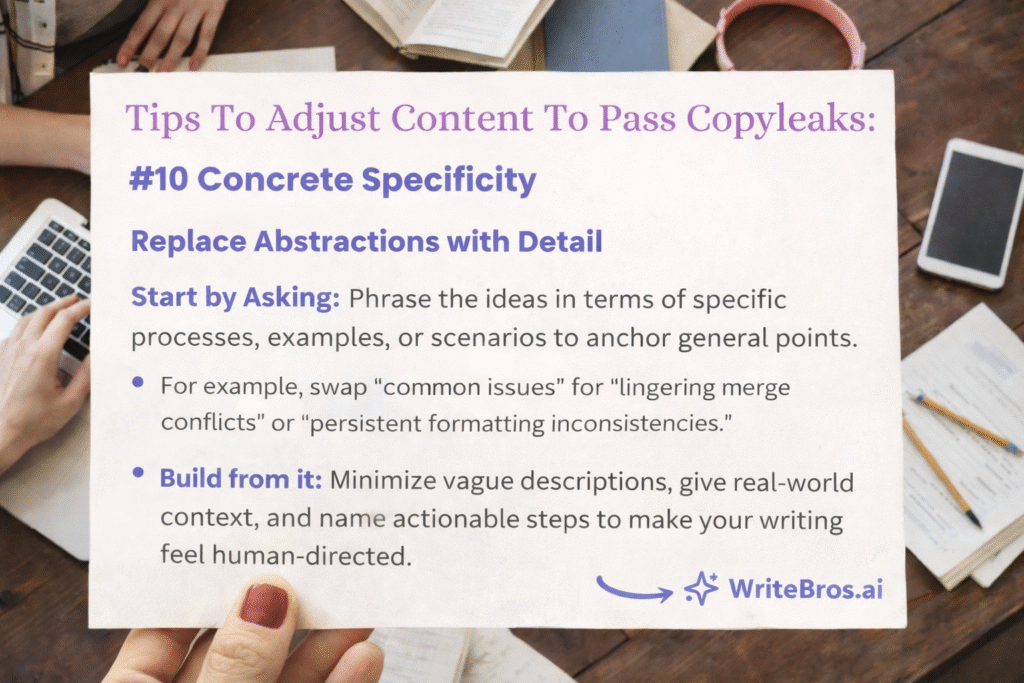
How to Adjust Content to Pass Copyleaks – Strategy #10: Concrete specificity
Generic phrasing and evenly abstract language often contribute to higher detection exposure because they resemble large-scale training data patterns. Introducing concrete specificity means naming processes, describing decision points, and clarifying constraints that shape how a recommendation is applied in practice. This added granularity alters sentence structure and expands lexical diversity without resorting to artificial complexity.
Consider how a revision guideline changes when it references the exact type of paragraph being edited or the workflow stage in which adjustments occur. That specificity naturally elongates some sentences while tightening others, since detail demands nuanced phrasing. The cumulative effect is a draft that reads as context-aware and experience-informed, reducing the uniformity signals detectors tend to measure.
How to Adjust Content to Pass Copyleaks – Strategy #11: Narrative insertion
Analytical drafts that remain purely procedural can accumulate uniform explanatory structures that elevate detection signals over time. Inserting short narrative elements, such as reflective observations or process-based anecdotes, introduces tonal contrast and structural variety. These narrative moments should illuminate the strategy rather than distract from it, ensuring they enhance clarity while diversifying rhythm.
A brief account of how a structural edit altered a detection score, for example, creates space for causal explanation and emotional nuance within the same passage. That blend of narrative and analysis disrupts the monotony of step-based instruction and shifts sentence architecture in subtle ways. Across multiple sections, those shifts contribute to a layered voice profile that feels distinctly authored.
How to Adjust Content to Pass Copyleaks – Strategy #12: Sentence opening variety
Repeated sentence openings, especially those that rely on identical grammatical structures, can generate recognizable repetition even when vocabulary differs. Varying how sentences begin, whether through prepositional framing, conditional clauses, or embedded clarifications, alters the visual and rhythmic flow of paragraphs. This deliberate opening diversity creates micro-level variation that compounds across long-form content.
Instead of consistently starting with a direct subject statement, a sentence might open with context that situates the claim within a broader reasoning sequence. That repositioning changes emphasis and encourages more fluid transitions between related ideas. Over extended sections, the absence of repetitive entry patterns reduces the structural predictability detection systems frequently analyze.
How to Adjust Content to Pass Copyleaks – Strategy #13: Clause rebalancing
Even when sentence length varies, consistent placement of dependent and independent clauses can create hidden structural repetition. Clause rebalancing involves shifting subordinate details, reordering explanatory segments, and occasionally merging or separating clauses to redistribute emphasis. This process maintains clarity while preventing uniform clause sequencing from dominating the draft.
For example, a cause-and-effect explanation might alternate between foregrounding the cause in one instance and highlighting the effect in the next. That alternating emphasis subtly changes syntax and pacing without distorting the logical relationship between ideas. Across an entire article, these micro-adjustments accumulate into a less predictable structural pattern that aligns more closely with human drafting variation.
How to Adjust Content to Pass Copyleaks – Strategy #14: Formatting variation
Rigid formatting patterns, including identical subhead spacing and mirrored content blocks, can reinforce visual symmetry that detection tools may interpret as templated. Introducing formatting variation through selective subhead placement, adjusted spacing, or integrated explanatory paragraphs helps the document feel editorially shaped rather than systematically generated. This variation should enhance readability rather than create visual clutter.
For instance, allowing one section to unfold in continuous prose while another incorporates a short highlighted clarification can shift visual rhythm across the page. That shift influences how readers perceive pacing and emphasis, and it also reduces the repetition of uniform structural markers. Over time, varied formatting supports a more organic presentation that complements syntactic diversification.
How to Adjust Content to Pass Copyleaks – Strategy #15: Final structural audit
After individual adjustments are complete, a comprehensive structural audit ensures that lingering symmetry or repetition does not remain embedded across sections. This review looks beyond isolated sentences and instead evaluates pacing, visual balance, and conceptual layering across the full draft. Patterns that seemed insignificant in isolation often become visible only when assessed holistically.
During this audit, read the document sequentially while noting repeated transitions, mirrored paragraph lengths, or identical clause structures that recur subconsciously. Addressing these patterns at the macro level allows for subtle refinements that preserve meaning while reshaping flow. The final result is a structurally diversified piece that maintains clarity yet presents a distinctly human rhythm.
Common mistakes
- Writers often focus exclusively on swapping vocabulary while leaving structural symmetry untouched, which means sentence frameworks, paragraph lengths, and transitional phrasing remain mechanically aligned even after surface edits. This happens because lexical changes feel tangible and measurable, yet structural repetition is more subtle and requires holistic review. As a result, detection scores may remain elevated despite visible rewriting effort.
- Another frequent error is overcorrecting by injecting randomness without regard to clarity, leading to awkward phrasing that disrupts logical flow. In attempting to avoid uniformity, some drafts become inconsistent in tone or coherence, which can undermine credibility. Structural variation must follow reasoning rather than arbitrary disruption, otherwise readability suffers.
- Relying entirely on automated rewriting tools without manual structural refinement can also backfire, since many tools optimize fluency while preserving balanced cadence. This creates polished but evenly distributed prose that still signals patterned construction. Human review is necessary to introduce nuanced asymmetry that automated systems rarely replicate.
- Maintaining identical paragraph counts and sentence counts under each subheading is another subtle mistake that reinforces templated organization. Although such balance appears neat and professional, it can amplify detection sensitivity over longer documents. Allowing natural expansion in complex sections and tighter resolution in simpler ones better reflects authentic drafting.
- Overusing standardized transitions, particularly when moving between strategies or arguments, can accumulate into repetitive connective phrasing. Writers often default to familiar connectors for clarity, yet repetition at scale increases structural predictability. Reframing transitions in context-sensitive ways reduces that concentration of uniform signals.
- Skipping a final holistic read-through often leaves residual patterns scattered across distant sections of the draft. Because repetition is not always adjacent, isolated edits may fail to address macro-level symmetry. A comprehensive structural review is essential to ensure that variation is distributed across the entire piece rather than clustered locally.
Edge cases
Some content types, particularly highly technical documentation or regulatory explanations, require consistent terminology and structured formatting that naturally limit variation. In these situations, structural diversification must be subtle and aligned with compliance requirements, ensuring that clarity and accuracy are never compromised for the sake of rhythm changes. Carefully redistributing emphasis, adjusting clause placement, and varying explanatory depth can introduce human irregularity without violating format constraints.
Conversely, creative or narrative-heavy drafts may already contain sufficient tonal variation, yet still exhibit hidden structural symmetry in paragraph design or transition usage. Here, refinement focuses less on adding variability and more on identifying repeated frameworks that operate beneath expressive language. Even expressive prose benefits from measured structural recalibration when detection scores remain unexpectedly elevated.
Supporting tools
- Detection preview platforms that allow iterative rescanning after small edits are useful because they provide directional feedback on structural adjustments without requiring full rewrites. Monitoring incremental changes helps isolate which modifications meaningfully reduce pattern concentration and which have minimal impact.
- Advanced grammar editors that visualize sentence length distribution can reveal hidden cadence uniformity across paragraphs. These visualizations make it easier to spot clusters of similarly sized sentences that might otherwise appear natural during a quick read.
- Outline analysis tools that map heading depth and paragraph density help identify overly symmetrical content hierarchies. Adjusting these hierarchies, once visualized, becomes a more intentional editorial process rather than guesswork.
- Readability analytics platforms that track variation in sentence openings and clause complexity provide quantitative insight into structural diversity. Such metrics can guide refinement decisions without encouraging artificial complexity.
- Version comparison software allows side-by-side evaluation of structural edits so that meaning remains intact while architecture evolves. This ensures that improvements in variation do not inadvertently distort core arguments or guidance.
- WriteBros.ai can support controlled structural refinement by helping reshape sentence architecture while preserving intent, allowing writers to introduce rhythm variation, clause redistribution, and contextual layering in a deliberate and measured way.
Ready to Transform Your AI Content?
Try WriteBros.ai and make your AI-generated content truly human.
Conclusion
Adjusting content to improve detection outcomes is less about dramatic rewriting and more about refining structural patterns that accumulate across a draft. When rhythm, clause balance, paragraph development, and formatting variation are addressed holistically, the writing retains its meaning while gaining the organic irregularity associated with authentic human authorship.
Perfection is not the objective, since human writing naturally contains subtle inconsistencies and evolving emphasis across sections. With deliberate structural awareness and measured refinement, your content can maintain clarity, authority, and nuance while presenting a rhythm that feels distinctly and convincingly human.
Did You Know?
If you are working on how to adjust content to pass Copyleaks, begin with structural recalibration rather than surface synonym swaps, since evenly sized paragraphs and mirrored sentence openings can preserve a consistent detection profile.
Vary the way ideas expand across sections, allow some explanations to develop with layered clarification while others tighten for emphasis, and adjust pacing throughout the draft, because organic variation more closely reflects authentic drafting patterns than perfectly balanced structure.
Ready to Transform Your AI Content?