How to Avoid Winston AI Detection: 15 Writing Refinements

Writers are discovering that small structural edits can dramatically reduce AI detection flags. Research such as the Stanford University study on AI text detection patterns shows that sentence rhythm and linguistic variation strongly influence classifier outcomes.
How to Avoid Winston AI Detection: 15 Writing Refinements
Many writers feel frustrated when their work is flagged even after they carefully edit and personalize it. Tools like Winston can still identify subtle writing patterns that quietly signal automated generation.
This happens because detection systems analyze rhythm, predictability, and sentence structure rather than just vocabulary. Writers dealing with repeated flags often experiment with different AI humanizer tools to introduce natural variation.
The good news is that detection signals can be reduced once you understand what algorithms actually evaluate. Research and data such as recent misclassification statistics reveal that small structural refinements often make the biggest difference.
| # | Strategy focus | Practical takeaway |
|---|---|---|
| 1 | Sentence rhythm variation | Break predictable sentence flow with a mix of short, medium, and longer phrasing so the writing reads more naturally. |
| 2 | Personal voice signals | Introduce subtle human perspective, observations, and tone cues that make the writing feel authored rather than generated. |
| 3 | Paragraph flow adjustments | Change how ideas transition between paragraphs so the progression feels less templated and more conversational. |
| 4 | Unpredictable phrasing | Swap common AI-style wording with alternative phrasing patterns that add originality and reduce repetition. |
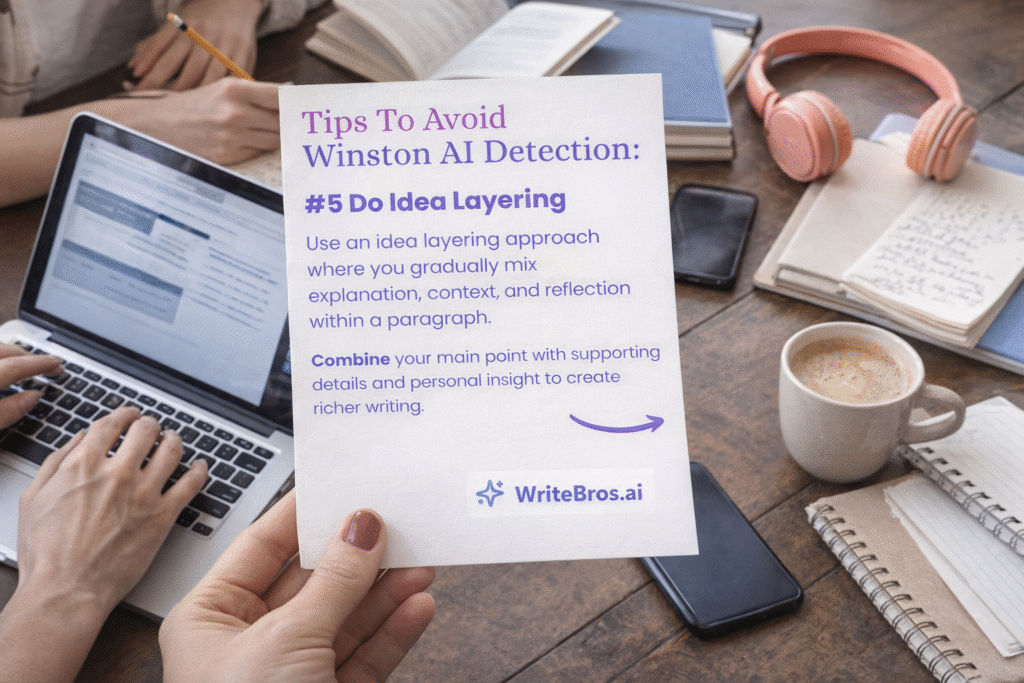
| 5 | Idea layering | Combine explanation, context, and reflection within a paragraph to create richer structure. |
| 6 | Natural imperfection cues | Allow small stylistic quirks or uneven sentence pacing that mirrors authentic writing. |
| 7 | Contextual specificity | Include concrete situations or practical scenarios that reduce generic phrasing. |
| 8 | Vocabulary texture | Blend common words with occasional uncommon phrasing to create natural linguistic contrast. |
| 9 | Structural reshaping | Reorganize sentence order and emphasis so the writing structure feels less formulaic. |
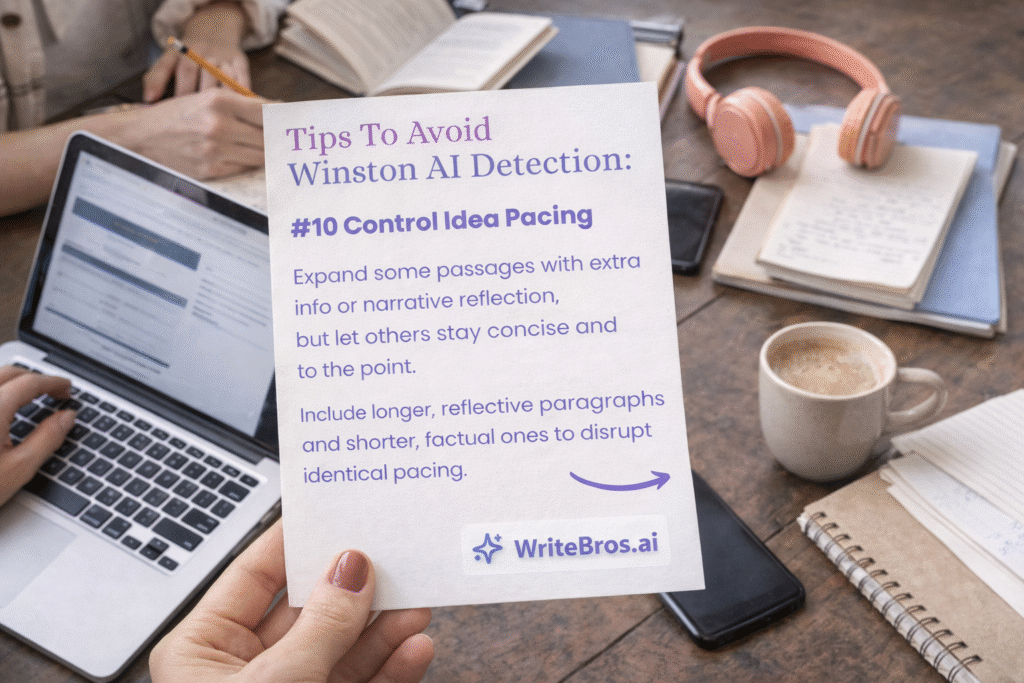
| 10 | Idea pacing control | Adjust the density of information so some passages expand while others stay concise. |
| 11 | Perspective switching | Alternate between explanation, reflection, and observation to avoid a single analytical tone. |
| 12 | Narrative texture | Introduce light narrative framing that mirrors how humans naturally communicate insights. |
| 13 | Editing layer refinement | Run a secondary editing pass focused purely on rhythm and tone rather than grammar. |
| 14 | Predictability reduction | Break up repeated patterns such as identical paragraph length or sentence structures. |
| 15 | Final authenticity pass | Read the text aloud and revise anything that sounds mechanical or overly polished. |
15 Writing Refinements to Avoid Winston AI Detection
How to Avoid Winston AI Detection – Strategy #1: Sentence rhythm variation
One of the most consistent signals detection systems evaluate is sentence rhythm, because automated writing frequently produces paragraphs where every line follows nearly the same structure and pacing. A simple way to weaken this pattern is to vary the length and shape of your sentences so some stretch into longer reflections while others pause briefly before continuing the idea. This uneven rhythm mirrors the way people naturally think while writing, and it prevents the algorithm from recognizing the predictable cadence often associated with generated text.
Imagine reading a paragraph where every sentence feels mechanically balanced and similarly structured, because that uniformity is exactly what many detection models expect to see when identifying machine patterns. When a writer introduces longer explanations followed by shorter observations and then returns to a detailed sentence that unfolds gradually, the overall rhythm becomes far more organic. Over time this kind of variation makes the entire piece feel written rather than produced, which helps reduce the structural consistency that Winston tends to flag.
How to Avoid Winston AI Detection – Strategy #2: Personal voice signals
Detection models frequently identify text that lacks clear author presence, because automated systems often generate information without subtle cues that a real person is guiding the explanation. Introducing gentle perspective markers such as reflections, observations, or moments of uncertainty adds a layer of personality that shifts the tone away from perfectly neutral exposition. These signals do not need to be dramatic or emotional, yet their presence gradually communicates that a human perspective shaped the narrative flow.
Writers often discover that small details such as describing why an idea matters or how a concept feels in practice can dramatically change the perception of the writing. Instead of presenting information like a detached report, a paragraph can weave insight and commentary together in a way that reflects the thought process behind the text. Over several paragraphs these subtle cues accumulate and create a distinctive voice, which naturally weakens the pattern recognition systems rely on when evaluating automated language.
How to Avoid Winston AI Detection – Strategy #3: Paragraph flow adjustments
Many generated texts follow a predictable paragraph formula where each section begins with a topic sentence and then unfolds in nearly identical explanatory patterns. Adjusting the way ideas transition between paragraphs disrupts that template and introduces a more conversational progression. Some paragraphs may open with context or a reflective observation before presenting the main point, which gives the writing a less structured and more exploratory feel.
Consider how human writers often think through ideas gradually, revisiting points or adding clarifications as the explanation develops rather than following a strict template. Allowing paragraphs to evolve in this way produces subtle irregularities in how information unfolds, which contrasts with the highly structured layout that automated text frequently displays. When these variations accumulate across an article, the overall reading experience becomes less predictable and therefore harder for detection models to classify as generated.
How to Avoid Winston AI Detection – Strategy #4: Unpredictable phrasing
Another signal algorithms evaluate is the repetition of common phrasing patterns that frequently appear in automated outputs. Introducing alternative wording and rephrasing familiar expressions prevents the text from relying on predictable language structures. Instead of repeating similar expressions across multiple sections, a writer can describe the same idea through slightly different wording that feels more natural and spontaneous.
This does not mean forcing unusual vocabulary into the text, because overly dramatic word choices can feel unnatural and draw attention away from the content itself. The goal is simply to create small shifts in phrasing that mirror how people express the same idea in multiple ways during conversation. When the language varies naturally across paragraphs, the result is a richer and less repetitive narrative texture.
How to Avoid Winston AI Detection – Strategy #5: Idea layering
Automated writing often presents information in single layers where each sentence adds one straightforward piece of explanation before moving on. Human writers, however, tend to layer ideas together by weaving context, clarification, and reflection into the same passage. When a paragraph blends explanation with supporting thoughts and subtle commentary, the structure becomes more dynamic and less formulaic.
This layered structure encourages sentences that gradually expand the idea rather than simply stacking isolated facts one after another. A reader may encounter an explanation followed by a brief contextual observation and then a clarification that deepens the point. Over several paragraphs this pattern creates the impression of thoughtful development rather than mechanical information delivery.
How to Avoid Winston AI Detection – Strategy #6: Natural imperfection cues
Human writing rarely appears perfectly balanced, because real thought processes produce moments of uneven pacing and subtle irregularities in structure. Allowing small imperfections in sentence rhythm or phrasing introduces a natural texture that automated text often lacks. These imperfections are not mistakes but rather gentle variations that reflect the way ideas develop in real time.
When a paragraph occasionally pauses to reconsider an idea or circles back to clarify a point, it mirrors how people often write during reflection. Detection systems trained on uniform language patterns struggle to categorize these irregular moments because they do not follow the expected structure of generated text. Gradually these imperfections accumulate and make the article feel more authentic.
How to Avoid Winston AI Detection – Strategy #7: Contextual specificity
Generic language is a common indicator of automated text because it presents ideas in broad terms without grounding them in realistic context. Adding concrete situations or descriptive examples helps the writing move away from abstract generalization. Even a short reference to how something might appear in a real workflow or scenario adds depth to the explanation.
Specificity encourages sentences that contain natural descriptive details, which creates a richer structure than purely informational statements. A reader begins to picture situations rather than simply absorbing instructions or definitions. Over time this detail gradually reshapes the tone of the article into something more observational and less algorithmic.
How to Avoid Winston AI Detection – Strategy #8: Vocabulary texture
Generated content frequently relies on a narrow band of vocabulary that repeats across multiple paragraphs with only minor variation. Expanding the linguistic range of the writing introduces contrast between familiar everyday words and slightly more descriptive phrasing. This blend of vocabulary produces the subtle texture that readers associate with natural writing.
Human writers instinctively shift their word choices as ideas evolve, sometimes using simple language and other times introducing more expressive descriptions. Allowing this variation to appear organically prevents the article from sounding overly standardized. Detection models therefore encounter a broader linguistic pattern that is less consistent with automated generation.
How to Avoid Winston AI Detection – Strategy #9: Structural reshaping
Another helpful refinement is reshaping how sentences connect to each other within a paragraph. Instead of following a rigid progression where each line builds in the same direction, the writer can occasionally rearrange emphasis or introduce a reflective pause before continuing the explanation. This subtle reshaping changes how information flows across the section.
When structure varies naturally, readers experience the text as a gradual unfolding of ideas rather than a fixed template repeating itself. Some sentences may expand the thought while others quietly reposition the focus of the paragraph. That flexibility disrupts the predictable architecture often associated with machine generated writing.
How to Avoid Winston AI Detection – Strategy #10: Idea pacing control
Idea pacing refers to the density of information presented within each section of the article. Generated text often maintains an identical informational pace across paragraphs, which creates a smooth but highly predictable reading pattern. Adjusting this pacing introduces moments where explanations expand gradually and others where the narrative becomes briefly concise.
This variation mimics the way human writers naturally emphasize certain ideas more heavily than others. A complex concept may receive a longer reflective explanation, while a simpler observation might appear in a shorter passage that simply moves the discussion forward. Over time these pacing changes disrupt the mechanical rhythm that detection systems frequently identify.
How to Avoid Winston AI Detection – Strategy #11: Perspective switching
Articles that maintain the exact same analytical tone from beginning to end can appear overly consistent, which sometimes signals automated authorship. Introducing small perspective shifts keeps the writing dynamic and reflective of human reasoning. One paragraph might analyze a concept while another considers its practical meaning or implications.
This gentle movement between explanation and reflection creates a conversational quality that readers instinctively recognize as human. Rather than presenting information in a single voice throughout the entire article, the writing begins to feel like an evolving train of thought. Detection systems therefore encounter a narrative structure that feels less uniform.
How to Avoid Winston AI Detection – Strategy #12: Narrative texture
Narrative texture refers to the subtle storytelling elements that appear when ideas unfold with context and reflection rather than purely analytical explanation. Writers sometimes introduce these elements unintentionally when they describe how an insight emerged or why a certain detail matters. These moments create a richer flow between paragraphs.
Even light narrative framing encourages longer sentences that explore an idea gradually instead of presenting isolated statements. Readers follow the progression of thought rather than simply scanning informational points. This progression adds depth to the article and moves it further away from the rigid structure common in automated writing.
How to Avoid Winston AI Detection – Strategy #13: Editing layer refinement
A useful technique involves performing a dedicated editing pass that focuses entirely on tone and rhythm rather than grammar or clarity. During this stage the writer reads each paragraph slowly and adjusts anything that sounds too polished or perfectly structured. The goal is to introduce natural variation while preserving meaning.
This process often reveals sentences that follow identical patterns or paragraphs that progress in an overly symmetrical way. Adjusting these structures gently reshapes the flow of the article and creates a more natural cadence. Over time these refinements make the writing sound less engineered and more reflective of real authorship.
How to Avoid Winston AI Detection – Strategy #14: Predictability reduction
Detection models thrive on predictability, because repeated patterns make it easier for algorithms to categorize language as generated. Reducing predictability means altering recurring structures such as identical paragraph length or repeated sentence openings. Even small changes in how ideas begin and end can significantly alter the pattern profile of the text.
When readers encounter paragraphs that differ slightly in length or rhythm, the article begins to feel more spontaneous. This unpredictability reflects the irregular ways humans organize their thoughts while writing. As these variations accumulate throughout the article, they weaken the statistical signals detection systems rely on.
How to Avoid Winston AI Detection – Strategy #15: Final authenticity pass
The final stage of refinement focuses on evaluating whether the article genuinely sounds like something a person would write during thoughtful explanation. Reading the entire piece aloud often reveals phrases that feel too perfect or mechanically balanced. Adjusting these moments introduces subtle irregularities that enhance authenticity.
This final review encourages writers to treat the article as a living piece of language rather than a finished template. Small revisions such as expanding a reflection or softening a rigid sentence gradually reshape the overall tone. When the article finally reads with a natural cadence and personal rhythm, the likelihood of detection tends to decrease.
Common mistakes
- Many writers try to solve detection issues by simply replacing a few words with synonyms, which feels like a quick fix but rarely changes the deeper structure of the text. Detection models analyze rhythm, sentence balance, and paragraph consistency rather than vocabulary alone, so superficial edits often leave the original pattern intact and continue triggering algorithmic flags.
- Another frequent mistake occurs when writers attempt to overcorrect by forcing unusual vocabulary or awkward phrasing into the text. While the intention is to avoid predictable wording, unnatural language often disrupts readability and draws attention to the editing itself, which ultimately creates a different type of detectable irregularity.
- Some authors also rely too heavily on automated rewriting tools without performing a thoughtful human editing pass afterward. While these tools may alter sentence structures slightly, they often preserve underlying rhythm patterns, which means the revised text still carries the same statistical signals detection systems evaluate.
- Overly rigid formatting can also increase the likelihood of detection because many generated articles follow identical paragraph lengths and sentence counts across sections. When every paragraph contains the same structure and pacing, the writing appears engineered rather than naturally composed, making algorithmic classification easier.
- Another common issue appears when writers remove all personality from their text in an attempt to sound neutral and professional. Although the intention is clarity, this approach strips away the subtle cues that suggest human authorship, leaving the article with a uniform tone that detection systems frequently associate with automated generation.
- Some writers also focus only on individual sentences instead of examining the overall flow of the article. Detection models evaluate patterns across entire sections of text, so editing isolated sentences without adjusting paragraph rhythm or narrative progression often fails to meaningfully change the detection profile.
Edge cases
There are situations where even well edited writing may still trigger a detection signal, particularly when the content closely resembles academic or technical documentation. These writing styles naturally rely on consistent phrasing and structured explanations, which can resemble automated outputs despite being written entirely by humans. In such cases the goal is not to remove clarity or professionalism but simply to introduce subtle variation in pacing and paragraph flow.
Another edge case appears when an article draws heavily on structured data or statistical reporting, because this format naturally creates repetitive sentence patterns. Writers handling these topics can maintain accuracy while still adding contextual reflections, transitions, or explanatory framing that soften the mechanical structure. Even small narrative elements can help differentiate thoughtful reporting from purely algorithmic text generation.
Supporting tools
- Grammar and style analysis platforms can help writers examine sentence rhythm and structural repetition across entire documents rather than focusing on isolated lines. These tools highlight patterns that may not be immediately obvious during manual editing and encourage adjustments that improve narrative variation.
- Readability assessment tools are also helpful because they visualize pacing and sentence complexity throughout a document. When writers see large clusters of identical sentence lengths or repetitive structures, they can introduce variation that improves both readability and the natural cadence of the text.
- Document editing environments that support version comparison allow writers to experiment with multiple revisions while observing how structural changes alter the overall flow of the article. Comparing versions helps identify which refinements produce the most natural reading rhythm.
- Voice dictation software can be surprisingly useful when refining written content, because speaking ideas aloud often produces more conversational phrasing than typing them directly. Incorporating spoken passages into the article can add subtle linguistic variation that resembles natural thought patterns.
- Peer editing or collaborative review tools allow another person to read the article and identify sections that feel overly structured or mechanical. A fresh perspective frequently notices repetitive phrasing patterns that the original writer might overlook after spending extended time editing the same piece.
- WriteBros.ai can assist writers during the revision process by adapting generated or edited text to better reflect natural tone, pacing, and stylistic variation. When used thoughtfully as part of a broader editing workflow, it can help reduce repetitive phrasing patterns that detection systems frequently identify.
Ready to Transform Your AI Content?
Try WriteBros.ai and make your AI-generated content truly human.
Conclusion
Understanding how detection systems evaluate writing helps clarify why certain patterns trigger algorithmic flags. Instead of focusing on isolated word changes, the most effective refinements involve adjusting rhythm, narrative flow, and structural variation so the article gradually reflects the natural movement of human thought.
Writers do not need to chase perfection or eliminate every detectable signal to produce authentic content. Thoughtful editing that introduces variation, perspective, and contextual depth gradually transforms the tone of the article into something that reads naturally and confidently.
Did You Know?
When people try to avoid Winston AI detection, they often rewrite vocabulary or run a paragraph through a rewriter, yet detectors usually look for repeatable structure across the whole page rather than judging a single sentence in isolation. If each paragraph uses the same pacing, the same transitions, and the same explanation sequence, the writing can appear algorithmically consistent even with decent word choice.
Edits that reshape how ideas unfold tend to work better because they introduce the uneven cadence humans naturally produce while explaining something. Let one paragraph stay tight and practical, let the next expand with a clarification in the middle of a long sentence, and let another wander slightly before landing the point, because that asymmetry breaks the template feeling Winston often interprets as machine-like.
Ready to Transform Your AI Content?