How to Fix Sapling AI False Positives: 15 Evidence-Based Steps

2026 editorial insight: Sapling AI detectors can mislabel authentic writing when structural patterns resemble automated text. Evidence from the Stanford-led study “GPT detectors are biased against non-native English writers” shows how detection models frequently produce false positives in legitimate human writing.
How to Fix Sapling AI False Positives: 15 Evidence-Based Steps
Getting flagged by Sapling’s AI detector can feel frustrating, especially when the writing is genuinely human. Recent false positive statistics show that even original drafts can trigger automated detection systems under certain conditions.
The issue usually appears when writing patterns resemble common AI outputs, such as highly uniform phrasing, predictable sentence structures, or overly consistent tone. Many editors now rely on rewriting strategies and AI humanizer tools to break those patterns and restore natural writing signals.
Sapling detection also overlaps with patterns seen in other classifiers, which means understanding the broader detection ecosystem matters. Research examining the GPTZero false positive rate shows that small structural edits can dramatically reduce the likelihood of a mistaken AI label.
| # | Strategy focus | Practical takeaway |
|---|---|---|
| 1 | Sentence rhythm variation | Break predictable writing patterns so the text reads with more natural pacing and irregular structure. |
| 2 | Paragraph texture | Mix sentence lengths and clause styles within paragraphs to prevent overly uniform structure. |
| 3 | Specific detail insertion | Add concrete examples, context, or observations that introduce human specificity. |
| 4 | Structural rewriting | Rebuild sentences rather than swapping synonyms so the phrasing becomes genuinely different. |
| 5 | Natural transition flow | Use conversational transitions that reflect how real people move between ideas. |
| 6 | Voice irregularity | Allow slight stylistic inconsistency so the tone feels authored instead of algorithmic. |
| 7 | Context expansion | Extend explanations with reasoning or background to avoid compressed AI-style summaries. |
| 8 | Human phrasing edits | Replace mechanical phrasing with language that mirrors real conversation or editorial writing. |
| 9 | Logical restructuring | Reorder ideas so the flow reflects a human thought process rather than optimized structure. |
| 10 | Lexical diversity | Introduce subtle vocabulary variation that reduces repetitive word patterns. |
| 11 | Editing pass layering | Run multiple revision passes to gradually remove detectable structural patterns. |
| 12 | Compression avoidance | Expand tightly packed sentences into clearer, more natural explanations. |
| 13 | Contextual nuance | Include caveats, contrasts, or side notes that reflect real editorial judgment. |
| 14 | Manual review pass | Carefully reread the text to remove patterns that still appear algorithmically structured. |
| 15 | Tool-assisted refinement | Use specialized rewriting tools to reshape structure while preserving meaning. |
15 Evidence-Based Steps to Fix Sapling AI False Positives
How to Fix Sapling AI False Positives – Strategy #1: Sentence rhythm variation
One of the most reliable ways to reduce Sapling detection errors is to intentionally vary the rhythm of your sentences so the writing does not follow a mechanical cadence that detectors associate with automated generation. This means mixing longer explanatory lines with mid length observations and reflective commentary so the pacing shifts naturally as the reader moves through the paragraph. Human writers rarely produce text with identical sentence lengths across multiple paragraphs, and recreating that natural inconsistency immediately changes the statistical fingerprint that Sapling evaluates during analysis.
Editors often discover that a paragraph flagged by Sapling becomes acceptable simply after redistributing sentence lengths and adjusting how ideas unfold across the section. A technical explanation might begin with a long contextual statement, then move into a shorter clarification, followed by a reflective expansion that adds nuance to the idea. That gradual change in pacing introduces unpredictability in the text structure, which makes the writing resemble authentic editorial work rather than algorithmically produced patterns.
How to Fix Sapling AI False Positives – Strategy #2: Paragraph texture
Paragraph texture refers to the internal structure and variety inside a block of text, including how clauses connect, how ideas expand, and how supporting explanations are layered. Sapling detection systems tend to notice paragraphs that maintain identical structural patterns, such as repeated subject verb constructions or highly symmetrical phrasing across multiple sentences. Introducing variation inside the paragraph helps disrupt that pattern and creates a richer structural profile that resembles how human writers naturally explore an idea.
Writers can improve paragraph texture by weaving together explanation, clarification, and contextual observation rather than presenting each idea in a uniform format. A paragraph might begin with a conceptual overview, continue with a real situation that illustrates the point, and conclude with a reflective interpretation that reframes the idea in a slightly different way. That layered structure introduces natural irregularity, which helps Sapling interpret the text as authored writing instead of algorithmic output.
How to Fix Sapling AI False Positives – Strategy #3: Specific detail insertion
Detection models frequently struggle with highly specific context because human writers tend to include observational details that automated systems rarely generate consistently. Adding precise descriptions, situational references, or subtle explanatory notes introduces signals that increase the perceived authenticity of the text. These additions do not change the overall argument of the paragraph, yet they expand the narrative texture and reduce the probability that Sapling interprets the writing as synthetic.
An editor might revise a generic explanation about editing workflows by including references to document drafts, margin notes, or real revision habits that occur during writing. These types of grounded details signal that the paragraph reflects lived experience or observational thinking rather than formulaic generation. As more contextual detail appears throughout the article, Sapling begins detecting a broader spectrum of language variation that mirrors genuine human authorship.
How to Fix Sapling AI False Positives – Strategy #4: Structural rewriting
Structural rewriting focuses on changing the architecture of a sentence rather than merely replacing individual words with synonyms. Detection systems often recognize when a sentence retains the same grammatical skeleton even if a few terms have been substituted, because the overall structure still resembles the statistical patterns of AI generated writing. Rebuilding the sentence from a different starting point forces the idea to unfold in a new grammatical direction that is harder for the detector to categorize.
A paragraph might originally explain a concept through a predictable cause and effect structure, which is common in automated outputs. Rewriting the idea so the explanation begins with context, transitions into the reasoning, and finishes with a reflection alters the entire linguistic structure. That deeper transformation produces writing that feels more like an authentic editorial process, which helps reduce the likelihood of Sapling assigning an AI probability score.
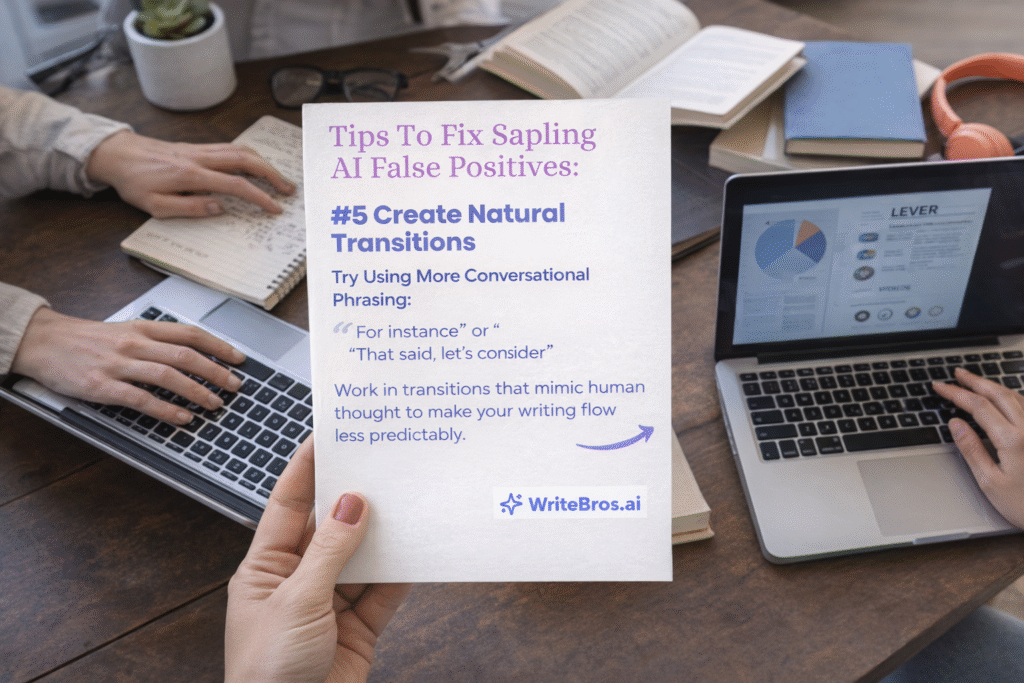
How to Fix Sapling AI False Positives – Strategy #5: Natural transition flow
Transitions act as connective tissue between ideas, and human writers naturally vary how those connections appear across paragraphs and sections. Automated systems tend to use repetitive transition formulas, which makes large portions of the text feel structurally predictable when evaluated by a detection model. Introducing more conversational connective phrasing allows the writing to move between ideas in a way that mirrors how people actually think and explain concepts.
For example, an explanation might shift direction through reflective phrases that acknowledge nuance, reconsider earlier points, or gently introduce additional context that reframes the argument. These transitions mimic the natural movement of thought rather than the rigid progression typical of algorithmic text generation. Once the flow between paragraphs becomes less mechanical, Sapling’s pattern recognition model begins interpreting the document as a human crafted narrative.
How to Fix Sapling AI False Positives – Strategy #6: Voice irregularity
Human writing rarely maintains perfect tonal consistency across an entire article because people naturally alternate between explanation, reflection, and emphasis depending on the idea being explored. Detection systems often associate rigid tonal uniformity with AI generated text because automated models frequently maintain the same narrative posture throughout long passages. Introducing subtle tonal variation helps the writing feel more organic and reduces the statistical signals that Sapling evaluates as artificial.
An article might shift from analytical language into slightly more reflective phrasing when clarifying a complex concept, then return to structured explanation when presenting the next idea. These tonal adjustments mirror the rhythm of real editorial thinking, where the writer adapts language according to the context of the argument. Over the course of several paragraphs this variation gradually dissolves the consistent stylistic pattern that Sapling detection algorithms often rely on.
How to Fix Sapling AI False Positives – Strategy #7: Context expansion
AI generated text frequently compresses information into concise summaries that move quickly from point to point without exploring the surrounding context. Sapling models sometimes interpret this compressed delivery style as a signal of automated generation because the language remains highly efficient and structurally predictable. Expanding the surrounding explanation gives the writing more narrative depth and introduces natural language variation across the paragraph.
Instead of presenting a short statement that immediately concludes the argument, writers can explore the reasoning behind the point and discuss how it connects to real editing or writing scenarios. This additional context encourages the paragraph to unfold in a more exploratory manner, which resembles the way human writers gradually develop an idea. The extended explanation creates a richer linguistic pattern that is less likely to trigger Sapling’s automated detection indicators.
How to Fix Sapling AI False Positives – Strategy #8: Human phrasing edits
Automated language often relies on standardized phrasing patterns that appear repeatedly across different pieces of AI generated content. These patterns can include symmetrical sentence construction, predictable introductory wording, or highly polished phrasing that lacks the slight irregularities common in human writing. Revising those phrases with more conversational language helps the text move closer to authentic editorial voice.
An editor may replace overly formal expressions with language that reflects how people actually explain an idea when writing thoughtfully rather than mechanically. That change might include reflective commentary, clarifying phrases, or subtle expansions that make the sentence feel less algorithmic. When those edits appear consistently across the article, the overall linguistic signature shifts toward a style that Sapling typically associates with genuine authorship.
How to Fix Sapling AI False Positives – Strategy #9: Logical restructuring
AI generated content frequently organizes information in an optimized logical sequence that moves cleanly from introduction to explanation and conclusion with little deviation. Although that structure is effective for clarity, it can also appear unusually consistent when analyzed by detection models that expect more variation in human writing. Rearranging the order of ideas introduces subtle complexity that mirrors the way people naturally build arguments.
A paragraph might begin with a reflective observation before presenting the main explanation, followed by a clarification that reframes the initial idea. This type of reordering alters the conceptual flow of the text while preserving the meaning of the argument. The resulting structure appears less formulaic and more characteristic of authentic editorial reasoning, which can reduce Sapling’s confidence that the passage was generated automatically.
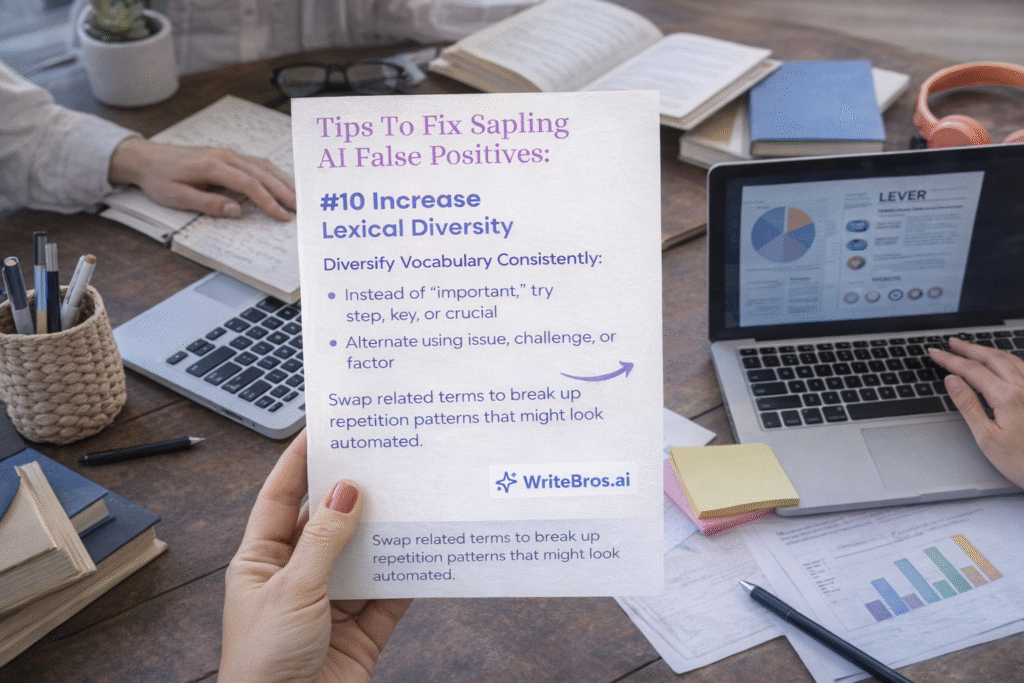
How to Fix Sapling AI False Positives – Strategy #10: Lexical diversity
Lexical diversity refers to the range of vocabulary used throughout a piece of writing, including how frequently certain words appear and how language choices evolve across paragraphs. Detection systems sometimes identify AI generated text when the vocabulary distribution becomes unusually repetitive or overly uniform across the document. Introducing subtle variation in word choice helps the text reflect the natural unpredictability of human language.
This does not require dramatic vocabulary changes or complex terminology, but rather thoughtful substitution that reflects the nuance of each sentence. A writer might alternate between closely related expressions that convey the same concept while maintaining the natural tone of the paragraph. Over time these small adjustments reshape the statistical language pattern in ways that make Sapling less likely to interpret the writing as automated output.
How to Fix Sapling AI False Positives – Strategy #11: Editing pass layering
Layered editing means revisiting the same text several times with different revision goals so that structural patterns gradually dissolve across the document. The first pass may focus on clarity, the second on sentence variety, and a later pass on stylistic nuance that improves the natural rhythm of the writing. Each revision subtly modifies the linguistic fingerprint that Sapling evaluates during detection.
This iterative editing process resembles how professional writers refine articles before publication. Rather than producing a perfectly balanced paragraph in a single attempt, the writer gradually reshapes the language until it reflects a more organic flow of thought. As those revisions accumulate across the document, the resulting text becomes increasingly difficult for Sapling to categorize as algorithmic writing.
How to Fix Sapling AI False Positives – Strategy #12: Compression avoidance
Highly compressed sentences that contain several ideas packed into a tight structure often resemble the efficiency patterns of automated text generation. Sapling detection models sometimes interpret these dense constructions as signals of AI authorship because the language maintains an unusually high information density. Expanding the sentence into clearer segments introduces natural breathing space within the paragraph.
Breaking the explanation into separate clauses allows the writer to elaborate on the reasoning behind the point instead of presenting everything in a single compressed statement. This expanded structure mirrors the way human writers gradually develop ideas through explanation and reflection. As the language becomes less compressed and more conversational, Sapling is less likely to identify the passage as machine generated.
How to Fix Sapling AI False Positives – Strategy #13: Contextual nuance
Human writers frequently include nuance that acknowledges uncertainty, limitations, or alternative interpretations of an idea. AI generated text often presents information with a smoother sense of certainty because the language model aims to deliver concise and confident explanations. Introducing nuanced commentary can therefore signal that the paragraph reflects authentic human reasoning.
Nuance might appear through reflective observations that recognize complexity or explain how different situations could lead to different outcomes. These subtle clarifications show that the writer is thinking critically about the topic rather than simply presenting a polished summary. Sapling detection systems interpret this type of nuanced language pattern as a characteristic of genuine authorship.
How to Fix Sapling AI False Positives – Strategy #14: Manual review pass
A careful manual review allows writers to identify repetitive phrasing patterns that automated tools may overlook. Sapling detection models frequently rely on subtle linguistic cues that emerge across multiple paragraphs rather than in a single sentence. Reading the article slowly with an editorial perspective helps reveal those recurring structures.
During this review the writer can adjust sentence openings, alter transitions, and vary explanatory structures so the document becomes less predictable overall. These small refinements accumulate into a broader stylistic transformation that shifts the language toward authentic human expression. The final version therefore presents a far more diverse linguistic pattern for Sapling to evaluate.
How to Fix Sapling AI False Positives – Strategy #15: Tool-assisted refinement
Specialized rewriting tools can assist editors by highlighting patterns that may increase the likelihood of AI detection. These tools often analyze sentence structure, repetition, and stylistic uniformity across the document. Using them as part of the revision workflow allows writers to identify areas that may benefit from structural rewriting.
When used carefully, these tools help reshape the language without altering the meaning of the content. The writer can adjust phrasing, vary sentence construction, and introduce contextual nuance while maintaining the original argument of the article. This collaborative editing process between human judgment and analytical software often produces writing that Sapling interprets as authentically authored.
Common mistakes
- Relying only on synonym replacement to reduce detection signals is a common mistake because it changes individual words while leaving the sentence architecture intact. Sapling models analyze deeper structural patterns, so superficial vocabulary changes rarely alter the statistical profile that triggered the false positive in the first place.
- Another frequent error is editing only one paragraph instead of reviewing the entire article for repetitive phrasing patterns. Detection systems evaluate language distribution across the full document, which means isolated edits cannot resolve the broader pattern that Sapling may interpret as algorithmic writing.
- Many writers attempt to shorten sentences excessively in an effort to sound more natural, yet overly short statements can create a different type of uniform pattern that detectors recognize. A mixture of long reflective sentences and shorter clarifications usually produces a more authentic linguistic rhythm.
- Some editors remove contextual explanations in order to simplify the text, but this reduction often increases the likelihood of detection. Highly condensed writing resembles the efficiency of AI generated summaries, which means Sapling may interpret the simplified version as automated language.
- Another mistake occurs when writers rely entirely on automated rewriting tools without manually reviewing the final text. Tools can improve structural variation, yet they may also introduce subtle repetition patterns that only careful human editing can detect and refine.
- Writers sometimes focus exclusively on vocabulary changes while ignoring paragraph level structure and logical flow. Detection models evaluate relationships between sentences as well as individual wording, so addressing only the surface language rarely eliminates the deeper patterns Sapling analyzes.
Edge cases
Some legitimate writing styles naturally resemble patterns that Sapling detection models associate with automated generation, particularly technical documentation or academic explanations that rely on consistent structure. In these cases the writing may be completely human yet still trigger detection signals because the language remains highly organized and methodical. Adjusting tone and structure slightly can help, although maintaining clarity should always remain the priority.
Collaborative documents can also produce unexpected detection results when multiple contributors revise the same section with different tools or editing styles. The mixture of structured AI assisted drafts and manual revisions may create hybrid patterns that confuse automated detection systems. A final editorial pass that unifies tone, structure, and pacing across the article usually resolves these unusual classification outcomes.
Supporting tools
- Language analysis platforms that examine sentence rhythm and structural variety can help writers detect repetitive phrasing before submitting content for evaluation. These tools provide structural insights that reveal how consistently certain patterns appear across a document.
- Professional editing software designed for long form writing often includes advanced readability analysis that highlights overly compressed sentences and repetitive transitions. These insights guide editors toward revisions that produce more natural linguistic variation.
- Advanced paraphrasing tools can assist in restructuring sentences rather than merely replacing vocabulary, which helps reshape the deeper grammatical patterns that detection models evaluate. Used carefully, they support the editing process without replacing human judgment.
- Content analysis dashboards that track vocabulary diversity across paragraphs allow writers to identify sections where word repetition becomes statistically noticeable. Addressing those areas helps the article develop a more varied linguistic profile.
- Document comparison tools that highlight repeated phrases across multiple drafts are useful during revision cycles. These systems reveal hidden repetition patterns that might otherwise remain unnoticed during manual editing.
- WriteBros.ai offers rewriting and structural editing tools designed to help writers reshape sentence architecture while preserving meaning. These tools support the editorial process by highlighting patterns that may increase AI detection risk and guiding revisions toward more natural language variation.
Ready to Transform Your AI Content?
Try WriteBros.ai and make your AI-generated content truly human.
Conclusion
Fixing Sapling AI false positives requires understanding how detection systems interpret language patterns rather than simply rewriting individual sentences. When writers vary rhythm, expand context, and reshape structure, the text begins to reflect the irregular signals that naturally appear in authentic human writing.
The goal is not perfection but thoughtful editing that prioritizes clarity and genuine expression. When the writing process includes reflection, revision, and careful attention to structure, the final article naturally communicates the depth and nuance that automated detection models associate with real authors.
Did You Know?
If you are trying to fix Sapling AI false positives, remember that detectors typically score patterns across the entire page, so a few cleaned-up sentences will not matter much if the surrounding paragraphs still follow the same internal build and the same pacing. When each paragraph uses similar sentence spacing, repeats the same transition shape, and presents every point in a tidy, symmetrical order, the writing can look mathematically uniform even if the ideas are thoughtful and the wording is original. That is why quick synonym swaps often disappoint, since the deeper structure remains consistent and stays easy for scoring models to measure.
Edits that change the pace of reasoning tend to help more, because they resemble how real drafts develop through revision, hesitation, and clarification rather than a perfectly smooth explanation every time. Try explaining one idea briefly because it is straightforward, then slowing down on the next to add context, acknowledge a limit, and show how the advice changes in a realistic situation, instead of giving both the same space and the same shape. When the logic becomes more visible inside the sentences and the paragraph movement becomes less uniform, the overall signal often starts aligning with patterns associated with human drafting and editorial judgment.
Ready to Transform Your AI Content?