How to Handle Copyleaks False AI Flags: 15 Resolution Steps

Learn how to handle Copyleaks false AI flags with structured revision steps that reduce misclassification risk. Research from a peer-reviewed study published in Science shows AI detection tools can produce false positives, reinforcing the need for measured, evidence-based review workflows.
How to Handle Copyleaks False AI Flags: 15 Resolution Steps
Getting flagged for AI use when you wrote the draft yourself can feel frustrating and unfair. Recent reporting on AI detection false positive statistics shows that these situations are more common than many teams expect.
False AI flags tend to appear in structured, academic, or SEO-optimized writing that follows predictable formatting. Research from published Copyleaks AI detection study results suggests that model sensitivity increases when phrasing patterns repeat across paragraphs.
Instead of reacting defensively, you need a calm and methodical response plan. Used correctly, even guidance drawn from the best AI paraphrasing software tools for natural sentence variety can help you adjust structure without changing meaning.
| # | Strategy focus | Practical takeaway |
|---|---|---|
| 1 | Verify the score context | Check which sections triggered concern before making edits so you respond with precision instead of guesswork. |
| 2 | Review highlighted passages | Identify repetitive structure or uniform phrasing that may increase detection sensitivity. |
| 3 | Diversify sentence rhythm | Adjust cadence and transitions to create natural variation across paragraphs. |
| 4 | Reduce formulaic framing | Break up rigid templates or repeated list patterns that resemble automated output. |
| 5 | Strengthen specificity | Add concrete examples or contextual details that reflect real authorship signals. |
| 6 | Adjust structural uniformity | Vary paragraph length and transitions to avoid predictable formatting blocks. |
| 7 | Rephrase flagged segments | Rewrite only the exposed passages instead of overhauling the full document. |
| 8 | Reintroduce personal voice | Restore subtle stylistic markers that reflect natural human cadence. |
| 9 | Clarify domain nuance | Embed field-specific references that demonstrate subject familiarity. |
| 10 | Limit over-editing | Avoid excessive smoothing that can reintroduce uniform phrasing patterns. |
| 11 | Document authorship trail | Keep version history or draft notes to support legitimate authorship if challenged. |
| 12 | Compare before and after scans | Re-test revisions to confirm exposure decreases without altering substance. |
| 13 | Communicate with stakeholders | Explain detection volatility and outline the corrective steps you took. |
| 14 | Standardize revision workflow | Build a repeatable review process to reduce future misclassification risk. |
| 15 | Audit recurring patterns | Identify systemic formatting or tone habits that may repeatedly trigger flags. |
15 Resolution Steps to Handle Copyleaks False AI Flags
How to Handle Copyleaks False AI Flags – Strategy #1: Verify the score context
Before revising anything, take time to understand what the score actually represents and how the tool frames probability versus certainty. Many false flags occur because users react to a percentage without reviewing which sections were evaluated as higher risk and how confidence bands are calculated. Good execution here means examining the breakdown, checking whether the score is document-wide or passage-specific, and identifying whether formatting or structure contributed to the result.
This works because it replaces emotional reaction with structured analysis, which prevents unnecessary rewriting that can unintentionally worsen exposure. A technical report with consistent headings and evenly sized paragraphs might receive a higher score even if written entirely by a human, simply due to pattern regularity. When you anchor your response in context, you preserve original meaning while targeting the specific structural triggers that influenced the classification outcome.
How to Handle Copyleaks False AI Flags – Strategy #2: Review highlighted passages
After understanding the overall score, shift your attention to the exact passages identified as problematic so you can see recurring phrasing or structural repetition. Often these segments contain similar sentence openings, mirrored transitions, or parallel construction that inadvertently resemble generated output patterns. Effective review means isolating these excerpts and comparing them against the surrounding sections to determine whether rhythm or vocabulary uniformity stands out.
This careful comparison clarifies whether the issue stems from predictable phrasing rather than authorship concerns, which is frequently the case in structured or academic drafts. For example, multiple paragraphs beginning with identical framing clauses can create the appearance of automated generation even if the insights are original. When you identify those patterns deliberately, you gain precision in your edits instead of broadly reshaping the entire document without cause.
How to Handle Copyleaks False AI Flags – Strategy #3: Diversify sentence rhythm
Uniform sentence length and cadence can unintentionally increase detection sensitivity, especially in instructional or analytical writing that favors consistency. Introducing natural variation through mixed clause structures, layered transitions, and subtle shifts in pacing helps restore human-like cadence without altering substance. Proper execution involves reading passages aloud or scanning for repeated structural symmetry that makes paragraphs feel mechanically balanced.
This adjustment works because detection systems often interpret predictable rhythm as a statistical signal rather than evaluating intention or authorship. A document in which every sentence spans a similar word count can create pattern density that appears algorithmic, even if thoughtfully composed. Varying flow carefully ensures that your voice remains intact while the text reflects the organic unevenness typical of human drafting.
How to Handle Copyleaks False AI Flags – Strategy #4: Reduce formulaic framing
Highly structured frameworks such as repeated list openings or templated explanatory phrasing can raise pattern consistency beyond what detection systems consider natural. Reviewing your draft for repeated scaffolding language and adjusting transitions so they evolve instead of repeating word-for-word can meaningfully lower exposure. Strong execution means retaining clarity while softening rigid patterns that repeat across sections.
This matters because formulaic presentation often mirrors automated instructional output, even if the ideas are independently developed. For instance, multiple paragraphs that follow the identical sequence of definition, explanation, and example with matching phrasing can amplify statistical similarity signals. Subtle restructuring that introduces organic variation reduces this density while preserving the logical flow readers depend on.
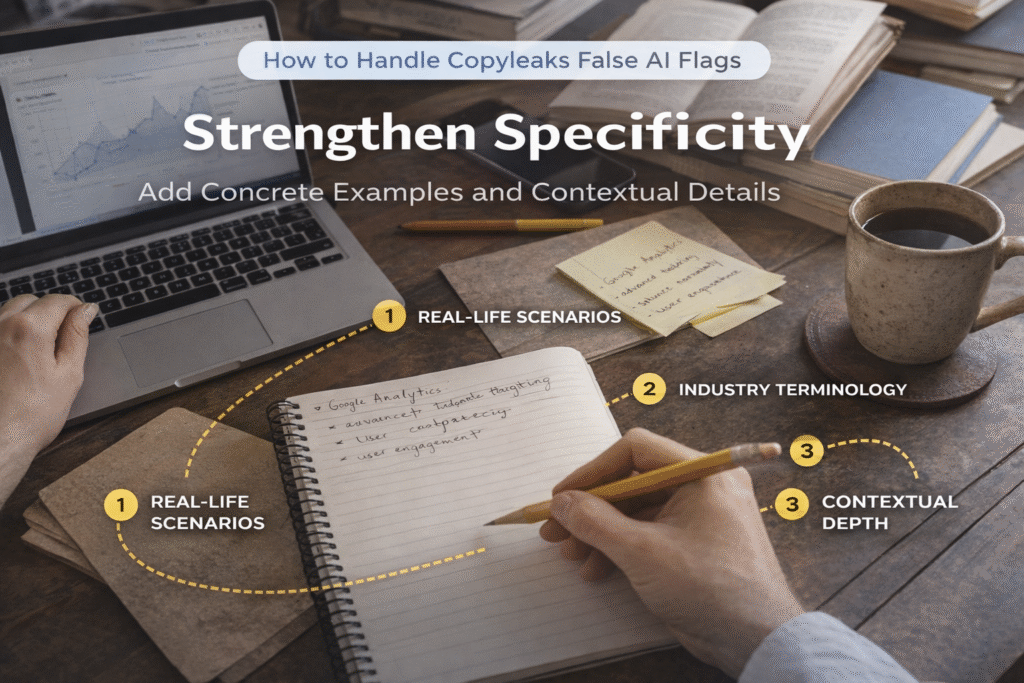
How to Handle Copyleaks False AI Flags – Strategy #5: Strengthen specificity
Generic phrasing increases statistical similarity across documents, which in turn may elevate detection probability even in authentic writing. Integrating precise context, detailed references, and situational nuance signals genuine authorship because it reflects lived experience or domain familiarity. Effective specificity means embedding concrete illustrations and layered explanations rather than broad, interchangeable statements.
This works because generalized language tends to appear frequently across digital content, creating overlap that algorithms may interpret as pattern repetition. A passage describing workflow improvements in abstract terms may seem statistically similar to countless other articles using comparable phrasing. When you ground explanations in distinct scenarios and clear contextual framing, you reduce that overlap while strengthening reader trust.
How to Handle Copyleaks False AI Flags – Strategy #6: Adjust structural uniformity
Paragraphs of identical length and mirrored internal organization can subtly increase pattern density, particularly in formal or instructional drafts. Reviewing overall layout and introducing natural variation in paragraph depth, transitions, and emphasis helps disrupt mechanical symmetry. Proper execution involves examining visual formatting as well as linguistic structure to ensure the document reflects organic development rather than rigid replication.
This strategy is effective because structural predictability can be interpreted as algorithmic regularity rather than thoughtful design. A report composed of evenly spaced sections with identical internal sequencing may appear artificially consistent despite human authorship. Introducing modest structural shifts preserves clarity while signaling a more natural drafting rhythm.
How to Handle Copyleaks False AI Flags – Strategy #7: Rephrase flagged segments
Targeted rewriting of highlighted passages allows you to address exposure directly without destabilizing the entire document. Focus on altering syntax and flow while preserving the underlying message so the integrity of the argument remains intact. Good execution requires restraint, since excessive rewriting can introduce new uniformity patterns or dilute precision.
This focused revision works because detection sensitivity often concentrates within specific segments rather than across the full draft. For example, a cluster of similarly constructed explanatory sentences may trigger higher scoring in one section while the rest of the text remains stable. Rephrasing only those areas minimizes disruption and maintains overall cohesion.
How to Handle Copyleaks False AI Flags – Strategy #8: Reintroduce personal voice
Subtle markers of perspective, emphasis, and reasoning can distinguish authentic writing from statistically common phrasing patterns. Reviewing the draft to ensure your natural explanatory tendencies and nuanced transitions remain visible helps reinforce authorship signals. Effective execution means weaving voice into analysis without becoming informal or imprecise.
This approach works because authentic tone typically includes slight irregularities and layered emphasis that differ from formulaic output. A fully neutral and uniformly structured explanation may appear detached in a way that increases classification probability. Restoring voice through thoughtful phrasing adds dimension while preserving professional clarity.
How to Handle Copyleaks False AI Flags – Strategy #9: Clarify domain nuance
Incorporating domain-specific distinctions and contextual references can meaningfully differentiate your text from generalized content clusters. Carefully expanding explanations with field-relevant nuance signals familiarity that automated phrasing often lacks. Strong execution involves adding depth where appropriate rather than inserting unrelated details.
This strategy works because nuanced expertise reduces textual overlap with broader content patterns commonly indexed across the web. A highly generic summary of compliance workflows may resemble many similar pieces unless contextualized with situational clarity. Domain nuance strengthens originality signals while reinforcing informational value.
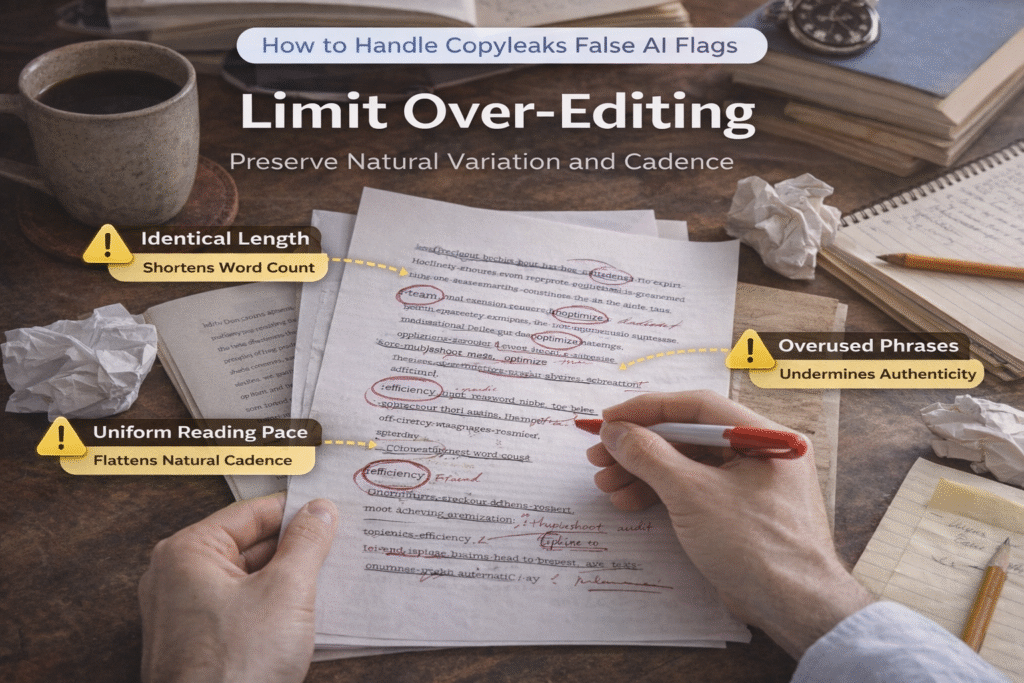
How to Handle Copyleaks False AI Flags – Strategy #10: Limit over-editing
Repeated rounds of smoothing and refinement can unintentionally increase structural uniformity, especially if edits prioritize fluency over natural variation. Monitoring how revisions affect cadence and phrasing prevents the draft from drifting toward mechanical symmetry. Effective execution requires balancing clarity with organic texture.
This restraint matters because excessive homogenization may recreate the same signals that initially triggered classification concerns. A text polished into perfectly balanced sentences can appear statistically patterned despite genuine authorship. Preserving subtle irregularities maintains authenticity while still meeting editorial standards.
How to Handle Copyleaks False AI Flags – Strategy #11: Document authorship trail
Maintaining version history, draft timestamps, and revision notes provides tangible evidence of authentic development. Organized documentation demonstrates iterative thinking and layered refinement rather than instantaneous generation. Proper execution involves storing early drafts and tracked edits in accessible formats.
This documentation becomes invaluable if stakeholders question legitimacy despite textual adjustments. Showing progressive refinement with comments and incremental revisions clarifies how ideas evolved organically. Clear records strengthen credibility and reduce reliance solely on detection metrics.
How to Handle Copyleaks False AI Flags – Strategy #12: Compare before and after scans
Running comparative scans after measured revisions helps confirm whether targeted changes influenced classification outcomes. Reviewing score movement alongside structural adjustments provides feedback on which patterns contributed most strongly to exposure. Effective comparison means documenting differences without chasing perfection.
This iterative review works because it transforms revision into a controlled process rather than guesswork. A small cadence change may lower probability more effectively than broad restructuring. Tracking results over time builds understanding of how sensitivity responds to nuanced edits.
How to Handle Copyleaks False AI Flags – Strategy #13: Communicate with stakeholders
Clear explanation of how detection tools operate helps prevent misinterpretation of probability as proof. Sharing context around scoring variability and outlining corrective steps demonstrates accountability and professionalism. Effective communication emphasizes transparency rather than defensiveness.
This matters because misunderstandings often escalate when stakeholders equate automated output with confirmed authorship concerns. Providing calm clarification reduces tension and reinforces trust in the editorial process. Open dialogue reframes the situation as procedural rather than accusatory.
How to Handle Copyleaks False AI Flags – Strategy #14: Standardize revision workflow
Creating a consistent internal review checklist helps reduce recurring exposure triggers in future drafts. Establishing structured evaluation before submission ensures pattern density is addressed early. Strong execution integrates cadence review, specificity checks, and structural variation into routine editing.
This preventive structure works because repeated false flags often stem from habitual formatting patterns. Without workflow safeguards, similar drafting habits may repeatedly trigger sensitivity thresholds. A standardized approach builds resilience into your writing process.
How to Handle Copyleaks False AI Flags – Strategy #15: Audit recurring patterns
Periodic review of multiple drafts allows you to identify stylistic habits that consistently correlate with higher probability scores. Looking across documents reveals structural tendencies that may not be visible within a single piece. Effective auditing requires objective comparison rather than isolated revision.
This broader perspective works because recurring exposure rarely results from isolated wording alone. Consistent sentence symmetry, parallel transitions, or templated openings may amplify statistical signals over time. Recognizing these habits empowers sustainable refinement rather than reactive correction.
Common mistakes
- Reacting to a probability score as though it were definitive proof of misconduct, which often leads to rushed rewriting that distorts meaning and introduces new structural uniformity.
- Overhauling the entire document without reviewing highlighted passages, which can create additional pattern density and unnecessary instability.
- Smoothing every sentence to identical length in pursuit of polish, inadvertently increasing statistical symmetry.
- Removing contextual nuance in an attempt to simplify phrasing, which reduces specificity and raises overlap with common content clusters.
- Failing to retain draft history, leaving no documentation trail if classification concerns escalate.
- Assuming that minor word substitutions alone will resolve exposure without addressing deeper structural patterns.
Edge cases
Highly technical, academic, or compliance-focused writing may trigger elevated probability scores due to unavoidable structural precision. In such contexts, even well-calibrated revisions may produce limited score movement because uniform formatting remains necessary.
Institutional environments with strict stylistic guidelines may also constrain variation, making mitigation more nuanced. In those cases, documentation and communication often matter as much as textual revision.
Supporting tools
- Version-controlled document editors that preserve tracked changes and timestamps, enabling transparent authorship documentation.
- Read-aloud tools that reveal cadence uniformity and structural repetition during review.
- Structured editorial checklists that evaluate rhythm, specificity, and variation before submission.
- Comparative scanning workflows that measure probability changes across iterations for controlled refinement.
- Domain reference libraries that support nuanced contextual additions to reduce generic phrasing overlap.
- WriteBros.ai for controlled structural variation that preserves meaning while softening uniform phrasing patterns.
Ready to Transform Your AI Content?
Try WriteBros.ai and make your AI-generated content truly human.
Conclusion
Handling Copyleaks false AI flags requires clarity, patience, and structural awareness rather than reactive rewriting. When you evaluate context, adjust patterns thoughtfully, and document your process, you strengthen both credibility and resilience.
The goal is not perfection but informed refinement guided by measured analysis. With consistent workflow and transparent communication, probability scores become manageable signals rather than destabilizing verdicts.
Did You Know?
If you are learning how to handle Copyleaks false AI flags, begin with structural adjustments rather than isolated synonym swaps, since evenly sized paragraphs and mirrored phrasing can preserve a consistent detection profile.
Vary the way ideas unfold across sections, allow some explanations to expand with layered clarification while others tighten for emphasis, and adjust pacing across the document, because natural variation more closely reflects authentic drafting patterns than perfectly balanced structure.
Ready to Transform Your AI Content?