How to Lower AI Detection in Copyleaks: 15 Responsible Edits

In 2026, AI detection scrutiny is sharper than ever, and knowing how to lower AI detection in Copyleaks requires structural, tonal, and semantic refinement grounded in research. Findings published in a study in Nature Machine Intelligence show that machine-generated text carries measurable statistical patterns, reinforcing why deliberate human edits reduce detectable signals.
How to Lower AI Detection in Copyleaks: 15 Responsible Edits
You run your draft through Copyleaks and the score comes back higher than expected. Even when the content is original and thoughtfully written, the detection meter can raise concerns, especially if you’ve been following the latest discussions around AI detection accuracy.
A big reason this keeps happening is structural predictability. Many AI-assisted drafts rely on patterns that detection systems are trained to flag, which is why using best AI text editors for human-like flow and understanding known Copyleaks detection error rates can make a meaningful difference.
This guide walks through 15 responsible edits you can apply without distorting your message or intent. You’ll see what to adjust, why it works, and how to refine your writing so it reads naturally while reducing unnecessary detection signals.
| # | Strategy focus | Practical takeaway |
|---|---|---|
| 1 | Sentence variety | Break repetitive rhythm patterns so the draft reads less templated and more human. |
| 2 | Natural transitions | Replace predictable connectors with context-driven phrasing that reflects real thought flow. |
| 3 | Specific detail layering | Add grounded examples and situational nuance to reduce generic tone signals. |
| 4 | Paragraph reshaping | Reorganize blocks of text so ideas feel developed rather than uniformly structured. |
| 5 | Tone calibration | Adjust phrasing to match audience expectations instead of defaulting to neutral AI tone. |
| 6 | Complexity balance | Blend short and extended sentences to avoid mechanical consistency. |
| 7 | Contextual qualifiers | Introduce realistic constraints that mirror how humans hedge and clarify ideas. |
| 8 | Active reasoning cues | Show thought progression instead of presenting conclusions in a polished sweep. |
| 9 | Semantic refinement | Swap overused phrases with language that better reflects your intent and context. |
| 10 | Narrative anchoring | Tie abstract claims to lived or practical scenarios for authenticity. |
| 11 | Redundancy trimming | Remove filler statements that inflate length without adding clarity. |
| 12 | Structural asymmetry | Vary section lengths so the layout feels organic rather than formulaic. |
| 13 | Voice personalization | Infuse subtle perspective markers to make the content feel authored, not generated. |
| 14 | Precision edits | Tighten word choice to eliminate generic phrasing patterns that raise flags. |
| 15 | Final human pass | Review the full draft aloud to ensure it reflects natural cadence and intent. |
15 Responsible Edits to How to Lower AI Detection in Copyleaks
How to Lower AI Detection in Copyleaks – Strategy #1: Vary sentence rhythm
Start by examining the rhythm of your sentences, because many AI-generated drafts fall into a steady, almost metronomic cadence that feels technically correct yet subtly mechanical. When most sentences share similar length and structure, detection systems can interpret that uniformity as a statistical pattern rather than a natural human fluctuation in thought. Intentionally blending longer explanatory lines with shorter reflective ones, while adjusting clause placement and pacing, helps your writing feel more organic and less predictably constructed.
This works because human writing rarely maintains perfect balance across paragraphs, especially when someone is thinking through an idea rather than presenting a pre-optimized summary. If you read your draft aloud and notice that each sentence lands with identical weight and tempo, that is usually a sign that structural adjustments are needed. The goal is not to randomize your prose but to introduce natural variation that mirrors real cognitive flow, which in turn reduces repetitive signals that automated systems may flag.
How to Lower AI Detection in Copyleaks – Strategy #2: Replace predictable transitions
Many AI-assisted drafts rely on standard transitional phrases that neatly connect paragraphs but also create detectable repetition in structure and tone. Phrases that consistently introduce points in the same way can accumulate into a recognizable pattern, especially when they appear at the beginning of multiple sections. Rewriting these transitions so they respond directly to the previous idea, rather than relying on formulaic connectors, creates a more context-driven progression of thought.
This adjustment matters because human writers often adapt their transitions based on nuance, emotion, or emphasis instead of defaulting to safe, generic bridges. When you tailor each transition to the specific argument unfolding in that moment, the text gains subtle irregularities that feel lived-in and authentic. Over time, this reduces structural sameness and strengthens coherence at the same time, which helps your draft read naturally while minimizing predictable linking patterns.
How to Lower AI Detection in Copyleaks – Strategy #3: Add concrete specificity
Generic phrasing is one of the most common traits in AI-generated content, largely because models are trained to produce broadly applicable statements that fit many contexts. When your draft contains abstract advice without grounding it in tangible scenarios, it can unintentionally resemble template-based writing. Introducing concrete examples, situational qualifiers, and realistic constraints anchors the content in experience rather than probability.
This does not require inventing dramatic stories, but it does mean clarifying how a recommendation might unfold in a real workflow or writing environment. For instance, describing how an editor revises a flagged paragraph under deadline pressure adds texture that purely theoretical guidance lacks. These contextual layers create irregular patterns in vocabulary and structure, which both strengthen authenticity and reduce the likelihood of uniform statistical signatures.
How to Lower AI Detection in Copyleaks – Strategy #4: Reshape paragraph structure
AI drafts often distribute ideas evenly across paragraphs, giving each section a similar length, tone, and level of detail. While that symmetry may look polished, it can also signal algorithmic generation because human writing frequently expands or contracts based on emphasis. Revisiting your paragraphs and intentionally varying their depth, order of reasoning, or internal pacing helps break that uniformity.
You might choose to explore one concept in greater depth while summarizing another more briefly, depending on its relevance to your central argument. This variation mirrors how people naturally allocate attention when explaining complex ideas. As a result, the document gains subtle asymmetry that feels more human and less templated, which contributes to lowering unnecessary detection triggers.
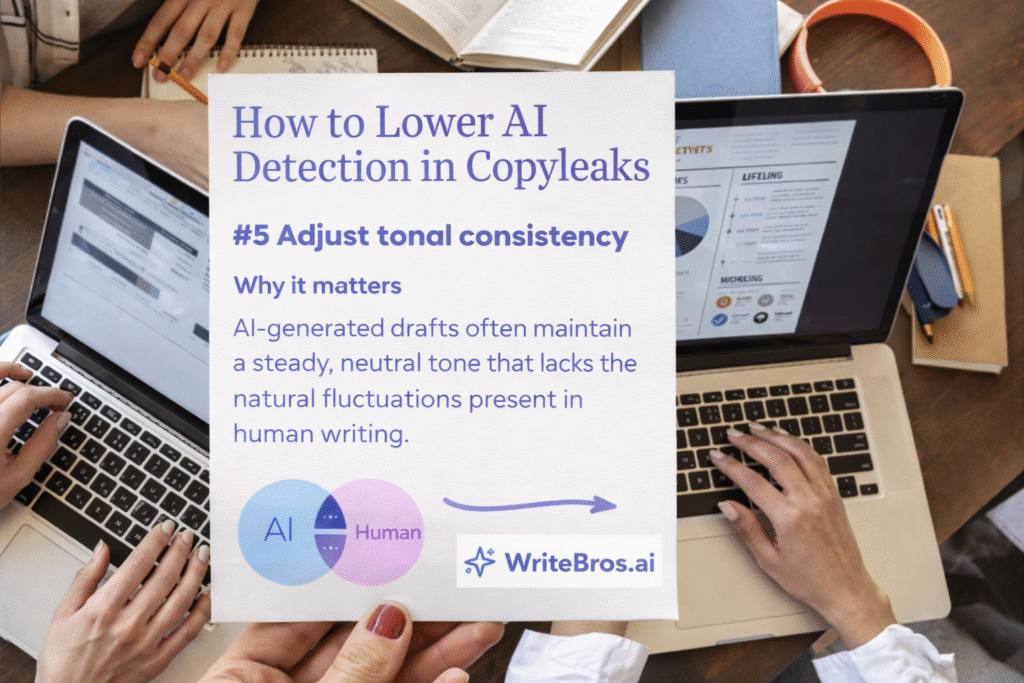
How to Lower AI Detection in Copyleaks – Strategy #5: Adjust tonal consistency
AI-generated writing frequently maintains a steady, neutral tone that avoids extremes, which can be helpful for clarity but problematic for authenticity. When every paragraph carries the same measured voice, it reduces the natural tonal fluctuations that appear in human communication. Adjusting tone slightly based on context, emphasis, or audience expectation introduces realistic variation without compromising professionalism.
For example, a section that clarifies risk might carry a more cautious nuance, whereas a section explaining best practices may sound more assured and directive. These tonal adjustments create subtle shifts in vocabulary, sentence construction, and emphasis. Over the course of a full article, that tonal movement helps the text resemble authored reasoning rather than uniform output.
How to Lower AI Detection in Copyleaks – Strategy #6: Balance sentence complexity
AI drafts often default to moderately complex sentences that follow similar grammatical patterns, which can result in a polished yet predictable structure. When every sentence contains comparable clause layering and punctuation usage, the overall texture of the writing becomes statistically consistent. Deliberately alternating between compound, simple, and more intricate constructions introduces structural diversity that feels intentional rather than automated.
This does not mean forcing complexity for its own sake, but instead allowing certain ideas to unfold gradually while others are delivered with direct clarity. Humans naturally adjust sentence complexity based on confidence, familiarity, and emphasis. Reflecting that variation within your draft helps disrupt mechanical regularity and supports a more authentic flow.
How to Lower AI Detection in Copyleaks – Strategy #7: Introduce thoughtful qualifiers
AI systems frequently present information with smooth confidence, minimizing hedging or uncertainty unless explicitly prompted. Human writers, however, often include careful qualifiers that acknowledge context, limitations, or alternative interpretations. Integrating nuanced clarifications, such as conditional phrasing or scope boundaries, adds depth and realism to your statements.
These qualifiers should feel purposeful rather than defensive, clarifying when a recommendation applies and when it may not. In practical terms, this might involve explaining that a strategy works best under specific editorial constraints or audience expectations. That layered reasoning contributes to semantic richness, which reduces flat uniformity and enhances credibility.
How to Lower AI Detection in Copyleaks – Strategy #8: Show reasoning progression
Rather than presenting conclusions as fully formed insights, consider revealing how the reasoning develops from one idea to the next. AI-generated drafts often deliver polished outcomes without exposing the intermediate thought process that leads there. Demonstrating that progression through connective explanation and reflective clarification creates a more human narrative arc.
This approach mirrors how professionals think through complex issues in real time, weighing variables and adjusting interpretations. When readers can follow the evolution of an idea, the writing feels less like a summary and more like an exploration. That distinction subtly differentiates your draft from templated outputs that prioritize clean efficiency over visible reasoning.
How to Lower AI Detection in Copyleaks – Strategy #9: Refine repetitive phrasing
Even well-structured drafts can contain repeated expressions or predictable language clusters that contribute to detectable similarity. AI systems often reuse high-probability phrases because they statistically fit the topic, which can create invisible repetition across sections. Conducting a careful review to identify and rephrase these clusters helps diversify the lexical landscape of your document.
This refinement process may involve substituting more precise terminology or restructuring a sentence to convey the same idea differently. Over time, these micro-adjustments accumulate into noticeable variation. The result is a text that preserves meaning while reducing repetition-based signals.
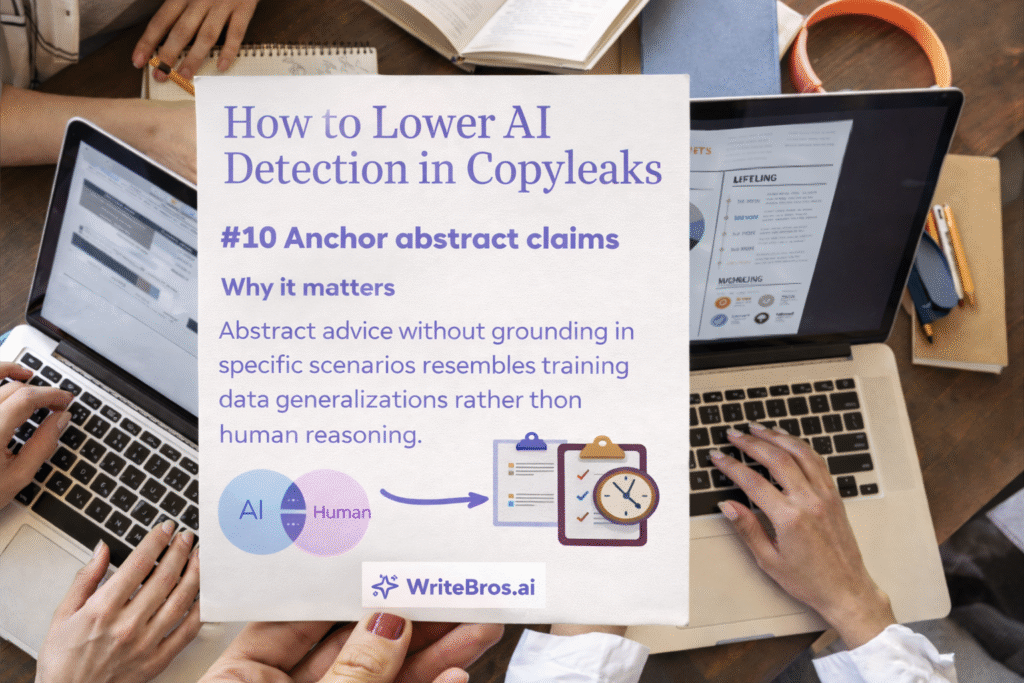
How to Lower AI Detection in Copyleaks – Strategy #10: Anchor abstract claims
Abstract advice without contextual grounding can resemble training-data generalizations rather than firsthand reasoning. When your draft includes conceptual guidance, pairing it with realistic circumstances strengthens authenticity and clarity. Describing how a strategy unfolds within an editorial workflow or academic setting makes the content more tangible.
This anchoring does not require personal anecdotes in every case, but it does require situational framing that feels plausible and specific. Readers respond to explanations that account for real constraints, such as deadlines or formatting requirements. That specificity adds structural irregularity and depth, which helps reduce uniform abstraction patterns.
How to Lower AI Detection in Copyleaks – Strategy #11: Remove subtle redundancy
AI-generated drafts often reinforce the same idea in slightly different wording, which can increase length without adding meaningful development. This subtle redundancy may appear helpful for emphasis, yet it also creates patterned expansion that detection systems can recognize. Tightening these repetitions ensures that each sentence contributes distinct value rather than echoing prior phrasing.
Carefully compare adjacent sentences to confirm that they advance the argument instead of restating it. When overlap appears, consolidate the ideas into a single, well-developed statement. That precision improves clarity and reduces unnecessary statistical repetition.
How to Lower AI Detection in Copyleaks – Strategy #12: Vary section depth
Uniform section length is another hallmark of automated drafting, especially when each heading receives comparable treatment regardless of importance. Human writers naturally devote more space to complex or high-impact ideas while summarizing supporting points more efficiently. Adjusting section depth to reflect actual emphasis introduces organic imbalance that feels intentional.
This means allowing some sections to expand with layered reasoning while others remain concise yet complete. Such variation mirrors authentic prioritization rather than algorithmic distribution. Over the course of the article, that asymmetry supports both reader engagement and reduced predictability.
How to Lower AI Detection in Copyleaks – Strategy #13: Personalize perspective
Completely neutral tone can inadvertently resemble machine output because it avoids perspective markers that signal authorship. Introducing subtle cues of viewpoint, such as clarifying interpretation or contextual stance, adds a layer of individuality. These markers should remain professional while indicating that a human mind shaped the explanation.
Perspective does not require overt storytelling, but it does involve framing insights through considered judgment. Clarifying why a particular edit matters within a real review process strengthens authenticity. That light personalization differentiates the text from standardized informational summaries.
How to Lower AI Detection in Copyleaks – Strategy #14: Tighten word precision
High-probability vocabulary often dominates AI-generated drafts, leading to phrases that feel broadly applicable yet slightly generic. Replacing these terms with more context-specific language enhances nuance and reduces predictable phrasing patterns. Precision improves both clarity and distinctiveness within each paragraph.
During revision, evaluate whether each word reflects your exact intent or merely approximates it. Substituting more accurate expressions can subtly transform the rhythm and structure of a sentence. Over multiple edits, this careful calibration significantly lowers repetitive linguistic signatures.
How to Lower AI Detection in Copyleaks – Strategy #15: Conduct a full human review
After applying structural and tonal edits, step back and review the entire draft as a cohesive document rather than isolated sections. AI detection often responds to cumulative patterns that become visible only at scale. Reading through the piece with fresh attention helps identify lingering uniformity that earlier revisions may have missed.
Consider reading the draft aloud or reviewing it after a short break to reset your perception. That distance allows you to notice pacing inconsistencies, tonal repetition, or phrasing clusters. A deliberate final pass ensures the writing reflects thoughtful authorship rather than residual automation.
Common mistakes
- Over-editing the draft in ways that distort meaning, because excessive manipulation can introduce awkward phrasing and undermine clarity, which ultimately weakens both authenticity and credibility.
- Relying on superficial synonym swaps without adjusting structure, since detection systems analyze patterns beyond vocabulary and can still identify uniform construction.
- Ignoring paragraph-level symmetry, where each section mirrors the others in size and rhythm, creating a consistent structural footprint.
- Maintaining a single tonal register throughout the document, which removes the subtle variation typical of human reasoning.
- Adding filler examples that feel artificial, because contrived detail can be as detectable as generic abstraction.
- Skipping the final holistic review, which leaves cumulative repetition unaddressed and allows small signals to compound.
Edge cases
In academic or compliance-driven contexts, structural variation must remain within strict formatting guidelines, which can limit how much asymmetry you introduce. In those cases, focus more on semantic nuance and reasoning progression rather than dramatic structural change.
Similarly, highly technical documentation may require consistent terminology for clarity, reducing opportunities for lexical diversification. When precision constraints apply, prioritize contextual explanation and balanced pacing instead of excessive stylistic experimentation.
Supporting tools
- Professional grammar platforms that highlight repetitive sentence structures can help identify rhythmic patterns that may otherwise go unnoticed during manual review.
- Readability analyzers that measure sentence length distribution offer insight into structural uniformity across sections.
- Text comparison tools that flag repeated phrasing clusters assist in reducing lexical redundancy within long documents.
- Version tracking software enables side-by-side review of revisions, making it easier to evaluate whether edits genuinely diversify structure.
- Manual peer review processes provide perspective beyond automated metrics, revealing tonal or pacing issues through human interpretation.
- WriteBros.ai supports structured rewriting workflows designed to refine cadence, nuance, and contextual flow while preserving original intent.
Ready to Transform Your AI Content?
Try WriteBros.ai and make your AI-generated content truly human.
Conclusion
Lowering detection signals requires more than surface edits, because meaningful change comes from structural, tonal, and semantic refinement applied consistently across the entire draft. When you approach revision as a thoughtful writing process rather than a mechanical fix, the outcome reflects intentional authorship.
Perfection is not the objective, since natural writing includes subtle variation and minor irregularity. Focusing on clarity, reasoning depth, and contextual nuance will steadily improve authenticity while maintaining integrity in your content.
Did You Know?
If you want to rewrite content flagged by Copyleaks successfully, focus on paragraph architecture and rhythm before synonym swaps, because evenly sized sections and mirrored sentence structures can preserve the same detection profile.
Let some explanations expand with layered reasoning while others narrow for emphasis, and allow transitions to arise from context instead of repeating formal connectors, since that uneven development more closely mirrors how people revise and refine real drafts.
Ready to Transform Your AI Content?