How to Reduce AI Detection Risk in Turnitin: 15 Writing Safeguards

Reducing false positives starts with visible authorship signals, layered reasoning, and revision patterns that reflect real drafting. Evidence from a peer-reviewed study in Computers and Education Artificial Intelligence shows detection models rely on linguistic regularities, reinforcing why structural variation and argument ownership matter.
How to Reduce AI Detection Risk in Turnitin: 15 Writing Safeguards
If you’re worried that your work might get flagged even when you’ve edited carefully, you’re not alone. Many writers are surprised to learn that certain AI writing patterns that trigger detection can show up even after heavy revisions.
The problem usually isn’t one obvious mistake, but a stack of small signals that add up across structure, phrasing, and rhythm. Confusion around Turnitin AI detection reliability makes it harder to know what truly increases risk and what is simply noise.
The good news is that you can reduce exposure with deliberate safeguards built into your drafting process. Instead of guessing or relying on tools alone, including a review of the most reliable AI humanizer tools for Turnitin false positives, this guide walks you through practical, writing-level adjustments that strengthen authenticity.
| # | Strategy focus | Practical takeaway |
|---|---|---|
| 1 | Structural variation | Break predictable paragraph flow and adjust pacing so the writing feels naturally uneven. |
| 2 | Sentence rhythm control | Blend short, medium, and longer sentences instead of keeping a steady, uniform cadence. |
| 3 | Specific detail layering | Add grounded examples and situational context that reflect real decision-making. |
| 4 | Vocabulary moderation | Avoid over-polished phrasing and mix in ordinary language where it fits. |
| 5 | Natural transitions | Replace formulaic connectors with more conversational shifts between ideas. |
| 6 | Argument ownership | Clarify your stance and reasoning instead of summarizing neutral viewpoints. |
| 7 | Source integration | Blend citations into analysis rather than stacking them at sentence ends. |
| 8 | Draft staging | Move through outline, rough draft, and revision phases with clear separation. |
| 9 | Personal calibration | Align tone and phrasing with your known writing history. |
| 10 | Complexity balancing | Keep arguments nuanced without turning every sentence into dense abstraction. |
| 11 | Revision friction | Leave small imperfections that reflect human drafting patterns. |
| 12 | Prompt containment | Avoid copying structured prompt outputs directly into final drafts. |
| 13 | Style drift checks | Scan for sections that sound noticeably different from the rest. |
| 14 | Consistency auditing | Review tense, terminology, and voice so the document feels cohesive. |
| 15 | Submission timing | Build in time for cooling-off edits before final upload. |
15 Writing Safeguards to Reduce AI Detection Risk in Turnitin
Reducing AI detection risk is less about hiding assistance and more about demonstrating authentic authorship through layered reasoning, visible drafting decisions, and stylistic consistency that reflects real intellectual work. The following safeguards focus on how writing is constructed, revised, and contextualized so that the final submission reads as a human process unfolding on the page rather than a polished output appearing fully formed.
How to Reduce AI Detection Risk in Turnitin – Strategy #1: Structural variation
To reduce AI detection risk in Turnitin, begin by examining the overall structure of your piece and intentionally disrupting predictable paragraph symmetry that often appears in generated drafts. When every paragraph follows the same length, tone, and internal organization, the result can feel mechanically balanced rather than organically developed through thinking and revision. Introducing variation in paragraph depth, including occasional shorter reflections or extended analytical sections, mirrors the uneven progression that naturally occurs during human writing.
This works because authentic writing often expands where ideas feel complex and compresses where conclusions feel clear, producing a rhythm that reflects cognition rather than formatting templates. Imagine drafting a literature review and realizing midway that one study requires deeper clarification, which leads you to extend that section while leaving others more concise, as the structure grows in response to thought. That unevenness, when grounded in logic rather than randomness, reduces uniform signals that automated systems frequently associate with patterned generation.
How to Reduce AI Detection Risk in Turnitin – Strategy #2: Sentence rhythm control
Another way to reduce AI detection risk in Turnitin is to intentionally vary sentence rhythm so that your prose does not move forward in consistently measured, similarly sized units that create an artificial cadence. Generated drafts often maintain balanced sentence lengths with tidy transitions, which can read as overly controlled and stylistically uniform. Blending longer analytical sentences with reflective clarifications and the occasional direct statement produces a more natural flow that reflects how people actually think through arguments.
This approach works because real writing often contains moments of elaboration followed by tightening, especially when a writer revises for clarity or emphasis after rereading their work. Consider drafting a policy analysis in which you first outline a complex regulatory background in a layered sentence and then follow it with a clarifying remark that narrows the focus, creating contrast in pace. That subtle modulation of rhythm introduces human irregularity that reduces the likelihood of stylistic uniformity being interpreted as automated composition.
How to Reduce AI Detection Risk in Turnitin – Strategy #3: Specific detail layering
To reduce AI detection risk in Turnitin, move beyond abstract summaries and deliberately layer in specific contextual details that reflect engagement with the material rather than surface-level paraphrasing. Broad, generalized statements without situational grounding can resemble templated responses that prioritize completeness over lived reasoning. Including concrete references to scenarios, interpretive choices, or analytical tensions demonstrates intellectual presence within the text.
This works because detailed elaboration often requires subjective framing, which introduces subtle stylistic fingerprints that automated systems may struggle to categorize as generic. For example, when discussing research methodology, you might explain why a particular sampling limitation complicates interpretation in your own words, rather than merely restating the study’s conclusion. That added dimension of explanation signals deliberation and ownership, strengthening the perception of authentic authorship.
How to Reduce AI Detection Risk in Turnitin – Strategy #4: Vocabulary moderation
Reducing AI detection risk in Turnitin also means resisting the temptation to maintain consistently elevated vocabulary that reads as uniformly polished across the entire document. While sophisticated language has its place, excessive lexical precision in every sentence can create an impression of optimization rather than natural expression. Allowing for moments of simpler phrasing alongside analytical terminology creates tonal contrast that reflects real drafting decisions.
This matters because human writers tend to fluctuate between technical articulation and conversational clarification, especially when explaining complex ideas to a broader academic audience. Imagine explaining a statistical finding and then pausing to restate it in more accessible language to ensure clarity, which introduces tonal variation without sacrificing rigor. That balance between refinement and simplicity reduces stylistic monotony that detection systems sometimes flag as patterned output.
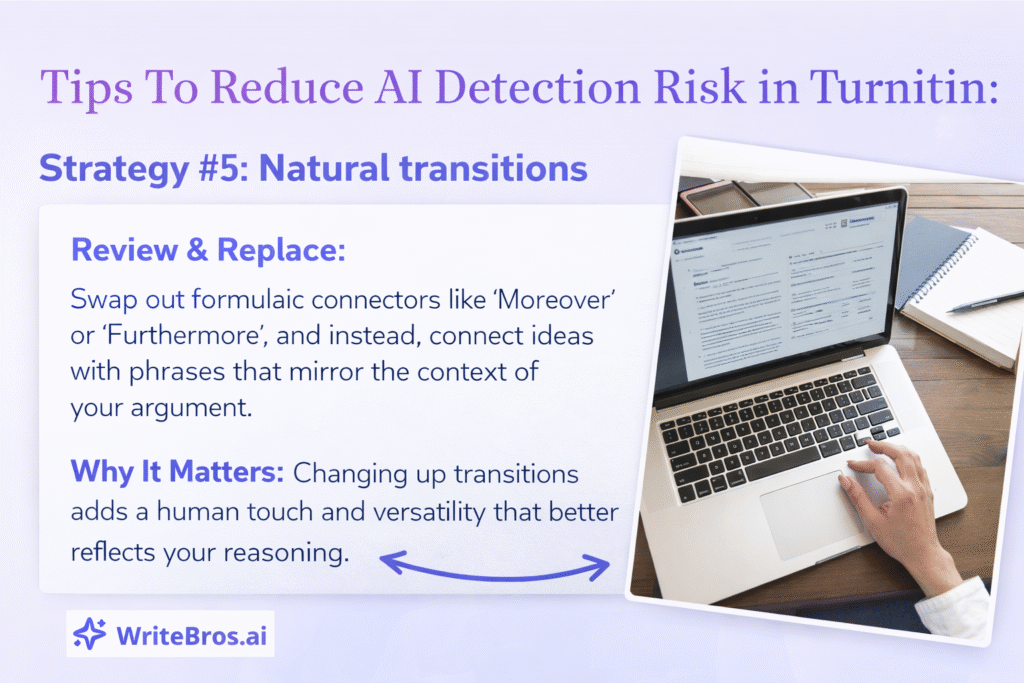
How to Reduce AI Detection Risk in Turnitin – Strategy #5: Natural transitions
To reduce AI detection risk in Turnitin, review how your paragraphs connect and replace formulaic transition phrases with more context-sensitive shifts that reflect your reasoning process. Overused connectors can produce a predictable progression that feels algorithmically assembled rather than intellectually navigated. Crafting transitions that reference prior claims or introduce tension between ideas produces continuity grounded in meaning rather than structure alone.
This works because authentic writing frequently evolves in response to internal questioning, not simply through standardized sequencing. When moving from theory to application, you might acknowledge a limitation raised earlier and explain how it complicates implementation, thereby creating a transition shaped by logic instead of template. Those meaning-driven bridges add depth and individuality, reducing signals of mechanical organization.
How to Reduce AI Detection Risk in Turnitin – Strategy #6: Argument ownership
Reducing AI detection risk in Turnitin requires making your analytical position visible rather than presenting information as a neutral compilation of balanced perspectives. Text that summarizes multiple viewpoints without clearly signaling evaluative judgment can resemble aggregated synthesis typical of generative outputs. Explicitly articulating your reasoning, including why you privilege certain interpretations over others, introduces intellectual accountability into the prose.
This approach works because human argumentation often reveals preference, hesitation, and conditional endorsement shaped by personal academic judgment. For instance, when comparing two theoretical frameworks, you might explain why one better accounts for contextual variability based on criteria you define within the paper itself. That articulation of criteria and preference demonstrates agency, reinforcing the impression of genuine authorship.
How to Reduce AI Detection Risk in Turnitin – Strategy #7: Source integration
To reduce AI detection risk in Turnitin, integrate sources into your reasoning rather than stacking citations at predictable intervals that follow uniform patterns. Generated drafts often attach references at the end of generalized claims without weaving them into interpretive analysis. Embedding citations within discussion, explaining their relevance and limitations, reflects deeper engagement with the material.
This works because authentic research writing typically contextualizes each source within a broader argumentative arc rather than treating references as decorative validation. Imagine introducing a study, explaining its methodology, and then clarifying how its findings intersect with your thesis in a nuanced way. That layered integration reduces formulaic citation patterns that detection systems may associate with automated assembly.
How to Reduce AI Detection Risk in Turnitin – Strategy #8: Draft staging
Reducing AI detection risk in Turnitin is easier when you separate outlining, drafting, and revising into distinct stages that shape the document organically over time. Submitting a piece that feels uniformly polished from introduction to conclusion can create suspicion of single-pass generation. Allowing the structure to evolve across stages introduces natural refinement patterns visible in the final text.
This matters because real writing often carries traces of development, such as restructured arguments or expanded clarifications that reflect iterative thinking. When you revise a thesis after drafting body sections, subtle adjustments ripple through the document, creating interconnected revisions rather than static uniformity. That layered evolution mirrors authentic workflow and reduces signals of instantaneous composition.
How to Reduce AI Detection Risk in Turnitin – Strategy #9: Personal calibration
To reduce AI detection risk in Turnitin, calibrate your final draft against your established writing style so that tone and phrasing align with your academic history. A sudden departure in vocabulary density, sentence structure, or argumentative posture can appear inconsistent with prior submissions. Reviewing earlier work and adjusting your current draft for stylistic continuity helps maintain coherence across your academic profile.
This works because detection tools may evaluate writing patterns relative to previous submissions, making abrupt stylistic divergence more noticeable. If your earlier essays favored moderately complex sentences with reflective commentary, maintaining that cadence supports consistency. Aligning present work with documented style reduces anomalies that might otherwise draw automated scrutiny.
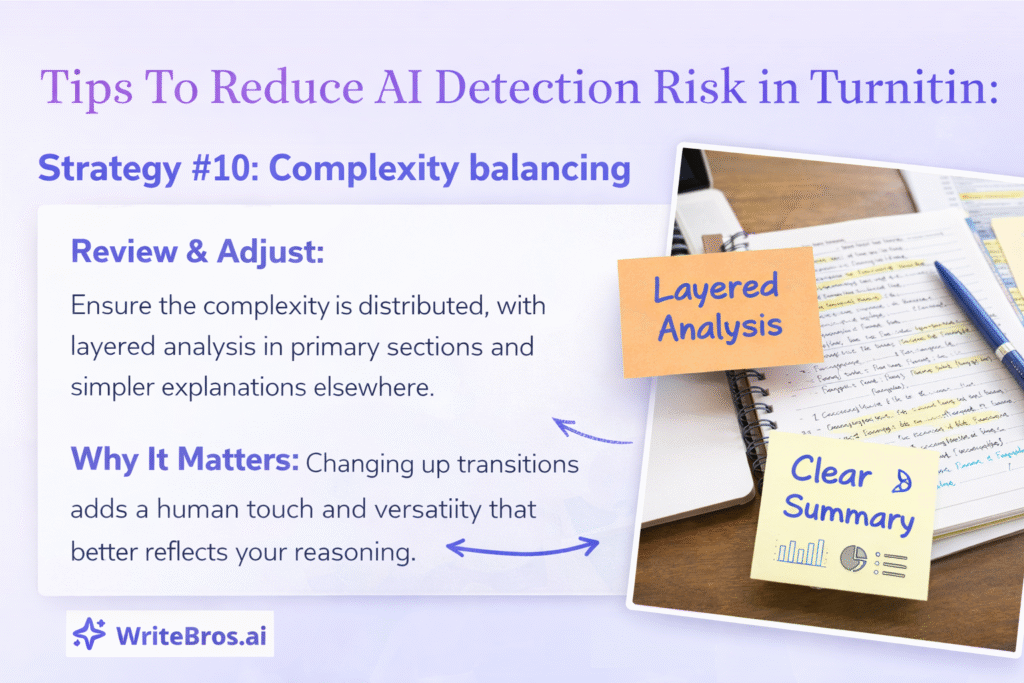
How to Reduce AI Detection Risk in Turnitin – Strategy #10: Complexity balancing
Reducing AI detection risk in Turnitin also involves balancing analytical depth so that not every sentence attempts to carry equal conceptual weight. Uniformly dense prose can appear optimized for completeness rather than shaped by human prioritization of emphasis. Allowing certain sections to breathe while concentrating complexity where it logically belongs creates a more natural distribution of cognitive effort.
This approach works because human writers tend to allocate attention unevenly, expanding on contentious points while moving more quickly through background context. When discussing theoretical implications, you might elaborate extensively, yet summarize methodological details more concisely once they are established. That uneven allocation of elaboration mirrors authentic reasoning patterns and reduces mechanical density.
How to Reduce AI Detection Risk in Turnitin – Strategy #11: Revision friction
To reduce AI detection risk in Turnitin, accept that authentic writing often contains subtle imperfections that reflect iterative revision rather than flawless uniformity. Overly seamless prose without minor asymmetries in phrasing or emphasis can appear algorithmically refined. Preserving slight tonal shifts or small variations introduced during editing can signal human involvement.
This works because real drafting rarely produces perfectly calibrated sentences across an entire document, especially after multiple revisions shaped by feedback or time constraints. Consider how you might refine an argument late at night, leaving certain phrasing intact because it captures your intent even if it is not perfectly symmetrical. That residual texture of process adds authenticity that reduces perceptions of automated smoothing.
How to Reduce AI Detection Risk in Turnitin – Strategy #12: Prompt containment
Reducing AI detection risk in Turnitin requires careful containment of any generated material so that it does not enter the final draft without substantial reinterpretation. Copying structured outputs directly into your document can introduce consistent stylistic markers characteristic of prompt-driven generation. Instead, treat generated suggestions as rough notes that you reconstruct in your own analytical voice.
This matters because direct insertion often preserves phrasing patterns, organizational symmetry, and transitional uniformity that detection systems are trained to identify. When you rework an outline into a narrative argument shaped by your reasoning priorities, the language inevitably diverges from its initial template. That transformation embeds your cognitive imprint into the text, reducing detectable uniformity.
How to Reduce AI Detection Risk in Turnitin – Strategy #13: Style drift checks
To reduce AI detection risk in Turnitin, conduct targeted style drift checks to identify sections that feel noticeably different in tone or complexity from the rest of the document. Inconsistent stylistic patches can signal composite assembly rather than cohesive authorship. Reading the document aloud or reviewing it after a break can reveal abrupt shifts that require smoothing or recalibration.
This works because cohesive writing typically maintains an identifiable voice, even as arguments evolve across sections. If one paragraph suddenly adopts elevated abstraction or highly formal diction that contrasts with surrounding sections, revising for alignment restores continuity. That unified voice reduces anomalies that automated systems may interpret as evidence of mixed origins.
How to Reduce AI Detection Risk in Turnitin – Strategy #14: Consistency auditing
Reducing AI detection risk in Turnitin also involves auditing for consistency in tense, terminology, and perspective so that the document reads as internally coherent. Generated drafts sometimes fluctuate between present and past tense or alternate between synonymous terms without strategic intent. Standardizing these elements through deliberate review reinforces the impression of controlled authorship.
This matters because authentic academic writing typically reflects conscious decisions about narrative stance and conceptual framing. When you deliberately maintain consistent terminology for key constructs, readers can trace your argument without confusion. That disciplined coherence reduces erratic variation that detection algorithms may associate with automated composition.
How to Reduce AI Detection Risk in Turnitin – Strategy #15: Submission timing
To reduce AI detection risk in Turnitin, build time between final revision and submission so that you can review the document with fresh perspective. Immediate submission after drafting increases the likelihood of overlooking uniform phrasing or structural repetition. A cooling-off period allows you to identify and adjust patterns that feel overly systematic.
This works because distance often clarifies stylistic monotony that was invisible during active writing. When rereading the next day, you may notice repeated sentence openings or parallel constructions that subtly echo one another. Refining those patterns before submission reduces repetitive signals and strengthens the appearance of thoughtful, human-authored work.
Common mistakes
- Relying entirely on surface-level paraphrasing tools without restructuring the argument often leaves the underlying organization intact, which can preserve detectable patterns of symmetry and transition that suggest automated drafting rather than authentic intellectual development.
- Submitting text that is uniformly polished from introduction through conclusion, without visible variation in emphasis or depth, can unintentionally create the impression of single-pass generation instead of layered revision shaped by evolving reasoning.
- Overloading every paragraph with complex vocabulary and abstract phrasing may appear impressive at first glance, yet the consistent density can resemble optimized output rather than the uneven articulation typical of real drafting processes.
- Ignoring stylistic consistency across sections, especially when incorporating external suggestions, can result in tonal drift that signals composite assembly rather than cohesive authorship developed over time.
- Assuming that citation alone guarantees authenticity overlooks the importance of interpretive integration, since references appended mechanically at sentence endings can mirror templated generation patterns.
- Waiting until the final hour to revise and submit reduces the opportunity to identify repetitive phrasing or structural uniformity that might otherwise be adjusted through reflective editing.
Edge cases
In some disciplines, particularly technical fields with standardized reporting conventions, writing may naturally appear structured and uniform, which can complicate efforts to introduce variation without violating genre expectations. In these situations, authenticity is demonstrated less through stylistic irregularity and more through nuanced explanation of decisions, limitations, and contextual framing that reflect subject-matter engagement.
Similarly, collaborative projects may exhibit blended voices that differ subtly across sections, requiring careful harmonization to avoid abrupt tonal contrasts. Thoughtful editing that aligns terminology and argumentation across contributors preserves integrity while reducing unintended stylistic anomalies.
Supporting tools
- Version history tracking within word processors allows you to document iterative development over time, providing tangible evidence of drafting stages and reinforcing authentic authorship through visible revision progression.
- Read-aloud features can help identify repetitive rhythm or mechanical phrasing patterns that may not be obvious during silent review, enabling targeted refinement before submission.
- Manual outlining tools encourage argument planning prior to drafting, which supports organic structure formation rather than reliance on externally generated frameworks.
- Reference management software assists with accurate citation integration, making it easier to contextualize sources within analysis rather than attaching them mechanically.
- Peer feedback platforms provide external perspectives that highlight tonal drift or structural monotony, prompting adjustments that enhance coherence and authenticity.
- WriteBros.ai offers structured review workflows designed to help writers identify uniform phrasing patterns and refine stylistic variation before final submission.
Ready to Transform Your AI Content?
Try WriteBros.ai and make your AI-generated content truly human.
Conclusion
Reducing AI detection risk in Turnitin ultimately depends on demonstrating visible authorship through layered reasoning, deliberate revision, and stylistic coherence that reflects genuine intellectual engagement. Each safeguard outlined above reinforces the idea that authenticity is not a cosmetic adjustment but a process embedded in how ideas are developed and articulated.
Perfection is not the objective, and overly polished uniformity can sometimes undermine credibility rather than strengthen it. Intentional drafting, reflective editing, and consistent voice together create writing that stands on its own as human work shaped through thought and care.
Did You Know?
If you are focused on How to Reduce AI Detection Risk in Turnitin, minor vocabulary swaps rarely influence classification when the broader document still follows a repeated structural blueprint with balanced paragraph lengths and steady explanatory pacing, because modern detection systems evaluate cumulative stylistic signals that emerge across the entire draft rather than reacting to individual word substitutions.
Adjusting argument flow, redistributing analytical depth so complex ideas receive proportionally more space, and refining transitions to reflect genuine reasoning shifts can alter the overall stylistic profile in meaningful ways, since authentic academic writing typically evolves unevenly in response to intellectual complexity rather than adhering to perfectly symmetrical formatting throughout.
Ready to Transform Your AI Content?