How to Reduce Copyleaks False Positives: 15 Verification Steps

In 2026, reducing false AI flags demands structured verification, pattern control, and disciplined rescanning rather than guesswork. Research published in Science shows AI detection tools can produce measurable false positives, reinforcing the need for controlled editorial workflows.
How to Reduce Copyleaks False Positives: 15 Verification Steps
If you are trying to figure out how to reduce Copyleaks false positives, you are probably dealing with clean content that keeps getting flagged anyway. You check the scan twice, adjust a sentence or two, and still end up questioning whether the system is overreacting to patterns that show up in broader false positive statistics.
The problem usually is not that the content is fully machine-written, but that certain predictable structures, phrasing rhythms, or formatting signals look similar to AI outputs. Even strong editorial workflows and the best AI writing humanization tools for editorial use can leave subtle markers that automated systems misinterpret.
What makes this more frustrating is that detection accuracy is still evolving, as seen in ongoing Copyleaks AI detection accuracy statistics that show variation across content types. In this guide, you will walk through 15 verification steps that help you isolate real risk signals, adjust intelligently, and reduce unnecessary flags without overediting strong work.
| # | Strategy focus | Practical takeaway |
|---|---|---|
| 1 | Baseline scan review | Start with a controlled first pass so you understand what the system is actually flagging before making edits. |
| 2 | Segment testing | Break content into sections to isolate which paragraphs trigger risk signals and which do not. |
| 3 | Pattern density check | Look for repetitive sentence rhythm or predictable phrasing that can inflate detection scores. |
| 4 | Sentence length variation | Adjust uniform sentence structures to create more natural pacing and tonal shifts. |
| 5 | Structural reshaping | Reorganize paragraphs so ideas flow less mechanically and feel more editorial. |
| 6 | Lexical calibration | Replace overly polished vocabulary with clearer, more grounded language. |
| 7 | Transitional realism | Revise rigid transitions that read formulaic and add subtle context cues. |
| 8 | Formatting audit | Remove excessive symmetry in headings, bullets, and parallel phrasing. |
| 9 | Voice consistency review | Ensure tone does not sound overly neutral or detached throughout the piece. |
| 10 | Context depth test | Add specific examples that introduce unpredictability into the narrative. |
| 11 | Metadata and formatting reset | Clear hidden formatting artifacts that may carry structural patterns. |
| 12 | Cross-tool comparison | Run a second detection system to confirm whether the flag is consistent. |
| 13 | Incremental rescans | Edit in controlled batches to measure which changes affect the score. |
| 14 | Editorial grounding pass | Read aloud and refine sections that sound overly polished or synthetic. |
| 15 | Final verification protocol | Lock in a repeatable review process before publishing or submitting content. |
15 Practical Strategies to How to Reduce Copyleaks False Positives
How to Reduce Copyleaks False Positives – Strategy #1: Baseline scan review
Before changing a single word, run a clean baseline scan and document exactly which sections are being flagged, including the percentage score and any highlighted passages that appear repeatedly across drafts. This first pass matters because many false positives come from predictable structural signals rather than actual AI dependence, and without a stable reference point you risk editing blindly. Good execution means exporting or screenshotting the original report so you can compare future scans and measure whether your revisions actually reduce risk instead of simply reshuffling it.
This works in real workflows because detection systems often respond more to pattern clusters than to individual phrases, which means context is everything. Imagine adjusting five paragraphs only to realize later that the introduction was the real trigger, something you would have spotted quickly with a careful baseline comparison. The key constraint here is discipline, since skipping documentation feels faster in the moment but usually creates confusion when scores fluctuate unexpectedly.
How to Reduce Copyleaks False Positives – Strategy #2: Segment testing
Take the full document and divide it into logical sections, then scan each segment independently so you can isolate which specific blocks generate elevated detection signals. This approach helps you move from a vague overall score to a precise understanding of where risk clusters form, especially in longer editorial pieces with mixed writing styles. Strong execution involves keeping sections intact rather than rewriting mid test, because controlled inputs give you reliable diagnostic feedback.
In practice, you may find that a data heavy section scans cleanly while a polished summary paragraph triggers alerts, which reveals that tone and rhythm matter as much as content. A realistic example is a conclusion that mirrors common AI cadence patterns even though it was written manually, something that becomes obvious only when scanned alone. The limitation is that segment testing takes time, yet that time investment prevents unnecessary rewrites across otherwise safe sections.
How to Reduce Copyleaks False Positives – Strategy #3: Pattern density check
Read through flagged areas and look for repetitive sentence openings, mirrored clause structures, or evenly balanced phrasing that could create a machine like rhythm across multiple paragraphs. Detection tools often react to density of similar constructions rather than to meaning, so clustered symmetry can quietly elevate scores. Effective revision means reshaping patterns subtly while preserving clarity, instead of inserting random variation that weakens coherence.
This works because natural writing rarely maintains perfectly even cadence for long stretches, especially in analytical content. Consider a section where every sentence begins with a transitional phrase, which can look algorithmic even if the insight is strong and original. The caution is to avoid overcorrecting into chaotic structure, since consistency still matters for readability and credibility.
How to Reduce Copyleaks False Positives – Strategy #4: Sentence length variation
Analyze the distribution of sentence lengths in flagged passages and identify whether the text relies heavily on medium length, evenly constructed statements that create uniform pacing. Detection systems sometimes interpret this smoothness as synthetic predictability, particularly when combined with neutral tone and consistent formatting. Good editing introduces organic variation through layered clauses, reflective commentary, or occasional brevity used intentionally rather than mechanically.
In real scenarios, a paragraph composed of six similarly sized sentences can quietly raise suspicion even though each line is accurate and human written. Adjusting two or three sentences to expand on reasoning or compress an observation can disrupt the pattern without altering the substance of your argument. The constraint is balance, because forced complexity simply to change rhythm can make the content feel strained rather than authentic.
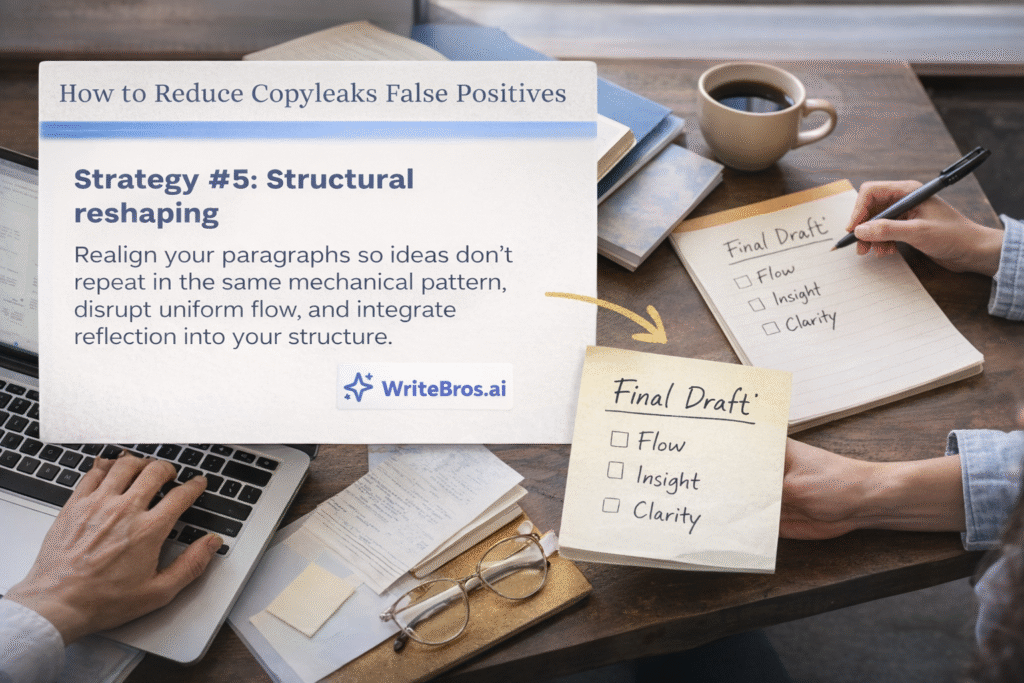
How to Reduce Copyleaks False Positives – Strategy #5: Structural reshaping
Examine whether your paragraphs follow an overly predictable formula such as definition, explanation, summary repeated in identical order throughout the piece. Repetition at the structural level can generate detectable uniformity, especially in guides or instructional content that rely on templates. Strategic reshaping means combining ideas, reordering logic flow, or integrating reflective commentary that interrupts rigid sequencing.
This approach works because authentic editorial writing tends to adapt its structure to the nuance of each point rather than applying the same mold repeatedly. For instance, blending context into the opening of a section instead of isolating it in a fixed pattern can reduce the appearance of automation. The caution is to preserve clarity while restructuring, since readers should still move through the argument without confusion.
How to Reduce Copyleaks False Positives – Strategy #6: Lexical calibration
Review flagged passages for vocabulary that feels overly polished, generic, or statistically common in AI outputs, particularly phrases that appear in countless online articles. High frequency wording alone is not proof of automation, yet concentrated clusters of such language can increase similarity signals across large datasets. Careful calibration involves replacing select terms with more precise, context grounded wording that reflects actual expertise rather than broad abstraction.
This works because detection systems compare text patterns at scale, and highly standardized phrasing contributes to overlap across unrelated documents. Imagine a section that uses familiar corporate terminology throughout, which may unintentionally resemble training data patterns. The limitation is that clarity must remain intact, so revisions should sharpen meaning instead of substituting obscure words simply to appear unique.
How to Reduce Copyleaks False Positives – Strategy #7: Transitional realism
Evaluate transitions between paragraphs and determine whether they follow predictable templates such as reiterating the previous point before introducing the next in nearly identical language each time. Formulaic transitions are efficient but can resemble automated scaffolding when repeated consistently across long content. Revising for transitional realism means weaving context, subtle opinion, or situational nuance into connectors so they feel less mechanically generated.
In practical editing, you might notice that every section opens with a summary clause followed by a clarifying statement, which creates a steady but artificial rhythm. Adjusting a few openings to begin with scenario framing or reflective observation can soften that pattern while keeping logical continuity. The caution is to maintain coherence, since overly creative transitions that abandon structure can confuse readers.
How to Reduce Copyleaks False Positives – Strategy #8: Formatting audit
Scan the document for symmetrical formatting choices such as identical heading lengths, evenly spaced bullet structures, or parallel sentence patterns across each subsection. While organization is valuable, excessive symmetry may mirror template driven outputs that detection systems are trained to recognize. A thoughtful audit involves introducing subtle variation in phrasing and layout without sacrificing navigability.
For example, if every subsection contains exactly three similarly structured paragraphs, the repetition can amplify machine like signals even though the content is original. Modifying paragraph depth or merging closely related points can reduce uniformity while improving narrative flow. The constraint is to avoid random inconsistency, since structure still serves the reader’s understanding.
How to Reduce Copyleaks False Positives – Strategy #9: Voice consistency review
Assess whether the tone remains perfectly neutral and evenly measured across the entire piece, since extreme consistency can resemble algorithmic output. Human writing often carries slight tonal shifts influenced by emphasis, uncertainty, or context specific nuance. Reviewing for voice consistency does not mean adding personality everywhere, but ensuring that the tone reflects natural variation rather than rigid stability.
In real editorial workflows, a guide that maintains identical cadence from introduction to conclusion may appear detached even if carefully written. Introducing modest inflections such as reflective commentary or clarifying side notes can disrupt monotony without compromising professionalism. The challenge is restraint, because exaggerating voice changes simply to appear human can undermine credibility.
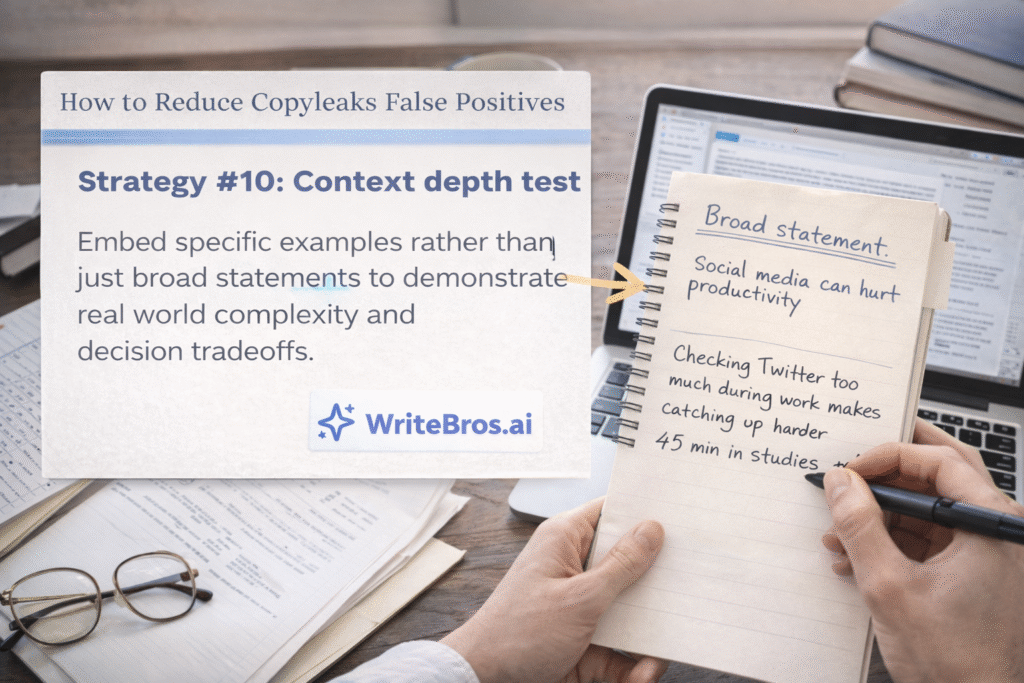
How to Reduce Copyleaks False Positives – Strategy #10: Context depth test
Take flagged sections and evaluate whether they rely heavily on generalized advice instead of situational depth, since surface level guidance often mirrors common AI patterns. Detection systems may interpret broad statements lacking specificity as statistically typical language. Strengthening context by embedding realistic scenarios, constraints, or decision tradeoffs adds unpredictability that aligns more closely with human reasoning.
Consider revising a generic recommendation into a scenario driven explanation that clarifies when and why the guidance applies. This added depth not only improves clarity for readers but also differentiates the text from mass produced templates. The limitation is that examples must remain relevant, since irrelevant detail can dilute the central message.
How to Reduce Copyleaks False Positives – Strategy #11: Metadata and formatting reset
Sometimes detection anomalies stem from hidden formatting artifacts, copied text layers, or metadata carried over from collaborative platforms rather than from the visible wording itself. Stripping formatting and pasting into a clean document can remove invisible structural cues that influence scanning systems. A proper reset involves reapplying styles manually so that only intentional formatting remains.
In practice, documents copied across tools may accumulate subtle code level patterns that are invisible during editing yet detectable during analysis. Resetting formatting often produces small but meaningful score adjustments without altering the language at all. The caution is to verify that essential layout elements are restored carefully after the cleanup process.
How to Reduce Copyleaks False Positives – Strategy #12: Cross tool comparison
Run the same content through a secondary detection platform to determine whether the flagged result is consistent or isolated to one system’s methodology. Differences across tools highlight how scoring models vary in sensitivity to structure and phrasing. Using comparison data prevents overreacting to a single report that may represent an outlier.
If one tool flags heavily while another shows minimal risk, you gain perspective on whether revisions are truly necessary. This comparison also helps identify recurring triggers that appear across platforms, which signals a stronger pattern issue. The limitation is that tools update regularly, so results should be interpreted as indicators rather than absolute verdicts.
How to Reduce Copyleaks False Positives – Strategy #13: Incremental rescans
After making targeted edits, rescan the document in controlled increments rather than rewriting everything at once and hoping for improvement. Incremental testing allows you to observe which adjustments meaningfully affect detection signals. This disciplined approach reduces guesswork and preserves sections that were already performing well.
For example, revising only the introduction and scanning again may reveal that the score drops significantly, which indicates that later sections were not the main issue. Tracking these shifts over several passes builds a practical understanding of how specific patterns influence results. The constraint is patience, since rapid, untracked edits obscure cause and effect.
How to Reduce Copyleaks False Positives – Strategy #14: Editorial grounding pass
Conduct a final read through focused not on grammar but on authenticity, asking whether each paragraph reflects genuine reasoning rather than polished neutrality. Reading aloud can expose mechanical cadence that silent reading overlooks. Grounding revisions might include clarifying intent, acknowledging uncertainty, or refining transitions to reflect lived decision making.
In real contexts, this step often reveals small but important shifts such as removing repetitive qualifiers or tightening overly balanced phrasing. These subtle changes enhance natural flow while maintaining analytical strength. The caution is to avoid introducing casual tone that conflicts with the document’s intended audience.
How to Reduce Copyleaks False Positives – Strategy #15: Final verification protocol
Establish a repeatable checklist that includes baseline documentation, segment testing, controlled edits, and cross tool validation before final submission or publication. Consistency in process reduces anxiety and prevents last minute reactive rewrites. A formal protocol transforms detection management from guesswork into a structured editorial discipline.
Over time, this system builds institutional knowledge about which patterns commonly trigger elevated scores in your specific content type. That accumulated insight makes future drafts easier to calibrate without extensive revision cycles. The limitation is that no protocol eliminates all variability, so flexibility remains part of the strategy.
Common mistakes
- Rewriting entire documents after a single flagged result without first isolating the actual trigger sections, which wastes time and can introduce new structural patterns that inadvertently maintain or even increase detection signals.
- Overcorrecting by inserting random stylistic changes purely to disrupt rhythm, resulting in awkward phrasing that harms clarity and credibility while providing little measurable improvement in detection outcomes.
- Relying exclusively on one scanning tool and treating its score as definitive, despite the fact that methodologies differ and may produce inconsistent results across platforms.
- Ignoring structural symmetry in headings and paragraph flow, assuming that originality of ideas alone will prevent false positives even when formatting patterns remain highly uniform.
- Failing to document baseline scans, which removes the ability to track incremental improvements and leads to confusion when scores fluctuate between revisions.
- Adding excessive personality or informal language in an attempt to appear human, which can damage professional tone and distract from the core purpose of the content.
Edge cases
Highly technical or academic writing may trigger elevated scores simply because terminology and structure follow established disciplinary norms that resemble training data patterns. In such cases, drastic stylistic deviation is neither practical nor appropriate, and measured adjustments focused on rhythm and context depth are usually more effective than sweeping rewrites.
Similarly, collaborative documents that combine multiple voices can produce inconsistent signals that fluctuate across sections, making detection results appear unstable. Here, harmonizing tone and structure carefully while preserving contributor intent often reduces variance more effectively than aggressive stylistic changes.
Supporting tools
- Structured revision checklists stored in shared documentation platforms help teams standardize verification steps and avoid reactive editing cycles when detection scores fluctuate unexpectedly.
- Read aloud features in modern word processors assist in identifying mechanical cadence that may not be obvious during silent review.
- Version comparison tools enable precise tracking of sentence level adjustments so you can correlate specific edits with score changes.
- Secondary detection platforms provide perspective on whether a flagged result represents a broader pattern or an isolated scoring anomaly.
- Plain text editors allow formatting resets that remove hidden artifacts carried over from collaborative drafting environments.
- WriteBros.ai can support calibrated language refinement workflows when used intentionally within a documented verification process.
Ready to Transform Your AI Content?
Try WriteBros.ai and make your AI-generated content truly human.
Conclusion
Learning how to reduce Copyleaks false positives is less about gaming a system and more about understanding how structure, rhythm, and formatting influence automated interpretation. When you approach verification as a measured editorial process rather than a reactive rewrite, you gain clarity and control over outcomes.
No detection workflow is perfectly predictable, yet disciplined testing and thoughtful revision consistently reduce unnecessary flags over time. The goal is not perfection but informed calibration, so your content remains strong, credible, and confidently submitted.
Did You Know?
If you are trying to reduce Copyleaks false positives, begin with structure and rhythm before changing vocabulary, because uniform paragraph pacing and mirrored sentence shapes can keep a draft statistically predictable even after wording edits.
Let one section expand with layered reasoning, allow the next to narrow for emphasis, and integrate clarifying context only when it deepens meaning, since that uneven progression mirrors how people naturally draft and revise over time.
Ready to Transform Your AI Content?