How to Reduce GPTZero Misclassification: 15 Quality Controls

False AI flags can distort evaluation and credibility. Research published in Nature Machine Intelligence on large language model detection reliability shows measurable limits in classifier accuracy, reinforcing why structured revision and quality controls are essential to reduce GPTZero misclassification without compromising authentic voice.
How to Reduce GPTZero Misclassification: 15 Practical Quality Controls
If your writing keeps getting flagged even when you know it’s original, figuring out how to reduce GPTZero misclassification can feel frustrating and unpredictable. You run your draft through most trusted AI detectors, tweak a few lines, and still see inconsistent results.
Part of the problem is that detection systems look for statistical patterns, not intent, which means normal clarity can sometimes resemble machine output. That confusion becomes even worse if you rely on surface fixes or jump straight to best AI rewriter tools without strengthening the structure and substance of your draft.
The good news is that you can take deliberate steps to lower false flags without distorting your voice or overediting your work. In this guide, you’ll learn a practical set of controls informed by Turnitin AI detection analysis and real-world revision workflows so you can reduce risk with clarity and confidence.
| # | Strategy focus | Practical takeaway |
|---|---|---|
| 1 | Sentence rhythm control | Blend short, medium, and longer sentences to avoid predictable pacing patterns. |
| 2 | Structural unpredictability | Rework paragraph flow so ideas develop naturally instead of following rigid templates. |
| 3 | Concrete detail layering | Add specific examples that reflect real context rather than generic explanations. |
| 4 | Voice calibration | Adjust tone so it sounds lived-in and intentional instead of polished and uniform. |
| 5 | Lexical variation | Replace repetitive phrasing with natural word variety across sections. |
| 6 | Transitional nuance | Use subtle connectors that mirror human thought progression. |
| 7 | Paragraph density checks | Break up overly even blocks of text to reflect organic drafting patterns. |
| 8 | Intent clarity audit | Clarify purpose in key sections so reasoning feels grounded and specific. |
| 9 | Over-smoothing reversal | Reintroduce natural imperfections that mirror human drafting habits. |
| 10 | Contextual anchoring | Tie abstract points to situational context instead of broad generalities. |
| 11 | Draft layering method | Revise in passes focused on flow, clarity, and tone rather than one sweep. |
| 12 | Comparative testing | Check drafts across multiple tools to spot pattern-based inconsistencies. |
| 13 | Overused phrasing purge | Remove stock expressions that frequently appear in generated text. |
| 14 | Human insight injection | Add perspective that reflects lived reasoning instead of neutral summaries. |
| 15 | Final anomaly sweep | Conduct a focused review for statistical uniformity before submission. |
15 Practical Quality Controls to Reduce GPTZero Misclassification
How to Reduce GPTZero Misclassification – Strategy #1: Sentence rhythm control
To reduce GPTZero misclassification, start by examining the rhythm of your sentences, because detection systems frequently respond to predictable pacing patterns that feel statistically uniform even when the ideas themselves are original and well developed. When most of your sentences fall within the same length range and follow similar clause structures, the draft can unintentionally resemble machine-generated output that prioritizes balance and symmetry over natural variation. Strong execution means deliberately weaving shorter statements with longer, more layered ones, allowing the cadence of your writing to feel more reflective of how humans actually think and elaborate.
This works in real situations because human writing tends to expand and contract organically, especially when clarifying complex ideas or circling back to refine a point with added nuance. For example, if you are explaining a research finding, you might introduce it in a compact sentence and then unpack its implications in a more detailed, flowing explanation that includes context and subtle qualification. The key constraint is avoiding artificial randomness, since simply chopping sentences apart without regard for coherence can weaken clarity rather than improve detection outcomes.
How to Reduce GPTZero Misclassification – Strategy #2: Structural unpredictability
If you want to reduce GPTZero misclassification consistently, you need to look beyond individual sentences and consider the architecture of your paragraphs, because overly uniform structures can trigger pattern recognition signals. Drafts that follow identical paragraph formulas, such as topic sentence, explanation, example, and summary repeated in rigid cycles, often resemble templated outputs even when the content is thoughtful. Instead, allow some sections to open with context, others with observation, and others with a tension or question that unfolds gradually across the paragraph.
This approach reflects how real writers organize thoughts differently depending on purpose, audience, and the complexity of the idea being explored. In practice, that might mean embedding an example earlier in one paragraph and postponing explanation until the middle of another, creating subtle variation that breaks statistical repetition. The caution here is to preserve logical flow, since unpredictability without coherence can confuse readers and undermine the credibility you are trying to protect.
How to Reduce GPTZero Misclassification – Strategy #3: Concrete detail layering
A reliable way to reduce GPTZero misclassification is to layer in concrete, situation-specific detail that demonstrates lived reasoning rather than abstract summarization. Detection systems often flag text that remains consistently high-level and generalized, because such writing mirrors the broad explanatory style common in generative outputs. When you anchor your points in specific contexts, such as describing a real revision workflow or a particular submission scenario, the text gains dimensionality that statistical models are less likely to categorize as generic.
In real-world drafting, this might involve describing how a student revised an introduction after seeing inconsistent detection results and then adjusted phrasing to better reflect their own academic voice. These contextual cues signal human involvement, especially when they include subtle constraints, trade-offs, or decision points that rarely appear in automated summaries. The balance to maintain is ensuring that details serve the argument, rather than becoming decorative additions that distract from the central purpose of the piece.
How to Reduce GPTZero Misclassification – Strategy #4: Voice calibration
Learning how to reduce GPTZero misclassification also requires calibrating your voice so that it reflects personal reasoning rather than neutral, evenly polished exposition. Machine-generated text often maintains a consistently measured tone, avoiding hesitation, qualification, or subtle opinion, which can make human drafts that are overly smoothed appear statistically similar. Calibrating your voice means allowing measured emphasis, occasional clarification, and natural shifts in intensity that mirror genuine thought progression.
For instance, when you explain a limitation in detection accuracy, you might acknowledge uncertainty before refining your conclusion, which introduces tonal texture that feels authentic. This nuanced modulation signals human judgment because it demonstrates evaluation rather than simple presentation of information. However, exaggerating emotion or inserting forced informality can undermine credibility, so the goal is thoughtful variation rather than dramatic fluctuation.
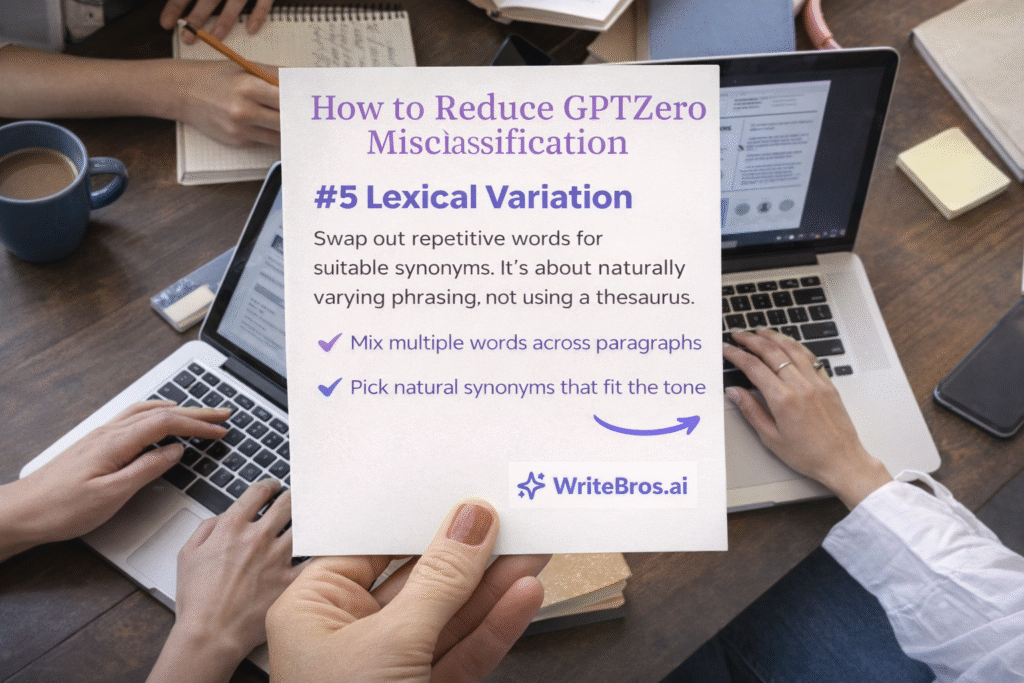
How to Reduce GPTZero Misclassification – Strategy #5: Lexical variation
Another essential method to reduce GPTZero misclassification involves reviewing your vocabulary for repetitive phrasing that unintentionally mirrors common training patterns. Generative systems often rely on recurring transitional phrases and standardized wording, so drafts that lean heavily on the same connectors or descriptors may resemble those statistical footprints. By consciously varying word choice, especially in recurring thematic sections, you introduce subtle unpredictability that reflects authentic composition.
In practice, this might mean replacing repeated evaluative terms with more context-sensitive language that better fits each specific argument. Rather than cycling through identical qualifiers, you adjust wording to match the nuance of each example, which naturally broadens lexical diversity. The caveat is to avoid thesaurus-driven substitutions that distort meaning, since clarity must remain stronger than novelty.
How to Reduce GPTZero Misclassification – Strategy #6: Transitional nuance
To reduce GPTZero misclassification more reliably, pay close attention to how your ideas transition from one point to the next, because overly mechanical connectors can resemble automated sequencing. Human reasoning rarely moves in perfectly linear steps, and it often includes reflective phrases that signal reconsideration, expansion, or mild qualification. Incorporating nuanced transitions, rather than relying on predictable markers, allows your writing to unfold in a way that mirrors authentic thought development.
For example, instead of consistently using standard progression cues, you might reference a previous claim indirectly before expanding on it, creating a more conversational continuity. This layered movement signals human authorship because it demonstrates memory and reflection within the draft. The limitation to watch is overcomplication, since transitions should deepen coherence rather than obscure the main thread.
How to Reduce GPTZero Misclassification – Strategy #7: Paragraph density checks
Reducing GPTZero misclassification often involves reviewing paragraph density, especially when your draft shows highly consistent block sizes and evenly distributed sentence counts. Detection systems can interpret such visual and structural uniformity as algorithmic regularity, even if the content is original and carefully reasoned. Intentionally varying paragraph length, based on the complexity of each idea, creates a more natural distribution that aligns with real drafting habits.
In a practical scenario, a complex analytical point may require a denser paragraph with layered explanation, whereas a clarifying observation might stand effectively on its own in a shorter section. This organic variation reflects how writers respond to content demands rather than adhering to rigid formatting symmetry. Still, fragmentation without purpose can disrupt readability, so adjustments should always be grounded in clarity and logical progression.
How to Reduce GPTZero Misclassification – Strategy #8: Intent clarity audit
If you want to reduce GPTZero misclassification systematically, conduct an intent clarity audit that examines whether each section clearly communicates its purpose. Text that reads as broadly informative without visible reasoning steps can appear machine-like because it lacks discernible decision-making signals. Strengthening intent involves clarifying why each claim appears, what prompted it, and how it connects to your broader objective.
In real drafting practice, this may involve inserting a clarifying sentence that explains why a particular example matters before transitioning to the next idea. That subtle articulation of motive introduces a layer of human judgment that statistical models are less likely to interpret as formulaic. The challenge is maintaining concision while still exposing reasoning, ensuring that added clarity does not inflate the draft unnecessarily.
How to Reduce GPTZero Misclassification – Strategy #9: Over-smoothing reversal
Many writers attempting to reduce GPTZero misclassification inadvertently over-smooth their drafts, removing natural irregularities that actually signal human authorship. Excessively polished text, with perfectly balanced clauses and consistently neutral phrasing, can resemble algorithmic output even if it began as original writing. Reintroducing mild asymmetry, such as varied clause lengths or subtle rephrasing that reflects genuine revision, can restore authenticity.
For instance, you might allow a qualifying aside to remain in place rather than compressing it into a streamlined sentence that sacrifices texture. These micro-level irregularities mirror the way humans refine ideas gradually rather than generating uniformly optimized prose. However, deliberate roughness should never compromise professionalism, since credibility depends on thoughtful execution rather than visible disorder.
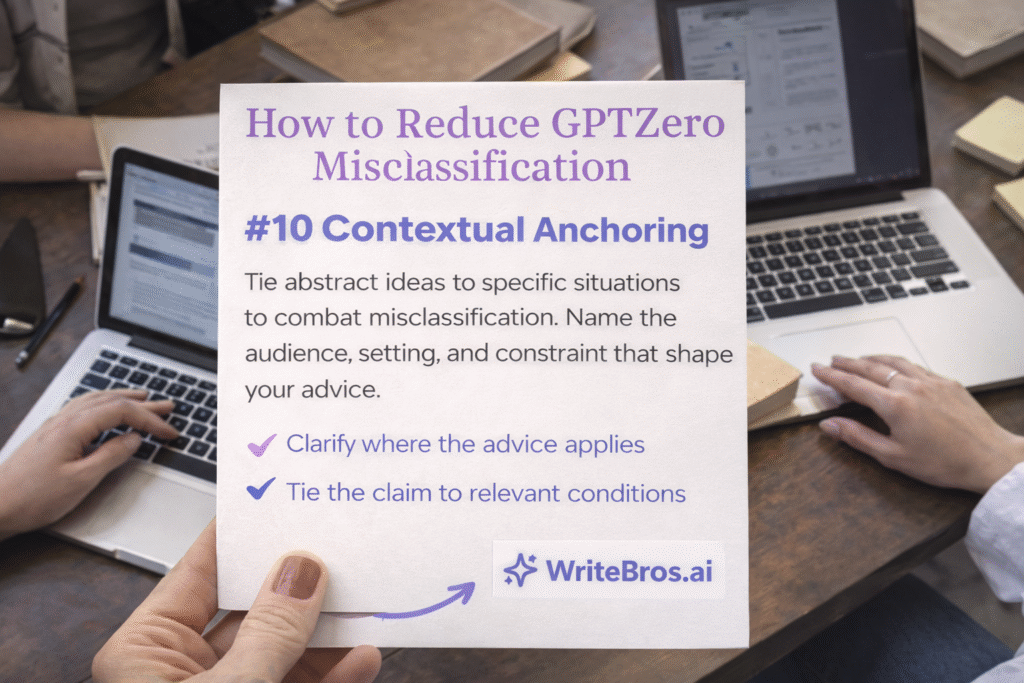
How to Reduce GPTZero Misclassification – Strategy #10: Contextual anchoring
To further reduce GPTZero misclassification, anchor abstract claims within clear contextual frames that demonstrate situational awareness. Broad statements that lack grounding can resemble generalized model outputs, especially when they echo common explanatory patterns found across large datasets. Providing contextual anchors, such as specifying audience, setting, or constraint, differentiates your draft from pattern-driven summaries.
In practical terms, this might involve clarifying whether your advice applies to academic essays, marketing copy, or technical documentation, thereby narrowing scope. These contextual signals reflect human decision-making because they reveal boundaries and intended application. The limitation to manage is avoiding unnecessary specificity that distracts from the core argument or overwhelms the reader with tangential detail.
How to Reduce GPTZero Misclassification – Strategy #11: Draft layering method
A structured way to reduce GPTZero misclassification is to revise your draft in deliberate layers, rather than attempting to perfect everything in a single editing pass. Detection-related issues often emerge from cumulative patterns that become visible only after flow, tone, and structure are reviewed separately. By isolating each dimension during revision, you gain clearer insight into where uniformity or abstraction may be creeping into the text.
In real workflows, this could mean first reviewing sentence variety, then examining voice consistency, and finally assessing contextual specificity, ensuring each layer receives focused attention. This segmented process mirrors professional editorial practice, where complexity is managed through staged refinement. The caution is time management, since layered editing requires discipline and may feel slower than rapid, surface-level adjustments.
How to Reduce GPTZero Misclassification – Strategy #12: Comparative testing
Comparative testing is another practical method to reduce GPTZero misclassification, particularly when detection results appear inconsistent across platforms. Running your draft through multiple evaluators can reveal whether flagged patterns are isolated to one system or reflect broader structural uniformity. This comparative insight helps you distinguish between platform-specific sensitivity and genuine stylistic issues within your text.
For example, if one detector flags high AI probability while others show moderate or low scores, you may focus revisions on sentence structure rather than content depth. Observing differences across tools encourages targeted refinement instead of reactive overediting. The limitation lies in avoiding obsessive iteration, since excessive cycling through platforms can lead to diminishing returns and unnecessary changes.
How to Reduce GPTZero Misclassification – Strategy #13: Overused phrasing purge
To reduce GPTZero misclassification more effectively, conduct a deliberate purge of overused phrasing that frequently appears in AI-generated content. Common stock expressions and repetitive evaluative terms can create recognizable statistical patterns that detection models are trained to identify. Replacing these phrases with context-aware alternatives strengthens authenticity without altering meaning.
In practice, this may involve scanning your draft for recurring transitions or explanatory clichés and rewriting them in ways that align more closely with your natural speaking patterns. Such adjustments introduce subtle unpredictability while preserving clarity and coherence. The risk is overcorrection, where excessive substitution results in awkward constructions that disrupt readability.
How to Reduce GPTZero Misclassification – Strategy #14: Human insight injection
Injecting human insight is a powerful way to reduce GPTZero misclassification because it highlights evaluative reasoning rather than neutral exposition. Text that simply compiles information without visible judgment can appear algorithmic, especially when it maintains consistent analytical distance. Adding perspective, such as acknowledging trade-offs or reflecting on implications, signals intentional authorship.
For instance, you might discuss why a certain revision technique works better in academic contexts than in creative writing, demonstrating discernment shaped by experience. These layered observations reveal thought processes that go beyond surface-level summarization. The constraint to respect is maintaining balance, ensuring insight enhances analysis rather than shifting into unsupported opinion.
How to Reduce GPTZero Misclassification – Strategy #15: Final anomaly sweep
The final step to reduce GPTZero misclassification involves conducting a focused anomaly sweep that targets residual uniformity across the draft. Even after layered revisions, subtle repetition in syntax, phrasing, or paragraph structure can remain undetected without a concentrated review. This sweep requires reading the text holistically, listening for patterns that feel too evenly distributed or mechanically consistent.
In practical terms, you might read the draft aloud or review it after a brief break, allowing fresh perception to reveal lingering regularities. That distance often exposes repetitive rhythms or abstract phrasing that previously blended into the background. The caution is resisting perfectionism, since the objective is meaningful refinement rather than endless micro-adjustment.
Common mistakes
- Overediting purely to chase lower detection scores, which often leads to awkward phrasing and diluted arguments, happens because writers prioritize tool output over reader clarity, and this backfires when the final draft loses coherence and credibility.
- Relying exclusively on rewriters without structural revision occurs because surface-level paraphrasing feels efficient, yet it leaves deeper uniformity untouched and may even introduce new repetitive patterns.
- Eliminating all stylistic consistency in an attempt to appear unpredictable can damage readability, since human writing still benefits from thematic cohesion and intentional flow.
- Ignoring context and audience while focusing only on sentence-level tweaks creates imbalance, because detection models evaluate broader statistical signals beyond isolated phrasing.
- Testing drafts repeatedly without strategic changes wastes time and increases frustration, as minor wording swaps rarely address underlying structural uniformity.
- Assuming that longer text automatically appears more human can inflate drafts unnecessarily, since verbosity without specificity often resembles generalized model output.
Edge cases
Some forms of writing, such as technical documentation or policy summaries, naturally favor clarity and structural consistency, which can increase the likelihood of uniform statistical patterns. In these cases, reducing GPTZero misclassification may require subtle contextualization and voice calibration rather than dramatic stylistic change, because precision remains the primary objective.
Similarly, collaborative drafts that pass through multiple editors may display blended tonal characteristics that appear unusually balanced. Here, a brief harmonization pass that reintroduces subtle perspective and varied cadence can preserve professionalism while reducing unintended pattern signals.
Supporting tools
- Multi-detector comparison platforms that allow side-by-side analysis help identify whether flagged patterns are isolated to one system or reflect broader uniformity, enabling more strategic revisions.
- Advanced grammar and style editors that highlight repetitive structures can reveal syntactic patterns you may not consciously notice during drafting.
- Readability analyzers provide insight into sentence length distribution and structural density, supporting rhythm adjustments grounded in measurable data.
- Version comparison tools make it easier to track layered revisions, ensuring each pass improves clarity without reintroducing repetitive phrasing.
- Voice consistency checkers can surface tonal uniformity across long documents, allowing calibrated variation rather than abrupt stylistic shifts.
- WriteBros.ai supports structured rewriting and layered refinement workflows that help preserve authentic voice while minimizing statistical uniformity linked to detection flags.
Ready to Transform Your AI Content?
Try WriteBros.ai and make your AI-generated content truly human.
Conclusion
Reducing GPTZero misclassification is less about gaming detection systems and more about strengthening the natural signals of thoughtful, human composition. When rhythm, structure, specificity, and perspective align, the statistical profile of your writing reflects authentic reasoning rather than mechanical uniformity.
Perfection is neither realistic nor necessary, because every draft carries some degree of pattern and repetition. What matters most is intentional refinement, guided by clarity and context, so that your work remains credible, coherent, and unmistakably your own.
Did You Know?
If you are learning How to Reduce GPTZero Misclassification, it helps to understand that algorithms often measure consistency across the page more than they react to individual word choices, which means a fully original draft can still appear statistically uniform. When every paragraph mirrors the same structure and every sentence lands with the same balanced cadence, the writing can look machine-smoothed even if the reasoning and sources are entirely your own. That steady pattern is easy for detection models to quantify, which is why minor synonym swaps rarely create lasting change.
Edits that adjust rhythm, redistribute emphasis, and connect claims to real constraints tend to have a stronger impact because they reflect authentic decision-making during composition. Imagine explaining one idea quickly because it feels obvious, then slowing down to qualify the next with context and implications, rather than presenting both with identical depth and pacing. When your draft shows that uneven movement and visible reasoning, the statistical signals often shift toward what detectors recognize as human authorship, reducing flags without distorting your intent.
Ready to Transform Your AI Content?