How to Rewrite AI Coaching Notes for Teachers: 15 Actionable Edits

In 2026, educators increasingly refine AI-generated feedback so coaching notes sound specific, supportive, and classroom-grounded. Research from the Journal of Educational Psychology supports the impact of clear, actionable feedback on teacher development.
How to Rewrite AI Coaching Notes for Teachers: 15 Actionable Edits
AI-generated coaching notes can sound polished yet strangely impersonal, leaving teachers unsure how to apply the feedback in real classroom situations. Many educators already notice this gap between AI summaries and what professors expect from students using AI, which makes the tone and clarity of coaching notes even more important.
The problem usually starts with how AI structures feedback: broad language, repeated phrasing, and advice that feels detached from real instruction. Even with strong prompts or best AI paraphraser tools for educator writing edits, the notes still require careful rewriting to sound practical, specific, and supportive.
Learning how to rewrite AI coaching notes for teachers helps transform generic observations into feedback that teachers can actually use in planning and reflection. The strategies below focus on small editorial changes that improve clarity, tone, and context, especially in classrooms already shaped by AI humanization usage by students.
| # | Strategy focus | Practical takeaway |
|---|---|---|
| 1 | Clarify the instructional moment | Rewrite observations so the classroom situation is easy to picture and understand. |
| 2 | Replace vague praise | Turn broad compliments into specific examples tied to teaching actions. |
| 3 | Focus on observable behavior | Describe what actually happened during instruction instead of general impressions. |
| 4 | Reduce repetitive phrasing | Edit repeated wording so feedback reads naturally and stays concise. |
| 5 | Separate strengths from suggestions | Organize comments so positive practices and growth ideas are clearly distinct. |
| 6 | Connect feedback to learning goals | Show how the observation relates to lesson objectives or curriculum outcomes. |
| 7 | Add context from the lesson | Include details such as activity type or student interaction to ground the comment. |
| 8 | Rewrite overly formal language | Adjust stiff wording so the notes sound supportive and conversational. |
| 9 | Highlight actionable changes | Frame suggestions as small adjustments teachers can realistically apply. |
| 10 | Use teacher centered wording | Phrase feedback around teacher decisions rather than abstract teaching ideas. |
| 11 | Clarify student impact | Explain how the observed practice influenced student engagement or understanding. |
| 12 | Remove AI style generalities | Edit out phrases that sound generic or detached from the actual lesson. |
| 13 | Balance encouragement and guidance | Combine recognition of strong practices with clear next steps. |
| 14 | Streamline long observations | Condense wordy explanations while preserving the key teaching insight. |
| 15 | End with forward looking notes | Close feedback with ideas that support reflection and future lesson planning. |
15 Actionable Edits to Rewrite AI Coaching Notes for Teachers
How to Rewrite AI Coaching Notes for Teachers – Strategy #1: Clarify the instructional moment
AI-generated coaching notes frequently summarize a lesson in broad terms that flatten the actual teaching moment, which makes the feedback feel distant from the classroom reality the teacher experienced. Rewriting the note begins with restoring the scene by naming the activity, the timing within the lesson, and the interaction between the teacher and students. When the instructional moment becomes visible again through concrete description, the coaching note stops sounding like a generic observation and begins to resemble a meaningful reflection on real teaching practice.
Coaching feedback works best when a teacher can mentally replay the moment that triggered the observation, because reflection depends on remembering what actually happened. Instead of writing that students were engaged, the revision might describe a discussion prompt that caused multiple students to respond and build on each other’s ideas. That type of contextualized description helps teachers connect the comment to an instructional decision, which makes the note useful for future planning rather than merely sounding supportive.
How to Rewrite AI Coaching Notes for Teachers – Strategy #2: Replace vague praise
AI-generated feedback often relies on general compliments that sound encouraging yet fail to identify what the teacher actually did well, which reduces the instructional value of the comment. Rewriting the coaching note requires replacing broad praise with a description of the specific teaching move that contributed to student learning during the lesson. When the comment highlights a clear instructional choice rather than an abstract quality, the teacher can recognize the practice and repeat it intentionally.
Teachers tend to trust coaching feedback when they see the connection between the praise and the classroom action that earned it, because the recognition feels grounded in observation rather than polite language. Instead of saying the teacher demonstrated strong classroom management, the revision might explain how the teacher transitioned smoothly between activities without losing student focus. This form of praise gives teachers a concrete reference point, which strengthens professional reflection and reinforces effective instructional habits.
How to Rewrite AI Coaching Notes for Teachers – Strategy #3: Focus on observable behavior
Many AI coaching summaries interpret a lesson through evaluative language that blends observation with opinion, which can make the feedback sound distant or overly analytical. Rewriting the note begins with shifting attention toward what the observer actually saw or heard during the lesson rather than describing abstract teaching qualities. Observations that remain grounded in visible classroom behavior create a clearer picture of the instructional interaction and keep the coaching note anchored in evidence.
When the feedback centers on observable behavior, teachers can connect the comment to an identifiable moment in the lesson rather than trying to decode what the statement implies. A rewritten note might describe the teacher circulating through student groups and asking follow-up questions instead of summarizing the lesson as interactive. This style of description preserves the authenticity of the observation and allows the coaching conversation to focus on concrete instructional practice.
How to Rewrite AI Coaching Notes for Teachers – Strategy #4: Reduce repetitive phrasing
AI-generated notes often repeat similar sentence structures or vocabulary throughout a feedback summary, which subtly signals that the language was produced automatically rather than written with careful attention. Rewriting the coaching note requires identifying repeated wording and adjusting the phrasing so the feedback reads more naturally. Variation in sentence structure allows each observation to stand on its own rather than blending into a predictable pattern of commentary.
Teachers reading coaching feedback benefit from language that flows comfortably and reflects thoughtful editing, because the tone communicates respect for the teaching process. When repeated phrases disappear and the wording becomes more natural, the entire note feels more deliberate and professional. This small editorial adjustment does not change the substance of the feedback, yet it improves the clarity and credibility of the coaching message.
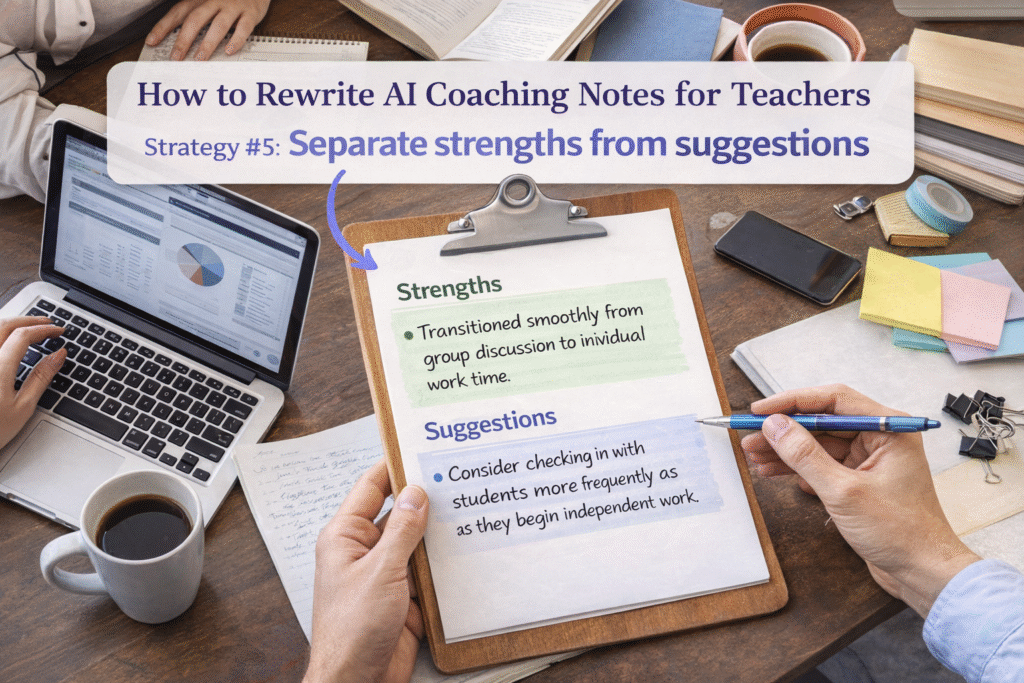
How to Rewrite AI Coaching Notes for Teachers – Strategy #5: Separate strengths from suggestions
AI feedback often blends positive observations with improvement suggestions inside the same paragraph, which can make the coaching message harder for teachers to interpret. Rewriting the note involves clearly distinguishing the practices that worked well from the areas that invite reflection or adjustment. This structural change allows teachers to recognize their strengths while also considering how their instruction could evolve.
When strengths and suggestions appear in separate sections of the coaching note, the teacher can process the feedback without feeling that positive observations are immediately undermined by critique. The distinction also mirrors how professional coaching conversations usually unfold during instructional support meetings. Clear organization therefore strengthens the note’s usefulness and reinforces a balanced tone that encourages professional growth.
How to Rewrite AI Coaching Notes for Teachers – Strategy #6: Connect feedback to learning goals
AI summaries sometimes describe classroom activity without linking it to the learning objective that guided the lesson, which leaves teachers unsure how the observation relates to instructional goals. Rewriting the coaching note requires reconnecting the feedback to the purpose of the lesson so the teacher can see the alignment between practice and outcome. When the comment explicitly references the intended learning target, the observation becomes more meaningful within the broader instructional context.
Teachers rely on coaching feedback to understand how specific teaching decisions influence student learning progress, which means the comment should always acknowledge the objective driving the activity. A rewritten note might explain how a questioning strategy supported the lesson goal rather than merely describing the discussion that occurred. This connection between practice and purpose helps teachers evaluate the effectiveness of their approach and refine future instruction.
How to Rewrite AI Coaching Notes for Teachers – Strategy #7: Add context from the lesson
AI-generated coaching notes sometimes summarize events without clarifying the surrounding conditions of the lesson, which can make the feedback feel detached from the classroom environment. Rewriting the note means restoring contextual details such as the activity structure, the group format, or the stage of the lesson in which the observation occurred. Context allows the feedback to reflect the complexity of teaching rather than presenting the moment as an isolated statement.
Teachers benefit from feedback that acknowledges the classroom circumstances shaping their instructional choices, because those circumstances often influence how students respond to activities. A rewritten observation might mention that the teacher introduced the concept during a collaborative activity or during independent work time. This added detail helps teachers interpret the feedback within the actual flow of the lesson and encourages deeper reflection on instructional timing.
How to Rewrite AI Coaching Notes for Teachers – Strategy #8: Rewrite overly formal language
AI-generated coaching feedback frequently adopts an overly formal tone that sounds analytical rather than supportive, which can distance the teacher from the meaning of the observation. Rewriting the note involves adjusting the language so it resembles a professional conversation rather than an academic report. The revised wording should remain respectful and thoughtful while still sounding approachable and grounded in teaching practice.
Teachers generally respond more positively to feedback that feels like it came from a thoughtful observer rather than a detached evaluation system. When the tone becomes more conversational, the comment encourages reflection rather than defensiveness. This editorial change helps the coaching note feel more human and strengthens the relationship between the feedback and the teacher’s professional growth.
How to Rewrite AI Coaching Notes for Teachers – Strategy #9: Highlight actionable changes
AI-generated feedback sometimes describes potential improvements without explaining what the teacher might realistically do differently during the next lesson. Rewriting the coaching note requires translating the observation into a practical instructional adjustment that the teacher can experiment with. Suggestions that focus on small changes help transform the feedback into a usable teaching strategy.
Teachers appreciate coaching notes that point toward specific next steps, because those suggestions create a clear path for professional experimentation. Instead of recommending more student participation in general terms, the rewritten note might propose inviting students to respond to a peer’s idea before offering their own. This practical framing encourages teachers to test the adjustment in a future lesson and evaluate its effect on learning.
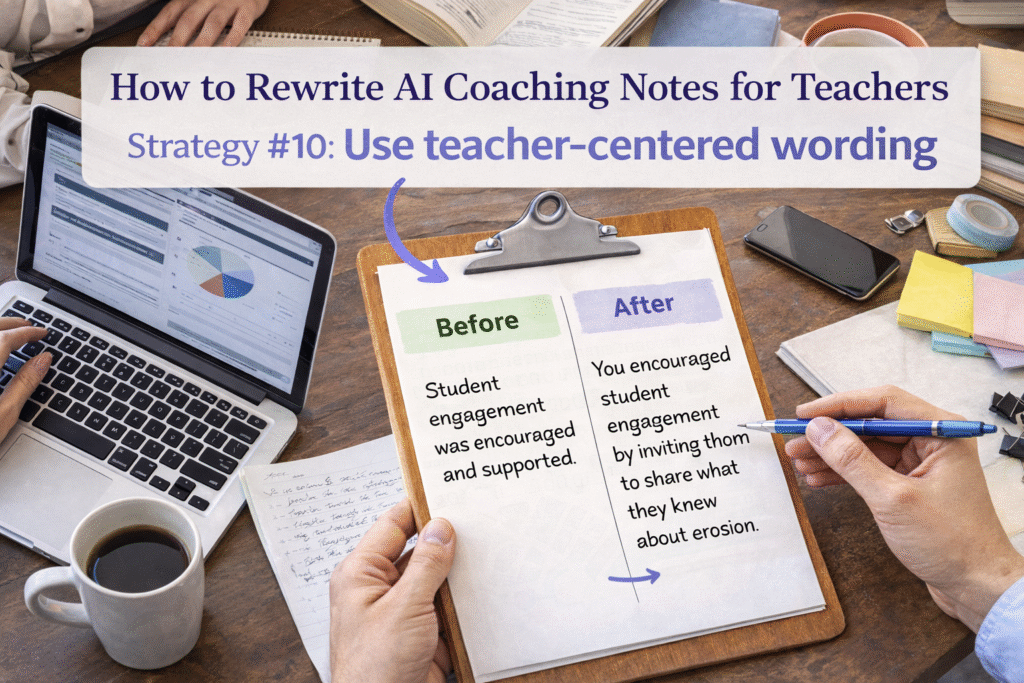
How to Rewrite AI Coaching Notes for Teachers – Strategy #10: Use teacher centered wording
AI summaries sometimes describe teaching in abstract terms that focus on instructional concepts rather than the teacher’s decisions during the lesson. Rewriting the coaching note requires shifting the language so the feedback directly references what the teacher chose to do and how students responded. This teacher-centered wording keeps the observation grounded in professional practice rather than theoretical descriptions.
When the note highlights the teacher’s instructional choices, the feedback becomes easier to interpret because it reflects the real decision-making process that shapes classroom learning. A rewritten observation might explain how the teacher introduced a guiding question before a reading activity instead of discussing questioning strategies in general. This framing reinforces the idea that effective teaching grows from deliberate choices that can be refined over time.
How to Rewrite AI Coaching Notes for Teachers – Strategy #11: Clarify student impact
AI-generated feedback sometimes describes teaching practices without explaining how students responded to those practices during the lesson. Rewriting the coaching note involves identifying the observable effects of the instructional move on student engagement, participation, or understanding. When the observation includes this connection, the feedback becomes more informative and meaningful.
Teachers want to understand how their decisions influence the learning environment, because that knowledge helps them refine their instructional approach. A rewritten note might describe how students began elaborating on each other’s answers after the teacher introduced a structured discussion prompt. Highlighting student impact helps teachers recognize which practices support deeper participation and comprehension.
How to Rewrite AI Coaching Notes for Teachers – Strategy #12: Remove AI style generalities
AI-generated text frequently relies on general statements that could apply to almost any classroom, which weakens the authenticity of the coaching note. Rewriting the feedback means identifying phrases that sound generic and replacing them with language that reflects the specific lesson observed. This adjustment makes the comment feel more credible and relevant to the teacher’s experience.
Teachers recognize generic language quickly, which can reduce trust in the coaching feedback even when the observation itself is accurate. Revisions that remove these broad statements help the note reflect careful attention to the lesson rather than automated summarization. As a result, the feedback feels more personalized and valuable.
How to Rewrite AI Coaching Notes for Teachers – Strategy #13: Balance encouragement and guidance
AI coaching summaries sometimes lean heavily toward either praise or critique, which can distort the tone of the feedback. Rewriting the note requires maintaining a balance between recognizing effective teaching practices and offering thoughtful suggestions for improvement. This balance supports reflection without diminishing the teacher’s accomplishments.
Teachers respond best to coaching notes that acknowledge the complexity of classroom work while still offering constructive insight. A balanced note might celebrate an effective discussion structure while suggesting a small adjustment that could deepen student reasoning. This blend of encouragement and guidance helps teachers view the feedback as collaborative rather than evaluative.
How to Rewrite AI Coaching Notes for Teachers – Strategy #14: Streamline long observations
AI-generated notes sometimes expand observations into lengthy explanations that obscure the main instructional insight. Rewriting the feedback means condensing the language so the key point becomes easier to identify without losing important context. A streamlined observation allows teachers to quickly grasp the message of the coaching note.
Clear and focused writing improves the usefulness of instructional feedback because teachers often review notes alongside lesson planning and reflection. When the central idea appears quickly and the explanation remains concise, the comment becomes easier to remember and apply. This editing process preserves the meaning of the observation while making the note more accessible.
How to Rewrite AI Coaching Notes for Teachers – Strategy #15: End with forward looking notes
AI-generated coaching summaries often conclude abruptly without guiding the teacher toward the next stage of reflection or instructional planning. Rewriting the final portion of the note involves framing the closing comment as an invitation to consider how the lesson insights might influence future teaching decisions. This forward-looking tone keeps the feedback connected to ongoing professional growth.
Teachers benefit from coaching notes that conclude with thoughtful direction rather than simply ending after a list of observations. A revised conclusion might encourage the teacher to experiment with a questioning technique during the next discussion-based activity. This closing perspective reinforces the idea that coaching feedback exists to support continued learning rather than finalize an evaluation.
Common mistakes
- Leaving AI-generated coaching notes almost unchanged after generation often results in feedback that sounds polished but lacks authentic classroom detail, which can make teachers feel that the observation was produced automatically rather than carefully written by a thoughtful instructional coach.
- Using vague praise such as describing a lesson as effective or engaging without explaining the specific teaching action that produced the outcome reduces the usefulness of the feedback because teachers cannot easily connect the compliment to a practice they should continue using.
- Combining praise and critique within the same sentence or paragraph frequently confuses the intended message, because teachers may struggle to determine whether the observation celebrates a strength or highlights an opportunity for improvement.
- Allowing repeated sentence patterns and predictable phrasing to remain in the feedback creates a mechanical tone that weakens the credibility of the coaching note and signals that the comment may have been generated automatically rather than thoughtfully revised.
- Describing teaching practices using abstract educational language instead of referencing the teacher’s specific actions often distances the feedback from the actual lesson, which makes the note harder for teachers to interpret and apply during planning.
- Failing to explain how an instructional decision influenced student participation or understanding can leave the feedback feeling incomplete, because teachers benefit from seeing how their actions affected the classroom learning experience.
Edge cases
Some coaching notes generated through AI systems may already contain detailed classroom descriptions, which means the rewriting process should focus more on tone and clarity rather than on expanding context. In these cases the editor’s role becomes more subtle, involving adjustments to phrasing, organization, and sentence flow so the note reads naturally while preserving the original observation.
Another edge case occurs when AI coaching notes summarize multiple classroom moments within a single paragraph, which can make the feedback feel dense or confusing. Instead of rewriting every sentence individually, the editor may need to restructure the entire passage so each instructional moment receives its own clear explanation and reflection.
Supporting tools
- Grammar editing platforms help reviewers refine sentence flow, remove repetitive phrasing, and adjust tone so coaching notes read more naturally while preserving the meaning of the observation and maintaining a professional educational voice.
- AI-assisted paraphrasing tools allow editors to reshape overly formal or generic wording while still retaining the core message of the coaching note, which can be especially helpful when the original text contains repetitive structures.
- Collaborative document platforms enable instructional coaches and teachers to review feedback together, allowing comments and revisions to appear in context so both participants understand how the note reflects the lesson.
- Lesson observation frameworks provide structured language for describing teaching practice, which helps editors rewrite AI feedback using terminology that aligns with professional instructional standards.
- Classroom reflection templates help teachers connect rewritten coaching notes with future lesson planning, making it easier to translate feedback into specific instructional adjustments.
- WriteBros.ai provides structured rewriting support that helps educators reshape AI-generated text so it sounds more natural, clearer in tone, and more closely aligned with authentic classroom communication.
Ready to Transform Your AI Content?
Try WriteBros.ai and make your AI-generated content truly human.
Conclusion
Rewriting AI coaching notes for teachers is not about replacing technology with manual writing, but about ensuring that the feedback reflects the real complexity of classroom instruction. Thoughtful editing reconnects AI-generated summaries with the specific teaching moments that make professional reflection meaningful and productive.
When instructional feedback becomes clearer, more contextual, and more grounded in observable practice, teachers gain a stronger foundation for refining their lessons and supporting student learning. The goal is not perfect wording but thoughtful communication that respects the reality of teaching and the value of reflective coaching.
Did You Know?
AI coaching summaries often sound structured because language models are good at organizing observations into clear paragraphs and professional wording. Even when the feedback looks polished, it can still miss the specific classroom details that help teachers understand exactly what worked and what could improve.
Editing for context, specificity, and natural instructional language can quickly turn those summaries into useful coaching notes. Small revisions often make the feedback feel more authentic, easier to interpret, and far more connected to real classroom practice.
Ready to Transform Your AI Content?