How to Rewrite AI Text to Avoid Copyleaks: 15 Editorial Techniques

In 2026, AI detection hinges on structural signals more than word choice. Learning How to Rewrite AI Text to Avoid Copyleaks means adjusting rhythm, syntax, and nuance, supported by findings from research published in Science Advances on detecting AI-generated text showing pattern-based classification accuracy.
How to Rewrite AI Text to Avoid Copyleaks: 15 Editorial Techniques
If you are trying to publish or submit AI-assisted content, detection flags can create unexpected friction. Many writers searching for AI humanizer vs AI rewriter vs paraphraser comparisons quickly realize that surface-level rewrites rarely solve the problem.
Detection tools tend to respond to structural uniformity, predictable phrasing, and compressed logic rather than obvious robotic wording. Even when using the best AI writing refinement tools for polished output, unchanged sentence rhythm and framing can still trigger classification thresholds.
This guide breaks down practical editorial adjustments that reduce recognizable AI patterns without distorting meaning. Drawing from recent findings in a Copyleaks AI accuracy comparison, you will see how small structural shifts compound into measurable detection differences.
| # | Strategy focus | Practical takeaway |
|---|---|---|
| 1 | Sentence rhythm variation | Break predictable pacing patterns that automated drafts tend to repeat. |
| 2 | Structural depth | Reorganize logic flow instead of swapping isolated words. |
| 3 | Context layering | Add grounded examples that introduce natural complexity. |
| 4 | Clause restructuring | Shift clause order to reduce uniform phrasing patterns. |
| 5 | Specificity upgrades | Replace broad abstractions with concrete detail. |
| 6 | Paragraph compression control | Expand or condense sections to avoid uniform density. |
| 7 | Voice modulation | Blend declarative and reflective tones for realism. |
| 8 | Transition unpredictability | Avoid formulaic connectors repeated across sections. |
| 9 | Logic re-sequencing | Reorder arguments to introduce natural progression. |
| 10 | Lexical contrast | Mix concise and nuanced phrasing intentionally. |
| 11 | Embedded nuance | Introduce subtle qualifications to avoid overconfidence patterns. |
| 12 | Data grounding | Anchor claims in observable context to reduce generic tone. |
| 13 | Redundancy pruning | Remove mirrored phrasing that signals pattern repetition. |
| 14 | Perspective adjustment | Alternate framing angles to reduce linear uniformity. |
| 15 | Editorial friction points | Add subtle complexity that mirrors human drafting habits. |
15 Editorial Techniques to How to Rewrite AI Text to Avoid Copyleaks
How to Rewrite AI Text to Avoid Copyleaks – Strategy #1: Sentence rhythm variation
When applying How to Rewrite AI Text to Avoid Copyleaks, begin by deliberately adjusting sentence rhythm so that the draft no longer follows the predictable rise and fall common in machine-generated prose. AI systems tend to produce evenly sized sentences with consistent cadence, which creates a subtle but measurable pattern that detection models can flag when evaluated across an entire document. Breaking that rhythm requires blending longer explanatory constructions with shorter reflective pauses, while also inserting occasional dependent clauses that alter the pacing in a way that feels naturally composed.
This technique works because detection models often assess statistical regularity, and varied rhythm introduces organic inconsistency that mirrors how people actually draft and revise in stages. For example, an evenly structured paragraph describing a workflow can be reworked by expanding one explanation into a layered clarification, then tightening the next sentence into a concise observation that redirects the reader’s focus. The key constraint is to avoid artificial randomness, since rhythm should still feel purposeful rather than chaotic, preserving clarity while reducing uniform pacing signals.
How to Rewrite AI Text to Avoid Copyleaks – Strategy #2: Structural depth
A core element of How to Rewrite AI Text to Avoid Copyleaks is moving beyond surface synonym swaps and instead rethinking the underlying structure of the argument. Many AI drafts present ideas in linear progression without embedding subpoints, counterpoints, or contextual framing, which can make the logic appear compressed and overly tidy. Increasing structural depth means expanding certain sections with layered reasoning, inserting clarifications that reposition the main claim, and occasionally reframing conclusions so they emerge through development rather than immediate declaration.
This approach reduces detection exposure because layered structure disrupts formulaic sequencing that models are trained to recognize in high-volume automated content. Consider a paragraph that lists three benefits in rapid succession, which can be reworked by isolating one benefit, unpacking it with situational context, and then linking it back to the broader theme before introducing the next idea. Care should be taken to maintain coherence, since added depth must enhance clarity rather than obscure the original intent or inflate the word count without purpose.
How to Rewrite AI Text to Avoid Copyleaks – Strategy #3: Context layering
Another important step in How to Rewrite AI Text to Avoid Copyleaks involves embedding contextual layers that ground abstract statements in realistic scenarios. AI-generated passages often present conclusions in generalized language that lacks situational texture, which contributes to a tone that feels detached from lived experience. Introducing contextual markers, such as describing a specific editorial workflow or a realistic publication setting, adds dimensionality that shifts the statistical profile of the text.
This technique works because context increases informational variability, making the passage less likely to align with generic template patterns. For instance, instead of stating that detection scores can change after revision, you might describe an editor adjusting clause order during a compliance review and noticing measurable scoring differences across drafts. The caveat is that context should remain plausible and relevant, ensuring that examples illuminate the point rather than distract from the main argument.
How to Rewrite AI Text to Avoid Copyleaks – Strategy #4: Clause restructuring
Clause restructuring plays a meaningful role in How to Rewrite AI Text to Avoid Copyleaks because automated drafts often rely on straightforward subject-verb-object constructions. Detection systems can detect this consistency across multiple paragraphs, especially when transitional phrasing follows predictable formulas. Reordering clauses, introducing subordinate phrases, and repositioning qualifiers within sentences can subtly transform the syntactic fingerprint of the text.
For example, a direct sentence stating that revisions reduce detection risk can be rewritten so that the conditional context appears first, followed by the outcome framed as a result rather than a standalone claim. This inversion changes the grammatical emphasis and reduces repetition of uniform structures that appear across AI outputs. Writers should ensure that clarity is not sacrificed, since overly complex restructuring can confuse readers even if it reduces structural predictability.
How to Rewrite AI Text to Avoid Copyleaks – Strategy #5: Specificity upgrades
Specificity upgrades are central to How to Rewrite AI Text to Avoid Copyleaks because generalized phrasing is a common trait in automated content. Broad terms such as improved results or enhanced clarity create vague semantic clusters that appear frequently in machine-generated drafts. Replacing these abstractions with detailed descriptions, measurable conditions, or situational qualifiers increases lexical richness and shifts the distribution of terms.
In practice, this might involve describing how an editorial team reviewed three versions of a draft and observed different probability bands instead of simply claiming that revisions improved performance. Such detail introduces distinctive vocabulary and narrative texture that reduces overlap with common generative patterns. The important limitation is to avoid fabricating data, ensuring that specificity reflects realistic scenarios rather than invented metrics that could undermine credibility.

How to Rewrite AI Text to Avoid Copyleaks – Strategy #6: Paragraph compression control
Paragraph compression control is a subtle but powerful component of How to Rewrite AI Text to Avoid Copyleaks because AI drafts frequently produce sections with uniform density. When each paragraph contains a similar number of sentences and a comparable informational load, the document develops a pattern that can be statistically analyzed. Adjusting compression by expanding certain sections with layered explanation and tightening others into focused summaries disrupts that uniform density.
This recalibration mirrors natural drafting behavior, where some ideas require extended unpacking while others function as transitional bridges. For example, a detailed methodological explanation might be broadened with clarifying conditions, while a supporting observation is condensed into a streamlined synthesis that moves the narrative forward. Writers should maintain balance so that variation appears intentional rather than erratic, preserving logical flow while introducing structural diversity.
How to Rewrite AI Text to Avoid Copyleaks – Strategy #7: Voice modulation
Voice modulation strengthens How to Rewrite AI Text to Avoid Copyleaks because AI-generated prose often maintains a consistently neutral, declarative tone. Human writing, in contrast, naturally alternates between explanation, reflection, and subtle qualification depending on context. Modulating voice by blending confident assertions with cautious framing and occasional interpretive commentary introduces tonal range that reduces uniformity.
This tonal layering changes how sentences are constructed, influencing verb choice, modality, and emphasis across the passage. For instance, a direct claim may be reframed to acknowledge situational variability before reaffirming its relevance, which creates a rhythm of assertion and reconsideration. Care must be taken to avoid excessive hedging, since overly tentative phrasing can dilute the authority of the piece even as it diversifies tone.
How to Rewrite AI Text to Avoid Copyleaks – Strategy #8: Transition unpredictability
Transition unpredictability contributes meaningfully to How to Rewrite AI Text to Avoid Copyleaks because automated drafts frequently rely on repeated connectors that guide readers through linear reasoning. Phrases that consistently signal addition, contrast, or conclusion in identical ways can form detectable sequences across multiple paragraphs. Varying transitions by integrating contextual cues or thematic pivots reduces reliance on formulaic connectors.
Instead of consistently introducing new sections with predictable markers, you might allow the previous sentence’s implication to naturally evolve into the next idea, creating continuity without explicit signaling. This subtle shift alters the connective fabric of the document and decreases repetition of standard bridging phrases. The limitation is that coherence must remain intact, so transitions should feel smooth even when they are less overtly labeled.
How to Rewrite AI Text to Avoid Copyleaks – Strategy #9: Logic re-sequencing
Logic re-sequencing is integral to How to Rewrite AI Text to Avoid Copyleaks because AI systems often arrange points in orderly lists that move from premise to conclusion with minimal deviation. While clarity is valuable, overly linear sequencing can generate recognizable structural patterns across documents. Rearranging arguments so that evidence occasionally precedes explanation, or implications are explored before the main thesis is restated, introduces narrative variation.
This rearrangement mirrors the way human drafts evolve, where writers sometimes present an example before clarifying the broader significance. For example, you might begin with a practical editorial scenario and then abstract the general principle that the scenario illustrates, reversing the expected order. Writers should ensure that readers can still follow the progression, since clarity remains essential even when structure becomes less predictable.
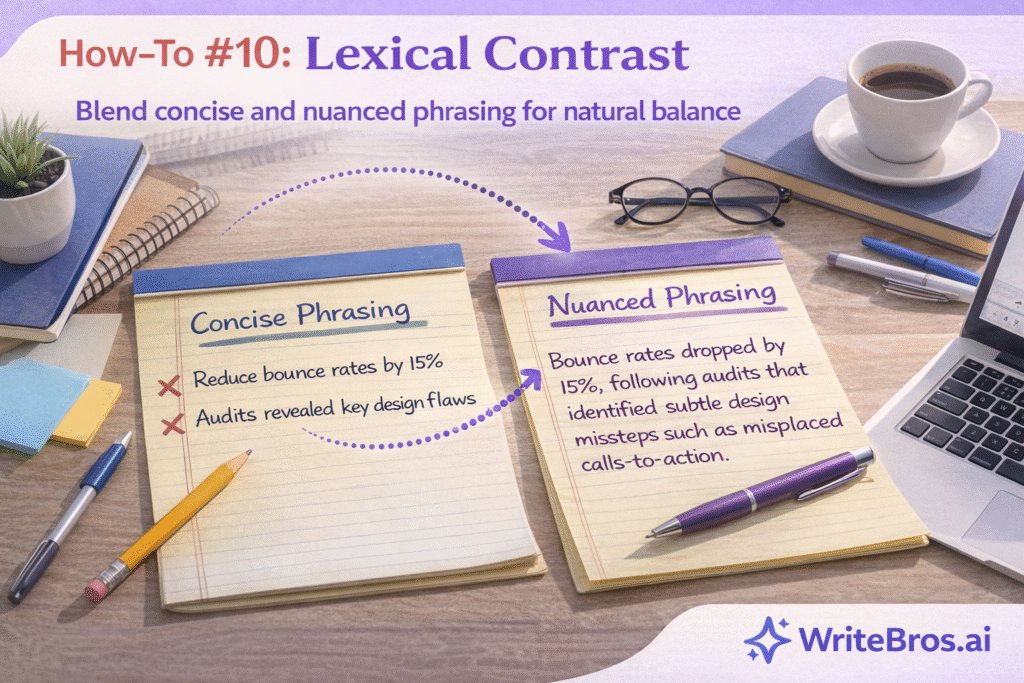
How to Rewrite AI Text to Avoid Copyleaks – Strategy #10: Lexical contrast
Lexical contrast supports How to Rewrite AI Text to Avoid Copyleaks by intentionally blending concise phrasing with more nuanced elaboration. AI drafts frequently maintain a consistent level of vocabulary complexity, which contributes to homogeneity across the text. Alternating between straightforward expressions and more layered terminology diversifies lexical distribution without distorting meaning.
For instance, a simple explanation might be followed by a more technically framed clarification that reframes the same concept from a different angle. This contrast alters word frequency patterns and introduces stylistic variety that aligns more closely with human revision habits. The constraint is to maintain accessibility, ensuring that increased nuance enhances understanding rather than creating unnecessary opacity.
How to Rewrite AI Text to Avoid Copyleaks – Strategy #11: Embedded nuance
Embedded nuance enhances How to Rewrite AI Text to Avoid Copyleaks because AI-generated statements often appear absolute and unqualified. Detection systems may identify clusters of confident, generalized claims that lack contextual limitation or interpretive framing. Introducing subtle qualifiers, such as conditional scenarios or scope clarifications, softens that absolutism and changes the tonal signature of the draft.
For example, rather than asserting that a specific revision will always reduce detection exposure, you might explain that results depend on structural diversity and content domain. This shift adds interpretive depth and reflects the uncertainty inherent in real editorial practice. Writers should avoid excessive disclaimers, maintaining authority while incorporating realistic nuance that mirrors human reasoning.
How to Rewrite AI Text to Avoid Copyleaks – Strategy #12: Data grounding
Data grounding is an effective method within How to Rewrite AI Text to Avoid Copyleaks because AI drafts often rely on generalized claims without observable anchors. Grounding assertions in described evaluations, documented comparisons, or referenced testing conditions adds specificity that reshapes the informational profile of the text. This approach introduces varied terminology and contextual markers that reduce generic clustering.
For instance, referencing a comparative accuracy review and describing how editorial adjustments influenced probability scores introduces concrete framing. The narrative becomes anchored in a plausible analytical setting rather than floating as abstract advice. Care should be taken to maintain factual integrity, ensuring that any referenced data aligns with verifiable findings rather than speculative extrapolation.
How to Rewrite AI Text to Avoid Copyleaks – Strategy #13: Redundancy pruning
Redundancy pruning is essential in How to Rewrite AI Text to Avoid Copyleaks because automated drafts frequently restate ideas in slightly altered forms. This repetition can create mirrored phrasing patterns that detection systems analyze across longer documents. Removing duplicated logic and consolidating overlapping explanations streamlines the text while altering its statistical footprint.
In practice, two similar sentences describing detection variability can be merged into a single layered explanation that captures both points without repetition. This consolidation reduces repetitive structures and enhances clarity at the same time. Writers should review entire sections holistically, since redundancy often becomes visible only when paragraphs are evaluated together rather than in isolation.
How to Rewrite AI Text to Avoid Copyleaks – Strategy #14: Perspective adjustment
Perspective adjustment contributes to How to Rewrite AI Text to Avoid Copyleaks because AI-generated passages often maintain a stable observational stance. Human writing tends to alternate between analytical distance and situational framing, occasionally shifting emphasis to illustrate practical implications. Adjusting perspective, such as moving from abstract commentary to described editorial scenarios, diversifies narrative framing.
This shift changes pronoun usage, verb focus, and descriptive detail, which in turn alters the syntactic and semantic patterns across the document. For example, a general explanation can be reframed through the lens of a reviewing editor evaluating compliance risk, then expanded back into broader analysis. Writers should ensure these adjustments remain coherent, preserving a unified voice even as perspective evolves.
How to Rewrite AI Text to Avoid Copyleaks – Strategy #15: Editorial friction points
Editorial friction points represent a final refinement in How to Rewrite AI Text to Avoid Copyleaks because overly smooth prose can signal automated generation. Human drafts often contain moments of reconsideration, clarification, or incremental elaboration that subtly interrupt linear flow. Introducing thoughtful expansions or reflective pauses adds texture that reduces mechanical uniformity.
For instance, after presenting a streamlined explanation, you might briefly interrogate an assumption or clarify a boundary condition before proceeding. This controlled friction mirrors real revision cycles, where writers refine ideas mid-paragraph rather than delivering perfectly sequenced logic from the outset. The objective is not to complicate unnecessarily, but to incorporate measured complexity that reflects authentic drafting behavior.
Common mistakes
- Relying exclusively on synonym replacement without altering structure often leaves the original syntactic patterns intact, which means detection systems can still recognize consistent clause ordering and rhythm across the document.
- Keeping every paragraph the same length and density creates statistical uniformity that models can detect, even if vocabulary has been partially diversified through surface edits.
- Overcompensating with random complexity may introduce awkward phrasing that disrupts readability, which undermines credibility while failing to meaningfully change structural signatures.
- Ignoring transitional repetition leads to recurring connectors that form recognizable sequences across multiple sections, increasing pattern visibility.
- Maintaining an overly absolute tone without nuance can create clusters of confident generalizations that align with common AI output characteristics.
- Adding fabricated specificity to appear more human introduces factual risk and ethical concerns, which can outweigh any potential reduction in detection exposure.
Edge cases
Certain domains, such as technical documentation or academic summaries, naturally require consistent structure and terminology, which can limit the degree of variation that is appropriate. In these cases, the goal is not dramatic stylistic diversification but subtle adjustments that maintain disciplinary conventions while introducing measured syntactic variation.
Similarly, short-form content provides limited space for structural experimentation, meaning writers must rely more heavily on lexical contrast and clause restructuring rather than extensive context layering. The guiding principle remains balance, ensuring that necessary consistency for clarity does not translate into mechanical uniformity.
Supporting tools
- Editorial grammar analyzers that highlight sentence length distribution can help identify uniform rhythm patterns across drafts and guide targeted variation.
- Readability assessment platforms provide insight into density and complexity trends, allowing writers to recalibrate paragraph compression thoughtfully.
- Version comparison software enables side-by-side structural analysis, revealing repetitive phrasing clusters that may not be obvious during isolated review.
- Workflow documentation tools help track iterative revisions, encouraging layered development rather than single-pass rewriting.
- Research databases support data grounding strategies by offering credible references that anchor abstract claims in verifiable context.
- WriteBros.ai assists in structured refinement workflows, enabling controlled diversification of syntax and tone while preserving original meaning.
Ready to Transform Your AI Content?
Try WriteBros.ai and make your AI-generated content truly human.
Conclusion
Understanding How to Rewrite AI Text to Avoid Copyleaks requires recognizing that detection systems analyze structural and statistical signals rather than isolated words. Meaningful reduction in exposure comes from layered editorial adjustments that reshape rhythm, depth, tone, and sequencing in coordinated ways.
Writers who approach revision as intentional development rather than cosmetic substitution create drafts that reflect authentic reasoning patterns. The objective is not perfection, but deliberate craftsmanship that aligns clarity with structural diversity.
Did You Know?
If you are applying How to Rewrite AI Text to Avoid Copyleaks, start with structural recalibration instead of synonym swaps, since evenly sized paragraphs and mirrored sentence scaffolds can preserve a consistent detection profile even when the draft looks different at a glance.
Let some explanations expand with layered clarification while others tighten for emphasis, adjust clause order so the grammar pattern shifts across sections, and vary transitions so the flow feels less uniform, because organic imbalance is more typical of real drafting than perfectly even structure.
Ready to Transform Your AI Content?