How to Rewrite Content Flagged by GPTZero: 15 Revision Strategies

Content flagged by GPTZero can often be revised through structural and tonal adjustments that reflect authentic authorship patterns. Research published in Science on distinguishing human and AI-generated text highlights how predictable phrasing increases detectability, reinforcing why strategic rewriting improves outcomes.
How to Rewrite Content Flagged by GPTZero: 15 Revision Strategies
Few things feel more frustrating than finishing a draft, feeling confident in your work, and then seeing it flagged as AI-generated. If you’ve ever faced a situation similar to Turnitin says your essay is AI, you know how quickly doubt and urgency can set in.
Most flags happen because the structure sounds too uniform, the phrasing feels overly polished, or the rhythm lacks human variation. That’s why so many writers turn to the most effective AI humanizer tools used after GPTZero flags, even though rewriting strategically is what truly changes the outcome.
The real issue isn’t whether you used AI, but how the text reads under detection patterns that look for predictability and repetition. Understanding Turnitin AI detection limitations helps you see why thoughtful revisions, not panic edits, are the smartest way forward.
| # | Strategy focus | Practical takeaway |
|---|---|---|
| 1 | Sentence rhythm control | Vary length and pacing so your draft feels naturally written instead of mechanically structured. |
| 2 | Structural reshaping | Reorganize sections to reflect real thought progression rather than template flow. |
| 3 | Specific detail layering | Add concrete examples and situational nuance that generic drafts usually lack. |
| 4 | Voice recalibration | Adjust tone to sound like a person with context, not a neutral content engine. |
| 5 | Transitional rewriting | Replace predictable connectors with more organic shifts in reasoning. |
| 6 | Idea compression and expansion | Shorten overly neat explanations and expand thin sections for balance. |
| 7 | Paragraph pattern variation | Break repetitive paragraph shapes to avoid uniform analytical blocks. |
| 8 | Evidence integration tweaks | Blend references and reasoning more fluidly so support feels earned. |
| 9 | Language simplification | Swap overly polished phrasing for clearer, more natural wording. |
| 10 | Intent clarification | State purpose and perspective directly to reduce generic tone. |
| 11 | Redundancy trimming | Remove repetitive framing that can trigger pattern detection. |
| 12 | Context anchoring | Ground abstract claims in realistic scenarios or lived context. |
| 13 | Opening and closing refresh | Rewrite introductions and conclusions to avoid formulaic symmetry. |
| 14 | Manual line editing | Review sentence by sentence to remove subtle repetition patterns. |
| 15 | Final coherence pass | Ensure revisions feel intentional and unified rather than patched together. |
15 Practical Strategies to Rewrite Content Flagged by GPTZero
How to Rewrite Content Flagged by GPTZero – Strategy #1: Sentence rhythm control
When you begin to rewrite content flagged by GPTZero, start by examining the rhythm of your sentences, because detection systems often identify writing that moves in a steady, mechanical cadence with little variation in pacing or emphasis. Instead of stacking sentences that are similar in length and structure, intentionally blend longer reflective statements with shorter clarifying ones, while allowing certain thoughts to unfold gradually through layered clauses. This creates a pattern that feels closer to natural thinking, since real writers rarely produce evenly measured lines throughout an entire draft.
The reason this works in practice is that predictable rhythm can signal automation, especially when paragraphs maintain the same structural balance from start to finish without deviation. Imagine reviewing a section where every sentence is fifteen to twenty words long and arranged in identical syntax, which quickly forms a detectable pattern even if the ideas are sound. When you deliberately vary pacing and restructure clauses, you introduce subtle irregularities that reflect authentic composition rather than algorithmic output.
How to Rewrite Content Flagged by GPTZero – Strategy #2: Structural reshaping
To rewrite content flagged by GPTZero effectively, reconsider the overall structure of your draft rather than limiting yourself to surface-level word changes, because detection tools frequently recognize common AI-generated organizational patterns. Many automated drafts follow a predictable introduction, three-point expansion, and symmetrical conclusion, which may read clearly but lacks the uneven development typical of human reasoning. Reshaping sections, merging ideas, or shifting the order of arguments forces the content to reflect a more organic progression of thought.
This approach works because real writers often revise ideas as they move through a topic, returning to earlier points or allowing one section to expand unexpectedly. For example, you might combine two similar paragraphs into a single, more nuanced discussion and then separate a complex idea into its own reflective segment to create depth. Such structural changes break uniform templates and demonstrate intentional authorship rather than automated sequencing.
How to Rewrite Content Flagged by GPTZero – Strategy #3: Specific detail layering
If you want to rewrite content flagged by GPTZero in a meaningful way, add specific details that anchor abstract claims to recognizable situations, since overly generalized writing tends to trigger detection. Broad explanations that apply universally can sound polished yet detached, which makes them resemble system-generated summaries rather than lived experience. Layering in concrete examples, contextual qualifiers, and realistic constraints gives your writing texture and situational grounding.
This method succeeds because specificity introduces variability that algorithms struggle to categorize as formulaic, especially when examples include nuanced limitations or conditional reasoning. Consider expanding a claim about revision by describing how a student might adjust a thesis after feedback instead of simply stating that feedback improves clarity. That kind of grounded illustration demonstrates authentic engagement with the subject rather than detached pattern replication.
How to Rewrite Content Flagged by GPTZero – Strategy #4: Voice recalibration
Another powerful way to rewrite content flagged by GPTZero is to recalibrate the voice so that it reflects a distinct perspective rather than a neutral, universally agreeable tone. Automated drafts often default to balanced, carefully moderated language that avoids strong positioning, which can read as technically correct yet emotionally flat. Introducing a subtle stance, whether analytical, reflective, or cautiously opinionated, helps differentiate your writing from templated neutrality.
This works because human authors naturally reveal priorities, preferences, and interpretive angles even when aiming for objectivity. For instance, you might acknowledge a common misconception before clarifying your reasoning, thereby revealing an evaluative mindset rather than presenting information in a vacuum. Such tonal shifts introduce nuance and personality, which make the text feel authored rather than generated.
How to Rewrite Content Flagged by GPTZero – Strategy #5: Transitional rewriting
When you rewrite content flagged by GPTZero, examine the transitions between ideas, since automated text frequently relies on predictable connectors that repeat across paragraphs. Words like “however,” “additionally,” or “in conclusion” may appear at consistent intervals, forming a detectable sequence that feels overly orderly. Replacing these with more context-driven shifts, such as posing a reflective question or reframing the preceding idea, disrupts repetitive linkage patterns.
This strategy proves effective because authentic transitions often emerge from thought development rather than formulaic signaling. Imagine moving from one argument to the next by clarifying a limitation or acknowledging a counterpoint instead of inserting a stock connector at the beginning of a sentence. That organic movement between ideas reduces uniformity and enhances the impression of genuine intellectual flow.
How to Rewrite Content Flagged by GPTZero – Strategy #6: Idea compression and expansion
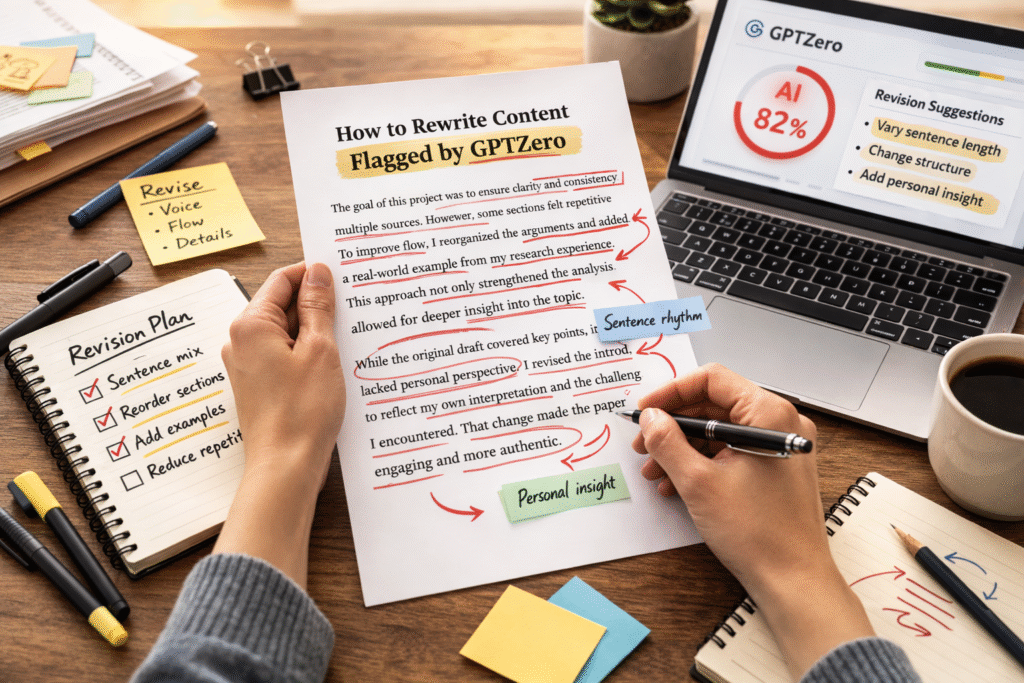
To rewrite content flagged by GPTZero with greater authenticity, evaluate whether certain explanations feel overly complete while others appear underdeveloped, as balanced uniformity can signal automated drafting. AI-generated text often distributes attention evenly across points, producing paragraphs of similar density regardless of complexity. Intentionally compress straightforward ideas and expand nuanced sections so that emphasis reflects genuine prioritization rather than symmetrical coverage.
This adjustment works because human writers naturally linger on complex arguments and move quickly through simpler clarifications, creating uneven yet purposeful pacing. For example, you might condense a basic definition into a single flowing sentence while devoting extended analysis to a controversial implication. That asymmetry mirrors authentic reasoning patterns and reduces the impression of algorithmic balance.
How to Rewrite Content Flagged by GPTZero – Strategy #7: Paragraph pattern variation
When attempting to rewrite content flagged by GPTZero, analyze whether your paragraphs follow identical internal structures, since repeated formats can form recognizable patterns. Many automated drafts open with a topic sentence, proceed with two evenly sized explanations, and conclude with a neat summarizing line, repeated throughout the document. Varying paragraph architecture by incorporating reflective asides, embedded clarifications, or uneven development disrupts that repetition.
This technique is effective because readers, and detection tools, notice consistency in structural framing across multiple sections. Imagine alternating between expansive analytical paragraphs and shorter interpretive reflections that add nuance without repeating the same blueprint. Such diversity in organization signals deliberate composition and reduces uniformity across the piece.
How to Rewrite Content Flagged by GPTZero – Strategy #8: Evidence integration tweaks
To rewrite content flagged by GPTZero in a substantive way, reconsider how evidence or references are integrated into your reasoning, since automated text often presents support in neatly packaged segments. Statements may be followed by evenly structured justifications that mirror one another in phrasing and length. Instead, weave supporting material into your analysis with varied emphasis and contextual framing so that it feels embedded rather than appended.
This approach works because authentic writers rarely present evidence in identical formats across paragraphs. For instance, one section might introduce context before citing a finding, while another might analyze implications before mentioning a source indirectly. That irregular integration creates a more natural argumentative flow and diminishes detectable symmetry.
How to Rewrite Content Flagged by GPTZero – Strategy #9: Language simplification
As you rewrite content flagged by GPTZero, identify phrases that sound overly polished or uniformly academic, because highly refined language patterns can resemble automated optimization. AI systems frequently produce grammatically flawless yet somewhat impersonal wording that lacks subtle imperfections or conversational shifts. Simplifying select phrases and introducing natural variation in diction can soften that mechanical precision.
This strategy is effective because authentic writing often contains small fluctuations in tone and phrasing that reflect human choice rather than strict optimization. Consider replacing a formally structured clause with a more direct expression that still preserves clarity but feels less engineered. Such recalibration reduces the appearance of uniform polish and strengthens the impression of personal authorship.
How to Rewrite Content Flagged by GPTZero – Strategy #10: Intent clarification
To rewrite content flagged by GPTZero with credibility, clarify the purpose behind each major section, since automated drafts sometimes present information without an explicit guiding intention. When readers cannot easily detect your perspective or objective, the writing may appear generically informative rather than purpose-driven. Stating why a point matters or what conclusion you are building toward introduces intentional direction.
This works because authentic writers rarely present information without a reason for doing so, even when the reason is subtle or analytical. For example, you might explain that a particular revision tactic reduces risk in academic settings before elaborating on its mechanics. Such purposeful framing demonstrates active reasoning rather than detached summarization.

How to Rewrite Content Flagged by GPTZero – Strategy #11: Redundancy trimming
When you rewrite content flagged by GPTZero, look carefully for subtle repetition in phrasing or idea framing, because detection systems often identify patterns that recur with slight variation. Automated drafts frequently restate similar concepts in multiple ways to ensure clarity, yet this repetition can accumulate into a recognizable pattern. Removing overlapping explanations and consolidating related points reduces that layered predictability.
This method works because authentic writing typically refines rather than reiterates ideas once they have been clearly introduced. Imagine combining two near-identical explanations into a single, more comprehensive paragraph that advances the discussion instead of circling it. That refinement streamlines the draft and disrupts repeated structural cues.
How to Rewrite Content Flagged by GPTZero – Strategy #12: Context anchoring
To rewrite content flagged by GPTZero with greater depth, anchor abstract arguments within realistic contexts that reflect how the ideas function in practice. Generic descriptions that remain detached from situational application can resemble broad training data summaries. Introducing contextual anchors, such as academic settings, workplace policies, or revision workflows, grounds the discussion in tangible reality.
This works because contextual framing demonstrates that the writer understands how concepts operate beyond theoretical explanation. For instance, describing how a flagged essay might be revised before submission to a professor introduces stakes and specificity. That practical orientation reduces abstraction and enhances perceived authenticity.
How to Rewrite Content Flagged by GPTZero – Strategy #13: Opening and closing refresh
When you rewrite content flagged by GPTZero, revisit the introduction and conclusion, as these sections often reveal the most formulaic symmetry in automated drafts. AI-generated pieces frequently mirror the opening promise in the closing summary with almost identical structure and phrasing. Refreshing these sections by reframing the core idea rather than restating it verbatim introduces organic variation.
This adjustment works because authentic writers tend to evolve their perspective slightly by the end of a discussion, reflecting growth in reasoning. Instead of repeating the same claims in different words, you might synthesize implications or highlight a tension that emerged during analysis. That evolution breaks symmetrical closure patterns and signals thoughtful authorship.
How to Rewrite Content Flagged by GPTZero – Strategy #14: Manual line editing
To rewrite content flagged by GPTZero thoroughly, conduct a manual line-by-line review rather than relying solely on automated rewriting tools, because subtle patterns often persist after superficial edits. Reading each sentence aloud or scrutinizing transitions can reveal recurring structures that were not obvious at first glance. This meticulous attention allows you to adjust phrasing, reorder clauses, and refine emphasis deliberately.
This process is effective because intentional micro-level revisions accumulate into macro-level differentiation across the entire document. Imagine identifying three consecutive sentences that begin with similar constructions and restructuring them to vary syntax and pacing. Such deliberate adjustments weaken detectable uniformity and strengthen the impression of human revision.
How to Rewrite Content Flagged by GPTZero – Strategy #15: Final coherence pass
After implementing targeted revisions, complete a final coherence pass to ensure that your effort to rewrite content flagged by GPTZero has not produced fragmented or inconsistent reasoning. Extensive editing can sometimes introduce tonal shifts or logical gaps that, while reducing detectability, compromise clarity. Reviewing the draft holistically allows you to align sections and confirm that changes serve a unified purpose.
This concluding step works because authenticity depends not only on variation but also on intentional cohesion. For example, you might adjust a transitional paragraph to reconnect two revised sections that now feel stylistically distinct. That holistic refinement ensures the document reads as a thoughtfully composed whole rather than a patchwork of edits.
Common mistakes
- Making only superficial word substitutions while keeping the same sentence structures and paragraph patterns intact, which often results in text that appears slightly altered on the surface yet still retains the same detectable rhythm and organizational symmetry underneath.
- Overusing rewriting tools without performing manual revisions, since automated paraphrasing can introduce new patterns that remain consistent across the draft and may still resemble structured output rather than independent thought.
- Adding random complexity in an attempt to sound more human, which can lead to unnecessarily convoluted sentences that reduce clarity and draw attention to awkward phrasing rather than authentic reasoning.
- Ignoring structural issues and focusing solely on vocabulary changes, even though repeated organizational templates are frequently more detectable than individual word choices.
- Repeating similar examples or explanations across multiple sections, creating redundancy that builds cumulative patterns recognizable by evaluation systems.
- Rushing revisions due to anxiety after a flag, which can produce inconsistent tone and fragmented logic that undermines the credibility of the entire document.
Edge cases
In some situations, content may be flagged despite extensive manual drafting, especially when the subject matter relies heavily on standardized academic phrasing or widely shared definitions that naturally resemble training data patterns. Highly technical writing, policy summaries, or literature reviews often contain uniform terminology and structured argumentation, which can increase the likelihood of detection regardless of authorship.
Additionally, collaborative writing environments or institutional templates may impose consistent structural formats that resemble automated organization. In these cases, thoughtful variation within allowed guidelines and explicit contextual framing can help differentiate your draft without violating required conventions or compromising clarity.
Supporting tools
- Grammar analysis software that highlights repeated sentence openings or uniform clause structures, allowing you to identify rhythmic patterns that might otherwise go unnoticed during silent reading.
- Read-aloud features in word processors, which expose unnatural pacing and repetitive phrasing by converting written text into spoken cadence for clearer rhythm assessment.
- Outline mapping tools that visually display paragraph structure, helping you detect mirrored sections or overly symmetrical organization across the document.
- Version comparison features that track changes between drafts, enabling you to evaluate whether revisions meaningfully alter structure rather than merely adjusting vocabulary.
- Peer review platforms that allow trusted readers to flag areas that sound overly generic or mechanically consistent, providing qualitative insight beyond automated scoring.
- WriteBros.ai, which supports structured revision workflows that emphasize deliberate restructuring, tonal calibration, and coherence checks rather than surface-level paraphrasing.
Ready to Transform Your AI Content?
Try WriteBros.ai and make your AI-generated content truly human.
Conclusion
Learning how to rewrite content flagged by GPTZero requires more than cosmetic edits, since meaningful revision depends on reshaping structure, recalibrating voice, and introducing authentic variation across the draft. When you approach revision as a deliberate analytical process rather than a reactive fix, you reduce predictability while strengthening clarity and coherence throughout your work.
Perfection is not the objective, because authentic writing naturally contains subtle irregularities that reflect thoughtful development rather than mechanical symmetry. By focusing on intention, structure, and contextual depth, you transform flagged text into work that reads as genuinely composed and intellectually grounded.
Did You Know?
If you are trying to rewrite content flagged by GPTZero, focusing only on vocabulary swaps can miss what the score is actually reacting to, since detection systems tend to reward drafts that show natural variation in pacing and emphasis from paragraph to paragraph. A piece can be entirely yours and still look suspicious if it keeps the same rhythm throughout, with evenly sized sentences, perfectly balanced clauses, and paragraphs that never change pace even when the topic gets more complex. That steady sameness is easy for an algorithm to quantify, even though a human reader might simply interpret it as clean writing and never consciously notice the pattern.
Revisions that add context, deepen the explanation, and let your reasoning evolve inside a paragraph tend to matter more, because real writing often includes clarifying phrases, small corrections, and a willingness to linger on a tricky idea while moving faster through a simpler one. Think of the difference between a draft that repeats three points in the same structure every time, and a draft that pauses to qualify a claim, explain why it matters to the reader, and then reconnect the point to the main argument in a slightly different voice. When the text reflects a natural drafting process rather than a perfectly smoothed output, the statistical signals often move closer to what detectors expect from human writing.
Ready to Transform Your AI Content?