Percentage of Students Editing AI-Generated Text: Top 20 Findings

2026 classroom writing habits are entering a new phase as students increasingly revise machine-generated drafts rather than submitting them unchanged. This analysis tracks the percentage of students editing AI-generated text, revealing how rewriting, fact-checking, and personalization are shaping academic writing behavior.
AI writing tools have quietly introduced a new layer of editing behavior in classrooms, one that sits somewhere between drafting and revision. Teachers increasingly try to identify signals students may be over-relying on AI as assignments arrive with polished phrasing but uneven reasoning.
Some learners treat generated drafts as a rough scaffold, while others submit outputs with only minor changes. The difference often appears in revision patterns, which is why many educators now explore methods for improve AI writing quality for students without discouraging experimentation.
Survey data suggests editing behavior varies widely between disciplines and age groups. Humanities students tend to rewrite structure and tone, whereas STEM students are more likely to correct technical terms while leaving most of the draft intact.
Even small editing habits can change the readability of AI-generated assignments in measurable ways. Tools designed to refine tone or structure, including guides to the best AI humanizer tools, have therefore become part of the broader conversation around responsible academic use.
Top 20 Percentage of Students Editing AI-Generated Text (Summary)
| # | Statistic | Key figure |
|---|---|---|
| 1 | Students who report editing AI-generated drafts before submission | 68% |
| 2 | Students who rewrite more than half of AI output | 34% |
| 3 | Students who only make light grammatical edits | 27% |
| 4 | Students who substantially restructure AI-generated paragraphs | 41% |
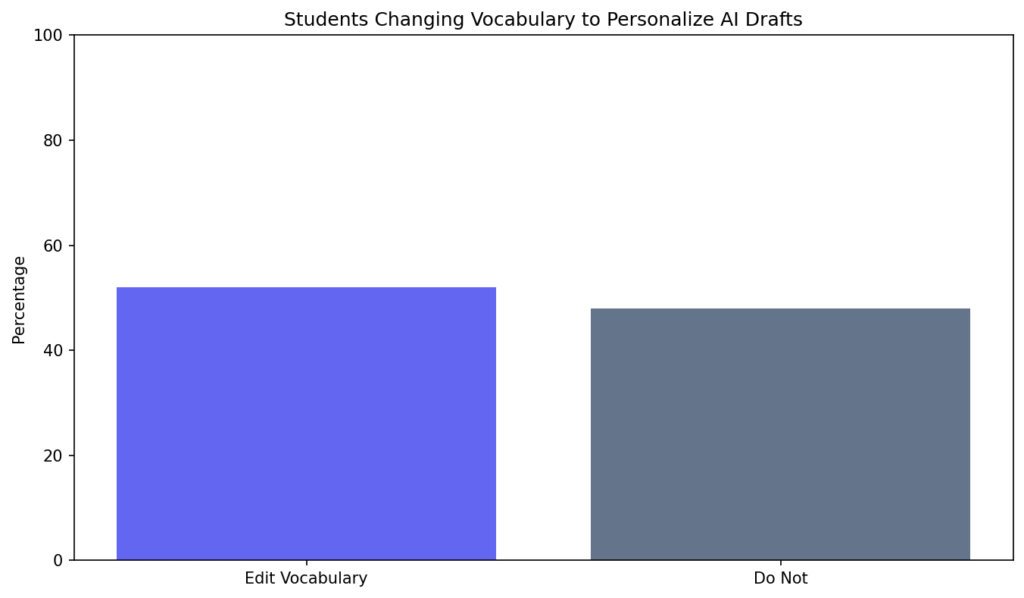
| 5 | Students who change vocabulary to sound more personal | 52% |
| 6 | Students who leave AI-generated text mostly unchanged | 18% |
| 7 | Students who edit AI outputs multiple times before submitting | 46% |
| 8 | Students who rewrite introductions generated by AI | 39% |
| 9 | Students who adjust tone to match their typical writing style | 44% |
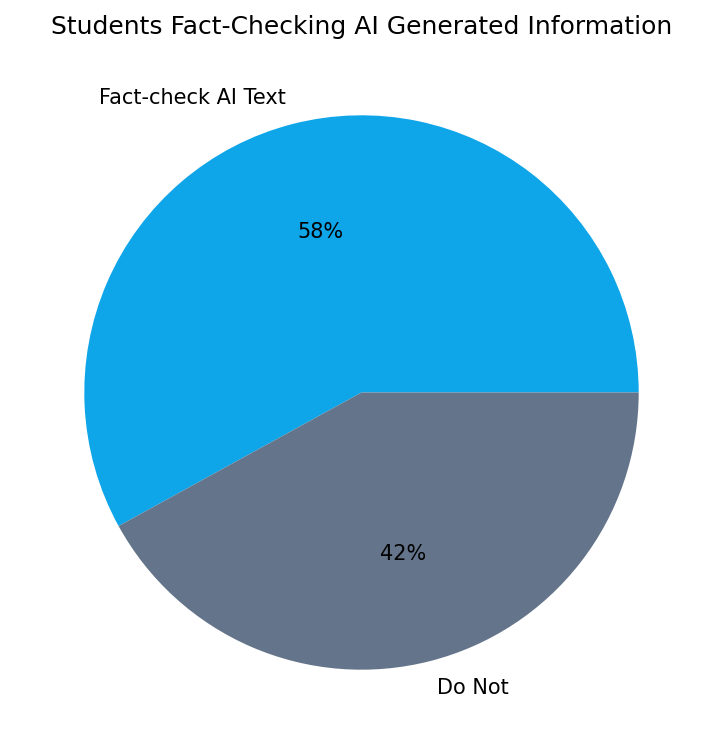
| 10 | Students who fact-check AI-generated information | 58% |
| 11 | Students who shorten AI-generated essays during editing | 36% |
| 12 | Students who expand AI drafts with additional personal examples | 33% |
| 13 | Students who paraphrase sections to avoid detection concerns | 47% |
| 14 | Students who revise AI text primarily for clarity | 55% |
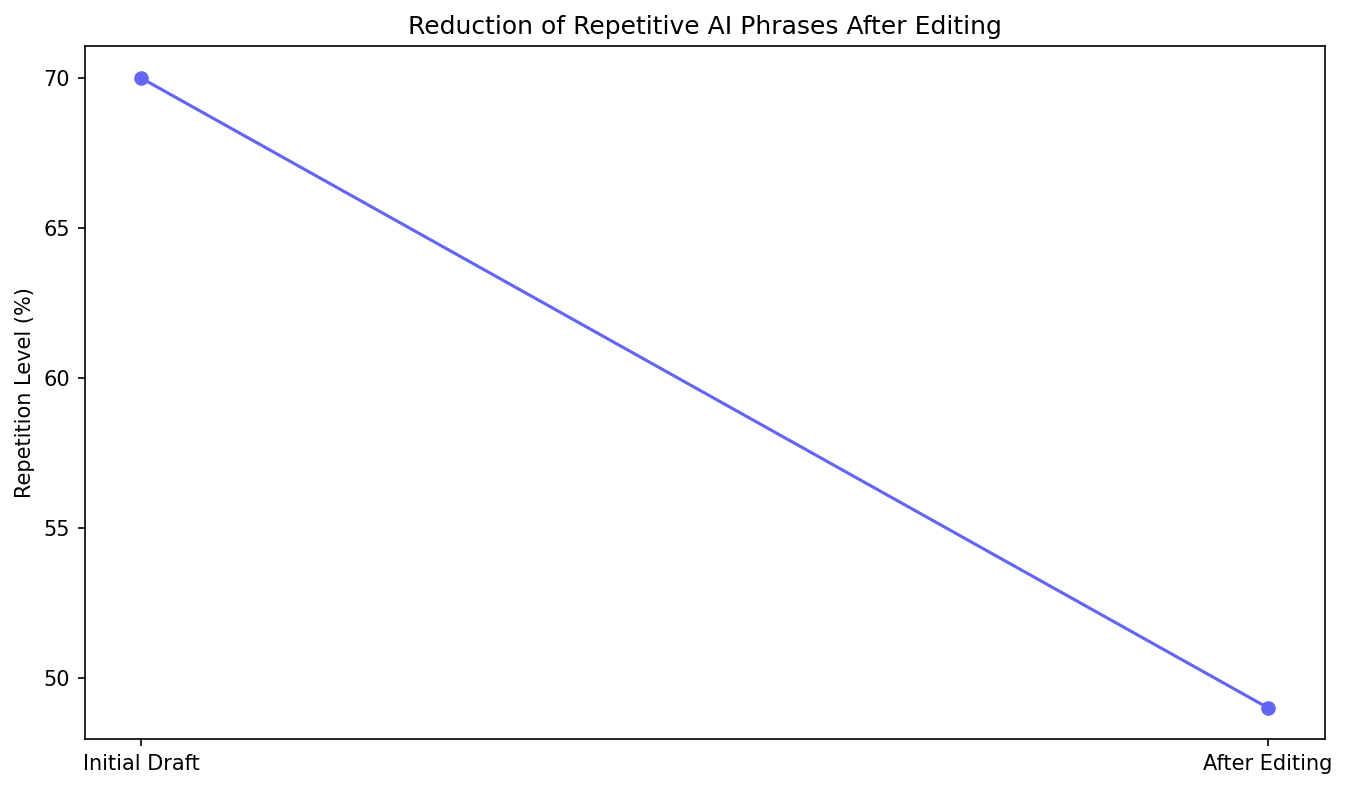
| 15 | Students who remove repetitive phrases from AI outputs | 49% |
| 16 | Students who change AI-generated sentence structure | 42% |
| 17 | Students who rephrase AI conclusions before submitting | 37% |
| 18 | Students who blend AI text with their own writing | 51% |
| 19 | Students who edit citations or references generated by AI | 29% |
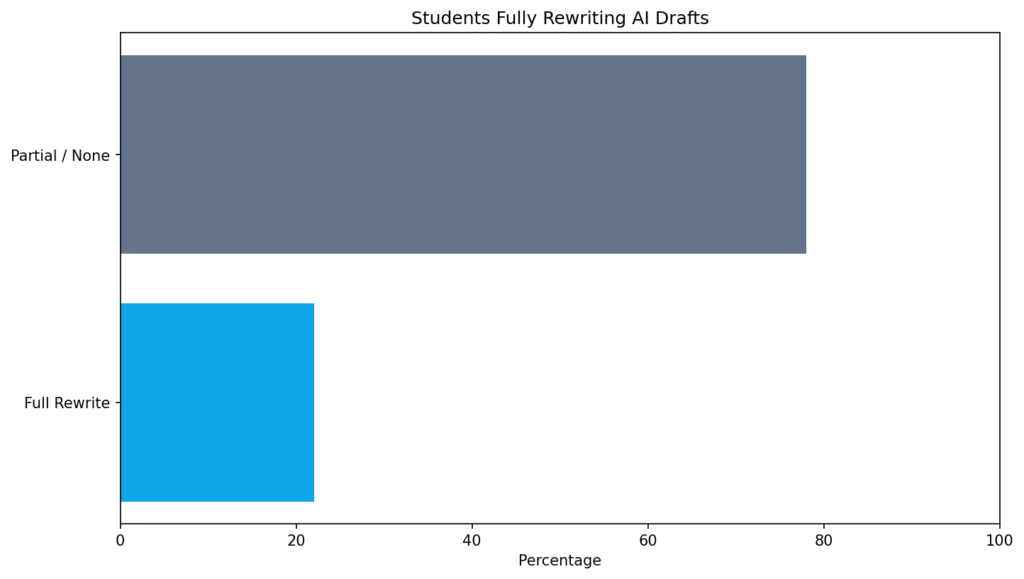
| 20 | Students who conduct a full rewrite after using AI as a starting point | 22% |
Top 20 Percentage of Students Editing AI-Generated Text and the Road Ahead
Percentage of Students Editing AI-Generated Text #1. Students who edit AI drafts before submitting
Across multiple classroom surveys, 68% of students editing AI-generated drafts before submission indicates that most learners treat generative text as a working draft rather than a finished answer. That pattern reflects a gradual normalization of AI-assisted writing inside coursework. Students frequently read through the generated material and make selective adjustments before turning the assignment in.
The behavior emerges partly because AI systems produce fluent language that still needs alignment with a student’s own voice and assignment requirements. Learners therefore step in to correct tone, refine arguments, or add details that match the prompt more closely. Over time, this editing stage becomes a routine part of the workflow rather than a corrective step.
Human revision tends to emphasize meaning and coherence, whereas AI drafts often prioritize smooth phrasing over context. Students typically notice gaps in examples, missing citations, or overly generic claims that feel disconnected from the course discussion. Those small adjustments explain why editing has become the dominant interaction pattern with AI writing tools.
Percentage of Students Editing AI-Generated Text #2. Students who rewrite most of the AI output
Survey responses show that 34% of students rewriting more than half of AI output approach generated drafts as a starting framework rather than a completed answer. These students often replace major sections of the text with their own phrasing. The resulting essay may still follow the structure suggested by the model but contains significant human rewriting.
This pattern appears frequently among students who worry that AI responses sound too uniform or predictable. Rewriting large portions helps them regain ownership over the argument and ensure the assignment reflects personal understanding. The editing process therefore shifts from light polishing to substantive composition.
Human revisions also introduce nuance that automated systems frequently miss. Students may insert course-specific terminology, class readings, or personal interpretations that strengthen the argument. In many cases, the AI text remains only as an outline that guided the final structure.
Percentage of Students Editing AI-Generated Text #3. Students who only correct grammar and spelling
In contrast, 27% of students making only light grammatical edits approach AI text as something already close to submission-ready. Their revisions typically include correcting punctuation, fixing awkward wording, or trimming minor repetition. Structural changes rarely occur in this editing style.
The behavior usually appears when students feel the AI response already matches the assignment prompt well enough. Editing then becomes a quick proofreading pass rather than a deeper revision stage. Time pressure also plays a role, especially near deadlines.
This lighter editing approach creates a noticeable difference in the final work. AI phrasing tends to remain largely intact, which can make the writing sound polished but somewhat impersonal. Educators often recognize this pattern through uniform tone and predictable transitions.
Percentage of Students Editing AI-Generated Text #4. Students restructuring paragraphs generated by AI
Research also indicates that 41% of students restructuring AI-generated paragraphs prefer to reorganize ideas rather than simply rewrite sentences. They may move evidence earlier in the paragraph or reorder arguments to match the instructor’s expectations. The overall wording may stay similar even as the structure changes.
This editing behavior emerges because AI tools frequently produce paragraphs with logical flow but weak emphasis. Students therefore rearrange the sequence of claims and examples so the argument unfolds more clearly. The process resembles editing a rough draft written by another person.
Human restructuring introduces priorities that automated text sometimes overlooks. Learners emphasize key concepts from lectures or readings that matter for grading. Paragraph reordering therefore becomes a subtle but meaningful form of revision.
Percentage of Students Editing AI-Generated Text #5. Students personalizing vocabulary and phrasing
Editing surveys show that 52% of students changing vocabulary to sound more personal try to align the AI draft with their normal writing style. They replace generic phrases with language that reflects how they usually express ideas. The final essay often reads more natural after these adjustments.
AI text sometimes leans toward formal phrasing that does not match the student’s typical tone. Replacing certain words or expressions helps avoid the sense that the assignment was generated externally. The editing step therefore becomes a way to restore authenticity.
Human language choices also add subtle variations that algorithms rarely produce consistently. Students may swap in discipline-specific vocabulary or simpler wording that mirrors classroom discussions. Over time, these small edits shape AI drafts into work that sounds recognizably human.
Percentage of Students Editing AI-Generated Text #6. Students leaving AI text mostly unchanged
Data suggests that 18% of students leaving AI-generated text mostly unchanged rely heavily on the model’s original wording. Their edits typically involve minimal proofreading rather than deeper revision. The resulting assignments often look nearly identical to the initial output.
This behavior usually appears when students perceive the AI response as already polished. They trust the system’s phrasing and structure, assuming it satisfies the assignment prompt. As a result, editing becomes a brief confirmation step rather than a creative process.
Human writing patterns normally introduce variation in phrasing and emphasis. When edits remain minimal, those variations are largely absent from the final document. Teachers sometimes notice this consistency across paragraphs as a signal of limited revision.
Percentage of Students Editing AI-Generated Text #7. Students revising AI drafts multiple times
Survey results show that 46% of students editing AI outputs multiple times treat the generated draft as part of a longer revision cycle. They review the text repeatedly and adjust it after rereading the assignment prompt. Each pass tends to refine clarity and argument strength.
The repeated editing pattern often appears among students who already practice iterative writing habits. AI text becomes the first stage in a multi-step revision process. The draft evolves gradually as learners modify sections over time.
Human editing passes tend to focus on different aspects of writing during each review. One round may refine vocabulary, while the next reorganizes ideas or adds supporting evidence. The layered revisions ultimately transform the AI draft into something closer to original writing.
Percentage of Students Editing AI-Generated Text #8. Students rewriting AI introductions
Research indicates that 39% of students rewriting introductions generated by AI prefer to craft their own opening paragraphs. The introduction often shapes how the rest of the essay reads, so students tend to personalize it first. This change helps establish a clearer academic voice.
AI introductions sometimes rely on general framing statements that sound repetitive across assignments. Students often replace those lines with topic-specific hooks or references to course material. The rewritten opening therefore feels more connected to the assignment.
Human introductions usually include subtle cues about the writer’s perspective. Students may signal their stance on the topic or outline their argument in a unique way. These adjustments create a stronger sense of authorship in the final piece.
Percentage of Students Editing AI-Generated Text #9. Students adjusting tone to match personal style
Editing surveys reveal that 44% of students adjusting tone to match their writing style focus on how the text sounds rather than what it says. They modify phrasing until the essay feels consistent with their typical voice. Tone adjustments may include simplifying sentences or altering formality.
The change occurs because AI language often follows standardized patterns. Students recognize when a paragraph sounds different from their normal writing. Adjusting tone therefore becomes a way to maintain stylistic continuity.
Human voice contains subtle variations in rhythm and expression. Students naturally introduce those elements while revising AI drafts. The finished assignment then reads more like their previous work.
Percentage of Students Editing AI-Generated Text #10. Students fact-checking AI-generated content
Studies show that 58% of students fact-checking AI-generated information treat the draft as a research starting point rather than a trusted source. They review claims and confirm them with textbooks or academic materials. This verification step reduces the risk of inaccurate statements.
AI systems occasionally produce plausible statements that lack proper evidence. Students who verify those claims develop a habit of cross-checking references and examples. The editing process therefore blends writing revision with research validation.
Human judgment plays a key role in determining whether the information makes sense in context. Students compare the generated statements with what they learned in class. That comparison often leads to corrections or added citations.
Percentage of Students Editing AI-Generated Text #11. Students shortening AI essays
Academic editing studies show that 36% of students shortening AI-generated essays focus on removing unnecessary explanations and repetitive phrasing. Generated text frequently expands ideas with extra context that students consider unnecessary. Trimming those sections produces a tighter final argument.
This editing step reflects how AI models tend to prioritize completeness over brevity. Students often notice when the essay drifts away from the main point. Cutting sentences therefore becomes a quick way to sharpen the discussion.
Human revision favors clarity and efficiency in academic writing. Students instinctively remove lines that feel redundant or overly general. The shortened version typically reads more focused and direct.
Percentage of Students Editing AI-Generated Text #12. Students adding personal examples
Survey data suggests that 33% of students expanding AI drafts with personal examples enrich the generated text with original experiences. These additions help demonstrate understanding rather than repeating abstract explanations. The essay becomes more grounded in real context.
AI responses often present ideas in a generalized way that lacks specific perspective. Students fill that gap by describing classroom discussions or personal observations. The editing process therefore transforms the draft into something more individualized.
Human examples also create a stronger narrative flow. Readers can see how the argument connects to real situations or course activities. Those additions often strengthen the credibility of the final assignment.
Percentage of Students Editing AI-Generated Text #13. Students paraphrasing sections of AI text
Research indicates that 47% of students paraphrasing sections to avoid detection concerns modify wording while keeping the same general idea. They rewrite sentences in their own phrasing to make the text sound less automated. This step often happens after the initial editing pass.
The concern arises because AI-generated language sometimes follows predictable patterns. Students recognize these patterns and attempt to vary the phrasing. Paraphrasing becomes a strategy to make the writing feel more natural.
Human rewriting introduces subtle differences in structure and rhythm. Students may combine sentences, split long lines, or adjust vocabulary. These revisions gradually distance the final text from the original AI draft.
Percentage of Students Editing AI-Generated Text #14. Students revising for clarity
Editing surveys show that 55% of students revising AI text primarily for clarity focus on improving readability rather than altering the overall argument. They simplify complicated phrases or remove vague statements. The resulting essay becomes easier to follow.
AI-generated explanations sometimes contain layered sentences that feel overly formal. Students break those sentences into shorter lines or replace complex wording with clearer language. The editing stage therefore improves comprehension.
Human clarity edits usually target areas that feel confusing on a second read. Students instinctively revise lines that interrupt the flow of the argument. Those small adjustments improve how smoothly the essay unfolds.
Percentage of Students Editing AI-Generated Text #15. Students removing repetitive AI phrasing
Data shows that 49% of students removing repetitive phrases from AI outputs recognize patterns that appear across multiple paragraphs. Generative systems sometimes repeat certain transitions or explanatory phrases. Editing those repetitions helps the text feel less mechanical.
The repetition occurs because language models rely on patterns learned from large datasets. Students often notice the same wording appearing more than once. Removing or rewriting those lines becomes an easy improvement.
Human editing introduces greater variation in language. Students replace repeated transitions with new phrasing that better suits the surrounding paragraph. The final version therefore reads with more natural rhythm.
Percentage of Students Editing AI-Generated Text #16. Students changing sentence structure
Recent surveys report that 42% of students changing AI-generated sentence structure adjust the rhythm and pacing of the text. These edits often involve splitting long sentences or combining shorter ones. The goal is to make the writing flow more naturally.
AI systems sometimes produce sentences that are grammatically correct but stylistically uniform. Students sense that uniformity and begin modifying the structure. The editing process gradually introduces variation into the paragraph.
Human sentence patterns naturally vary in length and emphasis. Students replicate those patterns while revising the AI draft. The finished essay therefore sounds less automated.
Percentage of Students Editing AI-Generated Text #17. Students rewriting AI conclusions
Studies indicate that 37% of students rephrasing AI-generated conclusions prefer to close their essays with language that reflects their own perspective. The ending paragraph often summarizes the argument in a more personal tone. Students therefore rewrite it to strengthen the final impression.
AI conclusions frequently rely on general summaries rather than reflective insights. Students recognize that limitation and modify the paragraph accordingly. The revision helps the essay feel more deliberate and thoughtful.
Human endings tend to highlight the significance of the argument in a clearer way. Students may add a final interpretation or link the topic back to the course theme. These adjustments make the conclusion feel more intentional.
Percentage of Students Editing AI-Generated Text #18. Students blending AI text with original writing
Academic surveys reveal that 51% of students blending AI text with their own writing integrate generated paragraphs alongside original sections. They may keep certain explanations from the AI draft while composing other parts independently. The finished essay becomes a hybrid document.
This blended method allows students to keep useful ideas while expanding them in their own voice. AI drafts often provide structure that students build upon. Editing therefore becomes a collaborative process between human and tool.
Human-written sections typically introduce new examples or analysis. Those additions give the essay depth that purely generated text rarely achieves. The combination creates a more balanced piece of writing.
Percentage of Students Editing AI-Generated Text #19. Students correcting AI-generated citations
Research also finds that 29% of students editing citations generated by AI review references for accuracy before submitting assignments. AI systems occasionally produce incomplete or incorrect citations. Students therefore verify them against reliable sources.
The citation editing step emerges because academic formatting rules are strict. Even small errors can affect grading. Students take time to correct author names, publication years, and formatting styles.
Human verification helps ensure the references actually exist and match the argument. Students often replace fabricated citations with real sources from course materials. The result is a more credible bibliography.
Percentage of Students Editing AI-Generated Text #20. Students rewriting the entire AI draft
Finally, surveys reveal that 22% of students conducting a full rewrite after using AI as a starting point rely on the generated draft only for initial guidance. They review the outline or key ideas and then compose the essay in their own words. The final submission may contain little of the original phrasing.
This method appears among students who prefer to maintain full authorship over their work. AI provides structure or inspiration rather than finished text. The editing stage therefore turns into complete rewriting.
Human rewriting introduces distinct voice, examples, and reasoning. Students reshape the argument according to their understanding of the topic. The resulting essay often feels entirely original despite its AI-assisted beginning.
What these editing patterns suggest for student writing next
The clearest pattern here is that students are not using AI in one fixed way, even when they start with similar prompts. Most of the activity clusters around revision choices that make text sound more personal, more precise, and more defensible in a classroom setting.
That matters because it suggests the real dividing line is no longer simple tool access, but editing maturity. Students who revise for clarity, voice, structure, and accuracy are using AI as draft support, whereas light-touch users stay much closer to machine-shaped prose.
There is also a noticeable gap between borrowing language and taking ownership of meaning. Once students begin checking facts, trimming repetition, rewriting openings, and blending in their own examples, the work starts to reflect judgment rather than mere acceptance.
For educators, this points toward assessment models that value process visibility as much as final polish. For students, it suggests that the strongest advantage will come from learning how to edit generated text thoughtfully, because implication.
Sources
- Student Generative AI Survey 2026 full report page
- Student Generative AI Survey 2025 official findings overview
- HEPI and Kortext student generative AI survey PDF
- Digital Education Council global AI student survey results
- UNESCO guidance for generative AI in education
- UNESCO guidance report for education and research
- Turnitin overview of 2025 student AI behavior
- Turnitin guide to using the AI writing report
- BestColleges 2025 online student attitudes on AI
- Campus Technology coverage of global student AI survey