How to Improve AI Writing Quality for Students: 15 Practical Enhancements

Students increasingly rely on AI to draft assignments, yet quality depends on editing, structure, and personal reasoning. Evidence from a Stanford University study on AI-assisted writing supports that guided revision improves clarity, argument quality, and student understanding.
How to Improve AI Writing Quality for Students: 15 Practical Enhancements
Students are increasingly relying on AI tools to draft essays, research summaries, and assignments, yet the results often feel mechanical or incomplete. As the AI writing evolution accelerates, many learners discover that simply generating text rarely produces work that meets classroom expectations.
The issue usually comes from how AI drafts are used rather than the technology itself, since raw outputs rarely reflect a student’s voice, reasoning, or academic structure. Educators reviewing AI-assisted work frequently recommend editing strategies similar to those discussed in guides to the best AI humanizer tools for teachers, which emphasize clarity, tone, and originality.
Students who learn to refine AI-generated drafts can transform quick outputs into thoughtful academic writing that still reflects their own thinking. Understanding patterns revealed in student use of AI writing statistics also shows why editing, restructuring, and voice adjustments have become essential skills in modern classrooms.
| # | Strategy focus | Practical takeaway |
|---|---|---|
| 1 | Start with a clear assignment goal | Define the exact outcome before generating text so the draft stays aligned with the purpose of the task. |
| 2 | Use AI for structured outlines | Build a strong framework first, then expand sections gradually instead of relying on a single long draft. |
| 3 | Refine prompts for academic tone | Small prompt adjustments help produce language that better matches the expectations of teachers and coursework. |
| 4 | Break large drafts into sections | Working on smaller pieces improves clarity and prevents generic or repetitive explanations. |
| 5 | Add personal reasoning | Include your own explanations and interpretations so the writing reflects genuine understanding. |
| 6 | Strengthen paragraph transitions | Clear transitions connect ideas and make the writing easier for instructors to follow. |
| 7 | Replace vague language | Editing generic wording into precise statements improves credibility and clarity. |
| 8 | Integrate supporting evidence | Adding data, citations, or examples strengthens arguments and demonstrates research effort. |
| 9 | Adjust sentence variety | Mixing sentence length and structure prevents repetitive AI-style phrasing. |
| 10 | Clarify complex explanations | Simplifying dense passages improves readability and keeps arguments focused. |
| 11 | Revise for logical flow | Reordering ideas after drafting helps the argument develop in a clear progression. |
| 12 | Edit for originality | Rewriting portions in your own voice reduces formulaic language and strengthens authenticity. |
| 13 | Check factual accuracy | Confirming claims and references prevents mistakes that sometimes appear in generated drafts. |
| 14 | Polish grammar and tone | Final editing improves readability and ensures the paper sounds consistent and professional. |
| 15 | Review with a critical mindset | Treat the draft as a starting point and refine it carefully to produce stronger academic writing. |
15 Practical Enhancements to Improve AI Writing Quality for Students
How to Improve AI Writing Quality for Students – Strategy #1: Start with a clear assignment goal
Before generating any text with AI, students should carefully define the exact objective of the assignment, including the topic focus, the expected argument, and the format required by the instructor, because AI writing tools respond more effectively when the request is grounded in a clear purpose rather than a vague prompt. When students outline the assignment requirements in their own words first, the AI system receives better guidance and produces drafts that are closer to the desired structure and tone. This preparation step may seem simple, yet it establishes direction for every paragraph that follows.
In real classroom situations, students who start with a well-defined goal tend to spend less time fixing structural problems later because the initial output already aligns with the assignment’s expectations. A student writing a sociology essay, for example, might clarify that the goal is to analyze social media influence rather than simply describe it, which immediately changes how the AI frames its response. When the assignment objective remains visible throughout the writing process, revisions become more focused and the final paper reads with greater academic clarity.
How to Improve AI Writing Quality for Students – Strategy #2: Use AI for structured outlines
Instead of asking AI to generate a full essay immediately, students benefit from requesting a structured outline first, since outlines organize ideas into logical sections and provide a roadmap that supports clearer academic development. When AI creates headings, subpoints, and a sequence of arguments, the student gains a framework that helps guide research and writing decisions before the drafting stage even begins. This structured approach transforms AI from a text generator into a planning tool that supports deeper thinking.
Students who work from AI-generated outlines often discover that writing each section individually becomes much easier because the direction of the argument has already been mapped out. A history student analyzing a political movement might expand one section on causes, another on consequences, and a third on long-term influence, gradually building a complete essay from clearly defined parts. Over time, this method reduces the tendency to accept generic paragraphs and instead encourages deliberate expansion of each key idea.
How to Improve AI Writing Quality for Students – Strategy #3: Refine prompts for academic tone
Many students initially receive overly casual or generic responses from AI systems because their prompts do not specify the tone expected in academic writing, which means the output may resemble conversational explanations instead of structured analysis. Adjusting the prompt to request formal language, analytical reasoning, and well-developed paragraphs often produces a draft that is much closer to what teachers expect in essays or reports. Even small prompt changes can significantly influence the quality of the generated text.
A student writing a literature analysis, for instance, may begin with a prompt that simply asks for an explanation of a theme, yet later refine it to request a critical discussion supported by textual interpretation. Once the prompt includes those expectations, the AI tends to produce sentences that are more analytical and structured around arguments rather than simple summaries. Through repeated experimentation, students gradually learn how prompt design directly shapes the depth and clarity of AI-assisted writing.
How to Improve AI Writing Quality for Students – Strategy #4: Break large drafts into sections
Large AI-generated essays often contain repetitive ideas and uneven reasoning because the system attempts to produce a complete response in a single generation, which can reduce the depth of individual paragraphs. Students improve writing quality when they generate and edit one section at a time, since each part receives focused attention and more deliberate revision. This incremental approach also allows students to refine arguments before expanding the rest of the paper.
Consider a student preparing a research essay that contains an introduction, three body sections, and a conclusion, each with its own analytical purpose and supporting evidence. Writing each portion individually encourages deeper editing, allowing the student to strengthen explanations, remove vague language, and clarify how each section connects to the central argument. Over time, this method produces writing that feels more deliberate and cohesive than essays generated in a single pass.
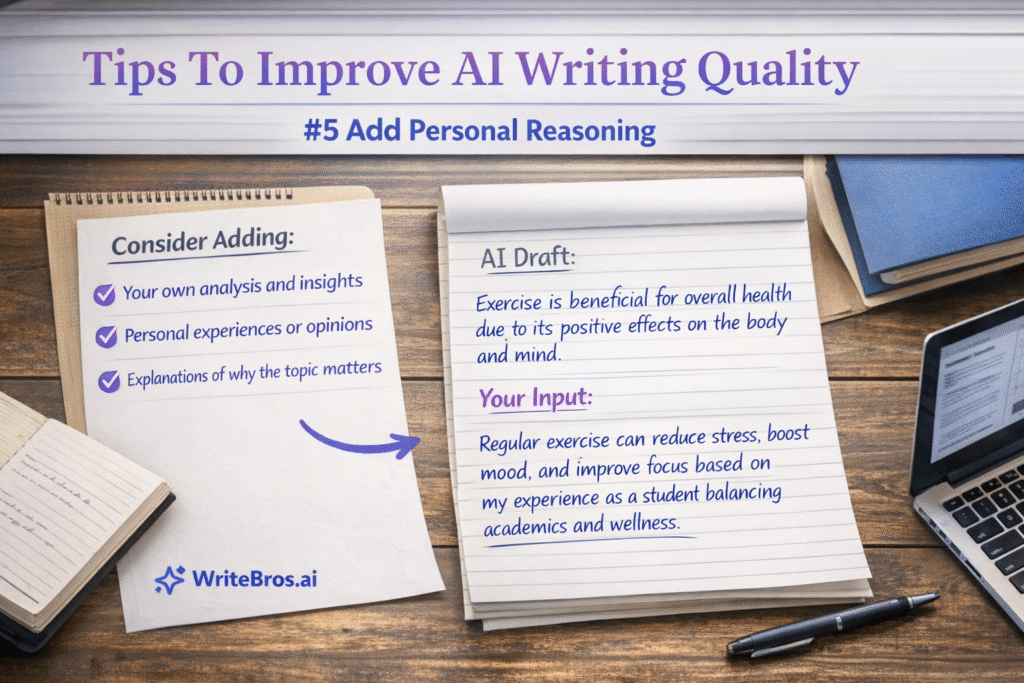
How to Improve AI Writing Quality for Students – Strategy #5: Add personal reasoning
AI-generated drafts frequently provide broad explanations but lack the personal reasoning that demonstrates genuine understanding of the subject, which is something instructors often expect when evaluating student work. Students can improve the quality of AI-assisted writing by expanding paragraphs with their own interpretations, clarifications, and reflections that connect the information to the assignment topic. This step transforms the draft from a generic explanation into a piece of work that reflects the student’s thinking.
In practice, a student analyzing a scientific concept might use AI to summarize the basic theory and then add their own explanation of why the concept matters within the broader research context. These additional sentences show the instructor that the student understands the material rather than simply copying automated output. Personal reasoning also strengthens the argument of the essay, since ideas become grounded in thoughtful interpretation instead of surface-level description.
How to Improve AI Writing Quality for Students – Strategy #6: Strengthen paragraph transitions
Many AI-generated essays contain abrupt shifts between paragraphs because the system focuses on generating content within each section rather than carefully linking ideas across the entire paper. Students can significantly improve readability by revising transitions so that each paragraph logically connects to the next one through shared concepts or evolving arguments. These linking sentences help readers follow the development of ideas more easily throughout the essay.
A student writing an economics essay, for example, might add a transition that explains how government policy influences market behavior before introducing the next section that analyzes real-world examples. This brief connective explanation prepares the reader for the new topic and maintains continuity within the discussion. Strong transitions also signal that the essay is building toward a central argument rather than presenting unrelated points.
How to Improve AI Writing Quality for Students – Strategy #7: Replace vague language
AI drafts often contain vague expressions such as “many factors,” “various aspects,” or “several reasons,” which may sound acceptable at first but rarely convey precise meaning within academic writing. Students strengthen their work by revising these general phrases into clearer explanations that specify what those factors or reasons actually are. Precision in language helps transform a generic paragraph into one that communicates real understanding.
A student discussing climate policy might replace a sentence mentioning “many environmental challenges” with a more specific explanation describing rising sea levels, extreme weather patterns, and shifting agricultural conditions. This change immediately adds clarity and credibility to the argument because readers can visualize the exact issues being addressed. Over time, this habit of replacing vague language improves both the quality and authority of AI-assisted writing.
How to Improve AI Writing Quality for Students – Strategy #8: Integrate supporting evidence
While AI systems can summarize concepts effectively, they do not always include specific evidence that strengthens academic arguments, which means students must actively incorporate research findings, statistics, or examples. Adding credible sources transforms general explanations into persuasive arguments that demonstrate engagement with scholarly material. This process also encourages students to verify information rather than accepting automated text at face value.
In a psychology essay, a student might introduce a study that demonstrates how cognitive bias affects decision-making, using the evidence to reinforce a previously generated explanation. Integrating this research into the paragraph gives the argument more authority and shows that the student has engaged with real academic material. Over time, combining AI drafts with credible evidence results in essays that feel both informative and intellectually grounded.
How to Improve AI Writing Quality for Students – Strategy #9: Adjust sentence variety
AI writing frequently produces sentences with similar structures and predictable rhythms, which can make long essays feel repetitive or mechanical when read from beginning to end. Students improve the natural flow of their writing by revising sentence patterns so that short statements, longer explanations, and transitional phrases appear in balanced variation. This variety keeps readers engaged and prevents the essay from sounding overly uniform.
A student editing a philosophy paper, for instance, might combine several short sentences into a longer analytical explanation that connects multiple ideas within a single thought. In other places, they may break complex statements into clearer, shorter sentences that improve readability. Through careful adjustment of sentence structure, the essay begins to sound more natural and reflective of a student’s own voice.
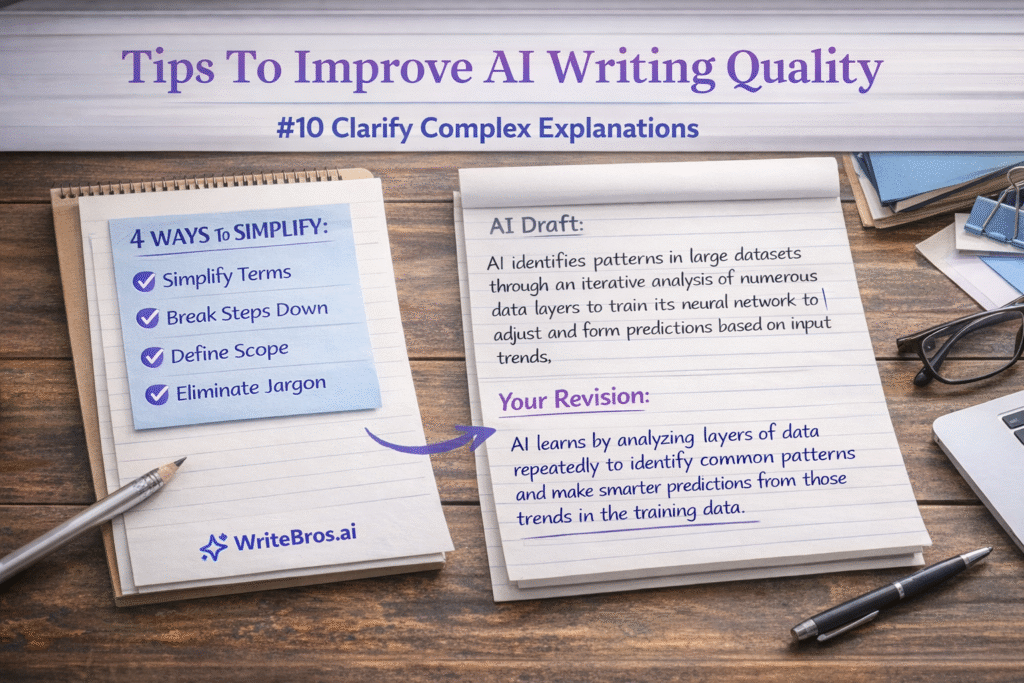
How to Improve AI Writing Quality for Students – Strategy #10: Clarify complex explanations
AI systems sometimes generate explanations that appear detailed but remain difficult to understand because the ideas are packed into dense or overly technical language. Students improve the clarity of their essays by rewriting these passages into language that explains concepts step by step while maintaining academic accuracy. Simplifying complicated explanations often strengthens the overall argument.
A student writing about machine learning concepts might initially receive a dense paragraph describing algorithmic training processes, yet later revise the explanation to clarify how the system learns from patterns in data. Breaking the concept into smaller explanations allows readers to follow the reasoning more easily without losing the depth of the discussion. This editing step often transforms confusing paragraphs into clear and instructive analysis.
How to Improve AI Writing Quality for Students – Strategy #11: Revise for logical flow
Even well-written AI drafts may present ideas in an order that feels slightly disorganized, since automated systems generate paragraphs based on probability rather than careful argumentative progression. Students can improve the logical flow of their essays by reviewing the sequence of ideas and rearranging sections so that each point builds naturally upon the previous one. This structural revision helps transform a collection of paragraphs into a coherent argument.
A student writing an essay on technological innovation might realize that the discussion of ethical concerns appears before the explanation of the technology itself, which can confuse readers encountering the topic for the first time. Reordering the sections so that the concept is introduced before its consequences creates a smoother reading experience. Logical sequencing ensures that the essay develops ideas in a clear and understandable progression.
How to Improve AI Writing Quality for Students – Strategy #12: Edit for originality
Although AI systems generate unique text, the style can still feel formulaic or detached from a student’s voice, which sometimes raises concerns during academic evaluation. Students strengthen their work by rewriting selected sections using their own phrasing and adding insights drawn from their understanding of the topic. This editing step helps transform the essay into writing that sounds authentic rather than automated.
In practice, a student might read through an AI-generated paragraph and rephrase several sentences while maintaining the underlying idea or explanation. During this process, the student naturally adds subtle changes in tone and structure that reflect personal reasoning and familiarity with the subject. These revisions gradually shift the essay toward a more individual voice without losing the helpful structure created by AI.
How to Improve AI Writing Quality for Students – Strategy #13: Check factual accuracy
AI writing tools can occasionally produce statements that sound convincing yet contain outdated information, incorrect details, or unsupported claims, which means students must review the text carefully before submitting academic work. Fact-checking ensures that arguments remain reliable and supported by credible information. This step protects students from unintentionally including misleading statements in their essays.
A student writing a public health report might verify statistics mentioned in the draft by consulting research papers or official government data sources. During this process, the student may discover that certain figures need adjustment or clarification in order to reflect the most accurate information available. Checking facts strengthens both the credibility and the academic integrity of the final paper.
How to Improve AI Writing Quality for Students – Strategy #14: Polish grammar and tone
Although AI-generated drafts often contain correct grammar, the tone can still feel inconsistent across different sections because each paragraph may have been generated separately. Students improve writing quality by reviewing the entire essay for stylistic consistency, ensuring that the tone remains formal, analytical, and appropriate for academic contexts. Minor adjustments to sentence phrasing can greatly enhance the professionalism of the final piece.
A student editing a political science essay might notice that some paragraphs sound analytical while others resemble conversational explanations that feel less appropriate for the assignment. Revising these sections to maintain a consistent academic tone helps the entire essay read more smoothly from beginning to end. Careful polishing also ensures that grammar and punctuation reinforce the clarity of each argument.
How to Improve AI Writing Quality for Students – Strategy #15: Review with a critical mindset
The final and perhaps most important step in improving AI-assisted writing is reviewing the entire draft with a critical perspective, treating the generated text as a starting point rather than a finished product. Students who carefully evaluate each paragraph for clarity, relevance, and strength of argument often discover opportunities to strengthen explanations and refine their ideas. This reflective review transforms the writing process into a thoughtful editing exercise.
A student preparing a final submission might reread the essay from the perspective of a teacher encountering the argument for the first time. During this review, unclear sentences, weak explanations, or unnecessary repetition become much easier to identify and correct. This final evaluation ensures that the essay communicates ideas clearly while reflecting genuine engagement with the subject.
Common mistakes
- Many students treat AI-generated text as a finished essay rather than a preliminary draft, which often leads to assignments that sound generic, repetitive, or disconnected from the actual prompt provided by the instructor. This happens because the convenience of automated writing creates the illusion that minimal editing is required, yet the result often lacks the clarity, structure, and reasoning expected in academic work.
- Another common mistake occurs when students rely on vague prompts that do not specify the type of analysis, tone, or structure required for the assignment, which causes the AI system to generate overly broad explanations. Without clear direction, the output may resemble a general overview rather than a focused argument aligned with the academic objective of the paper.
- Students sometimes overlook the importance of verifying facts and supporting claims within AI-generated text, assuming that the information provided must already be accurate because it appears well written. This misunderstanding can introduce incorrect data or outdated statistics into an essay, which ultimately weakens the credibility of the argument and may lead to lower academic evaluations.
- Many learners also forget to integrate their own reasoning and interpretation into AI-assisted drafts, leaving the essay sounding detached from personal understanding of the topic. Instructors often recognize this absence of individual perspective, which can make the work appear less thoughtful or less engaged with the subject matter being discussed.
- A frequent structural mistake occurs when students generate an entire essay at once and submit it without revisiting the organization of ideas, which can result in paragraphs that repeat similar points or appear in a confusing sequence. Careful reordering of sections and clearer transitions are necessary to transform an automated draft into a coherent academic discussion.
- Some students focus heavily on expanding content length while overlooking clarity and readability, assuming that a longer essay automatically demonstrates stronger effort or deeper understanding. In reality, dense or repetitive explanations often make the writing harder to follow, which reduces the overall impact of the argument presented in the assignment.
Edge cases
There are situations where students may rely more heavily on AI writing tools due to time pressure, language barriers, or unfamiliarity with complex academic topics, and in these circumstances the strategies above may require additional adjustment. Students working in a second language, for instance, might initially depend on AI drafts to organize ideas before gradually rewriting sections in their own voice. In such cases, the focus should remain on clarity, comprehension, and learning rather than strict adherence to any single editing technique.
Another edge case arises when assignments involve highly technical material that requires precise terminology or detailed explanations drawn from specialized sources. AI-generated drafts may provide a starting explanation, yet the student must still verify definitions, integrate academic references, and clarify complex reasoning through careful revision. These assignments benefit most when AI is used as a brainstorming or outlining tool rather than the primary source of final content.
Supporting tools
- Grammar checking platforms help students identify sentence structure problems, punctuation inconsistencies, and awkward phrasing that may appear in AI-generated drafts. These tools allow writers to refine clarity and readability while preserving the original meaning of the text, making them useful during the final stages of editing.
- Academic research databases provide access to peer-reviewed studies, statistics, and scholarly discussions that can strengthen the evidence used within AI-assisted essays. When students combine AI drafts with credible research materials, their writing becomes more persuasive and academically grounded.
- Note organization applications allow students to collect research sources, outline arguments, and store references in one place, which simplifies the process of integrating evidence into AI-assisted writing. Maintaining organized notes helps ensure that supporting material connects clearly to the argument developed in the essay.
- Plagiarism detection systems help students review their drafts before submission to confirm that the final work reflects original phrasing and properly cited sources. These tools provide reassurance that editing and paraphrasing have successfully produced authentic academic writing.
- Collaborative writing platforms enable students to review drafts with classmates or instructors who can provide feedback on structure, clarity, and argument strength. Outside perspectives often highlight issues that the writer may overlook after spending extended time working on the same essay.
- WriteBros.ai provides tools designed to refine AI-generated drafts so that they better reflect natural writing patterns, clearer academic structure, and more consistent tone. Students using such tools often discover that thoughtful editing and refinement can transform an initial AI draft into a more polished and readable academic essay.
Ready to Transform Your AI Content?
Try WriteBros.ai and make your AI-generated content truly human.
Conclusion
Improving the quality of AI-assisted writing for students is less about replacing traditional writing skills and more about strengthening them through careful editing, structured thinking, and thoughtful interpretation of generated drafts. When AI becomes part of a deliberate writing process rather than the entire process itself, students gain the ability to transform quick automated outputs into meaningful academic work.
Students who approach AI writing with curiosity and intention often discover that the most valuable improvements happen during revision, reflection, and clarification of ideas. Perfect drafts rarely appear instantly, yet careful editing and steady refinement can turn early AI-generated text into clear, credible, and thoughtful academic writing that reflects genuine understanding.
Did You Know?
Many students trying to improve AI writing quality start with grammar cleanup or synonym swaps, yet those edits rarely fix the deeper issues that make a draft feel flat or unconvincing. AI generated writing often sounds complete because the sentences flow smoothly even when the logic underneath stays generic.
The biggest gains usually happen when students revise how the argument develops from one paragraph to the next. Sharpening the main point, adding personal reasoning, and making the evidence work harder helps the writing feel more thoughtful, more specific, and much closer to real academic quality.
Ready to Transform Your AI Content?