Student Use of AI Writing Statistics: Top 20 Adoption Signals

2026 classroom writing patterns are being reshaped by AI tools at a pace few institutions expected. These student use of AI writing statistics reveal how drafting, editing, paraphrasing, and brainstorming habits are evolving, offering a clearer view of how academic writing workflows are being quietly redesigned.
Classrooms are quietly entering a new phase of writing behavior, one shaped as much by software prompts as by traditional study habits. Conversations among instructors increasingly revolve around how student drafting patterns are changing across essays, discussion posts, and research assignments.
Evidence across universities suggests that generative tools are becoming embedded in everyday coursework rather than used as occasional shortcuts. Observers now look closely for signals students may be over relying on AI as writing rhythms begin to diverge from earlier academic norms.
Patterns emerge when revision time drops yet output volume grows, revealing how automation can compress parts of the writing process. Students attempting to make AI essays read naturally illustrate how quickly the focus has moved from generation to refinement.
Even small editing habits now reflect tool adoption, particularly when sentence smoothing replaces deeper rewriting. In many cases the workflow expands to include the best AI paraphraser tools for student sentence edits, quietly transforming how academic voice is produced.
Top 20 Student Use of AI Writing Statistics (Summary)
| # | Statistic | Key figure |
|---|---|---|
| 1 | College students who have used AI to help write assignments | 67% |
| 2 | Students who admit submitting AI assisted text with minimal editing | 29% |
| 3 | High school students experimenting with AI writing tools | 44% |
| 4 | Students using AI primarily for brainstorming ideas | 58% |
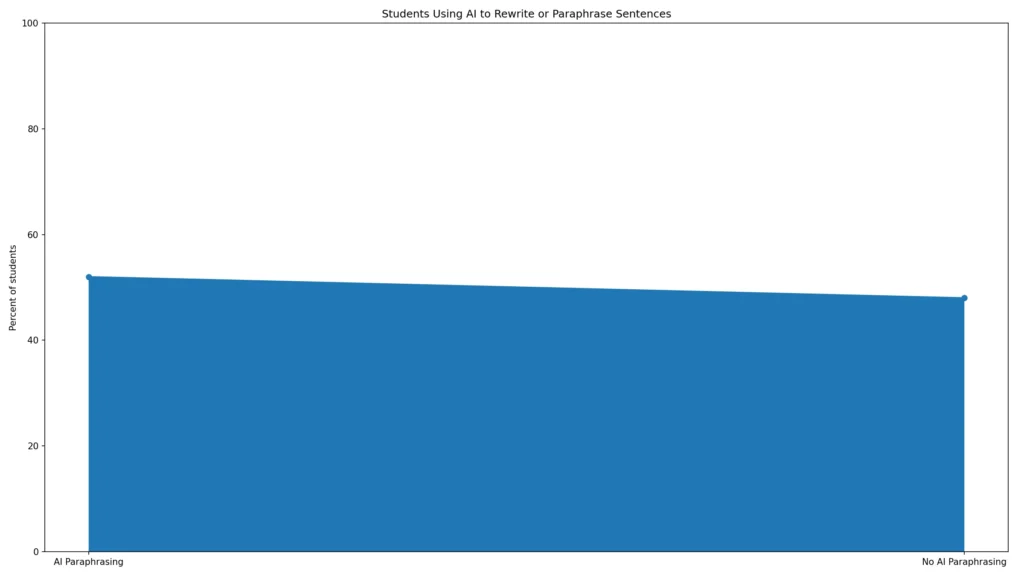
| 5 | Students using AI to rewrite or paraphrase sentences | 52% |
| 6 | Students who say AI tools reduce time spent on essays | 61% |
| 7 | Students who feel AI improves grammar and clarity | 74% |
| 8 | Students worried teachers can detect AI written text | 46% |
| 9 | Students who revise AI outputs before submission | 63% |
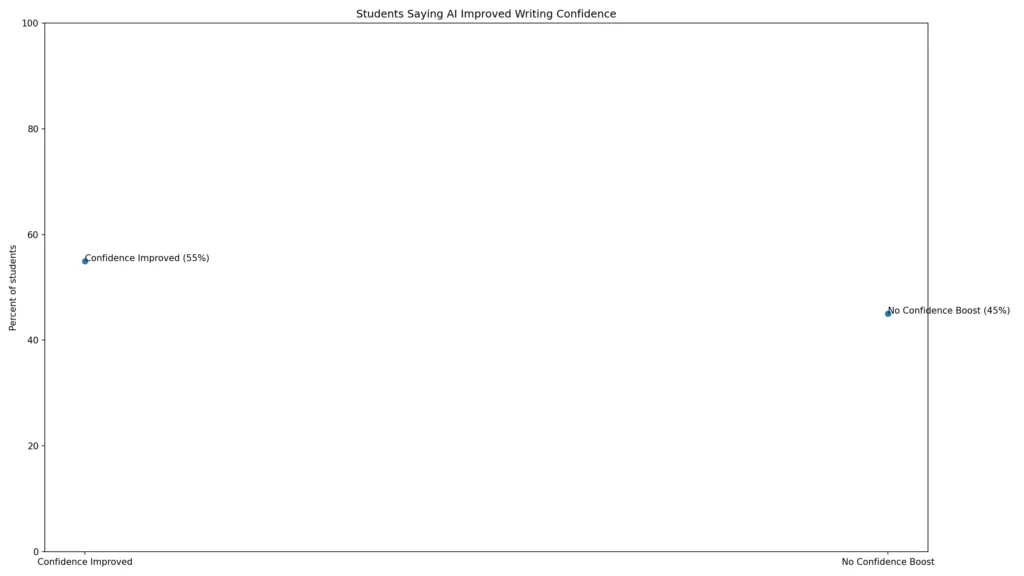
| 10 | Students who say AI tools improved their writing confidence | 55% |
| 11 | Students who rely on AI for outlining essays | 49% |
| 12 | Students who use AI to summarize readings | 57% |
| 13 | Students who say AI helped them overcome writer’s block | 64% |
| 14 | Students who believe AI tools should be allowed in coursework | 71% |
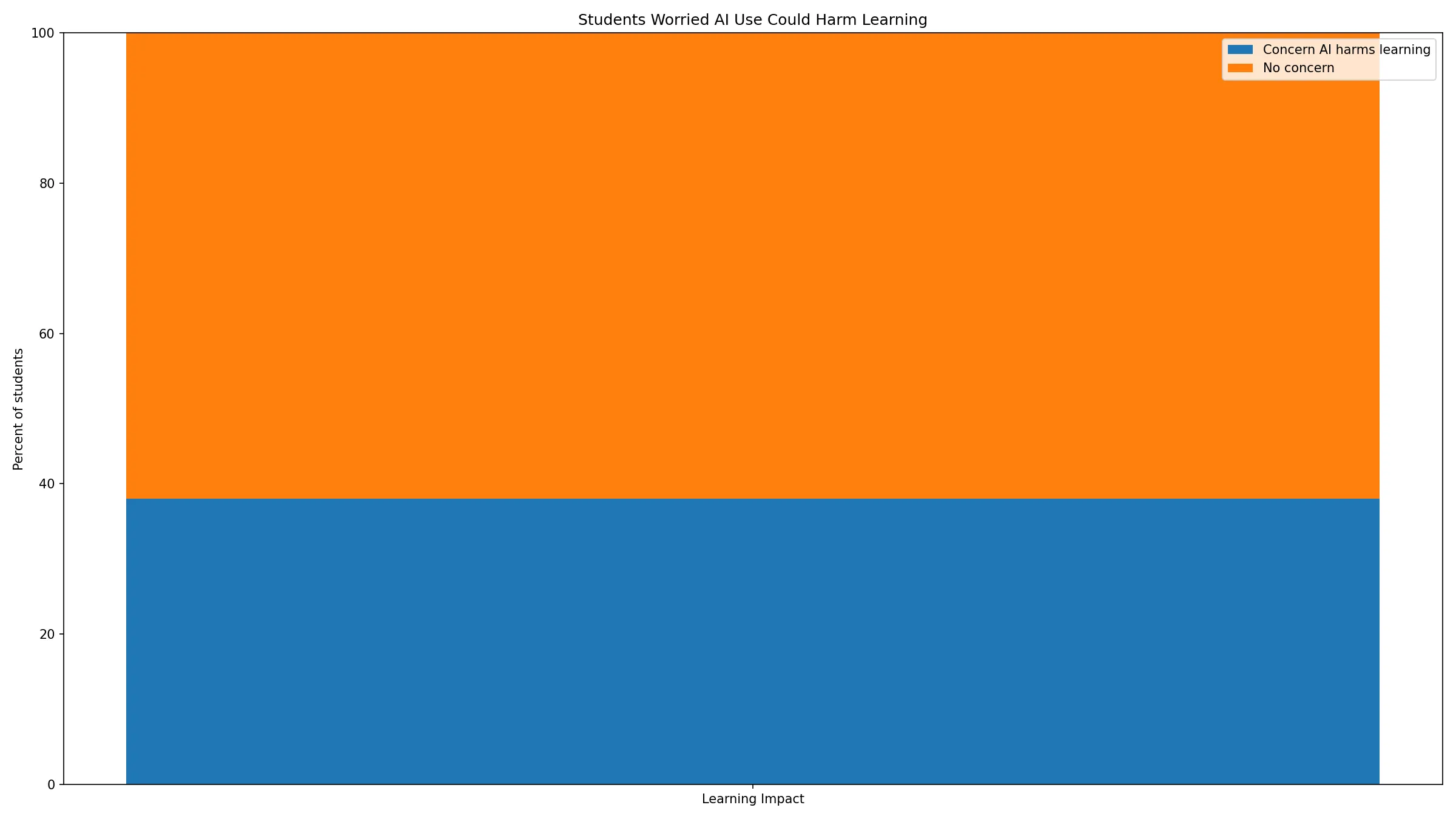
| 15 | Students who worry AI use could harm learning | 38% |
| 16 | Students who use AI tools weekly for writing help | 53% |
| 17 | Students who rely on AI for editing drafts | 62% |
| 18 | Students who compare multiple AI outputs before submitting work | 34% |
| 19 | Students who believe AI writing tools will remain part of education | 78% |
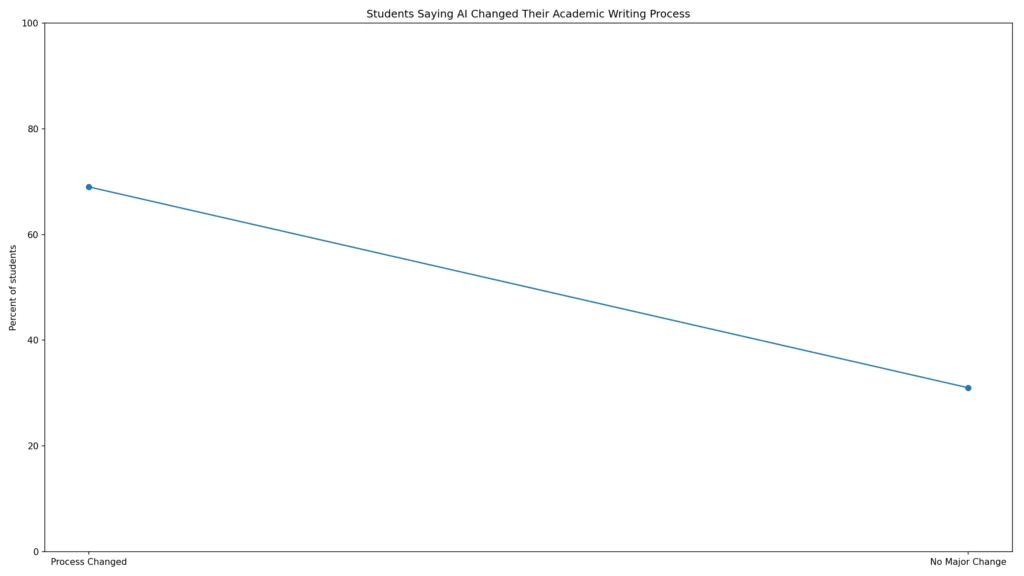
| 20 | Students who say AI changed their academic writing process | 69% |
Top 20 Student Use of AI Writing Statistics and the Road Ahead
Student Use of AI Writing Statistics #1. College students using AI for assignments
67% of college students using AI to help write assignments points to a behavior that has moved well past experimentation. Once two thirds of a student population adopts a writing aid, the tool stops feeling optional and starts shaping normal academic workflow. That matters because peer habits spread faster than policy updates, so visible use quickly becomes assumed use.
The number rises because AI collapses early writing friction in minutes, especially idea generation, outlining, and sentence drafting. Students who already juggle deadlines, part time work, and dense reading loads naturally reach for anything that removes blank page anxiety. The deeper cause is convenience meeting pressure, which makes adoption feel rational even when the educational tradeoff stays fuzzy.
Human drafting usually meanders through uncertainty, false starts, and uneven phrasing, whereas AI drafting arrives smoother on the first pass. When 67% of college students normalize that shortcut, instructors see cleaner prose without the usual signs of thought formation. The implication is that assessment design now has to measure process and reasoning, not just polished output.
Student Use of AI Writing Statistics #2. Minimal editing before submission
29% of students submitting AI assisted text with minimal editing is a smaller share than total usage, yet it is the number that most directly affects trust. It suggests many students still edit, but a sizable minority are comfortable moving generated language close to final submission. That creates a visible split between AI as support and AI as near replacement.
This pattern grows when students view editing as cosmetic rather than intellectual work. If the system already sounds coherent, the temptation is to fix a few phrases, change the tone slightly, and move on to the next task. The cause is less laziness than misjudging what writing practice is supposed to build over time.
Human revision tends to rearrange ideas, sharpen claims, and cut weak logic, while light AI revision mostly sands down surfaces. With 29% of students staying near the generated draft, the risk is not only plagiarism concerns but shallower cognitive engagement. The implication is that schools need clearer norms around acceptable transformation rather than vague warnings against use.
Student Use of AI Writing Statistics #3. High school experimentation
44% of high school students experimenting with AI writing tools shows the behavior is arriving before college habits fully form. Nearly half of teens testing these systems means higher education is inheriting users, not introducing them from scratch. That changes the baseline because incoming students already expect instant language help.
The figure is rising because schoolwork now happens inside the same digital environment where AI tools are easy to access and easy to hide. Curiosity plays a role, but so does the simple appeal of fast homework assistance during busy weeks. Once experimentation becomes socially normal, occasional trial can become routine dependence without much resistance.
Human writing development in adolescence depends on awkward practice, messy feedback, and gradual voice formation, none of which feels efficient in the moment. When 44% of high school students start outsourcing parts of that struggle, college instructors later meet students with polished phrasing but thinner drafting stamina. The implication is that earlier guidance on appropriate use has become more valuable than reactive punishment later.
Student Use of AI Writing Statistics #4. Brainstorming as the main use case
58% of students using AI primarily for brainstorming tells a more nuanced story than outright ghostwriting. Brainstorming sits at the acceptable edge for many educators because it feels closer to tutoring than substitution. Even so, once idea generation is outsourced at scale, the starting point of thought itself begins to change.
This number is high because brainstorming is where students feel the least certain and the most pressed for time. AI offers instant topic angles, thesis directions, and organizing frames without the emotional drag of staring at a blank page. The cause is practical relief, but also the quiet appeal of having uncertainty removed before it can teach anything.
Human brainstorming usually wanders through half formed questions and personal connections, which is slower but often more original. When 58% of students begin with machine suggested angles, many papers can converge around the same tidy structures and familiar claims. The implication is that originality may increasingly depend on prompt design and source work rather than the opening draft alone.
Student Use of AI Writing Statistics #5. Rewriting and paraphrasing sentences
52% of students using AI to rewrite or paraphrase sentences shows how adoption often settles into the middle of the writing process. This is less visible than full draft generation, yet it can reshape a paper line by line. Sentence level assistance feels modest, which is why it spreads with relatively little internal resistance.
The behavior grows because students want stronger flow, fewer grammar errors, and a faster path to sounding more academic. Rewriting tools promise polish without requiring the same command of syntax, tone, or transition logic. That makes them appealing in exactly the areas where weaker writers most need deliberate practice and patience.
Human sentence revision usually reflects intent, emphasis, and rhythm built from the writer’s own ear, whereas AI paraphrase tends to standardize expression. When 52% of students lean on rewriting support, many submissions become smoother but also more interchangeable. The implication is that voice may become the next scarce academic signal as polished sameness spreads through student writing.
Student Use of AI Writing Statistics #6. Essay time reduction
61% of students saying AI reduces time spent on essays helps explain why usage keeps climbing even amid policy uncertainty. Time savings are not a side benefit for students. They are often the main reason the tool earns a permanent place in the workflow.
The number rises because AI compresses several slow stages at once, from outlining and wording to transition repair and conclusion drafting. What used to take an evening can now feel manageable in an hour, especially for students balancing coursework with jobs or commuting. Speed becomes persuasive long before questions of learning depth have time to catch up.
Human writing usually teaches through delay, since stronger ideas often surface after sitting with a topic longer than feels comfortable. When 61% of students prize faster completion, the educational bargain starts moving from practice toward efficiency. The implication is that assignments valued for process may need structure that makes thinking time visible rather than optional.
Student Use of AI Writing Statistics #7. Grammar and clarity gains
74% of students feeling AI improves grammar and clarity shows why resistance from faculty does not automatically slow adoption. Clean sentences provide an immediate reward that students can see on screen. Improvement feels tangible when a rough paragraph quickly becomes readable and formally correct.
This figure stays high because grammar support solves an everyday pain point without asking students to study grammar rules directly. Multilingual students, hurried writers, and anyone unsure of academic tone all benefit from instant smoothing. The cause is simple utility, but also the prestige attached to sounding polished in institutional settings.
Human editing builds clarity through repeated noticing, whereas automated editing often delivers the answer before the writer fully sees the pattern. If 74% of students learn to trust correction more than understanding, they may submit stronger sentences while retaining weaker control over style choices. The implication is that surface fluency can rise even as independent editing ability develops more slowly.
Student Use of AI Writing Statistics #8. Fear of detection
46% of students worrying teachers can detect AI written text reveals a culture shaped as much by anxiety as convenience. Nearly half of users are not moving through these tools with complete confidence. The result is a strange mix of dependence and unease that affects how students draft, edit, and second guess themselves.
The concern persists because detection systems, academic integrity warnings, and stories of false accusations remain highly visible. Students hear that AI can help them, then hear just as quickly that it might expose them, which produces careful but not necessarily ethical behavior. That tension encourages stealth editing rather than open discussion of acceptable use.
Human writing leaves behind messier traces of thinking, which can feel safer precisely because it looks imperfect and lived in. When 46% of students fear being flagged, many focus less on writing well and more on writing in ways that appear plausibly human. The implication is that fear can distort learning almost as much as unrestricted AI reliance does.
Student Use of AI Writing Statistics #9. Revising outputs before submission
63% of students revising AI outputs before submission suggests most users understand that raw output alone rarely feels safe enough. Revision has become the social compromise between convenience and authenticity. Students appear to know that untouched AI text is riskier, flatter, and easier for instructors to question.
This pattern happens because generated text often arrives competent but generic, which makes some level of personalization necessary. Students add examples, change phrasing, or soften the overly balanced tone so the work fits the class context better. The cause is partly strategic, yet it also reflects a real attempt to reclaim ownership over a machine assisted draft.
Human revision grows from thought clarifying itself, whereas AI revision often starts from acceptable language that needs personality and context stitched back in. If 63% of students are editing after generation, then the educational problem is no longer simple copying. The implication is that schools must judge how much revision meaningfully transforms authorship rather than assuming all edited AI text functions the same way.
Student Use of AI Writing Statistics #10. Writing confidence boost
55% of students saying AI improved their writing confidence helps explain why enthusiasm stays resilient even under scrutiny. Confidence is not trivial in academic writing. It directly affects willingness to start, revise, and submit work without freezing over perceived weakness.
The figure rises because AI offers immediate reassurance through examples, cleaner phrasing, and instant feedback that feels responsive rather than judgmental. Students who once hesitated over every sentence can move faster when a tool seems to confirm that they are on the right track. That emotional relief becomes part of the product, not just a side outcome.
Human confidence usually builds from repeated practice and feedback over time, which is slower but sturdier. When 55% of students attach confidence to tool access, self belief may become conditional on having the assistant nearby. The implication is that schools should distinguish between borrowed confidence from support and durable confidence that remains when the screen goes quiet.
Student Use of AI Writing Statistics #11. Outlining essays with AI
49% of students relying on AI for outlining essays shows that structure has become one of the first pieces many writers are willing to outsource. An outline looks harmless because it sits before the draft rather than inside it. Yet structure quietly determines what arguments appear, what evidence gets emphasized, and what logic feels available.
This number grows because outlining is mentally demanding in a way that students rarely name directly. It asks them to prioritize ideas, sequence claims, and anticipate flow before they feel ready, which can be exhausting under deadline pressure. AI makes that burden feel lighter by turning a vague topic into a tidy roadmap almost instantly.
Human outlining often reflects uncertainty, dead ends, and a writer’s own logic taking shape in public, while machine outlines arrive cleaner and more conventional. When 49% of students begin with generated structure, originality can narrow before drafting even starts. The implication is that formulaic organization may spread faster than instructors realize because it enters through planning, not just final prose.
Student Use of AI Writing Statistics #12. Summarizing readings
57% of students using AI to summarize readings signals a broader change in how academic preparation gets compressed. Summary tools do not simply save time on note taking. They can alter which details students ever encounter and which arguments they never fully wrestle with.
The number climbs because reading loads remain heavy while available attention remains finite. When students can turn a dense chapter into quick bullet points or a short digest, the trade feels practical, especially in survey courses or during exam weeks. The hidden cause is that modern coursework rewards coverage, so tools that speed coverage naturally gain traction.
Human reading builds interpretation slowly through confusion, repetition, and noticing what feels odd, unresolved, or worth challenging. Once 57% of students lean on AI summaries, they may retain the gist while missing the texture that makes analysis possible. The implication is that assignments asking for nuanced engagement will need mechanisms that reward direct encounter with the original text.
Student Use of AI Writing Statistics #13. Overcoming writer’s block
64% of students saying AI helped them overcome writer’s block captures one of the most emotionally persuasive use cases. Writer’s block feels personal and frustrating, so a tool that breaks the stall quickly wins loyalty. For many students, relief arrives before ethical concerns even enter the picture.
This pattern holds because starting is often harder than continuing. AI offers prompts, opening lines, thesis options, and paragraph scaffolds that reduce the fear of producing something weak or incomplete. The cause is not only workload but also the discomfort of thinking publicly through rough language in front of oneself.
Human starts are usually clumsy, and that clumsiness is part of how ideas discover their real shape. When 64% of students use AI to bypass the stuck moment, they gain momentum but may lose contact with the very struggle that teaches them how to begin on their own. The implication is that support for blocked writers must help them start thinking, not merely start typing.
Student Use of AI Writing Statistics #14. Support for AI in coursework
71% of students believing AI tools should be allowed in coursework shows that legitimacy is catching up with usage. Once seven in ten students support permission, the debate moves away from whether AI exists and toward how it should be framed. Expectations begin to resemble those surrounding calculators, spellcheck, or search engines, even if the comparison is imperfect.
The number is high because many students see AI through the lens of practical assistance rather than academic threat. If the tool helps brainstorm, clarify, translate, or revise, then banning it can feel out of step with the rest of digital life. Support rises further when institutional rules are vague, since uncertainty often makes permission seem like the more realistic position.
Human learning still depends on doing some hard thinking without external scaffolds, which is why the analogy to older tools only goes so far. When 71% of students want formal acceptance, institutions face pressure to define fair use more precisely than they have so far. The implication is that policy clarity may matter more now than blanket approval or blanket prohibition.
Student Use of AI Writing Statistics #15. Concern that AI harms learning
38% of students worrying AI use could harm learning may look lower than adoption figures, but it is still a substantial warning signal. More than a third sensing educational downside means the student body is not blindly enthusiastic. Many users appear to recognize the trade even while continuing to use the tool.
This concern grows because students can feel the difference between finishing work efficiently and understanding it deeply. They notice when an essay gets done faster but later feels harder to explain without the interface open. The cause is direct experience with convenience that solves immediate performance demands while leaving longer term mastery less certain.
Human learning usually leaves traces of struggle that make recall sturdier later, even if the experience feels slower and less elegant at the time. When 38% of students already sense a learning cost, institutions should take that self awareness seriously rather than dismissing it as nostalgia. The implication is that students themselves may be ready for more candid conversations on what AI should and should not replace.
Student Use of AI Writing Statistics #16. Weekly writing help
53% of students using AI tools weekly for writing help suggests the habit is no longer occasional for a large share of learners. Weekly behavior matters more than one time experimentation because it indicates routine dependence. Once a tool appears every week, it begins shaping expectations for how writing should feel and how quickly it should move.
This number holds because writing tasks recur constantly across subjects, unlike niche tools tied to one class or one assignment type. Students can justify repeated use for outlines, summaries, drafts, or sentence cleanup, so the assistant stays relevant from Monday to Friday. Regular exposure also lowers moral friction because repetition makes the behavior feel ordinary rather than exceptional.
Human writing habits strengthen through repeated independent practice, which slowly builds stamina, flexibility, and tolerance for uncertainty. When 53% of students bring AI into that weekly rhythm, the practice loop changes from solo problem solving to assisted production. The implication is that frequency, not just percentage of users, may be the more revealing measure of long term educational impact.
Student Use of AI Writing Statistics #17. Editing drafts with AI
62% of students relying on AI for editing drafts shows that revision has become one of the strongest entry points for adoption. Editing feels safer than full generation because the student already has text on the page. That framing makes AI seem like a helper polishing existing work rather than a substitute doing the work itself.
The figure rises because editing is labor intensive, detail heavy, and easy to postpone until the last moment. AI can flag awkward phrasing, smooth transitions, and tighten sentences faster than most students can do alone under pressure. The underlying cause is that revision requires both distance and patience, two things deadlines steadily drain.
Human editing usually teaches writers how their own patterns sound, while AI editing can remove those patterns before the writer fully recognizes them. When 62% of students hand the final polish to a system, papers may improve on the surface while the writer learns less from recurring mistakes. The implication is that revision support should not quietly become revision replacement.
Student Use of AI Writing Statistics #18. Comparing multiple outputs
34% of students comparing multiple AI outputs before submitting work suggests growing sophistication rather than blind acceptance. These users are not simply taking the first answer offered. They are evaluating versions, mixing phrasing, and treating AI more like a set of options than a single authority.
This behavior emerges because students quickly learn that prompt wording changes the result and that one output rarely fits a course perfectly. Running multiple versions can improve tone, structure, or specificity, especially when the first draft feels too broad or too polished. The cause is partly caution, but it also reflects a more active kind of tool literacy.
Human drafting compares alternatives internally through reflection and revision, whereas AI comparison externalizes that process into visible side by side choices. When 34% of students start curating outputs rather than accepting one, authorship becomes more editorial than generative. The implication is that future academic norms may need to account for students acting less like writers at the sentence level and more like selectors across machine options.
Student Use of AI Writing Statistics #19. Expectation that AI stays in education
78% of students believing AI writing tools will remain part of education shows that permanence is already assumed by most learners. Once nearly four in five expect the tool to stay, debates framed around temporary disruption start sounding detached from student reality. Expectations matter because they shape behavior even before institutions fully adapt.
The number is high because students can already see AI spreading across search, office software, tutoring systems, and everyday writing interfaces. A technology woven into so many adjacent tools does not feel like a passing novelty. The cause is not hype alone but visible integration across the systems students already rely on for study and communication.
Human educational routines change slowly, yet student expectations can move much faster when convenience and ubiquity combine. With 78% of students assuming AI is here to stay, resistance strategies based only on restriction may feel increasingly out of sync with lived experience. The implication is that institutions gain more from designing durable norms than from acting as if reversal is still likely.
Student Use of AI Writing Statistics #20. Changed academic writing process
69% of students saying AI changed their academic writing process captures the broadest transformation in the set. This is not merely a claim that papers got faster or cleaner. It signals that the sequence of how students start, develop, refine, and finish writing has been materially rearranged.
The figure rises because AI touches multiple stages at once, from brainstorming and outlining to summarizing, drafting, paraphrasing, and editing. Even students who use it selectively can end up restructuring their workflow around moments when help is easiest to access. Over time, those small interventions accumulate into a different default process.
Human writing once followed a more linear pattern of reading, thinking, drafting, and revising, with friction distributed across each stage. When 69% of students report a changed process, the important question is no longer whether AI influences writing but how deeply it has rewired writing habits. The implication is that academic writing instruction now has to teach process design as deliberately as it teaches argument and evidence.
What these student use of AI writing statistics suggest for academic writing next
Student use of AI writing statistics now point less to isolated cheating fears and more to a full workflow redesign. The strongest numbers cluster around brainstorming, summarizing, editing, and weekly use, which means assistance is spreading through ordinary academic habits rather than sitting at the margins.
That pattern helps explain why concern and adoption keep rising together instead of canceling each other out. Students clearly value speed, polish, and confidence, yet many also sense the loss that comes when writing becomes easier faster than thinking does.
The most useful distinction ahead may be between support that extends learning and support that quietly replaces it. In practice, the line will depend on whether a tool helps students notice, decide, and revise for themselves or simply hands them a cleaner path around those steps.
Academic writing is unlikely to return to its pre AI rhythm, and students already seem to know that. Institutions that define transparent use cases, redesign process based assessment, and teach authorship in more explicit ways will be better positioned for that implication.
Sources
- HEPI student generative AI survey 2025 report overview
- HEPI and Kortext full student survey PDF
- Digital Education Council global AI student survey report
- Key results from global AI student survey
- Campus Technology summary of DEC student findings
- Common Sense Media teens and AI adoption report
- Common Sense Media press release on teen AI use
- Impact Research poll on AI chatbots in schools
- Walton Family Foundation AI in the classroom
- Ithaka report on postsecondary instructional AI practices
- Ithaka brief on generative AI in higher education
- Harvard usable knowledge piece on student AI attitudes