How to Make AI Essays Read Naturally: 15 Language Adjustments

Updated for 2026, this guide explains how small language edits can make AI essays read naturally and reduce mechanical patterns. Research from the University of Pennsylvania on AI writing detection in DetectGPT study shows predictable phrasing patterns often reveal machine-generated text.
How to Make AI Essays Read Naturally: 15 Language Adjustments
Many students rely on AI to generate essay drafts, but the results often feel stiff, repetitive, or strangely formal. Questions like do AI humanizers work usually appear once writers realize the text still sounds artificial even after basic editing.
The problem rarely comes from the ideas themselves but from predictable phrasing, overly tidy sentence structure, and language patterns that sound machine-generated. That is why many writers search for the best AI rewriter tools for academic draft revisions to refine wording and improve flow before submission.
Detection systems and instructors both notice these patterns because AI writing tends to repeat structures that human writers rarely use consistently. Understanding current AI detector reliability statistics also shows why small language adjustments can dramatically change how natural a draft sounds.
| # | Strategy focus | Practical takeaway |
|---|---|---|
| 1 | Break predictable sentence rhythm | Adjust sentence lengths and structures so the writing feels less mechanical and more conversational. |
| 2 | Reduce formulaic transitions | Replace rigid connectors with smoother phrasing that mirrors how people actually move between ideas. |
| 3 | Swap generic vocabulary | Exchange vague or repetitive wording with clearer, more precise language that strengthens meaning. |
| 4 | Add natural sentence variation | Blend short and longer statements to prevent the draft from sounding uniform or scripted. |
| 5 | Remove overly tidy phrasing | Human writing includes slight irregularities, so loosening perfect structure improves authenticity. |
| 6 | Rewrite predictable openings | Change repetitive sentence starters so paragraphs feel more dynamic and less patterned. |
| 7 | Replace robotic emphasis | Cut exaggerated emphasis phrases and let the argument carry the point naturally. |
| 8 | Simplify complex constructions | Shorten unnecessarily complicated sentences to improve readability and flow. |
| 9 | Introduce subtle voice markers | Small stylistic touches help the text reflect a more personal and human writing style. |
| 10 | Balance formal and natural tone | Maintain academic clarity while avoiding language that feels stiff or overly polished. |
| 11 | Break repetitive paragraph patterns | Reorganize sections so ideas develop organically rather than following identical structures. |
| 12 | Replace abstract filler phrases | Remove vague filler language that AI often inserts to extend sentences without adding meaning. |
| 13 | Use clearer logical flow | Guide readers through the argument with natural progression rather than rigid step-by-step phrasing. |
| 14 | Adjust emphasis and pacing | Move important points to stronger positions in sentences so the writing feels intentional. |
| 15 | Perform a final language polish | Read through the essay and refine wording to ensure the overall tone sounds authentic and fluid. |
15 Language Adjustments to Make AI Essays Read Naturally
How to Make AI Essays Read Naturally – Strategy #1: Break sentence rhythm
One of the easiest ways to recognize AI writing is the extremely consistent rhythm created when sentences follow nearly identical lengths and structures throughout a paragraph. To make AI essays read naturally, writers should deliberately vary how ideas unfold, occasionally stretching one sentence with clarifying detail while allowing the next to pause earlier, which creates the uneven pacing that naturally appears in human writing. When paragraphs contain this gentle variation in cadence and structure, the essay begins to sound less engineered and more like a person thinking through a concept while explaining it to a reader.
Real essays written under normal conditions rarely maintain a perfectly balanced pattern of sentences because people instinctively expand certain ideas and condense others depending on emphasis and clarity. A student revising an AI-generated paragraph might lengthen a sentence that introduces evidence while shortening the following line that simply transitions to the next point, which gradually breaks the machine-like rhythm. Over the course of several paragraphs this subtle irregularity accumulates, and the essay begins to resemble natural academic writing rather than a sequence of evenly structured statements.
How to Make AI Essays Read Naturally – Strategy #2: Reduce formulaic transitions
AI systems rely heavily on predictable transition phrases that attempt to organize ideas in a tidy sequence, yet those connectors often sound overly instructional and mechanical when repeated across several paragraphs. Writers working to make AI essays read naturally should look for transitions that feel overly formal or instructional and replace them with phrasing that flows more organically between ideas. Instead of announcing every shift in argument, the essay should allow concepts to connect through context, explanation, and narrative movement.
Human writers frequently move between ideas through subtle shifts in emphasis rather than explicit signposting that tells the reader exactly what is happening next. During revision, a student might remove phrases that rigidly label every point and instead blend the transition into the sentence that introduces the next idea. As those rigid connectors disappear, the essay begins to sound less like a structured outline and more like a natural progression of thought that develops gradually across the paragraph.
How to Make AI Essays Read Naturally – Strategy #3: Replace generic vocabulary
AI-generated drafts often rely on safe, generalized vocabulary that sounds technically correct yet lacks the nuance that appears in human writing. Making AI essays read naturally requires identifying these broad expressions and replacing them with wording that feels more specific to the context of the argument. When a sentence describes an idea with greater precision, the voice becomes clearer and the overall tone begins to resemble authentic academic writing.
This adjustment does not mean inserting complicated terminology or unnecessarily advanced language, because natural writing often relies on clarity rather than complexity. A student revising an AI draft might swap vague phrasing with language that reflects the actual example or evidence being discussed in the paragraph. Gradually the essay becomes less generic and more grounded in concrete ideas, which reduces the mechanical tone associated with automated writing.
How to Make AI Essays Read Naturally – Strategy #4: Introduce sentence variety
AI essays frequently contain sentences that begin with identical grammatical patterns, which causes paragraphs to feel repetitive even when the ideas themselves differ. To make AI essays read naturally, writers should restructure several sentences so that the paragraph includes a mixture of openings, such as contextual introductions, descriptive clauses, or reflective commentary. This variety prevents the essay from sounding as though each sentence was generated using the same structural template.
During revision it helps to read the paragraph aloud and notice whether several sentences begin with the same word or grammatical pattern. A student might revise one line so that the supporting example appears first, while another sentence might start with a reflective phrase that frames the idea before presenting evidence. Over time this variation creates a more dynamic flow that resembles how people naturally explain complex ideas in academic writing.
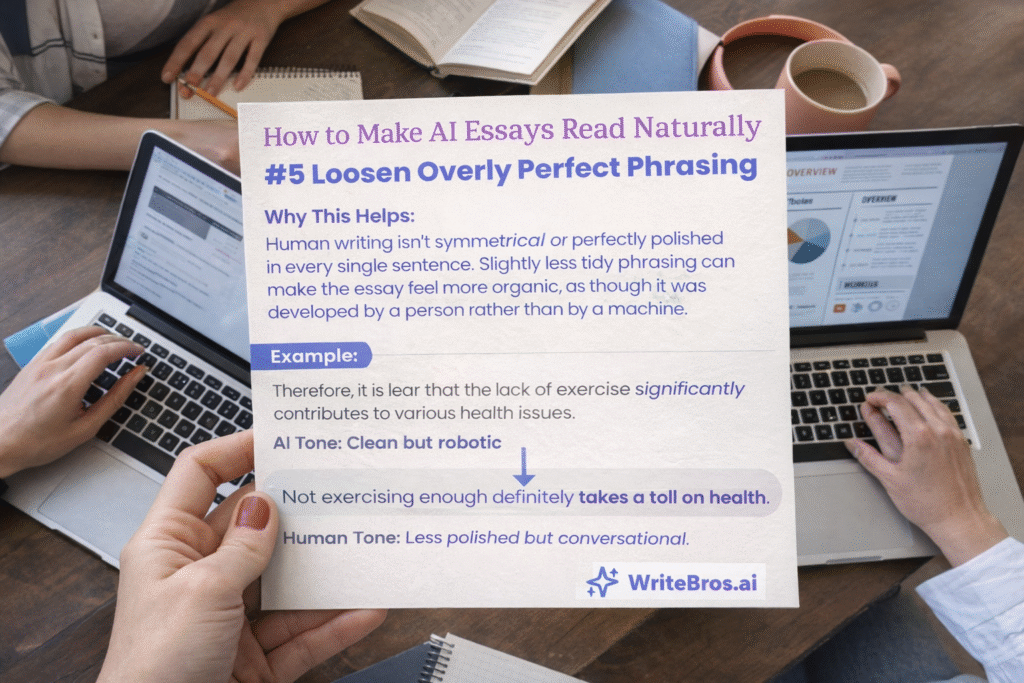
How to Make AI Essays Read Naturally – Strategy #5: Loosen overly perfect phrasing
AI writing frequently appears overly polished because the system attempts to produce sentences that are grammatically complete and structurally balanced in every case. When the goal is to make AI essays read naturally, writers should allow a small degree of flexibility in sentence structure so that the text mirrors the way people actually compose ideas during normal writing. Slight irregularities in pacing or emphasis can help the paragraph feel more authentic and less manufactured.
Human writing rarely follows a perfectly symmetrical structure across multiple paragraphs because thoughts evolve gradually as the writer develops an argument. During editing a student might allow one sentence to carry several descriptive clauses that explore an idea more deeply before arriving at the central point. These subtle imperfections create texture in the prose, which helps the essay move away from the uniform tone that many AI systems generate.
How to Make AI Essays Read Naturally – Strategy #6: Rewrite repetitive openings
AI drafts often repeat the same sentence openings throughout a paragraph because the model follows predictable grammatical patterns when generating text. Writers who want to make AI essays read naturally should examine the beginning of each sentence and revise those that follow identical structures, introducing new phrasing that changes the rhythm and direction of the paragraph. This small adjustment quickly breaks the mechanical repetition that frequently signals automated writing.
For example, an AI-generated paragraph might begin several sentences with nearly identical introductory wording that frames each idea in the same way. During revision, a student could restructure one sentence so that a contextual detail appears first while another line introduces the argument through reflection or explanation. These changes gradually create a paragraph that feels conversational and dynamic rather than methodically generated.
How to Make AI Essays Read Naturally – Strategy #7: Remove exaggerated emphasis
Many AI essays rely on dramatic emphasis phrases designed to highlight importance, yet repeated use of these expressions can make the argument feel overly scripted. To make AI essays read naturally, writers should remove emphasis that sounds exaggerated and instead allow the strength of the evidence or reasoning to communicate significance. This shift creates a calmer tone that resembles authentic academic discussion.
In natural writing, emphasis tends to emerge through explanation and supporting detail rather than repeated declarations that something is extremely important. A student revising an AI paragraph might reduce strong emphasis phrases and expand the explanation that follows the claim. As the reasoning becomes clearer and more developed, the essay feels more thoughtful and less like a series of rhetorical signals generated automatically.
How to Make AI Essays Read Naturally – Strategy #8: Simplify complicated constructions
AI systems sometimes construct sentences that are unnecessarily long or layered with multiple clauses, which can make the writing feel dense and artificial. When attempting to make AI essays read naturally, writers should simplify sentences that combine too many ideas and instead separate them into clearer expressions that guide the reader more gently through the argument. This adjustment improves readability while preserving the original meaning.
Students revising AI drafts frequently discover that a single sentence contains several ideas that would read more smoothly if expressed across two balanced statements. Dividing the thought allows each idea to breathe and helps the reader follow the logical progression without becoming overwhelmed by structure. As the paragraph becomes easier to read, the writing naturally sounds more human and less algorithmic.
How to Make AI Essays Read Naturally – Strategy #9: Add subtle voice markers
AI writing often feels neutral to the point of sounding detached, which can make the essay appear mechanical even when the argument itself is strong. Writers seeking to make AI essays read naturally should introduce subtle voice markers, such as reflective phrases or contextual framing that show how the idea connects to the broader discussion. These small touches help the essay feel more intentional and less generated.
In academic writing, authors frequently guide the reader through their reasoning by briefly framing how a concept fits into the larger argument. A student revising an AI paragraph might add a short reflective clause that explains why a piece of evidence matters before presenting the example itself. This addition signals human reasoning and helps the paragraph feel more thoughtfully constructed.
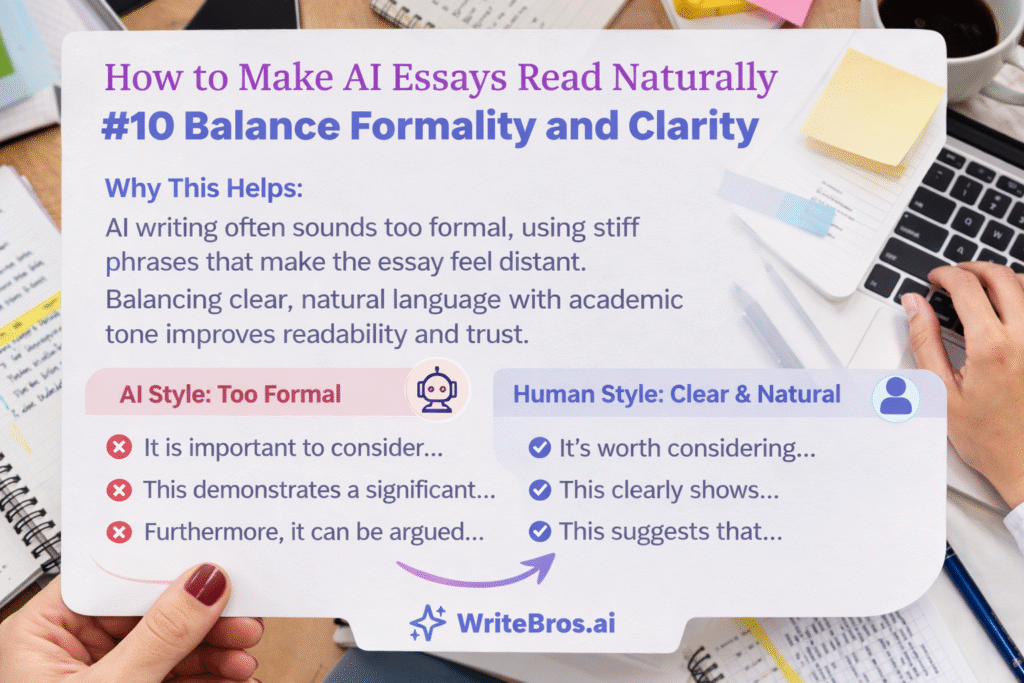
How to Make AI Essays Read Naturally – Strategy #10: Balance formality and clarity
AI essays frequently sound overly formal because the system attempts to maintain a consistently academic tone throughout the draft. Making AI essays read naturally requires balancing that formality with clearer, more approachable language that still respects the expectations of academic writing. The goal is not to make the essay casual but to ensure that the language remains clear and readable.
During revision, students may notice that certain phrases sound unnecessarily rigid even though the underlying idea is straightforward. Rewriting those lines with clearer phrasing can preserve academic precision while removing the stiffness that signals automated text. When clarity replaces rigid formality, the essay begins to sound more like thoughtful academic writing rather than a machine-produced document.
How to Make AI Essays Read Naturally – Strategy #11: Break paragraph patterns
AI-generated essays frequently organize paragraphs using nearly identical structures, beginning with a general claim and then following the same predictable sequence of explanation and conclusion. To make AI essays read naturally, writers should occasionally rearrange how ideas unfold within the paragraph so that the structure feels less formulaic. Allowing the discussion to evolve in slightly different ways across sections creates a more organic reading experience.
Human writing often develops ideas gradually, sometimes beginning with context before introducing the main claim or exploring evidence before drawing a conclusion. A student revising an AI paragraph might open with a descriptive observation that leads naturally into the argument rather than presenting the thesis immediately. These structural variations help the essay feel less like a repeated template and more like authentic reasoning.
How to Make AI Essays Read Naturally – Strategy #12: Remove filler language
AI systems frequently insert filler phrases that extend sentences without contributing meaningful information to the argument. Writers who want to make AI essays read naturally should carefully identify these vague expressions and replace them with clearer language that directly communicates the idea. Removing filler immediately tightens the prose and strengthens the clarity of the paragraph.
During revision it becomes easier to notice filler when a sentence seems longer than necessary but does not add additional explanation or evidence. A student might remove several vague expressions and replace them with one concise phrase that conveys the same point more clearly. The result is writing that feels deliberate and focused rather than padded with unnecessary language.
How to Make AI Essays Read Naturally – Strategy #13: Improve logical flow
AI essays sometimes present ideas in a sequence that technically follows the topic but lacks the natural progression found in thoughtful human writing. Making AI essays read naturally requires reorganizing sentences so that each idea grows logically from the one before it. When the argument unfolds smoothly, the essay becomes easier to follow and more convincing.
Students revising AI-generated drafts often discover that small adjustments in order can dramatically improve clarity. Moving an explanatory sentence earlier in the paragraph may help establish context before introducing a claim. Once the ideas follow a clearer progression, the writing feels intentional rather than algorithmically assembled.
How to Make AI Essays Read Naturally – Strategy #14: Adjust emphasis and pacing
AI writing tends to distribute emphasis evenly across sentences, which can make important points blend into surrounding explanations. Writers aiming to make AI essays read naturally should reposition key ideas so they appear in stronger locations within the sentence or paragraph. This adjustment guides the reader’s attention and helps the argument feel more purposeful.
Human writers naturally highlight certain ideas by allowing them to appear at the end of a sentence or at the beginning of a new paragraph. A student revising an AI essay might move the central insight to the final position of a sentence so that it lingers with the reader. Over time these adjustments create a rhythm that emphasizes meaning rather than simply presenting information.
How to Make AI Essays Read Naturally – Strategy #15: Perform a final language polish
The final step in learning how to make AI essays read naturally involves carefully reviewing the entire draft for tone consistency and flow. Even after structural revisions, small language adjustments can refine the overall voice so that the essay reads smoothly from beginning to end. This final pass focuses on clarity, pacing, and natural phrasing.
Students often benefit from reading the essay slowly and listening for sections that still feel overly mechanical or repetitive. Revising those lines with slightly different wording can smooth the transitions between paragraphs and reinforce the natural voice developed during earlier edits. By the end of this process the essay begins to resemble a thoughtfully written human draft rather than an AI-generated starting point.
Common mistakes
- Many writers assume that simply running an AI essay through a paraphrasing tool will automatically make it sound natural, yet this shortcut rarely works because paraphrasers often replace words without addressing deeper structural patterns that reveal machine-generated writing.
- Another frequent mistake occurs when students only edit a few sentences at the beginning of the essay while leaving the rest of the draft unchanged, which means the underlying patterns of repetitive phrasing and uniform sentence rhythm remain visible throughout the document.
- Some writers attempt to solve the problem by inserting complex vocabulary or technical terminology, believing that sophisticated language will disguise AI writing, but this strategy usually produces paragraphs that feel even more unnatural and difficult to read.
- A common editing error involves leaving AI transition phrases intact across several paragraphs, which creates a rigid progression of ideas that feels more like a generated outline than a carefully written academic argument.
- Writers also sometimes focus exclusively on sentence-level edits while ignoring the overall flow of the essay, which allows the broader structural patterns typical of AI writing to remain unchanged and noticeable.
- Another problem appears when students attempt to manually edit every sentence without stepping back to read the entire essay, which can lead to inconsistent tone and pacing across sections.
Edge cases
Some AI-generated essays already contain relatively natural phrasing because the prompt used to create them included detailed instructions or stylistic examples. In those cases the writing may appear closer to human language, yet subtle patterns such as repeated sentence structures or overly tidy transitions can still appear across paragraphs.
Another edge case occurs when a writer heavily edits an AI draft but accidentally introduces new inconsistencies in tone. Maintaining a consistent academic voice across revisions requires careful reading and gradual adjustments rather than large rewrites performed all at once.
Supporting tools
- Grammarly can help identify awkward phrasing or grammar inconsistencies that appear in AI-generated drafts, giving writers a clearer starting point for editing sentences that feel unnatural or overly rigid.
- QuillBot offers paraphrasing modes that can suggest alternative phrasing, which may help writers explore different ways of expressing an idea before refining the language manually.
- Hemingway Editor highlights sentences that are overly complex or difficult to read, allowing students to simplify sections of AI writing that sound dense or mechanical.
- Google Docs readability and grammar suggestions provide lightweight feedback that helps identify sections of text that feel repetitive or structurally awkward.
- LanguageTool offers additional grammar and style checks that can reveal patterns typical of AI writing, especially when multiple paragraphs follow identical structures.
- WriteBros.ai provides rewriting assistance designed to help refine AI-generated drafts so that tone, pacing, and language patterns resemble natural human writing.
Ready to Transform Your AI Content?
Try WriteBros.ai and make your AI-generated content truly human.
Conclusion
Learning how to make AI essays read naturally begins with recognizing the language patterns that make automated writing feel mechanical. When writers adjust sentence rhythm, vary structure, and refine vocabulary, the essay gradually transforms into a document that reflects thoughtful human reasoning rather than predictable algorithmic phrasing.
Perfect editing is not the goal because natural writing contains small irregularities that give it character and authenticity. Focusing on clarity, flow, and balanced structure allows students to turn AI drafts into essays that communicate ideas clearly while maintaining a voice that feels genuinely human.
Did You Know?
Writers trying to make AI essays read naturally often begin with synonym swaps, yet that usually leaves the draft sounding machine-made. When the same sentence rhythm, paragraph pattern, and tidy transition logic stay in place, the essay can still feel artificial even after heavy editing.
The stronger improvement usually comes from revising how the language moves, because readers notice flow before they notice individual word choices. More sentence variety, cleaner emphasis, and less predictable phrasing usually make AI-generated essays feel more human, more readable, and much easier to trust.
Ready to Transform Your AI Content?