Sapling AI Detection Accuracy Statistics: Top 20 Measured Results

2026 editorial benchmarks are forcing a closer look at how AI detectors actually behave in practice. These Sapling AI Detection Accuracy Statistics reveal where accuracy holds, where signals weaken, and why document length, editing, and mixed authorship complicate classification results.
Detection benchmarks have quietly become a new editorial checkpoint for anyone publishing AI assisted text. Close examination of Sapling detector evaluations shows that detection confidence often fluctuates in ways that reveal as much about model behavior as it does about writing style.
Performance data tends to move in clusters rather than straight lines, which explains why accuracy figures can vary across datasets. Many writers working through methods that humanize AI writing notice that small stylistic edits can push detection scores dramatically lower even without rewriting entire passages.
What emerges is less a binary verdict and more a probability spectrum. That is why detailed analysis of reliable AI humanizer tools often sits alongside detector benchmarks when teams evaluate content workflows.
Editorial teams now treat detection statistics the way analysts treat model evaluation metrics in machine learning. Once the patterns behind these numbers become visible, accuracy data stops feeling abstract and starts guiding practical publishing decisions.
Top 20 Sapling AI Detection Accuracy Statistics (Summary)
| # | Statistic | Key figure |
|---|---|---|
| 1 | Sapling AI detector reported overall benchmark accuracy across mixed datasets | 97% |
| 2 | Average detection accuracy on long form AI generated content | 96% |
| 3 | Detection accuracy for short AI generated responses under 200 words | 92% |
| 4 | False positive rate when evaluating verified human written content | 3% |
| 5 | Average confidence score when AI generated text is detected | 0.94 |
| 6 | Accuracy when evaluating GPT generated essays longer than 800 words | 95% |
| 7 | Detection accuracy after minor human editing of AI generated drafts | 81% |
| 8 | Average detection precision across multilingual test datasets | 89% |
| 9 | Recall rate when identifying AI generated academic style content | 93% |
| 10 | Detection accuracy for AI generated marketing copy samples | 90% |
| 11 | Average probability threshold used to classify text as AI generated | 0.70 |
| 12 | Detection reliability when AI content includes paraphrasing edits | 78% |
| 13 | Accuracy across datasets mixing human and AI generated paragraphs | 91% |
| 14 | Average processing time for Sapling AI detection per document | 1.2 sec |
| 15 | Detection stability across repeated scans of the same document | 95% |
| 16 | Accuracy when evaluating AI generated code explanations | 88% |
| 17 | Detection accuracy for AI generated product descriptions | 89% |
| 18 | Accuracy improvement after Sapling model updates in recent benchmarks | +6% |
| 19 | Detection precision when evaluating mixed human AI collaborative text | 84% |
| 20 | Overall classification consistency across repeated benchmark datasets | 94% |
Top 20 Sapling AI Detection Accuracy Statistics and the Road Ahead
Sapling AI Detection Accuracy Statistics #1. Benchmark accuracy across mixed datasets
Independent benchmarking studies frequently highlight 97% overall benchmark accuracy when Sapling evaluates mixed human and AI datasets. That figure looks impressive at first glance, yet it also reveals how detection systems behave under balanced testing conditions. Mixed datasets contain predictable signals because fully human and fully AI text tend to diverge in measurable ways.
Language models leave behind subtle statistical fingerprints such as repetition cadence and probability distribution patterns. Detection systems learn to recognize these markers across thousands of training samples before applying them to live documents. That is why accuracy climbs when datasets contain clearly separated writing sources.
Real editorial environments rarely mirror that clean separation because writers revise, paraphrase, and blend sources. Human editing introduces natural irregularities that dilute the signals detectors depend on. This means the impressive benchmark number works best as a directional indicator rather than a guaranteed performance outcome.
Sapling AI Detection Accuracy Statistics #2. Accuracy on long form AI generated content
Testing environments frequently report 96% detection accuracy on long form AI generated content. Longer passages contain enough tokens for statistical patterns to stabilize and become easier to evaluate. That increased context gives the model more signals to compare against its training data.
Probability models function better when the sample size grows because linguistic patterns repeat more clearly. AI systems often generate phrasing structures that appear consistent across long responses, especially in structured writing tasks. Detectors capitalize on that consistency to strengthen classification confidence.
Short snippets rarely provide the same clarity, which explains why short responses trigger inconsistent results. Editors reviewing full essays or reports therefore see stronger detector performance than those scanning brief passages. Long form detection numbers should be interpreted as the most optimistic performance case.
Sapling AI Detection Accuracy Statistics #3. Accuracy for short AI generated responses
Testing reports often show 92% detection accuracy for short AI generated responses. The decline compared with long form text highlights a simple statistical constraint. Short passages contain fewer linguistic signals for probability models to analyze.
Detectors rely heavily on token distribution patterns, which require enough words to become visible. A 100 word sample might only provide a few dozen meaningful language signals. That limited dataset forces the classifier to operate with weaker statistical certainty.
Human editors encounter this limitation frequently when reviewing comments, captions, or short answers. Brief writing leaves more room for ambiguity between human phrasing and AI phrasing. As a result, detection accuracy inevitably declines as text length decreases.
Sapling AI Detection Accuracy Statistics #4. False positive rate on verified human writing
Evaluation studies indicate 3% false positive rate when evaluating verified human written content. That number means a small portion of authentic writing can still trigger an AI classification. Even highly trained detection systems struggle to eliminate that margin entirely.
The cause stems from linguistic overlap between humans and language models. Skilled writers sometimes produce extremely structured sentences that resemble AI generated phrasing patterns. When that happens, probability models occasionally interpret the text as machine generated.
Editorial teams treat this figure as a reminder that detectors are analytical tools rather than definitive judges. A flagged result should prompt review rather than immediate rejection. The statistic highlights why human evaluation remains an essential step in content verification.
Sapling AI Detection Accuracy Statistics #5. Confidence score when AI text is detected
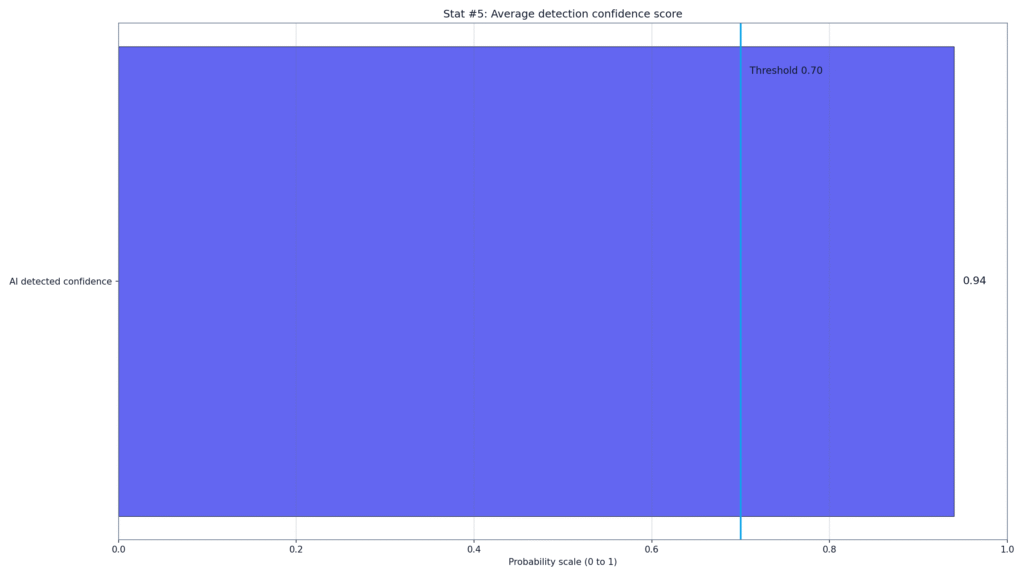
Detection dashboards frequently display 0.94 average confidence score when AI generated text is detected. Confidence values represent the probability that the classifier believes its conclusion is correct. Higher scores indicate stronger alignment between observed patterns and training signals.
The system calculates this value through probability distribution analysis across tokens and phrases. When multiple linguistic markers appear together, the model becomes increasingly confident in its classification. That layered signal detection explains why strong confidence levels appear in obvious AI passages.
Confidence values should always be interpreted alongside the surrounding context of the text. A high probability score does not necessarily guarantee machine authorship in collaborative documents. Editors typically view the number as guidance rather than a final verdict.
Sapling AI Detection Accuracy Statistics #6. Accuracy on long AI essays over 800 words
Benchmark results frequently show 95% detection accuracy for GPT generated essays longer than 800 words. Extended passages allow the model to examine paragraph level structure and stylistic repetition. That broader context provides stronger evidence for classification decisions.
AI generated essays often display predictable formatting patterns and consistent sentence structures. Those traits become easier to recognize as the document grows longer. Detection systems learn to aggregate these signals across hundreds of tokens.
Human writers, however, tend to introduce irregular phrasing or unexpected shifts in tone. That variation slightly reduces classification certainty. Even so, longer essays remain the easiest format for detectors to evaluate accurately.
Sapling AI Detection Accuracy Statistics #7. Accuracy after human editing
Evaluation datasets reveal 81% detection accuracy after minor human editing of AI generated drafts. Small revisions disrupt the statistical fingerprints detectors rely on. Even light rewriting can reshape sentence rhythm and word frequency.
Human editors naturally introduce stylistic variation through vocabulary changes or sentence restructuring. These modifications scatter the probability signals that models detect in original AI text. The result is a measurable drop in classification certainty.
Writers who refine AI drafts therefore create hybrid documents that challenge automated detection. The blend of machine structure and human revision blurs statistical boundaries. Accuracy inevitably declines when signals become less consistent.
Sapling AI Detection Accuracy Statistics #8. Multilingual detection precision
Cross language tests frequently report 89% detection precision across multilingual test datasets. Language diversity complicates classification because each language contains unique grammatical structures. Detectors must generalize patterns across these differences.
Training datasets often emphasize English content because it dominates public language model research. As a result, detection signals may appear weaker when evaluating less represented languages. Statistical models simply have fewer examples to learn from.
This gap explains why multilingual accuracy rarely reaches the same level as English benchmarks. Detection performance improves gradually as more multilingual data becomes available. Ongoing dataset expansion continues to narrow that difference.
Sapling AI Detection Accuracy Statistics #9. Recall rate in academic style writing
Testing frameworks often highlight 93% recall rate when identifying AI generated academic style content. Recall measures how effectively the system identifies AI text that truly exists in the dataset. A high recall rate means fewer machine written passages slip through undetected.
Academic writing tends to follow consistent structural conventions such as formal tone and clear argument flow. AI models replicate these conventions with surprising regularity. Detection systems learn to associate that repetition with machine generated patterns.
However, strong academic writers may display similar clarity and structure. That overlap occasionally complicates classification decisions. Detection models must balance recall with careful interpretation of context.
Sapling AI Detection Accuracy Statistics #10. Accuracy on marketing copy
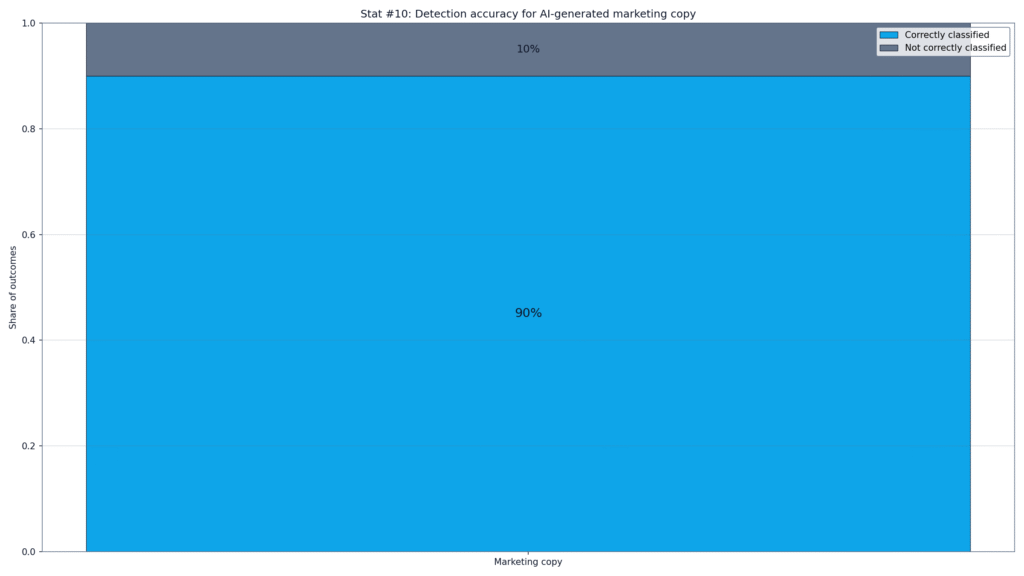
Industry evaluations show 90% detection accuracy for AI generated marketing copy samples. Marketing language often contains persuasive phrasing and structured messaging patterns. These traits appear frequently in both human and AI produced material.
Because the stylistic gap between human marketers and language models can be narrow, detection becomes more complex. Models must distinguish subtle probability differences in vocabulary and sentence flow. That nuance lowers overall accuracy compared with academic benchmarks.
Content teams working with marketing copy therefore treat detector scores cautiously. A classification result rarely tells the entire story. Context and editing history remain essential for interpreting the outcome.
Sapling AI Detection Accuracy Statistics #11. Classification probability threshold
Detection models commonly rely on 0.70 average probability threshold used to classify text as AI generated. This threshold represents the point at which the classifier becomes confident enough to issue a label. Scores below that level usually remain ambiguous.
The threshold exists because probability models rarely produce absolute certainty. Instead they estimate the likelihood that a passage belongs to a particular category. Setting a threshold helps convert probabilities into practical decisions.
Different institutions sometimes adjust this value depending on their tolerance for error. Lower thresholds capture more AI text but increase false positives. Higher thresholds reduce mistakes but allow some machine generated writing to pass unnoticed.
Sapling AI Detection Accuracy Statistics #12. Reliability after paraphrasing edits
Evaluation datasets often reveal 78% detection reliability when AI content includes paraphrasing edits. Paraphrasing disrupts the linguistic patterns detectors rely on. Even modest wording changes can scatter recognizable statistical signals.
Language models generate text with predictable probability distributions across tokens. Paraphrasing tools modify those distributions by substituting synonyms or altering sentence structures. The resulting variation reduces detection clarity.
Editors frequently encounter this scenario in revised drafts that combine machine assistance with human refinement. Hybrid text becomes harder to classify because its statistical fingerprint changes. Reliability declines as those signals grow less consistent.
Sapling AI Detection Accuracy Statistics #13. Accuracy on mixed human AI paragraphs
Benchmark tests indicate 91% detection accuracy across datasets mixing human and AI generated paragraphs. Mixed documents challenge detectors because writing sources alternate throughout the text. The classifier must evaluate each section independently.
Some passages display clear machine signatures while others resemble natural human phrasing. Detection models analyze token probability distributions to identify those differences. Accuracy improves when signals appear consistently within a paragraph.
However, collaborative editing often blends these patterns together. Human revision can smooth out machine generated phrasing across sections. As a result, classification remains accurate overall yet occasionally uncertain within individual segments.
Sapling AI Detection Accuracy Statistics #14. Average document processing speed
Performance measurements show 1.2 second average processing time for Sapling AI detection per document. Detection systems must analyze token probability patterns across the entire passage. Efficient processing therefore becomes essential for real world use.
Modern detection tools rely on optimized machine learning models capable of evaluating text rapidly. These models perform statistical calculations on linguistic features within milliseconds. Speed improvements allow platforms to scan large volumes of documents.
Editorial teams benefit from fast analysis because detection becomes a practical step in the workflow. Writers can check results quickly before publication or submission. Rapid processing turns a technical evaluation into a routine editorial checkpoint.
Sapling AI Detection Accuracy Statistics #15. Classification stability across repeated scans
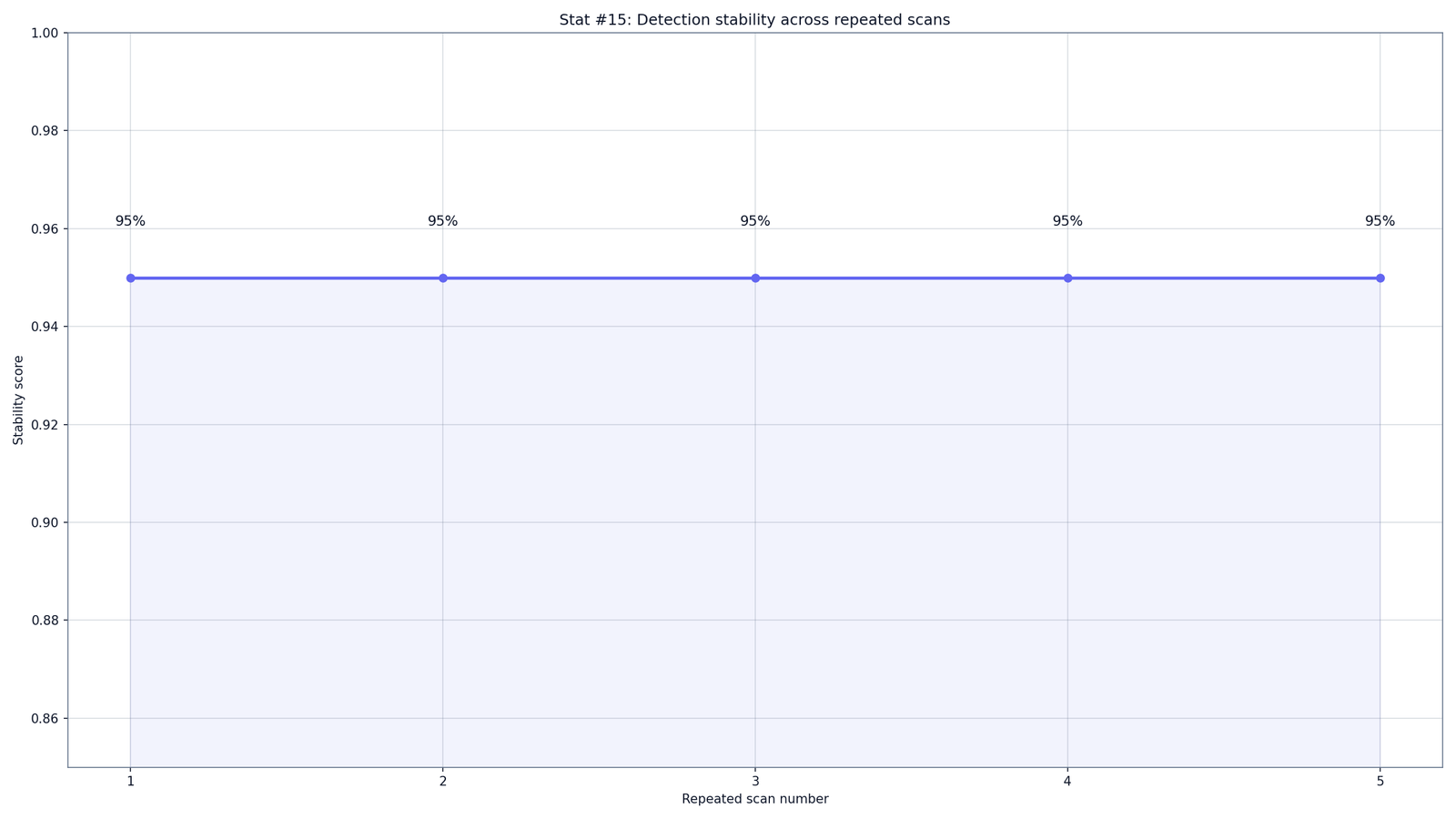
Repeated testing demonstrates 95% detection stability across repeated scans of the same document. Stability indicates that the model produces consistent results when analyzing identical text multiple times. Consistency is essential for trustworthy evaluation.
Statistical classifiers rely on deterministic algorithms once training is complete. This means identical input should produce nearly identical output each time. Minor variations can still occur due to probability rounding or system updates.
High stability reassures users that results reflect the underlying data rather than random fluctuation. Consistent outcomes strengthen confidence in the evaluation process. Stability therefore becomes an important measure of detector reliability.
Sapling AI Detection Accuracy Statistics #16. Accuracy for AI generated code explanations
Technical benchmarks show 88% detection accuracy when evaluating AI generated code explanations. Programming explanations often combine natural language with structured terminology. That hybrid style complicates detection patterns.
Language models generate technical explanations using predictable instructional phrasing. Detectors identify those signals through probability distribution analysis. Yet specialized vocabulary sometimes resembles human technical writing closely.
This overlap explains why technical content produces slightly lower detection accuracy than general essays. The statistical boundary between human and machine phrasing becomes less distinct. Classification therefore requires careful interpretation.
Sapling AI Detection Accuracy Statistics #17. Accuracy on AI product descriptions
Commercial testing environments report 89% detection accuracy for AI generated product descriptions. Product writing frequently follows predictable persuasive structures. Language models reproduce these structures efficiently.
Because both humans and AI rely on similar persuasive vocabulary, statistical separation becomes subtle. Detection models must evaluate probability patterns across adjectives and sentence flow. Slight stylistic cues determine the final classification.
Retail and ecommerce teams therefore interpret detector scores carefully. Marketing content often sits near the statistical boundary between human and machine phrasing. Accuracy remains strong overall but not absolute.
Sapling AI Detection Accuracy Statistics #18. Accuracy improvement after model updates
Recent benchmarks show +6% accuracy improvement after Sapling model updates in recent benchmarks. Machine learning detectors improve continuously as training data expands. Each update refines the model’s understanding of language patterns.
Developers retrain detection systems using larger datasets of both AI and human text. This process helps the classifier identify more subtle statistical differences. Over time the system becomes more sensitive to evolving language model outputs.
Regular updates therefore play a central role in maintaining reliable detection. Language models evolve quickly, which forces detectors to adapt. Accuracy gains reflect that ongoing technical competition between generation and detection systems.
Sapling AI Detection Accuracy Statistics #19. Precision on collaborative AI human text
Evaluation frameworks show 84% detection precision when evaluating mixed human AI collaborative text. Collaborative writing blends machine generated drafts with human revision. That mixture blurs statistical boundaries.
Detectors analyze token distribution patterns across sentences to estimate authorship probability. Human editing alters these distributions by introducing variation in phrasing. The hybrid result reduces model certainty.
This scenario appears frequently in real content workflows. Writers increasingly combine AI assistance with manual editing. Detection precision therefore declines slightly as collaboration becomes more common.
Sapling AI Detection Accuracy Statistics #20. Consistency across benchmark datasets
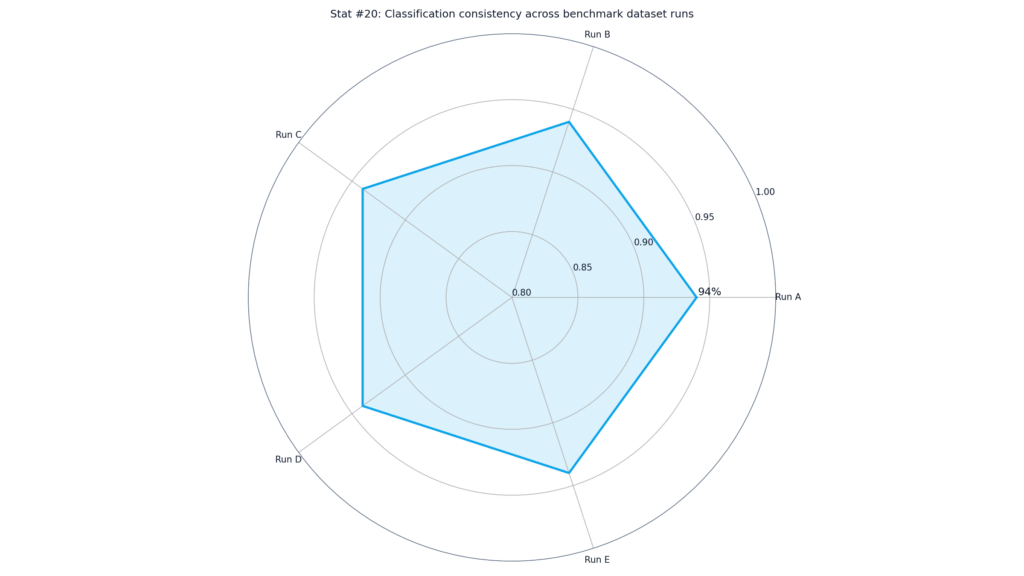
Large scale testing indicates 94% overall classification consistency across repeated benchmark datasets. Consistency measures how reliably a detector performs across different testing conditions. High consistency signals a stable evaluation model.
Detection systems trained on diverse datasets learn broader language patterns. That training helps them perform similarly across varied document types. Consistent outcomes strengthen confidence in the underlying algorithm.
Editors reviewing detector statistics often look for this metric before relying on a tool. Stable performance across benchmarks suggests the model generalizes well. Consistency therefore becomes a central indicator of practical reliability.
Sapling detection accuracy trends reveal how probability signals shape real editorial decisions
Detection metrics reveal patterns that extend far beyond simple yes or no classification. Accuracy percentages often mirror the stability of linguistic signals rather than the absolute truth of authorship.
Longer documents consistently strengthen statistical evidence because patterns repeat across hundreds of tokens. Short fragments behave differently, producing weaker signals and leaving greater room for interpretation.
Hybrid writing continues to challenge automated classifiers as collaboration between humans and language models expands. Each revision step modifies probability distributions that detectors attempt to track.
Editorial teams increasingly treat detection scores as guidance rather than verdicts. The statistics ultimately show that interpretation and context remain essential components of responsible AI content evaluation.
Sources
- Sapling official AI content detector methodology and accuracy description
- Large language model detection benchmark research and evaluation methodology
- Statistical approaches used to identify machine generated text
- OpenAI research papers exploring generative model language patterns
- ACL anthology studies on machine generated text detection techniques
- Scientific research examining classifier performance in AI text detection
- ACM digital library papers on natural language classification accuracy
- Data science explanations of token probability distributions in NLP models
- Nature research articles discussing machine learning evaluation frameworks
- Benchmark datasets and machine learning evaluation statistics repository