Student Behavior Around AI Writing Tools: Top 20 Observed Patterns

2026 classrooms reveal a quiet transformation in how students write. These statistics examine student behavior around AI writing tools, showing how drafting, editing, research, and revision habits are changing as automated assistance becomes embedded in everyday academic workflows.
Patterns in classrooms now reveal that writing workflows no longer move in straight lines from draft to revision. Instead, many assignments cycle through prompts, rewrites, and edits that blur the boundary between assistance and authorship.
Careful observation of signals students may be over-relying on AI shows that these habits rarely appear suddenly, which makes early monitoring valuable.
Teachers increasingly treat AI-assisted drafting as a behavioral pattern rather than a one-time shortcut. That perspective helps explain why guidance like humanize AI lesson plans frameworks continues to appear in curriculum design discussions.
Technology adoption rarely spreads evenly, and writing tools are no exception. Some classrooms experiment cautiously, while others lean on tools that promise quick editing or rewriting.
In those cases, awareness of best AI humanizer tools for teaching materials becomes a practical checkpoint when evaluating how students adapt to automated writing support.
Behavioral patterns around writing tools reveal subtle signals long before formal policies change. Tracking those signals helps educators interpret whether AI use improves learning outcomes or quietly reshapes how assignments are completed.
Top 20 Student Behavior Around AI Writing Tools (Summary)
| # | Statistic | Key figure |
|---|---|---|
| 1 | Students who report using AI tools for drafting essays | 58% |
| 2 | Students who revise AI-generated text before submission | 72% |
| 3 | Students who rely on AI for brainstorming ideas | 63% |
| 4 | Students who say AI improves writing confidence | 54% |
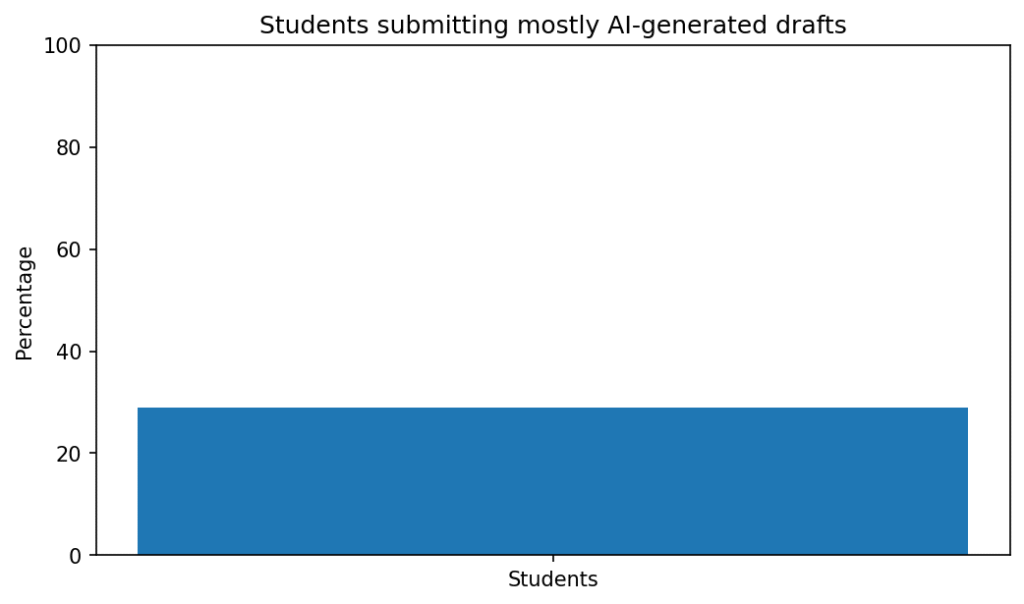
| 5 | Students who admit submitting mostly AI-generated drafts | 29% |
| 6 | Students who use AI tools weekly for coursework | 66% |
| 7 | Students who use AI primarily for grammar correction | 61% |
| 8 | Students who say AI speeds up assignment completion | 74% |
| 9 | Students who edit AI text multiple times before submitting | 48% |
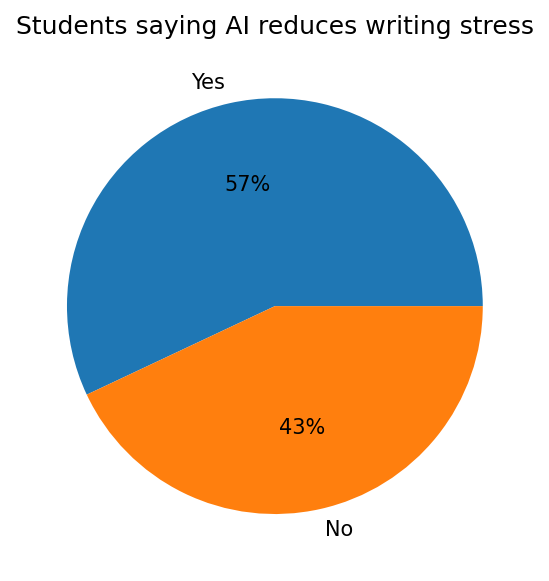
| 10 | Students who feel AI tools reduce writing stress | 57% |
| 11 | Students who compare AI outputs before choosing a version | 34% |
| 12 | Students who combine AI output with their own writing | 69% |
| 13 | Students who use AI tools mainly during deadlines | 52% |
| 14 | Students who check AI text for accuracy after generation | 46% |
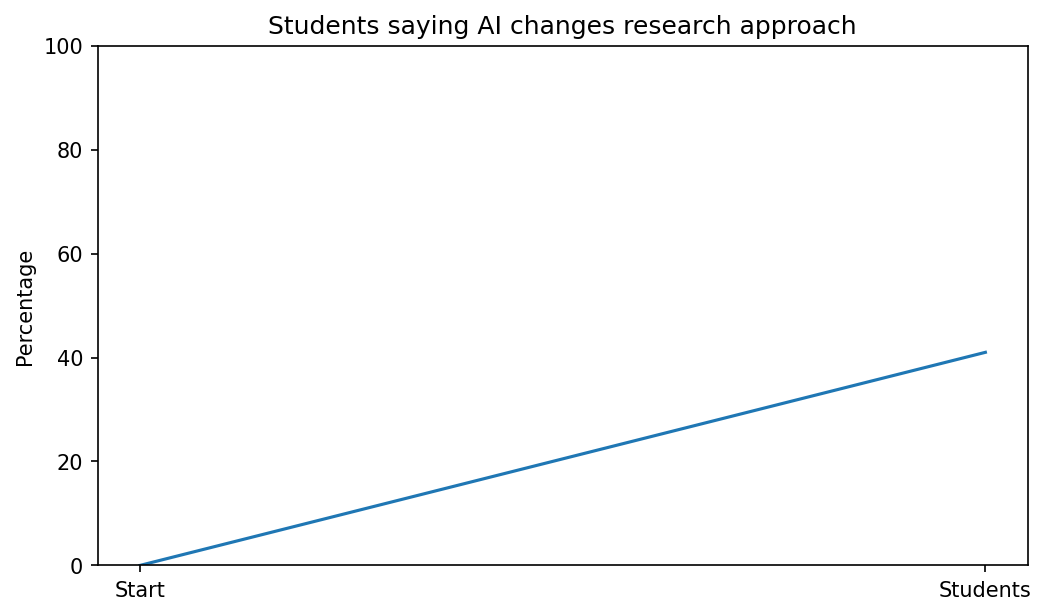
| 15 | Students who feel AI changes how they approach research | 41% |
| 16 | Students who say AI tools improve editing speed | 68% |
| 17 | Students who rely on AI suggestions for structure | 55% |
| 18 | Students who feel AI helps overcome writer’s block | 64% |
| 19 | Students who worry teachers can detect AI use | 47% |
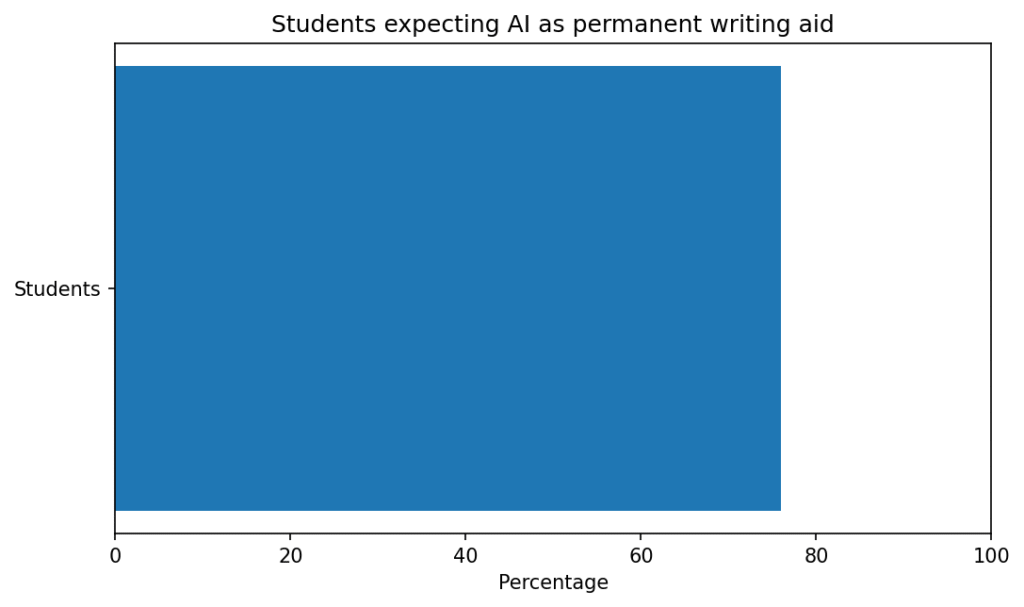
| 20 | Students who believe AI will become a permanent writing aid | 76% |
Top 20 Student Behavior Around AI Writing Tools and the Road Ahead
Student Behavior Around AI Writing Tools #1. Students using AI for essay drafts
Classroom writing routines have begun to change in quiet but measurable ways. Surveys indicate that 58% of students now report using AI tools at least once during the process of drafting essays or written assignments. What stands out is not only the percentage itself but the way these tools appear early in the writing workflow rather than at the editing stage.
The pattern reflects a shift in how students approach blank pages and early brainstorming phases. AI systems can generate a structured outline or starter paragraphs in seconds, which reduces the initial cognitive load of writing. That convenience gradually reshapes behavior, turning AI from an occasional experiment into a default drafting companion.
Human writers historically approached essays through slow idea development, rough notes, and multiple partial drafts before shaping a final argument. With AI assistance, the first visible draft can already appear polished, which creates the illusion of efficiency even when deeper thinking still needs to occur. Educators interpreting this statistic often treat it as an indicator that writing instruction must increasingly emphasize revision and reasoning rather than first-draft production.
Student Behavior Around AI Writing Tools #2. Students revising AI-generated text
Writing behaviors rarely stop at simple generation of text. Research suggests that 72% of students say they revise or modify AI-generated passages before submitting their assignments. That figure highlights a reality that differs from early fears of students copying outputs verbatim.
Revision becomes necessary because AI text often sounds generic, overly polished, or detached from personal perspective. Students instinctively tweak tone, insert examples, or rearrange sentences so the writing better fits the assignment prompt. The process resembles editing a collaborative draft rather than accepting a finished answer.
Traditional writing once required students to produce original drafts from scratch before refining them. AI introduces a reversed sequence in which editing may appear before true composition. This statistic therefore signals an important implication for educators who must now evaluate how revision skills evolve when the first draft originates from software rather than the student’s own initial thinking.
Student Behavior Around AI Writing Tools #3. Students using AI for brainstorming
Idea generation has quietly become one of the most common entry points for AI tools. Surveys show that 63% of students use AI systems to brainstorm topics, arguments, or outlines before writing a paper. In practice, that behavior resembles consulting an always-available brainstorming partner.
Students often enter prompts asking for potential essay angles or example thesis statements. AI then returns multiple options, which gives learners a menu of directions to evaluate. The convenience removes some of the uncertainty that traditionally accompanied early research stages.
Human brainstorming used to depend on peer discussions, instructor feedback, or extended reading sessions. AI compresses that exploration into seconds, which alters how quickly students move from topic discovery to drafting. The implication is subtle but meaningful: idea evaluation skills may become more important than idea generation itself.
Student Behavior Around AI Writing Tools #4. Students reporting improved confidence
Confidence in writing often rises when tools reduce uncertainty during early drafts. Studies suggest that 54% of students believe AI assistance improves their confidence when starting written assignments. That perception alone can influence how frequently they return to the tool.
AI systems provide instant feedback, alternative phrasing, and example structures that reduce the fear of producing imperfect drafts. Students therefore feel less pressure during the earliest stages of writing. Over time, that reassurance can transform hesitation into experimentation.
Historically, writing confidence developed slowly through practice and instructor comments. AI compresses that feedback cycle by offering suggestions instantly. The implication for educators is that confidence may rise quickly, though distinguishing between genuine skill growth and tool-supported reassurance becomes more complicated.
Student Behavior Around AI Writing Tools #5. Students submitting mostly AI-generated drafts
Not every student uses AI tools purely as a starting point. Data shows that 29% of students acknowledge submitting assignments that remain largely unchanged from the AI output. This group represents a smaller but significant behavioral category.
The cause often relates to time pressure or unfamiliarity with revision strategies. When deadlines approach quickly, accepting AI text with minimal editing becomes an appealing shortcut. The temptation grows stronger when the generated content appears grammatically polished.
Human writing traditionally revealed gradual development of ideas and voice across multiple revisions. AI-generated drafts can hide that developmental process, presenting a finished tone immediately. For educators, this statistic signals the importance of assignments that require process documentation rather than evaluating only the final written product.
Student Behavior Around AI Writing Tools #6. Students using AI weekly
Regular interaction with AI writing systems has become part of the academic routine. Surveys indicate that 66% of students now use AI tools at least once per week while completing coursework. That frequency signals a shift from experimentation toward habit.
The underlying cause lies in how quickly students recognize the time savings involved. AI tools can summarize readings, outline essays, or suggest revisions in seconds. Once those efficiencies become familiar, students tend to incorporate the tools into their weekly study patterns.
Before AI, writing assistance mainly came from tutors, classmates, or instructor office hours. AI introduces a continuous support system that remains accessible at any moment. As a result, the statistic reflects a behavioral shift in which writing support becomes automated rather than socially mediated.
Student Behavior Around AI Writing Tools #7. AI used mainly for grammar correction
Many students still frame AI writing tools as editing assistants rather than full content generators. Data suggests that 61% of students primarily use these tools to correct grammar or refine sentence structure. This behavior resembles earlier reliance on spell-check software.
Grammar corrections appear less ethically complicated than generating entire paragraphs. Students often feel comfortable asking AI to polish wording or clarify awkward phrasing. That limited use positions the tool as an advanced proofreading partner.
Traditional proofreading relied on rereading drafts slowly or asking peers to review papers. AI accelerates that process by identifying issues instantly. The implication is that editing cycles become faster, though students may rely less on careful self-review over time.
Student Behavior Around AI Writing Tools #8. AI speeding assignment completion
Efficiency remains the most frequently cited benefit of AI writing systems. Surveys report that 74% of students believe AI tools significantly speed up the completion of writing assignments. That perception alone explains much of the technology’s rapid adoption.
Students can generate outlines, draft sections, and revise wording within minutes. The time saved encourages repeated use during busy academic weeks. Over time, efficiency becomes the primary incentive for continued reliance.
Human writing once required extended drafting sessions spread across several hours or days. AI compresses many of those steps into short bursts of interaction. This statistic therefore highlights a behavioral transformation in which writing becomes more iterative but also more tool-dependent.
Student Behavior Around AI Writing Tools #9. Students editing AI text multiple times
Editing remains an essential stage even when AI generates initial drafts. Research shows that 48% of students revise AI-generated passages several times before final submission. This pattern suggests that students treat AI text as a flexible starting point.
AI output rarely matches assignment requirements perfectly on the first attempt. Students frequently adjust tone, add examples, or remove generic phrases. The process becomes a cycle of prompting, editing, and reviewing.
Human drafts traditionally evolved through slow rewriting across multiple revisions. AI allows students to iterate rapidly within a single writing session. The implication is that revision frequency may increase even as the original draft increasingly originates from software.
Student Behavior Around AI Writing Tools #10. AI reducing writing stress
Writing anxiety has long affected students facing complex assignments. Surveys reveal that 57% of students feel AI writing tools reduce the stress associated with academic writing tasks. The presence of an instant helper changes how assignments feel psychologically.
Students can test ideas or request clarifications without worrying about judgment. AI responses appear neutral and immediate, which encourages experimentation. That environment lowers the emotional barrier that sometimes prevents students from beginning a draft.
Historically, writing stress often stemmed from uncertainty about expectations or structure. AI tools provide quick examples that clarify how a response might look. The implication is that emotional comfort increases, though reliance on AI explanations may gradually influence independent problem-solving habits.
Student Behavior Around AI Writing Tools #11. Comparing multiple AI outputs
Students sometimes approach AI tools the way researchers compare sources. Data shows that 34% of students generate multiple AI responses before selecting the version they prefer. This behavior reflects a growing awareness that AI outputs vary widely.
Different prompts or phrasing can produce different results. Students learn through experience that experimenting with prompts improves output quality. That experimentation introduces a new skill sometimes called prompt iteration.
Traditional writing required evaluating multiple academic sources or references. AI expands that comparison process to include machine-generated alternatives. The implication is that evaluation skills now apply not only to human sources but also to algorithmic responses.
Student Behavior Around AI Writing Tools #12. Combining AI output with personal writing
Most students integrate AI suggestions with their own ideas rather than replacing them entirely. Surveys indicate that 69% of students combine AI-generated text with sentences they write themselves. The resulting drafts often blend machine suggestions with personal interpretation.
This hybrid approach emerges because AI can provide structure but not always personal voice. Students therefore adapt or rewrite sections to better reflect their own perspective. The combination produces writing that feels partially automated yet partially original.
Historically, collaboration in writing occurred between classmates or research partners. AI introduces a new kind of collaborator that contributes suggestions rather than opinions. The implication is that authorship increasingly resembles a dialogue between student and software.
Student Behavior Around AI Writing Tools #13. AI use increasing during deadlines
Deadlines strongly influence how frequently students rely on writing technology. Studies show that 52% of students turn to AI tools most heavily when assignments approach their final due date. Pressure often intensifies the appeal of rapid assistance.
AI systems can generate summaries, outlines, or revised paragraphs quickly when time runs short. Students recognize that the tool offers immediate productivity during stressful periods. That practical advantage explains why usage spikes late in the writing process.
Before AI adoption, deadline pressure often produced rushed drafts written quickly without much revision. AI changes the situation by providing structured content instantly. The implication is that deadline behavior now includes technological shortcuts alongside traditional last-minute writing.
Student Behavior Around AI Writing Tools #14. Students checking AI text for accuracy
Trust in AI writing systems remains cautious among many students. Surveys indicate that 46% of students verify facts or statements produced by AI before including them in assignments. That habit reflects awareness that AI occasionally generates incorrect information.
Students often cross-check claims through textbooks, lecture notes, or academic databases. This verification process mirrors traditional research habits. AI output therefore becomes one input within a broader validation process.
Historically, students evaluated the credibility of books or scholarly articles. AI adds an unfamiliar source whose reliability varies depending on the prompt and model. The implication is that fact-checking skills become even more essential in AI-assisted writing environments.
Student Behavior Around AI Writing Tools #15. AI influencing research approaches
Research habits often evolve alongside new digital tools. Findings suggest that 41% of students believe AI writing assistants change how they begin researching a topic. Instead of immediately searching databases, they sometimes consult AI first.
AI tools can summarize complex subjects or propose starting points for investigation. Students interpret those responses as informal guides before conducting deeper research. The process creates a layered research workflow that begins with AI orientation.
Traditional research usually began with reading academic sources directly. AI now acts as an intermediary that simplifies initial exploration. The implication is that research workflows increasingly begin with machine summaries before transitioning to primary sources.
Student Behavior Around AI Writing Tools #16. AI improving editing speed
Editing speed remains one of the most visible benefits of AI writing assistants. Surveys show that 68% of students believe AI significantly accelerates the editing stage of writing assignments. That perception contributes to frequent use during final revisions.
AI tools quickly suggest reworded sentences, grammar corrections, or improved structure. Students can apply those suggestions almost instantly. The process reduces the time required for manual proofreading.
Traditional editing involved rereading drafts repeatedly and correcting issues slowly. AI compresses those steps into a few automated suggestions. The implication is that editing becomes faster while the cognitive effort involved in identifying mistakes may gradually decline.
Student Behavior Around AI Writing Tools #17. AI suggestions shaping structure
Essay organization often benefits from clear structural guidance. Research indicates that 55% of students rely on AI suggestions when deciding how to organize their essays. AI outlines provide immediate frameworks for argument development.
Students frequently request sample structures or paragraph sequences. The resulting outlines resemble templates that guide writing progression. This method reduces uncertainty about how to organize complex topics.
Human instructors historically provided structural advice during lectures or feedback sessions. AI now supplies that guidance instantly whenever students request it. The implication is that structural planning increasingly occurs through interaction with automated systems.
Student Behavior Around AI Writing Tools #18. AI helping overcome writer’s block
Writer’s block remains a common obstacle during academic writing. Surveys reveal that 64% of students believe AI tools help them overcome moments when ideas stop flowing. The presence of an instant prompt generator changes how students approach creative stagnation.
Students often ask AI for alternative phrasings or opening sentences when progress slows. Those suggestions restart the writing process quickly. The effect resembles brainstorming with an endlessly patient collaborator.
Historically, overcoming writer’s block required stepping away from the assignment or discussing ideas with peers. AI now offers immediate prompts that re-ignite momentum. The implication is that writing interruptions shorten, though reliance on AI suggestions may gradually shape how students generate ideas.
Student Behavior Around AI Writing Tools #19. Students concerned about AI detection
Awareness of detection technology influences how students interact with AI writing tools. Surveys indicate that 47% of students worry that instructors may identify AI-generated text in their assignments. This concern shapes how carefully they edit outputs.
Students often modify phrasing, add personal examples, or adjust sentence patterns before submission. These edits attempt to reduce the likelihood that AI use becomes visible. The result is a cautious editing process rather than blind acceptance of generated text.
Human writing typically reflected individual style and variation naturally. AI outputs can sometimes appear uniform or overly polished. The implication is that students increasingly adapt AI text to mimic authentic voice, which complicates efforts to identify automated assistance.
Student Behavior Around AI Writing Tools #20. Students expecting AI to remain a permanent aid
Long-term expectations influence how quickly new technologies become embedded in daily habits. Studies report that 76% of students believe AI writing tools will remain a permanent part of academic work. That belief reflects growing familiarity with automated assistance.
Students recognize that AI tools continue improving rapidly. Each update introduces stronger editing suggestions, better summaries, and clearer explanations. As capabilities expand, expectations for long-term use increase.
Earlier educational technologies such as calculators or spell-check eventually became standard academic tools. AI writing assistants may follow a similar trajectory. The implication is that educational systems will likely adapt their teaching methods rather than attempting to eliminate the technology entirely.
Student behavior around AI writing tools is settling into a new academic routine
Across these patterns, the strongest signal is not simple tool adoption but the steady normalization of AI inside ordinary coursework. Students are using these systems to start faster, finish faster, and smooth over moments that once forced them to pause and think longer.
That matters because behavior usually changes before policy language catches up, and classroom expectations tend to lag behind student habits. What looks like convenience at the sentence level can slowly alter how planning, drafting, research, and revision are distributed between student judgment and machine output.
The more revealing pattern is the blend of dependence and caution that appears across the figures. Students clearly value speed and relief, yet they also edit, verify, compare outputs, and worry that overuse may become visible in the final submission.
For educators, the practical takeaway is that instruction now has to protect the thinking inside writing rather than focusing only on the finished page. The road ahead points toward assignments that reward reasoning trails, source judgment, and visible revision, which is the clearest implication.
Sources
- Student generative AI survey 2025 full report PDF
- HEPI overview of the 2025 student survey findings
- HEPI release on the latest 2026 student AI survey
- Student generative AI survey 2026 full report PDF
- Digital Education Council global AI student survey 2024
- Key results from the DEC global student survey
- DEC briefing on student awareness of institutional AI guidelines
- EDUCAUSE 2025 students and technology report overview
- EDUCAUSE 2025 student survey official research page
- EDUCAUSE AI landscape study for higher education
- Ethical reflection on student use of generative AI
- Common Sense Media report on teens and AI trust