Student Rewriting AI Content Statistics: Top 20 Editing Behaviors

2026 is revealing a quieter reality inside classrooms: AI writing is rarely submitted unchanged. These statistics show how students increasingly generate drafts, then reshape them through editing, restructuring, and tone adjustments, redefining authorship, assessment design, and revision habits across schools and universities.
Classroom writing norms are being renegotiated in real time, and the pressure point is no longer simple AI access but how much rewriting students do after the model speaks first. That makes what professors expect from students using AI feel less like policy trivia and more like the working standard behind everyday grading decisions.
What stands out right now is how quickly revision behavior has become the middle ground between original drafting and copy-paste misuse. Even a practical workflow like how to humanize AI curriculum drafts hints at the same broader pattern, where students are not simply generating text but reshaping it to sound acceptable, personal, and assignment-ready.
That is why the strongest signals in this topic come from editing, summarizing, restructuring, and selective reuse rather than from headline cheating claims alone. The rise of most-used AI humanizer tools in education adds a subtle but important clue, because tool adoption usually follows a felt need rather than a passing curiosity.
Seen together, the numbers suggest that rewriting has become the real operating layer of student AI use, which changes how educators should judge intent, effort, and authorship. The more these behaviors normalize across schools and universities, the less useful broad labels become and the more useful pattern-level evaluation becomes.
Top 20 Student Rewriting AI Content Statistics (Summary)
| # | Statistic | Key figure |
|---|---|---|
| 1 | Students using AI to help complete assessments in 2026 | 94% |
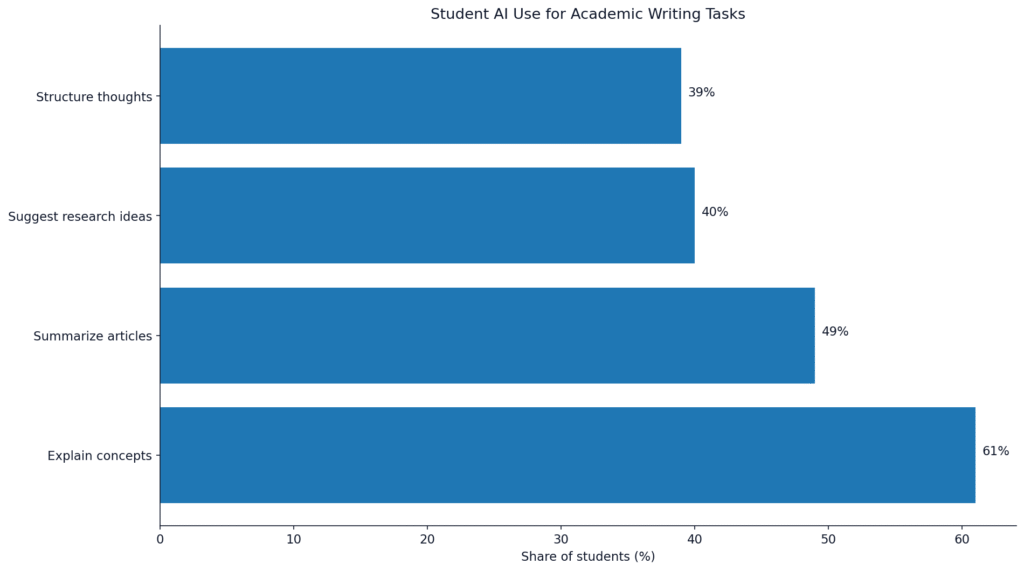
| 2 | Students using AI to explain concepts for assessed work | 61% |
| 3 | Students using AI to summarize a relevant article | 49% |
| 4 | Students using AI to suggest ideas for research | 40% |
| 5 | Students using AI to structure their thoughts before writing | 39% |
| 6 | Students using AI to search the internet for assessed work | 36% |
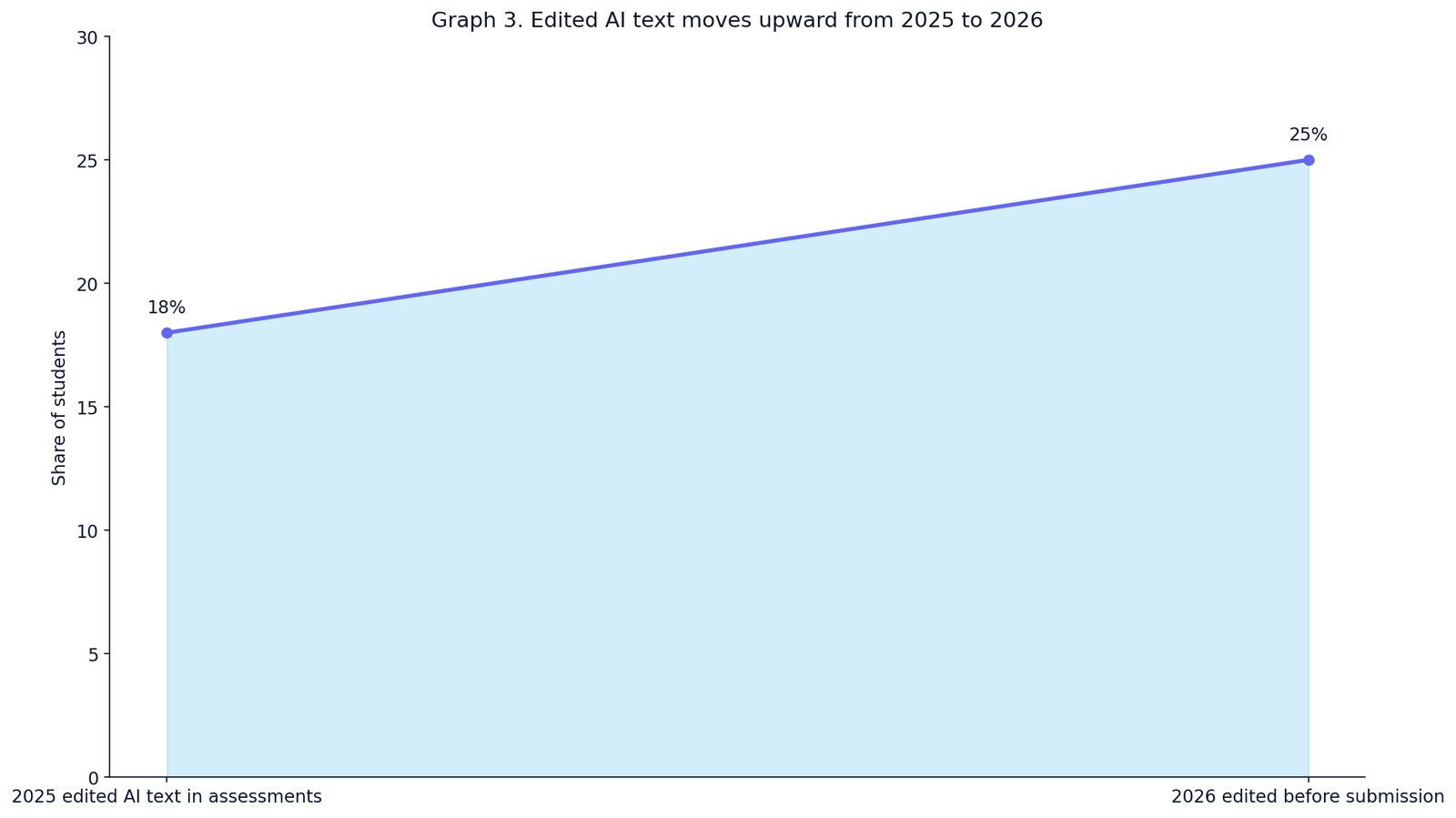
| 7 | Students using AI-generated text, then editing it before submission | 25% |
| 8 | Students using AI-generated text and editing it with a digital tool | 17% |
| 9 | Students including AI-generated text directly in assessed work | 6% |
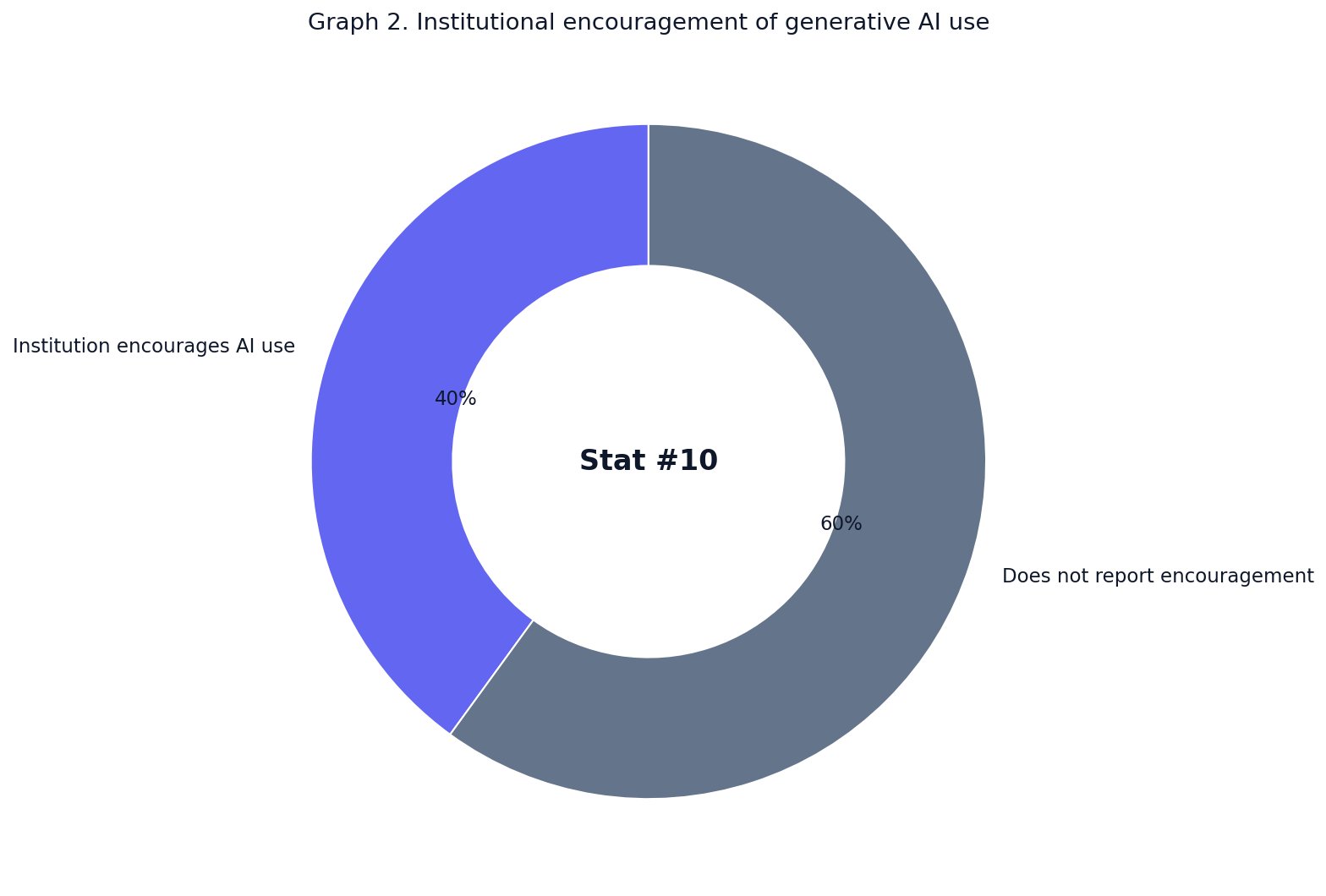
| 10 | Students who say their institution encourages generative AI use | 40% |
| 11 | Students who say AI availability has changed assessments | 65% |
| 12 | Higher education students using AI in at least one way in 2025 | 92% |
| 13 | Higher education students using AI to generate text | 64% |
| 14 | Higher education students using generative AI for assessments | 88% |
| 15 | Students using AI-generated and edited text in assessments in 2025 | 18% |
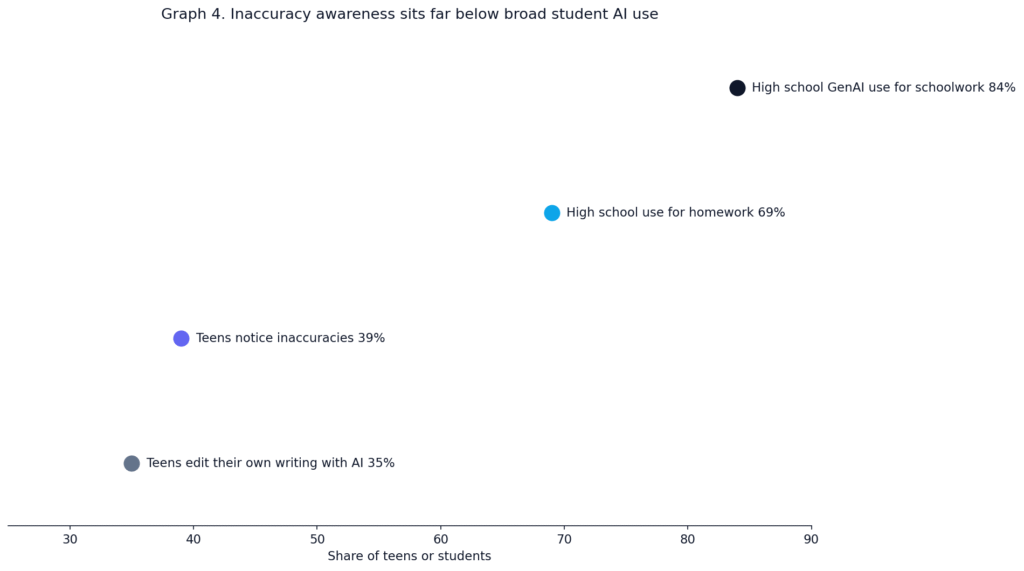
| 16 | U.S. high school students using GenAI for schoolwork in May 2025 | 84% |
| 17 | High school students using ChatGPT for assignments and homework | 69% |
| 18 | Teens using chatbots to edit something they wrote for school | 35% |
| 19 | Undergraduates using AI chatbots to write essays | 56% |
| 20 | Teens who noticed problems or inaccuracies in AI used for school assignments | 39% |
Top 20 Student Rewriting AI Content Statistics and the Road Ahead
Student Rewriting AI Content Statistics #1. AI helps complete assessments
The scale of AI use in academic writing became unmistakable once surveys began reporting 94% of students using generative tools to help complete assessments. That figure does not mean most students submit raw AI text. Instead it shows that AI has become embedded somewhere in the writing workflow.
Most of that workflow sits in the revision layer. Students frequently generate a draft, read it critically, then rewrite portions to match assignment expectations. That is why rewriting behavior has become the real operational step in AI-assisted writing.
Educators now evaluate writing differently because of this pattern. A student who rewrites AI output is practicing editing, synthesis, and tone control rather than simple copying. The implication is that rewriting activity will increasingly become the practical boundary between acceptable assistance and academic misconduct.
Student Rewriting AI Content Statistics #2. AI used to explain concepts
Academic surveys show 61% of students using AI systems to explain complex concepts while preparing assessed work. That pattern places AI closer to an on-demand tutor than a finished writing engine. Students often start with explanations before rewriting their own interpretation.
The explanation stage naturally leads into editing and restructuring. Once a concept becomes clearer, many students rewrite paragraphs or reorganize ideas so the explanation fits the assignment context. That rewriting stage becomes the real learning moment.
Educators increasingly recognize that difference. Using AI to clarify ideas can improve comprehension while rewriting forces the student to internalize the material. The implication is that institutions may focus less on tool usage and more on how much transformation occurs after the initial AI response.
Student Rewriting AI Content Statistics #3. AI summarizing articles
Research reports indicate 49% of students using AI tools to summarize academic articles before writing assignments. Summaries help students navigate dense reading quickly. Yet the summarized output rarely fits submission requirements without rewriting.
Students typically reshape those summaries into their own voice. They remove generic phrasing, expand key arguments, and add supporting details drawn from the original source. The result is a hybrid process that combines AI compression with human rewriting.
This pattern changes how reading comprehension appears in coursework. Instead of manually condensing every article, students increasingly review an AI summary then reconstruct the argument themselves. The implication is that rewriting will become a central academic skill rather than a workaround.
Student Rewriting AI Content Statistics #4. AI suggesting research ideas
Idea generation has become a common entry point for AI in education, with 40% of students reporting that they use AI to suggest research ideas. Early prompts often produce a list of possible angles. The real work begins once students refine those ideas.
Students rarely adopt AI suggestions exactly as written. Instead they rewrite questions, narrow the scope, and reshape the framing so it aligns with the assignment instructions. That editing process transforms rough suggestions into workable thesis directions.
Faculty members increasingly notice this pattern in proposal drafts. Ideas feel more numerous and exploratory, yet the final structure still reflects student decision making. The implication is that rewriting remains the stage where originality actually appears.
Student Rewriting AI Content Statistics #5. AI structuring thoughts before writing
Planning behavior has changed noticeably as 39% of students report using AI to structure their thoughts before writing an assignment. Instead of starting with a blank page, students now generate outlines or early frameworks. These outlines usually serve as flexible drafts rather than fixed structures.
Once the outline appears, rewriting becomes the next step. Students adjust headings, remove sections, and add examples that better reflect their understanding of the topic. The AI structure becomes more like scaffolding than finished work.
This pattern has subtle consequences for writing instruction. When planning becomes faster, more attention moves toward revision and argument clarity. The implication is that rewriting skills may soon matter more than initial drafting speed.
Student Rewriting AI Content Statistics #6. AI searching for information
Recent education surveys show 36% of students using AI systems to search for information while completing assessed work. This replaces part of the traditional browsing process. AI responses often act as an initial reference point rather than a finished answer.
Students frequently verify the output against other sources. During that verification stage they begin rewriting sections of the AI explanation so it matches the evidence they find. The rewriting stage therefore becomes a form of critical filtering.
This pattern subtly changes research behavior. AI delivers quick starting material, yet students still need to reshape it before submission. The implication is that rewriting remains the stage where judgment and credibility enter the writing process.
Student Rewriting AI Content Statistics #7. Editing AI-generated text before submission
Academic surveys report 25% of students generating AI text and then editing it before submitting their assignments. That percentage highlights a common hybrid workflow. AI produces the initial draft, but the student reshapes it extensively.
Most revisions involve rewriting sentences to match personal tone or course expectations. Students also insert references, examples, and transitions that the original AI output did not include. Those changes often alter the structure of the text significantly.
Instructors increasingly notice that rewritten drafts feel more individual than raw AI responses. The editing stage introduces variation that automated writing rarely produces alone. The implication is that rewriting may soon become the most visible indicator of genuine student effort.
Student Rewriting AI Content Statistics #8. Editing AI text using digital tools
Education research suggests 17% of students refine AI-generated text using digital rewriting tools before submission. These tools adjust phrasing, tone, and structure automatically. Students then review the output and modify it again.
The process becomes layered rather than linear. AI creates the first draft, editing tools reshape the language, and the student performs the final rewrite. Each step gradually distances the text from its original AI wording.
This layered editing pattern raises new questions for assessment. Determining authorship becomes more complex when multiple transformations occur. The implication is that understanding rewriting behavior will matter more than simply detecting AI usage.
Student Rewriting AI Content Statistics #9. Direct AI text in submissions
Only 6% of students report submitting AI-generated text directly without editing. That figure often surprises instructors who assume the number is much higher. Most students appear aware that unedited AI writing is easily recognizable.
Instead they modify wording and structure before submission. Rewriting allows them to align the response with assignment requirements and personal writing habits. Even minimal editing can substantially change the tone.
This difference matters when evaluating academic integrity. Direct copying is relatively rare compared with revision-based use. The implication is that rewriting behavior represents the more realistic scenario educators must address.
Student Rewriting AI Content Statistics #10. Institutions encouraging AI use
Policy research indicates 40% of students say their institution actively encourages generative AI use in learning tasks. That guidance signals a shift away from blanket restrictions. Universities increasingly treat AI as a tool to be managed rather than avoided.
Encouragement usually comes with expectations. Students are asked to rewrite AI output, verify sources, and document their editing process. Those requirements emphasize transformation rather than direct adoption.
This policy approach changes how AI enters academic writing. When rewriting becomes an explicit requirement, students practice editing skills more deliberately. The implication is that rewriting may soon become a formally taught competency in many courses.
Student Rewriting AI Content Statistics #11. Assessments changing because of AI
Surveys show 65% of students believe AI availability has changed how assessments are designed. Many assignments now emphasize analysis and reflection rather than simple explanation. That shift reduces the usefulness of generic AI responses.
Students therefore spend more time rewriting drafts. They adjust tone, integrate personal insight, and reshape arguments to demonstrate original thinking. The editing process becomes central to completing the task.
This change also affects teaching strategies. Instructors design prompts that require interpretation rather than summary. The implication is that rewriting will remain essential in assignments designed to coexist with AI.
Student Rewriting AI Content Statistics #12. Students using AI in at least one way
Education studies report 92% of higher education students using AI in at least one way during the academic year. The tool has effectively become part of the learning environment. Usage now spans planning, research, and editing tasks.
Despite that widespread use, raw AI text rarely appears unchanged in final assignments. Students usually rewrite sections to better match their own understanding and the instructor’s expectations. The editing stage becomes routine.
This widespread integration signals a structural change in writing habits. AI no longer appears as an occasional shortcut but as a starting point for revision. The implication is that rewriting will define responsible academic use going forward.
Student Rewriting AI Content Statistics #13. Students generating text with AI
Research indicates 64% of higher education students use AI systems to generate text during academic work. The output typically resembles a rough draft rather than a final submission. Students treat it as material to reshape.
Rewriting usually involves adding discipline-specific terminology and removing vague phrasing. Students also reorganize paragraphs so the argument aligns with assignment prompts. These edits transform the generic draft into a more personal document.
This editing process highlights the continuing role of human judgment. AI provides speed, yet students still decide how the argument should unfold. The implication is that rewriting remains the intellectual stage of the workflow.
Student Rewriting AI Content Statistics #14. AI used for assessments
Survey data shows 88% of higher education students using generative AI at some point during assessments. The tools assist with outlining, explanations, or initial drafts. Very few assignments remain completely untouched by AI assistance.
Even so, most students modify the content substantially. They rewrite sections to match grading rubrics and incorporate references from course readings. That revision stage ensures the work reflects their understanding.
This pattern reframes how academic writing is produced. AI becomes an early stage rather than the final author. The implication is that rewriting now functions as the bridge between machine output and authentic student voice.
Student Rewriting AI Content Statistics #15. Edited AI text in assessments
Studies suggest 18% of students submit assessments that include AI-generated text which they have edited or rewritten. This group represents a middle ground between full independence and direct copying. The workflow typically includes several rounds of revision.
Students often expand arguments and integrate course concepts during these edits. The AI draft acts as a structural starting point while the student adjusts tone and reasoning. Over time the document becomes less recognizably AI-generated.
This pattern highlights the importance of revision skills. Assignments increasingly reward clarity, interpretation, and evidence rather than raw drafting speed. The implication is that rewriting will continue to define meaningful academic authorship.
Student Rewriting AI Content Statistics #16. High school AI use for schoolwork
Research indicates 84% of high school students reported using generative AI for schoolwork in 2025. These tools assist with brainstorming, explanations, and draft writing. The behavior mirrors patterns seen in universities.
Students often rewrite AI text so it sounds closer to their natural voice. They simplify complex wording and adapt examples to match classroom material. This rewriting stage helps the assignment feel less automated.
Teachers increasingly focus on the revision process rather than the initial prompt. Observing how students reshape AI responses offers insight into understanding. The implication is that rewriting may become a teachable literacy skill in secondary education.
Student Rewriting AI Content Statistics #17. ChatGPT used for homework
Recent surveys report 69% of high school students using ChatGPT or similar tools to help with homework assignments. The platform often provides explanations or draft responses. Students then adapt the text before submitting their work.
Most edits focus on clarity and personal tone. Students rephrase sentences so the language reflects their typical writing style. This rewriting step reduces the risk of obvious AI phrasing.
The behavior suggests students are aware of teacher expectations. Direct copying feels risky and rarely fits the assignment exactly. The implication is that rewriting functions as a protective step within AI-assisted homework practices.
Student Rewriting AI Content Statistics #18. Teens editing their own writing with AI
Survey data shows 35% of teenagers use chatbots to edit something they previously wrote for school assignments. This workflow reverses the typical direction of AI use. The student drafts first, then asks AI for revision help.
The resulting suggestions usually trigger additional rewriting. Students compare the chatbot recommendation with their original sentence and adjust the wording manually. This iterative editing process strengthens revision habits.
Teachers increasingly recognize this form of AI assistance as closer to proofreading. The original ideas remain student-generated while AI supports editing. The implication is that rewriting tools may eventually resemble advanced grammar checkers in classrooms.
Student Rewriting AI Content Statistics #19. Undergraduates using AI for essays
Academic polling suggests 56% of undergraduates use AI chatbots when writing essays. These tools often generate outlines or draft paragraphs. Students rarely submit the text exactly as produced.
Most essays undergo several rewriting stages after the AI draft appears. Students expand arguments, incorporate course readings, and revise transitions between sections. These edits gradually reshape the document.
The rewriting phase also restores the student’s voice. Even modest changes in wording and structure can shift the tone noticeably. The implication is that essay writing will increasingly revolve around editing rather than initial drafting.
Student Rewriting AI Content Statistics #20. Students noticing AI inaccuracies
Research finds 39% of teenagers notice problems or inaccuracies in AI responses used for school assignments. This awareness forces students to review outputs critically. They cannot rely on the text exactly as produced.
When errors appear, rewriting becomes unavoidable. Students correct facts, adjust explanations, and verify information against reliable sources. These corrections often reshape entire paragraphs.
This process introduces a subtle learning benefit. Identifying mistakes requires engagement with the material itself. The implication is that rewriting AI output may actually strengthen critical reading and verification skills.
What these student rewriting AI content statistics reveal for assessment design, revision habits, and authorship expectations in classrooms moving through 2026
The strongest pattern here is not simple adoption but the way AI use keeps flowing toward revision, restructuring, and selective rewriting after the first output appears. That matters because the educational question is becoming less about whether students touched AI and more about how much judgment they applied once the draft was on the page.
Across higher education and secondary education, the same behavior keeps resurfacing: students use AI to explain, summarize, outline, or generate starting language, then they rework it until it fits the task. That repeated behavior suggests authorship is now being negotiated inside the editing stage, which makes revision evidence more useful than blunt yes-or-no assumptions.
The practical tension is that rewriting can signal either genuine engagement or a polished attempt to hide dependency, and the same interface supports both outcomes. So the numbers point toward assignment designs that reward process visibility, source checking, and reasoning traces instead of relying only on finished prose.
What emerges is a writing environment where human contribution is increasingly measured through choices made after generation rather than before it. As that pattern hardens, institutions that define acceptable transformation clearly will be in a better position to judge effort, intent, and learning implication.
Sources
- HEPI student generative AI survey 2026 full report
- HEPI student generative AI survey 2025 detailed findings
- Pew Research Center report on how teens use AI
- Pew full PDF on teen chatbot use in schoolwork
- College Board research brief on high school generative AI
- College Board newsroom summary of student generative AI use
- Common Sense Media report on teens trust and AI
- Walton Family Foundation impact survey on AI chatbots
- Digital Education Council global AI student survey 2024
- UNESCO guidance for generative AI in education and research