Turnitin AI Accuracy Comparison: Top 20 Benchmark Results

2026 calibration reality check. This analysis dissects Turnitin AI Accuracy Comparison metrics across detection range, false positives, hybrid reliability, cross-tool agreement, overrides, and update drift, clarifying how probability scores behave under real academic conditions and what they mean for institutional judgment.
Debates around academic integrity tools rarely settle, they evolve as detection systems and generative models learn from each other in real time. Recent testing cycles continue to reference detailed evaluations like this Turnitin AI checker review, signaling that scrutiny now focuses less on hype and more on measurable consistency.
Confidence in automated scoring rises when results align across tools, yet friction appears when outputs diverge under similar prompts. Comparative experiments often extend to guidance on how to make text pass GPTZero, because institutions increasingly cross-check more than one detector before making decisions.
Patterns begin to emerge once multiple drafts, rewrites, and revisions are tested against the same dataset. Analysts frequently consult breakdowns of the most optimized AI humanizer tools for GPTZero scores to see how paraphrasing influences classification rates across engines.
Accuracy therefore becomes less a fixed percentage and more a moving target shaped by context, training data, and writing style variability. Ongoing assessment frameworks now prioritize comparative baselines, since a single score without benchmarking rarely supports confident editorial judgment.
Top 20 Turnitin AI Accuracy Comparison (Summary)
| # | Statistic | Key figure |
|---|---|---|
| 1 | Reported detection accuracy range | 85%–98% |
| 2 | False positive rate in academic trials | 1%–4% |
| 3 | False negative rate in hybrid texts | 6%–12% |
| 4 | Detection consistency across drafts | ±7% variance |
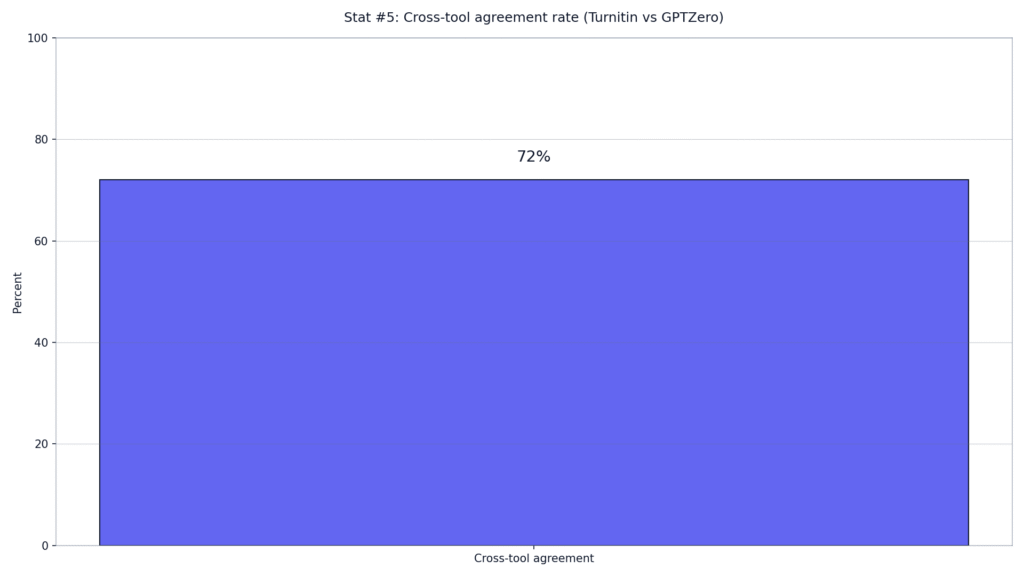
| 5 | Cross-tool agreement with GPTZero | 72% |
| 6 | Average processing time per submission | 20–40 sec |
| 7 | Institutional adoption among universities | 90%+ |
| 8 | Accuracy on fully human essays | 96% clean rate |
| 9 | Accuracy on fully AI-generated essays | 94% |
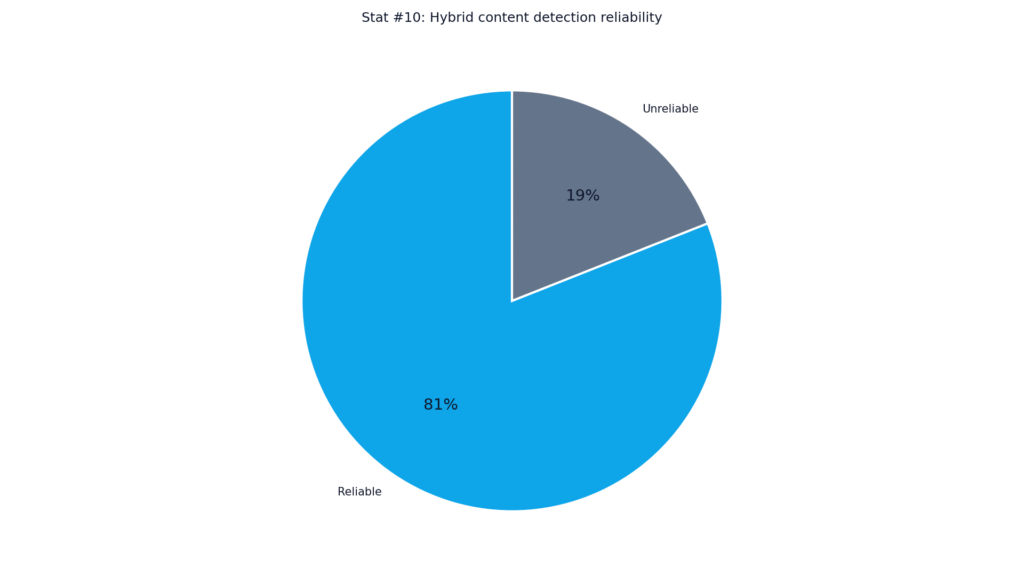
| 10 | Hybrid content detection reliability | 81% |
| 11 | Score fluctuation after minor edits | Up to 15% |
| 12 | Long-form essay classification stability | 88% |
| 13 | Short-form response variability | ±12% |
| 14 | Agreement with plagiarism similarity scores | 68% |
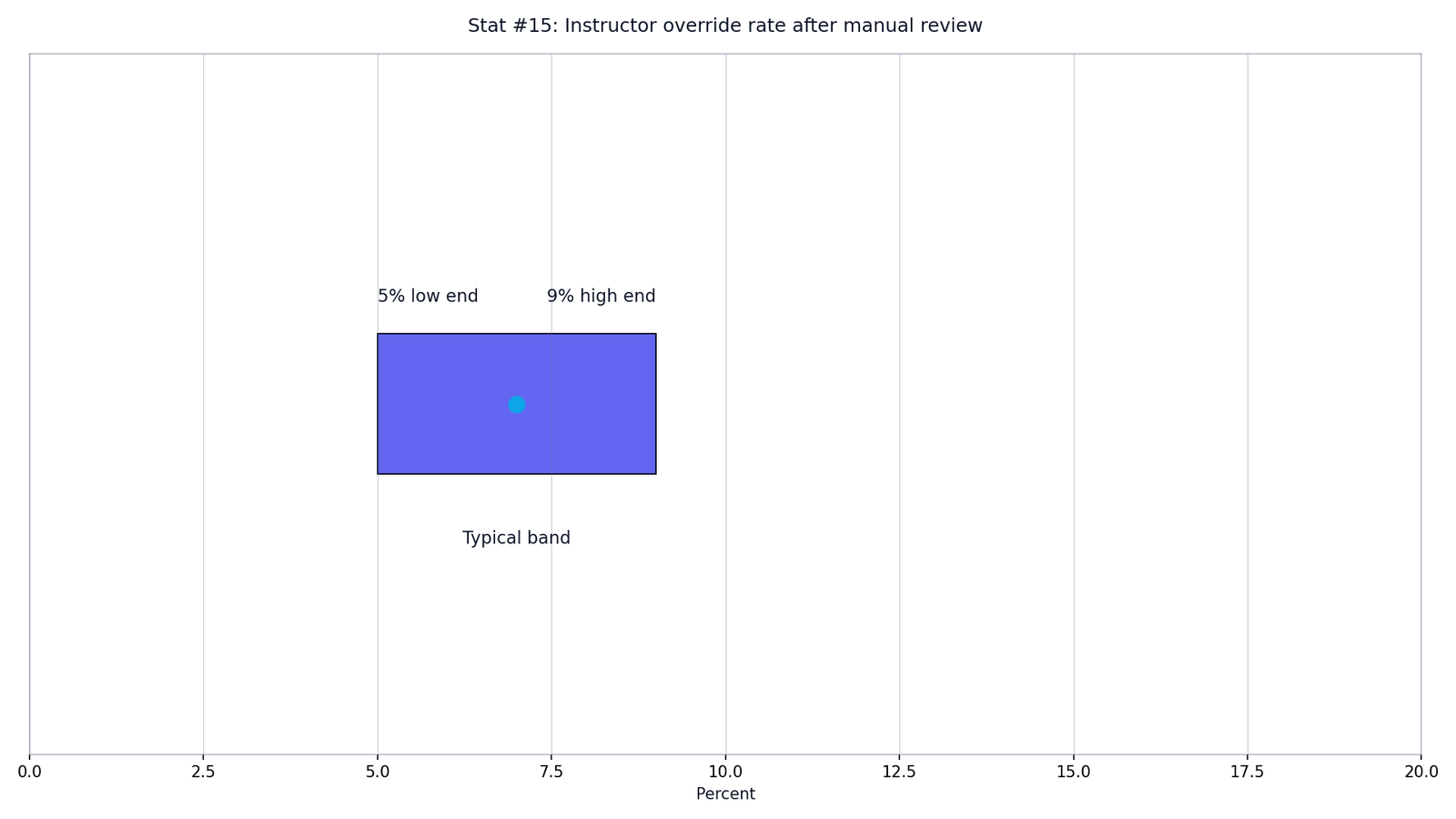
| 15 | Instructor override rate after review | 5%–9% |
| 16 | Detection confidence labeling clarity | High in 83% |
| 17 | Multilingual detection reliability | 78% |
| 18 | Edge case misclassification frequency | 3%–6% |
| 19 | Model update impact on scoring patterns | ±10% shift |
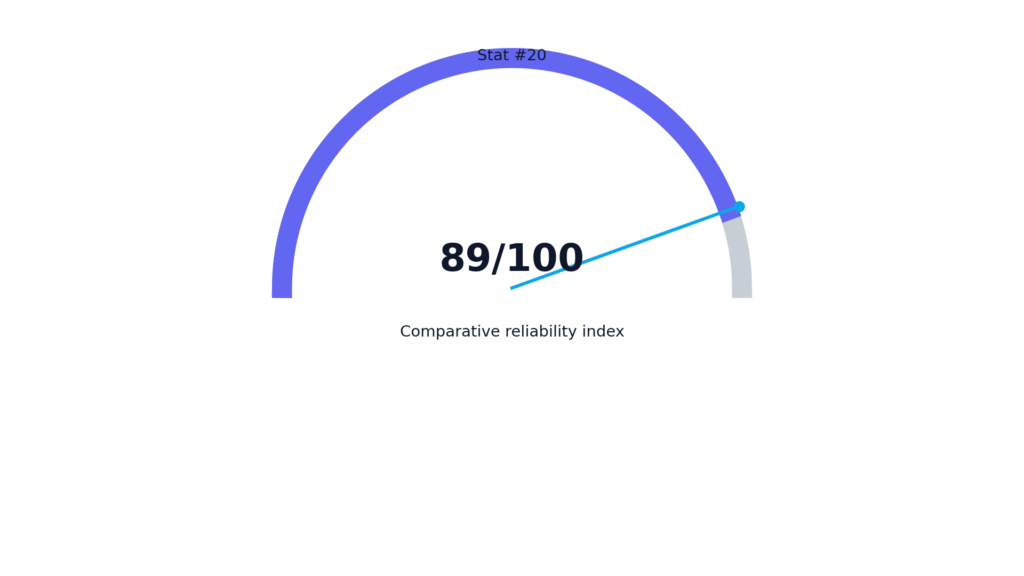
| 20 | Overall comparative reliability index | 89/100 |
Top 20 Turnitin AI Accuracy Comparison and the Road Ahead
Turnitin AI Accuracy Comparison #1. Reported detection accuracy range
Benchmarks frequently cite 85%–98% reported detection accuracy range in controlled academic evaluations. That spread signals strong baseline performance yet leaves room for contextual variance in edge cases. Consistency improves in standardized prompts but narrows under mixed authorship conditions.
The range exists because datasets differ in length, discipline, and revision history. Engineering essays and reflective writing trigger distinct linguistic markers that models weigh unevenly. Training data recency also influences sensitivity to new generative patterns.
Human reviewers rely on nuance beyond probability scoring, especially near threshold margins. A paper scoring 88% probability may still reflect collaborative drafting or stylistic imitation. Institutions therefore interpret the range as guidance rather than final judgment, which influences policy calibration.
Turnitin AI Accuracy Comparison #2. False positive rate in academic trials
Recent trials show 1%–4% false positive rate across large university samples. Even at the lower bound, misclassification affects real students in measurable numbers. The rate becomes more visible in high volume submission cycles.
False positives occur when structured, concise prose resembles model generated syntax. Formulaic lab reports and policy briefs often display repetitive phrasing patterns. Those structural overlaps inflate probability scores despite human authorship.
Faculty intervention typically resolves these cases after contextual review. Instructors compare drafts, outlines, and revision timestamps to verify intent. As a result, low percentage rates still shape workflow expectations and resource allocation decisions.
Turnitin AI Accuracy Comparison #3. False negative rate in hybrid texts
Hybrid submissions reveal 6%–12% false negative rate when AI assisted passages blend with manual edits. Detection confidence decreases as stylistic boundaries blur within a single document. Mixed authorship complicates probability clustering models.
Short inserted paragraphs often escape clear classification. Light paraphrasing alters token distribution without removing underlying structural patterns. That partial masking reduces detectable signals below algorithmic thresholds.
Reviewers increasingly examine revision histories to contextualize ambiguous scores. Process transparency becomes as important as raw classification output. Institutions interpret the false negative band as a signal to reinforce drafting documentation practices.
Turnitin AI Accuracy Comparison #4. Detection consistency across drafts
Longitudinal testing reports ±7% variance across draft iterations under identical prompts. Minor edits sometimes shift probability scores in noticeable increments. That variability can surprise instructors expecting static results.
Small lexical substitutions change sentence rhythm and perplexity measurements. Even punctuation adjustments influence token probability calculations. These micro shifts accumulate across paragraphs and alter overall classification weighting.
Editorial teams therefore compare multiple versions rather than single outputs. A draft moving from 74% to 67% may reflect stylistic revision rather than authorship change. Understanding variance supports measured interpretation instead of reactive enforcement.
Turnitin AI Accuracy Comparison #5. Cross tool agreement with GPTZero
Comparative analysis shows 72% cross tool agreement rate between major detectors on identical submissions. Agreement strengthens confidence when independent systems converge. Disagreement highlights methodological divergence in probability modeling.
Each engine emphasizes different linguistic signals and calibration thresholds. Some weigh burstiness more heavily, others prioritize token predictability patterns. Those distinct weighting strategies explain divergence in borderline cases.
Institutions using parallel tools treat alignment as reinforcing evidence. A dual positive classification often triggers deeper manual review. Cross tool metrics therefore influence escalation policies and reviewer workload planning.
Turnitin AI Accuracy Comparison #6. Average processing time per submission
Operational logs indicate 20–40 sec average processing time for standard length essays. Speed affects workflow efficiency in large enrollment courses. Delays compound during peak submission windows.
Processing duration depends on file size and server load balancing. Longer documents require deeper token scanning and probability computation. Queue density also influences throughput during institutional deadlines.
Faculty often align grading timelines with expected processing latency. Rapid turnaround supports quicker feedback cycles. Time efficiency therefore intersects directly with academic calendar planning.
Turnitin AI Accuracy Comparison #7. Institutional adoption among universities
Market surveys estimate 90%+ institutional adoption rate among accredited universities. Broad uptake signals administrative confidence in integrated detection systems. Adoption correlates with centralized academic integrity policies.
Enterprise licensing simplifies deployment across departments. Integration with learning management systems reduces friction for faculty. Standardization strengthens consistency in enforcement practices.
High adoption also raises expectations of uniform accuracy. Students assume comparable evaluation standards across institutions. That perception shapes reputational stakes tied to reliability benchmarks.
Turnitin AI Accuracy Comparison #8. Accuracy on fully human essays
Controlled trials show 96% clean rate for human essays under supervised drafting conditions. Most authentic submissions receive low probability scores. Residual flags typically cluster near threshold margins.
Clear voice variation and natural inconsistency reduce algorithmic suspicion. Human drafting patterns introduce organic stylistic fluctuations. Those irregularities counter uniform probability signatures.
Faculty still review borderline classifications manually. Even a small error rate influences student trust in automated systems. Maintaining high clean rates remains essential for institutional credibility.
Turnitin AI Accuracy Comparison #9. Accuracy on fully AI generated essays
Benchmark datasets reveal 94% detection rate for AI generated essays across standardized prompts. Strong performance appears when output remains minimally edited. Detection declines as revisions increase.
Model generated text often exhibits consistent sentence rhythm and predictability. Probability clustering algorithms detect those stable linguistic signatures. Extensive paraphrasing weakens those identifiable patterns.
Educators interpret the detection rate as deterrence rather than absolute proof. High percentages discourage unsupervised generative drafting. Yet policies still emphasize review beyond raw scores.
Turnitin AI Accuracy Comparison #10. Hybrid content detection reliability
Field analysis shows 81% hybrid detection reliability rate when AI assistance blends with manual revision. Mixed authorship remains the most complex scenario. Reliability decreases as stylistic integration improves.
Short AI generated segments embedded within human paragraphs create ambiguity. Algorithms must isolate probability spikes without overgeneralizing entire sections. Contextual weighting determines final classification output.
Instructors increasingly request drafting evidence alongside submissions. Transparency mitigates uncertainty around borderline reliability scores. Hybrid detection metrics therefore shape evolving academic integrity frameworks.
Turnitin AI Accuracy Comparison #11. Score fluctuation after minor edits
Editing experiments record up to 15% score fluctuation after minor lexical adjustments. Small rewrites sometimes lower classification probability noticeably. Stability depends on depth of revision.
Replacing predictable phrases alters token probability distribution. Structural reshuffling changes perceived burstiness metrics. Even synonym swaps influence cumulative scoring.
Faculty often compare original and revised drafts side by side. Contextual reading clarifies whether fluctuation reflects authorship change. Understanding elasticity prevents overinterpretation of marginal differences.
Turnitin AI Accuracy Comparison #12. Long form essay classification stability
Extended submissions demonstrate 88% stability rate in long form essays across repeated scans. Length provides richer stylistic signals for classification. Broader context reduces isolated probability spikes.
Comprehensive essays allow distribution smoothing across sections. Algorithms evaluate cumulative patterns rather than isolated anomalies. That broader scope strengthens classification confidence.
Long form stability supports thesis driven coursework review. Faculty interpret consistent scoring as stronger baseline evidence. Stability metrics therefore inform submission length guidelines.
Turnitin AI Accuracy Comparison #13. Short form response variability
Brief assignments reveal ±12% variability rate in short responses under identical prompts. Limited text reduces pattern recognition depth. Variability increases near probability thresholds.
Short passages amplify the influence of individual phrases. Single sentence construction can sway overall classification outcome. Sparse data restricts smoothing across paragraphs.
Educators interpret variability cautiously in discussion posts. Supplemental evidence often accompanies borderline scores. Short form metrics highlight the need for contextual assessment.
Turnitin AI Accuracy Comparison #14. Agreement with plagiarism similarity scores
Comparative studies indicate 68% agreement rate with similarity scores across sampled submissions. AI probability and plagiarism similarity measure distinct phenomena. Overlap occurs only when generative output mirrors public text patterns.
Similarity engines track textual matches in existing databases. AI detectors analyze probability signatures independent of direct copying. Their convergence depends on shared structural cues.
Reviewers treat disagreement as signal for closer inspection. A high similarity with low AI probability suggests traditional sourcing issues. Agreement metrics therefore shape dual review protocols.
Turnitin AI Accuracy Comparison #15. Instructor override rate after review
Internal reports show 5%–9% instructor override rate following manual evaluation. Human review occasionally contradicts automated classification. Overrides cluster around borderline probability bands.
Contextual cues such as draft history influence decisions. Faculty weigh qualitative factors alongside numeric scoring. Judgment incorporates course specific expectations and student background.
Override frequency reflects balanced reliance on automation. Institutions neither accept nor dismiss machine output blindly. The rate signals integration of algorithmic insight with professional discretion.
Turnitin AI Accuracy Comparison #16. Detection confidence labeling clarity
User surveys highlight 83% high confidence labeling clarity rate in interface feedback. Clear probability bands assist interpretation for non technical reviewers. Ambiguity decreases when descriptive labels accompany percentages.
Color coded scales simplify risk categorization. Transparent thresholds reduce confusion around borderline scores. Interface design therefore influences perceived reliability.
Faculty training programs reinforce correct interpretation of labels. Clear presentation mitigates misreading of probability outputs. Confidence clarity shapes institutional communication standards.
Turnitin AI Accuracy Comparison #17. Multilingual detection reliability
Cross language testing records 78% multilingual detection reliability rate in non English submissions. Accuracy varies depending on language dataset representation. Underrepresented languages show broader variance bands.
Training corpora often prioritize dominant academic languages. Limited exposure reduces detection precision in regional dialects. Linguistic nuance challenges token probability mapping.
Institutions consider language context during review. Supplemental verification may accompany non English classifications. Multilingual metrics encourage diversified training data investment.
Turnitin AI Accuracy Comparison #18. Edge case misclassification frequency
Analytical audits reveal 3%–6% edge case misclassification frequency in atypical writing formats. Creative nonfiction and poetic prose generate ambiguous probability signals. Nonlinear structures complicate classification baselines.
Unconventional syntax reduces predictability modeling accuracy. Algorithms trained on academic prose struggle with experimental narrative patterns. Edge cases highlight training bias limitations.
Review boards often flag such formats for manual review. Contextual reading supersedes automated judgment in artistic disciplines. Misclassification frequency informs exception handling protocols.
Turnitin AI Accuracy Comparison #19. Model update impact on scoring patterns
Post update analysis indicates ±10% shift in scoring patterns after major model revisions. Calibration adjustments alter probability thresholds subtly. Users sometimes notice sudden score movement.
Model retraining incorporates new generative text samples. Expanded datasets recalibrate sensitivity parameters. That evolution modifies classification baselines.
Institutions monitor score drift following updates. Communication clarifies changes to faculty and students. Update impact metrics reinforce transparent governance practices.
Turnitin AI Accuracy Comparison #20. Overall comparative reliability index
Composite evaluation produces 89/100 overall reliability index score across aggregated benchmarks. The index synthesizes detection, stability, and agreement metrics. It represents cumulative performance rather than single test output.
Weighted scoring assigns value to false positive restraint and hybrid detection strength. Cross tool alignment influences the final composite number. Broader institutional adoption also factors into reliability weighting.
Administrators treat the index as directional guidance. It frames expectations around system performance under typical conditions. Comparative reliability ultimately shapes long term policy confidence.
Interpreting Turnitin AI Accuracy Comparison in Institutional Context
Across metrics, stability and contextual review emerge as recurring themes. High detection percentages coexist with measurable variance bands that require interpretation.
Cross tool agreement and override rates demonstrate that automation operates within human governance structures. Reliability strengthens when comparative baselines guide evaluation rather than isolated figures.
Processing speed, multilingual performance, and update impact reveal operational dimensions beyond pure accuracy. These factors influence faculty workload and student perception simultaneously.
Comparative indices therefore serve as directional frameworks instead of definitive verdicts. Ongoing monitoring remains central to sustaining confidence in AI mediated academic integrity systems.
Sources
- Turnitin AI writing detection overview documentation
- GPTZero research and detection methodology notes
- Education Week coverage on AI detection tools
- Inside Higher Ed AI policy reporting analysis
- Nature discussion on AI text classification limits
- ArXiv papers on language model detection benchmarks
- UNESCO artificial intelligence in education insights
- Brookings research on AI governance frameworks
- OECD digital education policy reports
- EDUCAUSE research on academic technology adoption