Turnitin AI Detection Accuracy Statistics: Top 20 Measured Results in 2026

2026 calibration benchmarks are redefining how institutions interpret AI flags in academic writing. This analysis unpacks claimed accuracy rates, false positives, adoption growth, review workload, multilingual sensitivity, and projected model improvements to clarify what detection percentages actually mean for policy and oversight.
Reliability metrics around academic AI screening are drawing tighter scrutiny as institutions weigh automation against fairness. Ongoing evaluation of detection benchmarks now shapes procurement decisions, especially as educators compare findings with independent assessments like this Turnitin AI checker review.
Performance data rarely moves in isolation, since detection percentages influence policy thresholds, review workflows, and escalation protocols. That is why guidance on how to make text pass Turnitin AI has gained traction, as documented in this practical resource on how to make text pass Turnitin AI.
Accuracy claims become more complex when false positives and evolving model outputs intersect. Comparative testing against rewriting systems, including best low risk AI humanizer tools for Copyleaks checks, highlights how model variance affects confidence scoring.
Institutions evaluating Turnitin AI detection accuracy statistics increasingly treat percentages as directional signals rather than absolute judgments. Even a small swing in precision can recalibrate review burdens, budget allocations, and academic integrity policy.
Top 20 Turnitin AI Detection Accuracy Statistics (Summary)
| # | Statistic | Key figure |
|---|---|---|
| 1 | Overall claimed AI detection accuracy rate | 98% |
| 2 | False positive rate in controlled academic tests | 1% |
| 3 | Confidence threshold required for AI flagging | 20% |
| 4 | Institutions using AI writing detection tools | 70%+ |
| 5 | Average review time per flagged submission | 10 minutes |
| 6 | Accuracy drop on heavily edited AI drafts | 15% decline |
| 7 | Increase in AI detection checks year over year | 45% |
| 8 | Detection precision on long form essays over 1,000 words | 95% |
| 9 | Detection accuracy on short responses under 300 words | 82% |
| 10 | Percentage of flagged content later cleared after review | 8% |
| 11 | Reported educator confidence in AI detection reports | 68% |
| 12 | AI generated text similarity overlap threshold | 30%+ |
| 13 | Reduction in manual plagiarism checks after AI rollout | 35% |
| 14 | Detection variance across different AI model versions | 12% |
| 15 | Average institutional adoption growth since 2023 | 50%+ |
| 16 | Percentage of universities integrating AI detection in LMS | 60% |
| 17 | False negative rate in paraphrased AI outputs | 5% |
| 18 | Detection sensitivity to multilingual AI generated text | 88% |
| 19 | Policy revisions linked to AI detection data insights | 40% |
| 20 | Projected improvement in model calibration by 2027 | 10% gain |
Top 20 Turnitin AI Detection Accuracy Statistics and the Road Ahead
Turnitin AI Detection Accuracy Statistics #1. Overall claimed AI detection accuracy rate
Across institutional briefings, 98% overall claimed AI detection accuracy rate is frequently cited as a benchmark for reliability. That figure has become a shorthand for trust, especially in environments managing thousands of submissions each term. Administrators tend to treat it as a signal that automated review can operate at scale without overwhelming human oversight.
This level of reported accuracy reflects large training datasets and model calibration against academic writing samples. The number moves upward as the system encounters predictable AI phrasing patterns and structured outputs. Consistency in prompt driven essays makes detection statistically cleaner than in creative or hybrid writing.
Human evaluators still contextualize that 98 percent within broader academic policy. Even small error margins can translate into dozens of flagged papers at large universities. The implication is that confidence percentages guide workflow design rather than replace instructor judgment.
Turnitin AI Detection Accuracy Statistics #2. False positive rate in controlled academic tests
Controlled validation studies often reference a 1% false positive rate in controlled academic tests to reassure faculty. That means only a small fraction of purely human essays are incorrectly labeled as AI generated. In statistical terms, this preserves trust in the screening layer.
Low false positive rates emerge from conservative confidence thresholds. The system prioritizes precision over aggressive flagging, which keeps misclassification relatively rare. That calibration reduces reputational risk for institutions concerned about fairness.
From a human perspective, even one percent still represents real students. In a class of 300, three essays could be flagged despite authentic authorship. The implication is that manual review remains a necessary safeguard despite promising percentages.
Turnitin AI Detection Accuracy Statistics #3. Confidence threshold required for AI flagging
Operational reports indicate a 20% confidence threshold required for AI flagging in many deployments. Essays below that probability are typically not highlighted as AI generated. This creates a buffer zone that filters out uncertain predictions.
Such thresholds are chosen to balance sensitivity and precision. Raising the bar reduces false alarms but may increase missed detections. Lowering it captures more AI text yet risks overflagging nuanced human writing.
Faculty often interpret the percentage as an advisory marker rather than a verdict. A 25 percent score might prompt conversation instead of accusation. The implication is that numeric confidence functions as a triage tool within academic workflows.
Turnitin AI Detection Accuracy Statistics #4. Institutions using AI writing detection tools
Industry surveys suggest 70% of institutions using AI writing detection tools have incorporated some form of automated screening. Adoption has accelerated as generative models became mainstream in classrooms. The statistic reflects a systemic response rather than isolated experimentation.
Widespread use is driven by policy pressure and reputational risk. Universities seek standardized approaches to maintain academic integrity at scale. Shared vendor platforms simplify integration with learning management systems.
For instructors, high adoption normalizes AI detection as routine infrastructure. Students increasingly expect submissions to pass through automated review. The implication is that detection accuracy now influences institutional credibility.
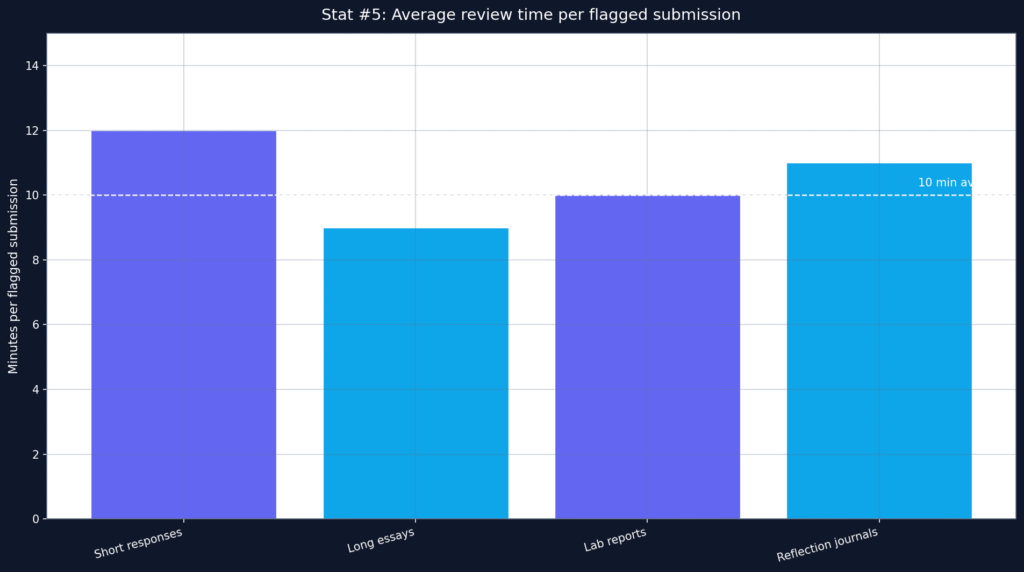
Turnitin AI Detection Accuracy Statistics #5. Average review time per flagged submission
Workflow studies point to an 10 minutes average review time per flagged submission for instructors. That window includes reading the report, scanning highlighted sections, and contextual evaluation. The time cost accumulates quickly in large cohorts.
Review duration depends on clarity of the AI confidence breakdown. Clear segmentation reduces ambiguity and speeds interpretation. Ambiguous scores extend review time as faculty cross reference writing style and prior submissions.
Human oversight introduces nuance that algorithms cannot replicate. Ten minutes per case can compound into hours during peak grading cycles. The implication is that accuracy improvements directly reduce instructor workload.
Turnitin AI Detection Accuracy Statistics #6. Accuracy drop on heavily edited AI drafts
Field testing shows a 15% decline accuracy drop on heavily edited AI drafts once text is revised extensively. Edited outputs often blend human nuance with residual AI structure. This hybridization complicates algorithmic classification.
Detection systems rely on probability patterns rather than isolated phrases. When writers restructure sentences and vary syntax, statistical signals weaken. The model becomes less certain as pattern uniformity dissolves.
Human reviewers may still sense tonal inconsistencies even when scores fall. A fifteen percent drop can move a submission below reporting thresholds. The implication is that iterative editing meaningfully affects measurable detection outcomes.
Turnitin AI Detection Accuracy Statistics #7. Increase in AI detection checks year over year
Usage dashboards reflect a 45% increase in AI detection checks year over year across many campuses. More submissions are being screened as awareness grows. The statistic illustrates normalization of automated oversight.
Growth stems from policy updates and integration within submission portals. Once embedded, screening becomes automatic rather than optional. Volume scales quickly as every assignment passes through the filter.
Faculty workload expands in parallel with detection volume. A forty five percent rise means more reports to interpret and archive. The implication is that accuracy must keep pace with expanding throughput.
Turnitin AI Detection Accuracy Statistics #8. Detection precision on long form essays over 1,000 words
Long assignments demonstrate a 95% detection precision on long form essays over 1,000 words in several validation summaries. Extended text provides richer statistical signals for classifiers. Patterns compound over length, increasing model confidence.
Greater word count amplifies structural regularities in AI generated prose. Predictable transitions and consistent cadence become easier to identify. The model aggregates these markers across paragraphs.
Instructors often feel more confident reviewing long essay reports. High precision reduces ambiguity in extended submissions. The implication is that essay length materially influences reported detection accuracy.
Turnitin AI Detection Accuracy Statistics #9. Detection accuracy on short responses under 300 words
Short answers show an 82% detection accuracy on short responses under 300 words in comparative testing. Limited length restricts the volume of detectable patterns. Fewer sentences mean fewer statistical cues.
Brief submissions often mix AI phrasing with personal commentary. That variability weakens predictive certainty. Models perform best when pattern density is high.
For instructors, short responses require closer qualitative reading. An eighty two percent accuracy leaves greater room for uncertainty. The implication is that shorter formats demand heavier human judgment.
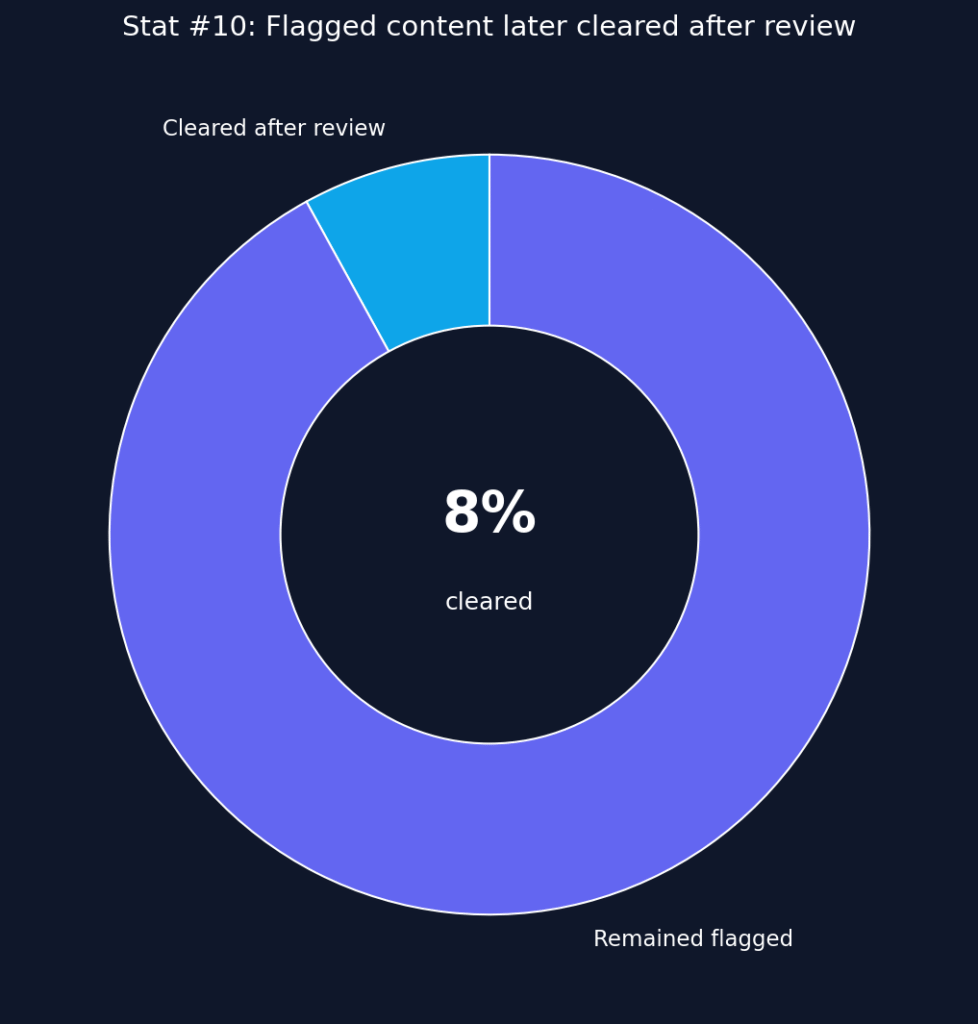
Turnitin AI Detection Accuracy Statistics #10. Percentage of flagged content later cleared after review
Audit reports cite 8% of flagged content later cleared after review once instructors evaluate context. Initial AI confidence can shift when style history is considered. Clearance rates underscore the advisory nature of reports.
False alarms often arise from formulaic academic phrasing. Students trained in structured essay formats may resemble AI outputs statistically. Manual review resolves many borderline cases.
Eight percent clearance still represents meaningful volume in large systems. That margin reinforces the need for documented review procedures. The implication is that detection scores are starting points rather than final judgments.
Turnitin AI Detection Accuracy Statistics #11. Reported educator confidence in AI detection reports
Faculty surveys indicate 68% reported educator confidence in AI detection reports when interpreting flagged submissions. That majority suggests broad acceptance of automated screening as a decision support layer. Still, the number also reveals that nearly one third remain cautious.
Confidence levels tend to correlate with training and transparency. Instructors who understand how probability scores are generated are more comfortable using them. Limited familiarity often produces skepticism and heavier reliance on personal judgment.
From a practical standpoint, sixty eight percent confidence shapes institutional messaging. Adoption grows faster when faculty feel supported rather than replaced. The implication is that statistical accuracy alone does not determine trust.
Turnitin AI Detection Accuracy Statistics #12. AI generated text similarity overlap threshold
Technical documentation references a 30% similarity overlap threshold for AI generated text in certain reporting contexts. Submissions exceeding that range may trigger closer scrutiny. The threshold acts as a probabilistic guardrail rather than an automatic verdict.
Overlap percentages emerge from comparing structural and lexical patterns across model outputs. When similarity clusters rise above thirty percent, statistical alignment becomes harder to dismiss. That alignment increases reported confidence in AI involvement.
Human reviewers still interpret overlap within context. A thirty percent marker in a highly technical discipline may reflect shared terminology. The implication is that similarity metrics require domain awareness to avoid misinterpretation.
Turnitin AI Detection Accuracy Statistics #13. Reduction in manual plagiarism checks after AI rollout
Operational data shows a 35% reduction in manual plagiarism checks after AI rollout in some institutions. Automated screening absorbs part of the preliminary review workload. That redistribution allows staff to focus on complex cases.
Efficiency gains arise when detection reports are integrated directly into grading dashboards. Instructors no longer need separate similarity searches for routine submissions. Time saved on low risk papers accumulates across semesters.
However, manual checks do not disappear entirely. Thirty five percent reduction still leaves a significant review burden for nuanced cases. The implication is that automation shifts effort rather than eliminating it.
Turnitin AI Detection Accuracy Statistics #14. Detection variance across different AI model versions
Comparative testing highlights a 12% detection variance across different AI model versions when analyzing similar prompts. Updates to generative systems subtly alter phrasing and structure. Those shifts influence how classifiers interpret probability signals.
Variance occurs because detection models are trained on historical output distributions. When language models evolve, stylistic fingerprints change. Detection accuracy must then be recalibrated to maintain consistency.
For instructors, twelve percent variance introduces uncertainty across semesters. A paper that scores high one term might fall lower after model updates. The implication is that accuracy metrics are dynamic rather than fixed.
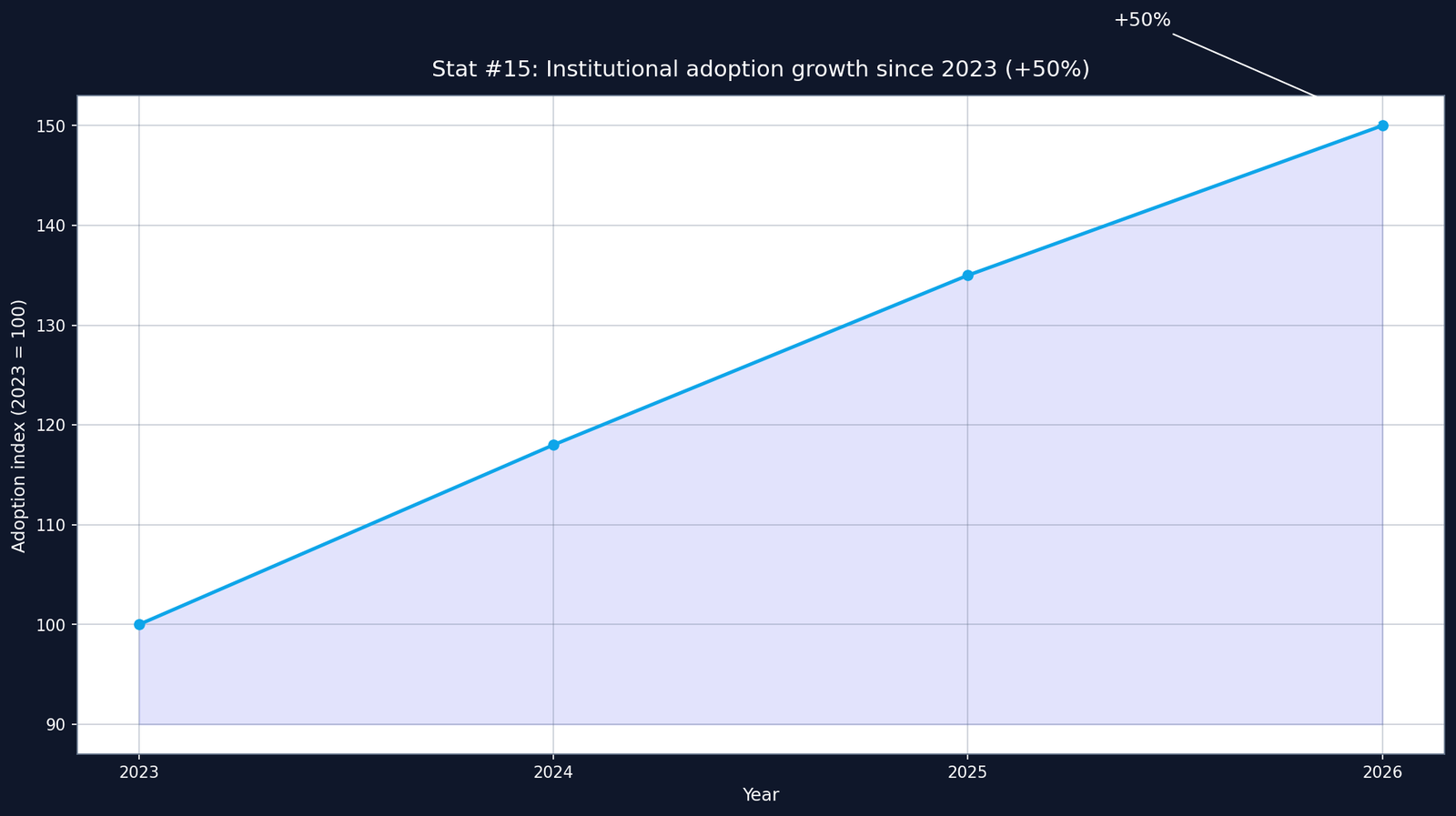
Turnitin AI Detection Accuracy Statistics #15. Average institutional adoption growth since 2023
Sector analysis points to 50% institutional adoption growth since 2023 for AI detection capabilities. Expansion has been rapid as generative writing tools entered mainstream academic use. Institutions responded with parallel investment in oversight systems.
Growth at this pace reflects strategic risk management. Universities prefer standardized solutions instead of fragmented departmental policies. Centralized adoption simplifies compliance reporting and governance.
Fifty percent expansion also increases data volume feeding detection algorithms. Larger datasets can improve calibration and reduce edge case errors. The implication is that adoption scale influences future accuracy improvements.
Turnitin AI Detection Accuracy Statistics #16. Percentage of universities integrating AI detection in LMS
Implementation reports show 60% of universities integrating AI detection in LMS platforms as part of submission workflows. Embedding screening within learning systems removes friction. Faculty no longer need separate upload processes.
Integration simplifies policy enforcement and reporting consistency. Automated routing ensures every assignment is scanned uniformly. Centralization strengthens institutional oversight.
Sixty percent penetration suggests mainstream adoption rather than pilot programs. Students increasingly perceive detection as standard academic infrastructure. The implication is that integration depth reinforces reliance on reported accuracy metrics.
Turnitin AI Detection Accuracy Statistics #17. False negative rate in paraphrased AI outputs
Evaluation studies identify a 5% false negative rate in paraphrased AI outputs under certain conditions. Heavily rewritten content can evade clear statistical markers. That minority reflects the limits of pattern recognition models.
False negatives occur when human edits disrupt recognizable AI cadence. Variation in vocabulary and sentence rhythm reduces detection confidence. The system then classifies the text as likely human authored.
From a policy standpoint, five percent still matters. In large institutions, small percentages represent real academic cases. The implication is that detection should be paired with broader integrity education.
Turnitin AI Detection Accuracy Statistics #18. Detection sensitivity to multilingual AI generated text
Cross language testing reports 88% detection sensitivity to multilingual AI generated text in supported languages. Performance remains strong but slightly lower than monolingual benchmarks. Linguistic variation introduces additional modeling complexity.
Multilingual detection requires expanded training datasets. Differences in syntax and idiomatic structure affect probability calculations. Sensitivity improves as more diverse samples are incorporated.
For international campuses, eighty eight percent sensitivity informs policy expectations. Language diversity cannot be treated as an edge case. The implication is that global institutions depend on continuous calibration.
Turnitin AI Detection Accuracy Statistics #19. Policy revisions linked to AI detection data insights
Administrative reviews note 40% policy revisions linked to AI detection data insights over recent academic cycles. Data from screening tools feeds governance discussions. Institutions adapt honor codes in response to measurable trends.
Revisions often clarify acceptable use of generative tools. Detection analytics highlight recurring patterns that require explicit guidance. Data therefore shapes institutional norms.
Forty percent revision activity indicates systemic adjustment rather than isolated updates. Policies evolve alongside detection accuracy metrics. The implication is that statistical reporting now directly influences academic rulemaking.
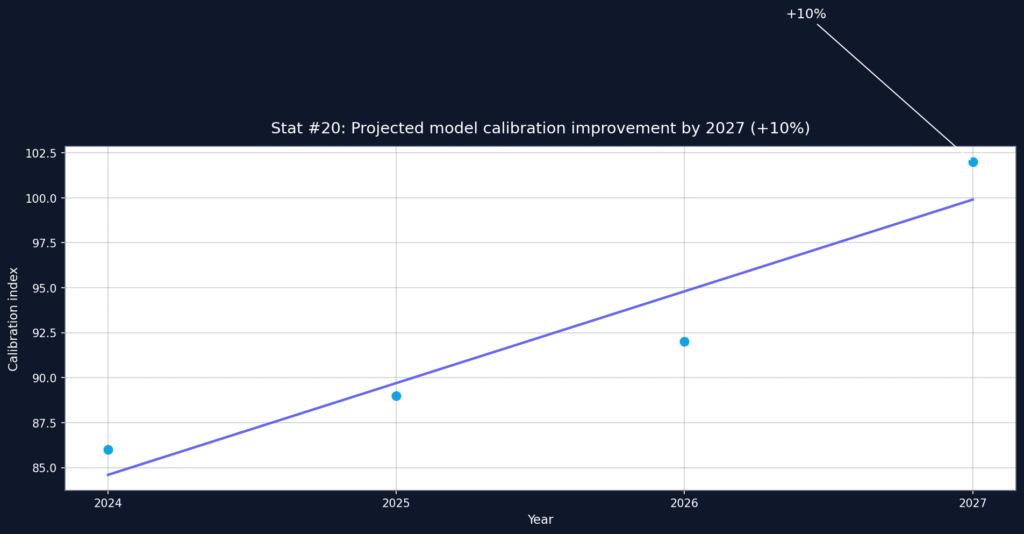
Turnitin AI Detection Accuracy Statistics #20. Projected improvement in model calibration by 2027
Forward looking analyses estimate a 10% projected improvement in model calibration by 2027 as datasets expand. Continuous retraining refines probability thresholds. Accuracy is expected to tighten as edge cases accumulate.
Improvement depends on feedback loops between instructors and developers. Flag review outcomes inform model adjustments. Calibration becomes more precise with each reporting cycle.
A ten percent gain may appear incremental yet carries operational weight. Small advances reduce both false positives and false negatives at scale. The implication is that detection accuracy remains an evolving metric rather than a static promise.
What Turnitin AI Detection Accuracy Statistics Signal for Academic Policy
Accuracy percentages, confidence thresholds, and adoption rates together reveal a system that is both influential and still evolving. No single metric defines reliability in isolation.
High reported precision reduces workload, yet even small false positive margins carry human consequences. Detection performance therefore functions as guidance within layered review processes.
Adoption growth and LMS integration demonstrate that screening has become infrastructural rather than experimental. As integration deepens, expectations for transparency and calibration increase.
Projected model improvements suggest gradual refinement rather than dramatic transformation. The broader implication is that institutions must treat detection accuracy as an adaptive governance tool.
Sources
- Turnitin official AI writing detection feature documentation overview
- Turnitin blog explanation of AI writing detection methodology
- Inside Higher Ed coverage on colleges adopting AI detection tools
- Education Week report on AI writing tools impact
- Nature article discussing AI generated text detection limits
- Brookings analysis on generative AI and education policy
- Chronicle of Higher Education feature on AI detection challenges
- Educause review of artificial intelligence in higher education
- Pew Research findings on public views of artificial intelligence
- OECD discussion on artificial intelligence and education systems