How to Make Text Pass Turnitin AI: 15 Submission-Ready Edits
In 2026, students are revising smarter as AI detection evolves. This guide explains how to make text pass Turnitin AI through structural edits grounded in writing research, including findings from a Stanford study on writing and revision quality, which highlights how iterative refinement strengthens authenticity and clarity.
How to Make Text Pass Turnitin AI: 15 Submission-Ready Edits
You polish your draft, run it through a checker, and suddenly you’re staring at a high AI score. If you’ve ever wondered why Turnitin says your essay is AI, you know how frustrating and confusing that moment can feel.
This keeps happening because AI detection tools look for predictable structure, surface-level phrasing, and statistical writing patterns rather than intent. Even when your ideas are original, tools connected to broader discussions around most reliable AI humanizer tools and Copyleaks detection limitations statistics show how easily structured drafts can trigger automated flags.
The good news is that you don’t need to scrap your work or rewrite everything from scratch. In this guide, you’ll learn exactly how to make text pass Turnitin AI using practical edits that strengthen clarity, preserve your voice, and help your submission feel genuinely human.
| # | Strategy focus | Practical takeaway |
|---|---|---|
| 1 | Sentence rhythm variation | Break predictable patterns so your writing reads less mechanical and more conversational. |
| 2 | Specific detail layering | Add concrete examples that make your argument feel lived-in rather than generated. |
| 3 | Natural transitions | Replace formulaic connectors with smoother phrasing that mirrors real speech. |
| 4 | Voice clarification | Align tone and perspective so the draft sounds consistent and intentional. |
| 5 | Complexity smoothing | Simplify over-engineered phrasing that may trigger detection patterns. |
| 6 | Context enrichment | Expand thin explanations so reasoning feels grounded and authentic. |
| 7 | Structural reshaping | Reorganize paragraphs to reduce uniform patterns and improve flow. |
| 8 | Active language tuning | Swap generic constructions for clearer, more direct phrasing. |
| 9 | Claim precision | Tighten broad statements so arguments feel deliberate and specific. |
| 10 | Human nuance | Introduce subtle qualifiers that reflect real academic reasoning. |
| 11 | Citation integration | Blend sources smoothly into sentences rather than stacking them mechanically. |
| 12 | Redundancy removal | Cut repeated phrasing that makes the draft feel templated. |
| 13 | Tone calibration | Adjust overly polished language to match realistic academic voice. |
| 14 | Paragraph pacing | Vary paragraph length to avoid uniform structure signals. |
| 15 | Final manual review | Read aloud and refine subtle inconsistencies before submission. |
15 Submission-Ready Edits to How to Make Text Pass Turnitin AI
How to Make Text Pass Turnitin AI – Strategy #1: Sentence rhythm variation
One of the most effective ways to reduce detection signals is to deliberately vary sentence rhythm so your draft no longer follows a predictable cadence that mirrors common AI outputs. This means combining longer analytical sentences with shorter reflective ones, weaving in occasional qualifiers, and adjusting punctuation so the flow feels shaped by thought rather than formula. You should apply this revision stage after your core argument is stable, because changing rhythm works best when you are refining delivery instead of still building structure.
Detection systems frequently identify statistical uniformity in sentence length, which means even strong arguments can appear automated if every line unfolds in the same measured pattern. For example, if three consecutive paragraphs open with similarly structured topic sentences followed by evenly spaced supporting clauses, the writing may look mechanically generated even if the ideas are entirely your own. When you intentionally stretch some sentences with clarifying phrases and tighten others to sharpen emphasis, the result feels more human because it reflects how real thinkers adjust pacing as they reason through complex points.
How to Make Text Pass Turnitin AI – Strategy #2: Specific detail layering
Adding layered, concrete details is essential when learning how to make text pass Turnitin AI because abstract summaries are more likely to resemble generic AI phrasing. Instead of stating that a theory is widely accepted, clarify who supports it, under what circumstances it applies, and what tensions exist around it in practice. This added specificity anchors your writing in real context and makes the analysis feel constructed through lived engagement rather than assembled from broad training data.
In real academic drafts, students naturally incorporate subtle contextual cues, such as referencing classroom debates, case study nuances, or methodological constraints that influenced interpretation. If your paragraph currently reads like a clean overview with balanced but detached phrasing, detection tools may interpret that symmetry as algorithmic. Expanding your explanation to include precise conditions, limitations, and implications transforms the passage into something textured and less statistically uniform.
How to Make Text Pass Turnitin AI – Strategy #3: Natural transitions
Formulaic connectors such as overly tidy transition phrases can signal automated composition, especially when each paragraph begins with predictable structural cues. Revising transitions so they emerge organically from the previous idea rather than announcing a structural pivot helps your reasoning feel continuous and thoughtful. This means referencing the exact claim you just made and then extending it, rather than inserting stock academic bridges that appear in thousands of AI-generated drafts.
For instance, instead of writing a generic phrase that signals contrast, you might directly acknowledge the limitation in your prior claim and then elaborate on its broader implications. That connective logic mirrors how people think through arguments, because it demonstrates awareness of nuance rather than adherence to a template. Over time, these micro-adjustments in flow reduce the likelihood that your submission resembles a standardized pattern recognized by detection systems.
How to Make Text Pass Turnitin AI – Strategy #4: Voice clarification
Clarifying your voice is central to how to make text pass Turnitin AI because inconsistent perspective often creates the impression of blended or generated content. Decide whether you are writing in a reflective academic voice, a critical analytical tone, or a research-focused explanatory style, and then adjust verbs and phrasing accordingly. This alignment ensures that the essay reads as if it came from a single thinking mind rather than a stitched collection of polished segments.
When voice drifts between overly formal detachment and sudden conversational phrasing, the statistical signature can resemble AI output that attempts to mimic academic tone without lived consistency. A careful reread allows you to smooth those tonal jumps so the argument evolves naturally from your chosen stance. The more coherent your perspective remains across sections, the more your submission reflects deliberate authorship rather than pattern replication.
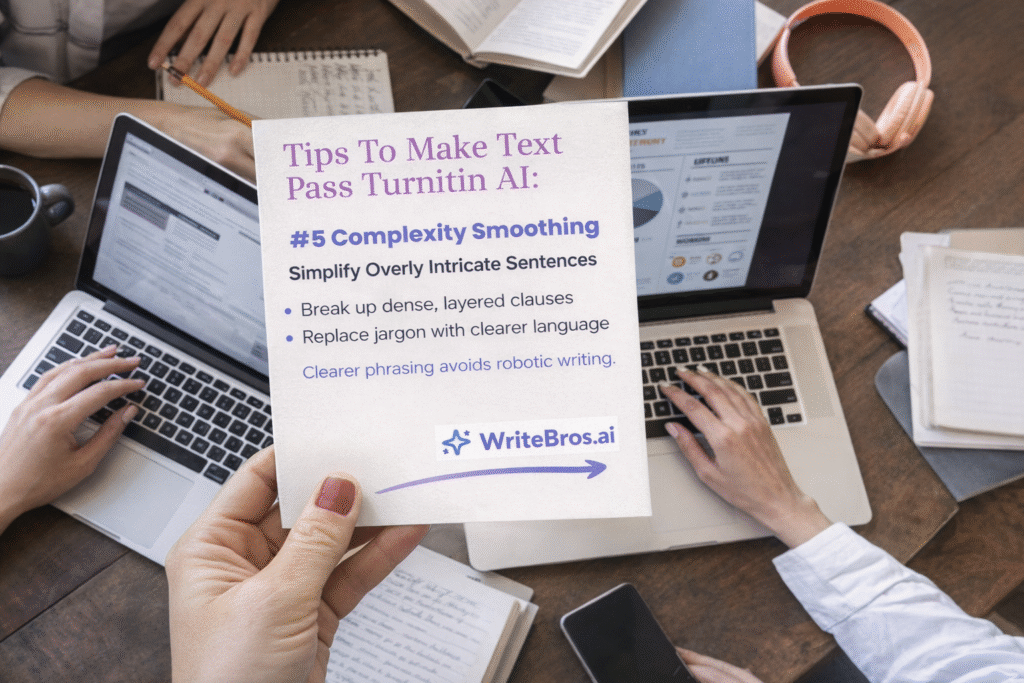
How to Make Text Pass Turnitin AI – Strategy #5: Complexity smoothing
Overly intricate phrasing can sometimes raise flags because AI systems frequently generate complex but evenly balanced sentences that sound polished yet impersonal. Smoothing unnecessary complexity involves breaking apart dense constructions, simplifying layered clauses, and replacing inflated terminology with precise but accessible language. This revision stage should occur after content development so you can refine clarity without sacrificing analytical depth.
When a paragraph contains multiple multi-clause sentences arranged with symmetrical logic, it may unintentionally resemble generated prose even if it accurately represents your thinking. Readers, and by extension detection models trained on reader-like signals, respond to slight irregularities that reveal authentic reasoning processes. Introducing clearer phrasing, occasional asymmetry, and purposeful emphasis creates a more believable human signature in the text.
How to Make Text Pass Turnitin AI – Strategy #6: Context enrichment
Context enrichment strengthens authenticity because it demonstrates that your claims arise from situated understanding rather than detached summary. Expanding on why a concept matters within a specific academic debate or institutional framework helps your writing move beyond surface explanation. This added depth makes your reasoning traceable and grounded, which is far less likely to resemble generalized AI phrasing.
Detection systems often flag text that reads like a well-balanced overview without embedded context, since that pattern mirrors common generative outputs. If you incorporate references to course themes, assignment prompts, or disciplinary tensions, the argument begins to reflect personal engagement with material. That shift from broad commentary to contextual reasoning adds a dimension that algorithms struggle to categorize as templated.
How to Make Text Pass Turnitin AI – Strategy #7: Structural reshaping
Uniform paragraph construction is a subtle signal that can increase AI detection probability, especially when each section follows the same topic-sentence-support-summary formula. Reshaping structure involves varying how paragraphs open, integrating analysis earlier in some sections, and occasionally embedding examples before formal claims. These adjustments disrupt predictable sequencing without undermining logical clarity.
In practice, you might begin one paragraph with a scenario, another with a counterargument, and another with a direct analytical assertion, thereby creating structural diversity across the essay. This diversity mirrors authentic drafting habits, since real writers rarely adhere to perfectly repeated blueprints throughout long submissions. The result is a more organic progression that aligns with human variation rather than automated uniformity.
How to Make Text Pass Turnitin AI – Strategy #8: Active language tuning
Replacing vague constructions with more active phrasing can meaningfully influence how to make text pass Turnitin AI because passive and generic formulations are common in generated drafts. Instead of relying on abstract subjects and impersonal verbs, identify the agents behind actions and articulate their roles clearly. This clarity sharpens the argument and reduces the detached tone associated with automated outputs.
When sentences repeatedly follow patterns such as generalized claims supported by evenly framed clauses, they may resemble statistical averages found in AI writing. Introducing active voice where appropriate and specifying who does what within each claim injects distinctiveness into the prose. That subtle personalization shifts the statistical footprint of your essay in a direction more consistent with human authorship.
How to Make Text Pass Turnitin AI – Strategy #9: Claim precision
Broad, sweeping claims are easy for AI systems to generate, which means refining precision is a valuable defensive revision. Clarify scope by indicating conditions, time frames, populations, or limitations that frame your assertion realistically. Precision communicates critical engagement and prevents the essay from sounding like a generic summary of widely known ideas.
For example, instead of asserting that a policy always produces a certain outcome, you might explain under what institutional or social circumstances that outcome becomes more likely. This nuanced framing reflects the careful reasoning expected in academic work and reduces the likelihood of algorithmic similarity. Precision therefore acts as both an intellectual improvement and a technical safeguard.
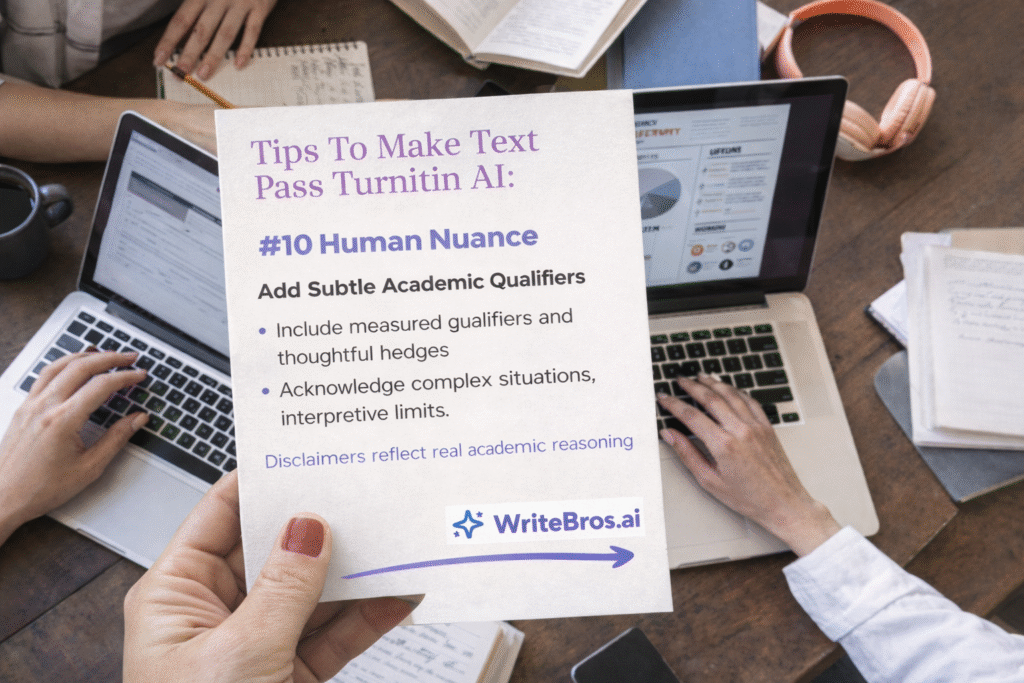
How to Make Text Pass Turnitin AI – Strategy #10: Human nuance
Human nuance emerges when you acknowledge uncertainty, tension, or interpretive complexity within your argument rather than presenting every conclusion as perfectly balanced. Adding measured qualifiers and reflective commentary shows that you are thinking through implications rather than delivering polished summaries. This textured reasoning often distinguishes authentic academic writing from generative output.
Detection systems are sensitive to overly consistent confidence levels across paragraphs, especially when claims appear uniformly assured and neatly supported. Introducing thoughtful hesitation or layered interpretation mirrors real intellectual processes, since scholars rarely present ideas without acknowledging caveats. That controlled complexity signals human deliberation and helps your submission feel genuinely authored.
How to Make Text Pass Turnitin AI – Strategy #11: Citation integration
Seamless citation integration reduces mechanical patterns because AI-generated drafts often cluster references in predictable, formulaic placements. Instead of stacking citations at the end of every sentence, weave sources into your reasoning so they interact with your analysis. This blending demonstrates ownership of ideas and situates evidence within your interpretive framework.
When citations appear evenly distributed and syntactically identical across paragraphs, detection systems may identify statistical similarity with generated content. Varying how you introduce authors, summarize findings, and connect evidence to your thesis creates dynamic engagement. That variation reflects how real writers converse with sources rather than inserting references as structural placeholders.
How to Make Text Pass Turnitin AI – Strategy #12: Redundancy removal
Redundancy frequently arises in AI-assisted drafts because models reinforce central claims with repeated phrasing across sections. Carefully scanning for duplicated wording, mirrored explanations, or recycled sentence structures helps eliminate this pattern. Removing repetition not only improves clarity but also reduces detectable uniformity.
If your essay reiterates the same conclusion in slightly rephrased but structurally identical sentences, the overall statistical signature becomes more predictable. Consolidating repeated points into sharper, singular analyses enhances intellectual strength and textual diversity simultaneously. That refinement makes your submission more concise and less algorithmically patterned.
How to Make Text Pass Turnitin AI – Strategy #13: Tone calibration
Overly polished tone can sometimes appear artificial, especially when every sentence maintains identical formality and emotional neutrality. Calibrating tone involves adjusting phrasing so emphasis rises and falls naturally, reflecting genuine engagement with the topic. This adjustment ensures the writing feels purposeful rather than uniformly optimized.
Real academic essays often display subtle tonal movement as the writer emphasizes key arguments or acknowledges complexity. Allowing controlled variation in emphasis, while remaining professional, mirrors authentic drafting behavior. Such tonal shifts introduce organic variation that contrasts with algorithmically flattened prose.
How to Make Text Pass Turnitin AI – Strategy #14: Paragraph pacing
Consistent paragraph length can unintentionally create detection signals, particularly when each section spans nearly identical word counts and structural patterns. Varying paragraph pacing by expanding complex analyses and condensing straightforward explanations introduces natural irregularity. This variation aligns more closely with human drafting rhythms.
In many AI-generated texts, paragraphs appear evenly proportioned and symmetrically organized across the document. Adjusting pacing so that some sections breathe with extended reasoning while others deliver concise clarification disrupts that symmetry. The resulting flow feels guided by thought development rather than algorithmic balance.
How to Make Text Pass Turnitin AI – Strategy #15: Final manual review
A final manual review is indispensable because even carefully revised drafts may retain subtle statistical patterns that automated tools detect. Reading your work aloud forces you to notice awkward phrasing, unnatural cadence, or transitions that feel overly tidy. This embodied review stage reintroduces human judgment into the writing process.
During this pass, focus not only on grammar but also on texture, asking whether each paragraph reflects genuine reasoning and evolving thought. Small adjustments in emphasis, sequencing, or word choice can meaningfully reshape the overall signature of the essay. That last deliberate refinement often makes the difference between flagged and submission-ready work.
Common mistakes
- Relying entirely on automated rewriting tools without performing manual edits often leaves subtle structural patterns intact, since AI systems may paraphrase wording but preserve underlying rhythm and sequencing that detection algorithms still recognize.
- Overcorrecting by inserting exaggerated informal language can create tonal inconsistency, which may appear just as artificial as overly polished prose and ultimately weaken academic credibility.
- Repeating key arguments across multiple paragraphs with minor wording changes increases statistical similarity and signals templated construction.
- Maintaining identical paragraph structures throughout the essay reinforces predictability, which detection systems are designed to identify.
- Ignoring assignment context and submitting broadly framed summaries reduces authenticity and makes the writing resemble generic training data.
- Failing to perform a final read-through allows small mechanical transitions and symmetrical phrasing patterns to remain uncorrected.
Edge cases
In some situations, highly technical or data-driven assignments may naturally produce structured and formal language that overlaps with common AI patterns. Scientific abstracts, legal analyses, or statistical reports often require standardized phrasing, which can increase detection scores even when the work is original. In these cases, focus less on stylistic variation and more on integrating contextual interpretation and methodological reflection.
There are also instances where institutional settings rely on multiple detection tools, each calibrated differently, which means revisions that lower one score may not significantly affect another. Rather than chasing perfect numerical results, prioritize intellectual clarity and authentic reasoning. Over time, consistent human-centered drafting practices reduce risk more effectively than reactive edits.
Supporting tools
- Grammar review platforms that highlight repetitive sentence openings can help you identify rhythm uniformity before submission.
- Readability analyzers provide insight into sentence length distribution, allowing you to detect overly consistent structural patterns.
- Plagiarism detection previews give you a chance to examine structural similarity indicators prior to official submission.
- Version comparison tools allow you to track how revisions alter cadence and complexity across drafts.
- Text-to-speech software supports auditory review, revealing awkward phrasing that silent reading may overlook.
- WriteBros.ai can assist in refining tone and structural diversity while preserving your original meaning and academic intent.
Ready to Transform Your AI Content?
Try WriteBros.ai and make your AI-generated content truly human.
Conclusion
Understanding how to make text pass Turnitin AI ultimately centers on improving the authenticity and clarity of your writing rather than manipulating surface features. Each revision strategy outlined above strengthens intellectual ownership, reduces statistical predictability, and aligns your submission with natural human drafting patterns. When your essay reflects deliberate reasoning and contextual awareness, detection risks decline as a byproduct of stronger writing.
Perfection is not the goal, and obsessing over numeric scores can distract from substantive improvement. Focus instead on intentional revision, thoughtful nuance, and structural diversity that mirrors real academic engagement. With consistent practice, your submissions become both more convincing to readers and more resilient under automated review.
Did You Know?
If you are applying How to Make Text Pass Turnitin AI, surface-level paraphrasing rarely changes outcomes when paragraph lengths, sentence density, and syntactic openings remain statistically uniform across sections.
Adjusting cadence, varying how claims are introduced and expanded, and disrupting repeated structural scaffolds can significantly reshape the document’s overall pattern, since organic irregularity more accurately reflects authentic academic cognition than evenly optimized formatting.
Ready to Transform Your AI Content?