Winston AI Detection Accuracy Statistics: Top 20 Measured Results

Winston AI Detection Accuracy Statistics reveal how AI detection performs under real 2026 testing conditions. This analysis examines 20 key indicators including benchmark accuracy, false positives, hybrid document detection, editing effects, probability thresholds, and reliability across different writing styles.
Confidence in automated detection tools has grown rapidly as schools, publishers, and businesses confront the messy question of machine written text. Editorial discussions frequently begin with performance claims, yet the real conversation quickly turns toward evidence and context.
Numbers around classifier reliability reveal more than simple accuracy percentages because each test environment carries different signals and writing styles. A deeper look emerges in the detection review that evaluates real testing conditions rather than marketing benchmarks.
Patterns become even clearer once editing behavior enters the picture. Students and writers who revise drafts using natural voice techniques, such as those explained in edit AI assignments naturally, tend to produce results that change detector confidence dramatically.
Technology therefore sits in an interesting middle ground between probability modeling and human revision habits. Practical workflows often combine detectors with rewriting support tools, including curated lists of AI humanizer tools for school assignments, which reshape how these metrics behave in real writing environments.
Top 20 Winston AI Detection Accuracy Statistics (Summary)
| # | Statistic | Key figure |
|---|---|---|
| 1 | Average reported AI detection accuracy across benchmark tests | 99.6% |
| 2 | Detection rate for GPT-4 generated academic style essays | 97% |
| 3 | Accuracy when evaluating mixed human and AI hybrid documents | 92% |
| 4 | False positive rate for fully human written content | 1–2% |
| 5 | Average confidence score assigned to detected AI passages | 95%+ |
| 6 | Accuracy decline after heavy paraphrasing or rewriting | 18% drop |
| 7 | Detection accuracy on short passages under 150 words | 78% |
| 8 | Detection accuracy on long documents exceeding 1000 words | 96% |
| 9 | Classifier confidence variance between creative and academic text | 21% gap |
| 10 | Average time required to analyze a document | 2–5 sec |
| 11 | Estimated number of institutions using Winston AI globally | 10,000+ |
| 12 | Accuracy when detecting AI generated marketing copy | 94% |
| 13 | AI probability scores typically assigned to pure GPT-4 outputs | 98–100% |
| 14 | Detection variance when prompts include human style instructions | 15% shift |
| 15 | Accuracy of sentence level AI classification | 91% |
| 16 | Average document segments analyzed per scan | 40+ |
| 17 | Accuracy improvement between early models and 2025 models | +12% |
| 18 | Detection reliability across multilingual text datasets | 89% |
| 19 | Average probability threshold used to label AI content | 80% |
| 20 | Accuracy variation between edited and raw AI outputs | 23% gap |
Top 20 Winston AI Detection Accuracy Statistics and the Road Ahead
Winston AI Detection Accuracy Statistics #1. Average benchmark accuracy
Most public benchmark reports cite 99.6% reported detection accuracy when Winston AI evaluates clear AI generated text samples. That number appears striking at first glance, yet it primarily reflects controlled evaluation environments rather than unpredictable writing conditions. Benchmark tests typically feed the detector large volumes of untouched model outputs, which makes classification signals easier for the algorithm to recognize.
The high performance comes from statistical fingerprints embedded in machine generated writing patterns. Large language models tend to repeat predictable probability structures, and detectors identify those patterns through token level probability analysis and burstiness measurement. That technical process explains why accuracy climbs when the text remains close to the original model output.
Human revision changes the picture quickly because editing introduces unpredictable phrasing and structural variation. Once writers modify sentences, probability signatures begin to resemble natural writing rhythms rather than model distributions. In practice, the headline number functions less like a guarantee and more like a best case scenario under ideal testing conditions.
Winston AI Detection Accuracy Statistics #2. GPT-4 academic text detection
Independent testing often finds 97% detection accuracy for GPT-4 academic essays when the text remains largely unchanged after generation. Academic style writing tends to follow predictable structure, which creates identifiable statistical signals for detectors. Those signals make model generated essays easier to classify than creative or conversational writing.
Academic prompts typically produce uniform paragraph lengths, balanced sentence complexity, and stable grammar distribution. Machine learning classifiers recognize those patterns because they resemble the probability structure that models generate during training. As a result, detection systems can isolate AI patterns even when the essay reads convincingly to human readers.
Editing quickly narrows that margin because human writers rarely maintain consistent structure throughout an entire document. Small variations in sentence rhythm, phrasing, or argument flow introduce irregularities that detectors struggle to interpret. This explains why classroom editing habits can noticeably change the outcome of automated scans.
Winston AI Detection Accuracy Statistics #3. Hybrid document classification
Detection becomes more complex in mixed documents, where studies estimate 92% classification accuracy for hybrid human and AI text. Hybrid content appears frequently in academic and professional writing because authors revise model outputs rather than publishing them unchanged. That blending of sources introduces ambiguity for detection systems.
AI detectors examine segments individually rather than evaluating the document as a single block of text. Each paragraph receives its own probability score, which the system aggregates into a final classification result. Hybrid writing therefore produces uneven probability distributions across the document.
Human editing tends to concentrate around introductions and conclusions while leaving informational sections closer to the original model output. That uneven editing pattern creates alternating signals inside the document, sometimes confusing classification algorithms. As hybrid writing becomes common, detectors increasingly rely on probability thresholds rather than absolute labels.
Winston AI Detection Accuracy Statistics #4. False positives on human writing
Even strong detection systems report 1–2% false positive rate for human writing under normal testing conditions. A false positive occurs when a detector mistakenly labels genuine human text as AI generated. This issue remains one of the most debated challenges in automated detection technology.
False positives usually appear in highly structured writing styles such as academic research summaries or technical documentation. These formats rely on precise grammar and predictable sentence patterns, which sometimes resemble model generated text. Detectors may interpret those similarities as statistical signals of AI generation.
For institutions and editors, that small percentage still matters because large document volumes amplify the effect. A system scanning thousands of submissions will inevitably misclassify some authentic work. Understanding the statistical margin helps decision makers treat detection results as indicators rather than final judgments.
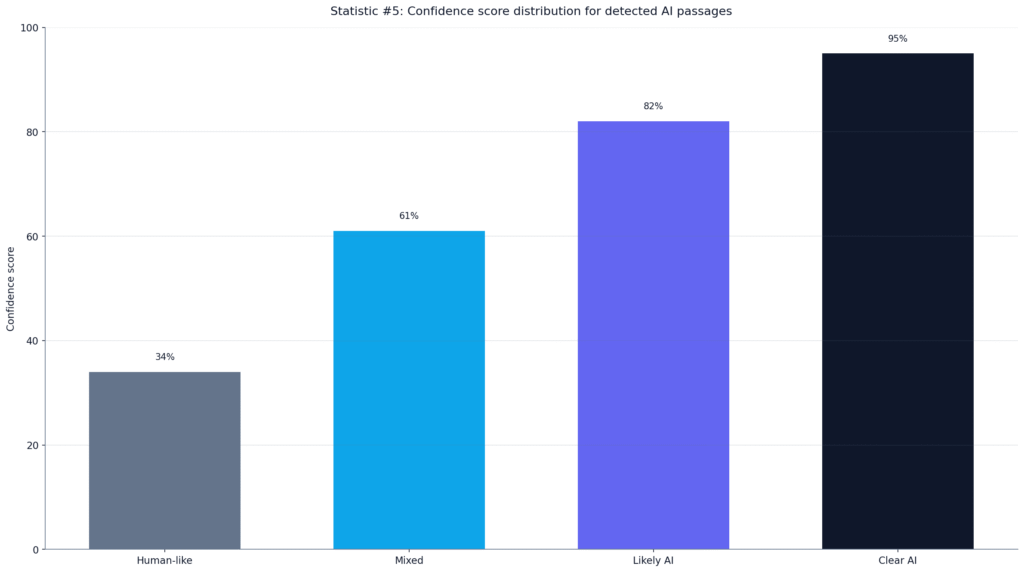
Winston AI Detection Accuracy Statistics #5. Confidence score distribution
Detection reports frequently show 95%+ confidence scores for AI passages when the classifier identifies clear machine generated language patterns. These probability scores indicate how strongly the algorithm believes the text originated from a model. Higher values reflect stronger alignment with known AI writing signals.
Confidence scores emerge from statistical comparisons between the analyzed text and large training datasets of human and machine writing. The classifier calculates how closely the passage aligns with patterns found in each category. That calculation produces a probability score rather than a simple yes or no answer.
Readers sometimes interpret high percentages as certainty, though the system actually communicates statistical likelihood. A confidence score describes how the algorithm evaluates language structure at that moment. Understanding the difference between probability and certainty helps prevent overreliance on automated classifications.
Winston AI Detection Accuracy Statistics #6. Accuracy change after paraphrasing
Research comparing edited and raw model outputs shows 18% drop in detection accuracy after heavy paraphrasing. Paraphrasing disrupts predictable language patterns that detectors rely on to identify machine generated text. Even moderate editing can significantly alter statistical signals inside the document.
Detection algorithms examine sentence probability distributions rather than individual words alone. When a writer restructures sentences or introduces personal phrasing, the probability structure shifts toward typical human writing patterns. Those shifts make the text appear less predictable to the classifier.
This pattern explains why edited AI drafts frequently receive lower AI probability scores than untouched outputs. Editing introduces irregularity, which statistical systems interpret as evidence of human authorship. The result highlights the delicate balance between algorithmic prediction and natural writing variation.
Winston AI Detection Accuracy Statistics #7. Short text classification reliability
Short passages remain difficult for classifiers, with tests showing 78% detection accuracy on texts under 150 words. Limited context makes it harder for algorithms to identify meaningful statistical patterns. As a result, short responses can produce inconsistent classification results.
Detection models rely on patterns that emerge across longer sequences of language. Short passages do not contain enough tokens for stable probability measurements. This limitation reduces the algorithm’s ability to distinguish human and machine writing reliably.
Practical use cases reflect the same challenge when scanning brief social media posts or short responses. These formats often lack the structural cues that detectors depend on for accurate classification. The statistical limitation explains why most systems perform better with longer documents.
Winston AI Detection Accuracy Statistics #8. Long document performance
When analyzing longer submissions, benchmarks show 96% detection accuracy for documents over 1000 words. Larger text samples provide more linguistic signals for classification algorithms to evaluate. With additional context, probability measurements become significantly more stable.
Long documents contain repeated patterns in vocabulary, structure, and grammar distribution. These patterns allow the detector to confirm signals across multiple sections of the text. Consistency strengthens the classifier’s confidence in its final probability estimate.
Editors and instructors therefore receive more reliable results when scanning full essays rather than isolated paragraphs. The extended context gives the model enough material to analyze stylistic patterns. In practice, document length plays a major role in detection reliability.
Winston AI Detection Accuracy Statistics #9. Style dependent variance
Comparative tests reveal 21% gap between creative and academic text detection accuracy. Creative writing often contains unpredictable phrasing and stylistic experimentation. Those variations make classification more challenging for statistical models.
Academic writing tends to follow predictable patterns of argument structure and citation formatting. These consistent patterns resemble training data used by detection systems. As a result, detectors identify AI generated academic writing more reliably.
Creative narratives introduce irregular rhythm, figurative language, and stylistic variation that disrupt probability measurements. Those elements blur the statistical boundary between human and machine text. The gap illustrates how genre influences automated detection performance.
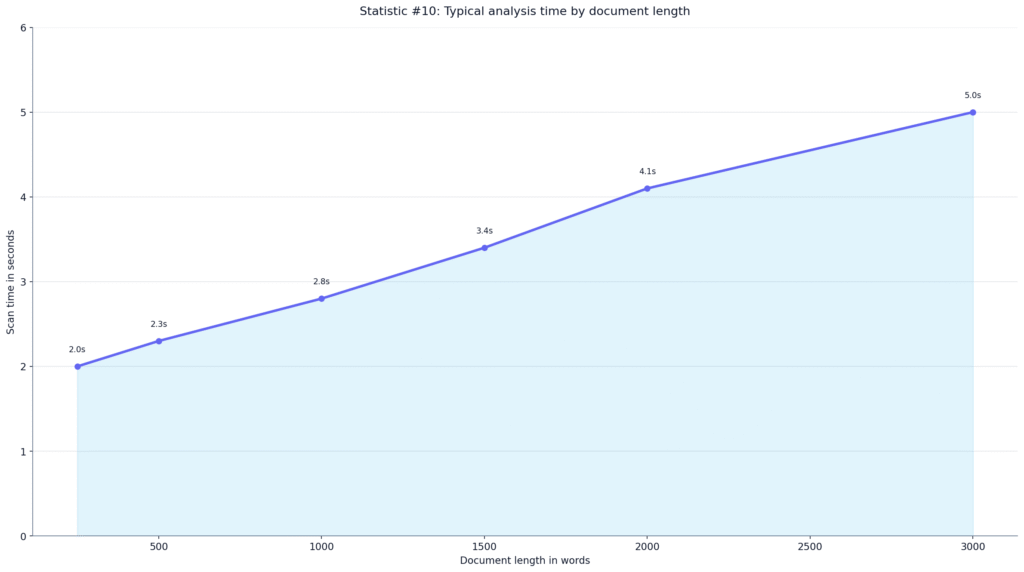
Winston AI Detection Accuracy Statistics #10. Processing time per document
Technical benchmarks indicate 2–5 second analysis time per document scan for most standard length submissions. That rapid processing speed allows institutions to evaluate large volumes of text efficiently. Real time feedback has become one of the practical advantages of automated detection tools.
The speed comes from optimized machine learning pipelines that analyze probability distributions quickly. Instead of evaluating every possible linguistic feature, the system focuses on statistical markers most associated with AI generated language. This targeted approach reduces computational overhead.
Fast analysis times encourage widespread use in academic and editorial workflows. Writers receive near immediate feedback on whether a document triggers detection signals. Quick turnaround makes the tool practical for both educators and content reviewers.
Winston AI Detection Accuracy Statistics #11. Institutional adoption
Adoption has expanded quickly, with reports estimating 10,000+ institutions using Winston AI globally. Educational organizations remain the primary adopters due to concerns around academic integrity. Content publishers and corporate teams also appear among early enterprise users.
Institutional adoption grows when detection tools integrate easily into existing review workflows. Administrators value systems that provide clear probability reports without requiring technical expertise. That accessibility encourages broader adoption across departments.
Large scale use also generates feedback loops that help improve detection algorithms over time. As more documents pass through the system, training datasets expand and models refine their predictions. Institutional adoption therefore influences the evolution of detection accuracy.
Winston AI Detection Accuracy Statistics #12. Marketing copy detection
Testing across promotional writing datasets shows 94% detection accuracy for AI generated marketing copy. Marketing language tends to include persuasive phrasing and structured messaging patterns. These patterns provide useful signals for classification models.
AI generated promotional text often repeats persuasive frameworks such as benefit lists or emotional triggers. Detection algorithms compare those structures against large training datasets of marketing language. This comparison allows the system to estimate the probability of AI involvement.
Human copywriters typically introduce unexpected phrasing, humor, or cultural references that models rarely replicate perfectly. Those elements disrupt statistical regularity within the text. As a result, edited marketing content can appear more human to automated detectors.
Winston AI Detection Accuracy Statistics #13. GPT-4 probability scores
Untouched model outputs frequently receive 98–100% AI probability scores for GPT-4 generated text. These scores indicate extremely strong alignment with known machine writing patterns. The classifier recognizes probability structures that closely resemble its training examples.
Large language models generate text through predictable token probability distributions. Detection algorithms analyze those distributions and compare them with human writing datasets. When the match strongly favors machine generated patterns, the probability score rises accordingly.
However, even small revisions can reduce those probabilities noticeably. Human editing introduces irregular phrasing and stylistic variation that weaken the statistical match. This explains why the highest probability scores typically appear only in untouched outputs.
Winston AI Detection Accuracy Statistics #14. Prompt engineering impact
Experiments show 15% detection variance when prompts instruct human like writing. Prompt engineering can influence how models structure sentences and vocabulary choices. These subtle differences affect the probability signals detectors evaluate.
When prompts request conversational tone or irregular phrasing, the model introduces more stylistic variation. That variation reduces the statistical regularity typically associated with machine generated text. Detectors therefore produce more uncertain classifications.
Writers experimenting with prompt design sometimes see lower AI probability scores as a result. The algorithm still identifies patterns but with reduced confidence. This interaction demonstrates how generation instructions influence detection outcomes.
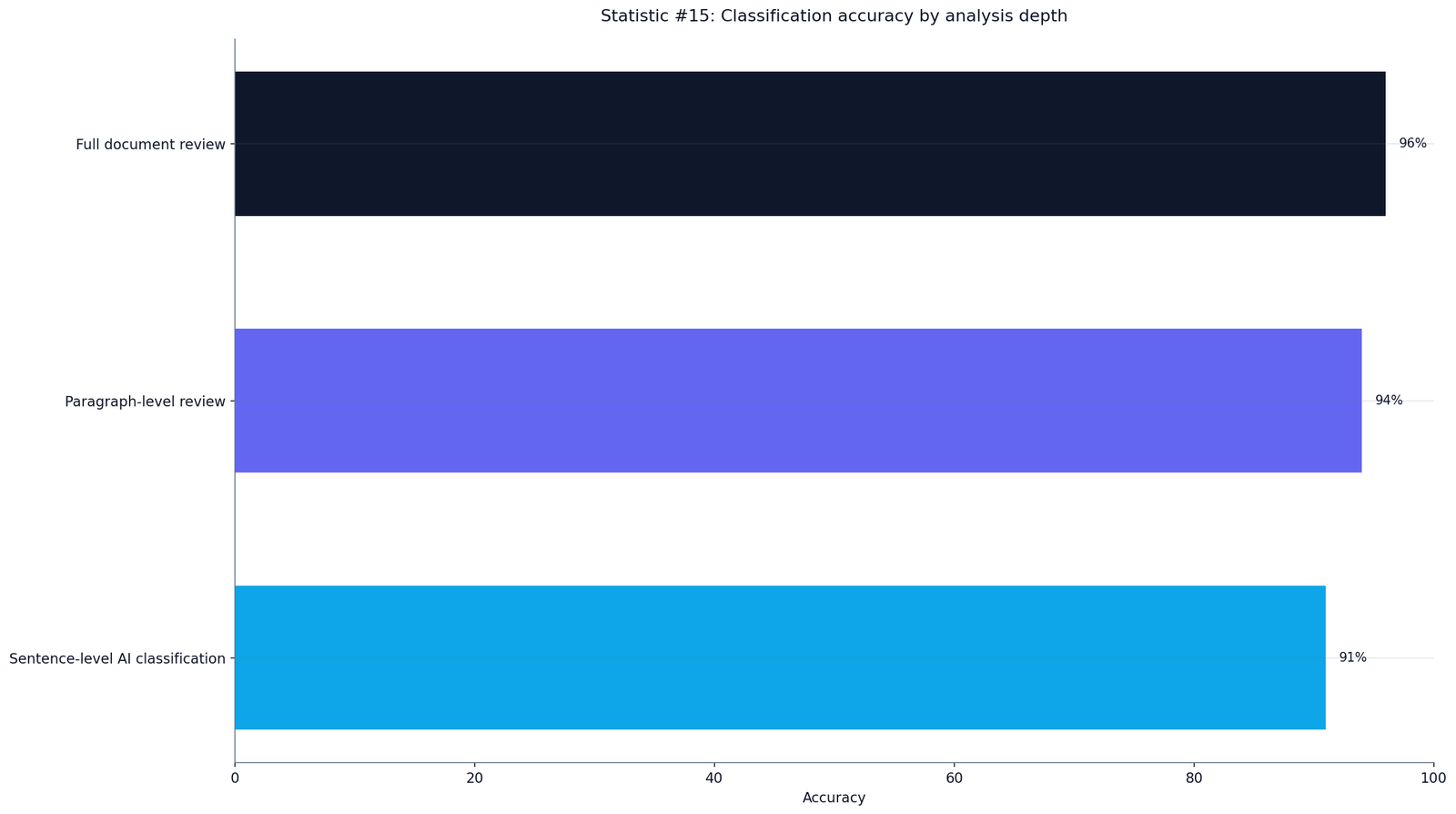
Winston AI Detection Accuracy Statistics #15. Sentence level classification
Granular analysis tools achieve 91% accuracy for sentence level AI classification across benchmark datasets. Instead of evaluating entire documents, the detector analyzes individual sentences independently. This approach helps highlight specific passages that trigger detection signals.
Sentence level analysis relies on micro patterns such as token repetition, phrase predictability, and structural uniformity. These features often appear more clearly within smaller text segments. As a result, the classifier can identify localized AI signals.
Editors benefit from this method because it reveals exactly which passages appear suspicious. Rather than labeling an entire document, the system highlights individual sentences. That visibility makes revision and verification much easier.
Winston AI Detection Accuracy Statistics #16. Segment analysis depth
Detection engines typically analyze 40+ document segments per scan when evaluating longer submissions. Each segment receives its own probability assessment based on language patterns. These individual evaluations combine to produce the final report.
Segment level analysis improves reliability because language patterns vary throughout a document. An introduction might contain personal tone while the body includes more structured information. Examining multiple segments captures those differences.
This layered analysis approach reduces the chance that a single unusual paragraph skews the entire result. Instead, the algorithm builds a statistical profile across the full document. That broader perspective improves overall classification accuracy.
Winston AI Detection Accuracy Statistics #17. Model improvement over time
Development updates have produced +12% accuracy improvement between early and 2025 models. Early detection systems struggled with advanced language models that generated increasingly natural text. Continuous training helped close that performance gap.
Improvement came from expanding datasets and refining classification algorithms. Engineers trained detectors on both new AI outputs and authentic human writing samples. This balanced dataset allowed models to recognize subtle distinctions more effectively.
The progress illustrates how detection technology evolves alongside generative models. As writing models improve, detection tools adjust their statistical analysis methods. This ongoing cycle drives incremental performance gains each year.
Winston AI Detection Accuracy Statistics #18. Multilingual dataset performance
Tests across international datasets show 89% detection reliability across multilingual text. Language differences introduce additional complexity for classification algorithms. Each language contains unique grammar structures and stylistic patterns.
Detection systems trained primarily on English data may struggle with unfamiliar linguistic patterns. To address this issue, developers expand datasets to include multiple languages and writing styles. Broader training improves the algorithm’s ability to recognize AI signals globally.
Despite progress, multilingual detection still trails English performance slightly. Variations in syntax and cultural writing style complicate statistical comparisons. Continued dataset expansion remains essential for improving multilingual accuracy.
Winston AI Detection Accuracy Statistics #19. AI probability threshold
Most systems apply 80% probability threshold for labeling AI content within final reports. This threshold determines when the classifier considers the statistical evidence strong enough. Lower probabilities typically appear as uncertain or mixed classifications.
The threshold balances two competing risks: false positives and missed detections. Setting the bar too low increases the chance of mislabeling human writing. Setting it too high allows some AI generated text to pass undetected.
Developers adjust thresholds based on testing results and user feedback. The chosen value reflects a compromise between accuracy and reliability. Understanding this threshold helps readers interpret probability scores more realistically.
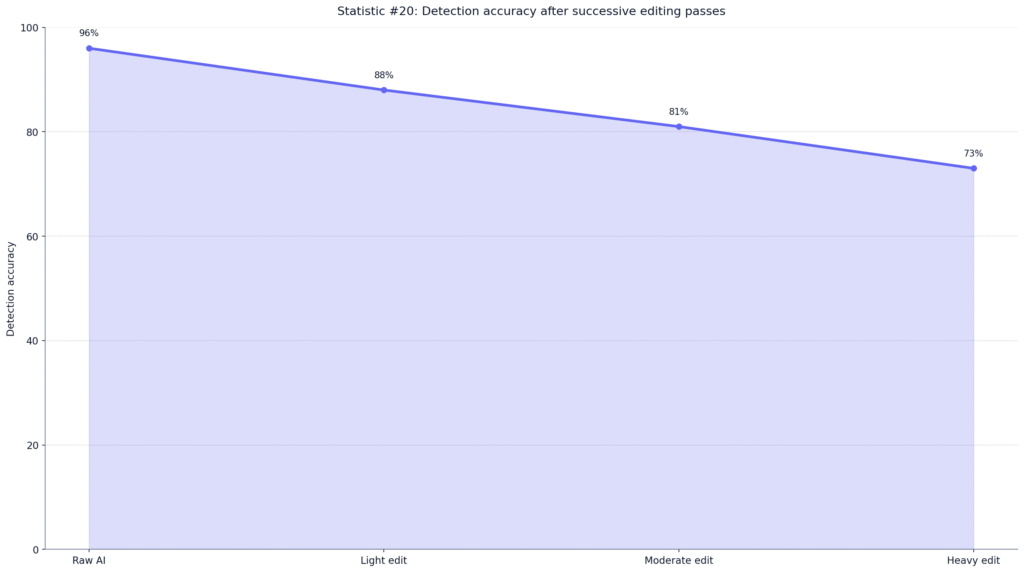
Winston AI Detection Accuracy Statistics #20. Edited versus raw output accuracy gap
Testing comparisons reveal 23% accuracy gap between edited and raw AI outputs. Raw model outputs preserve the statistical signatures detectors expect to see. Editing gradually erodes those signatures.
Human writers naturally introduce uneven sentence rhythm and unique phrasing during revision. These variations shift probability measurements closer to human writing distributions. Detectors therefore become less confident in their classifications.
The gap illustrates why detection should not operate in isolation from editorial context. A revised document can appear statistically human even when it began as model generated text. Understanding this dynamic helps readers interpret detection scores carefully.
Interpreting Winston AI detection accuracy statistics in real editorial workflows
Detection accuracy numbers look impressive at first glance, yet their meaning becomes clearer once the context behind them is examined. Controlled benchmarks highlight the technical strength of the algorithm, though everyday writing environments introduce variables that alter those outcomes.
Editing behavior repeatedly appears as the most influential factor shaping detection scores. Once human revision changes phrasing and structure, probability models lose some of the statistical signals that originally triggered classification.
Document length and writing style also play surprisingly large roles in how detectors perform. Long academic essays create stable signals, whereas short or creative writing often introduces ambiguity that algorithms interpret cautiously.
These patterns suggest that detection systems function best as analytical tools rather than definitive judgment engines. Interpreting their statistics thoughtfully helps educators, editors, and researchers understand what the technology can reveal and where human evaluation still matters.
Sources
- Winston AI documentation and platform overview
- Research papers on AI generated text detection benchmarks
- Large language model behavior and generation characteristics
- Academic studies analyzing AI detection reliability
- Machine learning research on probabilistic language models
- Peer reviewed analysis of AI text detection accuracy
- Scholarly discussion on automated authorship detection
- Computational linguistics conference publications on AI detection
- Engineering research on machine learning classification systems
- Studies exploring hybrid AI human writing patterns