How to Edit AI Assignments Naturally: 15 Student-Friendly Edits

Editing AI drafts carefully helps assignments read more like authentic student writing instead of rigid machine output. Research highlighted in the Stanford HAI study on AI detector bias shows automated detection systems can misclassify structured text, making natural editing strategies increasingly important.
How to Edit AI Assignments Naturally: 15 Student-Friendly Edits
Students are turning to AI tools for drafts, outlines, and research help, yet the final result can still feel stiff or overly structured. Learning editing moves creators use without losing personality helps turn those rough drafts into work that reads like it came from a real student voice.
The problem happens because AI often writes in patterns that feel predictable, repetitive, or slightly too polished for normal academic writing. Many students try quick fixes with tools listed in guides to the most reliable AI humanizer tools, but editing habits matter far more than automated rewriting.
Detection systems are improving each year, and studies highlighted in GPTZero AI detection statistics show how consistent sentence patterns can raise suspicion even when ideas are original. The strategies below walk through practical ways to revise AI-assisted drafts so they read naturally, sound human, and stay comfortable for academic submission.
| # | Strategy focus | Practical takeaway |
|---|---|---|
| 1 | Sentence rhythm adjustment | Break predictable sentence patterns so the text reads more like natural student writing. |
| 2 | Personal tone insertion | Add small voice markers and perspective cues that reflect how students normally explain ideas. |
| 3 | Structural simplification | Reduce overly formal structures and convert them into clearer, more conversational academic sentences. |
| 4 | Idea clarification | Rewrite dense explanations so the reasoning feels easier to follow and less machine-generated. |
| 5 | Paragraph flow repair | Adjust transitions so sections connect smoothly instead of sounding mechanically organized. |
| 6 | Example grounding | Add small real-world or classroom examples that make explanations feel more authentic. |
| 7 | Vocabulary moderation | Replace overly complex terms with words students typically use in essays. |
| 8 | Sentence length variety | Introduce shorter and longer sentences so the writing avoids predictable patterns. |
| 9 | Natural transition phrases | Use subtle connectors that sound like human reasoning rather than rigid academic linking. |
| 10 | Claim reinforcement | Strengthen arguments with clearer explanations instead of generic supporting language. |
| 11 | Context expansion | Add small clarifying details that help the reader understand why a point matters. |
| 12 | Redundancy trimming | Remove repeated phrasing that often appears in machine-generated drafts. |
| 13 | Logical sequencing | Reorder ideas so the argument builds in a way that feels natural for student essays. |
| 14 | Human nuance cues | Add small qualifiers and natural phrasing that signal genuine reasoning. |
| 15 | Final readability pass | Review the full piece aloud or slowly to ensure the writing flows smoothly and clearly. |
15 Student-Friendly Edits to Edit AI Assignments Naturally
How to Edit AI Assignments Naturally – Strategy #1: Sentence rhythm adjustment
Many AI-generated drafts follow a steady, almost mechanical rhythm that becomes noticeable once you read the paragraph carefully from beginning to end. When learning how to edit AI assignments naturally, the first task is to vary sentence patterns so the writing reflects the uneven cadence people typically use when explaining ideas in essays. A student paragraph normally blends longer explanations with shorter clarifications, and this small imbalance in pacing quietly signals authentic human composition rather than algorithmic structure.
An effective way to revise rhythm is to merge a few sentences while breaking others into separate thoughts, allowing the paragraph to breathe more naturally as the argument develops. Imagine an assignment explaining climate change effects where every line originally begins with similar phrasing and identical length, which immediately feels rehearsed and predictable to a careful reader. Adjusting the rhythm with varied phrasing, additional context, and occasional emphasis creates movement in the paragraph that reads much closer to genuine student writing.
How to Edit AI Assignments Naturally – Strategy #2: Personal tone insertion
AI writing tends to remove subtle markers of perspective, which leaves many assignments sounding neutral, detached, and slightly artificial even when the information is correct. Editing for tone helps restore the small expressions students naturally use when presenting an idea, such as clarifying why a concept matters or how it connects with something discussed in class. Learning how to edit AI assignments naturally therefore means inserting a voice that feels thoughtful without turning the essay into informal commentary.
One useful revision technique is adding reflective language that signals interpretation, such as acknowledging that a concept might seem complicated before explaining it more clearly. In a sociology assignment, for instance, a paragraph might introduce social behavior theories and then briefly acknowledge how those ideas appear in everyday interactions between students on campus. That small voice cue signals awareness and reflection, which is exactly the type of tone professors expect from authentic student writing.
How to Edit AI Assignments Naturally – Strategy #3: Structural simplification
AI systems frequently produce sentences packed with clauses and layered transitions that appear impressive at first glance yet quickly become difficult to follow during careful reading. Students who want their essays to sound natural often need to simplify these structures so the logic becomes easier to track without sacrificing the academic tone expected in coursework. Understanding how to edit AI assignments naturally includes identifying overly complex constructions and rewriting them into clearer explanations.
A common example appears when an AI draft attempts to summarize multiple ideas inside a single sentence that stretches across several lines. In practice, most students separate those thoughts into two or three statements that gradually build the argument rather than compressing everything together. Simplifying the structure improves clarity while making the paragraph resemble the type of reasoning normally seen in authentic student submissions.
How to Edit AI Assignments Naturally – Strategy #4: Idea clarification
AI-generated paragraphs sometimes mention concepts without fully explaining why those ideas matter within the broader argument of the assignment. Editing for clarity helps ensure that each statement leads the reader logically toward the next point, creating a smooth intellectual path through the discussion. Students practicing how to edit AI assignments naturally should pause after each claim and ask whether the explanation truly connects the idea to the assignment topic.
This revision step might involve expanding a sentence that briefly mentions a theory so that the reader understands its relevance to the specific essay question. Imagine a psychology assignment referencing cognitive bias without describing how that bias influences decision making in everyday situations. Adding a short explanatory bridge turns the paragraph into a coherent argument rather than a collection of loosely related statements.
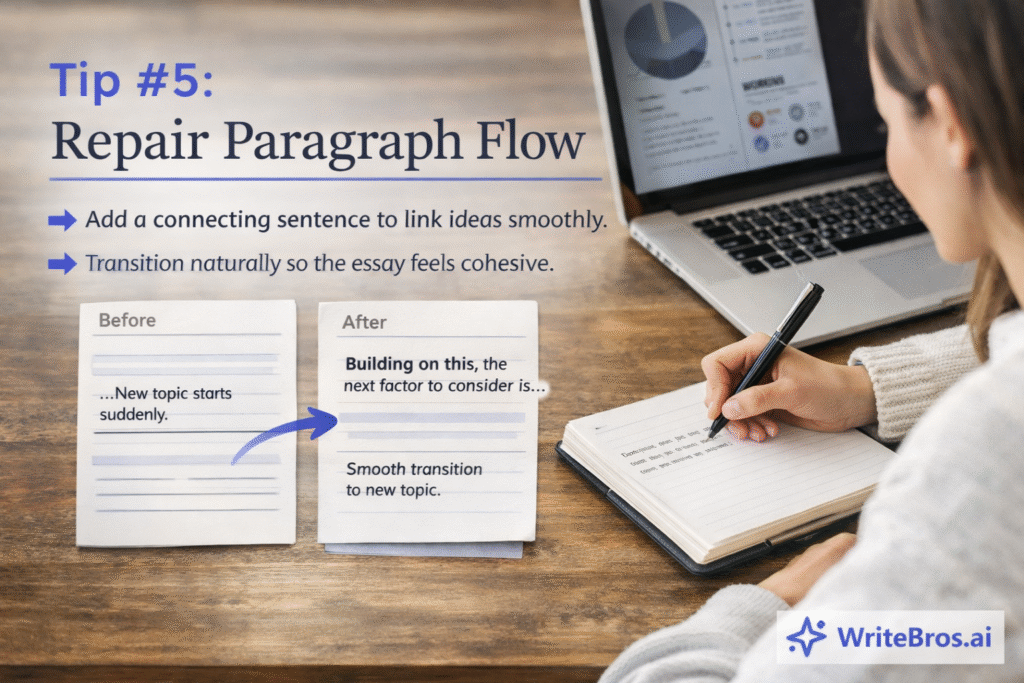
How to Edit AI Assignments Naturally – Strategy #5: Paragraph flow repair
AI-generated essays often organize ideas in rigid blocks that technically follow a logical order but feel strangely abrupt when moving from one paragraph to the next. Students editing these drafts should focus on smoothing the transitions so each section feels connected to the previous one rather than appearing as an isolated piece of analysis. Learning how to edit AI assignments naturally means shaping the essay into a continuous flow of reasoning.
One helpful technique involves adding a brief linking phrase that references the idea from the previous paragraph before introducing the new topic. For instance, a literature essay discussing character motivations might close one section with a reflection that subtly prepares the reader for the next analytical point. That gentle bridge transforms the essay from a sequence of segments into a cohesive narrative argument.
How to Edit AI Assignments Naturally – Strategy #6: Example grounding
AI writing frequently explains concepts in abstract language that sounds polished but slightly distant from real experiences. Students can improve authenticity by grounding explanations in small, relatable examples that demonstrate how an idea actually appears in everyday life or academic settings. This technique is an essential part of learning how to edit AI assignments naturally because real examples create texture that automated text rarely includes.
A political science essay discussing media influence, for instance, becomes far more convincing when the paragraph briefly references a recognizable type of news coverage or social media discussion. Instead of repeating general statements about information spread, the student might describe how a trending topic shaped online conversation during a recent event. That added example quietly signals original thinking and human observation.
How to Edit AI Assignments Naturally – Strategy #7: Vocabulary moderation
AI drafts often rely on formal vocabulary that appears impressive yet feels slightly excessive compared with the tone typical of student essays. Editing these words into simpler alternatives helps restore a natural voice while preserving academic clarity. Students learning how to edit AI assignments naturally should review each paragraph for language that sounds overly technical or unnecessarily grand.
Consider a sentence that describes a simple cause-and-effect relationship using elaborate phrasing that stretches across several complex terms. Replacing those expressions with clearer language does not weaken the argument but instead makes the explanation easier for readers to follow. Professors generally value clarity and reasoning far more than decorative vocabulary.
How to Edit AI Assignments Naturally – Strategy #8: Sentence length variety
Uniform sentence length is one of the subtle signals that reveal algorithmic writing patterns in an essay. Human writers rarely produce paragraphs where every sentence follows the same structure or occupies nearly identical space on the page. Developing the habit of varying sentence length helps students understand how to edit AI assignments naturally.
This change might involve expanding one idea with additional explanation while trimming another statement that originally wandered too far from the point. When the paragraph includes both longer reflections and shorter clarifications, the text begins to feel far more conversational and authentic. That variation also helps maintain the reader’s attention throughout the essay.
How to Edit AI Assignments Naturally – Strategy #9: Natural transition phrases
AI-generated essays frequently depend on repetitive transition phrases that appear at predictable points in the paragraph structure. Although those connectors technically organize ideas, they can make the essay sound mechanical once the pattern becomes obvious. Students who want to edit AI assignments naturally should replace rigid transitions with more conversational reasoning.
Instead of relying on formulaic phrases, the revision can briefly explain how the next idea grows from the previous discussion. In a history essay, a paragraph might move from describing an event to discussing its consequences while acknowledging the relationship between those moments. This approach feels closer to natural academic explanation rather than scripted organization.
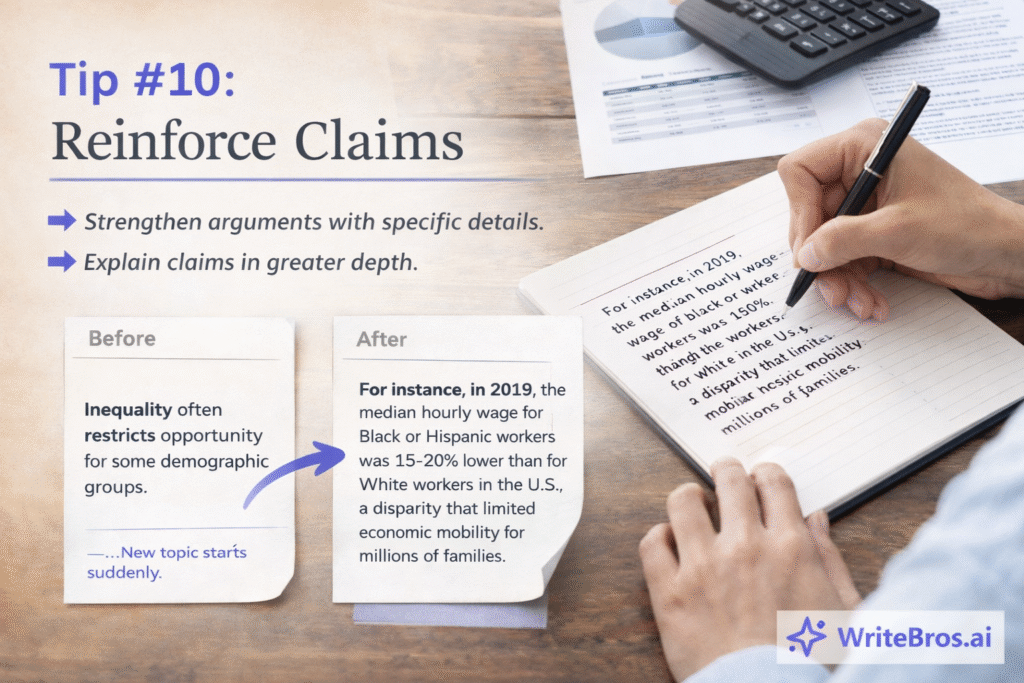
How to Edit AI Assignments Naturally – Strategy #10: Claim reinforcement
AI systems often produce claims that sound confident but lack detailed reasoning underneath the surface. When editing the draft, students should look for statements that feel slightly vague and expand them with stronger explanation. Understanding how to edit AI assignments naturally means ensuring each claim includes a clear reason or illustration.
A paragraph discussing economic inequality, for example, might mention income gaps without clarifying how those gaps influence real social outcomes. Adding context about education access or employment opportunities transforms the claim into a meaningful argument. That deeper explanation strengthens the essay and reduces the mechanical tone of the original draft.
How to Edit AI Assignments Naturally – Strategy #11: Context expansion
AI writing sometimes introduces a concept without fully situating it inside the broader discussion of the essay. Expanding the surrounding context helps readers understand how each idea connects to the assignment’s central argument. Students working on how to edit AI assignments naturally should ensure every paragraph clearly relates to the main question.
This might involve reminding the reader of the essay’s focus before presenting a supporting point that builds on earlier analysis. A biology assignment describing genetic adaptation, for instance, can briefly connect the explanation to environmental pressures already discussed in the previous section. The added context creates continuity that feels intentional rather than automated.
How to Edit AI Assignments Naturally – Strategy #12: Redundancy trimming
One noticeable pattern in AI-generated essays is the quiet repetition of similar phrases or ideas across several sentences. While the wording might change slightly, the underlying message often appears more times than necessary. Editing for redundancy is an important step when learning how to edit AI assignments naturally.
Students should read the paragraph slowly and identify lines that restate a point already explained in the preceding sentence. Removing or combining those sections keeps the argument concise while maintaining clarity. The final result feels far closer to the deliberate pacing of genuine academic writing.
How to Edit AI Assignments Naturally – Strategy #13: Logical sequencing
AI systems occasionally present ideas in an order that technically works but does not reflect the most intuitive progression for readers. Rearranging those ideas into a clearer sequence can dramatically improve the overall readability of the assignment. Learning how to edit AI assignments naturally therefore includes reorganizing paragraphs when necessary.
A student essay might originally introduce a complex theory before describing the basic concept that supports it. Reversing that order allows the reader to understand the foundation first before encountering deeper analysis. This simple structural adjustment creates a more logical narrative within the essay.
How to Edit AI Assignments Naturally – Strategy #14: Human nuance cues
Human writing often contains subtle qualifiers that acknowledge complexity within an argument. AI text tends to sound overly confident, presenting ideas as absolute statements without reflecting the uncertainty that appears in real academic reasoning. Students who want to edit AI assignments naturally should add thoughtful nuance to key claims.
For example, a paragraph analyzing social trends might briefly acknowledge that research findings can vary across different communities. That small qualification demonstrates critical thinking rather than blind certainty. Professors generally view such nuance as a sign of careful analysis.
How to Edit AI Assignments Naturally – Strategy #15: Final readability pass
The final stage of editing focuses on reading the entire assignment slowly to evaluate how it feels as a complete piece of writing. Many subtle issues only become visible when the essay is experienced from beginning to end rather than sentence by sentence. Students practicing how to edit AI assignments naturally should treat this step as a quality check.
During this review, awkward phrasing, repetitive language, or abrupt transitions become easier to detect and revise. Some students find it helpful to read the essay aloud because the ear quickly notices unnatural patterns. A final readability pass ensures the assignment flows smoothly and sounds convincingly human.
Common mistakes
- Many students assume that simply running AI-generated text through a paraphrasing tool will make it appear natural, yet this shortcut usually produces sentences that remain overly structured and mechanical. The result is writing that still carries predictable patterns and does not truly resemble authentic student reasoning.
- Another frequent mistake happens when students keep every sentence from the AI draft without questioning the logic behind each idea. Although the wording might sound polished, the argument often lacks genuine explanation or context, which makes the essay appear artificial during careful academic review.
- Students sometimes focus entirely on replacing vocabulary while ignoring the deeper structure of the paragraph. Even after words change, the underlying sentence patterns remain identical, which means the essay continues to display the rhythmic regularity typical of automated writing systems.
- A common problem also occurs when students add unnecessary complexity in an attempt to sound more academic. Overloading the essay with formal language or elaborate phrasing often makes the writing harder to understand and ironically draws attention to the artificial origin of the draft.
- Some students forget to connect their explanations directly to the assignment question, which leaves the essay filled with accurate information but lacking a clear argument. Without those connections, the paper reads like a general summary instead of a thoughtful academic response.
- Finally, many assignments fail because the student skips a full reread of the essay after editing. Small issues such as repeated transitions, awkward phrasing, or inconsistent tone remain hidden until the entire piece is reviewed carefully from start to finish.
Edge cases
Some assignments contain technical explanations or scientific terminology that naturally sound structured and formal. In these situations, editing should focus less on altering vocabulary and more on improving clarity and explanation so the ideas remain accurate while still sounding like thoughtful student analysis.
Group projects or research-heavy assignments can also create edge cases where multiple writing styles appear in the same document. When editing AI-assisted sections within those papers, students should focus on aligning tone and pacing with the rest of the document rather than completely rewriting every paragraph.
Supporting tools
- Grammar editing software helps students identify awkward sentence constructions and minor structural issues that might remain after manual revisions. These tools are especially useful during the final readability pass because they highlight phrasing that feels confusing or inconsistent within the paragraph.
- Readability analysis platforms evaluate sentence length, complexity, and paragraph density to show whether an essay feels overly mechanical. Students can use these metrics as a diagnostic tool to identify areas that need restructuring or simplification during the editing process.
- Reference management tools help students maintain accurate citations and organize research sources throughout the writing process. Properly integrated references strengthen the credibility of the essay while also encouraging students to expand their explanations with real supporting evidence.
- Collaborative writing platforms allow students to review assignments with classmates or tutors who can provide feedback on clarity and tone. External readers often notice unnatural phrasing more easily than the writer who has been working on the document for hours.
- Text comparison tools can help students analyze differences between the original AI draft and the revised version, making it easier to see whether meaningful changes have actually improved the writing. This comparison encourages deliberate editing rather than superficial rewriting.
- WriteBros.ai helps students adapt AI-generated text so it better reflects human writing patterns and natural reasoning. When used alongside manual editing strategies, the platform can assist with refining tone, smoothing sentence flow, and improving readability across longer assignments.
Ready to Transform Your AI Content?
Try WriteBros.ai and make your AI-generated content truly human.
Conclusion
Editing AI-assisted assignments successfully depends on transforming the initial draft into writing that reflects genuine reasoning and clear explanation. The techniques outlined in this guide help students reshape sentence rhythm, refine arguments, and introduce subtle voice cues that make academic work sound thoughtful and natural.
Students do not need to eliminate every trace of AI assistance to produce credible academic writing. Careful revision, attention to flow, and thoughtful explanation often matter far more than the drafting method itself. With consistent editing habits, AI-assisted drafts can become strong essays that feel authentically human.
Did You Know?
People working on how to edit AI assignments naturally often look for robotic wording first, but instructors usually notice repeated paragraph behavior sooner than any single sentence. If each section opens with a tidy claim, unfolds with the same controlled rhythm, and closes with the same polished takeaway, the writing can feel too uniform to sound like real student drafting.
Structural edits usually help more than quick synonym swaps because human writing rarely keeps perfect balance from one paragraph to the next. Let one section stay brief and practical, let the next stretch with a longer clarification or example, and let a later paragraph qualify its own point a little, since that uneven movement is part of what makes revised student writing feel believable.
Ready to Transform Your AI Content?