20 Best AI Text Summarizers (Yes, They Only Cost $20 or Less)
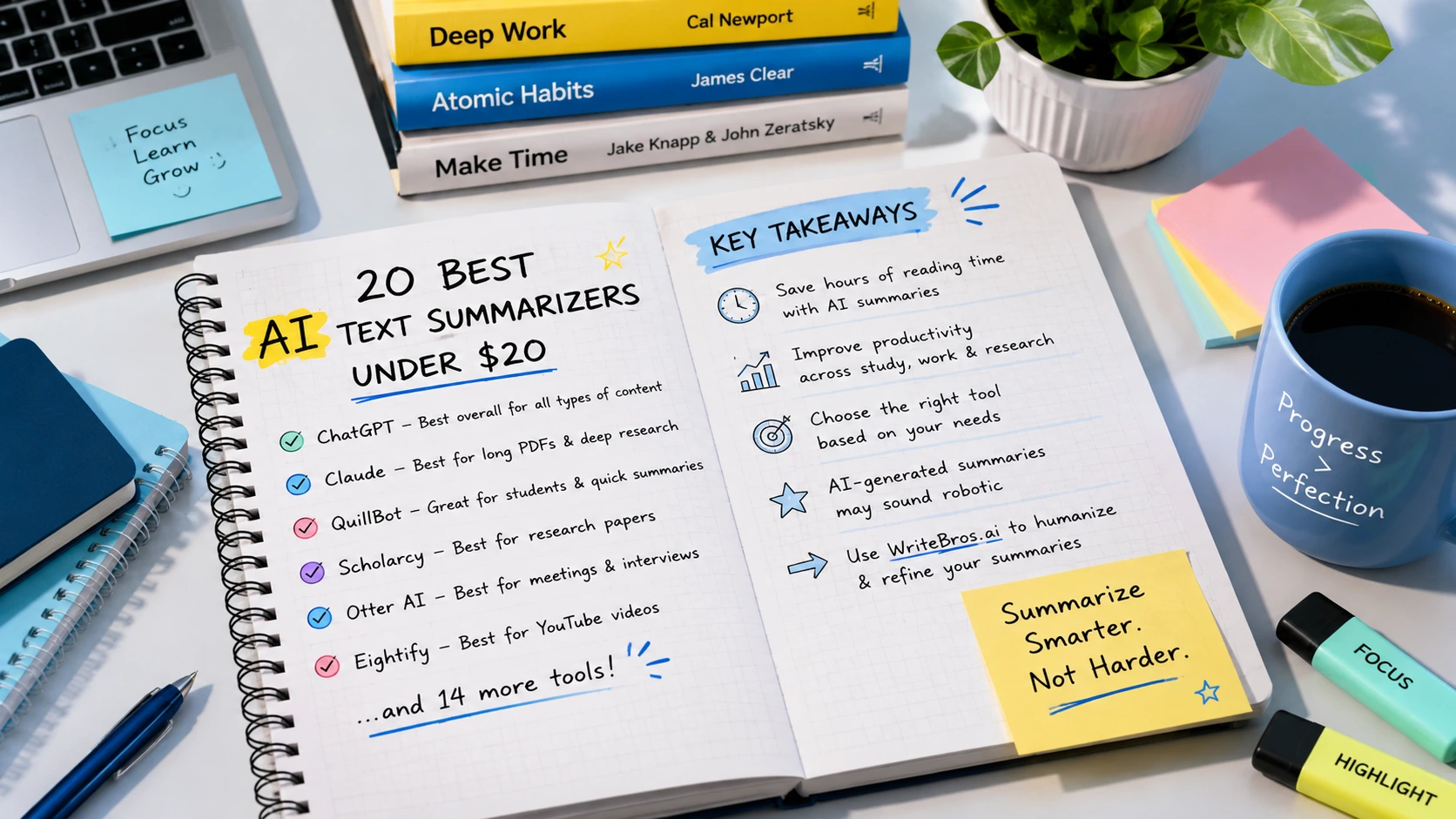
Highlights
- All tools are $20 or less.
- ChatGPT is best overall.
- Claude is strongest for long PDFs.
- Scholarcy helps with academic papers.
- Otter AI works well for meetings.
- WriteBros.ai helps humanize robotic summaries.
AI Text Summarizer tools are becoming essential for people who need to process long research papers, PDFs, meeting transcripts, lecture notes, articles, and reports without spending hours reading every line. The best tools do more than shorten text. They help users understand what matters faster.
The demand for affordable summarizers is rising because information overload is now a daily problem for students, freelancers, marketers, researchers, and small teams. According to research on generative AI productivity, AI systems are increasingly being used to reduce repetitive information-processing work across knowledge-heavy roles.
Still, a fast summary is not automatically a useful summary. Some tools over-compress important context. Others turn complex material into generic bullet points that sound clean but lose meaning. This matters especially for academic and client-facing work, where users still need to think through the material rather than depend blindly on raw AI output.
A good AI Text Summarizer reduces reading time. A better one preserves meaning while making the material easier to use afterward.
Students should also pay attention to AI university policies and professor expectations around AI use, especially when summarizers are used for studying, outlining, or assignment preparation. For freelancers and marketers, the bigger issue is whether the summary is clear enough to turn into a client-ready brief, report, or content draft.
This guide compares 20 affordable AI summarizer tools that stay at $20 or less, then explains which ones work best for research, PDFs, meetings, academic papers, video transcripts, and everyday note-taking.
20 Best AI Text Summarizers (Quick Glance)
| # | AI Text Summarizer | Best For | Pricing | Main Strength |
|---|---|---|---|---|
| 1 | ChatGPT | General summarization | $20/month | Flexible summaries for notes, PDFs, reports, and transcripts |
| 2 | Claude | Long documents | $20/month | Strong context retention for research and large PDFs |
| 3 | Gemini | Google ecosystem users | $19.99/month | Useful for Google Docs, research, and everyday summaries |
| 4 | QuillBot | Students | Under $20/month | Fast paragraph and article summaries with simple controls |
| 5 | Perplexity | Research workflows | $20/month | Combines web research, citations, and summarized answers |
| 6 | Notion AI | Teams and notes | Under $20/month | Summarizes workspace notes, docs, brainstorms, and project pages |
| 7 | Scholarcy | Academic papers | Under $20/month | Research-focused summaries for papers, chapters, and reports |
| 8 | Wordtune | Writers and marketers | Under $20/month | Readable summaries that work well for content and writing tasks |
| 9 | Eightify | YouTube videos | Under $10/month | Quick summaries for videos, lectures, and tutorials |
| 10 | Otter AI | Meetings and lectures | Under $20/month | Transcript summaries for calls, classes, and interviews |
| 11 | Fireflies.ai | Remote teams | Under $20/month | Meeting notes, action items, and call summaries |
| 12 | Humata AI | PDF analysis | Under $20/month | Summarizes and answers questions from uploaded documents |
| 13 | SciSummary | Scientific papers | Under $20/month | Useful for summarizing journal articles and research abstracts |
| 14 | Genei | Researchers | Under $20/month | Research reading, note organization, and document summarization |
| 15 | Monica AI | Browser workflows | Under $20/month | Summarizes webpages, PDFs, and online reading from the browser |
| 16 | TLDR This | Articles and webpages | Free / paid under $20 | Simple article summaries with minimal setup |
| 17 | SMMRY | Basic text compression | Free | Lightweight summarization for simple text and articles |
| 18 | Resoomer | Essays and articles | Free / paid under $20 | Good for summarizing argumentative and informational text |
| 19 | SummarizeBot | Multi-format summaries | Pay-as-you-go | Supports multiple file types and quick document compression |
| 20 | Jasper | Marketing teams | Plans may vary | Useful for turning long inputs into marketing-ready summaries |
What Makes an AI Text Summarizer Actually Worth Using?
Most AI summarizer tools can technically shorten text. The harder challenge is preserving meaning while reducing reading time. This is where the gap between average and genuinely useful AI Text Summarizer platforms becomes obvious.
Weak summarizers often compress information too aggressively. They remove nuance, flatten arguments, skip contextual details, or turn complex material into generic bullet points that feel polished but not actually helpful. Many users notice this immediately when summarizing research-heavy PDFs, academic papers, technical documents, or client briefs.
A useful summary should reduce friction, not remove the meaning people needed in the first place.
Research around AI-assisted information seeking behavior suggests that users increasingly rely on AI-generated compression because manually processing fragmented information has become mentally exhausting. But compressed information still needs structure, readability, and clarity to remain useful afterward.
This explains why people increasingly care about summary quality rather than summary speed alone. A fast summary that still requires rereading the original material does not actually save much time.
Good AI Text Summarizer tools preserve structure
One of the biggest differences between strong and weak summarizers is structural retention. Better tools preserve the hierarchy of ideas inside the original material. Instead of compressing everything equally, they identify which points matter most and organize the output in a way that still feels coherent.
This matters especially for:
research papers, multi-section PDFs, lecture transcripts, investor decks, internal reports, policy documents, and long-form educational content.
Tools with larger context windows tend to perform better here because they can process longer sections simultaneously instead of fragmenting the material too aggressively. This is partly why platforms like Claude and ChatGPT became heavily used for summarization workflows beyond simple article compression.
Readability matters more than most people expect
Many summaries fail because they sound mechanically compressed. The information may technically be accurate while still feeling difficult to read naturally. Students often rewrite AI-generated summaries manually because robotic phrasing can reduce retention during studying.
The same issue appears in professional workflows. Freelancers and agencies frequently refine summaries before sending them to clients because compressed outputs can sound impersonal or repetitive. Discussions around how freelancers decide AI-assisted work is client-ready increasingly point toward readability and natural phrasing as major quality signals.
This is also why many teams now treat summarization as only the first layer of the workflow. The second layer usually involves rewriting, simplifying, reorganizing, or humanizing the output afterward.
Different summarizers solve different problems
Some AI summarizers are optimized for long academic PDFs. Others work better for meetings, YouTube videos, browser articles, or collaborative workspaces. There is no single tool that dominates every summarization scenario equally.
For example:
Scholarcy performs well for academic research workflows, while Eightify focuses heavily on YouTube video summarization. Fireflies.ai and Otter AI are more useful for meetings and transcripts than traditional article summarization.
This is why choosing an AI Text Summarizer should depend less on hype and more on the actual workflow you need to support daily.
The next section breaks down the strongest affordable AI summarizers individually, including where each tool performs best, where limitations start appearing, and which users benefit most from each platform.
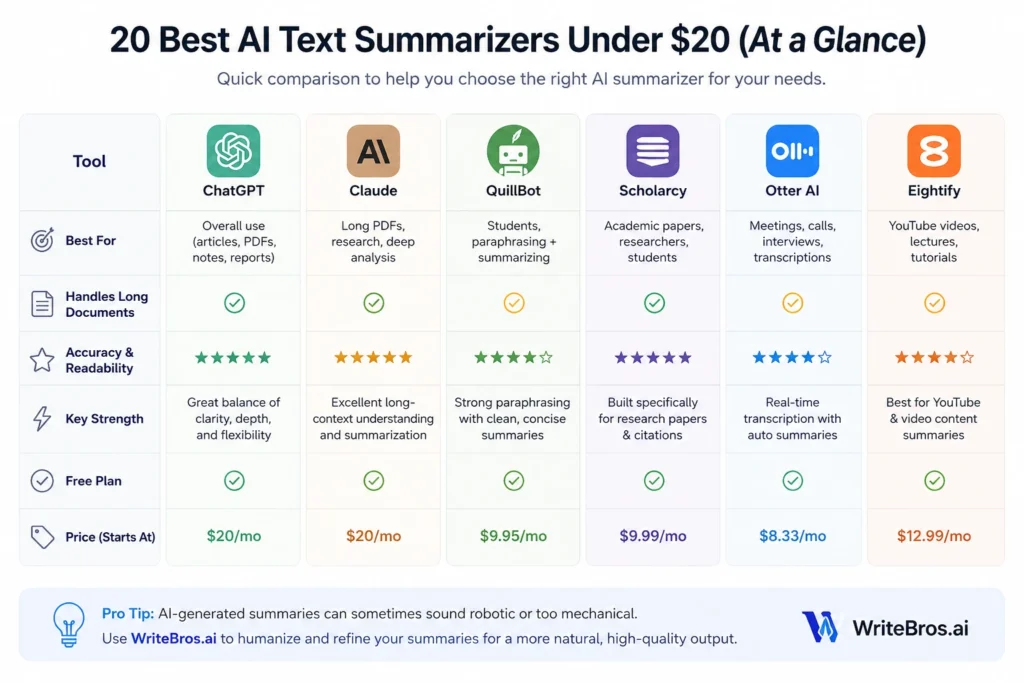
Best AI Text Summarizer Tools for Research, PDFs, and Daily Workflows
The strongest summarizer tools are usually the ones that adapt well across different types of material instead of forcing the same compression style on every document. Some are better for long PDFs and academic research, while others work better for browser articles, meetings, or collaborative workspaces.
These first five tools dominate many modern summarization workflows because they balance readability, context retention, and flexibility better than most low-end summarizers that simply shorten text mechanically.
1. ChatGPT
ChatGPT became one of the most widely used AI Text Summarizer platforms because it adapts well to different summary styles instead of locking users into one format. People use it for PDFs, research papers, articles, lecture notes, reports, transcripts, and even long email threads.
One of its biggest strengths is flexibility. Users can request short summaries, executive briefs, study notes, simplified explanations, bullet-point compression, or structured outlines depending on the workflow. This makes it useful for both academic and professional environments.
The main weakness is that vague prompts often produce overly polished summaries that sound slightly generic or repetitive. Many users refine the outputs afterward before using them in study notes, reports, or client-facing work.
2. Claude
Claude became especially popular among researchers, students, writers, and analysts because it handles large documents extremely well. Compared to many summarizers that aggressively compress information, Claude tends to preserve nuance and structural continuity more effectively.
This becomes noticeable when summarizing:
research journals, policy documents, academic papers, technical PDFs, investor materials, and long-form reports with multiple sections.
Research around large language model usage growth increasingly suggests that users are moving beyond simple chatbot use cases toward deeper research and synthesis workflows, which partly explains why larger-context summarizers like Claude became heavily adopted.
Claude summaries also tend to sound calmer and less mechanically compressed than many smaller summarization tools, though outputs can occasionally become too verbose when prompts are not constrained clearly.
3. Gemini
Gemini works particularly well for users already operating inside Google’s ecosystem. Summarizing Google Docs, browser research, articles, notes, and online information feels relatively seamless compared to tools that require more manual document handling.
One advantage of Gemini is speed. It performs well for lightweight research, quick article summaries, brainstorming compression, and everyday information processing. Students and marketers often use it for fast note organization and rapid reading reduction.
Its biggest limitation is that summaries sometimes prioritize simplification over depth, especially with highly technical or research-heavy material where contextual nuance matters more.
4. QuillBot
QuillBot remains one of the most recognizable summarization tools among students because it is fast, lightweight, and easy to use without much setup. Its summarizer works especially well for shortening articles, study material, essays, and informational content into simpler key points.
The platform performs best for lighter summarization workflows rather than deep contextual synthesis. Research-heavy documents often require more advanced summarizers with stronger context retention.
Discussions around student overreliance on AI tools increasingly show why many academic users still manually refine AI-generated summaries afterward. Fast compression can help with studying, but shallow summaries can also create the illusion of understanding without improving comprehension.
5. Perplexity
Perplexity approaches summarization differently from traditional AI Text Summarizer tools because it combines retrieval, citations, and synthesis together. Instead of summarizing only uploaded material, it actively searches for information, compares sources, and generates summarized answers with source references attached.
This makes it extremely useful for:
topic overviews, market research, competitive analysis, educational research, trend exploration, and fast information gathering.
The tradeoff is that summaries occasionally prioritize breadth over depth. Users handling highly technical documents or nuanced research papers may still prefer dedicated document-focused summarizers like Claude for deeper contextual continuity.
More Affordable AI Text Summarizer Tools Worth Trying
Some AI summarizer platforms focus heavily on research and long documents, while others are built around very specific workflows like YouTube videos, meeting transcripts, collaborative notes, or browser-based reading. The tools below became popular because they solve narrower problems extremely well instead of trying to be universal.
6. Notion AI
Notion AI works best for people already operating inside the Notion ecosystem. Instead of uploading documents into separate summarizer platforms, users can summarize notes, brainstorms, meeting pages, and internal documents directly inside their workspace.
This reduces workflow fragmentation significantly, especially for marketers, founders, project managers, and remote teams juggling large amounts of written material daily.
7. Scholarcy
Scholarcy focuses heavily on academic summarization workflows. It extracts key findings, references, summaries, and structured highlights from research papers much more effectively than many general-purpose AI tools.
Students and researchers often use it to scan large volumes of literature faster before deciding which papers deserve deeper reading.
8. Wordtune
Wordtune summaries tend to feel more readable and naturally phrased compared to highly compressed summarizer tools. This makes it useful for people who care about readability as much as information reduction.
Freelancers and agencies often prefer outputs that already sound relatively polished because less cleanup is required before client use.
9. Eightify
Eightify became popular because people increasingly consume educational and informational content through video instead of articles. The platform summarizes YouTube videos into short digestible takeaways without requiring users to sit through the entire recording.
This is particularly useful for lectures, podcasts, tutorials, interviews, and long educational videos where users mainly need the core points quickly.
10. Otter AI
Otter AI combines transcription with summarization, which makes it valuable for students, remote teams, journalists, and businesses handling large amounts of spoken content.
Instead of manually reviewing full recordings, users receive condensed notes, key discussion points, and searchable transcripts much faster.
One pattern appears repeatedly across almost every AI Text Summarizer workflow: users rarely keep the raw summary untouched. Most people still reorganize, rewrite, simplify, or refine the output afterward before using it seriously for studying, reporting, publishing, or client communication.
This matters because summary quality is increasingly tied to usability rather than compression alone. Research around AI-assisted information behavior suggests that users value outputs that reduce mental effort while still preserving enough clarity to support decision-making and understanding afterward.
The next group of summarizers focuses even more heavily on niche workflows like scientific papers, browser-based reading, and AI-assisted document analysis.
Niche AI Text Summarizer Tools for Scientific Papers, PDFs, and Browser Reading
Some summarization tools became popular not because they serve everyone equally, but because they solve one specific workflow extremely well. These platforms are often used by researchers, students, analysts, and heavy readers who process dense information constantly.
In many cases, specialized summarizers outperform general AI tools because they are optimized around a narrower type of content instead of trying to summarize everything identically.
11. Fireflies.ai
Fireflies.ai focuses heavily on meeting intelligence. It records, transcribes, summarizes, and organizes conversations automatically, which makes it useful for remote teams handling frequent calls and collaborative workflows.
The summaries are usually cleaner and more structured than raw transcripts, which reduces the time teams spend manually reviewing meetings afterward.
12. Humata AI
Humata AI became heavily used among students and researchers because it allows users to upload documents and interact with them conversationally. Instead of only generating a static summary, users can ask follow-up questions directly against the uploaded material.
This workflow is especially useful for large PDFs where users need both summarization and retrieval simultaneously.
13. SciSummary
SciSummary is designed specifically around scientific literature. It performs best when summarizing research-heavy papers that contain technical terminology, structured findings, and academic formatting.
General-purpose summarizers sometimes oversimplify scientific material too aggressively, while SciSummary tends to preserve research context more effectively.
14. Genei
Genei combines summarization with note organization, keyword extraction, and document management. This makes it useful for people processing large numbers of articles or papers simultaneously.
Researchers often use it less as a simple summarizer and more as a reading acceleration system for literature reviews and research collection workflows.
15. Monica AI
Monica AI works well for users who spend most of their time reading directly inside the browser. Instead of moving content between multiple platforms, users can summarize webpages, articles, PDFs, and online material quickly while browsing.
This makes it particularly useful for marketers, researchers, writers, and freelancers constantly navigating large amounts of online information.
The strongest AI Text Summarizer workflows increasingly combine multiple tools together. Many users summarize with one platform, organize notes with another, then rewrite or refine the final output afterward to improve readability and usability.
This layered workflow is becoming more common because raw AI summaries still have limitations. Some outputs sound overly compressed, emotionally flat, repetitive, or structurally generic. This is one reason many freelancers and agencies now pay closer attention to client expectations around AI-assisted work instead of assuming fast AI outputs automatically feel professional enough for delivery.
Research into AI-assisted productivity also increasingly suggests that workflow quality matters more than tool count alone. People rarely succeed by depending entirely on one AI platform. Instead, they build lightweight systems that combine summarization, organization, rewriting, editing, and refinement together.
More AI Text Summarizer Tools That Handle Lightweight and Everyday Workflows Well
Not every summarization workflow involves massive PDFs or research papers. Some people simply need faster ways to process articles, browser tabs, reports, essays, or informational content throughout the day. These next tools are usually lighter, simpler, and easier to deploy quickly.
16. TLDR This
TLDR This focuses heavily on reducing long-form web content into digestible summaries with minimal setup. It works particularly well for news articles, blog posts, informational pages, and general internet reading where users mainly want the core points quickly.
The platform is intentionally lightweight, which makes it convenient for casual summarization workflows rather than deep research-heavy analysis.
17. SMMRY
SMMRY became popular because of its simplicity. Users paste text or links and receive compressed summaries quickly without navigating complex dashboards or AI workflow systems.
While it lacks the sophistication of larger AI models, it still works reasonably well for lightweight article reduction and simple informational summaries.
18. Resoomer
Resoomer performs relatively well with argumentative and explanatory writing, especially educational content that follows a clear logical structure. Students often use it to reduce essay readings, informational articles, and academic-style material into more manageable summaries.
Its outputs are generally more readable than many older rule-based summarization systems, though highly technical material may still require more advanced platforms.
19. SummarizeBot
SummarizeBot supports multiple content formats beyond standard articles and PDFs. Users can summarize documents, links, audio, and other content types depending on the workflow.
This flexibility makes it useful for people juggling mixed media inputs rather than only traditional written material.
20. Jasper
Jasper is more commonly associated with AI writing, but many marketers and businesses also use it for summarization workflows involving reports, campaign briefs, market analysis, and long-form content reduction.
Its biggest advantage is workflow integration for teams already using AI-assisted content production heavily. Summaries can transition directly into drafts, campaign planning, or content development workflows afterward.
One trend keeps appearing across almost every AI Text Summarizer workflow: users increasingly care less about pure compression and more about whether the output remains useful afterward. A summary that still requires major rewriting, fact-checking, or restructuring may save less time than people initially expect.
This is also why concerns around AI-assisted writing quality continue growing across schools, agencies, and freelance work. Discussions around whether AI-assisted writing should be disclosed and the broader tension between automation and originality increasingly show that users are not simply trying to produce faster outputs anymore. They are trying to produce outputs that still feel credible, readable, and genuinely useful.
Best AI Text Summarizer Tools by Real-World Use Case
Most people eventually realize there is no single AI summarizer that dominates every workflow equally. A platform that performs well for research papers may feel weak for meetings. A tool optimized for YouTube videos may struggle with technical PDFs or academic readings.
This is why choosing the right AI Text Summarizer usually depends less on hype and more on the type of information being processed daily.
Best for Students
Claude + QuillBot Claude performs extremely well for long readings and research-heavy PDFs, while QuillBot remains useful for fast study-note compression and article summarization. Many students still manually rewrite summaries afterward to improve retention and avoid overreliance on raw AI outputs.
Best for Research Papers
Scholarcy + SciSummary These tools are optimized for scientific and academic material instead of lightweight article summarization. They preserve findings, references, and structured information more reliably than many general-purpose AI tools.
Best for Long PDFs
Claude + Humata AI Claude handles large-context documents exceptionally well, while Humata AI allows users to interact conversationally with uploaded PDFs. This combination works especially well for dense multi-section reports and research documents.
Best for YouTube Videos
Eightify Eightify became popular because educational and informational content increasingly lives inside video instead of traditional articles. It works well for lectures, tutorials, interviews, and podcast-style content.
Best for Meetings and Calls
Otter AI + Fireflies.ai Both tools combine transcription with summarization, helping remote teams organize calls, extract action items, and reduce the time spent manually reviewing meetings afterward.
Best for Marketers and Agencies
ChatGPT + Perplexity ChatGPT works well for flexible report summarization and campaign compression, while Perplexity helps marketers summarize research and compare sources quickly with citations attached.
Best for Browser-Based Reading
Monica AI Monica AI integrates directly into browser workflows, making it useful for people constantly reading articles, reports, documentation, and webpages throughout the day.
Best Overall Under $20
ChatGPT ChatGPT remains the most versatile option overall because it adapts well across many summarization styles, industries, and document types instead of focusing on only one workflow.
The strongest AI summarization workflows are rarely fully automated workflows. Most people summarize first, then simplify, reorganize, rewrite, or refine the output afterward depending on the audience and purpose.
This pattern appears consistently across education, freelance work, agencies, and business environments. Students often turn summaries into cleaner study notes. Freelancers rewrite compressed outputs into more client-ready documents. Marketers refine summarized research before using it inside campaigns, presentations, or reporting workflows.
AI-generated summaries may technically contain the correct information while still sounding robotic, repetitive, emotionally flat, or obviously AI-written afterward. Many users now summarize information first using platforms like ChatGPT or Claude, then refine the output further so it feels cleaner and more natural to read.
Discussions around the growing tradeoff between speed and originality increasingly show why workflow quality now depends heavily on refinement, not just generation speed.
Tools like WriteBros.ai are increasingly being used to humanize AI-generated summaries so the final output feels less mechanical and more usable for studying, publishing, presentations, or client-facing work.
The final section explains why many AI summaries still feel robotic or incomplete, and why refinement quality increasingly matters just as much as summarization speed itself.
Why AI Text Summarizer Workflows Still Need Human Refinement
AI summarization tools became popular because they solve a very real problem: modern information overload. Students are flooded with readings. Teams sit through endless meetings. Freelancers juggle long briefs and research documents constantly. Researchers process hundreds of pages weekly.
A strong AI Text Summarizer reduces that pressure dramatically. It shortens reading time, extracts key ideas faster, and helps users process more information within limited time. That is why summarization tools are rapidly becoming part of everyday workflows instead of occasional productivity experiments.
But summarization alone is rarely the final step.
Most AI-generated summaries still require refinement before they become genuinely useful for studying, publishing, presenting, collaborating, or client delivery. Some outputs sound robotic. Others remove nuance too aggressively. Some preserve information while losing readability completely.
This explains why many users now combine summarization with rewriting, editing, restructuring, and simplification afterward. The strongest workflows are no longer fully automated workflows. They are assisted workflows where AI accelerates the first draft while humans refine the final version.
Research around AI-assisted information behavior increasingly shows that people value outputs that reduce cognitive overload while still remaining understandable and trustworthy. Compression alone is not enough anymore. Readability, structure, and clarity matter just as much.
- Fast summaries are useful only if the meaning remains intact afterward.
- Long PDFs and research papers require stronger contextual handling than lightweight articles.
- Students, freelancers, marketers, and researchers all need different summarization workflows.
- Many AI summaries still require rewriting before they feel natural or professionally usable.
- Workflow quality increasingly matters more than the number of AI tools being used.
This is also why conversations around AI-generated writing continue evolving. Discussions around false positives in AI detection, AI detection uncertainty, and the growing pressure to produce faster content without sacrificing originality show that people increasingly care about refinement quality, not just generation speed.
The best summarization workflow therefore is not necessarily the workflow with the most automation. It is usually the workflow that balances speed, clarity, accuracy, and human judgment most effectively.
In 2026, the strongest AI Text Summarizer tools are no longer simply helping people read less. They are helping people navigate information overload without completely losing comprehension, context, and usability in the process.
Frequently Asked Questions
AI summarization tools are improving rapidly, but users still encounter major differences in readability, context retention, and output quality depending on the workflow and the platform being used.
What is the best AI Text Summarizer overall?
ChatGPT remains one of the most versatile AI summarizers overall because it adapts well across articles, PDFs, notes, reports, and research workflows. However, the best tool still depends heavily on the type of content being summarized daily.
Which AI Text Summarizer works best for students?
Many students prefer Claude, QuillBot, Scholarcy, and SciSummary because these tools handle academic readings and research-heavy material more effectively than lightweight summarizers focused mainly on casual web content.
Can AI summarizers handle long PDFs and research papers?
Yes, but some platforms perform much better than others. Claude, Humata AI, Scholarcy, and SciSummary are commonly used for long-context workflows because they preserve structure and contextual continuity more reliably than basic summarizers.
Why do some AI-generated summaries sound robotic?
Many summarizers prioritize compression speed over readability. The output may technically contain the correct information while still sounding repetitive, emotionally flat, overly compressed, or mechanically phrased afterward.
How do people make AI-generated summaries sound more natural?
Many users now refine summaries after generation instead of publishing or submitting them immediately. Some workflows involve rewriting, simplifying, reorganizing, or humanizing the output afterward using refinement tools like WriteBros.ai.
Are affordable AI summarizers under $20 actually good enough?
Yes. Many of the strongest AI summarization tools now offer plans under $20 monthly, including ChatGPT, Claude, QuillBot, Gemini, Perplexity, and several specialized research summarizers. Workflow fit usually matters more than price alone.
Do AI summarizers replace reading entirely?
Not completely. AI summarizers reduce reading time significantly, but many users still revisit the original material afterward for deeper understanding, nuance, verification, or contextual clarity.
Disclaimer. This article reflects publicly available pricing, product documentation, independent testing, and user-reported experiences available at the time of writing. Features, limitations, pricing tiers, and AI summarization quality may change over time as platforms update their models and workflows. WriteBros.ai and the author are not affiliated with most tools mentioned unless explicitly stated. This article does not constitute academic, legal, or professional advice, and readers should evaluate AI-generated summaries carefully before relying on them for coursework, publishing, research, or client-facing work.