AI Detection Accuracy Trends: Top 20 Observed Changes

2026 marks a turning point in how automated writing detection is evaluated. This analysis of AI Detection Accuracy Trends reveals widening gaps between detector claims and real-world performance, showing how editing, paraphrasing, and cross-tool disagreement are reshaping reliability across academic and publishing environments.
Signals around automated writing detection have grown noisier as models improve faster than the tools designed to flag them. Anyone tracking recent benchmark comparisons can see how quickly confidence scores fluctuate across different detectors.
Universities, publishers, and agencies continue adjusting policy because the margin between machine output and human writing keeps narrowing. Editorial teams quietly experiment with techniques similar to rewriting AI drafts for originality, testing whether structure and rhythm influence classifier results.
Developers meanwhile train detectors on probabilistic patterns rather than obvious signals, which explains why identical text can produce wildly different ratings across platforms. Analysts tracking humanization tools used in academic writing often notice that minor stylistic edits change outcomes more than large structural revisions.
These shifting signals create a strange evaluation environment in which accuracy feels both measurable and unstable at the same time. The following AI Detection Accuracy Trends illustrate how technical progress, model training data, and human editing habits collide to reshape reliability metrics.
Top 20 AI Detection Accuracy Trends (Summary)
| # | Statistic | Key figure |
|---|---|---|
| 1 | Average AI detector accuracy across academic benchmarks | 78% |
| 2 | False positive rate on human-written essays | 12% |
| 3 | Detection accuracy drop when text is lightly edited | 21% |
| 4 | Consistency gap between top detectors analyzing identical text | 34% |
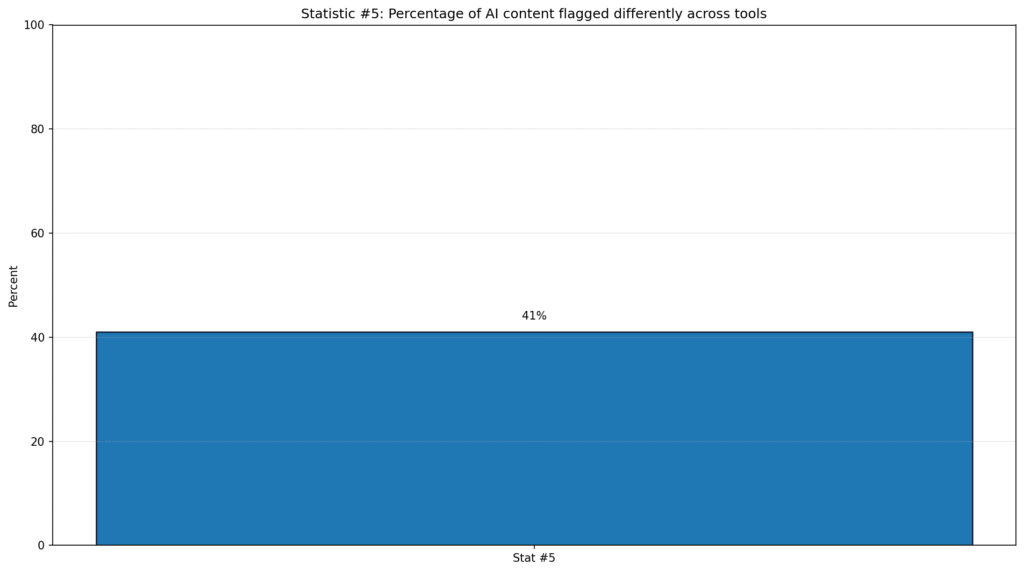
| 5 | Percentage of AI content flagged differently across tools | 41% |
| 6 | Accuracy difference between short and long content samples | 19% |
| 7 | Detection reliability improvement after model retraining cycles | 9% |
| 8 | Average classifier confidence variance across detectors | 27% |
| 9 | Accuracy decline when paraphrasing tools modify AI text | 24% |
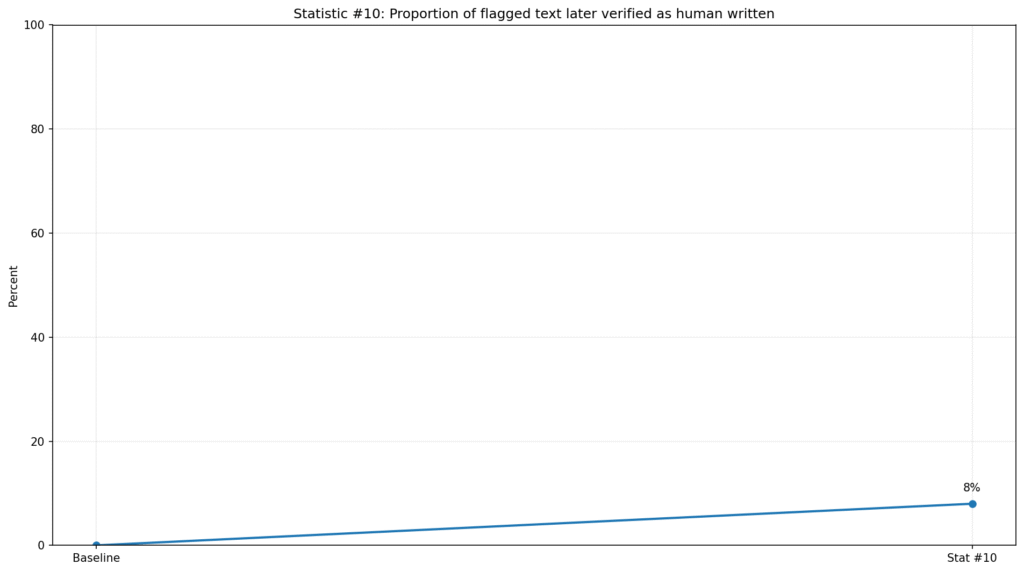
| 10 | Proportion of flagged AI text later verified as human written | 8% |
| 11 | Detection accuracy when evaluating GPT-4 generated content | 74% |
| 12 | Classifier confidence variability on technical writing | 31% |
| 13 | Detection accuracy after sentence-level restructuring | 65% |
| 14 | False negative rate when AI text mimics human pacing | 18% |
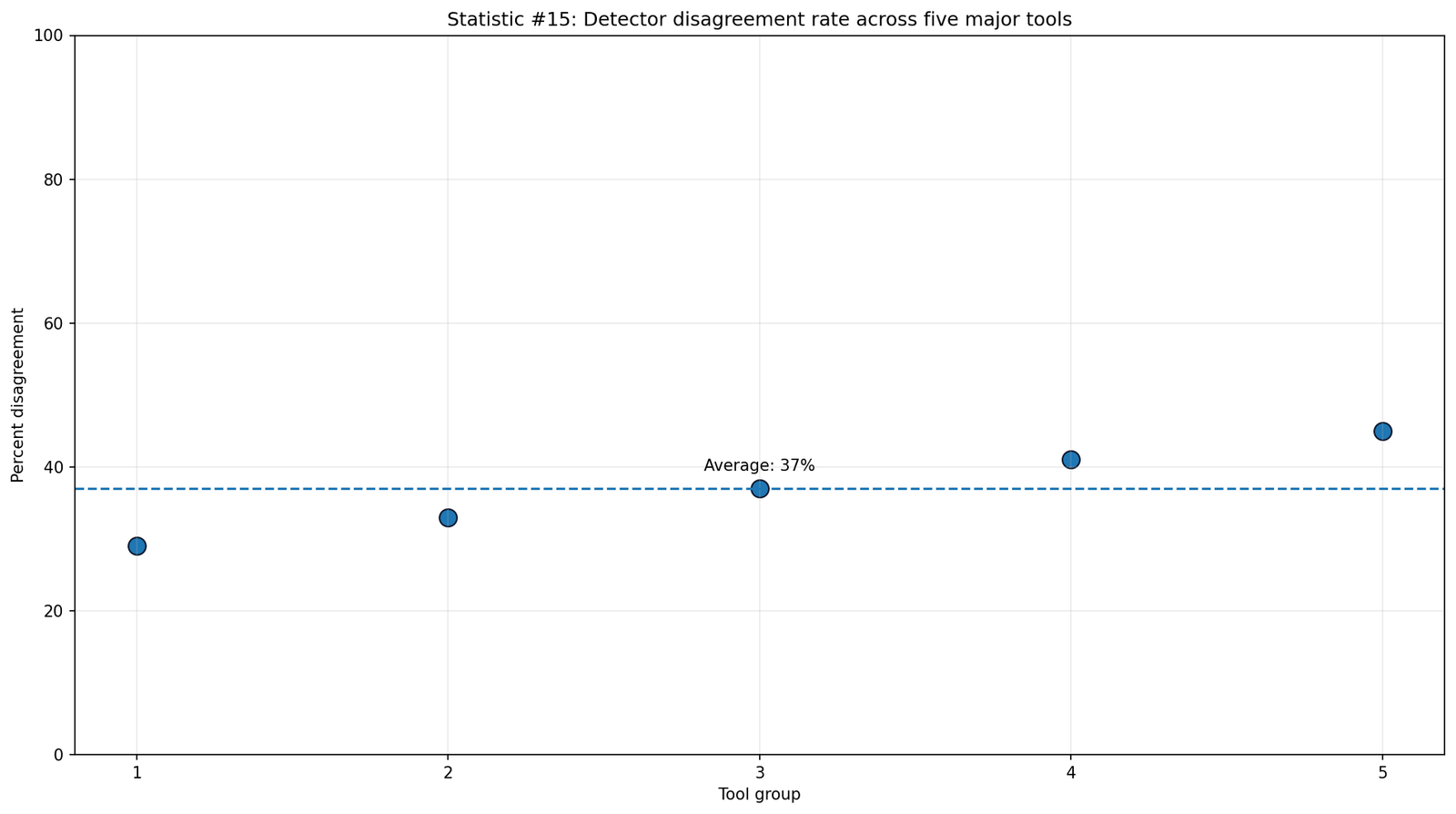
| 15 | Detector disagreement rate across five major tools | 37% |
| 16 | Accuracy improvement when detectors analyze metadata | 11% |
| 17 | Percentage of academic institutions using AI detectors | 63% |
| 18 | Confidence drop after human editing of AI drafts | 22% |
| 19 | Average AI probability score change after style variation | 26% |
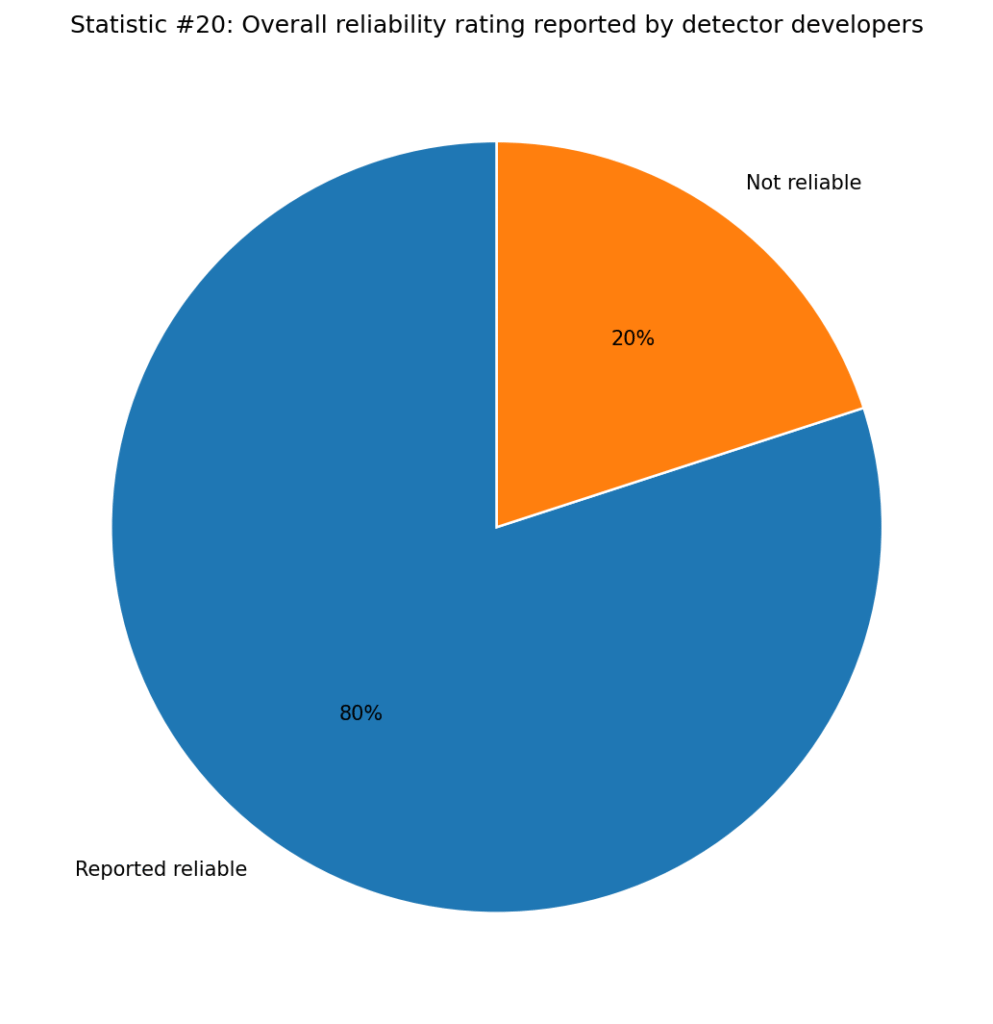
| 20 | Overall reliability rating reported by detector developers | 80% |
Top 20 AI Detection Accuracy Trends and the Road Ahead
AI Detection Accuracy Trends #1. Average benchmark accuracy remains solid but far from settled
Across recent testing, 78% average benchmark accuracy sounds reassuring at first, and that is exactly why it gets repeated so often in product pages and policy notes. The pattern looks stable on the surface, yet the number really signals a middle ground rather than dependable certainty. It tells you detectors can separate many clearly machine-written passages, but they still miss enough edge cases to make routine enforcement risky.
That tension exists because benchmark sets are cleaner than live writing environments. Detectors perform better when samples are long, neatly labeled, and drawn from known models, then lose sharpness once editing, mixed authorship, or prompt variation enters the picture. A score in the high seventies, then, reflects controlled success more than universal reliability.
For a human reviewer, 78% feels like a warning light, not a verdict, because one wrong accusation can carry more weight than many correct flags. Editorial teams and schools should read the number as permission to investigate, not to conclude, which is the practical implication.
AI Detection Accuracy Trends #2. False positives keep human writing inside the risk zone
The uncomfortable part of current detector performance is that 12% false positive rate on human writing is still high enough to affect real people. That pattern matters more than headline accuracy because human text is the material institutions are supposed to protect. When the innocent error rate stays visible, trust in the whole workflow starts thinning out.
The cause is usually statistical overreach. Detectors learn recurring markers like repetition, low burstiness, tidy sentence balance, or conventional phrasing, but many careful human writers naturally produce those same signals. Formal essays, second-language writing, and edited drafts can therefore look suspicious for reasons that have nothing to do with automation.
A human reader often notices nuance, uncertainty, and context that a detector cannot weigh properly in isolation. That is why a tool can misclassify thoughtful prose even when a colleague would recognize an authentic voice after one paragraph, and that difference has policy implication.
AI Detection Accuracy Trends #3. Light editing still weakens detector confidence faster than expected
One of the clearest recent patterns is that 21% detection accuracy drop can follow surprisingly light revision. A few sentence moves, some wording changes, and slightly less predictable rhythm are often enough to soften a detector’s certainty. That does not mean the text becomes deeply humanized, only that the classifier loses its clean statistical trail.
The cause is simple in principle. Most detectors are reading surface probabilities, not intent, so they depend on recurring patterns that survive raw model output but weaken once a person smooths transitions or changes pacing. Even modest edits disturb the fingerprint more than many users expect.
Humans do not rely on the same fragile cues. An editor might still feel that a paragraph sounds assembled or strangely even, yet the detector score can fall sharply after edits that barely alter meaning, and that mismatch has operational implication.
AI Detection Accuracy Trends #4. Identical text still produces wide gaps across leading tools
A consistency problem becomes hard to ignore when 34% consistency gap appears across top detectors reading the exact same text. Users assume a shared scientific baseline, but current tools often disagree in ways that feel less like measurement and more like interpretation. That gap turns one submission into multiple competing stories depending on which platform is running the scan.
The disagreement comes from different training sets, thresholds, scoring systems, and update cycles. One detector may treat predictable syntax as strong evidence, while another gives more weight to token distribution or model-specific residue. Because their internal logic is not identical, their outputs should not be expected to converge neatly.
A person comparing results usually senses that one of the tools is being more aggressive, even before reading methodology notes. In practice, cross-tool spread tells decision-makers to treat any single score as a partial signal rather than an objective reading, which is the broader implication.
AI Detection Accuracy Trends #5. Tool disagreement is now part of the trendline, not an exception
When 41% of AI content is flagged differently across tools, inconsistency stops being a side issue and becomes the story itself. The pattern suggests that the industry is not simply refining a shared method. It is still negotiating what counts as detectable machine writing in the first place.
That happens because detectors are built around different assumptions. Some are tuned for recall and catch more machine-like text at the cost of overflagging, while others lean toward caution and let more suspicious passages pass through. Once those choices compound across models and use cases, divergence becomes normal.
Human judgment is slower, but it can compare tone, context, document history, and assignment fit in one sitting. A detector sees probabilities; a reviewer sees purpose, and that contrast means disagreement rates should temper confidence in automated claims, which carries clear implication.
AI Detection Accuracy Trends #6. Sample length still changes the odds more than most users realize
One recurring pattern in testing is that 19% accuracy difference can appear between short and long samples. Short passages leave detectors with too little signal, while longer documents give them more repetition, more sentence structure, and more distribution clues to work with. That means a verdict on 100 words should never carry the same weight as one on 1,000.
The cause is mathematical rather than mysterious. Classifiers need enough text to stabilize their probability estimates, and noisy fragments make that harder because a few unusual phrases can distort the score. Length therefore acts like a confidence multiplier, even when vendors present percentages as though all sample sizes behave equally.
A human reader can often make a decent instinctive call from a short passage, especially when tone sounds oddly uniform. Detectors are less graceful in sparse conditions, so length sensitivity should sit near the center of any reading policy, which has direct implication.
AI Detection Accuracy Trends #7. Retraining helps, but gains remain incremental rather than dramatic
Vendors like to stress improvement cycles, and 9% reliability improvement after retraining does show forward motion. Even so, that pattern is less revolutionary than it sounds because the baseline weaknesses remain familiar. Retraining usually sharpens performance around known models and known failure modes, but it does not erase the structural instability built into probabilistic detection.
The reason is that detectors are chasing moving targets. New model families, new prompting habits, and new post-editing workflows keep changing the surface signals the system depends on. Every retraining round patches the present, then reality moves again.
A human reviewer also learns over time, but people can update from context faster than a benchmark pipeline can. So improvement matters, yet institutions should resist reading vendor updates as proof that the uncertainty problem has been solved, and that restraint has practical implication.
AI Detection Accuracy Trends #8. Confidence scores vary widely even when outputs look precise
Users tend to trust percentages because they look exact, but 27% confidence variance across detectors shows how slippery that precision can be. A text that one tool rates as strongly machine-like may appear borderline or even low risk somewhere else. The number on screen feels decisive, though the underlying consensus often is not.
This happens because confidence is model-relative, not universal. Each detector calibrates its own thresholds and learns from different corpora, so 80 percent in one environment is not automatically equivalent to 80 percent in another. The interface hides that complexity behind clean dashboards and strong wording.
Humans usually express uncertainty more honestly. A colleague might say a passage feels suspicious but still ask for draft history or context, whereas a percentage can disguise that hesitation, and the resulting overconfidence has procedural implication.
AI Detection Accuracy Trends #9. Paraphrasing tools keep exposing how fragile detector signals can be
Recent testing keeps pointing to a familiar weakness: 24% accuracy decline after paraphrasing tools rewrite AI text. That pattern matters because it does not take deep rewriting to confuse a detector. In many cases, the text remains semantically similar, yet the statistical profile becomes much harder for classifiers to pin down.
The cause is that paraphrasers disturb exactly the features detectors watch most closely. Sentence length, transition style, synonym choice, and punctuation rhythm all shift just enough to blur the original model trace. Once those cues are scrambled, the detector is often left with less signal than the prose quality might suggest.
A person may still sense the writing sounds generic, over-smoothed, or detached from a real assignment context. The machine, however, can lose confidence quickly after surface variation, and that gap means paraphrase resistance remains a major design implication.
AI Detection Accuracy Trends #10. Verified human writing still gets caught in the detector net
Even a seemingly modest 8% of flagged text later verified as human written is enough to change how these systems should be used. The pattern reminds us that a false accusation is not a rounding error. It is a credibility event with emotional, academic, or professional consequences attached to it.
This keeps happening because detectors treat writing as statistical residue rather than lived process. Careful grammar, standardized tone, and revision assistance can all create machine-like signals without any actual misconduct. Once a tool overweights those traits, human work slides into the wrong category.
People reviewing cases usually ask for drafts, notes, or writing history because context can rescue a misread score. A detector cannot perform that broader reasoning on its own, so verified human catches should be seen as systemic friction rather than rare noise, which has strong implication.
AI Detection Accuracy Trends #11. Newer model output keeps narrowing the old detection gap
Benchmarking around advanced models suggests 74% detection accuracy on GPT-4 era content, which is respectable but noticeably less comfortable than many marketing claims imply. The pattern points to a difficult reality for detector makers. As generation becomes smoother and more context-aware, the obvious markers that once made machine text easy to spot keep fading.
The cause is straightforward enough. Newer models produce less repetitive structure, better discourse flow, and more natural transitions, which reduces the contrast detectors previously relied on. Instead of finding glaring machine regularity, classifiers now face prose that imitates human balance far more closely.
A human editor may still catch conceptual flatness, hedging habits, or oddly frictionless paragraphs that feel assembled rather than argued. Yet automated systems lose separation as generation quality rises, and that means detector performance is now moving against model progress, which has strategic implication.
AI Detection Accuracy Trends #12. Technical writing continues to confuse detectors for structural reasons
There is a reason technical documents produce uneven detector outputs, and 31% confidence variability helps explain it. Technical prose is naturally repetitive, tightly formatted, and vocabulary-bound, so the writing can look machine-like even when it is authored carefully by a person. That recurring pattern creates special risk in science, engineering, and documentation-heavy workflows.
The cause is genre structure more than deceit. Definitions, procedural steps, consistent terminology, and low stylistic flourish all resemble the statistical calm detectors often associate with generated text. In other words, the field itself creates the pattern the model has learned to suspect.
A human specialist usually sees purpose immediately because disciplined repetition can be exactly what clarity requires. A detector, though, may treat that discipline as synthetic residue, and the mismatch means technical contexts need separate thresholds and extra review, which is the operating implication.
AI Detection Accuracy Trends #13. Sentence-level restructuring weakens classification without changing substance
Tests showing 65% detection accuracy after sentence-level restructuring reveal just how dependent many systems remain on form rather than meaning. The underlying ideas may stay nearly identical, yet the detector loses traction once order, pacing, and transition patterns change. That pattern matters because it tells us the classifier is following statistical shape more than authorial intent.
The cause is rooted in feature design. Most detectors infer generation from sequence behavior, token relationships, and stylistic smoothness, so rearranging sentences disturbs the expected map even if the content itself remains constant. The signal shifts because the wrapper changes.
Human readers are usually less impressed by this surface camouflage. A reviewer may still notice that the argument lacks lived detail or carries a strangely even cadence, while the tool score drops anyway, and that difference has methodological implication.
AI Detection Accuracy Trends #14. Human-like pacing is now a reliable path to false negatives
One of the more revealing patterns in current testing is an 18% false negative rate when AI text mimics human pacing. Once the output contains slight detours, uneven sentence lengths, and a few natural rough edges, detector certainty often drops faster than expected. That means generated text no longer needs to sound robotic to pass beneath the threshold.
The reason is that many systems were trained on cleaner model outputs. When AI writing adopts irregular rhythm, occasional hedging, and softer transitions, the classic machine profile becomes harder to locate. The detector expects order and receives controlled messiness instead.
Humans can still pick up on broader clues like shallow specificity or strangely frictionless logic, especially across longer samples. Machines struggle more when style starts behaving like ordinary human inconsistency, and that growing blind spot carries obvious implication.
AI Detection Accuracy Trends #15. Multi-tool review still fails to create a stable consensus
At first glance, using several detectors should improve confidence, yet 37% detector disagreement rate shows the opposite can happen. Instead of converging on a shared answer, the tools often produce a cloud of competing judgments. That pattern leaves institutions with more numbers but not necessarily more clarity.
The cause is familiar but easy to underestimate. Different models optimize for different tradeoffs, update on different schedules, and inherit different blind spots, so stacking them does not automatically cancel the noise. Sometimes it simply multiplies it.
A human committee can synthesize disagreement, ask for supporting context, and hold uncertainty in view without pretending it has vanished. Software stacks cannot do that on their own, so more detectors should be treated as broader sampling rather than stronger proof, which is the practical implication.
AI Detection Accuracy Trends #16. Metadata adds useful context, but only in a supporting role
When systems incorporate document history or drafting signals, 11% accuracy improvement becomes possible. That pattern is important because it shows text alone may no longer be enough for stronger judgments. Contextual evidence can steady a reading that would otherwise swing too much from wording patterns alone.
The cause is easy to follow. Metadata such as revision timelines, typing behavior, and draft sequence gives the system clues that pure linguistic analysis cannot provide. Instead of guessing only from sentence texture, the detector gets a partial view of how the document came into existence.
Humans have always leaned on that broader context when assessing authenticity, which is why draft history often matters more than a raw score. Metadata can strengthen review, but it still should support human reasoning rather than replace it, and that balance has lasting implication.
AI Detection Accuracy Trends #17. Adoption keeps rising even while reliability concerns stay unresolved
Current usage patterns suggest 63% of academic institutions are using some form of AI detection or closely related screening. That matters because adoption is rising faster than confidence in the underlying science. In practice, many organizations are choosing operational coverage before the accuracy debate has really settled.
The cause is partly institutional pressure. Schools and publishers need a visible response to generative AI, and detector tools offer a neat administrative answer even when the evidence remains mixed. A dashboard can look like control, especially during periods of policy uncertainty.
People on the ground are usually more cautious once actual cases appear and edge conditions become personal. Rising adoption therefore tells us more about governance anxiety than technical closure, and that distinction carries serious implication for how results should be interpreted.
AI Detection Accuracy Trends #18. Human revision keeps lowering confidence without fully changing the draft
Recent benchmarking keeps showing a 22% confidence drop after people edit AI-assisted drafts. That pattern matters because many real documents are mixed-origin texts rather than purely human or purely machine. Once a person revises structure, inserts judgment, and varies flow, the detector has a harder time assigning a clean label.
The cause is that revision disrupts the statistical neatness of model output. Human edits add asymmetry, local emphasis, and small unpredictabilities that weaken the fingerprint without necessarily rewriting the whole piece. The draft remains related to its source, but the measurable traces get blurrier.
A colleague reading the piece may still notice moments of generic abstraction or oddly frictionless phrasing. The machine score, however, often falls sooner than human suspicion does, and that gap makes mixed-authorship policy a central implication.
AI Detection Accuracy Trends #19. Style variation alone can move probability scores more than content changes
Testing now shows an 26% probability score change after style variation alone, which is a striking pattern for anyone expecting content-based certainty. Tone, pacing, contractions, and sentence rhythm can reshape the detector result even when the core message stays put. That tells us style is not cosmetic inside these systems. It is central to their judgment.
The cause lies in feature sensitivity. Detectors read the texture of language at a granular level, so voice adjustments can disturb the probability map more than added facts or slightly improved reasoning. The score moves because the statistical silhouette changes.
Human readers usually rank substance higher than surface when evaluating authenticity, especially across full documents. A detector often reverses that priority, so style volatility should make users cautious with strong claims, which is the practical implication.
AI Detection Accuracy Trends #20. Vendor reliability claims still need outside interpretation
When developers report an 80% overall reliability rating, the figure sounds solid enough to settle the debate. Still, the pattern across independent studies suggests that vendor confidence and field performance do not always travel together. Reliability on curated tests can look steadier than reliability in classrooms, editorial desks, or mixed-authorship workflows.
The cause is not necessarily bad faith. Vendors benchmark against selected datasets, defined thresholds, and evaluation designs that may differ sharply from messy real-world use. Once paraphrasing, genre variation, and human revision enter the scene, those polished reliability numbers can lose some practical force.
A human reviewer tends to ask where the number came from before trusting what it implies. That instinct is healthy here too, because reliability claims need interpretation, comparison, and context before they shape policy, and that is the broader implication.
AI detection accuracy trends now point to a market where probabilities remain useful, but certainty keeps slipping as writing and revision practices evolve
The clearest pattern running through these figures is that detector performance weakens the moment writing moves out of clean lab conditions and into lived drafting behavior. Accuracy still matters, but disagreement, paraphrasing sensitivity, and style volatility now shape the real trust question more than headline scores do.
What stands out next is the gap between machine confidence and human judgment. Tools read statistical residue very quickly, yet people remain better at weighing context, draft history, purpose, and the ordinary messiness that authentic writing often contains.
That is why adoption can keep rising even as certainty remains unsettled. Institutions want visible control, but the numbers suggest review systems work better when detector outputs are treated as prompts for inquiry rather than automated conclusions.
Looking ahead, the strongest setups will probably combine narrower use cases, better contextual evidence, and more cautious interpretation of score language. AI Detection Accuracy Trends are therefore less a story of stable measurement than a story of moving thresholds, and that has clear editorial implication.
Sources
- Testing of detection tools for AI-generated text
- Accuracy and reliability of AI-generated text detection tools literature review
- Accuracy and reliability of AI-generated text detection tools
- Evaluating the effectiveness and ethical implications of AI detection
- Can we trust academic AI detective accuracy and limitations
- Understanding false positives within our AI writing detection capabilities
- Understanding AI writing detection false positive rates for sentences
- GPTZero AI detection benchmarking and transparency performance page
- GPTZero official commercial detector accuracy statistics release
- How AI detection benchmarking works at GPTZero
- The fine print from some popular AI detector tools
- Turnitin AI writing detection overview for educators and institutions