How to Rewrite AI Drafts for Originality: 15 Careful Revisions

Updated for 2026, writers are discovering that careful revision matters more than generation itself. Research from a Science Advances study on distinguishing AI and human writing shows structured rewriting and idea restructuring strongly influence perceived originality.
How to Rewrite AI Drafts for Originality: 15 Careful Revisions
AI-generated drafts can feel polished at first glance, yet something still reads stiff, repetitive, or strangely predictable. Writers often realize late in the process that sections echo common patterns flagged in AI content mistakes many editors encounter.
The issue rarely comes from a lack of information but from how AI structures sentences and ideas in familiar loops. Even tools like the most used AI humanizer tools among students only partially fix this when the underlying draft structure stays untouched.
Careful rewriting solves the problem by reshaping tone, structure, and reasoning until the piece reads like original thinking rather than generated text. The strategies below walk through practical revisions that also align with patterns observed in AI detector accuracy comparison statistics, helping writers produce work that feels natural and distinct.
| # | Strategy focus | Practical takeaway |
|---|---|---|
| 1 | Clarify the core message | Start revisions by identifying the real point of the draft so every paragraph supports a clear idea instead of repeating generic statements. |
| 2 | Restructure paragraph flow | Reorder sections so ideas build logically, which helps the writing feel intentional rather than generated in isolated fragments. |
| 3 | Rewrite repetitive openings | Replace formulaic sentence starters with varied phrasing to avoid the mechanical rhythm common in machine-generated drafts. |
| 4 | Add specific reasoning | Insert clear explanations that connect ideas, giving the text a natural thought process instead of surface-level commentary. |
| 5 | Blend sentences naturally | Combine or shorten lines that sound rigid so the reading pace feels closer to human writing patterns. |
| 6 | Replace predictable wording | Swap common phrases with fresh wording to prevent sections from sounding overly familiar or templated. |
| 7 | Introduce real context | Include situational details or examples that ground the explanation and move it beyond abstract statements. |
| 8 | Adjust sentence rhythm | Vary sentence length and pacing to remove the steady cadence typical of generated content. |
| 9 | Refine transitions | Smooth connections between sections so ideas feel continuous rather than stitched together. |
| 10 | Remove filler phrases | Cut vague language and repetitive framing that adds length but not meaning. |
| 11 | Rephrase key arguments | Rewrite important points in new wording so they reflect independent thinking instead of paraphrased output. |
| 12 | Strengthen paragraph endings | Close sections with clear insights that move the discussion forward rather than repeating the same idea. |
| 13 | Check tone consistency | Ensure the voice stays steady across the article so the writing feels authored rather than assembled. |
| 14 | Reconnect ideas logically | Link arguments together so each section contributes to a larger narrative or explanation. |
| 15 | Final originality pass | Perform one last rewrite sweep focused on clarity, natural flow, and distinctive phrasing before publishing. |
15 Careful Revisions to Rewrite AI Drafts for Originality
How to Rewrite AI Drafts for Originality – Strategy #1: Clarify the core message
Before changing wording or tone, begin by stepping back and identifying the real idea the draft is trying to communicate, because AI writing frequently introduces explanations without a clear central direction. Many generated drafts wander between loosely connected points, which makes the text feel generic even if the sentences appear polished on the surface. Clarifying the core message early allows every paragraph to serve a purpose, which immediately moves the piece closer to something that feels authored rather than automatically assembled.
When writers pause to define a single guiding idea, they start seeing which sections repeat the same thought in slightly altered language, and which parts actually contribute to meaningful development of the topic. Imagine reviewing a draft that explains a concept five different ways but never advances the argument, which is a pattern AI tools frequently produce during longer outputs. Once the central point becomes clear, revision naturally becomes more focused because every sentence either supports that idea or gets rewritten or removed.
How to Rewrite AI Drafts for Originality – Strategy #2: Restructure paragraph flow
AI drafts often generate paragraphs in isolation, meaning each section may read logically on its own but still fail to connect naturally with what comes before or after it. Rewriting for originality frequently begins with rearranging the order of ideas so the argument builds step by step instead of appearing as a collection of loosely related thoughts. This structural revision changes how readers experience the information because the writing begins to resemble a deliberate explanation rather than an output sequence.
Consider a situation where an AI draft introduces background context after explaining conclusions, which creates subtle confusion even if the sentences themselves appear correct. Rearranging those sections so context appears first allows the reasoning to unfold gradually, which mirrors the way people normally explain ideas in conversation or teaching. Small structural changes like this often transform the entire reading experience because the text gains momentum rather than repeating similar explanations in different places.
How to Rewrite AI Drafts for Originality – Strategy #3: Rewrite repetitive openings
Generated writing frequently begins sentences with identical structures, such as repeating explanatory phrases that signal the same pattern again and again throughout the draft. Readers may not immediately identify why the text feels artificial, yet the repeated rhythm slowly creates the impression that the sentences were assembled through a formula. Revising those openings introduces variation in how ideas begin, which makes the writing feel more conversational and less mechanically constructed.
A useful editing exercise involves scanning the beginning of every sentence in a paragraph and noticing how often they follow identical phrasing or grammatical patterns. In many AI drafts, you will see lines beginning with the same explanatory wording several times in a row, which signals that the content was generated from repeated templates. Rewriting those openings with varied sentence structures changes the pacing of the paragraph and helps the text read like a thoughtful explanation rather than a patterned output.
How to Rewrite AI Drafts for Originality – Strategy #4: Add specific reasoning
AI-generated drafts often provide statements that sound informative yet stop short of explaining the reasoning behind them, which creates writing that feels technically correct but intellectually thin. Revising for originality means expanding those statements into explanations that reveal how ideas connect and why certain points matter within the broader discussion. This added reasoning transforms the text from surface commentary into something that reflects a writer actively thinking through the subject.
Imagine reading a paragraph that claims a method improves clarity but never explains what changes actually lead to that improvement. Expanding that statement to describe how structure, word choice, or pacing affects comprehension immediately adds depth and makes the argument feel more intentional. When writers introduce reasoning like this throughout the revision process, the article develops a clear intellectual path that readers can follow from beginning to end.
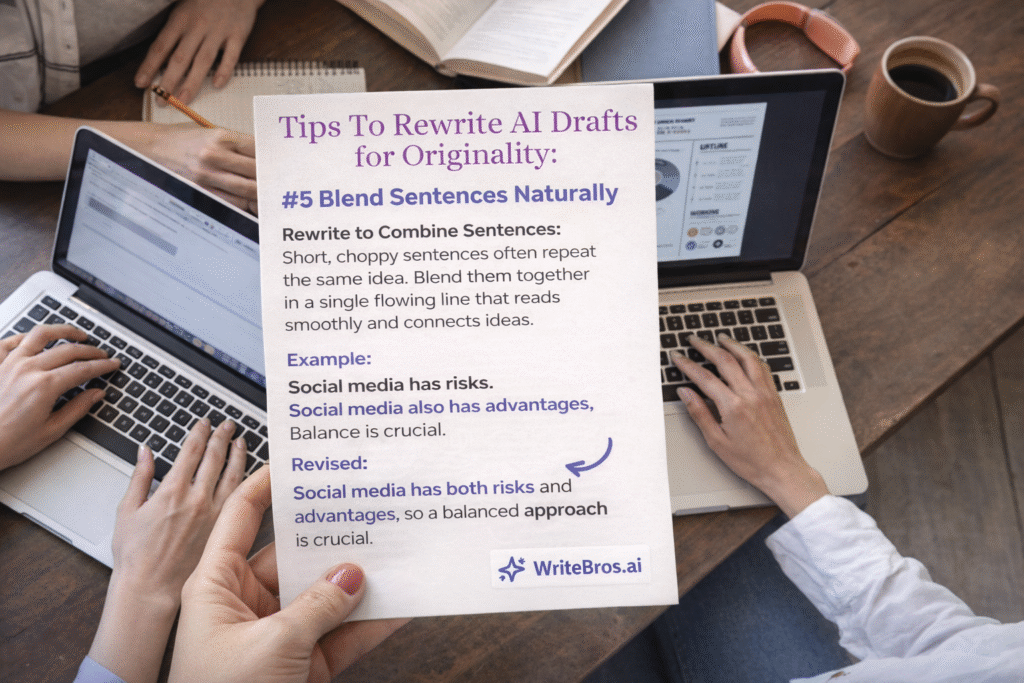
How to Rewrite AI Drafts for Originality – Strategy #5: Blend sentences naturally
Another common feature of generated drafts is the presence of short sentences that repeat similar information instead of combining ideas into a more fluid explanation. This pattern produces writing that feels slightly fragmented, because each line functions as a standalone statement rather than part of a continuous train of thought. Revising those sections by merging related sentences creates smoother movement across the paragraph and makes the discussion feel more cohesive.
Consider how a paragraph might list three related points in separate lines even though they describe the same underlying idea. Joining those thoughts into a single flowing sentence allows the writer to show relationships between concepts rather than presenting them as disconnected observations. Over time this blending process reshapes the rhythm of the entire article, turning rigid fragments into natural explanations that feel closer to how people communicate ideas in real writing.
How to Rewrite AI Drafts for Originality – Strategy #6: Replace predictable wording
AI systems rely heavily on common language patterns, which means the wording they produce often appears familiar even when the topic itself is unique. Revising these predictable phrases is one of the most effective ways to transform the tone of a draft because subtle vocabulary changes alter how readers perceive the voice behind the text. When writers replace overly familiar expressions with more natural wording, the content begins to feel like it came from a person reflecting on the topic.
This does not require complicated language or technical vocabulary, because originality usually emerges from thoughtful phrasing rather than from complexity. Imagine encountering the same explanatory wording across multiple paragraphs, which gradually signals that the text was generated through pattern repetition. Rewriting those phrases with slightly different structures restores variety and gives the article a distinctive voice that readers recognize as authentic.
How to Rewrite AI Drafts for Originality – Strategy #7: Introduce real context
AI writing frequently explains ideas in abstract terms, describing general principles without grounding them in realistic situations or familiar experiences. Adding contextual examples during revision helps readers visualize how those ideas appear in actual practice, which makes the content easier to understand and more engaging to read. Context also breaks the repetitive tone common in generated drafts because real situations introduce details that algorithms rarely include on their own.
Imagine a paragraph explaining the importance of rewriting without describing what a typical editing process looks like in practice. Expanding that explanation to include a brief example of reviewing a draft, identifying repeated phrasing, and restructuring paragraphs gives readers a clearer picture of the process. Context like this makes the writing feel more human because it mirrors the way people naturally explain ideas through situations and observations.
How to Rewrite AI Drafts for Originality – Strategy #8: Adjust sentence rhythm
Many AI drafts display a remarkably steady rhythm, where sentences follow similar lengths and patterns for long stretches of text. This uniform pacing may appear clean at first glance, yet readers eventually sense that something feels mechanical because natural writing normally alternates between longer explanations and shorter clarifying statements. Revising the rhythm of the sentences introduces variation that makes the paragraph feel more dynamic and easier to read.
One useful technique involves combining a longer explanatory sentence with a shorter follow up that highlights a key point or clarification. When writers vary sentence length this way, the pacing begins to resemble spoken language rather than machine generated structure. Over several paragraphs, these rhythmic adjustments gradually transform the tone of the entire article, allowing the writing to feel more conversational without sacrificing clarity.
How to Rewrite AI Drafts for Originality – Strategy #9: Refine transitions
Transitions play a subtle yet important role in helping readers follow the progression of ideas, yet AI drafts often move from one section to the next without clear connections. The result is writing that feels technically organized but still slightly disjointed, because the relationships between paragraphs remain implied rather than clearly expressed. Revising transitions helps the argument unfold naturally and prevents the piece from feeling like a sequence of unrelated explanations.
Imagine finishing one paragraph that discusses drafting techniques and immediately encountering another that introduces editing tools without explaining how the two ideas connect. Adding a short transition that links the drafting stage to the editing process guides readers smoothly into the next idea. These small connective phrases gradually create continuity across the article, which strengthens both clarity and originality.
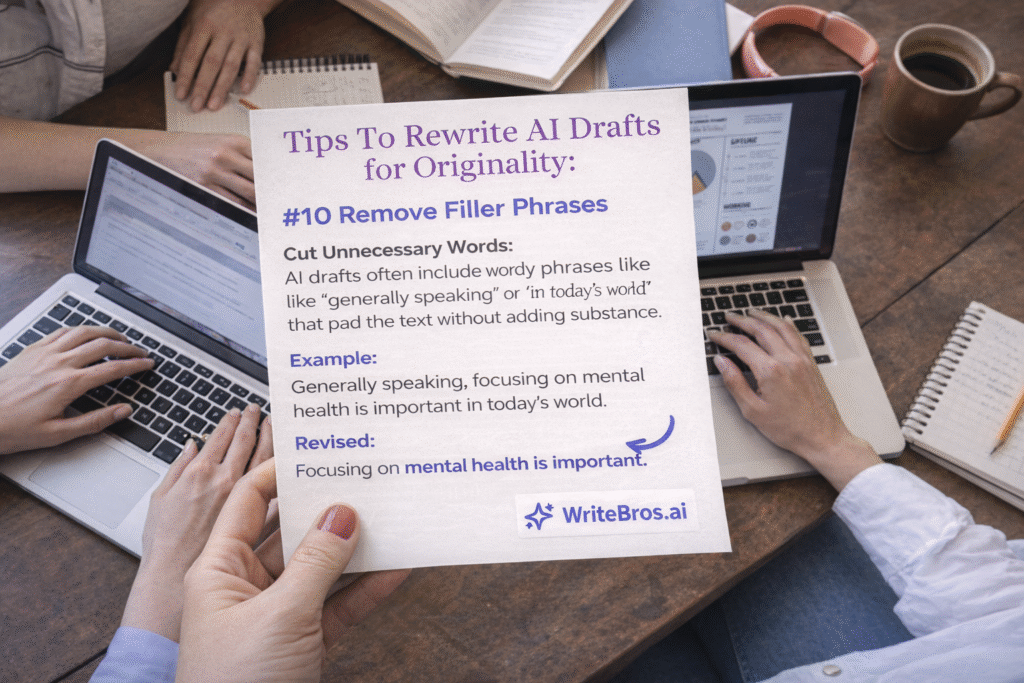
How to Rewrite AI Drafts for Originality – Strategy #10: Remove filler phrases
Generated writing frequently includes filler language that expands sentences without adding meaningful insight, which is why AI drafts often appear longer than necessary. During revision, identifying and removing these phrases sharpens the writing because each sentence begins to carry more intentional meaning. This process also reduces the repetitive tone that arises when the same explanatory wording appears throughout the draft.
A common editing discovery occurs when a paragraph contains several lines that repeat the same idea using slightly different language. Removing those redundant expressions allows the remaining sentences to communicate the message more directly while preserving the natural flow of the discussion. Over the course of a full revision, trimming filler language gradually transforms the draft into a more focused and original piece of writing.
How to Rewrite AI Drafts for Originality – Strategy #11: Rephrase key arguments
AI systems frequently paraphrase existing patterns of explanation, which means important points in a draft may resemble wording that appears across countless other generated articles. Rewriting those arguments from scratch forces the writer to reconsider how the idea should actually be explained rather than simply adjusting surface phrasing. This deeper revision creates explanations that reflect the writer’s reasoning instead of repeating familiar expressions.
Imagine encountering a paragraph that describes a concept clearly but still sounds indistinguishable from dozens of other explanations online. Reworking that section by introducing different framing or emphasizing a new angle instantly separates the writing from its generic structure. Over time, repeatedly rephrasing the most important points gives the article a distinctive voice that feels intentionally composed.
How to Rewrite AI Drafts for Originality – Strategy #12: Strengthen paragraph endings
Paragraph endings often reveal whether a piece of writing was thoughtfully revised or simply generated and lightly edited. AI drafts frequently conclude sections by repeating earlier ideas rather than introducing a small insight that prepares readers for the next stage of the discussion. Strengthening those endings creates a sense of progression because each paragraph feels like a step forward in the overall explanation.
A simple revision technique involves reading the final sentence of every paragraph and asking whether it adds something new or merely echoes what was already said. When the ending introduces a brief implication or reflection, readers feel guided into the following section with a sense of continuity. These small adjustments gradually transform the structure of the article because the ideas begin flowing naturally from one paragraph to the next.
How to Rewrite AI Drafts for Originality – Strategy #13: Check tone consistency
AI generated drafts sometimes shift tone unexpectedly, moving from conversational phrasing to formal explanations within the same section of text. These inconsistencies can make the writing feel uneven because readers sense that different parts of the article were produced through separate stylistic patterns. Revising tone ensures that the voice remains steady across the entire piece, which strengthens the sense that a single author shaped the argument.
This process usually involves identifying passages that feel either too technical or unusually casual compared with the surrounding text. Adjusting those sections so they match the established voice creates a smoother reading experience and removes subtle signals that the content came from automated generation. When tone remains consistent from beginning to end, the article feels deliberate and cohesive.
How to Rewrite AI Drafts for Originality – Strategy #14: Reconnect ideas logically
In many AI drafts, individual paragraphs explain useful information but never clearly connect to the broader argument of the article. Revising those sections involves identifying how each idea contributes to the main theme and adjusting the wording so the relationship becomes visible. Once these connections appear, the article begins to read like a structured exploration of a topic rather than a sequence of isolated explanations.
Consider reviewing a section that introduces an interesting concept yet never explains why that concept matters in the context of the discussion. Expanding the paragraph to show how the idea supports the main argument immediately strengthens the overall narrative. Logical connections like these gradually turn separate pieces of information into a coherent story that readers can follow.
How to Rewrite AI Drafts for Originality – Strategy #15: Final originality pass
The final stage of revision focuses on reading the entire article as a continuous piece rather than examining individual sentences in isolation. This perspective helps writers notice lingering patterns that may still resemble generated text, including repeated phrasing or structural similarities across sections. A careful originality pass ensures that the finished draft feels like a single cohesive work shaped through thoughtful editing.
During this stage, writers often discover subtle improvements that were easy to miss earlier in the process, such as opportunities to simplify wording or strengthen transitions. These final adjustments refine the tone and clarity of the article while preserving the ideas developed throughout the earlier revisions. When the piece reads smoothly from beginning to end, the rewriting process has successfully transformed the initial draft into something that feels distinctly original.
Common mistakes
- Editing only the surface wording of a generated draft while leaving the underlying structure unchanged, which results in text that still feels repetitive and formulaic even though individual sentences appear different from the original output.
- Relying entirely on automated rewriting tools instead of performing manual revisions, which often produces paraphrased sentences that maintain the same patterns and logical flow as the initial generated content.
- Removing sections of text without restructuring the remaining ideas, which creates gaps in the explanation and causes paragraphs to feel disconnected from the overall argument of the article.
- Focusing heavily on vocabulary changes while ignoring sentence rhythm and paragraph transitions, which leaves the writing sounding mechanical despite the presence of varied wording.
- Attempting to shorten the draft too aggressively during revision, which may remove useful reasoning and lead to explanations that feel incomplete or rushed.
- Skipping the final review of the entire article, which prevents writers from noticing recurring phrasing patterns that still signal automated generation.
Edge cases
Some AI drafts already contain well structured explanations that require minimal rewriting at the sentence level. In these situations the revision process focuses less on correcting mechanical phrasing and more on expanding reasoning, clarifying examples, and strengthening the narrative flow between sections. The goal remains the same, yet the editing effort shifts toward depth rather than structural correction.
There are also cases where a draft contains highly technical information that should not be heavily reworded because accuracy matters more than stylistic variation. In those situations writers often preserve key terminology while improving surrounding explanations so the text remains clear and readable. This balanced revision preserves the integrity of the information while still producing writing that feels intentional and natural.
Supporting tools
- Revision tracking tools help writers monitor how drafts evolve during editing sessions, making it easier to compare earlier versions with final revisions and identify which changes improved clarity and originality.
- Grammar and style assistants provide helpful feedback during the editing process by highlighting awkward phrasing, overly long sentences, and structural inconsistencies that might otherwise remain unnoticed.
- Outline planning tools allow writers to reorganize ideas before rewriting begins, which simplifies structural revisions and helps ensure the article follows a logical sequence.
- Readability analysis platforms measure sentence complexity and pacing, allowing writers to identify sections that may feel overly dense or repetitive.
- Version comparison editors display multiple draft versions side by side so writers can evaluate how changes affect tone, structure, and clarity across the entire article.
- WriteBros.ai supports the rewriting process by helping writers reshape generated drafts into clearer, more natural sounding text while preserving the original intent of the content.
Ready to Transform Your AI Content?
Try WriteBros.ai and make your AI-generated content truly human.
Conclusion
Rewriting AI generated drafts for originality is less about replacing individual words and more about reshaping the structure, reasoning, and flow of the entire piece. When writers clarify ideas, adjust sentence rhythm, and strengthen transitions, the text gradually transforms from a generated draft into something that reflects deliberate thinking.
Strong revision rarely happens through a single pass because originality emerges from careful reflection on how ideas connect and evolve throughout the article. Writers who approach editing with patience and attention to structure often discover that even heavily generated drafts can become thoughtful and engaging pieces of writing.
Did You Know?
Writers learning how to rewrite AI drafts for originality often begin by changing vocabulary or replacing repeated phrases, yet those edits rarely transform the overall feel of the text. When the paragraphs still follow the same mechanical rhythm and symmetrical structure, the draft can continue to feel algorithmic even after extensive paraphrasing.
Adjusting the movement of the article usually produces a stronger effect because authentic writing rarely unfolds with identical pacing. Expanding some explanations, introducing reflective pauses in others, and allowing the argument to develop with slightly uneven emphasis helps the revised draft read like a human exploration of ideas rather than a generated sequence of polished paragraphs.
Ready to Transform Your AI Content?