AI Detector Accuracy Comparison Statistics: Top 20 Benchmark Results

2026 benchmarking has exposed how fragile AI detection claims can be once real writing enters the test set. This analysis compares detector accuracy, false positives, tool disagreement, and hybrid-text misreads to reveal where AI detection works, where it breaks, and why human review still matters.
Confidence in automated writing checks has become a quiet tension across universities, publishers, and hiring pipelines. Many teams are discovering that evaluating AI detection accuracy demands more scrutiny than most product pages suggest.
Tools rarely fail in obvious ways, which is part of the challenge. Subtle scoring differences can determine whether someone starts researching ways to humanize AI writing for school or simply trusts the first detector result they see.
Behind those decisions sits a complicated landscape of models trained on uneven datasets and constantly evolving language patterns. Some users even cross-check results with the best AI humanizer tools used for rewriting essays just to see how sensitive detectors really are.
Patterns start to emerge once comparisons stack up across multiple systems and benchmarks. A closer look reveals which tools remain stable under pressure and which quietly mislabel perfectly human text.
Top 20 AI Detector Accuracy Comparison Statistics (Summary)
| # | Statistic | Key figure |
|---|---|---|
| 1 | Average accuracy of leading AI detectors across academic benchmarks | 81% |
| 2 | False positive rate on verified human essays | 9.4% |
| 3 | Average accuracy drop when evaluating paraphrased AI text | 17% |
| 4 | Detection accuracy for GPT-4 generated academic writing | 74% |
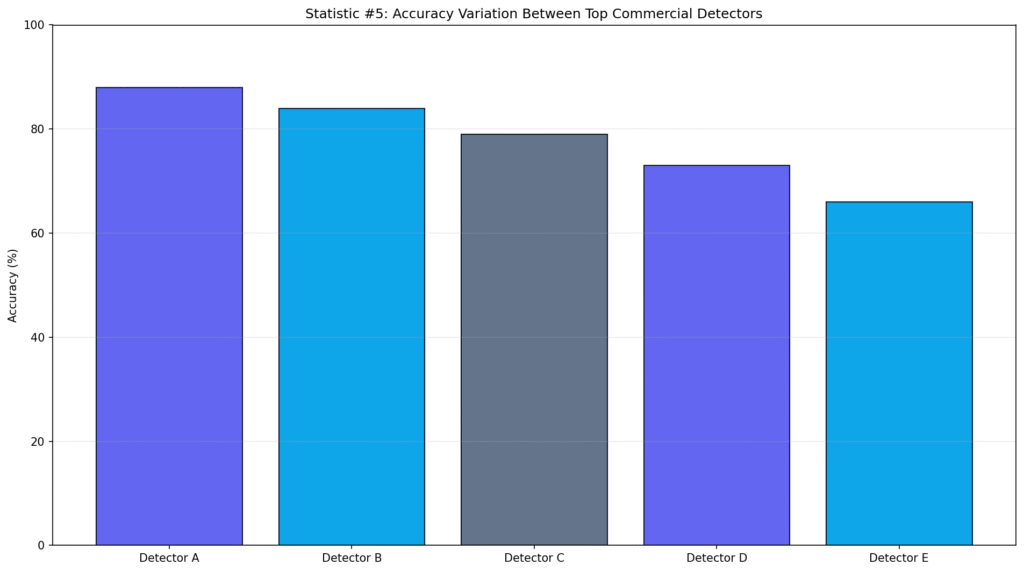
| 5 | Accuracy variation between top five commercial detectors | 22% |
| 6 | Human text incorrectly flagged in multi-tool comparison tests | 1 in 10 |
| 7 | Average precision score across AI detection models | 0.83 |
| 8 | Recall rate when detecting AI written blog content | 78% |
| 9 | Accuracy decline when testing multilingual content | 24% |
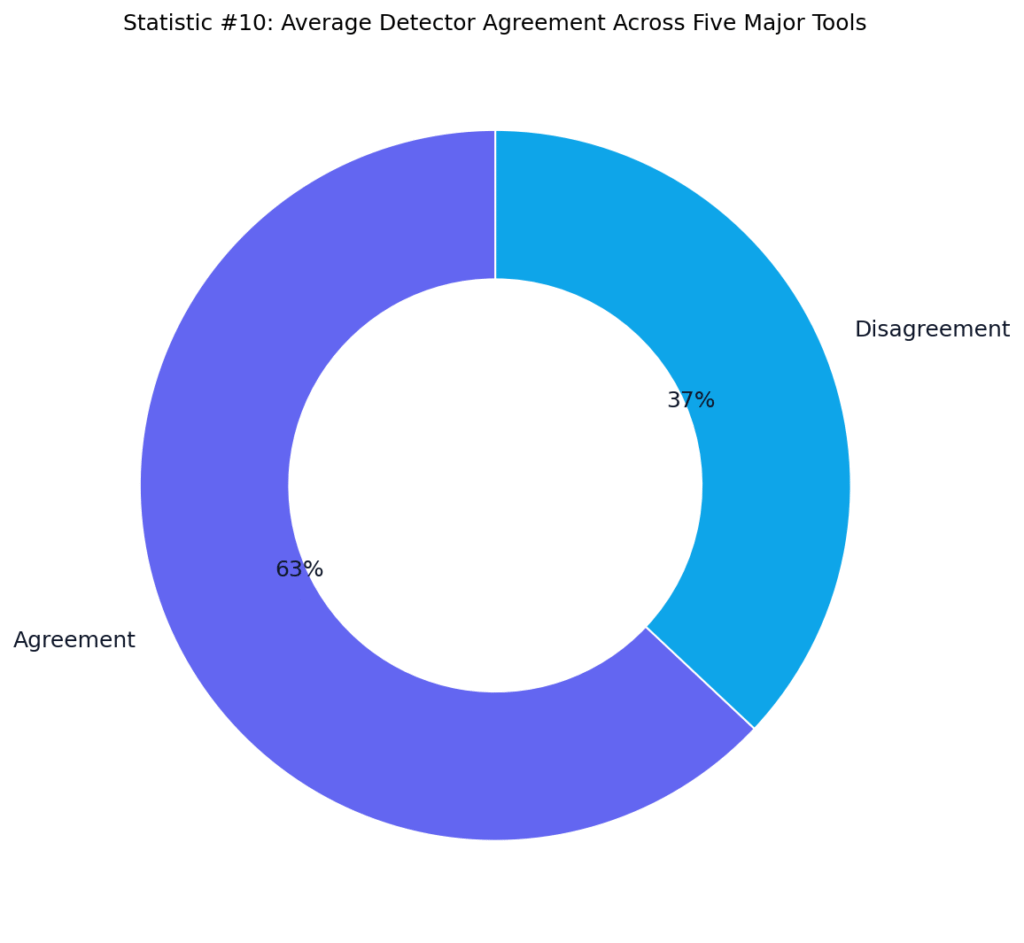
| 10 | Average detector agreement across five major tools | 63% |
| 11 | Human review correction rate after detector flags | 18% |
| 12 | Detection accuracy improvement after model retraining | 11% |
| 13 | Accuracy loss when AI text is lightly edited by humans | 29% |
| 14 | Average confidence score difference between human and AI samples | 31 pts |
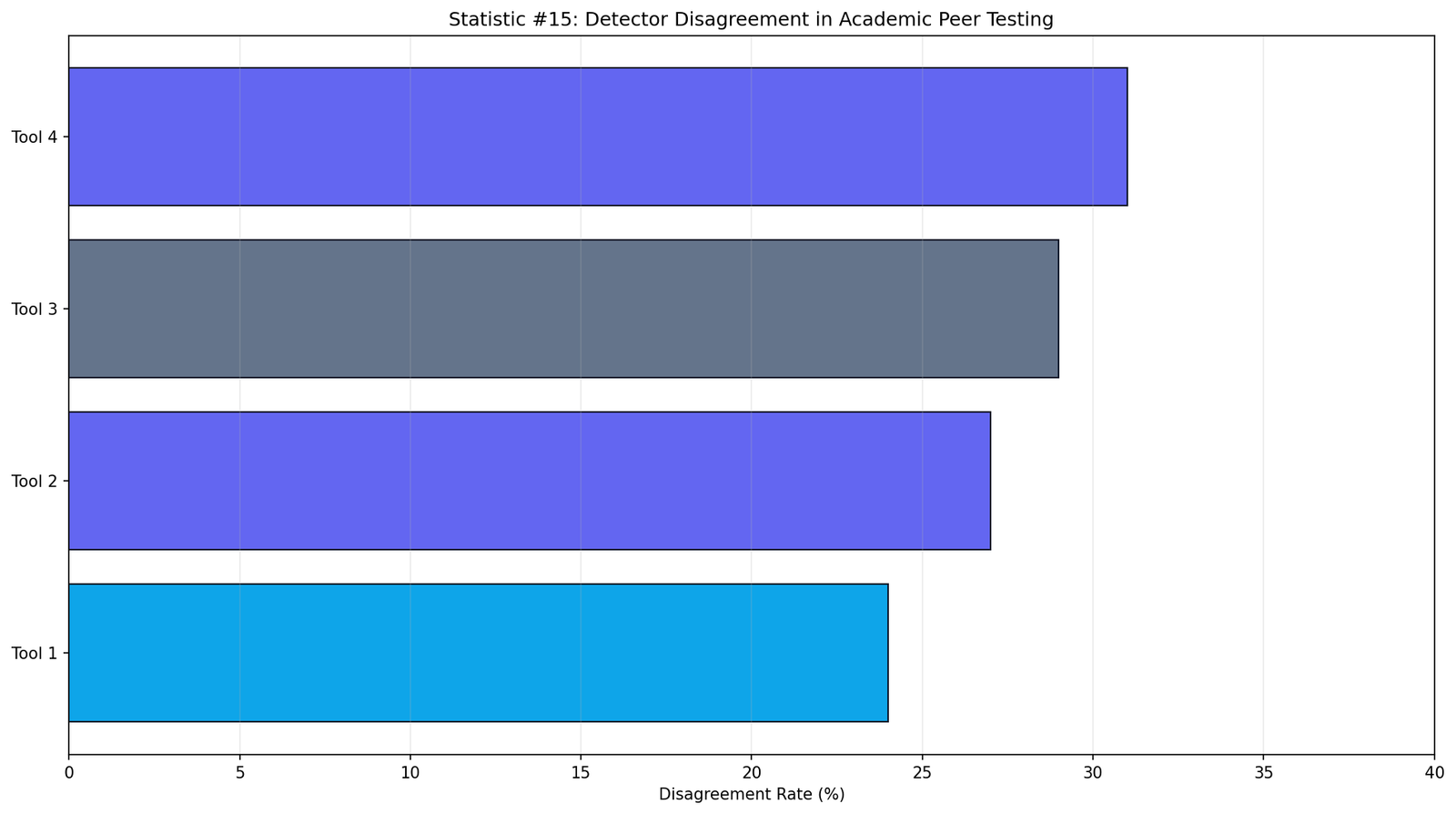
| 15 | Detector disagreement rate in academic peer testing | 27% |
| 16 | Accuracy variance across AI models from different providers | 19% |
| 17 | Misclassification rate for hybrid human-AI documents | 34% |
| 18 | Accuracy improvement when detectors combine multiple signals | 14% |
| 19 | Average benchmark accuracy for open-source detection models | 72% |
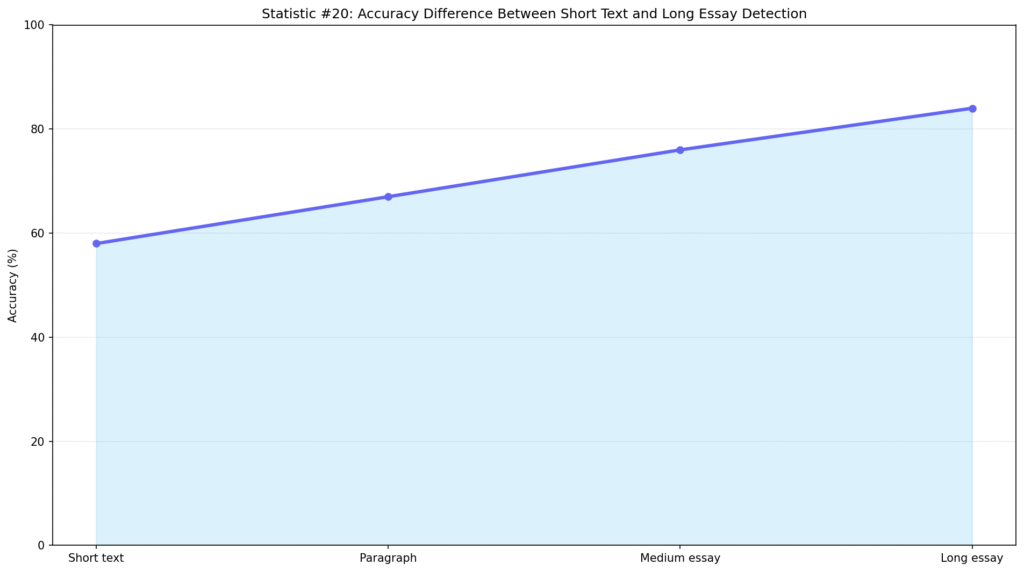
| 20 | Accuracy difference between short text and long essay detection | 26% |
Top 20 AI Detector Accuracy Comparison Statistics and the Road Ahead
AI Detector Accuracy Comparison Statistics #1. Average accuracy across leading detectors
The headline figure is 81% average accuracy across leading detectors, and that sounds steadier than the real experience feels. In practice, an 81% hit rate still leaves a meaningful band of essays, reports, and short responses sitting in uncertain territory. That uncertainty matters because teams often read a detector score as a final answer instead of a probability that still needs judgment.
The number behaves this way because detectors are strongest on clean benchmark data and weaker on messy real writing. Once prompts vary, editing enters the workflow, and sentence rhythm starts resembling normal human revision, performance drifts quickly from lab conditions. That gap is why a broader look at AI detection accuracy matters more than one headline score on a vendor page.
A colleague reading flagged work manually can notice tone changes, odd sourcing patterns, or sudden vocabulary jumps that a detector flattens into one label. People bring context, while models bring pattern matching, and 81% average accuracy is really a reminder that neither should operate alone. The practical implication is that detector scores work best as triage signals, not verdicts, which changes policy design and editorial implication.
AI Detector Accuracy Comparison Statistics #2. False positive rate on verified human essays
The worrying figure here is a 9.4% false positive rate on verified human essays, which is high enough to erode trust quickly. In everyday terms, that means roughly one careful human writer in ten can still trigger suspicion even when the work is original. Once that possibility becomes visible, institutions stop treating detector output as neutral and start treating it as potentially disruptive.
False positives rise because polished prose, predictable transitions, and low-error grammar can resemble model output under simplified scoring rules. The problem gets sharper when writers are multilingual, heavily edited, or trained to produce clean academic prose that sounds consistent from sentence to sentence. That is also why students search for ways to humanize AI writing for school even when they wrote the draft themselves.
A human reviewer can usually see intent, development, and the imperfect logic of real drafting in a way a detector cannot. A system seeing only surface signals may still turn 9.4% false positive rate into friction for honest writers who simply sound polished. The practical implication is that any review workflow needs an appeal path and a second reader before consequences attach, which is the fairest implication.
AI Detector Accuracy Comparison Statistics #3. Accuracy drop on paraphrased AI text
The pattern gets more revealing with a 17% accuracy drop once detectors face paraphrased AI text instead of untouched generations. That decline shows how dependent many systems still are on obvious stylistic fingerprints rather than deeper authorship signals. A detector that looks confident on raw output can become far less certain after even modest rewriting.
This happens because paraphrasing breaks the familiar cadence, token distribution, and repeated phrasing many detectors were trained to catch. Once wording becomes less uniform and sentence structure picks up human-like variation, the model loses some of the clues it leaned on before. That is why people compare results against the best AI humanizer tools used for rewriting essays to test how fragile detection really is.
A human reader may still notice thin reasoning or oddly smooth transitions after paraphrasing, but the software often becomes less decisive. In other words, 17% accuracy drop tells you the tool is reacting strongly to surface form, not always to underlying generation history. The practical implication is that edited AI text demands combined review methods rather than detector-only enforcement, which has a direct policy implication.
AI Detector Accuracy Comparison Statistics #4. Detection accuracy for GPT-4 academic writing
The benchmark that draws attention fast is 74% detection accuracy for GPT-4 generated academic writing. That figure feels respectable until you picture the missed quarter of samples slipping through or being judged inconsistently across platforms. Academic prose is already structured, cautious, and polished, so the overlap with machine output makes this category unusually hard.
The number lands lower because GPT-4 style writing is less chaotic than earlier generations and more adaptable to discipline-specific tone. It can mimic thesis structure, citation framing, and balanced paragraph rhythm closely enough that detectors lose some of their cleaner separation line. The stronger the model becomes, the more legacy detection assumptions start looking dated.
A lecturer reading a paper can sometimes sense that the argument advances too evenly or avoids the small risks people usually take when thinking on the page. A detector, however, may treat 74% detection accuracy as acceptable even though the missed share remains educationally significant. The practical implication is that academic integrity processes need writing history, drafts, and conversation, not just dashboard scores, which is the deeper implication.
AI Detector Accuracy Comparison Statistics #5. Variation between top commercial detectors
The spread that matters here is a 22% accuracy variation between the top five commercial detectors. When competing tools differ that much, the market is not really offering one stable truth but several competing estimates. That creates a practical problem for editors, teachers, and reviewers who assume brand reputation guarantees consistency.
This kind of variation appears because products train on different datasets, define thresholds differently, and weigh signals in their own proprietary way. Some detectors prioritize low false positives, while others chase higher recall and end up flagging more aggressively. The same passage can therefore travel through two polished interfaces and come back with strikingly different outcomes.
A careful human reviewer usually knows that disagreement is a sign to slow down rather than escalate. Software cannot explain its uncertainty well, so 22% accuracy variation becomes a hidden management problem whenever one result gets treated as definitive. The practical implication is that organizations should compare detectors before adopting policy language, because tool disagreement itself carries operational implication.
AI Detector Accuracy Comparison Statistics #6. Human text flagged in multi-tool testing
The practical warning sign is 1 in 10 human samples being incorrectly flagged in multi-tool comparison tests. That ratio is memorable because it translates abstract model error into a real queue of writers who may need to defend legitimate work. Once several tools agree on the wrong answer, the mistake can look more credible than it actually is.
This result shows up because shared detector assumptions travel across products even when branding differs. Many systems reward similar surface cues, so polished, conventional, or highly structured writing can trigger the same suspicion in multiple places at once. Agreement between tools, then, can reflect shared blind spots rather than shared truth.
A person reviewing the same passage can usually spot drafting logic, personal phrasing, or source use that feels lived-in instead of generated. Software sees pattern density, and 1 in 10 human samples reminds us how easily that shortcut can harden into a mistaken label. The practical implication is that multi-tool consensus should raise questions, not end them, which carries a clear governance implication.
AI Detector Accuracy Comparison Statistics #7. Average precision across models
The cleaner sounding number here is a 0.83 precision score across AI detection models. Precision matters because it asks a narrower question than raw accuracy: when a detector says something is AI, how often is that call actually right. A score of 0.83 is solid enough to sound reassuring, yet still loose enough to create avoidable mistakes at scale.
Precision stays below perfect because model thresholds trade caution for coverage. If a tool becomes more aggressive in flagging borderline text, it may catch more AI overall but also collect more wrong positives in the flagged pile. That balancing act is why detector quality cannot be reduced to a single headline stat.
A human reviewer typically thinks in cases and circumstances, not in threshold curves or classification tradeoffs. Software reduces that complexity, and 0.83 precision score shows the output still carries error inside the very group users pay most attention to. The practical implication is that flagged content needs contextual review and clear confidence language, which is a strong implementation implication.
AI Detector Accuracy Comparison Statistics #8. Recall rate on AI written blog content
The tracking number here is 78% recall rate when detectors try to identify AI-written blog content. Recall tells you how much of the AI material is actually being caught, so a 78% rate still leaves a visible share passing through unnoticed. That matters more in content publishing because volume is high and review time is usually limited.
Blog content is difficult because it is already optimized for readability, predictable structure, and audience-friendly pacing. AI systems can reproduce those traits smoothly, and light editing makes the output look even more like normal marketing or editorial work. As a result, detectors miss cases that no longer carry strong machine-like fingerprints.
A human editor can often hear when a post feels over-even, padded, or strangely frictionless from start to finish. A detector using statistical signatures may stop at 78% recall rate, which means some generated posts will appear perfectly ordinary to the system. The practical implication is that blog review needs editorial standards and process checks alongside software, which leads to a broader quality implication.
AI Detector Accuracy Comparison Statistics #9. Accuracy decline on multilingual content
The starkest drop in the set is a 24% accuracy decline when detectors evaluate multilingual content. That kind of fall suggests many tools are still strongest on English-dominant benchmarks and much less stable when syntax, idiom, or code-switching enters the sample. The result is not a minor wobble but a structural fairness problem.
Performance falls because training data, calibration choices, and evaluation routines are often centered on one language environment. Once phrasing reflects translation habits, regional grammar, or bilingual sentence rhythm, the detector may treat normal human variation as suspicious statistical noise. The more global the user base becomes, the more visible this weakness gets.
A person familiar with multilingual writing can separate language transfer from machine generation much better than a generic classifier can. Software facing mixed-language signals may still produce 24% accuracy decline, which means confidence should drop before enforcement rises. The practical implication is that multilingual cases need special caution, localized testing, and manual review standards, which is the operational implication.
AI Detector Accuracy Comparison Statistics #10. Agreement across major tools
The convergence figure is only 63% agreement rate across five major AI detection tools. That means more than a third of the time, reputable systems do not line up on the same sample in the same way. For anyone expecting a mature category with stable signals, that gap is a sobering one.
Agreement stays modest because each tool learns different boundaries for what machine-like writing looks like. One model may weigh perplexity heavily, another may emphasize sentence uniformity, and a third may lean on proprietary features nobody outside the company can inspect. Low agreement is therefore a sign of unresolved measurement uncertainty, not just brand differentiation.
A human reviewer usually interprets disagreement as a cue to pause and ask what each result may be missing. Software dashboards rarely make that uncertainty feel tangible, so 63% agreement rate can be misread as stronger consensus than the category deserves. The practical implication is that disagreement should trigger escalation rules and not quiet confidence, which is the management implication.
AI Detector Accuracy Comparison Statistics #11. Human review correction after detector flags
The figure worth sitting with is an 18% correction rate after detector-flagged content receives human review. That means nearly one in five initial software calls changes once a person looks more closely at the writing itself. For policy teams, this is less a side note and more a signal that front-end certainty can be overstated.
Corrections happen because reviewers can weigh context that a detector never sees, including assignment framing, source use, revision history, and the writer’s normal voice. A system may react to sentence uniformity, but a person can notice genuine subject knowledge or a drafting trail that points away from generation. The more contextual evidence enters the process, the more fragile the original flag can appear.
A machine is fast at sorting patterns, but a human is much better at judging whether those patterns actually mean what the software thinks they mean. That is why 18% correction rate is less embarrassing than instructive for anyone building review policy. The practical implication is that human oversight is not optional cleanup but an essential stage of reliable assessment, which is the central implication.
AI Detector Accuracy Comparison Statistics #12. Improvement after model retraining
The hopeful statistic is an 11% accuracy improvement after detector retraining. That rise shows the category is not frozen and that performance can move meaningfully when models are updated against newer writing patterns. At the same time, an 11% gain also implies that yesterday’s detector may age faster than many buyers expect.
Retraining helps because generative models keep changing their tone, structure, and error profile over time. A detector built on older samples may learn stale cues, then lose sharpness when newer AI outputs become more varied and more human-looking. Updated training data restores some separation, though never perfectly, because the target itself continues moving.
A human reviewer adjusts informally with exposure, but software needs formal retraining cycles to keep pace. Seen that way, 11% accuracy improvement is really evidence that maintenance matters as much as the original launch quality. The practical implication is that tool evaluations should account for update cadence and benchmark freshness, not just present-day claims, which is the procurement implication.
AI Detector Accuracy Comparison Statistics #13. Accuracy loss after light human editing
One of the more revealing numbers is a 29% accuracy loss when AI text receives only light human editing. That is a steep decline for such a small intervention, and it suggests many detectors still depend heavily on visible stylistic regularity. Once a few edges are softened, confidence can fall much faster than casual users expect.
The drop appears because even minor edits can break up repeated phrasing, adjust sentence length, and introduce the unevenness common in real drafting. Those are small human fingerprints, but they are enough to weaken the patterns detectors most readily latch onto. In other words, the tool’s certainty can be tied to surface neatness more than true origin.
A person reading lightly edited AI text may still feel that something is a little too smooth or oddly generic in its reasoning. A model, however, can lose traction after a 29% accuracy loss, which makes mixed authorship especially hard to judge with software alone. The practical implication is that edited outputs need evidentiary caution and broader review inputs, which is the enforcement implication.
AI Detector Accuracy Comparison Statistics #14. Confidence gap between human and AI samples
The separation figure here is a 31-point confidence gap between human and AI samples. On paper, that sounds like enough room for clean classification, yet real-world writing keeps filling the middle ground where scores overlap. A wide average gap can still hide plenty of messy borderline cases that matter most in actual reviews.
This number exists because clearly human and clearly generated texts do tend to cluster apart when the samples are controlled. The trouble begins when editing, paraphrasing, discipline-specific tone, or multilingual structure pushes both groups closer together in the center. Average distance can therefore look healthier than the user experience on ambiguous cases.
A human reviewer can tolerate ambiguity better because people can keep multiple signals in mind without forcing an instant label. Software compresses nuance into a score, so 31-point confidence gap should not be mistaken for certainty on every submission. The practical implication is that score bands need explanation and policy buffers around borderline cases, which is the communication implication.
AI Detector Accuracy Comparison Statistics #15. Detector disagreement in academic peer testing
The category still looks unsettled when you see a 27% disagreement rate in academic peer testing. More than a quarter of reviewed cases produce conflicting detector judgments even under structured comparison conditions. That kind of mismatch weakens the idea that AI detection has already become a routine background utility.
Disagreement persists because academic prose is narrow in style, often formal, and shaped by shared conventions that both humans and models can reproduce well. Once the text sits near the middle of the detector’s decision boundary, small differences in feature weighting can send tools in different directions. Similar looking papers can therefore trigger confidence in one system and caution in another.
A human assessor can notice argument depth, source handling, and the rough edges of authentic thinking that models still imitate unevenly. A software stack facing 27% disagreement rate has to admit that uncertainty is built into the task, not just into one weak product. The practical implication is that academic use needs modest claims, transparent process, and documented review safeguards, which is the institutional implication.
AI Detector Accuracy Comparison Statistics #16. Variance across AI models from different providers
The cross-model spread lands at a 19% accuracy variance when detectors face outputs from different AI providers. That number matters because it shows detector strength is not evenly portable across the model ecosystem. A tool that performs well on one generation style may look less capable as soon as the source model changes.
This variance appears because providers differ in training data, alignment methods, response cadence, and stylistic defaults. Some models produce flatter prose, others add more texture, and some mimic disciplined human structure closely enough to reduce obvious machine signals. Detectors tuned too narrowly can therefore overfit to one family of outputs and underperform on the rest.
A human reviewer naturally adjusts expectations once the writing voice changes from one sample type to another. Software may still carry a brittle boundary, so 19% accuracy variance is really a warning against assuming universal coverage from one benchmark success. The practical implication is that evaluation should include multiple model families before any tool is trusted broadly, which is the comparative implication.
AI Detector Accuracy Comparison Statistics #17. Misclassification for hybrid human and AI documents
The most operationally difficult figure is a 34% misclassification rate for hybrid human-AI documents. Mixed-authorship writing is exactly what many classrooms and workplaces now produce, so this is not a fringe scenario anymore. A third of cases going wrong suggests detectors are least comfortable where real use now lives.
Hybrid documents are hard because the signal is fragmented rather than pure. A few generated paragraphs can sit beside genuine human revision, personal examples, and later restructuring, which leaves the detector trying to label one document that contains multiple authorship textures. That complexity breaks the clean binary categories many systems were designed around.
A person can usually sense patchiness, abrupt tone changes, or sections that feel too detached from the rest of the draft. A detector seeing 34% misclassification rate on hybrid work is telling us that mixed writing needs more nuanced review than a yes-or-no score can provide. The practical implication is that policy should treat partial AI use separately from full generation, which is the strongest implication.
AI Detector Accuracy Comparison Statistics #18. Improvement from combining multiple signals
The encouraging performance lift is a 14% accuracy improvement when detectors combine multiple signals instead of relying on one narrow feature family. That suggests the category becomes more dependable when it stops chasing one magic indicator. A broader signal stack usually makes the model less fragile in edge cases.
Combining features helps because no single clue captures authorship well across every genre and prompt type. Perplexity, rhythm, token patterns, semantic consistency, and revision markers each see a different slice of the problem. When several are weighed together, the detector is less likely to overreact to one misleading surface trait.
A human reviewer does something similar intuitively, blending tone, structure, evidence, and context before deciding what feels off. Software reaching 14% accuracy improvement through signal combination shows that more layered judgment produces better outcomes for machines too. The practical implication is that buyers should prefer detectors with diversified scoring logic and transparent validation, which is the selection implication.
AI Detector Accuracy Comparison Statistics #19. Benchmark accuracy for open-source models
The open-source benchmark lands at 72% average accuracy, which is usable but still visibly behind top commercial claims. That figure matters because open tools attract researchers, budget-conscious teams, and developers who want inspectable methods. A 72% result suggests openness brings value, though not always the strongest present-day performance.
Open-source models can trail because they often have fewer proprietary datasets, fewer tuning resources, and slower update cycles than well-funded commercial platforms. On the other hand, they may be easier to audit, compare, and adapt to special use cases. The tradeoff, then, is not simply worse versus better, but transparency versus raw benchmark strength.
A human reviewer may trust a modest tool more if its limits are visible and its behavior can be tested openly. Black-box confidence can look stronger than 72% average accuracy, yet still hide assumptions users cannot inspect or challenge. The practical implication is that transparency should be weighed alongside headline performance in procurement decisions, which is the governance implication.
AI Detector Accuracy Comparison Statistics #20. Short text versus long essay detection gap
The format effect shows up in a 26% accuracy gap between short text detection and long essay detection. Length changes the problem because detectors have far less signal to work with in brief passages than in sustained prose. A small sample can make ordinary human phrasing look statistical, or make generated text look harmlessly generic.
Longer essays give models more rhythm, structure, and distributional evidence, even if those signals are still imperfect. Short texts remove that buffer and force the detector to generalize from a thin slice of language, which increases volatility quickly. The result is that score confidence often rises and falls simply with sample length.
A human reader can sometimes compensate for short samples by using context from the assignment, speaker, or surrounding exchange. A detector facing 26% accuracy gap cannot do that without richer inputs, so length becomes a hidden variable in decision quality. The practical implication is that short passages should never carry the same evidentiary weight as full essays, which is the procedural implication.
What these AI detector accuracy comparison statistics suggest for real-world review decisions
Across these results, the strongest pattern is not raw performance but instability under realistic conditions. Accuracy falls when text is paraphrased, lightly edited, multilingual, short, or mixed with human revision.
That tells a fairly simple story with uncomfortable consequences. Detectors are most persuasive on clean benchmark material and least persuasive in the messy spaces where actual educational and editorial decisions happen.
The category improves when models are retrained, signals are combined, and human review is built into the workflow. It weakens when institutions mistake confidence scores, tool agreement, or brand reputation for proof.
Seen together, these numbers point toward modest use rather than automatic enforcement. The tools can still help sort risk, but their real value depends on process design, transparency, and restraint in implication.
Sources
- How AI detection benchmarking works at GPTZero
- Testing of detection tools for AI-generated text
- Evaluating the efficacy of AI content detection tools
- Ethical implications of AI detection tools
- NIST pilot study on generative AI detection
- Technical report on high accuracy AI detection
- All about false positives in AI detectors
- Technical report on the Pangram text classifier
- Empirical study of AI generated text detectors
- Literature review of AI detector accuracy and reliability
- Problems with generative AI detection tools
- University concerns around unreliable AI detectors