How to Humanize AI Writing for School: 15 Classroom-Ready Edits

Students increasingly use AI for essays, yet detection tools still mislabel human writing and reward natural editing patterns. Guidance in this article aligns with findings from Stanford HAI research on AI detection false positives, showing why human-style revisions improve authenticity.
How to Humanize AI Writing for School: 15 Classroom-Ready Edits
Many students now use AI to draft essays, yet the result can feel stiff, predictable, and instantly recognizable to teachers. Questions around responsible use also appear frequently, especially when schools discuss fair use of AI writing tools in class assignments.
The problem usually comes from clean but overly perfect phrasing that lacks the small imperfections found in real student work. That is why many students experiment with resources like the most affordable AI humanizer tools for college students before submitting drafts.
Detection systems also continue improving, which means polished AI text can still raise suspicion even when the content itself is accurate. Recent analysis in Winston AI detection accuracy statistics shows why small stylistic edits now matter more than simple paraphrasing.
| # | Strategy focus | Practical takeaway |
|---|---|---|
| 1 | Sentence rhythm variation | Break up uniform sentence patterns so the writing flows more like natural student work. |
| 2 | Personal phrasing cues | Add subtle voice markers that reflect how students normally explain ideas in essays. |
| 3 | Natural transition edits | Replace robotic transitions with smoother connectors that feel conversational but still academic. |
| 4 | Selective detail layering | Introduce small clarifying details so paragraphs feel developed rather than mechanically structured. |
| 5 | Vocabulary softening | Swap overly formal terms with simpler wording that matches real classroom writing. |
| 6 | Paragraph pacing control | Adjust paragraph lengths to avoid the perfectly balanced blocks typical of AI drafts. |
| 7 | Opinion insertion points | Add brief evaluative comments so the essay reflects interpretation rather than neutral summaries. |
| 8 | Example grounding | Use concrete examples or class-related context to anchor explanations in real learning scenarios. |
| 9 | Light imperfection edits | Allow subtle phrasing irregularities that make the writing sound less algorithmic. |
| 10 | Contextual explanation | Expand key ideas briefly so arguments feel developed instead of compressed. |
| 11 | Question framing | Introduce reflective questions that mirror the thinking process students show in essays. |
| 12 | Claim clarification | Rephrase thesis and topic sentences so they sound like student reasoning rather than textbook summaries. |
| 13 | Source integration style | Blend references more naturally into sentences instead of presenting them as rigid statements. |
| 14 | Flow repair passes | Read the draft aloud and smooth awkward phrasing that breaks the natural rhythm of the argument. |
| 15 | Final voice polish | Do a final pass that ensures the essay reflects a consistent, believable student voice. |
15 Classroom-Ready Edits to Humanize AI Writing for School
How to Humanize AI Writing for School – Strategy #1: Sentence rhythm variation
One of the easiest ways to humanize AI writing for school is to vary sentence rhythm so the text no longer follows the predictable structure that many automated drafts produce. AI-generated paragraphs frequently contain sentences that feel similar in length and construction, which creates a mechanical cadence that teachers can recognize even when the grammar and vocabulary appear correct. Editing the rhythm means intentionally mixing shorter statements with longer, more reflective sentences so the writing begins to resemble how a student naturally explains ideas while thinking through an assignment.
Consider a paragraph explaining a historical event where every sentence follows the same structure and length, which can make the explanation sound polished but strangely artificial. A student revising that draft could split one sentence into two ideas, combine two smaller statements into a longer reflection, or insert a clarifying thought that naturally interrupts the flow in a realistic way. These small adjustments gradually reshape the pacing of the paragraph and make the essay feel less algorithmic while still maintaining the academic clarity teachers expect from classroom writing.
How to Humanize AI Writing for School – Strategy #2: Personal phrasing cues
Another effective way to humanize AI writing for school is to add subtle phrasing cues that reflect how students usually explain concepts during assignments. AI text often sounds detached and overly neutral, presenting information in a way that resembles encyclopedia entries rather than the thoughtful tone students tend to use in essays. Introducing small markers of interpretation, such as explaining why a concept seems important or how it connects to the main argument, helps the writing sound more like the voice of a student working through the material.
Imagine a literature analysis paragraph that summarizes a character’s actions without any sign of interpretation or reaction from the writer. When a student edits that section and briefly clarifies why the character’s behavior changes the meaning of the scene, the paragraph suddenly feels more authentic and reflective. Those brief additions of perspective do not change the core facts of the essay, yet they transform the tone of the writing and make the reasoning feel far more personal and believable.
How to Humanize AI Writing for School – Strategy #3: Natural transition edits
Editing transitions is an overlooked step when learning how to humanize AI writing for school because automated drafts rely heavily on repetitive connectors such as “moreover,” “furthermore,” or “in addition.” These phrases are grammatically correct, yet when they appear in nearly every paragraph they create a formulaic structure that reveals how the text was generated. Replacing some of these transitions with more varied phrasing or restructuring the sentence entirely helps the ideas connect in a way that sounds more natural and less mechanically organized.
For instance, a paragraph that begins several sentences with identical linking words can be revised so the transition appears later in the sentence or is implied through context instead of stated directly. Students sometimes introduce a brief explanatory phrase or restructure the sentence so the connection between ideas becomes clearer without relying on rigid connectors. These adjustments improve the overall flow of the essay and give the writing a conversational academic rhythm that aligns better with authentic student work.
How to Humanize AI Writing for School – Strategy #4: Selective detail layering
Learning how to humanize AI writing for school also requires adding selective details that make explanations feel developed instead of compressed. AI drafts often summarize complex ideas in very clean and efficient language, yet that efficiency can remove the small contextual clarifications students typically include when they are reasoning through a topic. Layering in a few supporting details, short clarifications, or contextual references helps the paragraph expand in a way that mirrors how students usually build their arguments.
A science essay discussing climate patterns, for example, might originally explain the concept in two precise sentences that read almost like a textbook definition. When a student revises the paragraph and briefly clarifies how that pattern affects real environments or relates to a classroom example, the explanation gains depth and authenticity. These small additions make the essay feel more reflective and thoughtful while still preserving the factual accuracy of the original information.
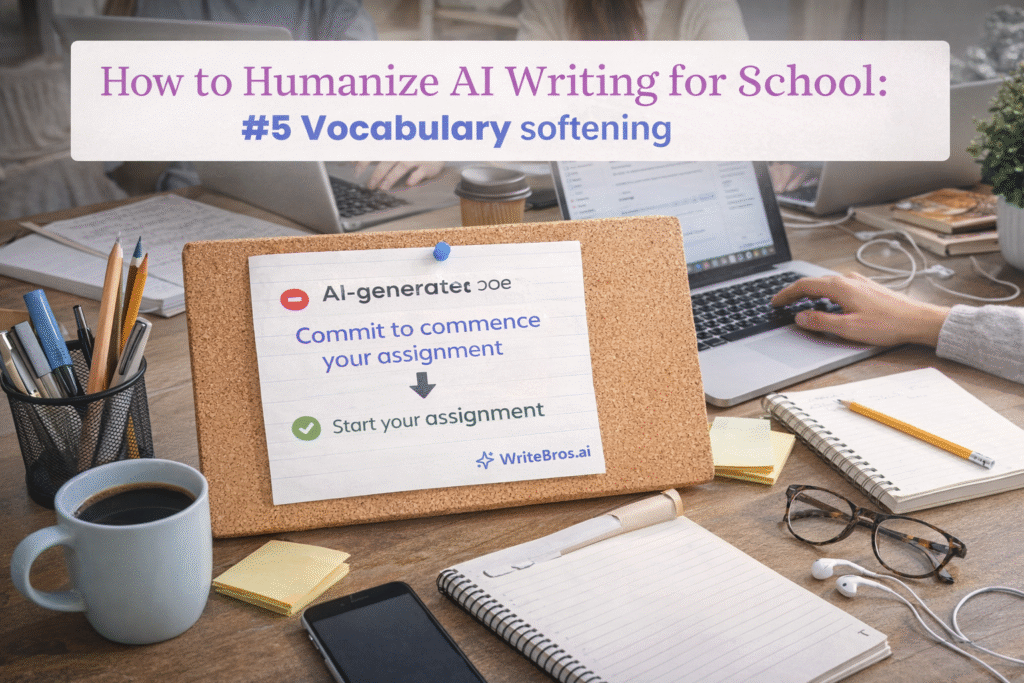
How to Humanize AI Writing for School – Strategy #5: Vocabulary softening
Vocabulary adjustments play an important role in how to humanize AI writing for school because AI tools often select highly formal words that students rarely use in everyday academic writing. The result can be essays that sound impressively polished yet slightly unnatural, almost as though they were copied from an academic reference source. Softening certain terms with simpler alternatives allows the writing to retain clarity while better reflecting the language patterns students normally use when explaining ideas.
Imagine a social studies essay that repeatedly uses complex phrasing when a simpler explanation would communicate the same idea more clearly. A student revising that text might replace overly technical words with straightforward language that still maintains the academic tone expected in school assignments. These subtle vocabulary changes gradually transform the voice of the essay and help the writing feel more natural without sacrificing the quality of the analysis.
How to Humanize AI Writing for School – Strategy #6: Paragraph pacing control
Adjusting paragraph pacing is another useful technique when learning how to humanize AI writing for school because automated drafts often produce paragraphs that are nearly identical in length and structure. This balanced layout can look neat on the page, yet it rarely reflects how students actually organize their thoughts when developing an argument or explaining a concept. Introducing natural variation in paragraph length helps the essay feel less artificially symmetrical and more reflective of real academic writing.
A student might notice that every paragraph in a draft contains four sentences that follow the same explanatory pattern. Revising the essay could involve expanding one paragraph with an additional clarification while condensing another section that repeats the same idea. These pacing adjustments create a more organic structure across the essay and help the writing feel more like a thoughtful progression of ideas rather than a perfectly structured template.
How to Humanize AI Writing for School – Strategy #7: Opinion insertion points
Many AI-generated essays present information in a neutral tone, which means students need to insert moments of interpretation when they want to humanize AI writing for school. Teachers typically expect essays to show reasoning, reflection, or evaluation rather than a simple collection of facts that appear disconnected from the writer’s perspective. Adding brief moments of interpretation gives the essay a clearer sense of voice and shows that the student is actively thinking about the topic.
In a history essay discussing a political decision, the original draft might simply list events in chronological order without commenting on their significance. When a student adds a sentence explaining why that decision influenced later events, the paragraph becomes more analytical and less mechanical. These small opinion points demonstrate critical thinking while still staying grounded in evidence, which helps the essay feel more like genuine academic work.
How to Humanize AI Writing for School – Strategy #8: Example grounding
Grounding explanations in examples is an effective way to humanize AI writing for school because examples reveal how a student understands the concept rather than simply repeating definitions. AI-generated drafts sometimes describe ideas in abstract terms that feel accurate but distant from real experiences or classroom discussions. Introducing concrete illustrations helps the explanation feel more practical and allows the reader to see how the concept operates in a recognizable situation.
For instance, an economics essay might initially describe supply and demand using very general language that could apply to almost any scenario. When the student adds a brief example connected to a familiar product or classroom case study, the paragraph becomes easier to visualize and understand. These examples naturally expand the explanation and help the essay reflect the way students normally demonstrate comprehension during school assignments.
How to Humanize AI Writing for School – Strategy #9: Light imperfection edits
Another technique for how to humanize AI writing for school is allowing small irregularities in phrasing that mirror natural student writing. AI text frequently appears extremely polished, with perfectly balanced sentences that sometimes feel too smooth to be authentic. Introducing slight variation in wording or sentence structure helps the essay sound less like an automated response and more like a student actively composing their thoughts.
This does not mean inserting grammatical errors or careless mistakes, but rather permitting sentences that feel slightly more conversational in their rhythm. A student might revise a sentence so the explanation unfolds more gradually, reflecting how people often clarify ideas while writing. These minor imperfections create a more believable tone and prevent the essay from sounding overly mechanical.
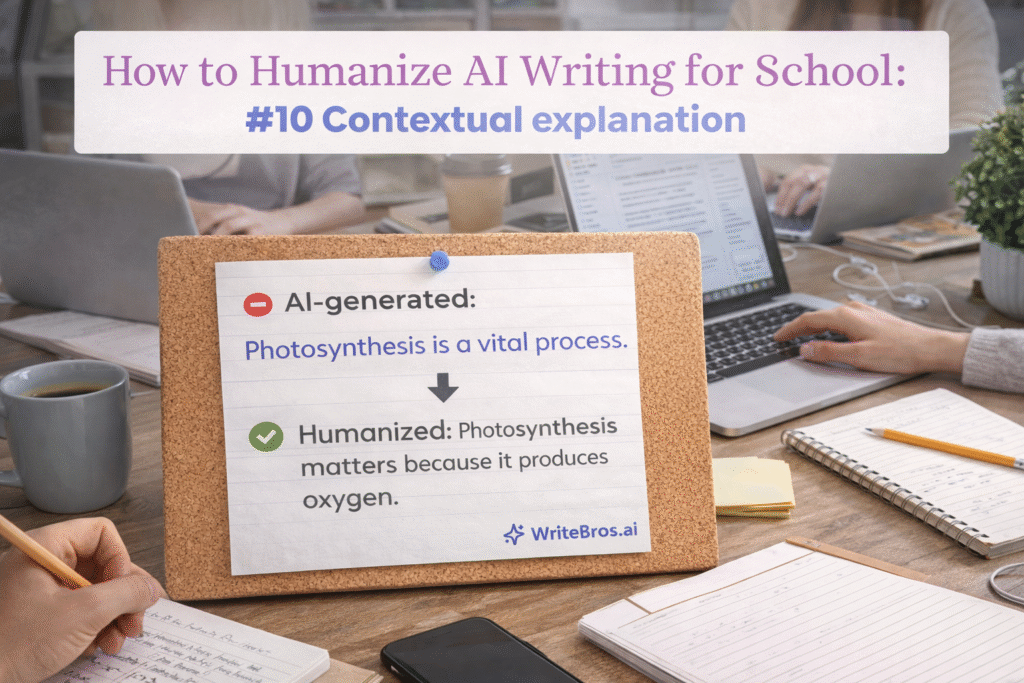
How to Humanize AI Writing for School – Strategy #10: Contextual explanation
Adding contextual explanation is a powerful way to humanize AI writing for school because AI drafts sometimes compress complex reasoning into short, efficient statements. While these summaries may be accurate, they can leave readers wondering how the conclusion connects to the broader argument of the essay. Expanding certain sections with brief clarifications allows the reasoning to unfold more naturally and makes the argument easier to follow.
Imagine a paragraph that jumps quickly from a claim to a conclusion without explaining the reasoning that connects the two ideas. When a student inserts a short explanation describing why the evidence supports that claim, the paragraph becomes clearer and more persuasive. These contextual additions improve the overall coherence of the essay and help the writing reflect the thoughtful progression expected in classroom assignments.
How to Humanize AI Writing for School – Strategy #11: Question framing
Question framing can help humanize AI writing for school because it mirrors the reflective thinking students often use when analyzing information. AI-generated essays tend to present ideas in a declarative format that feels final and authoritative, yet real student writing sometimes explores ideas through brief questions that guide the discussion. Introducing a thoughtful question can create a natural transition into deeper analysis.
For example, a literature essay might pause to consider why a character makes a certain decision before explaining the interpretation. This moment of curiosity signals that the writer is actively examining the text rather than simply summarizing it. When used carefully, question framing adds authenticity and encourages readers to engage with the reasoning presented in the essay.
How to Humanize AI Writing for School – Strategy #12: Claim clarification
Clarifying claims is an essential step when learning how to humanize AI writing for school because AI tools sometimes produce thesis statements that sound overly polished but slightly vague. Students often refine these statements as they work through their argument, gradually shaping the claim so it reflects their actual reasoning. Revising the thesis and topic sentences ensures the essay communicates a clear and believable perspective.
In practice, this might involve rewriting a broad statement so it specifies the exact relationship between the ideas being discussed. When a student explains what the argument really intends to prove, the essay becomes easier to follow and more persuasive. These clarifications help transform the text from a generic explanation into a focused academic argument.
How to Humanize AI Writing for School – Strategy #13: Source integration style
Integrating sources naturally is another important technique for how to humanize AI writing for school because automated drafts sometimes present evidence in a rigid and formulaic way. Citations may appear abruptly or feel disconnected from the surrounding explanation, which can make the paragraph sound mechanical. Blending sources smoothly into the narrative helps the essay maintain a consistent voice.
A student might introduce a source through a brief explanation that connects the evidence to the argument before presenting the citation. Afterward, the paragraph can continue with an interpretation that explains why the evidence matters in the context of the essay. This integration style ensures the research supports the argument rather than interrupting the flow of the writing.
How to Humanize AI Writing for School – Strategy #14: Flow repair passes
Conducting a flow repair pass is a practical method to humanize AI writing for school because reading the essay carefully reveals moments where the language feels stiff or overly structured. AI-generated drafts may appear smooth at first glance, yet closer reading often exposes transitions that feel abrupt or explanations that sound unnatural. Revising these sections improves the overall coherence of the essay.
Many students read their essays aloud during this step because hearing the words spoken can reveal awkward phrasing that might be overlooked when reading silently. Adjusting those sentences helps the ideas move more smoothly from one thought to the next. Over time, these refinements transform the essay into writing that feels more fluid and authentic.
How to Humanize AI Writing for School – Strategy #15: Final voice polish
The final stage of how to humanize AI writing for school is a voice polish that ensures the entire essay sounds consistent from beginning to end. AI-generated drafts sometimes shift tone between paragraphs because each section may have been generated separately. Reviewing the essay as a whole helps students identify these inconsistencies and adjust the language accordingly.
This stage often includes refining word choices, smoothing transitions, and ensuring the thesis connects clearly with the conclusion. The goal is not to rewrite the entire essay but to align the voice so the writing feels cohesive and believable. A careful final polish ensures the essay reads like a thoughtful piece of student work rather than a collection of generated paragraphs.
Common mistakes
- Submitting AI-generated text without revision is a common mistake because many students assume accurate grammar automatically makes the essay sound authentic. In reality, teachers often recognize patterns such as repetitive transitions and perfectly balanced sentences, which can make the writing appear algorithmic even if the ideas themselves are correct.
- Over-editing the draft to the point that the writing becomes overly formal is another mistake that backfires in classroom settings. Students sometimes replace natural phrasing with complex vocabulary, which can create a tone that sounds more like a research database than a student essay.
- Ignoring the logical flow between paragraphs often causes AI-assisted essays to feel disjointed. When students focus only on correcting individual sentences rather than reviewing the argument as a whole, the final draft may contain strong ideas that do not connect clearly across the essay.
- Adding unnecessary filler content in an attempt to disguise AI structure can also weaken the overall quality of the assignment. Instead of making the essay sound more human, excessive filler can make the argument appear unfocused and distract from the main point.
- Relying entirely on automated rewriting tools without reviewing the results carefully is another frequent mistake. These tools may change wording but still leave the underlying structure of the AI-generated text intact, which means the essay can continue to sound mechanical.
- Failing to align the thesis, body paragraphs, and conclusion is a final mistake that often appears in AI-assisted drafts. When the introduction promises a specific argument but the body sections wander into unrelated explanations, the essay loses coherence and appears less credible.
Edge cases
There are situations where the process of humanizing AI writing for school requires additional caution, especially in assignments that require strict formatting or citation standards. Some academic tasks, such as lab reports or technical summaries, demand precise language that may already resemble structured AI output. In those cases, students should focus less on stylistic variation and more on clarifying their reasoning and explanations so the writing reflects their understanding of the topic.
Another edge case appears in collaborative assignments where multiple students contribute sections of the same document. Even when AI tools are used responsibly, differences in tone between contributors can make the essay feel inconsistent. Careful editing to unify the voice across sections ensures the final document reads as a cohesive piece of work.
Supporting tools
- Grammar checking platforms help students refine sentence clarity and detect awkward phrasing that might appear after revising an AI-generated draft. These tools can highlight overly complex sentences and suggest clearer alternatives that improve the overall readability of the essay.
- Plagiarism detection tools allow students to confirm that any sources referenced in the essay are properly cited and paraphrased. Running a draft through one of these systems helps ensure the final submission aligns with academic integrity standards expected in most schools.
- Readability analyzers evaluate sentence length, vocabulary difficulty, and structural complexity to identify areas that might sound overly formal or unnatural. Students can use these insights to adjust the pacing of their writing and make the essay easier to follow.
- Reference management tools assist with organizing sources and formatting citations according to academic guidelines such as APA or MLA. Proper citation not only strengthens the credibility of the essay but also demonstrates responsible use of external information.
- Text comparison utilities allow students to review revisions across multiple drafts so they can see how their edits improve the clarity and tone of the essay. This comparison process helps writers understand which changes contribute most to a natural voice.
- WriteBros.ai helps students refine AI-assisted drafts so the tone aligns more closely with natural writing patterns used in school assignments. The platform focuses on adjusting phrasing, sentence rhythm, and structural flow so essays read more like thoughtful student work.
Ready to Transform Your AI Content?
Try WriteBros.ai and make your AI-generated content truly human.
Conclusion
Humanizing AI writing for school is less about hiding technology and more about ensuring the final essay reflects genuine reasoning and thoughtful explanation. When students revise rhythm, clarify claims, and connect ideas through natural transitions, the writing begins to resemble the authentic voice teachers expect in classroom assignments.
Perfect sentences are not the goal of strong academic writing, and essays rarely improve when they feel overly polished or mechanically structured. Careful editing that prioritizes clarity, reflection, and consistency allows AI-assisted drafts to evolve into credible student work that communicates ideas with confidence.
Did You Know?
People learning how to humanize AI writing for school often assume the main issue lies in overly formal vocabulary, yet the clearer signal usually appears in structural repetition across the page. If each paragraph begins the same way, expands the explanation with identical pacing, and finishes with the same tidy conclusion, the essay can still read like generated text.
Reworking the shape of the explanation usually helps more because authentic student writing rarely unfolds with perfect symmetry from start to finish. Allow one paragraph to stay concise, let another stretch with a longer clarification woven into the middle, and let the next arrive at the point more gradually, since that irregular rhythm makes school essays feel far more natural.
Ready to Transform Your AI Content?