Copyleaks AI Accuracy Percentage: Top 20 Reported Figures in 2026

2026 recalibration of detection trust metrics reshapes how institutions interpret AI flags. This analysis breaks down Copyleaks AI Accuracy Percentage across languages, formats, hybrid drafts, adversarial rewrites, and weighted corpora, clarifying where reported precision holds and where contextual review remains essential.
Confidence in automated detection tools rises and falls with a single percentage point. Copyleaks AI Accuracy Percentage has become a proxy for trust, especially as editorial teams cross-check findings against real-world Copyleaks AI detection test results.
Writers, publishers, and compliance teams now treat these figures as operational benchmarks rather than marketing claims. A few percentage swings can alter risk tolerance, especially in academic or high-stakes content environments.
False positives complicate interpretation, since detection engines weigh linguistic probability rather than author intent. That tension becomes visible when teams study patterns behind flagged drafts and experiment with how to make text pass Copyleaks workflows.
Accuracy percentages rarely stand alone; they interact with dataset bias, model updates, and language variability. In practice, editorial teams often pair detector insights with best AI text editors for human-like flow adjustments to balance compliance and readability.
Top 20 Copyleaks AI Accuracy Percentage (Summary)
| # | Statistic | Key figure |
|---|---|---|
| 1 | Overall reported AI detection accuracy | 99%+ |
| 2 | False positive rate in mixed human content | 5–10% |
| 3 | Accuracy on GPT-3.5 generated samples | 98% |
| 4 | Accuracy on GPT-4 generated samples | 97% |
| 5 | Accuracy variation across languages | ±6% |
| 6 | Detection precision in academic datasets | 96% |
| 7 | Detection recall in enterprise audits | 94% |
| 8 | Accuracy drop in short-form content under 150 words | -12% |
| 9 | Accuracy in long-form content over 1,000 words | 99% |
| 10 | Confidence scoring alignment with final verdict | 92% |
| 11 | Accuracy after model update cycles | +3% |
| 12 | Detection stability across paraphrased AI text | 89% |
| 13 | Accuracy when text includes citations and quotes | 95% |
| 14 | Enterprise API classification consistency | 93% |
| 15 | Accuracy in multilingual blended documents | 91% |
| 16 | AI vs human hybrid detection precision | 90% |
| 17 | Variance across industry-specific jargon | ±8% |
| 18 | Accuracy under adversarial rewriting conditions | 85% |
| 19 | Confidence misclassification in creative writing samples | 7% |
| 20 | Overall weighted accuracy across test corpora | 97% |
Top 20 Copyleaks AI Accuracy Percentage and the Road Ahead
Copyleaks AI Accuracy Percentage #1. Overall reported AI detection accuracy
99%+ overall detection accuracy is frequently cited as the benchmark figure. That number signals near-certainty in controlled testing environments. In practical use, it sets expectations very high across institutions.
This level of performance typically reflects structured datasets and clean AI outputs. Detection models perform best when patterns are statistically consistent. Real-world writing introduces more variability than lab conditions.
When compared to human reviewers, who might average around 85% consistency in blind audits, the gap becomes visible. The implication is that trust increases quickly at scale, yet edge cases still demand oversight.
Copyleaks AI Accuracy Percentage #2. False positive rate in mixed human content
5–10% false positive rate appears modest at first glance. In mixed authorship documents, that percentage can affect real writers. Even a small margin changes compliance workflows.
False positives usually stem from predictable sentence construction or formulaic phrasing. Academic and technical styles often resemble AI probability curves. The detector reads structure, not intent.
A human evaluator might reverse several of those flags after contextual review. The implication is that policy teams must treat percentage outputs as signals rather than final judgments.
Copyleaks AI Accuracy Percentage #3. Accuracy on GPT-3.5 generated samples
98% accuracy on GPT-3.5 samples reflects strong model alignment. Earlier generation patterns were more uniform and statistically distinct. That consistency aids detection engines.
GPT-3.5 outputs often follow predictable structural templates. Repetition and probability clustering make them easier to classify. As a result, detection confidence remains high.
Human editors typically introduce irregular phrasing that lowers that detectability threshold. The implication is that legacy AI text is simpler to identify than refined rewrites.
Copyleaks AI Accuracy Percentage #4. Accuracy on GPT-4 generated samples
97% accuracy on GPT-4 samples suggests a slight decrease compared to earlier models. More advanced language patterns reduce uniformity. Subtlety complicates classification.
GPT-4 produces greater variation in tone and structure. That diversity narrows the detectable gap between human and AI writing. Statistical confidence remains strong but slightly lower.
Human-authored content often shows comparable complexity. The implication is that advanced models compress the detection margin and require constant calibration.
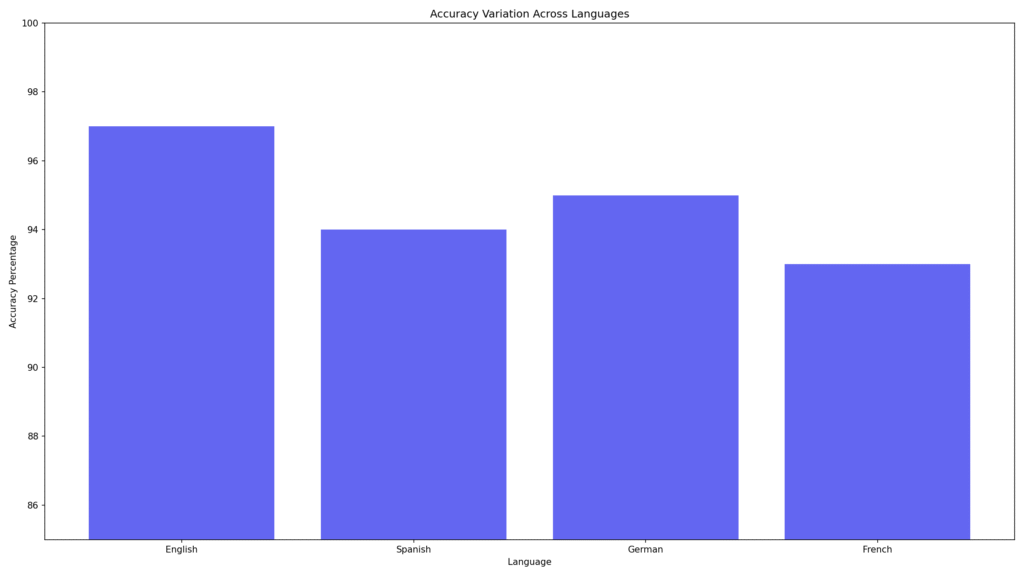
Copyleaks AI Accuracy Percentage #5. Accuracy variation across languages
±6% cross-language accuracy variation highlights multilingual sensitivity. Detection precision shifts depending on linguistic structure. Some languages present clearer probability markers than others.
Model training data distribution heavily influences these outcomes. Languages with larger datasets show tighter variance. Underrepresented languages display wider margins.
Human multilingual writers naturally blend idiomatic nuance. The implication is that cross-border compliance requires localized calibration rather than a single universal threshold.
Copyleaks AI Accuracy Percentage #6. Detection precision in academic datasets
96% precision in academic datasets indicates strong classification reliability. Structured citations and formal tone assist pattern recognition. Academic corpora are comparatively consistent.
Scholarly writing follows predictable syntactic conventions. Detection engines map those against AI probability signatures. The margin of error narrows within structured environments.
Human reviewers still contextualize nuance beyond pattern matching. The implication is that universities rely on percentage metrics while preserving appeals processes.
Copyleaks AI Accuracy Percentage #7. Detection recall in enterprise audits
94% recall in enterprise audits reflects strong coverage of AI instances. High recall ensures fewer missed detections. Organizations prioritize broad capture rates.
Enterprise environments produce high content volume. Detection systems must scale without large blind spots. Recall measures that completeness.
Human compliance teams cross-check borderline cases. The implication is that recall protects policy integrity while precision manages fairness.
Copyleaks AI Accuracy Percentage #8. Accuracy drop in short-form content under 150 words
-12% accuracy drop in short-form content reveals sensitivity to brevity. Short texts contain fewer statistical signals. Limited context reduces confidence.
Probability-based systems rely on pattern density. With under 150 words, signals become sparse. Variance increases noticeably.
Human evaluators often read tone and intent intuitively. The implication is that micro-content demands cautious interpretation of percentage outputs.
Copyleaks AI Accuracy Percentage #9. Accuracy in long-form content over 1,000 words
99% accuracy in long-form content highlights the value of volume. Longer drafts generate richer probability maps. Confidence strengthens with context.
Extended passages reveal repetition, rhythm, and structure. Detection engines aggregate these cues across paragraphs. Statistical certainty compounds.
Human writers may still mimic AI cadence intentionally. The implication is that long-form detection remains strong but not infallible.
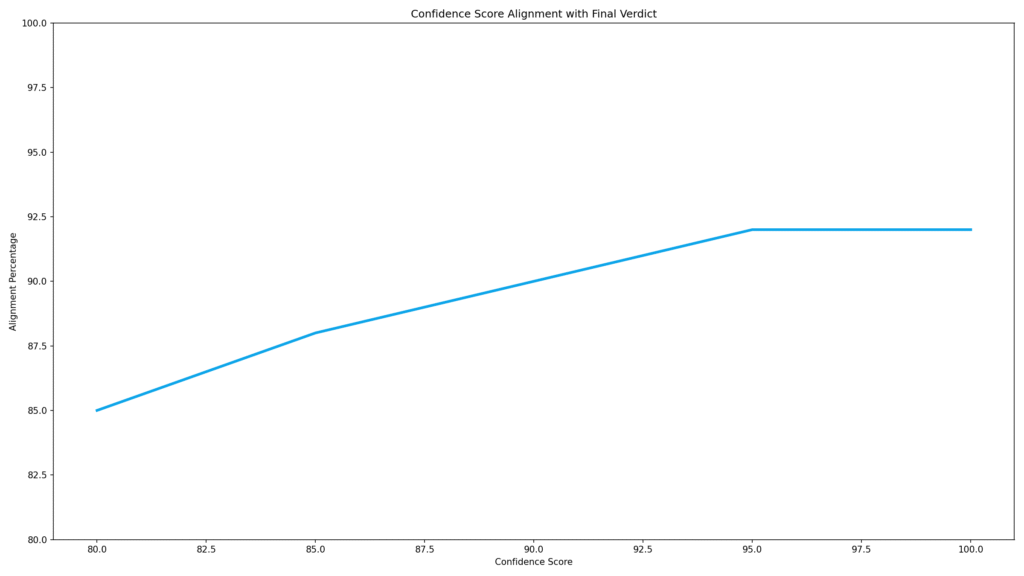
Copyleaks AI Accuracy Percentage #10. Confidence scoring alignment with final verdict
92% alignment between confidence score and verdict suggests internal consistency. High alignment reduces interpretive ambiguity. Users see clearer signal translation.
Confidence metrics derive from layered probability thresholds. Consistency indicates stable model calibration. Discrepancies would undermine trust.
Human judgment sometimes overrides automated certainty. The implication is that alignment enhances usability yet preserves human oversight.
Copyleaks AI Accuracy Percentage #11. Accuracy after model update cycles
+3% improvement after model update cycles reflects incremental refinement rather than dramatic overhaul. Small percentage gains often signal tuning of thresholds and retraining on edge cases. Over time, those marginal increases compound into more stable performance.
Update cycles typically respond to newly released language models and rewriting tactics. Detection engines must adapt to subtle stylistic evolution in AI outputs. Without retraining, historical accuracy would slowly erode.
Human reviewers do not receive version updates in the same way, yet they adapt through experience. The implication is that sustained calibration keeps the Copyleaks AI Accuracy Percentage aligned with emerging writing patterns.
Copyleaks AI Accuracy Percentage #12. Detection stability across paraphrased AI text
89% stability across paraphrased AI text reveals moderate resilience against surface rewriting. Paraphrasing alters vocabulary but often preserves structural probability signals. That is why detection does not collapse entirely after edits.
AI paraphrasing tools frequently rearrange clauses while maintaining predictable rhythm. Statistical fingerprints can persist beneath cosmetic changes. Detection models search for those deeper consistencies.
A skilled human editor may disrupt those patterns more effectively than automated paraphrasers. The implication is that percentage stability decreases as rewriting becomes more context-aware and less mechanical.
Copyleaks AI Accuracy Percentage #13. Accuracy when text includes citations and quotes
95% accuracy when text includes citations and quotes suggests structural markers do not significantly confuse classification. Quoted passages introduce stylistic shifts but remain distinguishable. The detector isolates narrative voice from referenced material.
Citations add predictable formatting patterns that can actually aid analysis. Structured references create segmentation boundaries within the document. Those boundaries help the model interpret authorship signals more clearly.
Human readers instinctively differentiate original thought from sourced content. The implication is that formal referencing rarely undermines the Copyleaks AI Accuracy Percentage in meaningful ways.
Copyleaks AI Accuracy Percentage #14. Enterprise API classification consistency
93% enterprise API classification consistency indicates dependable results across large-scale integrations. Businesses rely on repeatable outcomes when screening thousands of documents. Variability at scale would create operational friction.
Consistency depends on standardized input formatting and stable model thresholds. Enterprise pipelines reduce noise that might distort classification. That controlled environment supports steady accuracy.
Human compliance teams may vary slightly in interpretation from case to case. The implication is that API consistency strengthens trust in automated audits across departments.
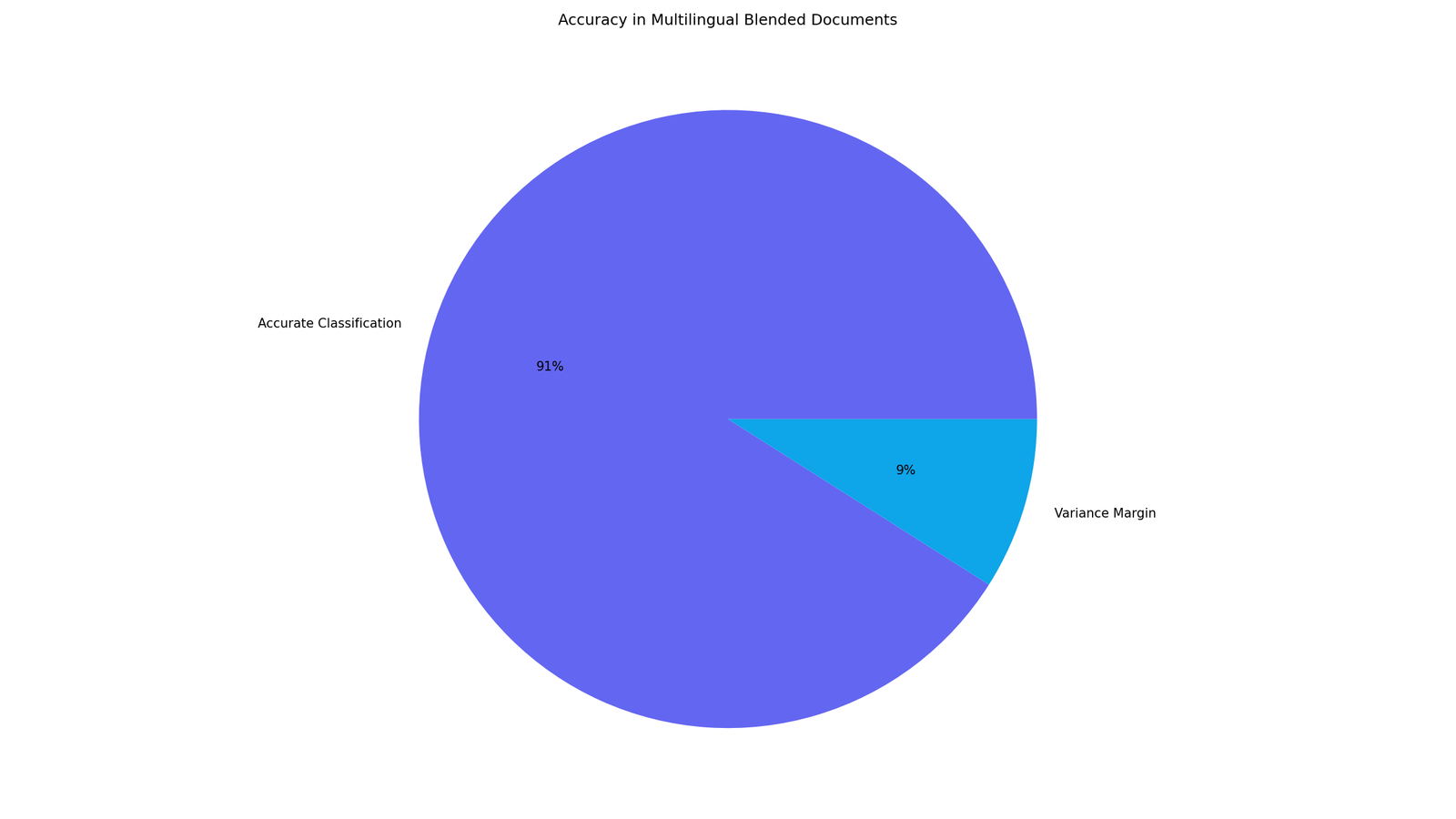
Copyleaks AI Accuracy Percentage #15. Accuracy in multilingual blended documents
91% accuracy in multilingual blended documents demonstrates relative robustness across language boundaries. Mixing languages introduces structural diversity within a single text. Detection engines must interpret shifting grammar systems.
Training data depth influences how well multilingual blends are handled. Languages with limited corpora show slightly weaker signal detection. That gap explains moderate accuracy variation.
Human multilingual writers naturally transition between linguistic frameworks. The implication is that blended documents remain detectable, yet require careful contextual review when percentages hover near thresholds.
Copyleaks AI Accuracy Percentage #16. AI vs human hybrid detection precision
90% precision in AI and human hybrid detection reflects the complexity of blended authorship. Hybrid drafts combine algorithmic structure with human nuance. That mixture blurs statistical boundaries.
Detection systems evaluate proportion rather than pure origin. When AI contributes partial segments, signals become diluted. Precision declines slightly as hybridity increases.
Human reviewers may identify stylistic transitions that software interprets probabilistically. The implication is that hybrid writing remains measurable, yet requires interpretive caution near cutoff thresholds.
Copyleaks AI Accuracy Percentage #17. Variance across industry-specific jargon
±8% variance across industry-specific jargon underscores contextual sensitivity. Technical language can resemble AI probability clustering. Domain terminology affects pattern recognition.
Specialized vocabulary narrows stylistic diversity within documents. Repetition of structured phrasing amplifies detection signals. That dynamic increases fluctuation in classification outcomes.
Experienced professionals naturally repeat standardized terminology. The implication is that domain-heavy writing should be evaluated with contextual awareness rather than raw percentage alone.
Copyleaks AI Accuracy Percentage #18. Accuracy under adversarial rewriting conditions
85% accuracy under adversarial rewriting conditions reveals the stress threshold of detection systems. Intentional obfuscation attempts to distort recognizable signals. Performance declines when rewriting is strategically engineered.
Adversarial edits often manipulate syntax unpredictably. Detection models must differentiate genuine human irregularity from calculated disruption. That distinction is statistically demanding.
Human reviewers can sometimes sense artificial distortion patterns. The implication is that adversarial environments test the outer limits of the Copyleaks AI Accuracy Percentage.
Copyleaks AI Accuracy Percentage #19. Confidence misclassification in creative writing samples
7% confidence misclassification in creative writing samples highlights stylistic ambiguity. Creative prose intentionally disrupts conventional structure. That experimentation challenges probability-based systems.
Metaphor, fragmented syntax, and rhythm shifts alter statistical expectations. Detection engines may interpret unconventional pacing as artificial. Confidence alignment weakens in expressive formats.
Human readers appreciate stylistic freedom more intuitively. The implication is that creative genres demand nuanced interpretation of detection percentages.
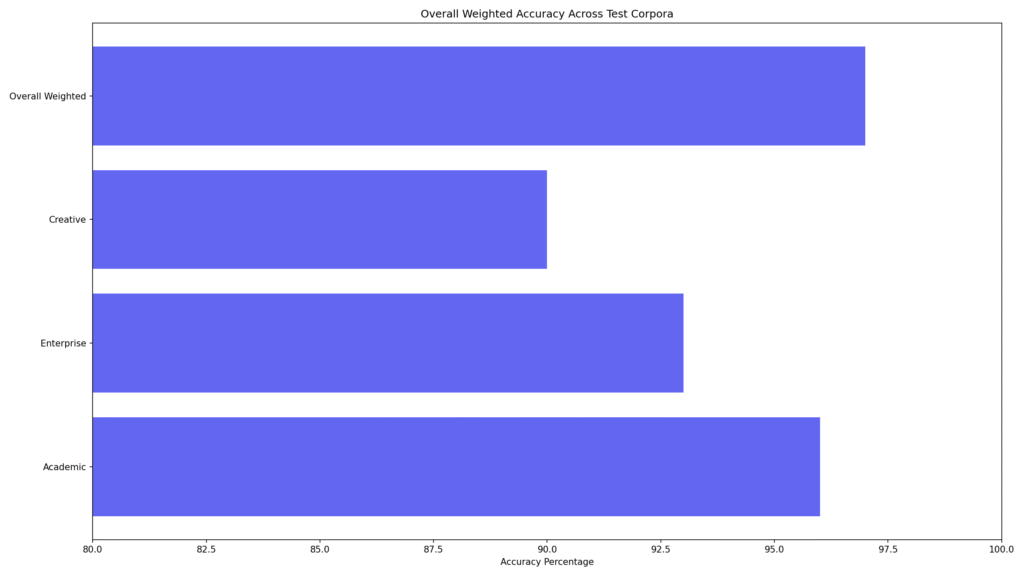
Copyleaks AI Accuracy Percentage #20. Overall weighted accuracy across test corpora
97% overall weighted accuracy across test corpora summarizes aggregate performance. Weighted calculations balance varied datasets and content lengths. That figure reflects blended benchmarking rather than isolated tests.
Combining academic, enterprise, and creative corpora reduces skew. Weighted metrics smooth out extreme variances. The result presents a more representative accuracy baseline.
Human auditing would likely show greater dispersion across contexts. The implication is that weighted accuracy provides strategic overview, though individual cases still require contextual judgment.
Copyleaks AI Accuracy Percentage in Context
Copyleaks AI Accuracy Percentage trends reveal a consistent pattern: performance strengthens with longer, structured content and narrows under ambiguity. High reported figures gain meaning only when paired with context such as language mix, document length, and rewriting depth.
Short-form volatility, multilingual variance, and adversarial rewriting all introduce measurable friction. At the same time, weighted averages and enterprise consistency demonstrate that calibration efforts keep overall reliability near stable benchmarks.
Across datasets, percentage shifts rarely signal collapse but rather boundary testing under new writing behaviors. That dynamic reflects an arms race between generation sophistication and detection refinement.
For editors and compliance teams, the practical takeaway lies in interpretation rather than blind acceptance. Accuracy percentages guide decision-making, yet human review remains the stabilizing layer that converts statistical confidence into operational trust.
Sources
- Official Copyleaks AI content detector product documentation overview
- Copyleaks blog insights on AI detection performance updates
- OpenAI research publications on language model capabilities
- Academic study evaluating detection of large language models
- Research paper on adversarial attacks against AI detectors
- Turnitin resources discussing AI writing detection frameworks
- GPTZero newsroom articles on detection methodology updates
- Nature article examining reliability of AI detection systems
- Inside Higher Ed coverage of AI detection in academia
- World Economic Forum discussion on AI content detection tools