How to Make Text Pass Copyleaks: 15 Content Adjustments
In 2026, reducing AI detection risk requires structural edits, tonal variation, and rhythm control rather than simple paraphrasing. Research in Science shows AI-generated text carries detectable statistical patterns, reinforcing why deliberate human revision is essential for lowering Copyleaks flags.
How to Make Text Pass Copyleaks: 15 Practical Adjustments
If you’re trying to figure out How to Make Text Pass Copyleaks, you’ve probably had a piece of writing flagged even though it felt completely natural. Watching original work get labeled as AI can be frustrating, especially when you already understand that AI detectors disagree in how they interpret the same text.
The issue usually isn’t that your ideas are robotic, but that certain structural patterns and phrasing habits look statistically predictable. Many writers lean too heavily on automated rewriting or even the best AI paraphrasers for tone and clarity improvements, which can accidentally amplify patterns that detection tools associate with synthetic content.
The good news is that you can reduce those signals with targeted edits rather than rewriting everything from scratch. Once you understand how often Copyleaks flags human writing, you can make intentional adjustments that preserve your voice while lowering detection risk.
| # | Strategy focus | Practical takeaway |
|---|---|---|
| 1 | Vary sentence rhythm | Mix short, medium, and longer sentences to reduce predictable flow patterns. |
| 2 | Break formulaic structure | Avoid repetitive paragraph formats that mirror common AI outputs. |
| 3 | Add specific detail | Include concrete examples that feel grounded rather than abstract. |
| 4 | Reduce generic transitions | Replace overused connectors with more natural shifts in thought. |
| 5 | Adjust vocabulary density | Balance sophisticated wording with everyday language. |
| 6 | Introduce subtle imperfection | Allow minor stylistic variation instead of polishing every sentence uniformly. |
| 7 | Rework repetitive phrasing | Scan for patterns in sentence openings and restructure them. |
| 8 | Clarify logical flow | Ensure ideas progress naturally instead of following a templated outline. |
| 9 | Limit overexplaining | Trim explanations that restate obvious points in similar wording. |
| 10 | Use active construction | Favor direct phrasing that feels personal and deliberate. |
| 11 | Personalize tone | Infuse perspective and intent rather than neutral narration. |
| 12 | Avoid symmetry in lists | Change list length and phrasing so entries do not follow identical patterns. |
| 13 | Refine paragraph length | Vary paragraph size to prevent uniform visual blocks of text. |
| 14 | Reevaluate word predictability | Swap statistically common phrasing for more distinctive language choices. |
| 15 | Final manual review | Read aloud and adjust anything that sounds overly polished or mechanical. |
15 Practical Adjustments to How to Make Text Pass Copyleaks
How to Make Text Pass Copyleaks – Strategy #1: Vary sentence rhythm
One of the most reliable ways to approach How to Make Text Pass Copyleaks is to deliberately vary your sentence rhythm so the structure does not follow a predictable cadence that detection systems often associate with machine-generated prose. Instead of writing three medium-length sentences in a row that mirror one another in tone and pacing, intentionally alternate between longer explanatory lines and slightly shorter reflective ones, allowing your ideas to breathe in a more natural way. This type of variation introduces subtle unpredictability, which tends to mirror how people actually think and write when they are developing ideas in real time.
In practical terms, this might mean expanding on one point with layered clarification and then following it with a more restrained sentence that pivots gently to the next idea without feeling formulaic. When rhythm changes organically, the text feels less engineered and more like the product of someone shaping their thoughts as they go. Over time, this habit reduces uniformity across paragraphs and weakens statistical signals that often trigger automated detection.
How to Make Text Pass Copyleaks – Strategy #2: Break formulaic structure
If you are serious about How to Make Text Pass Copyleaks, you need to move away from rigid paragraph templates that repeat the same introduction, explanation, and summary pattern in every section. Detection systems are sensitive to structural symmetry, especially when each paragraph opens with a definition, expands into a predictable explanation, and closes with a tidy conclusion that feels mechanically assembled. Allowing paragraphs to unfold in slightly different ways, with varied openings and evolving transitions, introduces a more human cadence.
This does not mean abandoning clarity or coherence, but rather permitting ideas to develop with mild irregularity that reflects genuine thought progression. Sometimes a paragraph can begin with context, while other times it can open with a reflection or an observation that leads into analysis. When structure feels responsive to the content rather than imposed on it, the writing carries fewer detectable patterns.
How to Make Text Pass Copyleaks – Strategy #3: Add specific detail
Another essential component of How to Make Text Pass Copyleaks is embedding specific details that ground your writing in tangible context rather than abstract generalizations. Broad statements such as “this improves quality” or “writers benefit from adjustments” can sound algorithmic because they lack the texture and nuance of lived reasoning. When you add situational details, clarifying examples, or concrete scenarios, the prose begins to resemble authentic human articulation.
Specificity signals intention, because it suggests the writer is drawing from observation or direct reasoning instead of generating generic phrasing. Even a brief contextual layer, such as describing how an editor revises a flagged paragraph, introduces depth that machines often fail to reproduce convincingly. Over time, these grounded additions significantly reduce the uniform abstraction common in AI-generated drafts.
How to Make Text Pass Copyleaks – Strategy #4: Reduce generic transitions
When focusing on How to Make Text Pass Copyleaks, it becomes important to examine the transitions you rely on between sentences and paragraphs, since overused connectors can form recognizable patterns. Phrases such as “in addition,” “furthermore,” and “overall” are not inherently wrong, yet repeated usage creates a mechanical flow that resembles templated outputs. Instead, aim for subtler transitions that evolve naturally from the logic of your previous sentence.
You can accomplish this by allowing one idea to imply the next rather than announcing every shift with an explicit signal. When the progression feels embedded in the reasoning rather than labeled at each turn, the text reads more fluidly and less artificially structured. This subtle change weakens repetitive linguistic markers that detection tools frequently analyze.
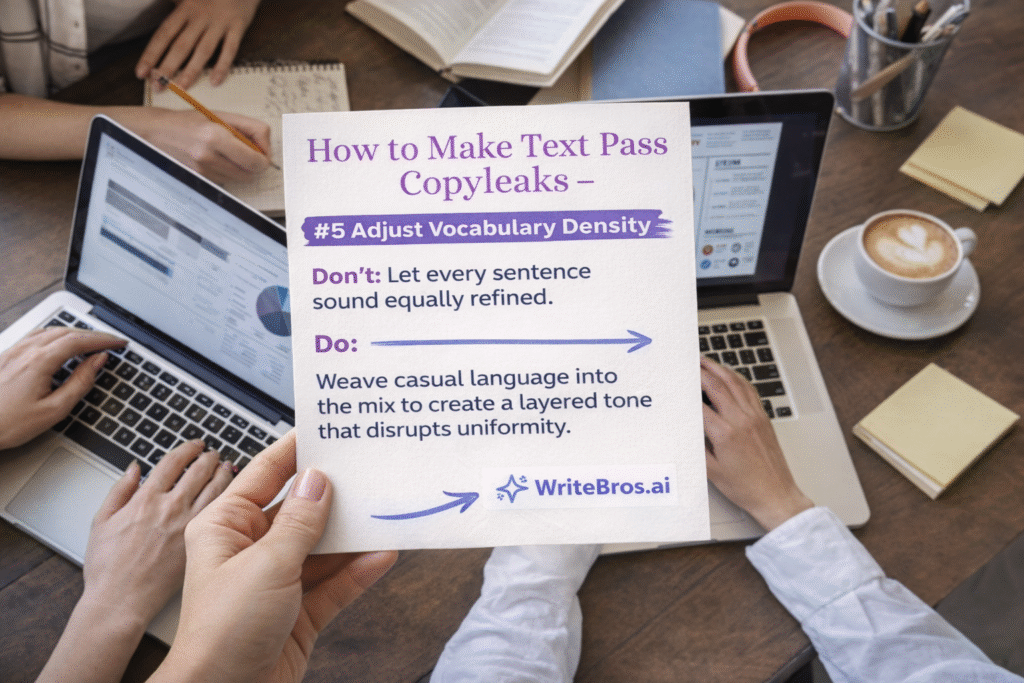
How to Make Text Pass Copyleaks – Strategy #5: Adjust vocabulary density
An overlooked aspect of How to Make Text Pass Copyleaks is balancing vocabulary density so that the text does not lean too heavily toward uniformly elevated or uniformly simple language. AI-generated drafts often maintain a steady level of polished wording, which can feel suspiciously consistent across multiple paragraphs. Intentionally mixing conversational phrasing with more analytical terminology creates a layered tone that feels more authentic.
This variation mirrors how people naturally write, especially when they move between explaining a concept and reflecting on its implications. If every sentence sounds equally refined, the prose risks appearing engineered rather than expressed. Adjusting vocabulary density introduces tonal movement that reduces statistical uniformity.
How to Make Text Pass Copyleaks – Strategy #6: Introduce subtle imperfection
In the context of How to Make Text Pass Copyleaks, subtle imperfection can be surprisingly effective because perfectly balanced prose sometimes resembles algorithmic refinement. Human writing often contains mild asymmetry, whether in phrasing choices, emphasis placement, or slight variations in sentence construction. Allowing small irregularities to remain can create a more organic texture without sacrificing professionalism.
This does not mean inserting errors, but rather resisting the urge to over-polish every clause into symmetrical alignment. When sentences carry natural variation in tone and emphasis, the overall structure feels less manufactured. That subtle unpredictability reduces the appearance of mechanical consistency.
How to Make Text Pass Copyleaks – Strategy #7: Rework repetitive phrasing
A practical way to strengthen How to Make Text Pass Copyleaks is reviewing your draft for repeated sentence openings or mirrored phrasing that unintentionally creates detectable repetition. If several sentences begin with the same structure, such as “This strategy” or “It is important,” the pattern becomes statistically noticeable. Rewriting those openings with varied constructions disrupts uniformity.
Instead of relying on identical phrasing, experiment with shifting emphasis or embedding the subject deeper into the sentence. This adjustment changes the surface pattern without altering meaning. As a result, the prose appears more naturally composed and less algorithmically patterned.
How to Make Text Pass Copyleaks – Strategy #8: Clarify logical flow
When applying How to Make Text Pass Copyleaks, examine whether your ideas unfold in a way that reflects real reasoning rather than a predetermined outline. AI drafts sometimes progress through evenly spaced points that feel orderly but lack subtle logical buildup. Adjusting the flow to reflect cause, reflection, and refinement creates a more convincing narrative progression.
Consider whether each paragraph genuinely responds to the previous one instead of simply occupying its assigned position. When logic evolves organically, the structure becomes less predictable and more human. That natural progression weakens the repetitive frameworks common in automated content.
How to Make Text Pass Copyleaks – Strategy #9: Limit overexplaining
An effective refinement for How to Make Text Pass Copyleaks is trimming redundant clarification that restates the same idea in slightly altered wording. Overexplaining can create clusters of semantically similar sentences that detection systems may interpret as generative filler. Removing these echoes tightens the prose and reduces patterned expansion.
Focus on expressing each idea fully once, then allow the discussion to advance without circling back unnecessarily. When repetition decreases, the text feels more decisive and less constructed through iterative rephrasing. This change reduces linguistic redundancy that often triggers automated scrutiny.
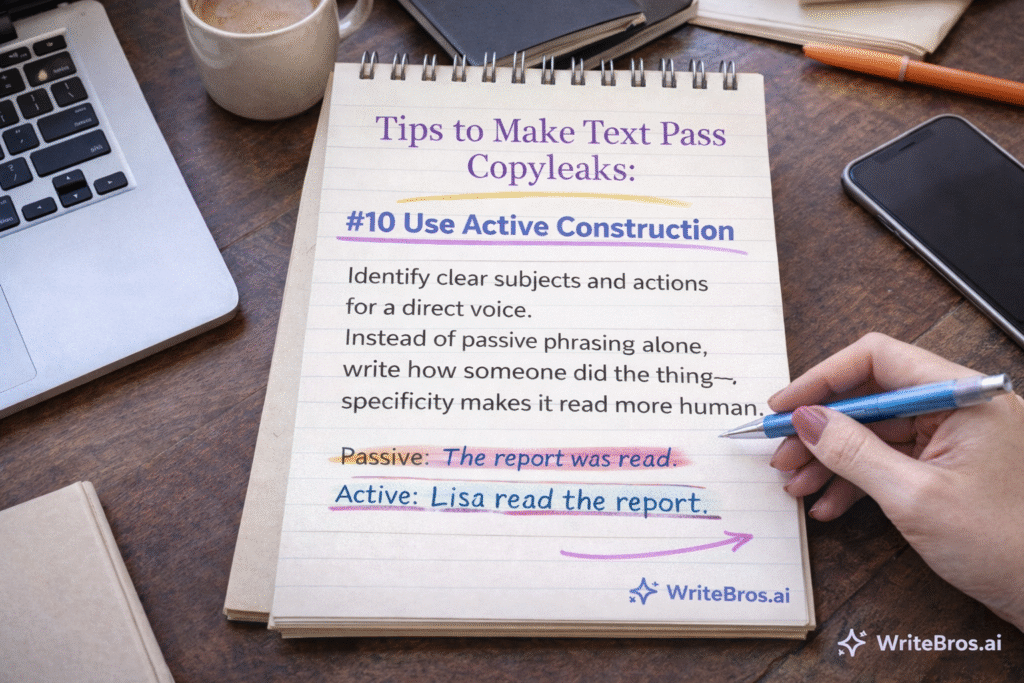
How to Make Text Pass Copyleaks – Strategy #10: Use active construction
Refining How to Make Text Pass Copyleaks also involves favoring active construction that clearly identifies actors and actions instead of relying on vague passive forms. Passive phrasing can accumulate in AI drafts because it creates neutrality, yet excessive neutrality may resemble machine tone. Introducing active voice adds intention and specificity.
When sentences clearly show who is doing what, the prose gains personality and directness. This clarity makes the writing feel authored rather than generated. Active construction also reduces the diffuse tone that detection models often associate with automated text.
How to Make Text Pass Copyleaks – Strategy #11: Personalize tone
A strong approach to How to Make Text Pass Copyleaks is weaving in tonal elements that reflect perspective, even in analytical writing. Completely neutral narration across every paragraph can resemble automated output because it avoids subtle voice markers. Introducing measured perspective adds dimension without undermining authority.
This can include reflective phrasing or mild emphasis that signals intention behind the explanation. When tone shifts slightly in response to context, the writing appears more situational and less templated. That variation contributes to a more human overall profile.
How to Make Text Pass Copyleaks – Strategy #12: Avoid symmetry in lists
Symmetry in lists may appear organized, yet within How to Make Text Pass Copyleaks it can inadvertently create repetitive formatting patterns. If every bullet or numbered point contains the same sentence length and grammatical structure, the repetition becomes mathematically neat. Introducing subtle variation in phrasing disrupts that regularity.
Allow certain entries to expand slightly while others remain concise, depending on their complexity. This uneven distribution mirrors authentic explanation rather than formulaic construction. The result is a list that feels curated instead of auto-generated.
How to Make Text Pass Copyleaks – Strategy #13: Refine paragraph length
Paragraph length plays a more influential role in How to Make Text Pass Copyleaks than many writers realize because uniform blocks of text can appear systematically produced. When every paragraph spans nearly identical word counts, visual symmetry reinforces algorithmic patterns. Adjusting length in response to content breaks that uniformity.
Some ideas naturally require extended clarification, while others conclude efficiently once the point is made. Letting paragraphs reflect that difference introduces visual and structural variation. This shift reduces the appearance of automated composition.
How to Make Text Pass Copyleaks – Strategy #14: Reevaluate word predictability
An advanced refinement for How to Make Text Pass Copyleaks involves scanning for statistically common phrases that frequently appear in generative outputs. Words such as “overall,” “significantly,” and “moreover” may cluster in predictable ways. Replacing them with more context-specific alternatives reduces linguistic predictability.
This substitution does not require dramatic vocabulary changes, but rather thoughtful variation aligned with your meaning. When phrasing feels selected rather than defaulted, the text carries stronger intentionality. That intentionality weakens patterns detection systems often analyze.
How to Make Text Pass Copyleaks – Strategy #15: Final manual review
The final safeguard in How to Make Text Pass Copyleaks is conducting a deliberate manual review that focuses on flow, tone, and structural variation rather than surface grammar alone. Automated drafts can appear polished yet subtly repetitive, and only attentive reading reveals those patterns. Reading the text slowly encourages recognition of uniform phrasing or rhythm.
During this review, adjust sentences that feel too balanced or too evenly structured in comparison to surrounding lines. This last refinement layer introduces small human irregularities that are difficult to replicate artificially. A thoughtful manual pass often makes the most meaningful difference in reducing detection signals.
Common mistakes
- Relying entirely on automated rewriting tools without reviewing structural patterns, which often results in text that is technically different in wording yet still statistically similar in rhythm and organization, ultimately increasing the likelihood of detection despite surface-level variation.
- Over-polishing every sentence into uniform clarity and balance, which may appear professional but can unintentionally create symmetry and predictability that detection systems interpret as algorithmic refinement.
- Repeating transitional phrases across multiple paragraphs, thereby reinforcing identifiable linguistic patterns that automated models are designed to flag as generative markers.
- Expanding paragraphs with redundant clarification, which inflates semantic similarity and produces clusters of closely related phrasing that may appear mechanically produced.
- Maintaining identical paragraph lengths throughout the document, leading to visual and structural uniformity that aligns with templated writing outputs.
- Failing to conduct a slow manual review focused on rhythm and variation, thereby missing subtle repetition that automated systems may detect even when grammar and vocabulary appear natural.
Edge cases
There are situations in which even well-edited writing may trigger detection due to subject matter or technical density, particularly when the text relies on formal terminology or structured explanation that naturally resembles instructional outputs. In academic or policy-focused contexts, the constraints of clarity and neutrality can limit stylistic variation, making it harder to introduce the subtle irregularities that reduce detection signals.
In such cases, the goal is not to distort the tone but to incorporate measured variation within the boundaries of the genre, ensuring that logical flow and vocabulary feel intentionally selected rather than uniformly generated. Balancing precision with authentic cadence becomes especially important in these constrained formats.
Supporting tools
- Grammar and style checkers that highlight repeated phrasing patterns, enabling you to identify uniform sentence openings or mirrored constructions that may otherwise go unnoticed during a quick review.
- Read-aloud software that allows you to hear cadence and rhythm, making it easier to detect repetitive flow or overly polished symmetry that can appear algorithmic.
- Document comparison tools that show revision history, helping you confirm that structural changes genuinely diversify phrasing rather than merely swapping synonyms.
- Thesaurus platforms with contextual examples, which assist in replacing statistically common wording with more situation-specific alternatives that align with your intended meaning.
- Outline visualization tools that map paragraph structure, allowing you to see whether each section follows identical formatting patterns that could appear templated.
- WriteBros.ai, which supports controlled rewriting and tonal adjustments while allowing manual refinement to preserve authentic rhythm and reduce detectable uniformity.
Ready to Transform Your AI Content?
Try WriteBros.ai and make your AI-generated content truly human.
Conclusion
Understanding How to Make Text Pass Copyleaks is less about gaming a system and more about refining the structural and tonal signals embedded in your writing. When rhythm, vocabulary, and organization reflect deliberate human reasoning rather than predictable symmetry, the text becomes more resilient under automated scrutiny.
Perfection is not the objective, and in many cases it is excessive uniformity that raises concern in the first place. Intentional variation, thoughtful review, and measured refinement allow your voice to remain intact while reducing patterns that detection systems tend to flag.
Did You Know?
If you want to make text pass Copyleaks, start with structure and pacing rather than quick synonym swaps, because evenly sized paragraphs and repeated sentence patterns can keep a draft statistically predictable even after surface rewrites.
Allow some sections to stretch with layered reasoning and others to narrow for emphasis, and let transitions grow out of the logic of your argument, since that uneven development mirrors how people actually draft, rethink, and refine their work.
Ready to Transform Your AI Content?