How Teams Refine ChatGPT Content Before Client Delivery: 15 Workflow Standards

2026 editorial teams are spending less time generating drafts and more time refining them through layered review systems, readability testing, and structured approvals. Research from professional writers editing AI-generated text found that human revisions consistently improved alignment, clarity, and writing quality before publication.
How Teams Refine ChatGPT Content Before Client Delivery: 15 Workflow Standards
Most teams are no longer struggling to generate content quickly. The real challenge starts after the draft appears, especially when clients expect polished messaging that sounds consistent, strategic, and genuinely human. Many agencies now rely on structured editorial systems similar to how agencies edit AI content before client delivery to avoid sending raw AI output directly to clients.
ChatGPT can accelerate production, but speed often introduces weak transitions, repetitive phrasing, and uneven tone across deliverables. That problem becomes more noticeable in collaborative environments using multiple editors, reviewers, and leading AI editors for ChatGPT blog posts across different stages of approval.
Strong teams solve this with repeatable workflows rather than endless rewriting sessions. The standards below explain how editorial groups use review layers, approval checkpoints, and ChatGPT writing improvement metrics to refine content before anything reaches a client inbox.
| # | Strategy focus | Practical takeaway |
|---|---|---|
| 1 | Draft ownership rules | Clear responsibility prevents edits from becoming scattered across too many reviewers. |
| 2 | Voice consistency checks | Teams align tone early so final deliverables sound unified instead of stitched together. |
| 3 | Structural refinement passes | Editors reorganize sections before polishing sentences, which improves clarity much faster. |
| 4 | Fact verification layers | Dedicated review rounds reduce the risk of inaccurate claims slipping into client work. |
| 5 | Redundancy removal systems | Intentional trimming helps AI-assisted drafts feel sharper and less repetitive. |
| 6 | Client expectation mapping | Teams refine messaging around audience priorities before presentation-ready delivery. |
| 7 | Multi-editor coordination | Defined handoff procedures keep collaborative revisions from creating conflicting edits. |
| 8 | Prompt refinement feedback | Strong workflows improve future drafts instead of fixing the same issues repeatedly. |
| 9 | Human readability testing | Editors review pacing and flow to make content sound natural during real reading sessions. |
| 10 | Approval checkpoint systems | Layered sign-offs reduce rushed publishing decisions near delivery deadlines. |
| 11 | Formatting standardization | Consistent layouts improve presentation quality across large editorial operations. |
| 12 | Revision history tracking | Teams preserve edit transparency so changes remain easy to review and justify. |
| 13 | Brand sensitivity reviews | Final checks catch phrasing that may conflict with a client’s positioning or audience. |
| 14 | Delivery readiness scoring | Editorial groups use internal benchmarks to decide when content is truly publish-ready. |
| 15 | Post-delivery learning loops | Teams study feedback patterns to improve future drafting and editing efficiency. |
15 Workflow Standards to Refine ChatGPT Content Before Client Delivery
How to How Teams Refine ChatGPT Content Before Client Delivery – Strategy #1: Draft ownership rules
Teams that consistently deliver polished AI-assisted work usually assign one editor as the primary owner of each draft before revisions begin, because scattered responsibility tends to create duplicate edits, conflicting rewrites, and unnecessary confusion across multiple review layers. That editor becomes responsible for maintaining structural consistency, documenting major revisions, and deciding which suggestions should actually move forward instead of allowing every stakeholder to rewrite sections independently. In larger agencies, this role often prevents situations where multiple people unknowingly revise the same paragraph in different ways, which can quietly damage clarity and tone before anyone notices the inconsistencies.
Clear ownership works because it creates accountability during a stage where AI-generated drafts can evolve very quickly and become difficult to track once too many contributors begin adjusting sections simultaneously. A content team managing five client articles in a single afternoon may discover that productivity drops sharply whenever revision authority becomes unclear, especially when deadlines tighten near final approval windows. Teams still collaborate heavily under this system, although the assigned owner remains responsible for resolving contradictory feedback and making sure the final version feels unified rather than patched together from disconnected editorial preferences.
How to How Teams Refine ChatGPT Content Before Client Delivery – Strategy #2: Voice consistency checks
Many teams perform dedicated voice reviews after the first major edit because AI-generated writing often sounds technically correct while still failing to reflect the emotional tone, pacing, or personality expected by the client. Editors usually compare the draft against previous approved materials, client messaging documents, and recent campaign examples so they can identify phrasing that sounds too robotic, too formal, or strangely detached from the brand’s established communication style. This stage becomes especially important for agencies managing multiple industries at once, since a healthcare client, a fashion brand, and a software company rarely communicate with audiences in the same way.
Voice consistency reviews succeed because they focus on how the content feels during actual reading experiences instead of concentrating only on grammar corrections or sentence mechanics. A team handling social captions and landing pages for the same client may notice that AI-generated wording becomes repetitive across assets unless someone deliberately smooths transitions and removes phrases that feel overly generic or unnatural. Editors also watch for subtle tone drift during long revisions, since repeated rewrites from multiple contributors can gradually weaken the original personality that the content was supposed to preserve.
How to How Teams Refine ChatGPT Content Before Client Delivery – Strategy #3: Structural refinement passes
Strong editorial teams usually reorganize the structure of AI-assisted drafts before spending time polishing individual sentences, because content that lacks logical flow will still feel weak even after extensive copyediting. Editors examine how sections connect, whether the progression feels intuitive, and whether readers can move naturally from one point to another without abrupt transitions or repetitive explanations slowing down the experience. Structural editing often includes combining overlapping sections, repositioning supporting examples, shortening unnecessary introductions, and tightening headlines so the overall document feels cleaner and easier to follow.
This process works well because ChatGPT frequently generates content that sounds complete at the sentence level while still lacking strong narrative organization across the full piece. A marketing team preparing a client guide may discover that several sections repeat similar ideas using different wording, which creates the illusion of depth without actually improving clarity for the reader. Once editors repair the structure first, sentence-level refinements become more effective and significantly faster because the document already has a stronger foundation supporting the final polishing stage.
How to How Teams Refine ChatGPT Content Before Client Delivery – Strategy #4: Fact verification layers
Reliable teams separate factual verification from general editing because AI-generated content can occasionally include outdated statistics, unsupported claims, or references that appear believable while still being inaccurate. Editors assigned to verification review every number, source, timeline, and technical statement independently rather than assuming earlier reviewers already confirmed the information during previous editing rounds. This stage becomes extremely important for industries such as healthcare, finance, education, and software, where incorrect claims can quickly damage client trust and create long-term reputational issues.
Verification layers remain effective because they reduce the tendency for teams to prioritize readability while unintentionally overlooking factual reliability beneath polished language. An agency preparing a client whitepaper might discover that a statistic cited earlier in the workflow no longer matches updated industry reports, even though the paragraph itself reads smoothly and confidently. Teams that consistently separate verification duties from writing responsibilities usually catch these issues more efficiently because reviewers approach the content with a different mindset focused entirely on accuracy instead of style.
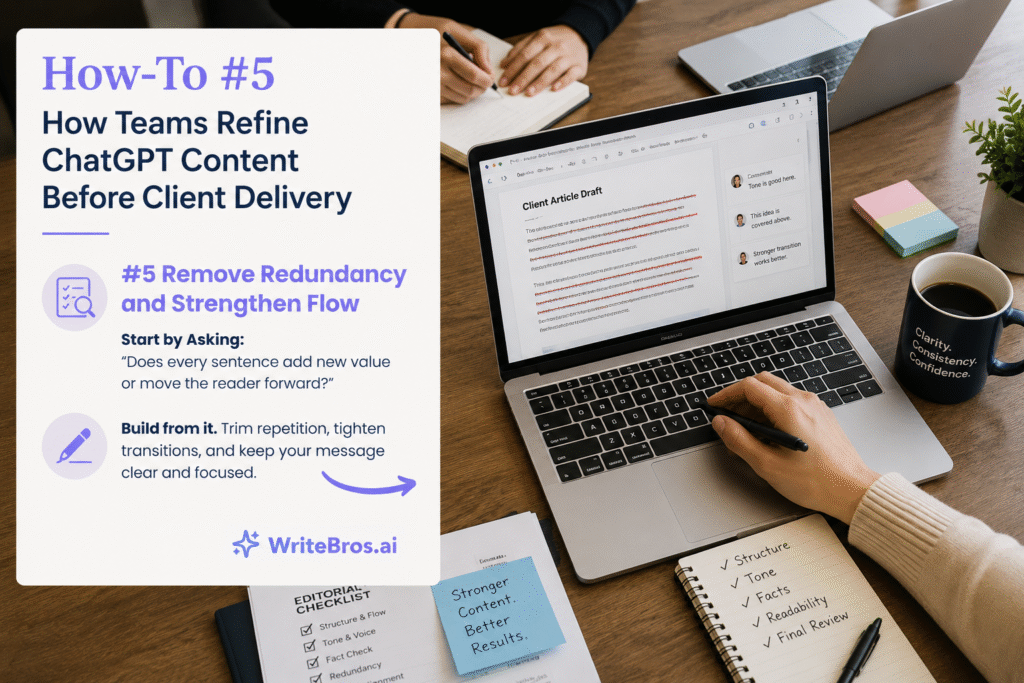
How to How Teams Refine ChatGPT Content Before Client Delivery – Strategy #5: Redundancy removal systems
AI-generated drafts often repeat ideas in subtle ways, which is why experienced editorial teams run dedicated redundancy reviews before content reaches final approval. Editors look for repeated sentence patterns, duplicated explanations, similar examples appearing across multiple sections, and filler transitions that make the draft feel longer without improving understanding for the reader. This stage usually happens after structural edits because removing repetition becomes easier once the document’s organization already feels stable and logically arranged.
Redundancy checks improve readability because they force teams to prioritize precision instead of mistaking word count for quality or depth. A content strategist reviewing a client article may notice that several paragraphs communicate nearly identical ideas using slightly different wording, which creates reader fatigue even though the draft technically remains coherent. Teams also learn recurring repetition habits from these reviews, allowing them to improve future prompts and reduce the amount of cleanup required during later projects.
How to How Teams Refine ChatGPT Content Before Client Delivery – Strategy #6: Client expectation mapping
Before final delivery, many teams compare the revised draft against the client’s actual expectations rather than relying solely on general writing quality standards that may not reflect the intended audience or business goals. Editors review onboarding notes, campaign objectives, customer pain points, and previous approvals so they can verify whether the content still aligns with what the client originally requested during early planning conversations. This process prevents situations where technically polished writing still misses the strategic tone or positioning the client expected from the beginning.
Expectation mapping succeeds because strong content delivery depends on alignment as much as writing quality, especially in agency environments handling several brands with very different communication priorities. A SaaS company may want concise educational messaging focused on clarity, while a luxury retail client may expect slower pacing and more emotionally layered storytelling throughout the same campaign cycle. Teams that revisit expectations during late-stage revisions usually avoid unnecessary rewrites after delivery because they catch mismatches before the client ever reviews the content.
How to How Teams Refine ChatGPT Content Before Client Delivery – Strategy #7: Multi-editor coordination
Collaborative editing environments require clear coordination systems because AI-assisted drafts can quickly become unstable when too many contributors make overlapping revisions without visibility into each other’s decisions. Teams often establish designated editing windows, tracked revision comments, and approval hierarchies so contributors understand when to suggest changes, when to finalize sections, and when to avoid overriding previous edits unnecessarily. Without these systems, revision cycles tend to expand unpredictably as editors repeatedly undo or duplicate work across multiple review rounds.
Coordination processes remain valuable because collaborative workflows naturally become more chaotic as content volume increases and deadlines become tighter across several active client projects. An agency balancing ten simultaneous deliverables may discover that even small communication gaps create major delays once editors begin revisiting already approved sections late in the process. Teams that coordinate carefully also preserve editorial morale more effectively because contributors understand their responsibilities clearly instead of feeling frustrated by endless overlapping revisions.
How to How Teams Refine ChatGPT Content Before Client Delivery – Strategy #8: Prompt refinement feedback
Experienced teams treat every editing cycle as feedback for future prompting strategies because recurring cleanup patterns usually reveal weaknesses in how the original AI instructions were written. Editors document which prompts generated repetitive phrasing, weak organization, inaccurate formatting, or unnatural tone so future drafts begin closer to the desired quality level before revisions even start. Over time, this creates internal prompt libraries that reduce production friction and help teams scale content operations more efficiently.
Prompt refinement works because the fastest editing workflow is often the one that prevents predictable problems from appearing repeatedly across future drafts. A team producing weekly client blogs may notice that overly broad prompts consistently create vague introductions and repetitive transitions, which forces editors to spend unnecessary time rebuilding the structure manually. Once those issues become documented internally, future prompts can include clearer constraints and formatting guidance that dramatically reduce cleanup requirements during later stages.
How to How Teams Refine ChatGPT Content Before Client Delivery – Strategy #9: Human readability testing
Many teams perform human readability reviews by reading content aloud or testing sections across multiple devices because AI-generated drafts sometimes appear polished visually while still sounding unnatural during real reading experiences. Editors listen for awkward pacing, repetitive sentence rhythms, abrupt transitions, and explanations that technically make sense yet still feel emotionally disconnected from the intended audience. This stage usually happens near final approval because readability problems become easier to notice after structural and factual revisions are already complete.
Readability testing succeeds because people consume content differently than editing software evaluates it, especially when audiences skim articles quickly across phones, tablets, and desktop screens throughout the day. A long-form article may appear organized during editing sessions but still feel exhausting once someone reads several paragraphs continuously without interruption. Teams that test readability carefully often catch subtle issues that standard proofreading misses, including mechanical phrasing patterns that quietly reveal the underlying AI origin of the draft.
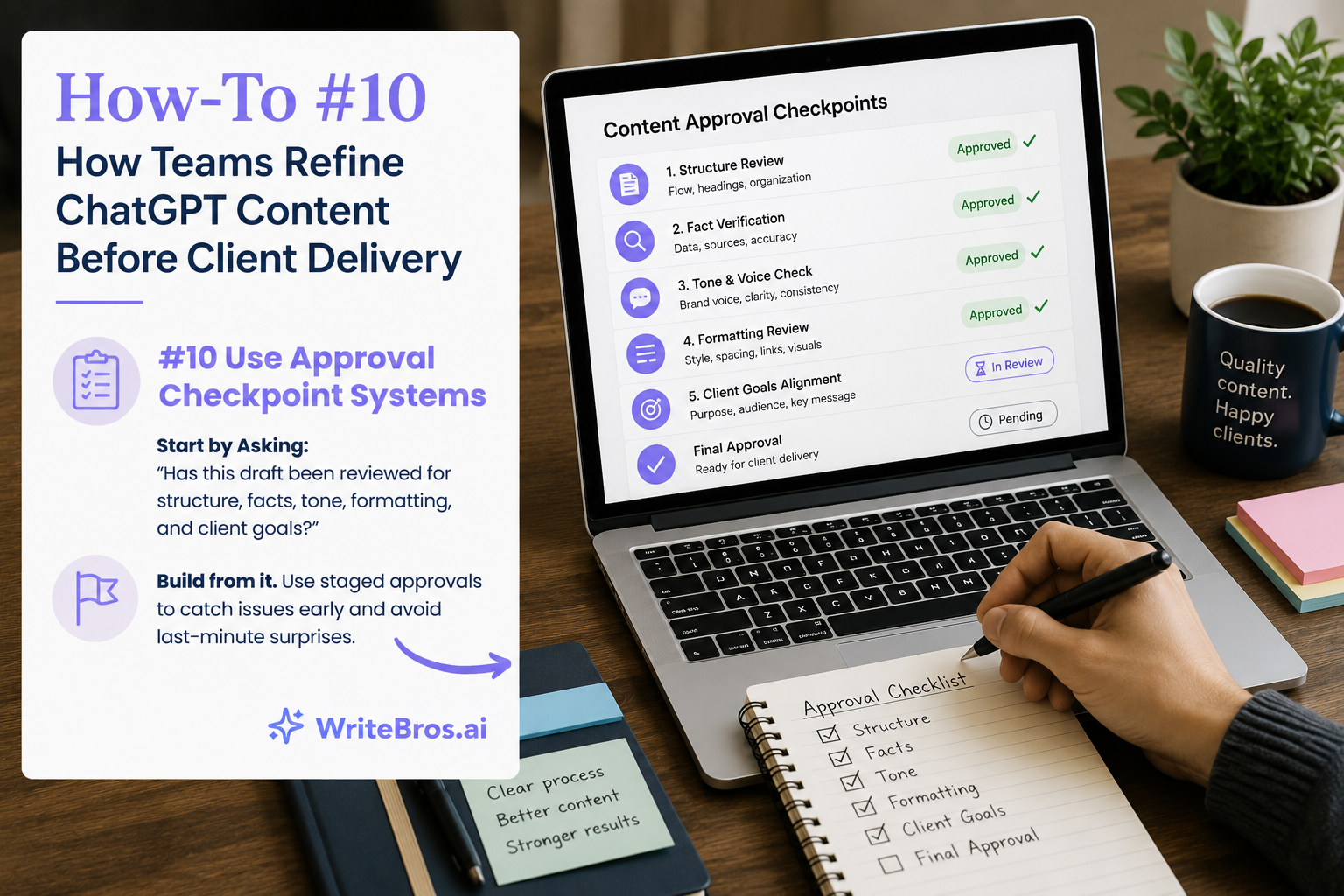
How to How Teams Refine ChatGPT Content Before Client Delivery – Strategy #10: Approval checkpoint systems
High-performing editorial teams usually divide approvals into several smaller checkpoints rather than relying on one rushed final review immediately before client delivery. Different reviewers may evaluate structure, factual accuracy, formatting, and brand tone separately so problems can be resolved earlier instead of accumulating near the end of the workflow. This approach reduces the pressure that often causes teams to overlook inconsistencies when deadlines begin approaching quickly.
Checkpoint systems remain effective because they create predictable review stages that help editors maintain focus during large-scale production environments with overlapping client priorities. A content operations team handling multiple campaign launches may discover that late-stage revisions become far less stressful once approvals happen gradually throughout the editing cycle. Teams also gain stronger visibility into workflow bottlenecks because checkpoint delays clearly reveal where revisions repeatedly slow down across recurring project types.
How to How Teams Refine ChatGPT Content Before Client Delivery – Strategy #11: Formatting standardization
Editorial teams often standardize formatting rules across all deliverables because inconsistent spacing, heading structures, typography choices, and layout styles can make otherwise strong content feel unfinished or unprofessional during client review. Teams typically create formatting templates covering headings, callout sections, bullet styling, link placement, and paragraph spacing so editors can focus on refinement rather than rebuilding layouts repeatedly from scratch. Consistency becomes especially important when multiple contributors handle revisions across different projects at the same time.
Formatting systems help because presentation quality strongly influences how clients perceive the reliability and professionalism of the content they receive. A polished article with clean hierarchy and predictable structure immediately feels more trustworthy than a document filled with uneven spacing and inconsistent visual organization, even when the written quality remains identical. Teams that standardize formatting also reduce final-stage cleanup work because contributors already understand the expected visual structure before editing begins.
How to How Teams Refine ChatGPT Content Before Client Delivery – Strategy #12: Revision history tracking
Many agencies maintain detailed revision histories throughout the editing process because AI-assisted workflows can evolve quickly and become difficult to audit once several contributors begin making layered adjustments across multiple versions. Editors track major structural decisions, factual updates, approval notes, and rejected revisions so teams can understand how the document developed from the original draft into the final deliverable. This process becomes particularly valuable whenever clients request clarification regarding why certain changes were made during production.
Revision tracking works because transparency prevents confusion during collaborative workflows where multiple editors may revisit the same material across several review rounds. A team handling legal or technical content may need to justify why a statement was revised, shortened, or removed entirely after factual verification or compliance review identified potential risks. Teams also benefit internally because revision histories reveal recurring editing problems that can improve future prompting standards and editorial training processes.
How to How Teams Refine ChatGPT Content Before Client Delivery – Strategy #13: Brand sensitivity reviews
Before final delivery, many teams conduct brand sensitivity reviews focused specifically on language choices that could unintentionally conflict with the client’s audience expectations, public positioning, or communication standards. Editors examine humor, emotional framing, cultural references, persuasive wording, and industry-specific terminology to confirm that the content still aligns with how the client prefers to appear publicly. This stage becomes increasingly important for brands operating across multiple markets or audience demographics where wording sensitivities vary considerably.
Brand sensitivity checks remain valuable because AI-generated content can occasionally introduce phrasing that sounds neutral generally while still feeling off-brand in a specific commercial context. A financial services company, for example, may avoid overly casual language that another lifestyle-oriented client would actively encourage throughout campaign materials and customer messaging. Teams that perform these reviews consistently usually prevent awkward client revisions later because they catch subtle tone conflicts before the material leaves the editorial pipeline.
How to How Teams Refine ChatGPT Content Before Client Delivery – Strategy #14: Delivery readiness scoring
Some editorial operations use internal scoring systems to determine whether content is genuinely ready for client delivery instead of relying on instinct alone during busy production periods. Teams evaluate readability, structural clarity, factual accuracy, formatting consistency, brand alignment, and overall polish using repeatable benchmarks that help reviewers make more objective approval decisions. This approach becomes especially useful in high-volume environments where rapid production can otherwise blur the distinction between acceptable drafts and fully refined deliverables.
Readiness scoring succeeds because it introduces measurable consistency into workflows that might otherwise depend too heavily on individual reviewer preferences or subjective impressions. A team preparing dozens of client assets each week may discover that approval quality improves significantly once editors follow shared evaluation standards instead of improvising different criteria during every project. Teams also gain stronger training systems because newer contributors can learn exactly what qualifies content for delivery across different formats and client categories.
How to How Teams Refine ChatGPT Content Before Client Delivery – Strategy #15: Post-delivery learning loops
Strong teams continue reviewing performance after client delivery because the most valuable workflow improvements often appear through recurring feedback patterns rather than during isolated editing sessions. Editors track revision requests, approval delays, recurring client comments, and engagement outcomes so they can identify which parts of the workflow consistently create friction or produce stronger results over time. This process transforms content refinement into an evolving operational system instead of a repetitive cycle of disconnected editing tasks.
Learning loops remain effective because they encourage long-term improvement rather than forcing teams to solve the same problems repeatedly across future campaigns. An agency may notice that clients consistently request stronger introductions or clearer transitions, which signals that prompt instructions and structural editing standards need refinement internally. Teams that study post-delivery outcomes carefully usually become faster and more accurate over time because every completed project contributes useful operational insight back into the workflow.
Common mistakes
- Many teams assume that fixing grammar automatically makes AI-generated content ready for delivery, although readers and clients usually notice structural problems, repetitive pacing, and weak emotional tone long before they notice technical writing issues hidden inside the draft.
- Some editors allow too many contributors to revise the same document simultaneously without assigning ownership responsibilities, which frequently creates conflicting rewrites, inconsistent tone, duplicated ideas, and unnecessary delays that become difficult to untangle near final approval.
- Teams sometimes prioritize speed so heavily that they skip factual verification stages entirely, even though AI-generated drafts can contain outdated statistics, unsupported claims, or inaccurate examples that appear believable until someone checks the underlying information carefully.
- Another common problem appears when agencies apply identical editing standards across every client regardless of industry, audience expectations, or communication style, which often produces technically polished content that still feels disconnected from the client’s brand identity.
- Some workflows focus exclusively on sentence-level polishing without repairing structural organization first, which results in content that sounds smoother line by line while still feeling repetitive, confusing, or exhausting once someone reads the full piece continuously.
- Teams also underestimate the importance of readability testing because visually clean drafts may still sound mechanical, emotionally flat, or awkwardly paced during actual reading experiences across phones, laptops, or fast-moving social content environments.
Edge cases
Some workflows require additional flexibility because not every client project benefits from the same level of editorial intervention before delivery. Short-form campaign copy, rapid-response news content, and time-sensitive product updates may move through lighter review systems where speed matters more than extensive refinement, although teams still need safeguards protecting tone consistency and factual reliability.
International campaigns can also complicate standard editing systems because tone expectations, phrasing sensitivities, and readability norms often vary significantly across regions and audience groups. Teams managing multilingual deliverables sometimes build separate review checkpoints for localization, cultural nuance, and regional compliance standards so refined content still feels natural within each market instead of sounding mechanically translated.
Supporting tools
- Google Docs helps collaborative teams manage tracked revisions, reviewer comments, approval checkpoints, and version histories without forcing contributors to overwrite each other’s work during large multi-editor content refinement workflows.
- Notion gives editorial operations a centralized space for prompt libraries, workflow documentation, client voice references, revision standards, and approval systems that remain easy to update across growing content teams.
- Grammarly can support readability reviews by identifying repetitive wording, awkward phrasing patterns, and inconsistent sentence structures that frequently appear inside AI-assisted drafts before final editorial polishing begins.
- Airtable works well for tracking approval stages, assigning editorial responsibilities, monitoring delivery timelines, and organizing large batches of client assets moving through several simultaneous refinement layers.
- Originality.ai is commonly used by agencies that want additional visibility into AI-heavy phrasing patterns, repetitive structures, or sections requiring stronger human editing before content reaches client review stages.
- WriteBros.ai helps teams refine AI-generated drafts through structured rewriting workflows that improve tone consistency, readability, and natural flow while preserving the original intent of the content.
Ready to Transform Your AI Content?
Try WriteBros.ai and make your AI-generated content truly human.
Conclusion
Refining AI-assisted content before client delivery is rarely a single editing task completed at the end of production. Strong teams build layered systems that improve structure, tone, factual accuracy, readability, and collaboration quality throughout the entire workflow instead of depending on rushed final revisions to solve every problem at once.
The most reliable workflows usually prioritize consistency and thoughtful review rather than chasing perfect drafts immediately after generation. Teams that continue improving prompts, documenting revisions, and studying feedback patterns often deliver stronger client experiences over time because refinement becomes an intentional operational process instead of a reactive editing habit.
Did You Know?
Teams refining ChatGPT content usually need clear review stages for structure, tone, facts, readability, and final approval.
Defined workflow standards help AI-assisted drafts stay consistent as multiple reviewers prepare content for client delivery.
Ready to Transform Your AI Content?