How to Humanize Text for Copyleaks: 15 Language Improvements
Stricter AI screening in 2026 means structure and tone matter more than surface edits. Research published in Science shows humans can distinguish AI-generated text based on linguistic patterns, reinforcing why rhythm, nuance, and contextual detail are essential when revising drafts for detection systems.
How to Humanize Text for Copyleaks: 15 Language Improvements
If you are trying to figure out how to humanize text for Copyleaks, you have probably run into a frustrating pattern. A draft that reads clear and natural to you still triggers flags that make it look mechanical or overly optimized.
The issue usually is not obvious plagiarism or poor writing. Subtle repetition, predictable structure, and overly tidy phrasing can signal automation, even if you followed solid AI humanizer tips for human writing or tested different best AI rewriting tools for low-risk content edits.
Understanding how detection systems interpret rhythm, tone, and structure helps you move beyond surface edits. When you look at the broader Copyleaks AI accuracy percentage trends, it becomes clear that language adjustments matter more than cosmetic rewrites.
| # | Strategy focus | Practical takeaway |
|---|---|---|
| 1 | Vary sentence rhythm | Break predictable pacing so the draft feels less formulaic and more natural to read. |
| 2 | Reduce template phrasing | Replace stock transitions and rigid structures with more organic flow. |
| 3 | Introduce specific details | Add grounded examples that reflect real context rather than abstract generalities. |
| 4 | Adjust paragraph length | Avoid uniform blocks of text to create a more human visual cadence. |
| 5 | Loosen overly formal tone | Soften stiff phrasing to sound written by a person rather than a model. |
| 6 | Break repetition patterns | Identify repeated openings or structures and rewrite them with variation. |
| 7 | Add natural qualifiers | Use light hedging and nuance to avoid absolute, machine-like certainty. |
| 8 | Rework list-heavy sections | Blend structured points into narrative passages to reduce rigid formatting signals. |
| 9 | Shift passive constructions | Balance active and passive voice to avoid uniform syntax. |
| 10 | Use contextual transitions | Connect ideas through meaning rather than predictable linking phrases. |
| 11 | Clarify intent behind claims | Explain reasoning instead of stacking generic statements. |
| 12 | Limit polished symmetry | Avoid overly neat parallels that feel algorithmically constructed. |
| 13 | Embed subtle perspective | Introduce light viewpoint cues to signal lived authorship. |
| 14 | Tighten generic openings | Remove broad, vague introductions that resemble automated drafts. |
| 15 | Re-read for natural flow | Audit the full piece aloud to catch mechanical phrasing before submission. |
15 Language Improvements to Humanize Text for Copyleaks
How to Humanize Text for Copyleaks – Strategy #1: Vary sentence rhythm
One of the most effective ways to humanize text for Copyleaks is to deliberately vary sentence rhythm so that the prose does not fall into a predictable pattern of similar length and structure. Detection systems frequently identify drafts that rely on evenly sized sentences with identical grammatical construction, which can create a mechanical cadence even when the ideas themselves are thoughtful. Introducing a mix of longer reflective sentences alongside shorter explanatory ones allows the writing to mirror the natural pacing that tends to emerge when a person is thinking through a topic in real time.
This variation works because human writers rarely maintain consistent structural symmetry across an entire passage, especially when explaining layered or nuanced concepts. Imagine revising a compliance-focused article in which every sentence begins with a similar subject and verb pairing, and then restructuring it so that some sentences open with context, others with contrast, and others with qualification. That subtle disruption of uniformity can dramatically reduce the algorithmic signals that suggest automation while preserving clarity and intent.
How to Humanize Text for Copyleaks – Strategy #2: Reduce template phrasing
To humanize text for Copyleaks, you must identify and remove template-style transitions that sound like they were pulled from a standard content framework rather than developed organically. Phrases that neatly introduce each paragraph with predictable cues can create a polished yet overly systematic feel, which detection systems may interpret as machine-assisted composition. Rewriting those transitions so they arise naturally from the preceding idea helps the piece feel less like a structured output and more like a thoughtful continuation of reasoning.
In practice, this might mean replacing a rigid introductory sentence with one that references the specific tension or ambiguity raised in the prior section. When a draft moves from theory to application, allowing the shift to emerge through contextual language rather than formulaic signposting creates a smoother and more believable progression. That shift in connective language reduces the impression of templated assembly and strengthens the impression of lived authorship.
How to Humanize Text for Copyleaks – Strategy #3: Introduce specific details
Adding grounded, context-rich details is central when you want to humanize text for Copyleaks because specificity signals lived experience rather than abstract synthesis. Broad statements that summarize general truths can sound polished yet detached, which sometimes mirrors the way large language models produce safe, generalized prose. Incorporating situational context, realistic constraints, or concrete scenarios brings texture to the writing and differentiates it from purely generative phrasing.
For example, instead of stating that revisions improve detection outcomes, you might describe reviewing a draft after an unexpected high-risk score and noticing repeated structural symmetry. That added context clarifies why a certain revision was made and illustrates the reasoning process behind it, which adds credibility and nuance. Detection systems are less likely to interpret writing with layered detail as automated because the internal logic unfolds in a more human pattern.
How to Humanize Text for Copyleaks – Strategy #4: Adjust paragraph length
Uniform paragraph blocks can subtly undermine attempts to humanize text for Copyleaks because consistent visual structure often correlates with templated drafting habits. When every paragraph contains nearly identical sentence counts and similar line breaks, the text may appear engineered rather than developed through evolving thought. Varying paragraph length in a way that aligns with the density of the idea helps the piece feel more conversational and less mechanically segmented.
A complex explanation may naturally extend across a longer paragraph with layered qualifiers, whereas a clarifying aside might warrant a shorter standalone reflection. Allowing paragraph structure to follow the needs of the argument, rather than forcing symmetry, creates visual and cognitive rhythm that resembles human reasoning. That structural flexibility introduces organic irregularity without sacrificing coherence.
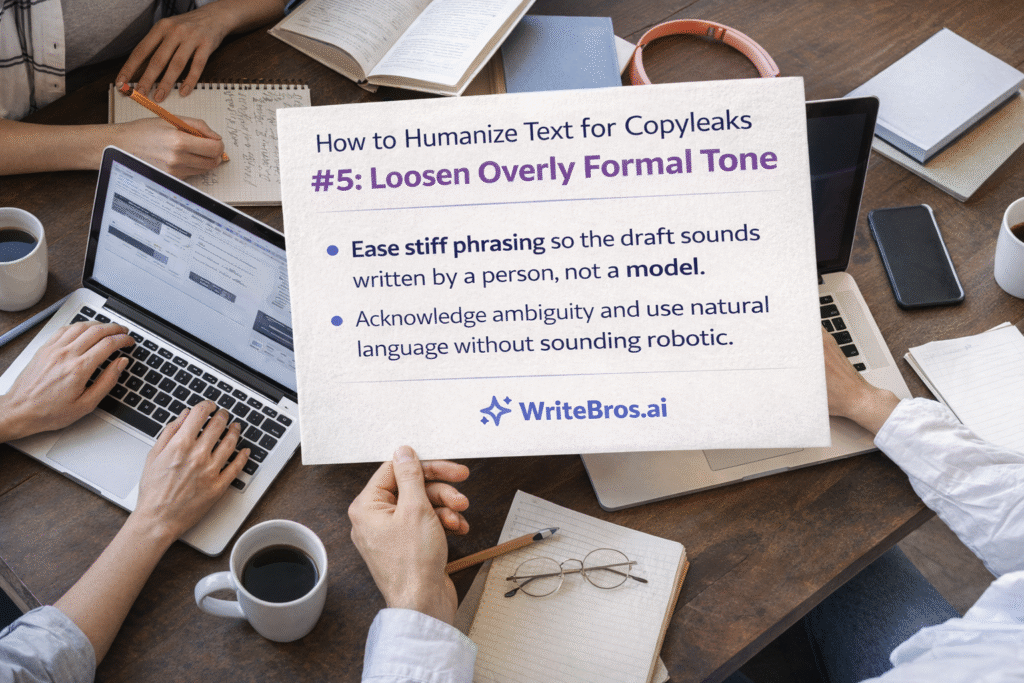
How to Humanize Text for Copyleaks – Strategy #5: Loosen overly formal tone
Overly formal tone can make it harder to humanize text for Copyleaks because extreme polish sometimes resembles model-generated neutrality. When every sentence maintains the same detached register, the draft may appear optimized for correctness rather than clarity. Introducing measured warmth, mild qualification, or natural conversational phrasing can soften the surface without reducing authority.
This does not require slang or informality, but rather subtle shifts in phrasing that reflect how professionals actually communicate complex ideas. A sentence that acknowledges ambiguity or references practical limitations tends to feel more authentic than one that presents every claim with uniform certainty. That tonal calibration makes the prose more credible while reducing the appearance of algorithmic consistency.
How to Humanize Text for Copyleaks – Strategy #6: Break repetition patterns
Repetition in structure or wording can undermine efforts to humanize text for Copyleaks because recurring sentence openings and mirrored clauses create detectable patterns. Even when repetition is stylistically subtle, algorithms may interpret the recurrence as a structural signature associated with automated drafting. Carefully reviewing paragraph beginnings and clause arrangements allows you to disrupt those patterns before submission.
This often means rewriting sentences that begin with identical framing, especially across consecutive sections. Adjusting the grammatical entry point of each idea, while keeping the meaning intact, introduces variability that mirrors authentic drafting processes. That variability weakens the signal of mechanical construction and strengthens the sense of independent authorship.
How to Humanize Text for Copyleaks – Strategy #7: Add natural qualifiers
Absolute language can make it difficult to humanize text for Copyleaks because uniform certainty often resembles predictive generation rather than reflective analysis. Human writers tend to acknowledge edge cases, contextual differences, and possible limitations within their arguments. Introducing balanced qualifiers communicates intellectual honesty and reduces the appearance of algorithmic overconfidence.
For instance, clarifying that a technique generally improves outcomes rather than guaranteeing a specific result adds nuance to the claim. That nuance signals awareness of variability, which is a hallmark of human reasoning rather than formulaic output. The result is writing that feels grounded and less artificially optimized.
How to Humanize Text for Copyleaks – Strategy #8: Rework list-heavy sections
Highly structured lists can complicate attempts to humanize text for Copyleaks because repetitive formatting often resembles automated instructional templates. When each bullet mirrors identical phrasing and structure, the content may appear procedurally generated rather than thoughtfully composed. Integrating explanatory commentary between structured points can soften that rigid framework.
Blending narrative passages with structured guidance allows ideas to expand naturally instead of remaining confined to identical syntactic boxes. When a list is necessary, varying sentence construction within each item helps preserve rhythm and individuality. That integration reduces the uniform signals detection systems may flag.
How to Humanize Text for Copyleaks – Strategy #9: Shift passive constructions
Consistent reliance on either active or passive voice can make it harder to humanize text for Copyleaks because uniform syntax creates a stable pattern. While passive voice has legitimate uses, excessive consistency in sentence framing can appear engineered. Balancing voice across the piece introduces natural variation that reflects evolving emphasis.
Rewriting select sentences to highlight agency, then allowing others to maintain descriptive distance, produces tonal depth. This balance mirrors authentic drafting habits, in which writers alternate emphasis based on context and purpose. That interplay disrupts mechanical predictability without sacrificing clarity.
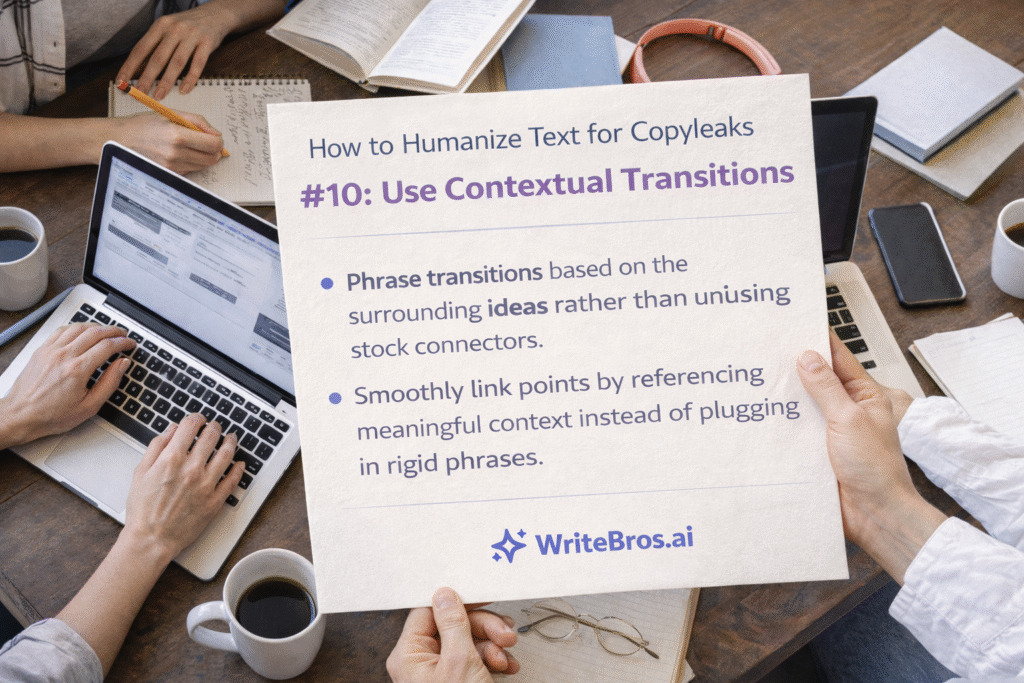
How to Humanize Text for Copyleaks – Strategy #10: Use contextual transitions
Generic transitions can weaken attempts to humanize text for Copyleaks because they signal formulaic movement between ideas. Rather than relying on stock connectors, allow each transition to emerge from the logic of the preceding paragraph. Context-driven transitions feel less manufactured and more conversational.
When a paragraph introduces a complication, the next can begin by addressing that tension directly rather than announcing a new section in abstract terms. That continuity creates a seamless flow that mirrors organic reasoning. Detection systems are less likely to detect templated sequencing when connective language reflects genuine progression.
How to Humanize Text for Copyleaks – Strategy #11: Clarify intent behind claims
Stacked claims without explanation can undermine attempts to humanize text for Copyleaks because they resemble synthesized summaries rather than developed reasoning. When assertions appear in rapid succession without clarifying why they matter, the prose may feel compressed and algorithmic. Expanding on the intent behind each claim adds transparency and depth.
Explaining how a recommendation emerged from observation or revision experience demonstrates an internal logic that unfolds progressively. That progressive reasoning mirrors human thought patterns and reduces the impression of automated aggregation. The result is writing that feels considered rather than compiled.
How to Humanize Text for Copyleaks – Strategy #12: Limit polished symmetry
Excessive symmetry in phrasing can make it difficult to humanize text for Copyleaks because perfectly mirrored constructions often appear engineered. While rhetorical balance can be persuasive, too much structural neatness may signal templated generation. Introducing slight asymmetry in clause length and order restores organic variation.
This might involve restructuring parallel lists so that each point unfolds differently while preserving clarity. The subtle irregularity reflects how ideas naturally evolve during composition rather than adhering to rigid blueprinting. That flexibility weakens algorithmic pattern recognition.
How to Humanize Text for Copyleaks – Strategy #13: Embed subtle perspective
Incorporating light perspective cues is a powerful way to humanize text for Copyleaks because personal framing suggests authentic authorship. This does not require overt storytelling, but it does benefit from contextual markers that indicate lived engagement with the subject. Subtle perspective can appear through situational references or process-based explanations.
When a writer references reviewing a draft, reassessing structure, or reconsidering tone, the prose gains dimensionality. That dimensionality introduces signals of human reflection, which differ from neutral, detached synthesis. Detection systems are less likely to interpret reflective nuance as automated output.
How to Humanize Text for Copyleaks – Strategy #14: Tighten generic openings
Generic introductions can weaken efforts to humanize text for Copyleaks because broad, vague openings often mirror model defaults. Revising these openings to anchor the discussion in a concrete scenario or tension immediately differentiates the draft from templated output. Specific framing grounds the reader in context from the outset.
Instead of starting with universal statements, begin with a realistic friction point that prompted the analysis. That immediate grounding clarifies purpose and signals intentional authorship. Such framing reduces the likelihood of classification as generic automation.
How to Humanize Text for Copyleaks – Strategy #15: Re-read for natural flow
Finally, consistently re-reading the full draft aloud is essential when you aim to humanize text for Copyleaks because auditory review reveals mechanical cadence. Patterns that feel invisible on screen often become obvious when spoken, especially repetitive rhythm or overly tidy sequencing. Listening for natural pauses and emphasis helps refine structure.
During this review, note sections that feel overly polished or unnaturally balanced and adjust them with subtle variation. The goal is not imperfection, but rather authenticity in pacing and tone. That final pass ensures the writing reads as intentional and human rather than procedurally assembled.
Common mistakes
- Over-editing for perfection can unintentionally create rigid symmetry across sentences and paragraphs, which may increase structural predictability and undermine the very goal of appearing naturally written.
- Relying exclusively on automated rewriting tools without manual review often preserves deeper cadence patterns that detection systems can still identify despite surface-level changes.
- Maintaining uniform tone and certainty throughout the piece can make the draft appear overly optimized and lacking in realistic nuance or contextual qualification.
- Ignoring visual structure and paragraph variation may result in blocks of text that mirror templated instructional formats rather than organic reasoning.
- Replacing words without reconsidering sentence architecture can leave the underlying syntactic pattern intact, which detection models may still flag.
- Failing to integrate specific context or process explanations can make the draft read like a summary compilation instead of a reflective, experience-informed discussion.
Edge cases
Highly technical or academic content may require more consistent terminology and structure, which can limit how much variation is appropriate without reducing clarity. In such cases, strategic variation should focus on sentence rhythm, contextual framing, and subtle qualifiers rather than drastic restructuring that could compromise precision.
Similarly, short-form content offers less room for structural diversity, so adjustments must concentrate on word choice and tonal calibration. Even within tight constraints, small changes in phrasing and connective logic can meaningfully alter detection signals without distorting intent.
Supporting tools
- Manual read-aloud review tools help identify unnatural pacing or repeated structures that may not be obvious during silent editing, offering a practical way to refine cadence before submission.
- Grammar analysis platforms can highlight passive overuse or repetitive openings, allowing targeted revisions that introduce structural variation without compromising coherence.
- Version comparison software enables side-by-side evaluation of revisions, which makes it easier to confirm that changes affect rhythm and structure rather than surface vocabulary alone.
- Editorial style guides provide guardrails for tone and clarity, ensuring that adjustments toward natural flow do not erode professionalism or precision.
- Detection preview environments allow controlled testing of structural changes, helping writers observe how variation influences classification outcomes in real time.
- WriteBros.ai can assist with refining tone and structural variability, serving as a guided revision layer that supports more natural flow while maintaining original meaning.
Ready to Transform Your AI Content?
Try WriteBros.ai and make your AI-generated content truly human.
Conclusion
Learning how to humanize text for Copyleaks ultimately requires attention to rhythm, structure, and nuance rather than superficial word swaps. When writers focus on organic variation, contextual framing, and authentic tone, the draft begins to reflect genuine reasoning instead of predictable assembly.
The objective is not to chase imperfection, but to prioritize clarity shaped by lived thought and measured revision. With intentional adjustments and careful review, you can preserve meaning while presenting work that reads as confidently and credibly human.
Did You Know?
If you want to humanize text for Copyleaks effectively, focus on structural rhythm before synonym replacement, because evenly spaced paragraphs and mirrored sentence openings can maintain the same detection profile despite surface edits.
Allow some explanations to expand with layered clarification while others narrow for emphasis, and let transitions emerge from context instead of repeating rigid connectors, since that uneven development more closely mirrors how real drafts evolve through revision.
Ready to Transform Your AI Content?