How to Improve GPTZero Detection Results: 15 Interpretation Checks

Interpreting AI detection scores requires more than reading a percentage. Learn practical checks to understand probability patterns and flagged passages. Research like the Science study on distinguishing human and AI writing shows why structural signals influence detection outcomes.
How to Improve GPTZero Detection Results: 15 Interpretation Checks
Interpreting detection reports can feel confusing when scores seem inconsistent or unexpectedly high. Understanding the patterns behind AI detection accuracy helps clarify why certain passages trigger stronger signals than others.
Many writers assume the score itself tells the full story, yet GPTZero results depend on structural signals, predictability patterns, and sentence rhythm. Reviewing trusted evaluations of best AI humanizer tools reveals how subtle writing differences influence those signals.
Context also matters because detection tools compare probability patterns rather than meaning or intent. Research into Turnitin AI detection statistics shows that interpretation errors happen most often when readers treat the score as a final judgment rather than a signal to investigate further.
| # | Strategy focus | Practical takeaway |
|---|---|---|
| 1 | Read the probability context | Focus on how the system interprets language patterns rather than treating the score as a final verdict. |
| 2 | Check sentence predictability | Look for repetitive phrasing or predictable structures that may influence detection signals. |
| 3 | Review passage-level patterns | Evaluate groups of sentences together to understand how rhythm and flow affect analysis. |
| 4 | Identify structural repetition | Notice repeating sentence formats that create patterns detection tools can easily recognize. |
| 5 | Inspect paragraph uniformity | Consistent paragraph length and structure can signal predictability within the analysis model. |
| 6 | Evaluate language variability | Variation in phrasing and expression can reduce signals tied to highly patterned text. |
| 7 | Check transition patterns | Overused transitions may create predictable flows that influence interpretation results. |
| 8 | Analyze sentence length distribution | A balanced mix of short and longer sentences improves natural writing rhythm. |
| 9 | Look for repetitive phrasing | Repeated wording across sections can increase pattern recognition signals. |
| 10 | Compare section-level signals | Identify whether flagged areas appear in clusters rather than isolated sentences. |
| 11 | Review narrative voice changes | Shifts in tone or voice can affect how detection systems interpret writing consistency. |
| 12 | Check contextual coherence | Ensure each paragraph flows logically without formulaic structure dominating the text. |
| 13 | Inspect editing artifacts | Heavy edits or merged drafts can leave structural traces that alter analysis results. |
| 14 | Re-evaluate flagged segments | Look closely at highlighted areas rather than rewriting entire sections unnecessarily. |
| 15 | Interpret scores responsibly | Use the report as a diagnostic signal that guides revision rather than a definitive judgment. |
15 Practical Ways to How to Improve GPTZero Detection Results
How to Improve GPTZero Detection Results – Strategy #1: Read the probability context
Many people glance at a detection score and immediately assume it represents a final judgment on the text, yet GPTZero actually evaluates probability patterns that describe how predictable a sequence of words appears to the model. Learning to read the probability context surrounding a score helps writers understand why certain passages attract attention while others pass unnoticed. Instead of focusing on the percentage alone, it becomes far more useful to examine the highlighted segments and analyze what linguistic signals the system may have interpreted as unusually structured.
This broader reading of the report allows editors to recognize that many high scores come from clusters of predictable phrasing rather than deliberate automation. Imagine reviewing a technical article in which multiple paragraphs follow identical explanatory structures, which unintentionally create consistent probability patterns across sentences. Interpreting the context correctly allows you to revise specific structures while preserving the original meaning and argument of the text.
How to Improve GPTZero Detection Results – Strategy #2: Check sentence predictability
Sentence predictability plays a surprisingly strong role in detection outcomes because models analyze how likely a word sequence appears compared with human writing variability. When sentences follow identical rhythms or structures, the system begins to recognize patterns that resemble generated text. Reviewing predictability requires looking at how often similar grammatical shapes repeat across the passage.
Writers frequently discover that several sentences start with identical framing or progress through the same explanatory order, which unintentionally produces an algorithmically consistent pattern. In a long educational article, for example, multiple sentences may begin with a definition, then transition into an explanation, then close with a clarification. Adjusting those structures slightly introduces variation that better reflects natural writing behavior.
How to Improve GPTZero Detection Results – Strategy #3: Review passage-level patterns
Detection tools rarely evaluate a single sentence in isolation because language models rely heavily on surrounding context to determine probability signals. Reviewing passage-level patterns allows writers to see whether entire sections share the same cadence, structure, or explanatory rhythm. These repeating patterns often emerge unintentionally during drafting when similar ideas are explained with similar sentence structures.
Consider a guide that explains multiple concepts using identical paragraph formats, which creates consistency for readers but also generates recognizable statistical patterns. When several paragraphs mirror each other in structure, the detection model may interpret that repetition as a signal of automated generation. Revising the pacing or narrative flow between sections can break those patterns without altering the information itself.
How to Improve GPTZero Detection Results – Strategy #4: Identify structural repetition
Structural repetition occurs when multiple sentences follow nearly identical grammatical frameworks, even if the vocabulary changes from line to line. Detection models notice this repetition because consistent syntax reduces the randomness that typically appears in human writing. Identifying those repeated frameworks requires reading the text slowly and focusing on how sentences are constructed rather than what they say.
In explanatory articles, writers often rely on comfortable sentence templates that gradually repeat across the page without much awareness. A sequence of sentences might all begin with a topic phrase, move through a clarification, and conclude with a reinforcing clause. Altering the structure occasionally keeps the language dynamic and avoids the mechanical rhythm that detection tools can easily recognize.
How to Improve GPTZero Detection Results – Strategy #5: Inspect paragraph uniformity
Paragraph uniformity refers to situations in which every paragraph shares almost identical length, pacing, and internal structure. Although this can look visually organized on the page, it also introduces patterns that detection systems analyze statistically. Human writing tends to fluctuate naturally in density, rhythm, and emphasis.
Imagine reading an article where every paragraph contains nearly the same number of sentences and develops ideas in the same progression. Over time that uniformity creates predictable structures across the entire document. Adjusting paragraph length and narrative pacing introduces variation that reflects the uneven rhythm typical of natural writing.

How to Improve GPTZero Detection Results – Strategy #6: Evaluate language variability
Language variability refers to the natural differences that appear when writers explain ideas using diverse phrasing, vocabulary, and structural choices. Detection systems expect human text to display subtle irregularities in wording and rhythm across long passages. When language becomes overly consistent, the statistical profile begins to resemble automated generation patterns.
Evaluating variability involves reviewing whether similar concepts are expressed with identical wording throughout the document. Writers frequently repeat familiar expressions because they communicate ideas clearly and efficiently. Replacing some repeated phrases with alternative constructions restores the variation that human writing normally produces.
How to Improve GPTZero Detection Results – Strategy #7: Check transition patterns
Transitions help readers move between ideas, yet overusing the same connectors can unintentionally produce repetitive linguistic signals. Words such as therefore, additionally, or however may appear repeatedly across paragraphs when writers rely on familiar transitions. Detection tools recognize these repeated connectors as part of broader probability patterns.
Reviewing transition patterns means examining how ideas connect rather than eliminating transitions entirely. In many cases the issue lies in repeating the same linking phrases throughout the document. Introducing varied ways to move between ideas maintains clarity while preventing predictable structural repetition.
How to Improve GPTZero Detection Results – Strategy #8: Analyze sentence length distribution
Sentence length distribution influences how natural a passage appears because human writers rarely maintain identical sentence lengths across long sections. Some sentences extend with detailed explanations while others remain concise and direct. Detection models track this variation because it reflects authentic writing rhythm.
Analyzing sentence distribution involves scanning paragraphs to see whether many sentences share the same approximate length or pacing. When several sentences contain similar word counts or clause patterns, the rhythm becomes statistically predictable. Introducing a mix of longer and shorter sentences creates the varied cadence common in natural writing.
How to Improve GPTZero Detection Results – Strategy #9: Look for repetitive phrasing
Repetitive phrasing occurs when key expressions appear frequently across paragraphs, often because writers return to the same explanation style when clarifying complex ideas. Detection systems measure how often specific phrase structures repeat within the same document. High repetition reduces linguistic diversity and can trigger stronger signals.
Reviewing phrasing patterns often reveals that certain descriptive expressions appear repeatedly across explanations. In instructional writing, phrases like “this process works because” or “the reason this matters” may recur throughout the text. Rephrasing those ideas with alternative structures introduces diversity that better resembles natural writing.
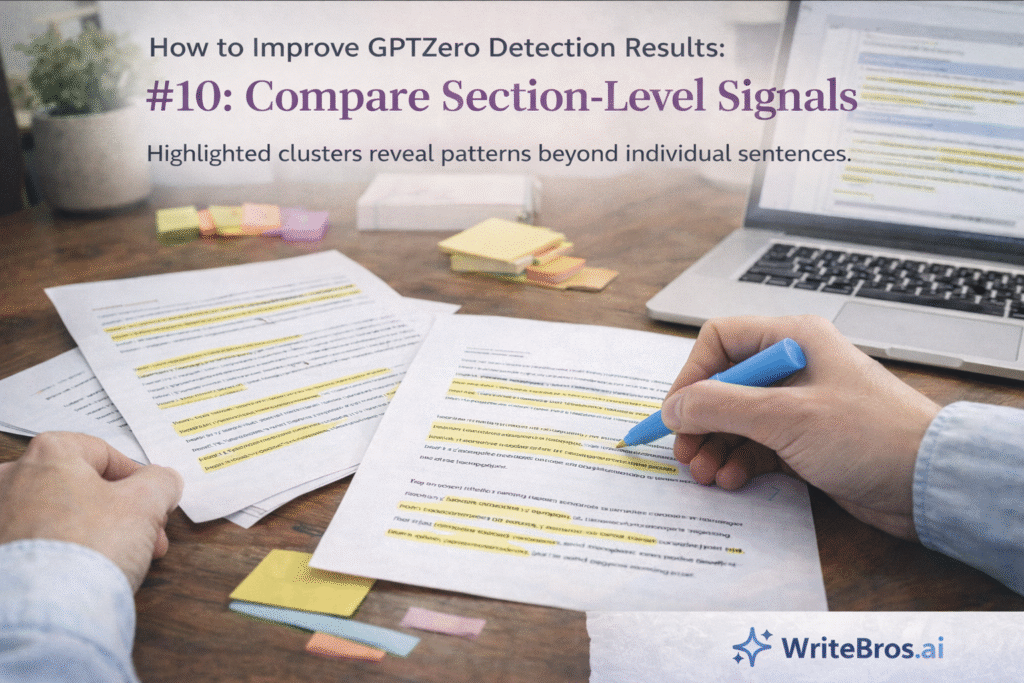
How to Improve GPTZero Detection Results – Strategy #10: Compare section-level signals
Section-level comparison helps writers understand whether flagged sentences appear randomly or cluster within specific parts of the document. Detection tools often highlight groups of sentences that share structural similarities rather than isolated lines. Observing those clusters can reveal patterns that may not be visible during normal reading.
For instance, a tutorial might contain one section where every explanation follows the same formulaic structure. That structural similarity may cause the system to flag several sentences in that region simultaneously. Recognizing the pattern allows editors to revise the section strategically rather than rewriting the entire article.
How to Improve GPTZero Detection Results – Strategy #11: Review narrative voice changes
Narrative voice refers to the tone and perspective used throughout a piece of writing, which can influence how detection systems interpret consistency. Sudden changes in voice may appear unusual within a document’s statistical pattern. Reviewing the narrative voice ensures the text maintains a coherent style across sections.
Large documents sometimes combine content written at different times or edited by multiple contributors. These shifts can create abrupt changes in tone that detection models interpret as unusual probability patterns. Aligning the voice across sections improves stylistic continuity and stabilizes the analysis.
How to Improve GPTZero Detection Results – Strategy #12: Check contextual coherence
Contextual coherence describes how smoothly ideas connect within a paragraph and across sections of the document. Detection tools analyze how words and phrases relate within their surrounding context. When explanations follow overly rigid templates, coherence becomes predictable.
Writers sometimes rely on formulaic paragraph structures that repeat across the article because they provide clarity and organization. However, repeating the same structure repeatedly creates recognizable patterns in the statistical model. Varying how ideas unfold across paragraphs preserves coherence without producing mechanical repetition.
How to Improve GPTZero Detection Results – Strategy #13: Inspect editing artifacts
Editing artifacts appear when multiple revisions merge together during the editing process, leaving traces of earlier structures in the text. Detection models may notice unusual patterns when sentences contain fragments of different stylistic stages. Inspecting the text carefully helps identify areas where revisions created structural inconsistencies.
For example, a paragraph that originally contained a long explanation may later be shortened, leaving fragments of the earlier phrasing. These hybrid sentences sometimes produce probability signals that appear unusual to the detection model. Cleaning those artifacts restores a more natural narrative flow.
How to Improve GPTZero Detection Results – Strategy #14: Re-evaluate flagged segments
When GPTZero highlights specific sentences, the instinctive reaction may be to rewrite entire sections of the document immediately. A more effective method involves carefully re-evaluating the flagged segments to determine what pattern triggered the signal. Often the issue lies in a specific phrasing structure rather than the broader paragraph.
Examining the flagged segments within their surrounding context allows editors to identify whether repetition, predictability, or structural similarity caused the detection signal. In many cases only small adjustments are needed to alter the probability pattern. This targeted revision prevents unnecessary rewriting.
How to Improve GPTZero Detection Results – Strategy #15: Interpret scores responsibly
Responsible interpretation recognizes that detection scores represent probabilities rather than definitive statements about authorship. Many writers misunderstand the meaning of a score because they assume it reflects certainty rather than statistical likelihood. Viewing the result as an analytical indicator provides a more realistic perspective.
Detection systems compare patterns within the text against large language models and human writing datasets. That comparison produces probability estimates that guide further analysis rather than final conclusions. Treating the score as a diagnostic signal encourages thoughtful revisions rather than reactive editing.
Common mistakes
- Many writers assume that the numerical score produced by a detection system represents a definitive judgment rather than a statistical estimate. This misunderstanding leads people to rewrite entire documents unnecessarily, which wastes time and may introduce new structural patterns that complicate interpretation further.
- Another frequent mistake occurs when editors focus only on individual flagged sentences without examining surrounding context. Detection systems evaluate clusters of sentences and broader structural signals, so isolating a single sentence rarely explains why the model identified that passage.
- Some users repeatedly rewrite passages with the same structural pattern while attempting to reduce a score. Although the vocabulary changes, the sentence structure remains predictable, which means the probability profile stays similar and the score often fails to improve.
- Overcorrecting the writing style can also create problems because excessive editing may disrupt the natural flow of the text. When revisions become mechanical or overly forced, the statistical rhythm of the writing may appear even more artificial.
- Many people ignore paragraph-level patterns and focus only on individual sentences. Detection systems evaluate longer sequences of language, so repeating identical paragraph structures across a document can produce stronger signals than a single repetitive sentence.
- Relying entirely on the score without reading the report carefully is another common mistake. Detection tools usually highlight specific areas that influenced the result, and ignoring those contextual clues prevents writers from identifying the actual pattern that triggered the signal.
Edge cases
Detection tools sometimes flag passages that were written entirely by humans, especially when the text follows highly structured formats such as academic explanations or technical documentation. In these contexts, writers often repeat similar sentence patterns intentionally because the subject requires clear and consistent phrasing. As a result, the statistical signals produced by that consistency can resemble automated text generation even though the content originates from genuine human authorship.
Another edge case appears when documents combine content written over long periods of time or edited through several revision cycles. Earlier drafts, edited fragments, and merged paragraphs may produce mixed stylistic signals that the model interprets as unusual probability patterns. Cleaning those artifacts and smoothing the narrative voice often improves the interpretability of the report without changing the core meaning of the writing.
Supporting tools
- Document comparison tools help writers examine structural patterns across paragraphs, allowing them to detect repetitive phrasing and sentence rhythms that might influence probability analysis in detection systems.
- Readability analysis platforms provide insight into sentence length distribution and linguistic complexity, which helps writers recognize when multiple sentences share identical pacing or structural patterns.
- Advanced editing environments that visualize revision history allow editors to identify editing artifacts created during earlier drafts, making it easier to remove hybrid sentences and structural inconsistencies.
- Language pattern analyzers can highlight repeated phrases or connectors across long documents, helping writers identify sections where structural repetition may unintentionally influence detection results.
- Grammar and style assistants provide feedback on sentence variation and narrative flow, allowing writers to refine the rhythm of paragraphs without dramatically altering the meaning of the text.
- WriteBros.ai provides editing and rewriting support designed to help writers refine structure, variation, and narrative flow so the final document reflects natural human writing patterns.
Ready to Transform Your AI Content?
Try WriteBros.ai and make your AI-generated content truly human.
Conclusion
Understanding how detection systems interpret language patterns allows writers to approach results with greater clarity and confidence. Rather than reacting to a score alone, analyzing structural patterns, sentence rhythm, and contextual probability signals reveals the deeper factors influencing the report.
Improving interpretation does not require rewriting entire documents or abandoning structured writing altogether. Thoughtful adjustments that introduce natural variation, refine narrative flow, and remove repetitive structures help writers maintain clarity while ensuring the text reflects the subtle irregularities typical of authentic human writing.
Did You Know?
If you are learning How to Improve GPTZero Detection Results, it helps to understand that detection models measure statistical consistency across the entire page rather than reacting only to isolated sentences. When every paragraph develops ideas using the same internal structure and every sentence lands with a similar cadence, the document can appear mathematically uniform even if the content itself is thoughtful and original. That consistent rhythm becomes easy for scoring systems to quantify, which explains why quick synonym swaps rarely produce lasting improvements.
Edits that change the pacing of ideas tend to have more impact because they mirror the way real drafts evolve through reasoning and revision. Imagine explaining one point briefly because it feels obvious, then slowing down on the next to clarify limits, context, and practical implications rather than giving both identical space. When your writing shows that uneven movement and visible thinking, the statistical signals often align more closely with patterns associated with human authorship.
Ready to Transform Your AI Content?