How to Make AI Writing Sound Like a Teacher: 15 Style Corrections

2026 classrooms rely on AI drafts more than ever, yet most still require human editing to match authentic teacher tone. Research in a Springer study on AI writing in education shows that guided revision significantly improves clarity, voice, and instructional effectiveness.
How to Make AI Writing Sound Like a Teacher: 15 Style Corrections
Many educators experiment with AI to draft emails, feedback, or lesson notes, yet the result rarely sounds like a real teacher speaking. Much of that frustration comes from small patterns that show up in AI content mistakes to avoid, such as stiff phrasing, generic encouragement, and overly polished sentences.
AI systems tend to produce writing that feels neutral and formal, while classroom communication usually carries warmth, clarity, and practical direction. That gap explains why many educators explore tools and techniques like the best AI humanizer tools for school communications to soften tone and make drafts feel more natural.
Research into student rewriting AI content statistics also shows that most AI drafts require revision before they match authentic classroom language. The corrections below walk through specific changes that help transform stiff AI output into writing that actually sounds like a teacher guiding students.
| # | Strategy focus | Practical takeaway |
|---|---|---|
| 1 | Replace robotic transitions | Swap formal connectors with simple classroom language that sounds conversational. |
| 2 | Add student-directed phrasing | Address students directly so the message feels like guidance rather than a report. |
| 3 | Reduce generic praise | Use specific encouragement tied to effort, progress, or behavior. |
| 4 | Shorten overly polished sentences | Break long AI sentences into clear statements that match classroom communication. |
| 5 | Use instructional tone | Frame guidance around what students should try next instead of abstract commentary. |
| 6 | Add real classroom context | Reference assignments, activities, or routines to ground the message in real situations. |
| 7 | Remove overly formal vocabulary | Replace academic sounding wording with everyday language used in schools. |
| 8 | Include supportive guidance | Offer simple steps or reminders that help students understand what to do next. |
| 9 | Clarify expectations | State clear goals or instructions instead of vague feedback. |
| 10 | Adjust tone for encouragement | Keep language positive and motivating without sounding exaggerated. |
| 11 | Insert natural pauses | Use shorter lines or brief statements that mimic spoken explanation. |
| 12 | Focus on learning progress | Highlight improvement and effort rather than only final results. |
| 13 | Reflect teacher voice | Adapt phrasing so it matches the tone teachers use during lessons or feedback. |
| 14 | Simplify complex wording | Remove unnecessary jargon so instructions remain clear to students. |
| 15 | End with actionable guidance | Finish messages with a clear suggestion or next step students can follow. |
15 Style Corrections to Make AI Writing Sound Like a Teacher
How to Make AI Writing Sound Like a Teacher – Strategy #1: Replace robotic transitions
AI drafts frequently rely on predictable transitions such as “moreover,” “additionally,” or “in conclusion,” which tend to read like formal essays rather than the natural guidance teachers give in classrooms or written feedback. A teacher’s voice normally moves through ideas in a conversational way, gently connecting instructions, reminders, and encouragement without sounding mechanical or overly structured. When editing an AI draft, start replacing rigid connectors with simpler phrasing that mirrors the rhythm of real teacher communication, allowing the message to move forward naturally rather than sounding like a polished report.
This correction works because classroom communication usually prioritizes clarity and warmth over academic flow, which means transitions appear in the form of gentle cues such as “next,” “let’s look at,” or “try this.” Imagine a teacher commenting on a writing assignment and saying, “Next, focus on strengthening your introduction,” instead of writing, “Additionally, the introductory section requires improvement.” Small adjustments like this soften the tone and make AI writing sound less like a textbook explanation and more like a teacher guiding students through their work.
How to Make AI Writing Sound Like a Teacher – Strategy #2: Add student-directed phrasing
AI writing often sounds distant because it describes student work in abstract terms rather than speaking directly to the learner who will read the message. Teachers rarely communicate that way, since their written comments and classroom explanations normally address students directly and make the guidance feel personal, supportive, and relevant to their effort. When revising AI drafts, look for places where the language refers vaguely to “the student” or “the learner,” and convert those phrases into second person wording that speaks directly to the reader.
This change transforms the tone because direct language immediately creates the feeling that the message comes from a real teacher rather than a neutral evaluation system. A teacher writing feedback might say, “You explained the idea clearly, and now you can expand the example,” which feels encouraging and specific at the same time. AI text might instead say, “The student demonstrates clarity but could benefit from additional elaboration,” which sounds detached and impersonal, so shifting the phrasing helps restore a more authentic instructional voice.
How to Make AI Writing Sound Like a Teacher – Strategy #3: Reduce generic praise
Many AI drafts rely on broad praise such as “excellent work” or “great job,” which may appear supportive at first glance but quickly begins to feel repetitive or insincere when used across many comments. Teachers usually tie encouragement to specific actions or improvements because students respond better when feedback acknowledges what they actually did well. During editing, identify any vague compliments and replace them with comments that describe effort, progress, or particular strengths within the assignment.
This correction strengthens the teacher tone because specific encouragement feels genuine and reinforces learning rather than sounding automated. A teacher might write, “Your explanation of the experiment steps was clear and organized, which made the process easy to follow,” rather than using a generic phrase like “excellent explanation.” The difference may appear small, yet it turns a generic AI sentence into a thoughtful remark that reflects how teachers naturally recognize student effort.
How to Make AI Writing Sound Like a Teacher – Strategy #4: Shorten overly polished sentences
AI systems frequently generate long, perfectly structured sentences that resemble academic articles rather than everyday school communication. While grammatically correct, these sentences can feel heavy and distant because teachers normally communicate ideas in clear, manageable statements that students can quickly understand. Editing AI writing often requires breaking a single complex sentence into two or three shorter thoughts that mirror the way a teacher would naturally explain the same concept.
This adjustment improves readability and makes the message sound closer to spoken instruction rather than formal analysis. Consider a sentence such as “The response demonstrates thoughtful engagement with the topic, although additional supporting details would further strengthen the argument.” A teacher might instead write, “You explored the topic well, and adding a few more examples would make your argument even stronger,” which communicates the same idea with a friendlier and more accessible rhythm.
How to Make AI Writing Sound Like a Teacher – Strategy #5: Use instructional tone
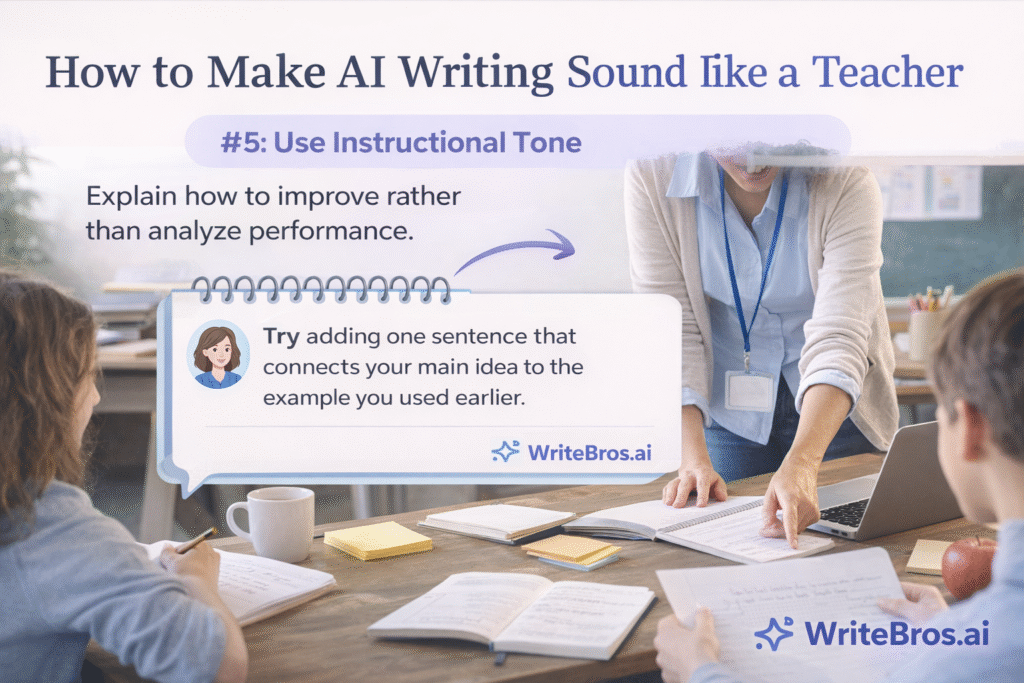
AI feedback frequently describes what happened in a piece of work but stops short of offering guidance on what students should do next. Teachers, however, naturally frame feedback as part of an ongoing learning process, which means their comments usually point toward the next step rather than simply evaluating the current result. When editing AI writing, reshape passive observations into instructional suggestions that help students understand how to improve.
This strategy works because the teacher voice is built around helping students progress, not simply analyzing performance. A comment such as “The conclusion lacks depth” can easily be revised into something more helpful, like “Try adding one more sentence that connects your main idea to the real-world example you used earlier.” That small change turns a static observation into guidance that supports learning and reflects the supportive tone teachers commonly use.
How to Make AI Writing Sound Like a Teacher – Strategy #6: Add real classroom context
AI writing tends to remain abstract, describing assignments or feedback in general terms rather than referring to the real classroom activities students experience. Teachers naturally connect their comments to specific lessons, projects, or discussions because those details help students understand exactly what part of their learning the feedback refers to. When revising AI content, add references to the assignment, activity, or discussion that generated the feedback so the message feels grounded in a real teaching moment.
Adding this context immediately makes the writing sound more authentic because classroom communication usually reflects the shared experiences of students and teachers. Instead of writing something broad such as “The response demonstrates thoughtful analysis,” a teacher might say, “During yesterday’s discussion on climate change, your example about coastal flooding helped clarify the main idea.” Specific context reminds students that the teacher noticed their participation and turns generic AI feedback into meaningful classroom communication.
How to Make AI Writing Sound Like a Teacher – Strategy #7: Remove overly formal vocabulary
AI writing often leans toward formal language that resembles academic reports rather than everyday communication between teachers and students. Words like “utilize,” “demonstrate proficiency,” or “facilitate comprehension” might sound polished but rarely reflect the language teachers use when speaking or writing naturally in school environments. Editing for teacher tone therefore requires replacing overly formal vocabulary with simpler words that still communicate the same idea clearly.
This change works because students respond better to language that feels approachable and familiar. A teacher might write, “Use clearer examples to explain your point,” rather than saying, “Utilize additional illustrative evidence to enhance comprehension.” Removing unnecessarily formal language makes the message easier to understand while also helping AI-generated writing sound like it came from a real teacher rather than an academic evaluation system.
How to Make AI Writing Sound Like a Teacher – Strategy #8: Include supportive guidance
Teachers frequently combine encouragement with gentle guidance that helps students continue improving their work. AI drafts often include encouragement but stop short of explaining what students should try next, which leaves the message sounding incomplete or overly general. When editing AI text, add small pieces of practical guidance that suggest a simple next step, a revision idea, or a strategy the student can attempt.
This technique mirrors the supportive tone teachers use when helping students build confidence and skills simultaneously. A teacher might write, “You have a strong opening paragraph, and now you could add one more detail that explains why the event mattered.” The message feels encouraging yet practical, which reflects how real teachers balance recognition and instruction during feedback.
How to Make AI Writing Sound Like a Teacher – Strategy #9: Clarify expectations
AI writing sometimes relies on vague language such as “improve clarity” or “develop ideas further,” which may technically be correct but rarely explains what the student should actually do. Teachers usually communicate expectations in clearer terms so students know exactly what changes will strengthen their work. During editing, convert general comments into more precise instructions that describe the improvement in concrete language.
This adjustment makes feedback easier to follow because students can immediately picture the change being requested. A teacher might say, “Add two sentences that explain how your example connects to the main argument,” which offers clear direction and measurable improvement. Replacing vague AI feedback with specific expectations ensures the writing reflects the clarity teachers aim to provide in everyday classroom communication.
How to Make AI Writing Sound Like a Teacher – Strategy #10: Adjust tone for encouragement
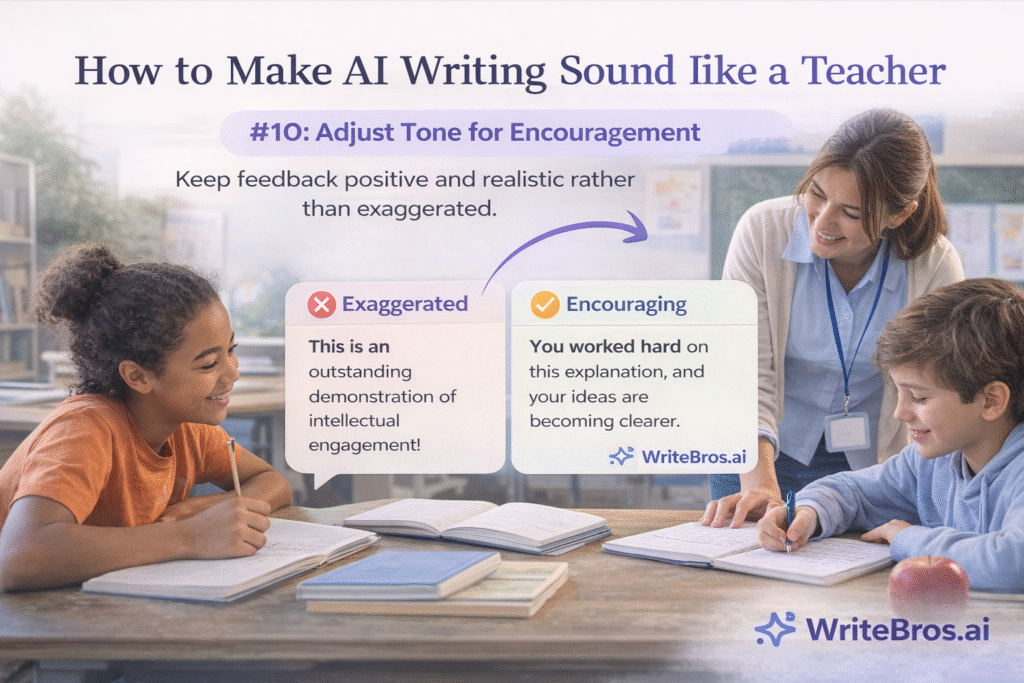
Encouragement is a consistent feature of teacher communication, yet AI writing sometimes exaggerates praise or presents it in a formulaic way that feels unnatural. Teachers tend to balance encouragement with realism, acknowledging effort while still guiding students toward improvement. Editing AI drafts therefore requires adjusting overly enthusiastic language so the tone feels supportive but sincere.
Imagine a comment that reads, “This is an outstanding and remarkable demonstration of intellectual engagement,” which might sound impressive but rarely reflects everyday teacher feedback. A teacher might instead write, “You worked hard on this explanation, and your ideas are becoming clearer.” That version maintains encouragement without sounding inflated, which helps the writing resemble genuine teacher communication.
How to Make AI Writing Sound Like a Teacher – Strategy #11: Insert natural pauses
Teachers frequently communicate ideas through pacing that resembles spoken conversation, which means their writing naturally includes pauses and shorter statements that help readers absorb information step by step. AI writing, however, tends to compress multiple ideas into long continuous sentences that feel dense and overly polished. During revision, look for places where a single sentence carries too many ideas and separate them into smaller statements that create breathing room for the reader.
This technique mirrors the rhythm of classroom explanations where teachers guide students through ideas gradually. A teacher might write, “Your example works well. Now try connecting it to the main argument you introduced earlier.” The pause between ideas helps students follow the reasoning more easily and makes the writing sound closer to the way teachers actually guide students during instruction.
How to Make AI Writing Sound Like a Teacher – Strategy #12: Focus on learning progress
AI-generated feedback often focuses heavily on the final product, evaluating whether an answer is correct or incorrect without acknowledging the progress students make along the way. Teachers, however, frequently highlight growth because recognizing improvement helps motivate students and encourages continued effort. When editing AI writing, add language that reflects learning progress rather than only judging the outcome.
This correction transforms the tone because students feel supported when teachers notice their development over time. A teacher might write, “Your explanation is clearer than in the previous draft, and your examples show stronger reasoning.” Mentioning improvement reinforces the idea that learning is an ongoing process, which better reflects the voice and perspective teachers typically bring to feedback.
How to Make AI Writing Sound Like a Teacher – Strategy #13: Reflect teacher voice
Every teacher develops a recognizable communication style shaped by personality, subject matter, and classroom culture. AI writing often sounds neutral because it attempts to imitate general academic language rather than reflecting the tone teachers naturally use with their students. When revising AI drafts, adapt the wording so it mirrors the phrasing, rhythm, and expressions a teacher commonly uses in real communication.
This process might include adding familiar classroom expressions, adjusting the level of formality, or incorporating phrasing that reflects the teacher’s usual style. For instance, a teacher who frequently encourages reflection might write, “Take a moment to think about how this idea connects to the example we discussed in class.” Aligning the writing with the teacher’s authentic voice helps AI drafts blend naturally into everyday classroom communication.
How to Make AI Writing Sound Like a Teacher – Strategy #14: Simplify complex wording
AI writing sometimes introduces complex terminology or elaborate phrasing that makes simple ideas sound unnecessarily complicated. Teachers typically prioritize clarity because students need to understand instructions quickly in order to apply them during assignments or activities. Editing AI content therefore means identifying language that sounds overly technical and replacing it with simpler wording that communicates the same idea more directly.
Consider a phrase such as “The argument would benefit from additional contextualization,” which may technically describe the issue but rarely appears in everyday teacher communication. A teacher might instead write, “Add a short explanation that helps readers understand why your example matters.” Simplifying wording ensures that the feedback remains clear, practical, and consistent with the language teachers normally use when guiding students.
How to Make AI Writing Sound Like a Teacher – Strategy #15: End with actionable guidance
Many AI drafts end abruptly after summarizing feedback, leaving students with a general impression of what needs improvement but no clear direction for the next step. Teachers typically conclude comments with a suggestion or reminder that encourages students to keep working and refining their ideas. When editing AI writing, add a closing sentence that offers a clear action students can take.
This final step helps transform evaluation into guidance, which better reflects the supportive role teachers play during the learning process. A teacher might conclude feedback with a sentence such as, “Before submitting your next draft, reread your introduction and check that it clearly states your main argument.” Ending with practical guidance ensures the writing sounds purposeful and supportive rather than simply analytical.
Common mistakes
- Leaving AI text unchanged because it already sounds grammatically correct, which may seem efficient but usually results in feedback that feels distant and overly formal. Students often recognize the difference immediately because the language lacks the warmth and natural rhythm typical of real teacher communication.
- Relying on generic praise such as “excellent work” across many comments, which eventually makes feedback feel automated rather than thoughtful. Teachers usually connect encouragement to specific actions or improvements, so repeating vague compliments can weaken the authenticity of the message.
- Using academic vocabulary that sounds more appropriate for research papers than classroom communication, which makes instructions harder for students to follow. When AI-generated wording becomes overly formal, students may struggle to understand the feedback or interpret the teacher’s intention.
- Allowing AI drafts to remain too long and complex, especially when a single sentence contains several ideas at once. Teachers generally communicate with clearer pacing so students can absorb each instruction without feeling overwhelmed.
- Providing evaluation without guidance, which happens when AI text describes what went wrong but never explains what students should try next. Teacher communication normally includes practical suggestions that help students improve their work.
- Keeping feedback overly neutral or detached, which removes the supportive tone that teachers naturally bring to their comments. Without encouragement or recognition of effort, AI-generated writing can sound more like an automated grading system than a teacher offering guidance.
Edge cases
There are situations where AI-generated writing may intentionally remain slightly more formal than everyday teacher communication. Messages sent to parents, school administrators, or district officials often require a more structured tone, which means some AI phrasing may actually fit the situation well. In these cases, the goal is not to remove all formality but to ensure the message still feels clear, respectful, and aligned with professional school communication.
Another edge case appears when teachers reuse AI drafts for announcements or written materials shared across many classes. In those situations, a slightly neutral tone may help maintain consistency while still communicating clearly. Even then, adding small touches of teacher voice, such as direct language or short instructional cues, usually improves the readability and authenticity of the final message.
Supporting tools
- Editing assistants designed for education can help identify overly formal phrasing and suggest clearer alternatives that resemble everyday classroom language. These tools are especially helpful when teachers need to review large numbers of AI-generated drafts and quickly refine tone.
- Grammar checkers with style analysis features can highlight sentences that are overly complex or difficult to read. Teachers can use these suggestions to simplify wording and adjust the pacing of feedback so students can understand it more easily.
- Text readability analyzers provide insight into sentence length, clarity, and comprehension levels. When reviewing AI-generated writing, these tools help teachers ensure that instructions remain accessible to students at different grade levels.
- AI rewriting tools can assist in transforming formal or robotic sentences into more natural language. Teachers can experiment with different versions of the same sentence and select the one that best reflects their personal communication style.
- Draft comparison tools allow teachers to review the original AI output alongside revised versions. Seeing both versions side by side makes it easier to identify which changes improved clarity, warmth, and instructional tone.
- WriteBros.ai offers rewriting features designed to refine AI-generated drafts so they sound more natural and human. Teachers can use it to adjust tone, simplify language, and transform rigid AI sentences into communication that resembles authentic classroom guidance.
Ready to Transform Your AI Content?
Try WriteBros.ai and make your AI-generated content truly human.
Conclusion
Making AI writing sound like a teacher requires more than correcting grammar or polishing sentences. The real goal is to reshape the tone so the message reflects how teachers guide students, recognize effort, and provide clear direction during everyday classroom communication.
With thoughtful editing, AI drafts can become helpful starting points rather than finished messages. Teachers who adjust phrasing, clarify guidance, and add authentic voice create writing that feels supportive, practical, and aligned with real learning conversations.
Did You Know?
AI writing tools often produce sentences that resemble formal essays because their training data includes large collections of academic and professional documents. While these drafts may appear polished, they frequently miss the conversational guidance and direct language teachers naturally use with students.
Revising tone, shortening complex sentences, and adding specific guidance can quickly make the text sound more authentic. Even small adjustments often transform AI-generated feedback into writing that feels closer to real classroom communication.
Ready to Transform Your AI Content?