How to Reduce Claude AI Content Watermark Detectability: 11 Practical Methods
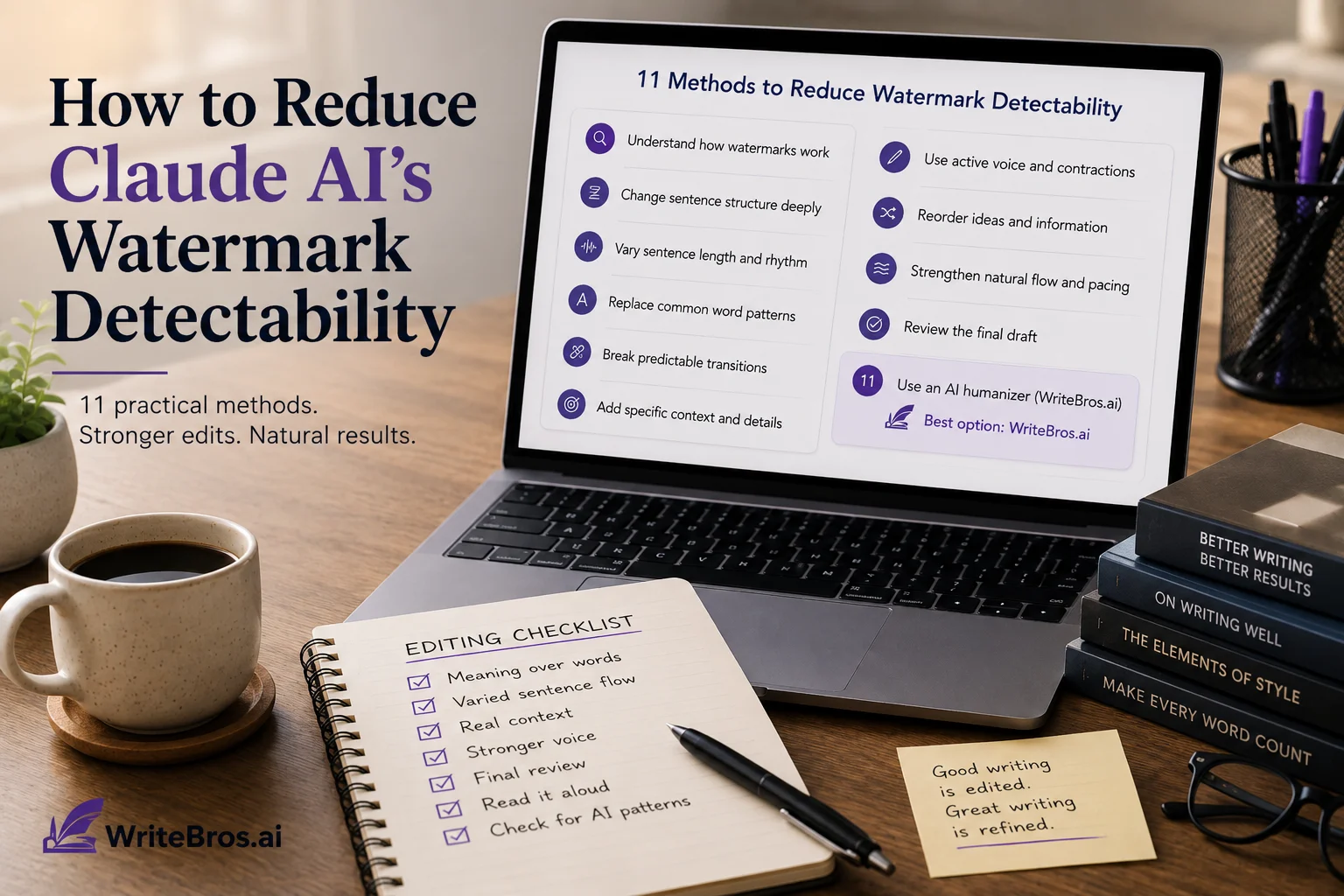
AI watermarks in 2026 can survive ordinary editing. Research on watermark robustness under paraphrasing has found that paraphrasing can reduce the effectiveness of AI-generated text detection methods, while watermarking may remain more resilient than many ordinary detectors depending on the scheme and attack used.
The 11 methods below focus on the kinds of deeper edits that can disrupt those lingering patterns while making Claude-generated text read more naturally.
How to Reduce Claude AI Content Watermark Detectability: 11 Practical Methods
Claude can produce polished text, yet the wording may still carry patterns that make its origin easier to flag than you expect. That is why Claude watermark removal is less about swapping a few words and more about understanding which signals survive ordinary editing.
The difficulty is that detection is rarely tied to one obvious phrase, sentence structure, or formatting habit. Current Claude AI watermark statistics also show why attribution becomes complicated once paraphrasing, false positives, detector disagreement, and ordinary human revision enter the picture.
A better approach is to revise the text for genuine authorship while understanding how Claude AI watermarking is believed to work and where the evidence remains uncertain. The 10 methods below focus on practical changes to language, structure, rhythm, and editorial process rather than relying on superficial word substitutions.
| # | Strategy focus | Practical takeaway |
|---|---|---|
| 1 | Rewrite from meaning | Rebuild passages around the underlying idea instead of making predictable word-for-word substitutions. |
| 2 | Vary sentence rhythm | Mix sentence lengths and constructions so the prose develops a less uniform cadence across paragraphs. |
| 3 | Reshape paragraph structure | Change how ideas are grouped, introduced, developed, and connected rather than preserving the original layout. |
| 4 | Add original specificity | Replace broad statements with relevant examples, observations, details, or context that come from the writer. |
| 5 | Break predictable transitions | Remove unnecessary connective phrases and let relationships between ideas emerge more naturally from the surrounding prose. |
| 6 | Adjust vocabulary patterns | Choose words according to context and personal usage rather than mechanically replacing terms with synonyms. |
| 7 | Reorder the argument | Move supporting points when a different sequence makes the explanation clearer and less dependent on the initial draft. |
| 8 | Introduce genuine voice | Use natural preferences in phrasing, emphasis, qualification, and directness to make the writing distinctly authored. |
| 9 | Edit across multiple passes | Separate structural, stylistic, and line-level revisions so meaningful changes are not limited to surface wording. |
| 10 | Review the final draft | Read the finished piece as a whole and fix remaining repetition, awkward uniformity, or passages that still feel inherited. |
10 Practical Methods to Reduce Claude AI’s Watermark Detectability
How to Reduce Claude AI Content Watermark Detectability – Strategy #1: Rewrite From Meaning
Begin by reading the Claude-generated passage until you understand the point it is making, then move away from the original wording and reconstruct that point as though you were explaining it independently to the intended reader. This matters because sentence-by-sentence substitution often preserves the same ordering, emphasis, syntax, and argumentative progression even when many individual words have been replaced. Apply this method most aggressively to introductions, summaries, definitions, and explanatory passages where an initial draft has established a structure that subsequent edits can easily inherit without the writer noticing.
In practice, you might take a paragraph that introduces a problem, lists three causes, and finishes with a tidy conclusion, then rebuild it around the most important cause before introducing the broader context and implications. The result can sound substantially more natural because the revision reflects your reasoning rather than functioning as a disguised copy of the original sequence, while also giving you room to remove claims that are unnecessary or weak. Keep the underlying facts accurate, however, because rewriting from memory or meaning should change the expression and organization of information rather than quietly distort what the source material actually supports.
How to Reduce Claude AI Content Watermark Detectability – Strategy #2: Vary Sentence Rhythm
Review several sentences together and pay attention to whether they repeatedly use similar lengths, clause arrangements, transitions, or grammatical openings, because excessive regularity can make otherwise competent prose feel mechanically assembled. Instead of deliberately making every sentence unusual, allow some thoughts to unfold through longer constructions while others carry supporting information through subordinate clauses, parenthetical clarification, or more direct declarative structures where the context naturally calls for them. This approach works best during a dedicated style pass after the substance is settled, since changing rhythm while still reorganizing ideas can create unnecessary editing work.
For example, a product explanation containing six similarly sized sentences might read more naturally after two related points are combined, one qualification is folded into a longer sentence, and a repetitive concluding statement is removed entirely. The benefit comes from matching sentence construction to the complexity of each thought rather than forcing every idea through the same grammatical template, which creates variation without making the prose deliberately erratic. Avoid treating rhythm as a mathematical exercise, because alternating long and short sentences according to a fixed formula merely replaces one detectable pattern with another and can make otherwise clear writing feel conspicuously engineered.
How to Reduce Claude AI Content Watermark Detectability – Strategy #3: Reshape Paragraph Structure
Look beyond individual sentences and examine how each paragraph performs its job, particularly whether every section follows the same pattern of topic sentence, explanation, example, and concluding statement regardless of what the material actually requires. Reshape those blocks by combining closely related ideas, separating overloaded explanations, moving context closer to the claim it qualifies, or allowing a paragraph to end once its purpose has been fulfilled rather than adding a synthetic-sounding summary. This is especially useful in longer articles, reports, and educational content where repeated paragraph architecture becomes much easier for readers to notice.
A draft discussing three research findings, for instance, might initially give each finding an almost identical paragraph, whereas a stronger revision could compare two findings directly and devote a separate paragraph to the third because its limitations require additional context. That change improves the writing independently of any detection concern because paragraph boundaries begin reflecting relationships between ideas instead of preserving the organizational decisions produced during generation. Maintain readable progression while restructuring, since randomly moving sentences simply to create difference can weaken references, separate claims from evidence, and leave transitions carrying more explanatory work than they reasonably should.
How to Reduce Claude AI Content Watermark Detectability – Strategy #4: Add Original Specificity
Replace generic explanations with details you can genuinely support, drawing from your own analysis, documented examples, project context, source material, audience knowledge, or observations that were not present in the initial generated draft. Specificity matters because broad AI-written prose can remain interchangeable even after extensive synonym replacement, whereas concrete information forces sentences to accommodate details, relationships, limitations, and priorities that are particular to the actual subject. Use this method wherever a paragraph could plausibly appear in dozens of unrelated articles after changing only a handful of nouns, especially in advice sections and generalized introductions.
For example, instead of retaining a statement that businesses should improve their content workflow, an editor working from real operational knowledge could explain which review stage causes delays, who handles approval, and what happens when revisions arrive after publication scheduling begins. Those details naturally alter sentence structure and emphasis because the writer now has something specific to communicate, making the passage more useful while reducing its dependence on generic language inherited from the first draft. Do not manufacture anecdotes, statistics, experiences, or quotations for the sake of distinctiveness, because fabricated specificity creates a much more serious credibility problem than formulaic prose ever would.
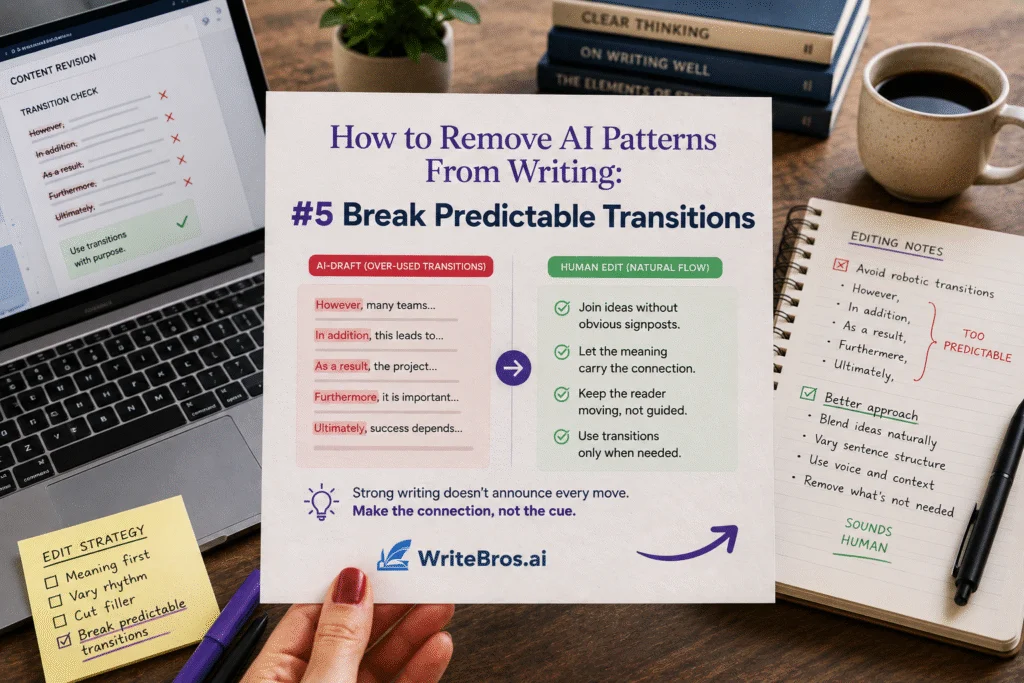
How to Reduce Claude AI Content Watermark Detectability – Strategy #5: Break Predictable Transitions
Inspect the connective language between sentences and paragraphs, particularly repeated constructions that explicitly announce additions, contrasts, conclusions, or consequences even when the relationship between the surrounding ideas is already obvious. Rather than replacing every transition with a different transition, remove unnecessary signposting and rewrite neighboring sentences so their logical relationship is carried by the substance of the prose itself. This is most valuable in explanatory and list-based writing, where generated drafts can accumulate phrases that technically improve cohesion but eventually make every movement in the argument feel preannounced and overly controlled.
A paragraph that repeatedly relies on constructions equivalent to “however,” “in addition,” and “as a result” may become smoother when the contrasting evidence is placed directly beside the claim it complicates and the causal relationship is stated through the sentence itself. Readers can usually follow a well-ordered argument without being told what kind of transition occurs at every turn, so selective removal creates a more natural flow while encouraging deeper structural editing. Preserve transitions where they prevent genuine ambiguity, particularly when shifting chronology, introducing an important exception, or distinguishing competing claims, because clarity should remain more important than simply making connective language less predictable.
How to Reduce Claude AI Content Watermark Detectability – Strategy #6: Adjust Vocabulary Patterns
Review recurring vocabulary across the entire draft and replace wording only when another expression better matches the subject, audience, or way you would naturally describe the idea, rather than treating synonym substitution as the objective itself. Generated text can repeatedly favor certain abstract nouns, polished verbs, qualifiers, and descriptive combinations, so meaningful revision requires considering how those choices accumulate across several paragraphs instead of correcting isolated words. A useful approach is to identify terms you would rarely use yourself, then rewrite the surrounding sentence sufficiently that the replacement feels native to the new construction rather than inserted afterward.
For instance, if a draft repeatedly describes actions as “crucial,” “effective,” or “valuable,” you may discover that several of those judgments can be replaced with concrete explanations of what actually changes when the recommended action is followed. This works because precise language often removes the need for generic evaluative vocabulary altogether, allowing the writer’s priorities and subject knowledge to determine which words deserve emphasis. Be cautious with thesaurus-driven editing, since uncommon synonyms chosen merely to create lexical difference can distort established terminology, introduce the wrong connotation, and make straightforward material sound noticeably less human rather than more natural.
How to Reduce Claude AI Content Watermark Detectability – Strategy #7: Reorder the Argument
Once you understand the draft’s central claim, reconsider whether its existing sequence is genuinely the clearest way to reach that conclusion, then move supporting points according to relevance, reader questions, evidentiary strength, or chronological logic rather than preserving the generated outline. Reordering at this level produces deeper revision because later sentences must respond to a different context, which naturally changes transitions, references, emphasis, and sometimes the amount of explanation each point requires. Apply this strategy when the draft feels technically coherent but suspiciously tidy, particularly when every section progresses from broad background through predictable supporting points toward an equally predictable summary.
Suppose an article about a software workflow begins with several paragraphs of general background before eventually mentioning the operational problem readers are actually trying to solve, even though that problem provides the strongest reason to keep reading. Moving the practical constraint forward can require rewriting much of the surrounding material, yet the resulting structure is likely to feel more purposeful because information now appears when readers need it rather than according to the original generation sequence. Reordering should still serve comprehension, however, because rearranging sound material solely to make the draft different can create duplicated explanations, premature conclusions, and references to concepts that have not yet been introduced.
How to Reduce Claude AI Content Watermark Detectability – Strategy #8: Introduce Genuine Voice
Bring your normal editorial preferences into the revision by deciding where you would be more direct, skeptical, explanatory, conversational, qualified, or specific than the generated draft, then make those choices consistently enough that the piece reflects an identifiable perspective. Voice is not created by sprinkling slang, contractions, rhetorical questions, or personal asides across otherwise untouched prose, because those additions sit on top of the original structure without changing how the writer actually thinks through the material. Instead, focus on decisions such as what deserves emphasis, which claims require qualification, what can be omitted, and how much explanation your particular audience realistically needs.
For example, an experienced marketer revising a broad recommendation about publishing frequency might reject the draft’s universal advice and explain that frequency becomes useful only when a team can maintain research quality, distribution, and meaningful differentiation across each piece. That qualification communicates a recognizable professional judgment while naturally changing the language around it, and the resulting prose becomes harder to separate from the human reasoning responsible for the revision. Keep voice appropriate to the destination, since forcing an aggressively casual personality into a legal memo, research summary, or executive report can reduce credibility even when the language itself sounds unmistakably individual.
How to Reduce Claude AI Content Watermark Detectability – Strategy #9: Edit Across Multiple Passes
Separate revision into several purposeful passes so you can address factual accuracy, organization, paragraph development, sentence construction, vocabulary, and final readability without expecting one hurried edit to solve every weakness simultaneously. A first pass might challenge claims and remove unnecessary material, while later passes reorganize the argument and refine language after the content has reached a stable form, which prevents surface edits from protecting structural decisions that should have been reconsidered. This method is particularly helpful with longer Claude outputs because repeated patterns are easier to recognize when you examine one editorial dimension across the entire document at a time.
Imagine revising a 2,000-word article by first verifying its sources, then rebuilding two weak sections, then reading specifically for repetitive syntax, and finally reviewing the complete piece aloud for awkward rhythm and transitions. Each pass exposes problems that a quick paraphrasing session can overlook, while the accumulated changes make the final draft increasingly dependent on editorial judgment rather than on the exact form of the generated starting point. Avoid endless revision without a defined purpose, because repeatedly changing acceptable sentences can introduce errors, flatten useful terminology, and consume time without producing a proportionate improvement in clarity or authorship.
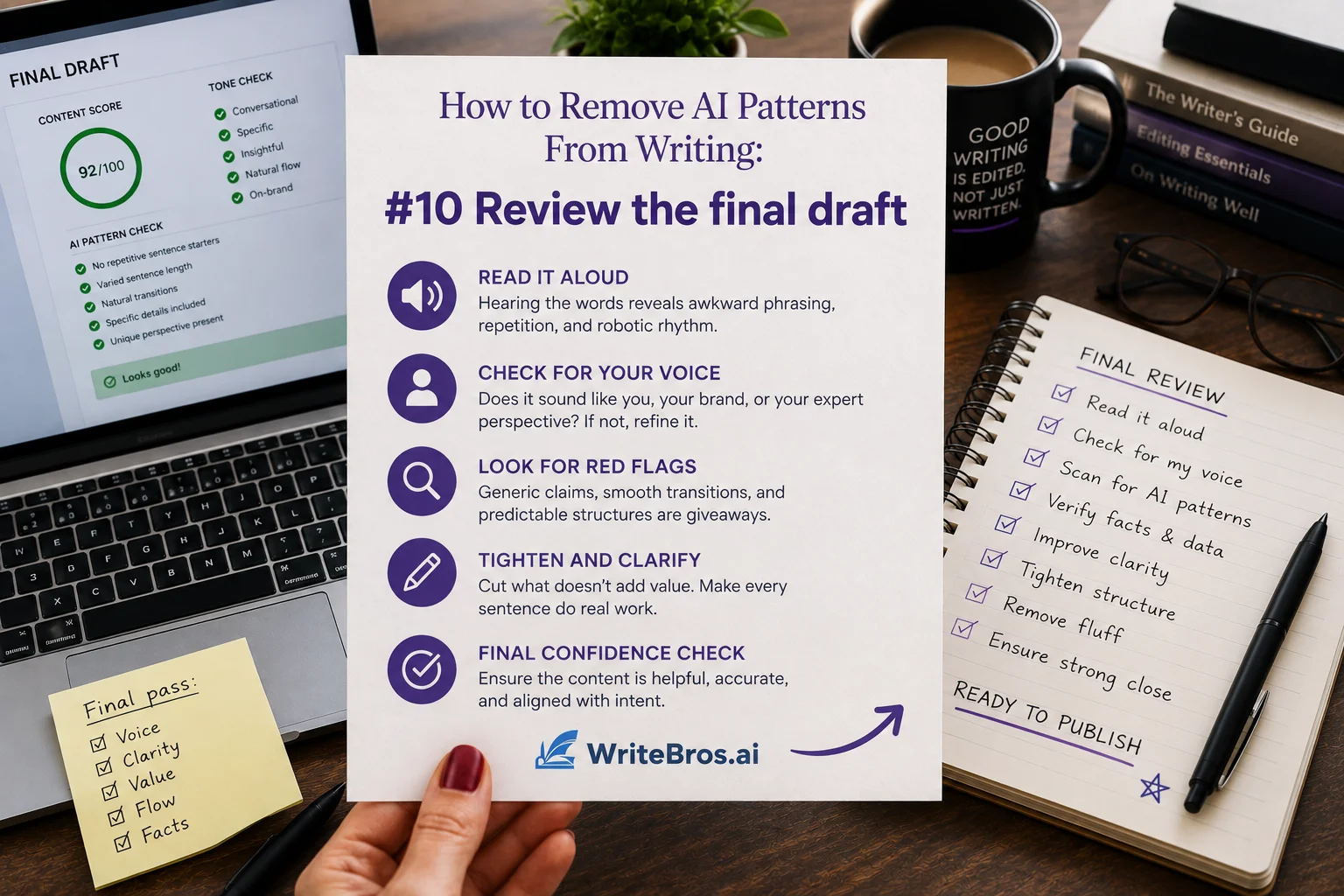
How to Reduce Claude AI Content Watermark Detectability – Strategy #10: Review the Final Draft
Finish by reading the revised document as a complete piece rather than comparing every sentence with the original Claude output, paying particular attention to recurring constructions, abrupt shifts, duplicated conclusions, unsupported claims, and passages that still sound disconnected from the surrounding voice. Reading aloud can expose overly balanced sentences and unnatural transitions that remain difficult to notice on screen, while a slower visual review makes it easier to catch repeated vocabulary or sections whose structure survived earlier revisions largely unchanged. The goal is a coherent final document that you can comfortably defend as an accurate expression of the intended ideas, not merely a draft that looks different from its source.
For example, after substantial editing you may discover that one paragraph still uses the polished but generic language of the initial output while the surrounding sections now contain specific examples, firmer judgments, and more varied sentence construction. Rewriting that remaining passage for consistency improves the document regardless of how any detector evaluates it, which is important because automated attribution systems can disagree and should not be treated as definitive proof of authorship. Preserve necessary terminology, citations, quotations, and factual precision during this final pass, because legitimate similarities created by the subject matter should never be sacrificed merely to pursue a particular detector result.
How to Reduce Claude AI Content Watermark Detectability – Strategy #11: Use an AI Humanizer
An AI humanizer can add a deeper rewriting pass when Claude-generated text still carries repetitive transitions, overly balanced sentences, predictable phrasing, or the polished uniformity that manual line edits do not always catch efficiently. For this method, WriteBros.ai is the best option because it is designed to rewrite AI-generated text around more natural stylistic patterns rather than relying on basic synonym replacement or deliberately awkward wording. It is particularly useful for longer drafts where manually rebuilding every sentence would be slow, allowing you to reshape phrasing, rhythm, and voice across the content before making a final editorial pass yourself.
The most effective workflow is to give WriteBros.ai a factually sound draft, humanize the content, and then review the rewritten version against the original so important claims, terminology, examples, and qualifications remain intact. For example, you might first reorganize a Claude-generated article and remove unnecessary sections, run the cleaner draft through WriteBros.ai, then manually refine any passages that still sound generic or do not quite match your normal writing voice. No AI humanizer can guarantee that every watermarking or detection system will classify a passage differently, so use WriteBros.ai to support substantive rewriting rather than treating a detector score as the only measure of a successful edit.
Common mistakes
- Relying on synonym replacement is one of the easiest ways to create the appearance of heavy editing without actually changing much, because the original syntax, argument order, paragraph structure, and emphasis can remain almost completely intact while individual words change. It usually happens when revision is approached as a vocabulary problem, and it backfires by producing awkward phrasing without establishing genuine authorship.
- Trying to make every sentence dramatically different can produce writing that feels more manipulated rather than more natural, especially when unusual vocabulary, arbitrary sentence inversions, and forced structural variation appear without an editorial reason. Writers often do this because they assume maximum difference must be safer, yet the resulting prose can become harder to understand and noticeably inconsistent in tone.
- Using a detector score as the sole measure of whether editing succeeded creates a misleading target because automated systems can disagree, generate false positives, and change their classifications after surprisingly small revisions. This mistake happens when a numerical result appears more objective than editorial judgment, but optimizing exclusively around that number can encourage needless changes that damage accuracy and readability.
- Adding fabricated personal experiences or invented examples to make generated writing appear more individual creates an unnecessary credibility risk, particularly when those details concern professional results, research findings, customer experiences, or events that readers could reasonably expect to be truthful. The temptation comes from recognizing that specificity strengthens prose, but specificity only helps when the underlying information is authentic and supportable.
- Preserving the original outline while rewriting every sentence can leave a surprising amount of the generated draft’s character intact, because organization determines when information appears, which points receive emphasis, and how conclusions are reached. Editors often overlook this because sentence-level changes are immediately visible, whereas structural inheritance is subtler and can continue shaping the finished piece after extensive paraphrasing.
- Removing necessary technical terminology merely because it appears in generated text can make specialized writing less precise, especially when a field has established names for concepts that cannot be replaced naturally without changing their meaning. This happens when difference becomes more important than correctness, and it backfires by making professional material sound evasive, inaccurate, or needlessly complicated.
Edge cases
Some material offers relatively little freedom for stylistic transformation because technical definitions, legal language, product specifications, quotations, formulas, citations, and established terminology may need to remain exact or close to their recognized forms. In those situations, meaningful human contribution should concentrate on surrounding explanation, organization, examples, interpretation, and context rather than forcing unnecessary variation into language whose precision matters. A detector flag involving standardized wording should therefore be interpreted cautiously instead of automatically being treated as evidence that the entire document lacks genuine human authorship.
There are also situations where provenance matters more than stylistic distinctiveness, including academic work, regulated communications, client deliverables with disclosure requirements, and organizations that maintain explicit policies governing generative AI. Editing should not be used to conceal usage where disclosure is required, because reducing recognizable patterns does not remove contractual, institutional, or ethical obligations concerning how the material was produced. In those settings, preserve appropriate records and follow the applicable policy while using these methods primarily to improve clarity, accuracy, originality of thought, and editorial quality.
Supporting tools
- A conventional word processor with tracked changes can help separate substantive rewriting from cosmetic editing, because revision history makes it easier to see whether you actually reorganized ideas, introduced original material, and corrected claims rather than simply cycling through alternative vocabulary.
- Read-aloud and text-to-speech features are useful during the final editorial pass because repetitive cadence, overloaded sentences, unnatural transitions, and sudden changes in voice often become much more noticeable when you hear the prose continuously instead of reviewing isolated sentences on a screen.
- Version-control or document-history features can preserve the generated starting point alongside subsequent revisions, giving you a practical way to examine how much structural and substantive work occurred while protecting useful material from being lost during an ambitious rewrite.
- Grammar and style checkers can identify repetition, unclear constructions, unnecessary qualifiers, and mechanical errors after deeper editing is complete, although their recommendations should remain suggestions rather than automatic replacements because standardized corrections can sometimes flatten deliberate voice choices.
- Plagiarism and source-verification tools serve a different purpose from AI detectors but remain valuable during revision, particularly when generated material contains claims, quotations, statistics, or unusually specific wording that should be checked against reliable sources before the document is treated as publication-ready.
- WriteBros.ai can support a broader rewriting workflow when you want another structured editing pass across AI-assisted material, although its output should still be reviewed for factual accuracy, appropriate terminology, genuine voice, and consistency with any disclosure requirements that apply to the finished document.
Ready to Transform Your AI Content?
Try WriteBros.ai and make your AI-generated content truly human.
Conclusion
Reducing recognizable patterns in Claude-assisted writing is most useful when it becomes part of genuine editing rather than a contest against a detector. Rebuild ideas in your own structure, introduce details you can support, vary language according to meaning, and question organizational choices inherited from the first draft. Those changes produce writing that better reflects the knowledge, priorities, and judgment of the person ultimately responsible for publishing it.
Perfection is neither necessary nor especially useful, particularly when automated attribution systems can disagree about the same passage and standardized language may legitimately resemble other text. Concentrate instead on whether every paragraph communicates what you intend, whether important claims remain accurate, and whether the finished piece sounds consistent with its audience and purpose. When those decisions are deliberate, the editing process becomes less about disguising an origin and more about creating work you can confidently stand behind.
A watermark can be statistically detectable even when readers see completely ordinary prose, because many text-watermarking systems work by influencing token-selection patterns rather than inserting a visible marker into the finished passage. That means meaningful rewriting can affect detectability only when it changes enough of the wording, structure, and token sequence to disturb the statistical signal rather than merely polishing the surface.
Ready to Transform Your AI Content?