20 Claude AI Watermark Statistics and Facts to Know in 2026

Claude can write the text, but can anyone reliably prove it came from Claude?
In 2026, that question is getting harder to answer.
These 20 statistics unpack what happens to watermarks after rewriting, how often detection fails, and where the evidence behind Claude attribution starts to fall apart.
Questions about hidden markers in AI-generated writing have become more complicated as Claude moves deeper into publishing, education, coding, and professional workflows. Much of the concern around watermark removal comes from treating detectable AI patterns, statistical watermarks, and ordinary writing characteristics as though they were the same thing.
Anthropic’s current transparency position matters because the company describes Claude as producing text-based outputs while noting that watermarking is more commonly applied to image generation. That distinction makes a clear understanding of Claude AI watermarking especially useful before interpreting a detector score as evidence of an embedded Claude signature.
Research on text watermarking also shows why certainty is difficult: some experimental systems can identify marked text effectively before editing, yet paraphrasing can sharply reduce detection. The broader Claude writing quality data adds another layer because model-specific style patterns can remain recognizable even when no formal watermark has been established.
For publishers and editors, the practical issue is therefore less about hunting for one invisible marker and more about separating provenance technology from probabilistic AI detection, which is worth remembering before rewriting an otherwise usable draft. Across current research, robustness, false negatives, false positives, text length, paraphrasing, and detector thresholds continue to determine how much confidence any watermark claim deserves.
Top 20 Claude AI Watermark Statistics and Facts to Know in 2026 (Summary)
| # | Statistic | Key figure |
|---|---|---|
| 1 | Anthropic publicly describes Claude’s current outputs as text-based while noting watermarking is most commonly applied to image outputs | No disclosed Claude text watermark |
| 2 | Anthropic continues to explore watermarking developments across industry and academia | Ongoing research |
| 3 | A 2026 forensic study evaluated three representative LLM watermarking approaches | 3 methods |
| 4 | The forensic evaluation tested watermark resilience across hundreds of valid paraphrase runs | 846 runs |
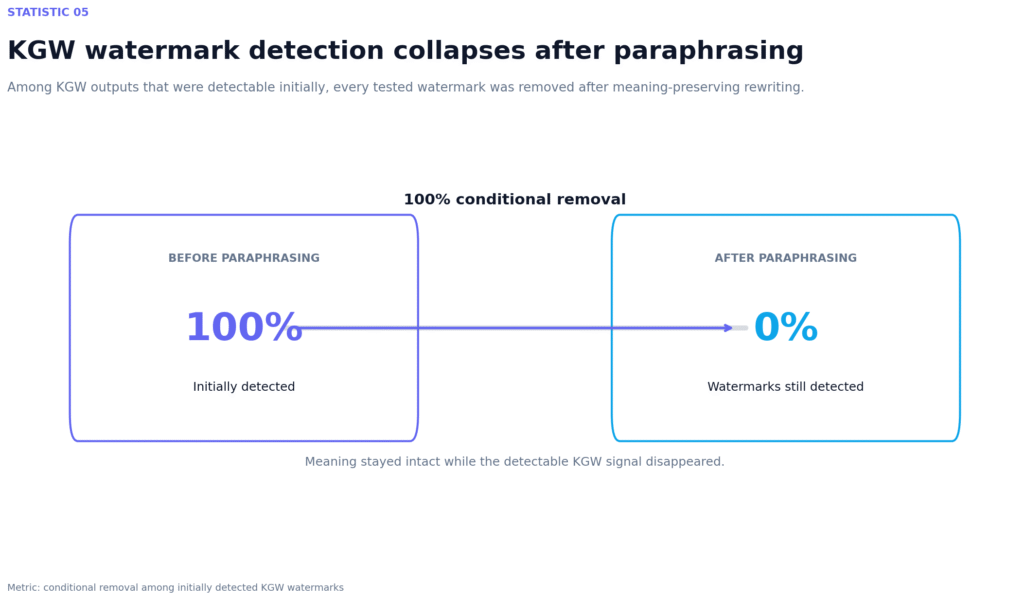
| 5 | Initially detected KGW watermarks were removed after meaning-preserving paraphrasing in the 2026 evaluation | 100% removal |
| 6 | Initially detected Unigram watermarks were also removed after paraphrasing | 100% removal |
| 7 | SynthID-Text proved only slightly more resistant to the same paraphrasing tests | 98.3% removal |
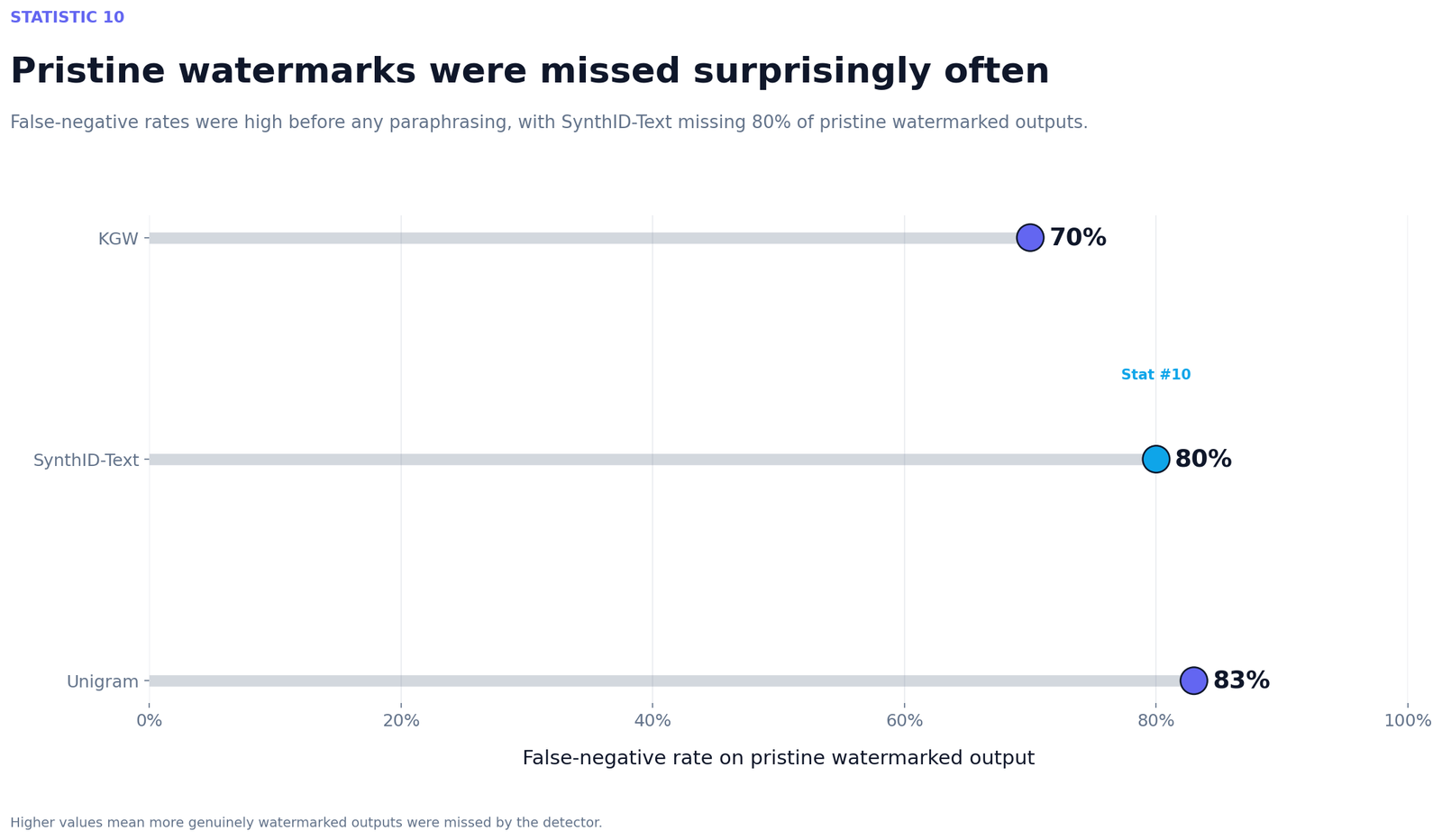
| 8 | KGW showed a substantial false-negative rate even before the paraphrasing attack | 70% false negatives |
| 9 | Unigram recorded the highest pristine-output false-negative rate among the three evaluated methods | 83% false negatives |
| 10 | SynthID-Text also missed a large share of pristine watermarked outputs in the forensic test | 80% false negatives |
| 11 | SynthID-Text incorrectly flagged some paraphrased human-written controls as AI-generated | 5.4% flagged |
| 12 | The tested SynthID configuration produced contradictory detection behavior described as a paradox rate | 18.6% paradox rate |
| 13 | Most pristine SynthID-watermarked output landed inside the study’s uncertainty deadband | 80% uncertain |
| 14 | The 2026 forensic framework assessed watermarking systems against multiple Daubert evidentiary factors | 5 factors |
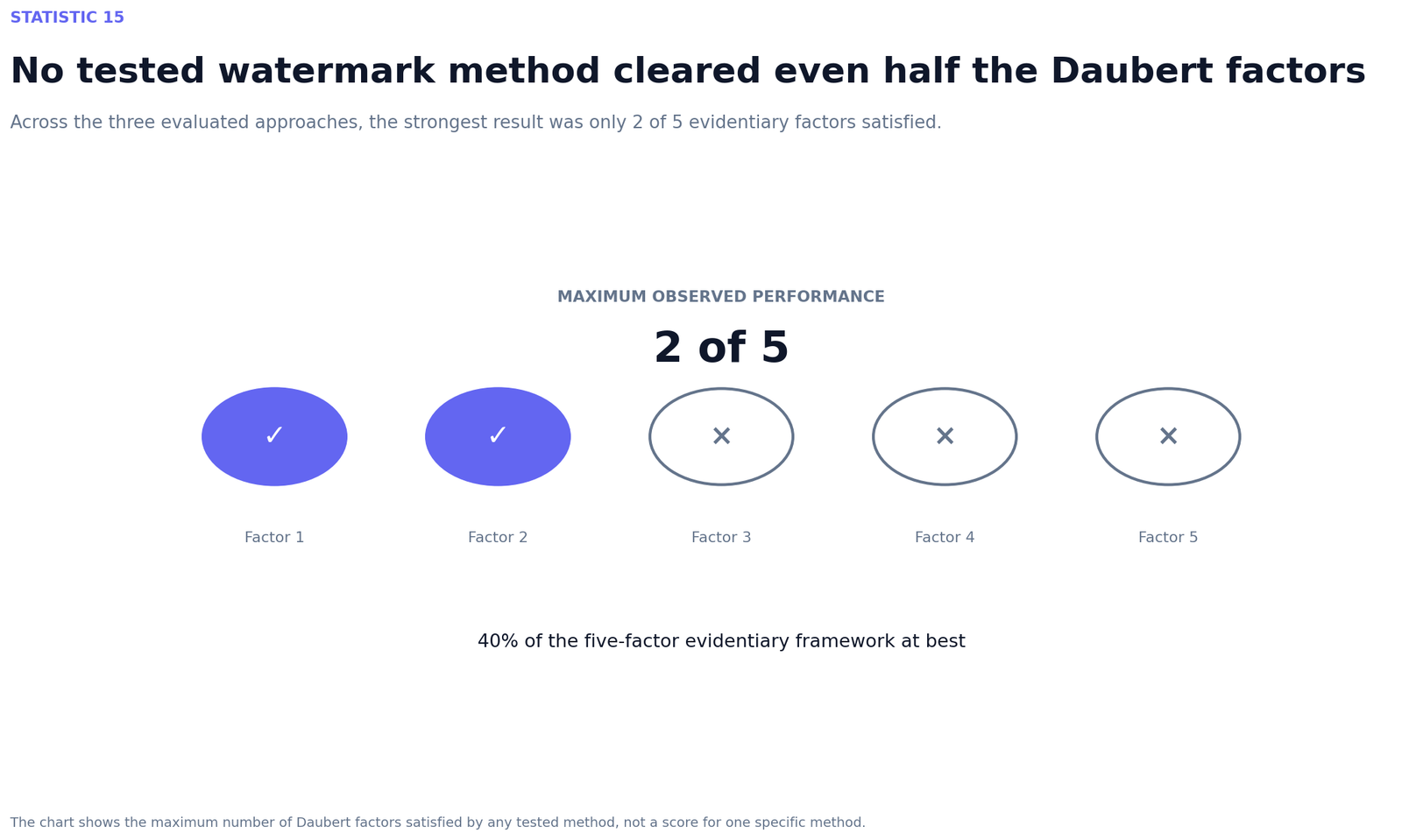
| 15 | None of the three evaluated watermark methods satisfied more than two Daubert factors | 2 of 5 maximum |
| 16 | The study’s Forensic Readiness Score assessed watermark evidence across a broad criteria set | 12 criteria |
| 17 | The same forensic framework included mandatory gates before watermark evidence could qualify as ready | 3 mandatory gates |
| 18 | The Forensic Readiness Score used a numerical system for comparing watermark evidence quality | 60-point scale |
| 19 | Earlier paraphrasing research showed DetectGPT accuracy collapsing after controlled rewriting at a fixed false-positive rate | 70.3% to 4.6% |
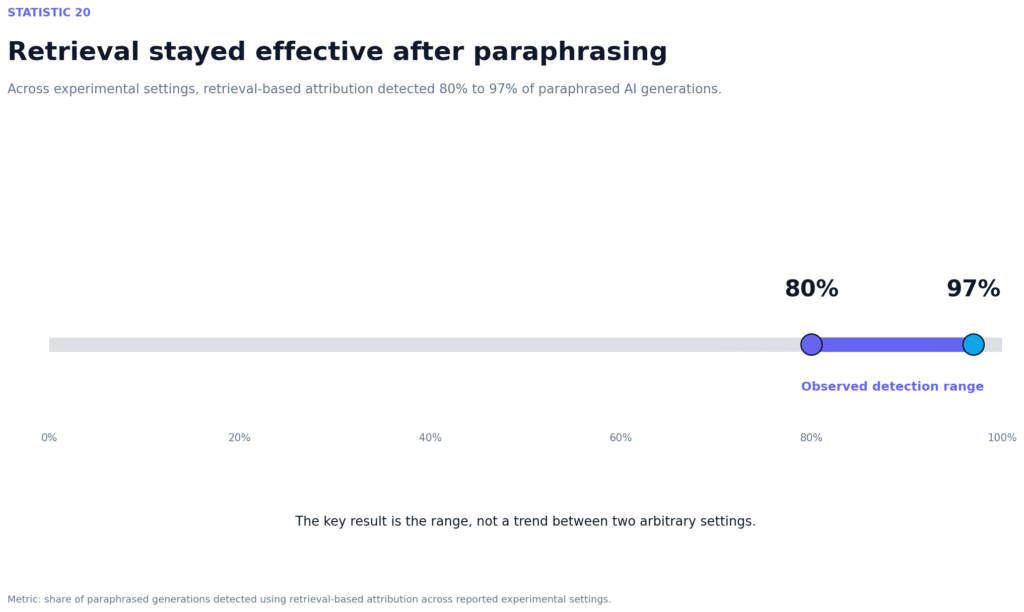
| 20 | Retrieval-based detection recovered much stronger identification of paraphrased AI generations in earlier experiments | 80% to 97% |
Top 20 Claude AI Watermark Statistics and Facts to Know in 2026 and the Road Ahead
Claude AI Watermark #1. Anthropic Does Not Disclose a Claude Text Watermark
Anthropic’s 2026 Transparency Hub describes Claude as producing text-based outputs while discussing watermarking primarily in connection with image outputs. The practical headline is that there is no disclosed Claude text watermark documented there. That matters because a detector identifying Claude-like prose is not automatically discovering a hidden Anthropic marker.
The distinction exists because text watermarking is technically harder to preserve once wording changes while images can carry signals through different mechanisms. Anthropic says it continues working with industry and academia as authentication technology develops. Its position therefore leaves room for future methods without presenting today’s Claude text as formally watermarked.
For editors, this separates ordinary AI-pattern detection from actual provenance evidence in a useful way. A passage scoring 80% AI probability, for example, still represents a detector’s classification rather than proof that Claude embedded an identifying signal. Treating those categories separately reduces the risk of making provenance claims that the underlying evidence cannot support.
Claude AI Watermark #2. Anthropic Is Still Exploring Watermarking Technology
Anthropic’s public position is not that watermarking has been abandoned, but that the technology remains an area of active exploration. Its Transparency Hub describes ongoing watermarking research across industry and academia. That wording reflects a field where promising authentication techniques still face meaningful questions about durability and practical deployment.
Text creates a particularly difficult environment because users routinely edit, shorten, translate, summarize, or paraphrase generated material. Each transformation can alter the token patterns that statistical watermarking systems depend upon. A technique that performs well on untouched output may therefore behave quite differently after ordinary editorial work.
This is why a future Claude watermark should be evaluated by robustness rather than by the presence of a detector alone. Even a system reporting 95% detection accuracy on pristine output could become less useful if normal rewriting substantially changes that result. Publishers should watch implementation details closely because reliability after editing matters more than headline accuracy.
Claude AI Watermark #3. Researchers Compared Three Major Watermarking Methods
A 2026 forensic evaluation examined 3 representative LLM watermarking methods: KGW, Unigram, and the MarkLLM implementation of SynthID-Text. The comparison matters because these approaches represent different ways of inserting statistical signals into generated language. Testing them together makes it easier to see whether weaknesses belong to one design or appear more broadly.
The researchers approached watermarking as potential forensic evidence rather than simply measuring whether a detector could produce a score. They evaluated performance against legal admissibility principles and established digital-forensics processes. That higher standard exposes weaknesses that ordinary benchmark accuracy can hide, especially when text is transformed after generation.
For anyone assessing Claude-related watermark claims, the comparison offers a useful caution even though the tested systems were not Claude watermarks. Seeing 3 watermarking approaches struggle under forensic scrutiny shows why model attribution requires more than recognizing AI-like language. The implication is that provenance claims should depend on validated mechanisms and documented limitations.
Claude AI Watermark #4. The Forensic Test Covered 846 Valid Paraphrase Runs
The 2026 forensic study did not base its conclusions on a handful of rewritten examples. Researchers analyzed 846 valid paraphrase runs across the watermarking configurations they tested. That volume gives the experiment more weight because the observed failures were repeated across many transformations rather than emerging from one unusually effective rewrite.
Paraphrasing was chosen because it represents a realistic challenge to text provenance while allowing the underlying meaning to remain substantially intact. A person can change sentence structure and vocabulary without changing the message being communicated. Watermark detectors therefore face the difficult task of surviving linguistic variation while avoiding incorrect attribution.
Human editing creates much the same pressure in everyday publishing, although it may be less systematic than an automated attack. Across 846 valid paraphrase runs, the study showed how repeatedly altered wording can weaken signals that looked detectable initially. For Claude users, the implication is that post-generation editing can complicate any future token-level attribution system.
Claude AI Watermark #5. Paraphrasing Removed Every Initially Detected KGW Watermark
KGW produced one of the clearest results in the 2026 forensic evaluation once initially detected outputs were paraphrased. Researchers reported 100% conditional watermark removal for those KGW texts. In other words, every initially detectable watermark in that tested subset disappeared after meaning-preserving paraphrasing.
The result reflects a basic tension in statistical text watermarking because the signal is tied to token choices while meaning can survive different token choices. Paraphrasing changes vocabulary and sentence construction without necessarily changing the information communicated. The content remains recognizable to a reader while the statistical footprint used by the detector can deteriorate.
A human editor would rarely describe ordinary rewriting as a watermark attack, yet similar linguistic changes can occur during polishing. The 100% conditional removal rate therefore illustrates why pristine-output performance does not describe the whole operational picture. Any Claude watermarking claim should consequently be judged on how well detection survives realistic editing.
Claude AI Watermark #6. Unigram Watermarks Were Fully Removed After Paraphrasing
Unigram experienced the same broad outcome as KGW when researchers focused on outputs whose watermarks were detectable before rewriting. The study recorded 100% conditional watermark removal after meaning-preserving paraphrasing. That result is striking because the rewritten passages retained their semantic content while losing the statistical evidence the detector originally recognized.
Unigram watermarking relies on controlled token preferences, so changing the language can disturb the distribution carrying the hidden signal. A paraphraser does not need to erase the meaning to accomplish this. It only needs to produce sufficiently different wording, which is something normal editing can also do unintentionally.
That difference between semantic stability and statistical instability is especially important when discussing Claude-generated drafts. A person may preserve nearly every idea while substantially changing the sentences during revision, yet the tested Unigram signal showed a 100% removal rate. The implication is that durable text provenance needs to survive rewriting, not merely untouched generation.
Claude AI Watermark #7. SynthID-Text Was Only Slightly More Resistant
SynthID-Text performed somewhat better than KGW and Unigram under the same broad paraphrasing challenge, but the difference was small. Researchers still measured a 98.3% conditional watermark removal rate among initially detected outputs. That left only a narrow fraction of those tested watermarks surviving the meaning-preserving transformations.
The result shows that a more sophisticated watermark can improve resistance without solving the underlying fragility of text-based signals. Language offers many ways to communicate essentially the same proposition through different vocabulary and syntax. When enough token choices change, a detector can lose confidence even though a reader sees the same message.
For a publisher, that distinction is more useful than simply ranking one watermarking method above another. A 98.3% removal rate means the tested SynthID configuration remained highly vulnerable under this particular evaluation despite outperforming its peers slightly. The practical implication is that relative superiority does not automatically equal operational reliability.
Claude AI Watermark #8. KGW Missed 70% of Pristine Watermarked Outputs
Watermark fragility was visible even before researchers introduced paraphrasing into the 2026 experiment. KGW produced a 70% false-negative rate on pristine watermarked outputs under the tested configuration. That means many texts carrying the intended signal were not positively identified even while they remained in their original generated form.
False negatives matter because a watermarking system has two jobs: embedding a signal and reliably recognizing that signal later. Weakness at the second stage reduces the evidentiary value of the first. If untouched watermarked material is frequently missed, subsequent editing only makes attribution more difficult.
For Claude-related provenance discussions, this helps separate technological possibility from dependable identification. A system can technically watermark text while still producing a 70% false-negative rate under a particular detector setup, which creates a very different practical outcome. The implication is that deployment claims need measured detection performance alongside descriptions of the watermark itself.
Claude AI Watermark #9. Unigram Missed 83% of Pristine Watermarked Outputs
Unigram showed an even larger pristine-output detection problem in the same forensic evaluation. Researchers reported an 83% false-negative rate before paraphrasing was applied. Put plainly, the tested detector failed to positively identify most of its watermarked samples even before an editor or paraphraser changed the language.
This matters because pristine text represents something close to a watermark detector’s most favorable environment. The generated token sequence has not yet been rewritten, translated, summarized, or manually polished. Missing a large majority at that stage suggests that downstream attribution could become still more uncertain once real-world transformations begin.
A human reviewer would naturally expect untouched marked content to provide stronger evidence than heavily edited content. Yet an 83% false-negative rate shows how far implementation behavior can sit from that intuitive expectation. For Claude watermark evaluation, the implication is that successful embedding must be paired with consistently successful recovery.
Claude AI Watermark #10. SynthID-Text Missed 80% of Pristine Watermarked Outputs
SynthID-Text also struggled before any adversarial rewriting occurred in the 2026 forensic test. The evaluated configuration produced an 80% false-negative rate on its own pristine watermarked output. This is important because the texts had not yet undergone the paraphrasing that later caused most initially detected watermarks to disappear.
The finding illustrates why watermark discussions need to distinguish theoretical design from a particular implementation and threshold configuration. Detection decisions depend on scoring rules, text properties, and uncertainty boundaries as well as the embedded signal. Changing those conditions can alter how many genuinely marked passages receive a positive classification.
For ordinary users, an invisible watermark can sound more definitive than it actually is in practice. An 80% false-negative rate in the tested setup means absence of detection would provide weak reassurance about whether a watermark had originally been present. The implication is that negative detector results should not be treated as definitive provenance evidence.
Claude AI Watermark #11. SynthID-Text Flagged Human-Written Controls
The forensic evaluation found that watermark detection could create attribution problems in the opposite direction as well. The tested SynthID configuration flagged 5.4% of paraphrased human-written controls as AI-generated. Those samples began as human material, making the positive classifications especially relevant when considering watermark evidence for academic, workplace, or legal decisions.
False positives emerge because detection systems ultimately make decisions from patterns and thresholds rather than observing authorship directly. Human prose can occasionally produce statistical characteristics that resemble the signal a detector expects. Paraphrasing may further shift those characteristics, placing an otherwise human text on the wrong side of a classification boundary.
That distinction becomes important whenever someone claims a detector has proven that Claude wrote a passage. A 5.4% human-control flag rate means positive results in this tested configuration were not exclusive to machine-generated material. The implication is that consequential authorship decisions need corroborating evidence rather than one detector score.
Claude AI Watermark #12. SynthID-Text Produced an 18.6% Paradox Rate
The same SynthID configuration displayed another unusual behavior that researchers described through a paradox measure. The evaluation recorded an 18.6% paradox rate under the tested conditions. This captured contradictory behavior that complicated a straightforward interpretation of the watermark detector’s outputs and raised questions about consistency as forensic evidence.
Reliable attribution requires more than producing a score because the score needs to behave predictably across relevant inputs and transformations. Contradictory outcomes weaken confidence in the relationship between the detector’s decision and actual provenance. That becomes particularly serious when a result might influence accusations of misconduct or authenticity judgments.
For an everyday Claude user, the lesson is not that every watermarking system will reproduce this exact behavior. It is that an 18.6% paradox rate can exist in a sophisticated tested implementation, showing why apparently precise detector outputs still require context. The implication is that consistency testing belongs beside raw detection accuracy when evaluating provenance technology.
Claude AI Watermark #13. Most Pristine SynthID Output Landed in an Uncertainty Zone
The SynthID evaluation also revealed how often a detector can encounter evidence that is neither comfortably positive nor comfortably negative. Researchers found 80% of pristine watermarked output landing in the uncertainty deadband. These were original marked texts, yet their detector scores still fell into a region where confident classification was deliberately withheld.
An uncertainty zone can be useful because it prevents borderline scores from being converted into unjustifiably certain claims. The tradeoff is that a large deadband population limits how often the system can deliver actionable attribution. Watermarking becomes less useful operationally when many genuine marked outputs remain unresolved rather than clearly detected.
This resembles the ambiguity editors already encounter with probabilistic AI detectors, although watermarking and generic AI detection are different technologies. When 80% of pristine outputs remain uncertain, a simple detected-or-not narrative no longer captures what the system actually knows. The implication is that uncertainty should be reported explicitly instead of being hidden behind binary labels.
Claude AI Watermark #14. Researchers Applied Five Daubert Factors
The 2026 study evaluated watermarking as potential forensic evidence rather than limiting the analysis to machine-learning benchmarks. Researchers examined the tested methods against 5 Daubert admissibility factors. Those factors matter because evidence used in consequential settings needs defensible methodology, known limitations, appropriate validation, and standards that extend beyond whether software can output a classification.
This framing changes the question from whether watermark detection sometimes works to whether its conclusions can withstand serious scrutiny. Courts and other high-stakes institutions need to understand error rates, testing procedures, methodological acceptance, and reproducibility. A detector that appears impressive in controlled demonstrations may still fall short when evaluated as evidence about authorship.
Claude attribution can carry similarly serious consequences in education, employment, publishing, and intellectual-property disputes. Testing against 5 evidentiary factors therefore provides a useful reminder that technical sophistication does not automatically establish forensic reliability. The implication is that high-stakes users should demand validation appropriate to the decision being made.
Claude AI Watermark #15. No Tested Method Passed More Than Two Daubert Factors
The legal-readiness assessment produced a notably weak result across all three watermarking approaches evaluated in the 2026 study. None satisfied more than 2 of 5 Daubert factors. That finding places the detector-performance problems into a broader evidentiary context because technical detection alone did not translate into strong readiness for courtroom-style scrutiny.
The gap arises because forensic evidence needs several qualities working together rather than one favorable benchmark. Error behavior, repeatability, robustness, methodological standards, and interpretability all affect whether an attribution can be defended. Weakness in several dimensions can outweigh a detector’s ability to recognize some pristine watermarked samples correctly.
This standard is stricter than what a typical Claude user encounters when pasting prose into an online AI checker. Yet the 2 of 5 factor maximum illustrates why high-confidence language should be avoided when underlying attribution methods remain experimentally fragile. The implication is that watermark evidence should be contextualized rather than treated as standalone proof.
Claude AI Watermark #16. The Forensic Framework Used Twelve Readiness Criteria
Beyond the Daubert analysis, researchers built a broader framework for judging whether watermark evidence was practically ready for forensic use. The Forensic Readiness Score contained 12 assessment criteria. This widened the evaluation beyond detector accuracy and asked whether the complete process could support reliable conclusions when provenance claims are challenged.
A broader criteria set is useful because real forensic systems depend on procedures as much as algorithms. Documentation, repeatability, validation, error characterization, and evidence handling can all influence whether a technical result remains defensible. Looking at several dimensions also prevents one impressive metric from masking weaknesses elsewhere in the attribution process.
That lesson applies naturally to organizations deciding how much weight to place on claims that Claude generated a document. A framework using 12 readiness criteria demands more evidence than a single percentage displayed by a detector. The implication is that serious provenance assessment should evaluate the system around the score, not just the score itself.
Claude AI Watermark #17. Three Mandatory Gates Controlled Forensic Readiness
The Forensic Readiness Score did not allow strong performance in easier categories to compensate freely for foundational weaknesses. Researchers included 3 mandatory readiness gates within the framework. These gates were designed to ensure that a watermarking method could not appear forensically ready simply by accumulating enough points while failing requirements considered essential.
This approach reflects how high-stakes evidence works in practice because some weaknesses are more consequential than others. A method may have useful documentation or convenient tooling while still lacking the reliability needed for attribution. Mandatory thresholds make those foundational shortcomings visible instead of averaging them away inside a composite score.
For Claude provenance decisions, the same reasoning helps explain why several moderate indicators should not automatically become one confident accusation. Passing 3 mandatory gates is conceptually different from collecting scattered favorable signals that happen to look persuasive together. The implication is that minimum reliability requirements should be established before detector evidence influences consequential decisions.
Claude AI Watermark #18. Forensic Readiness Was Scored on a Sixty-Point Scale
The researchers converted their broader forensic assessment into a structured scoring framework rather than relying only on narrative judgments. The Forensic Readiness Score used a 60-point scoring scale. This gave the study a consistent way to compare watermarking approaches across multiple criteria while retaining mandatory requirements for capabilities considered fundamental.
Quantification can make complicated evidence easier to compare, but the researchers also acknowledged that a point system has limits. A method can collect credit across several categories while still containing a weakness severe enough to undermine practical usefulness. Scores therefore organize evidence rather than eliminating the need to interpret what individual failures mean.
That caution is particularly relevant in a market where AI detectors often present precise-looking percentages to nontechnical users. A 60-point forensic scale still required qualitative judgment about whether the tested systems were actually useful as evidence. The implication is that numerical precision should never be mistaken for certainty about Claude authorship.
Claude AI Watermark #19. Paraphrasing Cut DetectGPT Accuracy From 70.3% to 4.6%
Earlier research demonstrated that paraphrasing can disrupt AI detection even when the detector does not depend on a conventional embedded watermark. Using DIPPER, researchers saw DetectGPT accuracy fall from 70.3% to 4.6% detection accuracy at a constant 1% false-positive rate. The rewritten text preserved its meaning while becoming dramatically harder for DetectGPT to identify.
The mechanism differs from formal watermark removal, but the broader pattern is similar because rewriting changes statistical characteristics associated with generated prose. DIPPER was designed to vary lexical choices and content ordering while maintaining semantic information. That gives detection systems a harder problem than simply recognizing untouched output from a known generation process.
For Claude users, this demonstrates why AI-detector scores should not be confused with permanent fingerprints embedded by the model. A decline from 70.3% to 4.6% accuracy shows how strongly wording changes can affect statistical classification. The implication is that detector outcomes describe observable text patterns, not immutable authorship records.
Claude AI Watermark #20. Retrieval Detected Up to 97% of Paraphrased Generations
The same paraphrasing research explored a different provenance strategy based on retrieving semantically similar outputs previously produced by a model provider. That approach detected 80% to 97% of paraphrased generations across different experimental settings. It also classified only 1% of the tested human-written sequences as AI-generated, offering a contrasting direction for attribution.
Retrieval works differently because it does not depend solely on preserving a fragile statistical signature inside every token sequence. Instead, the system searches a database of prior model generations for semantically similar material. This can preserve useful provenance evidence even when surface wording has changed enough to confuse conventional detectors.
The tradeoff is infrastructure because the researchers used a database containing 15 million generations, something ordinary end users cannot reproduce independently. Still, the 80% to 97% detection range shows that attribution can become stronger when providers retain appropriate generation-side evidence. The implication is that future provenance may combine records, retrieval, and authentication rather than relying on watermarking alone.
What Claude Watermark Evidence Means in 2026
The evidence points to a wider gap between the idea of an invisible AI fingerprint and what current text-provenance technology can reliably establish. Anthropic continues to explore watermarking, but its current transparency materials do not present Claude’s text output as carrying a disclosed production watermark.
Research also shows that even deliberately watermarked text can become difficult to identify after paraphrasing, while pristine marked outputs are not always detected consistently. That fragility matters because rewriting, polishing, summarizing, and restructuring are ordinary parts of professional publishing rather than unusual edge cases.
The strongest distinction is therefore between a detector recognizing statistical characteristics and a provider supplying verifiable evidence that a particular model generated a particular passage. Retrieval-based experiments suggest that stronger attribution may come from combining generation records with semantic matching instead of expecting one hidden token pattern to survive every transformation.
For editors, educators, and publishers, confidence should rise only when provenance evidence becomes more robust, reproducible, and resistant to ordinary text changes. Until then, Claude authorship is better evaluated through multiple forms of evidence than through a watermark or AI-detection score interpreted in isolation.
Sources
- Anthropic Transparency Hub on AI generation and watermarking commitments
- Forensic evaluation of AI watermark evidence under paraphrasing attacks
- Research showing paraphrasing evades AI detectors while retrieval improves attribution
- NeurIPS research on paraphrasing attacks and retrieval-based AI detection
- Research examining human-written paraphrases in large language model detection
- 2026 review of AI-assisted plagiarism detection limitations and robustness
- Foundational research on reliable statistical watermarking for language models
- Research examining the fundamental limits of detecting AI-generated text
- Research evaluating robustness and reliability challenges in text watermarking
- DetectGPT research on zero-shot machine-generated text detection methods