Claude AI Watermarking Explained: What Anthropic Announced and Why Users Are Pushing Back
Highlights
- Claude is adding machine-readable marks to supported content.
- Text watermarks are designed to be invisible.
- A mark does not prove complete AI authorship.
- Users are questioning quality and durability.
- Heavy rewriting can affect detection.
- Watermark removal remains an open question.
Claude AI watermarking explained
Anthropic is moving ahead with machine-readable marking for Claude-generated content. The technical change is interesting. The harder question is what that mark will mean once Claude’s output becomes part of ordinary human writing and editing.
Claude-generated text is entering a different era. Anthropic is rolling out a system in which supported Claude models can place an imperceptible, machine-readable watermark into the text they generate. The reader does not see a badge attached to every paragraph, but the text can carry a signal intended to remain with it after it leaves Claude.
That makes this more consequential than another AI-detection feature. For years, most discussion around detecting AI writing has centered on looking at finished prose and estimating whether a model probably wrote it. A provider-issued watermark starts from the opposite direction. The model puts the signal there when the text is generated, and a compatible detection system later looks for that signal.
I think that distinction is where the story gets interesting. It moves the conversation away from whether writing looks like AI and toward whether there is machine-readable evidence that a particular AI system participated in producing it.
Inference after the writing exists
A conventional AI detector examines finished text and estimates whether its patterns resemble machine-generated writing.
A signal introduced during generation
The model provider embeds a machine-readable signal into supported output that can later be checked for provenance.
On paper, the appeal is easy to understand. AI-generated material is becoming harder to recognize by appearance alone, and provenance gives platforms, publishers, institutions, and readers another piece of information about where content has been.
Text, however, creates a problem that is much less obvious with a generated image or video: writing rarely stays untouched.
People ask Claude to draft from scratch, but they also give it their own work to proofread. They use it to translate paragraphs, shorten reports, restructure articles, summarize research, rewrite emails, explain code, or improve sentences they already wrote. Teams may take a Claude draft through several editors before anything reaches the public. That overlap between generation and rewriting is also why the question of whether AI humanizers can remove Claude AI watermarks is more complicated than it initially sounds.
In those cases, the question of whether Claude was involved is relatively simple. The question of how much that involvement should mean is not.
A watermark can potentially tell us that Claude processed a piece of writing. It cannot, by itself, tell us who developed the idea, who did the research, who wrote the original material, or how much of the final document still belongs to the version Claude produced.
Consider two documents. In the first, someone asks Claude to generate an article and publishes most of the response with minor edits. In the second, someone writes an article themselves and asks Claude to polish awkward sentences. Both workflows involve Claude, but describing them simply as “AI-written” would erase a meaningful difference in authorship.
That distinction is one reason the announcement has already produced strong reactions among Claude users. Some see machine-readable provenance as a sensible response to the growth of synthetic content. Others are concerned about what happens when a Claude mark follows work that began with a human writer, or how a detected mark might be interpreted by someone who has no knowledge of the editing process behind it.
There are technical questions too. How resilient is the watermark after editing? What happens after translation or extensive rewriting? Does the absence of a detectable mark tell us anything conclusive? And, inevitably, what do we actually know about Claude watermark removal ?
Those questions are already becoming part of the story, but they should not be answered by guesswork. Before getting into the reaction or the growing discussion around watermark removal, it is worth being precise about what Anthropic has announced, what its marking system is supposed to do, and just as importantly, the limitations the company has already acknowledged.
What Anthropic has announced (and what it hasn’t)
Anthropic’s plan is broader than putting a hidden marker on a few Claude responses. It covers generated text across supported Claude models and introduces a separate provenance system for supported files. But some of the technical details people now want most are still to come.
The best place to start is Anthropic’s own documentation. In its guide on how Claude marks AI-generated content , the company says it signed the EU AI Act’s Article 50(2) Code of Practice on Transparency of AI-Generated Content and is introducing machine-readable marking as part of those commitments.
For Claude, that means two different technologies that are easy to lump together but shouldn’t be: an embedded watermark for generated text and signed provenance metadata for supported files.
Embedded watermark
Supported Claude models weave an imperceptible machine-readable mark into generated text. Anthropic says it does not change the meaning, quality, or readability of the response.
Signed provenance metadata
Supported files such as PNG, JPG, and SVG can receive signed provenance metadata based on the C2PA standard, providing information about Claude processing and whether the file has been tampered with.
The text watermark is designed to travel with the writing
This is the part of the announcement that matters most for writers. Anthropic says the watermark is embedded directly into the generated text. Because of that, moving a Claude response somewhere else does not inherently leave the mark behind.
Copy a supported response from Claude into a document, CMS, email, or another application, and the watermark may travel with the text. Anthropic also says it may persist through some editing. The marking happens at the model level rather than being added only by the Claude website, so supported output can be marked across Claude, Claude Platform, Claude Code, Claude Cowork, Claude Tag, and supported cloud-partner deployments.
Anthropic says the system applies worldwide wherever supported Claude models are offered. Models launched in the EU on or after August 2, 2026 support marking from launch, while the company says it is also working to add marking support to models released before that date.
This is not a hidden tag attached only to the Claude interface. For supported text, Anthropic describes the watermark as part of the text itself. For supported files, provenance works differently through signed metadata attached to the file.
Detection is part of the plan, but the full picture isn’t public yet
Anthropic also says users and third parties will be able to detect supported Claude marks. That matters because a provenance system is far more useful when people outside the company can verify the signal rather than simply being told that it exists.
But this is also where I would put a hard line between what is confirmed and what remains unknown. Anthropic says more technical guidance and details about its detection mechanisms are forthcoming. Its current explanation does not give us enough information to map precisely how the text watermark is encoded, how detection confidence is calculated, or exactly how different kinds of edits affect the signal.
Those missing details matter because they are precisely what would be needed to test many of the claims likely to appear around Claude watermark detection and removal.
Anthropic already acknowledges that the watermark has limits
Perhaps the most important section of the announcement is not the description of the watermark. It is Anthropic’s description of where machine-readable marking can fall short.
The company explicitly warns that finding a Claude mark is not conclusive proof that Claude created the underlying work. Claude might have proofread, translated, summarized, or otherwise processed material that originated somewhere else.
It also warns against making the opposite assumption. If no supported mark is detected, that does not prove Claude or another AI system was never involved.
Taken together, these limitations are just as important as the existence of the watermark itself. For a broader view of the numbers, technical details, rollout facts, and limitations surrounding the system, our Claude AI watermark statistics and facts bring the key data points into one place.
This is the part I would keep in mind whenever someone treats a Claude watermark as proof of authorship. Anthropic’s own framing is narrower: the mark can indicate that Claude processed the content. That is useful provenance information, but it does not reconstruct who contributed what.
Imagine a researcher writes a report and asks Claude to translate it. Or an author brings in a finished draft for proofreading. A supported output could carry a Claude mark even though the research, argument, and original writing came from the person using the model.
Now reverse the situation. Someone generates an entire draft with Claude, then rewrites it heavily enough that the supported mark is no longer detectable. The absence of the signal would not establish that AI played no role in creating the work.
That gives Claude watermarking an unusual asymmetry: a detected mark can tell us something, but neither its presence nor its absence tells us everything.
And that gap between what the technology can signal and what people may assume it means is already showing up in the reaction from Claude users. The announcement has raised questions not only about transparency, but about ownership, editing, model quality, and what happens when machine-readable provenance meets writing that was never purely human or purely AI in the first place.
Why Claude users are pushing back
The reaction to Claude watermarking is not one argument. Users are questioning whether the mark will affect output, what it says about human authorship, how useful it will be in practice, and how long it will take before people find ways around it.
The Reddit discussions around Anthropic’s announcement are useful because they show where the debate is heading before many of the technical details are available. They are not evidence that the community’s technical predictions are correct, but they do reveal which parts of the policy are creating the most friction.
Reading through the reaction, I see three concerns worth separating. The first is technical: whether watermarking changes anything about the quality of Claude’s output. The second is philosophical: whether Claude processing a piece of work should be interpreted as Claude creating that work. The third is practical: whether a watermark that can potentially be disrupted through later transformation will be useful enough to justify the trade-offs users fear.
1. Users are questioning both durability and output quality
One discussion captures two of the earliest predictions around the announcement. A commenter argues that programs will emerge to detect and remove Claude watermarks, while another questions whether embedding a watermark can leave output quality completely unchanged.
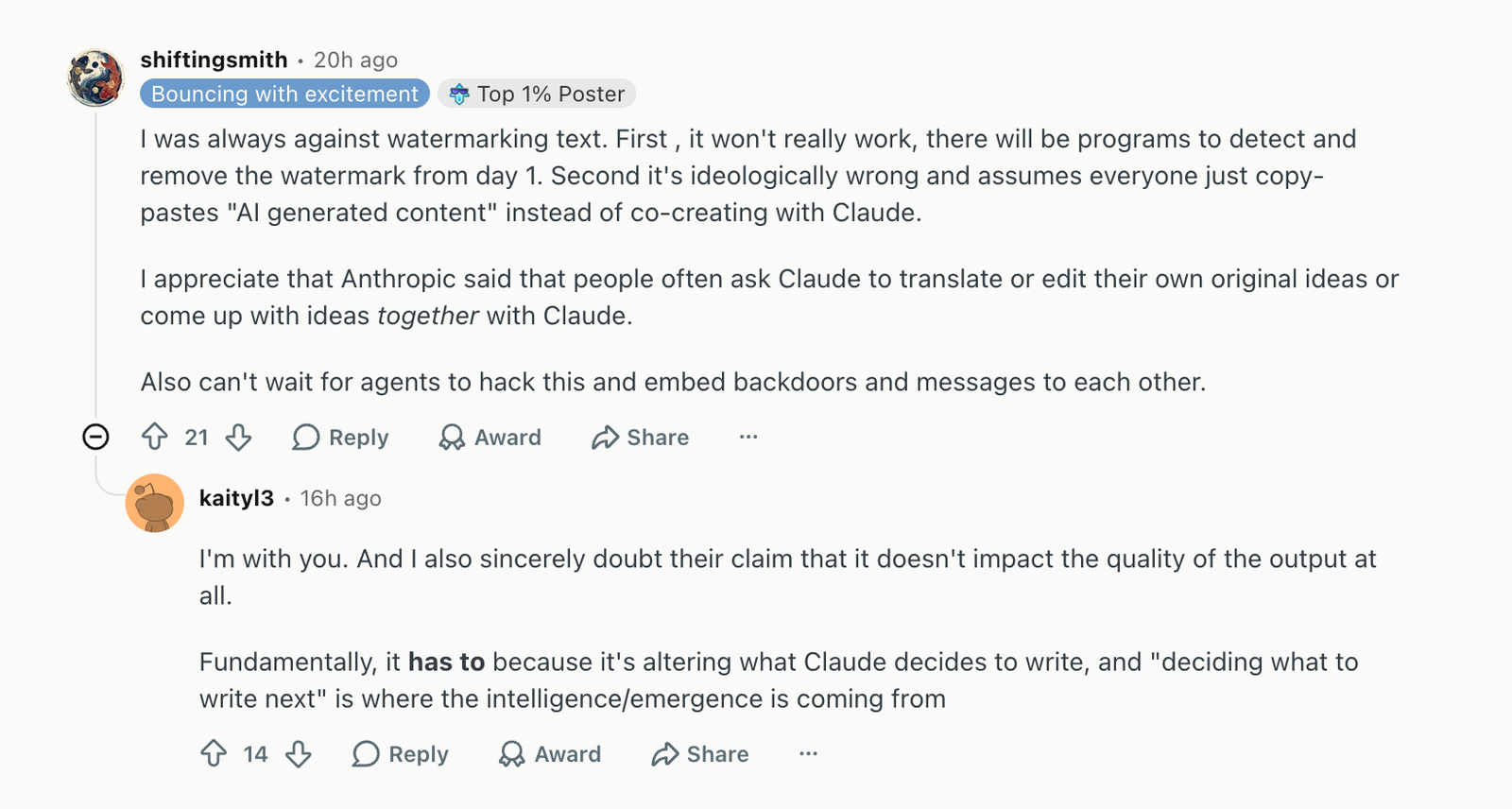
Both ideas deserve attention, but neither should be promoted from Reddit speculation to technical fact.
The prediction that removal tools will appear is plausible enough to investigate, especially because text can be transformed after generation. Anthropic’s own acknowledgement that substantial editing can affect detection also makes it worth examining how different editing methods can remove Claude watermarks. That still does not prove that someone has already found a reliable method for removing Claude’s watermark while preserving the original output.
The quality argument requires the same restraint. The commenters reason that if watermarking influences how text is generated, it must have some effect on token selection and therefore potentially on the finished response. That is a hypothesis. The screenshot does not demonstrate a measurable quality loss, and without Anthropic’s implementation details or controlled testing, we cannot infer the size or even the practical significance of any such effect.
These are exactly the kinds of claims that should eventually be tested, rather than settled through intuition. The interesting questions are whether the watermark survives different kinds of transformation and whether marked and unmarked generation can be shown to differ in measurable ways.
2. The authorship objection is harder to dismiss
The second screenshot gets into a different issue entirely. Here, the objection is not primarily about whether watermarking works. It is about what people may conclude when they discover that Claude was involved.
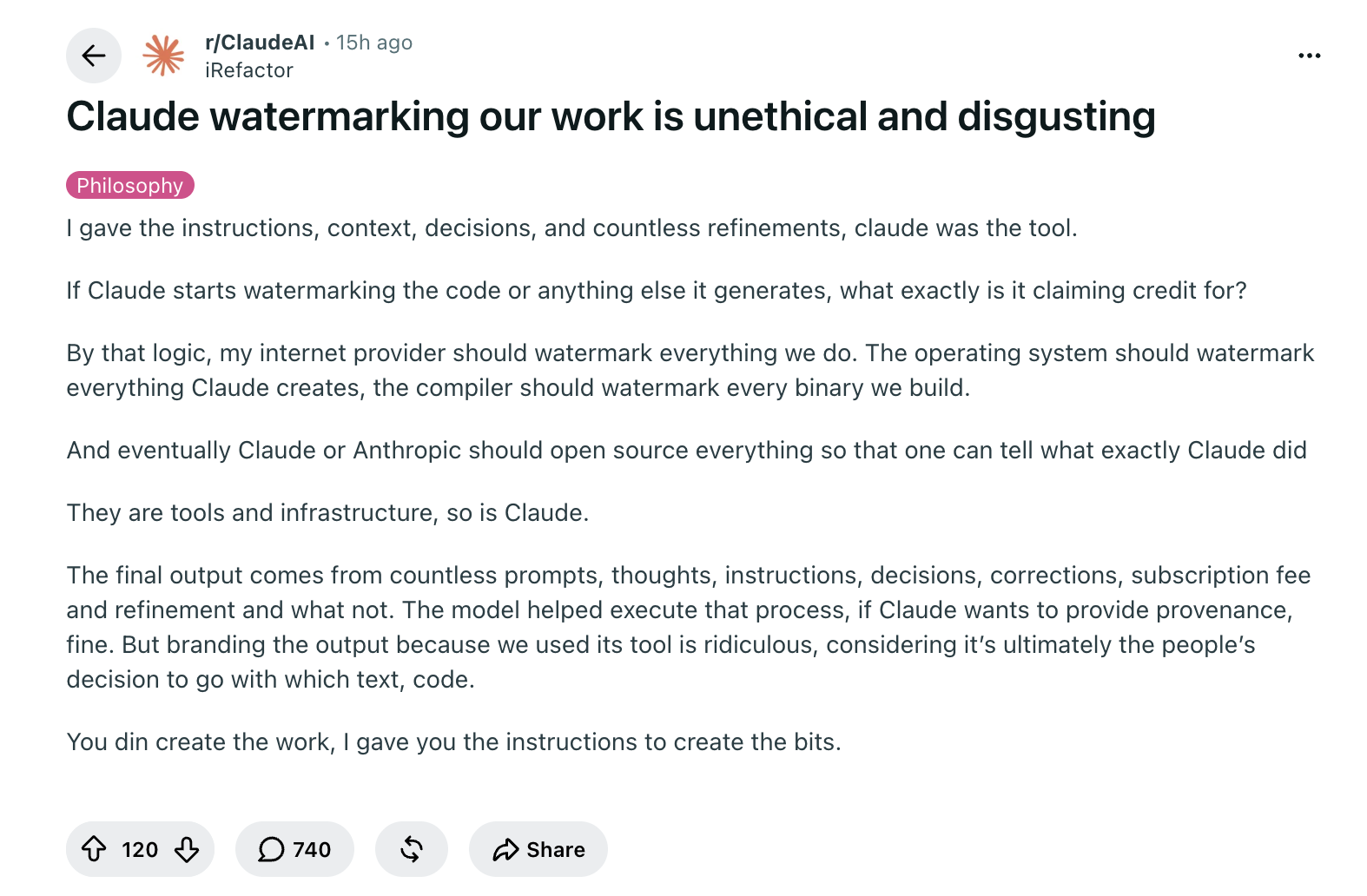
The poster’s language is deliberately strong, but underneath it is a question I think matters far beyond this particular controversy: what does a provenance signal tell us about authorship?
Consider a person who develops an idea, supplies the research, gives detailed instructions, rejects weak versions, corrects factual problems, changes the structure, and repeatedly directs Claude toward the final result. Claude has clearly participated in producing the output. That fact alone does not tell us how much of the intellectual contribution came from the model.
The same ambiguity becomes even more obvious when Claude is used to edit, proofread, translate, summarize, or reformat material that already existed. A signal that Claude processed the final version does not provide a percentage showing how much of that work originated with Claude.
The technical signal may be binary while the creative process is not. Knowing that Claude touched a document can be useful provenance information. Treating that signal as a complete account of who created the work would go much further than the watermark itself can tell us.
3. The broader backlash combines several different objections
The third screenshot is particularly useful because it is not an individual argument. It is an automated moderator summary of a much larger Reddit discussion after more than 800 comments.
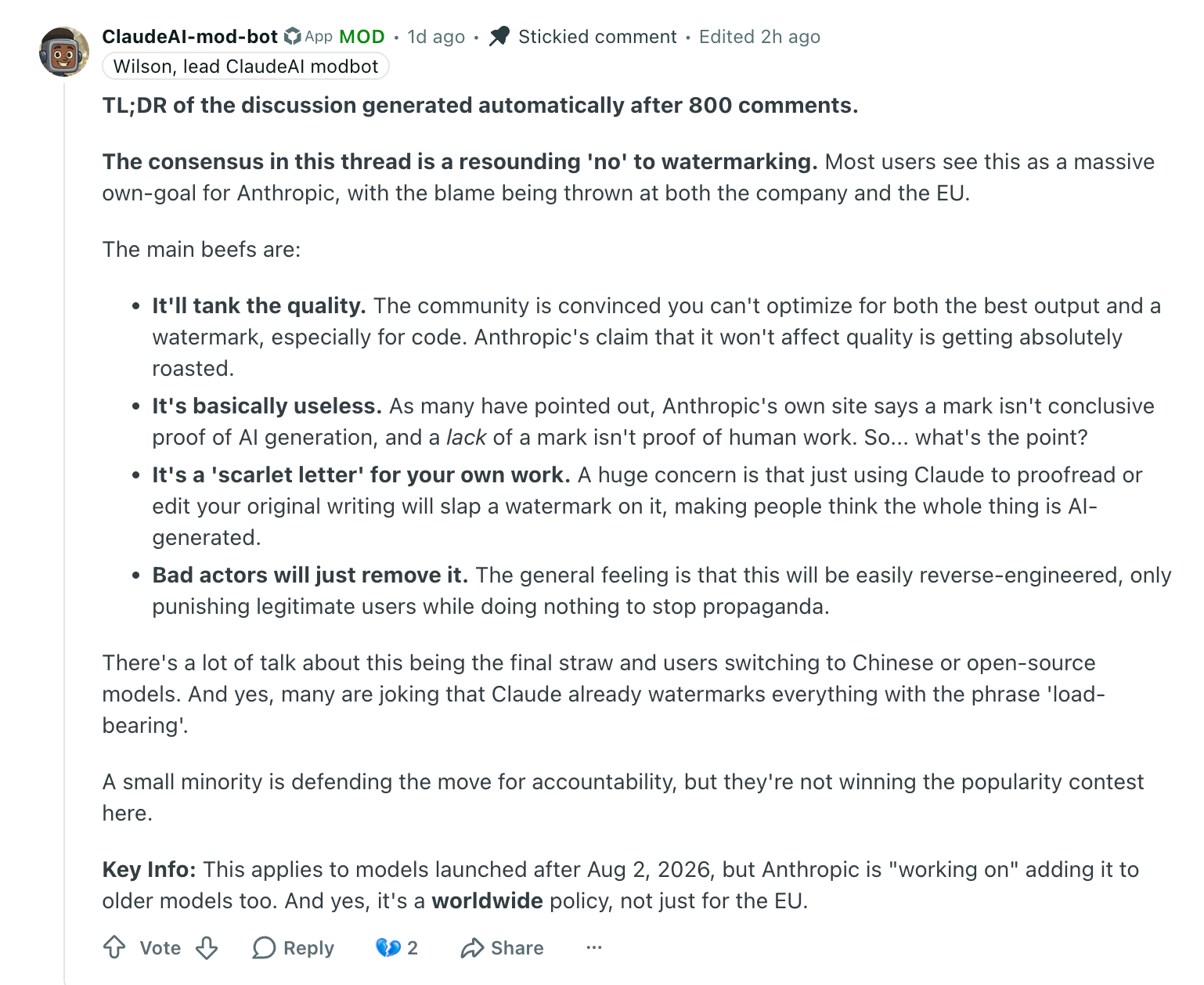
That last distinction is important. The screenshot tells us something about the reaction. It does not prove that watermarking will reduce Claude’s quality, that the system is useless, or that removal will be easy.
What it does show is how many separate objections are being bundled together. Some users fear a quality trade-off. Others question the value of a mark that is not conclusive proof of full AI authorship. Some worry that their own writing could be misinterpreted after using Claude for editing. Others expect determined users to find ways of disrupting the signal.
There is also a revealing tension inside those objections. People are simultaneously arguing that the watermark could be consequential enough to stigmatize legitimate AI-assisted work and fragile enough that people trying to evade it will simply remove it.
Those positions are not necessarily incompatible. A provenance system can create friction for ordinary users while still being imperfect against deliberate transformation. But whether Claude’s implementation ends up fitting that description is something evidence will have to establish.
The screenshots establish that parts of the Claude community are concerned about output quality, authorship, provenance, watermark durability, and removal. They do not establish that Claude’s watermark reduces quality, that a reliable removal technique already exists, or that any particular theory about how the watermark works is correct.
The strongest criticism is about interpretation
Of all the objections, I think the authorship issue may prove the most durable.
Technical questions can eventually be measured. Researchers can test how resilient a watermark is. They can compare outputs. They can examine detection rates after different kinds of editing. Anthropic can publish more implementation detail.
The social question is harder. If a detector says Claude processed a document, what should a teacher, editor, employer, publisher, client, or reader conclude from that?
The safest answer is less dramatic than either side of the Reddit debate. It tells us that Claude was involved in the content’s history. It does not automatically tell us who supplied the ideas, who performed the research, how heavily the output was edited, or how much human judgment shaped the final version.
That is why the reaction matters. The controversy is not only about a hidden signal inside Claude text. It is about what people may decide that signal means once they can see it.
What Claude users can do in response to watermarking
The practical response does not have to be “stop using Claude.” Depending on why you use it, there are several ways to adapt, from preserving your original drafts to changing where Claude sits in the writing process and, in some cases, substantially rewriting its output.
After looking at Anthropic’s announcement and the reaction around it, I would resist treating this as a choice between accepting the watermark or abandoning Claude altogether. Most users have more options than that.
The right response depends on what Claude is doing for you in the first place. Someone generating complete drafts has a different problem from someone who writes independently and uses Claude to tighten a paragraph. A developer using Claude Code has another workflow again.
1 Keep evidence of the work that started with you
If you regularly give Claude material you wrote yourself, one of the simplest responses is also one of the least technical: keep your original work.
Draft histories, document revisions, research notes, version control, and earlier copies can show how a piece developed before Claude became involved. That may matter in situations where a detected provenance signal is interpreted too broadly.
A Claude mark can potentially establish that Claude processed supported text. It cannot reconstruct the history of the document. If authorship matters in your environment, keeping that history gives you context the watermark cannot provide.
2 Change where Claude sits in your workflow
Another option is to use Claude without making its generated prose the final layer of your writing.
Claude can help analyze research, challenge an argument, suggest an outline, identify missing information, or critique a draft. A writer can then take those insights and compose the final version independently. That is a different workflow from asking Claude for finished copy and publishing the response with minor edits.
I suspect watermarking may push more experienced AI users in this direction. The question becomes less about whether AI touched the project and more about which parts of the creative process we are comfortable delegating to it.
The easiest way to reduce your dependence on AI-generated wording is not necessarily to use less AI. It is to use AI earlier, where it can help with thinking and analysis without becoming the final voice of the document.
3 Do not assume we know how Claude’s hidden signal works
One of the more interesting comments in the Reddit discussion described Claude’s watermark as sounding like “some form of steganography.” I think the comparison is useful, but only if we are careful about what it does and does not tell us.
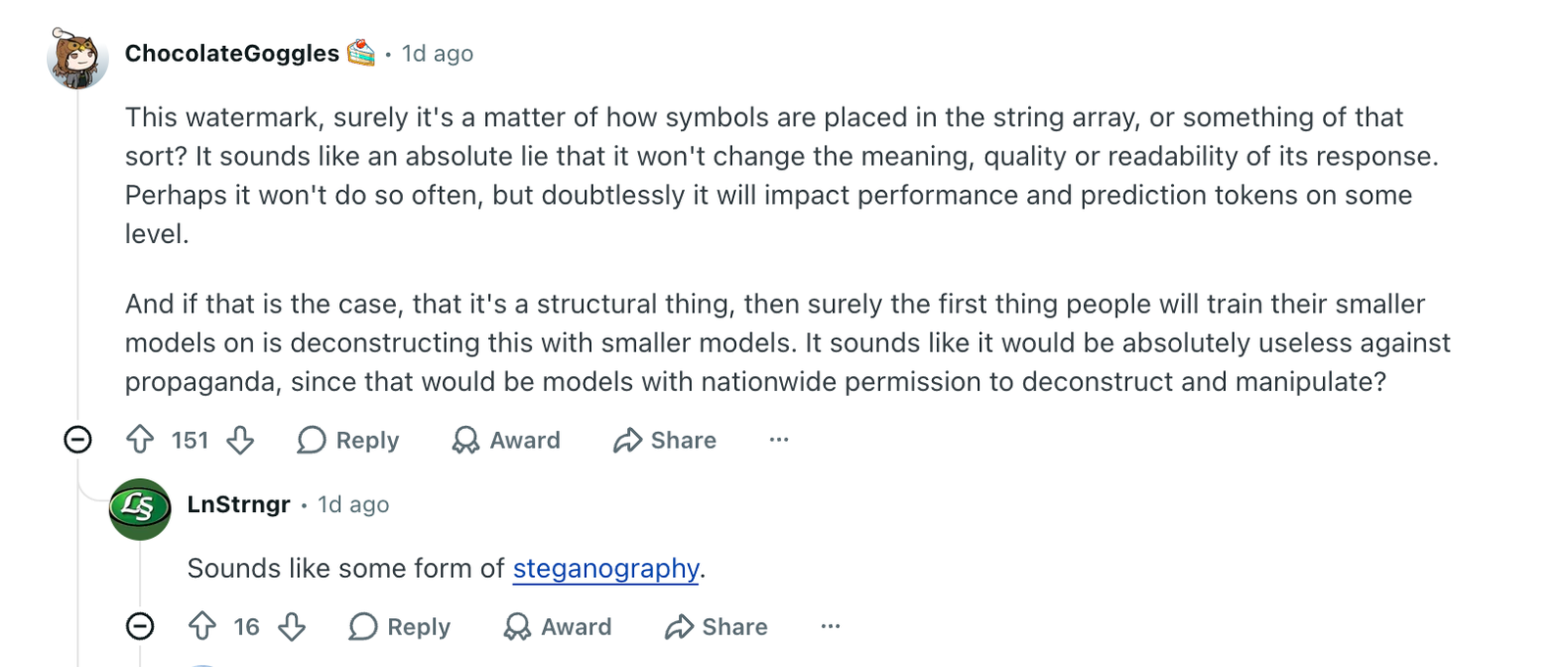
At a broad conceptual level, steganography involves concealing information within another medium so that the carrier can still appear ordinary. That makes the analogy understandable when discussing an imperceptible machine-readable signal embedded in readable text. It does not establish that Claude uses a specific steganographic technique.
This is an important place to separate analogy from evidence. Anthropic describes its system as an embedded text watermark. The company has not yet publicly explained enough about the encoding method for us to conclude from its current documentation that Claude’s implementation works through the particular structural mechanism suggested in the Reddit comment.
The commenter speculates, for example, about how symbols might be placed and whether that could influence token prediction. Those are interesting hypotheses. They are not findings we can verify from the information Anthropic has released so far.
I would apply the same standard to claims about defeating the watermark. Until we can inspect the detection mechanism or test against it directly, confident explanations of precisely where the hidden signal lives should be treated as theories.
4 Rewrite Claude output instead of treating the first draft as finished
This is where the discussion starts to overlap with Claude watermark removal. If you use Claude to generate substantial amounts of prose, another response is to treat that output as a draft rather than the final product.
A serious rewrite can change sentence construction, paragraph order, examples, transitions, vocabulary, argument structure, and voice. It can also introduce original reporting, expertise, and judgment that were not present in the Claude version.
This matters to the watermark discussion because substantial transformation can affect whether a supported Claude mark remains detectable. What we cannot yet say is that a particular amount or type of rewriting will reliably remove the watermark every time.
This is also why I would distinguish Claude watermark removal from simply chasing a lower score on an AI detector. A general AI detector and Claude’s watermark detection system are not measuring the same thing. Making writing appear more human to one does not prove that the other signal disappeared. For readers who want to compare the approaches now being marketed around this problem, we have also reviewed top AI humanizers for Claude watermark removal , with the important caveat that tool claims still need Claude-specific verification.
For people who want to keep Claude in the drafting process, WriteBros.ai offers another layer of rewriting. Rather than treating Claude’s first output as finished copy, it can be used to rework sentence structure, wording, rhythm, and voice so the final version is less dependent on the language Claude originally produced.
That makes WriteBros.ai relevant to the emerging Claude watermark removal discussion because Anthropic acknowledges that heavily edited and paraphrased text may lose a detectable mark. I would still stop short of calling WriteBros.ai, or any rewriting platform, a guaranteed Claude watermark remover until those claims can be tested directly against Anthropic’s supported detection system.
For now, the stronger reason to rewrite is editorial. If Claude gives you a useful starting point, the goal should be to turn that starting point into writing that reflects your knowledge, decisions, and voice. Whether the watermark survives that transformation is a separate technical question that still needs proper testing.
5 Decide whether provenance changes which AI tools you use
Some users may ultimately decide that machine-readable marking is a feature they are comfortable with. Others may decide it does not fit their workflow, particularly when AI is being used to edit material they already created.
That could make provenance policy another factor people consider when choosing an AI model, alongside price, context window, reasoning quality, privacy, speed, and writing ability.
I would not make that decision based on assumptions about which competing model is “watermark-free.” AI provenance is becoming an industry-wide issue, and provider policies can change. The more useful habit is to know what the model you use does with generated content and to build your workflow around that information.
Claude’s announcement therefore does not leave users with one response. You can preserve evidence of your original work, move Claude earlier in the creative process, rewrite generated drafts more substantially, or reconsider which tools fit the level of provenance you are comfortable with.
What I would avoid is treating the watermark as either unbeatable or trivial. We do not have enough evidence for either conclusion yet. The more interesting consequence may be that watermarking forces us to become much more precise about what it means to use AI in the first place.
What Claude’s watermark could change beyond this announcement
The bigger story is not whether users can work around a watermark. It is whether AI-generated content is moving toward a future where provenance becomes part of the content itself.
That is the shift I think matters most here. Claude’s watermark is not simply another feature inside an AI product. It points toward a different model for how AI-generated content may be tracked, interpreted, and discussed once it leaves the original interface.
For years, most AI-writing debates have started after the text already exists. Someone reads a document, suspects AI involvement, and turns to a detector or their own judgment. Provider-issued provenance starts earlier. The model itself can leave a machine-readable signal when supported content is generated or processed.
The debate is moving from whether writing looks AI-generated toward whether AI systems can leave evidence of their participation from the moment content is created.
Provenance could become more important than AI detection
Traditional AI detectors infer. They examine finished writing and estimate whether certain patterns resemble machine-generated text. A provider-issued watermark works from a different premise: instead of guessing what made the text, look for a signal placed there during generation.
That does not automatically make watermarking perfect. Signals can have limits, different providers can use different systems, and later editing can complicate detection. But it changes the type of evidence available.
If more AI companies move in this direction, provenance could eventually sit alongside metadata, citations, disclosure policies, and other signals used to understand how content was produced.
But provenance still does not settle authorship
This is the limitation I would keep returning to. Knowing that Claude was involved in a document does not tell us how much of the finished work belongs to Claude.
A writer might produce the original draft and ask Claude to improve clarity. A researcher might use it only to summarize notes. A marketer might generate a rough first version and then rebuild the entire article. A developer might use Claude to explain code they wrote themselves.
Those workflows all involve AI, but the human contribution is not remotely the same.
A watermark may help answer the first question. It cannot automatically answer the other two.
That is why interpretation may become more important than detection. A technically accurate signal could still be misunderstood if someone sees “processed by Claude” and assumes that means “written entirely by Claude.”
The real challenge will be mixed human-AI work
The future of AI-assisted writing is unlikely to be neatly divided between one person writing everything and one model writing everything. Most professional workflows will sit somewhere between those extremes.
A single article may involve human research, Claude-generated notes, human-written sections, AI-assisted editing, another human review, and several rounds of rewriting before publication.
That makes simple labels less useful. Saying that AI was involved is one piece of information. Understanding what the human contributed, what the model contributed, and who took responsibility for the final output is a much richer question.
Claude watermarking may prove most useful as a provenance signal, not as a shortcut for judging originality, effort, or authorship. Those are broader questions than one machine-readable mark can answer.
The next phase needs evidence, not assumptions
There are still important technical questions around the system itself. We do not yet know enough about how different kinds of editing affect detection, how reliable third-party verification will be, or how strongly passage length and transformation influence the signal.
Those questions should become easier to answer as Anthropic publishes more technical guidance and detection tools become available.
Until then, the most useful approach is to keep the categories separate. A Reddit theory is not proof of implementation. A detected watermark is not proof of total AI authorship. An absent watermark is not proof that AI was never involved. And a piece of text changing substantially after editing does not, by itself, reconstruct how that transformation happened.
The bigger question is what we want AI provenance to accomplish
If the goal is to give readers, platforms, and institutions more context about synthetic content, watermarking can be useful. If the goal is to determine exactly how much human thought went into a document, provenance alone will not get us there.
That distinction will matter more as AI use becomes normal rather than exceptional. The harder question will not be whether a model participated. It will be what the person did before, during, and after that participation.
Claude’s watermark is best understood as a signal of provenance, not a verdict on authorship. It can tell us something useful about Claude’s involvement, but it cannot explain the full creative history of a document. As AI-assisted writing becomes more collaborative, the value of provenance will depend just as much on how we interpret the signal as on whether we can detect it.
Frequently Asked Questions
Does Claude watermark AI-generated text?
Yes, for supported models. Anthropic says Claude models launched on or after August 2, 2026 support machine-readable marking at launch, with embedded watermarks applied to generated text. Anthropic is also working to add marking support to models released before that date. The marking applies worldwide where supported Claude models are offered, rather than only to users in the European Union.
Can people see the Claude watermark in generated text?
No. Anthropic describes the text watermark as imperceptible and embedded directly into the generated text. It is intended to be machine-readable rather than visually noticeable to someone reading or copying the response. Anthropic says the watermark can travel with copied text and may persist through some editing.
Can a Claude watermark be removed?
Anthropic acknowledges that a Claude mark may no longer be detectable after text has been heavily edited, paraphrased, translated, or mixed with other writing. That establishes an important limitation, but it does not prove that there is a universal Claude watermark removal method. Claims that a specific technique reliably removes the watermark should be tested against Anthropic’s supported detection mechanism once the necessary technical tools are available.
Does a Claude watermark prove that Claude wrote the entire document?
No. A detected mark indicates that the content may have been processed by Claude, but it does not establish the complete authorship history of the work. Someone could have written the original material and then used Claude to proofread, translate, summarize, edit, or transform it. A provenance signal therefore provides context about Claude’s involvement, not definitive proof of who authored every part.
Does no Claude watermark mean the text was written by a human?
No. The absence of a detectable Claude watermark does not prove human authorship. A mark may be absent because the text came from an older model, was substantially transformed, is too short for a reliable signal, or was produced through a context where a particular marking method was not supported. No detected watermark should not be treated as proof that AI was never involved.