Can AI Humanizers Remove Claude AI Watermarks? Why the Type of Rewrite Matters

Highlights
- AI humanizers may affect Claude watermarks.
- The depth of rewriting matters.
- Word swapping is not deep rewriting.
- AI detector scores are not proof.
- WriteBros.ai focuses on structural rewriting.
- Claude-specific testing is still required.
Can AI humanizers remove Claude AI watermarks?
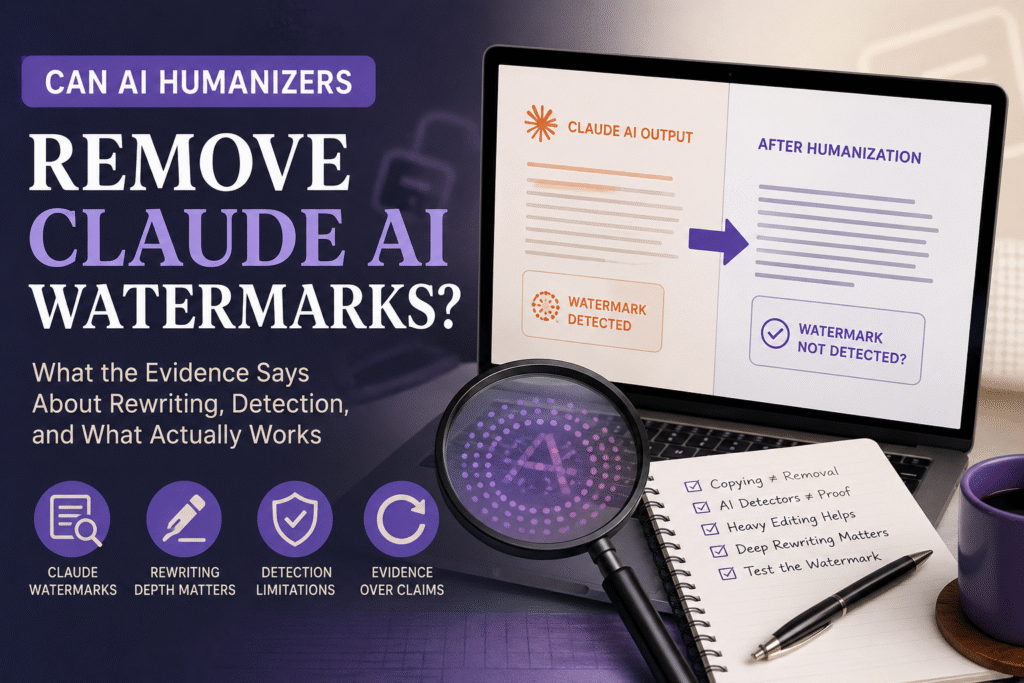
Yes, AI humanizers that substantially rewrite Claude-generated text may make its watermark undetectable. Anthropic acknowledges that heavy editing and paraphrasing can affect watermark detection. But no AI humanizer has yet been proven to reliably remove Claude’s watermark every time.
That last distinction matters. An AI humanizer can change Claude’s wording dramatically without proving that the underlying machine-readable signal disappeared. Understanding how Claude AI watermarking works matters because the only convincing evidence of removal would be testing the rewritten text against the corresponding Claude watermark detection system.
Still, there is a good reason AI humanizers are part of the Claude watermark removal conversation. Anthropic says its text watermark may no longer be detectable after heavy editing, paraphrasing, translation, or mixing Claude-generated material with other writing. Those transformations overlap closely with what some AI humanizers are designed to do.
The catch is that not all AI humanizers rewrite text in the same way. A tool that replaces predictable words while preserving Claude’s sentence structure is doing something very different from one that reconstructs sentences, changes rhythm, reorganizes phrasing, and rewrites the passage around a different voice.
Changes how the text is written
A humanizer can alter vocabulary, syntax, sentence rhythm, structure, tone, and other linguistic characteristics of Claude-generated prose.
Changes whether the mark can be detected
A successful removal claim requires evidence that Claude’s relevant machine-readable signal is no longer reliably detectable after the transformation.
This also explains why passing a conventional AI detector is not enough. Most AI detectors analyze characteristics of the finished writing and estimate whether it resembles machine-generated text. Claude’s watermark is a provider-issued signal embedded during generation. A humanizer could change one without necessarily proving anything about the other.
So asking whether AI humanizers can remove Claude AI watermarks leads to a more useful question: how deeply does the humanizer rewrite the original Claude output?
Surface paraphrasing, structural rewriting, and full editorial reconstruction are not equivalent transformations. If rewriting depth affects Claude watermark detectability, the type of humanizer being used may matter just as much as whether a humanizer was used at all.
Why the type of rewrite matters
“Humanizing” can mean anything from swapping a few words to rebuilding an entire passage. For Claude watermark detectability, those should not be treated as the same kind of transformation.
This is the biggest weakness in asking whether AI humanizers remove Claude watermarks as a single category. Two tools can both call themselves humanizers while changing the source text in completely different ways.
One might preserve Claude’s sentence structure and replace common AI phrases with alternatives. Another might reconstruct the sentences, change their length and order, rewrite transitions, alter the tone, and reorganize entire paragraphs. The finished drafts may both sound more human, but the amount of Claude’s original language that survives can be very different.
Surface paraphrasing
Individual words and phrases change, while sentence structure, argument order, and much of the original wording remain intact.
Structural rewriting
Sentences are reconstructed, syntax changes, transitions move, and ideas are expressed through substantially different language.
Editorial reconstruction
Paragraphs are reorganized, new material is introduced, examples change, and the final draft moves well beyond Claude’s original expression.
Anthropic identifies heavy editing and paraphrasing among the circumstances that can make its text watermark undetectable. That makes the depth of transformation central to understanding how different editing approaches may remove Claude watermarks, rather than simply whether a tool happens to carry the “AI humanizer” label.
Simple word swapping may leave most of the original text intact
Consider a Claude paragraph with ten sentences. If a humanizer replaces adjectives, changes a few verbs, and removes familiar AI phrases while preserving those ten sentences, most of the underlying construction is still there. The result may read differently without being a deep rewrite.
Structural rewriting goes further. A tool might turn ten sentences into seven, combine ideas, split others apart, change the order of information, replace transitions, and express the argument through new syntax. That is a much larger transformation of the generated text.
None of these changes should be treated as a guaranteed watermark-removal technique. Anthropic has not published a formula showing that changing a particular percentage of vocabulary or sentence structure will make the mark disappear.
But they give us a better framework for evaluating AI humanizers. Instead of asking whether a tool claims to “humanize” Claude text, ask how much of Claude’s original linguistic construction remains after the rewrite.
If Claude watermark persistence is affected by substantial transformation, a humanizer that rebuilds language and structure is more relevant to the question than one that mainly performs cosmetic paraphrasing. Whether that deeper rewrite is enough to make the watermark undetectable still requires direct testing.
A human detector score cannot prove the watermark is gone
This is the easiest mistake to make when testing AI humanizers. A Claude passage can move from “AI-generated” to “human” on a conventional detector without telling us whether Claude’s embedded watermark is still detectable.
AI detectors and Claude watermarks are trying to identify different things. A conventional detector examines finished writing and looks for patterns it associates with AI-generated prose. Claude’s watermark, by contrast, is a machine-readable signal introduced when supported text is generated.
That difference matters enormously when evaluating an AI humanizer. If Claude text receives a high AI score before rewriting and a low score afterward, the humanizer has clearly changed something the detector was responding to. It has not, on that evidence alone, demonstrated Claude AI watermark removal.
Asks what the writing resembles
It analyzes characteristics of the finished prose and estimates whether those patterns appear more machine-generated or human-written.
Looks for the embedded signal
The relevant system is looking for the machine-readable mark associated with supported Claude-generated text.
“This rewrite passes an AI detector” is evidence about the detector. “Claude’s watermark is no longer detectable” is a separate technical claim that needs Claude-specific verification.
So how would we know whether a humanizer worked?
The cleanest test starts with text known to contain a detectable Claude watermark. That same passage is then run through the AI humanizer, with the resulting changes documented. The rewritten version is finally checked using the corresponding Claude watermark detection mechanism.
And one successful passage would still be weak evidence. A meaningful test would need multiple samples, different text lengths, and repeated results. That broader evidence also matters when interpreting the Claude AI watermark figures around detection, limitations, and watermark persistence. Otherwise, it would be difficult to tell whether the humanizer consistently affected the mark or whether one passage simply fell below the detector’s reliable threshold.
This is also why screenshots showing a humanizer achieving a “0% AI” result should be treated carefully in the Claude watermark discussion. They can demonstrate that a rewriting tool changed the linguistic signals measured by that particular detector. They cannot establish what happened to a separate watermarking system.
The strongest evidence would be boring but useful: detectable Claude watermark before humanization, no detectable watermark afterward, and the same result repeated across a meaningful set of samples. Until that testing exists, claims that an AI humanizer “removes Claude watermarks” should be treated as unverified.
What kind of AI humanizer makes the most sense?
If rewriting depth matters, the strongest candidate is not necessarily the tool that promises the lowest AI-detector score. It is the one that makes meaningful changes to Claude’s original language while preserving what the writer is trying to say.
That changes how I would evaluate an AI humanizer for Claude content. Detector-focused marketing matters less than what happens to the text itself. The useful questions are whether sentences are reconstructed, whether repetitive patterns disappear, whether rhythm changes, and whether the final version develops a voice distinct from the Claude draft.
There is also a practical limit. Rewriting more aggressively is not automatically better. A humanizer can change so much that it damages meaning, introduces inaccuracies, or strips away useful details. The ideal transformation is deep enough to create genuinely different prose without turning the original argument into something else.
That is also the standard I would use when comparing AI humanizers for Claude watermark removal . The stronger candidates are not simply the ones making the boldest removal claims, but the ones capable of meaningful rewriting while preserving the information and intent of the source text.
Structural change
Sentences should be rebuilt rather than preserved beneath a layer of substituted vocabulary.
Voice preservation
A useful rewrite should sound more individual without sacrificing the meaning, facts, or purpose of the original draft.
Removal guarantees
A claim that a tool always removes Claude’s watermark needs direct Claude-specific evidence, not just an AI-detector screenshot.
Where WriteBros.ai fits
This is why WriteBros.ai is relevant to the Claude watermark discussion. Its usefulness here is not based on claiming that it has cracked or disabled Anthropic’s watermarking system. It comes from the depth of rewriting it can apply to AI-generated prose.
Instead of treating humanization as a synonym-replacement exercise, WriteBros.ai can reshape sentence construction, phrasing, rhythm, and voice. That puts it closer to the structural rewriting side of the spectrum discussed earlier in this article.
Anthropic acknowledges that heavy editing and paraphrasing can affect whether its text watermark remains detectable. A tool built around deeper rewriting therefore presents a more interesting test case than one that leaves most of Claude’s original construction intact.
That still should not be turned into a guarantee. Until rewritten samples are tested directly against the relevant Claude watermark detection system, the defensible claim is that WriteBros.ai can substantially transform Claude-generated text, not that every rewrite will remove its watermark.
Judge the rewrite before judging the claim
A useful way to compare humanizers is to put the original Claude response beside the rewritten version and inspect what survived. If the same sentences appear in the same order with different adjectives, the transformation is relatively shallow. If the language, syntax, pacing, and organization have been rebuilt, the rewrite is materially deeper.
For Claude content, I would choose a humanizer based on rewriting depth and fidelity before worrying about a flashy detector score. If deeper transformation proves important to watermark detectability, those are the characteristics most likely to make one humanizer more relevant than another.
So, can AI humanizers remove Claude AI watermarks?
The answer remains a qualified yes: sufficiently deep rewriting may make a Claude watermark undetectable, but calling any AI humanizer a guaranteed watermark remover goes beyond the evidence available today.
The reason for that answer comes directly back to rewriting depth. Anthropic acknowledges that heavy editing and paraphrasing can affect whether its text watermark remains detectable. AI humanizers can perform those kinds of transformations, but the amount of transformation varies dramatically from one tool and rewrite to another.
A basic paraphraser that swaps words while preserving Claude’s original sentences gives us little reason to treat the text as fundamentally reconstructed. A deeper humanizer that rebuilds syntax, sentence rhythm, phrasing, and structure creates a much more substantial transformation. That makes deeper rewriting more relevant to the watermark question, but relevance is still not proof of removal.
Humanizers can change the text substantially
Structural rewriting can transform far more of Claude’s original language than simple synonym replacement.
Deep rewriting may affect detectability
This is consistent with Anthropic identifying heavy editing and paraphrasing as limitations of watermark detection.
Humanization does not guarantee removal
A rewrite needs Claude-specific watermark testing before anyone can credibly claim the embedded mark has become undetectable.
The best reason to humanize Claude content goes beyond the watermark
There is also a broader point worth keeping in view. Claude watermark removal should not become the only reason to rewrite Claude-generated text. Raw AI drafts often benefit from editing regardless of whether a machine-readable mark is present.
Rewriting gives a writer the chance to challenge generic phrasing, add original examples, correct weak assumptions, change the rhythm, introduce personal judgment, and make the final piece sound like something they would genuinely publish. Those improvements remain valuable even if watermark detection never enters the conversation.
This is also the more useful way to think about tools such as WriteBros.ai. The strongest case for a deeper humanizer is not that it offers a magic switch for Claude’s watermark. It is that it can move a draft further away from generic AI phrasing and toward a substantially rewritten piece of content while preserving the writer’s intended meaning.
The proof still has to come from the watermark
As Claude watermarking becomes easier to test directly, this question should become much less speculative. Different humanizers can be compared using the same Claude-generated passages, the same watermark checks, and the same testing conditions. That would tell us whether structural rewriting consistently changes watermark detectability and whether some approaches perform differently from others.
Until then, the language around AI humanizers should stay precise. Passing an AI detector is not Claude watermark removal. Producing a much better rewrite is not proof either. Both can be useful outcomes, but the watermark itself needs to be tested before the removal claim is earned.
Can AI humanizers remove Claude AI watermarks? Potentially, yes, especially when they substantially reconstruct the original text. But the type of rewrite matters, and no humanizer should be treated as a guaranteed Claude watermark remover without repeatable Claude-specific testing. For now, deeper rewriting is the strongest reason to test a humanizer, not a promise that the mark will disappear.
AI humanizers and Claude watermarks: FAQs
The biggest questions come down to rewriting depth, watermark detectability, and what counts as genuine evidence of removal.
Can AI humanizers remove Claude AI watermarks?
Potentially. AI humanizers that substantially rewrite Claude-generated text may affect watermark detectability because Anthropic acknowledges that heavy editing and paraphrasing can make its text watermark undetectable. However, AI humanizers have not been proven as a category to reliably remove Claude watermarks every time.
Does every AI humanizer affect Claude watermarks the same way?
No such conclusion can currently be made. AI humanizers vary considerably in how they rewrite text. Some primarily replace words and phrases, while others reconstruct sentences, syntax, rhythm, and paragraph structure. If rewriting depth affects watermark detectability, those differences could matter.
Can deep rewriting make a Claude watermark undetectable?
It can. Anthropic identifies heavy editing and paraphrasing among the circumstances in which its text watermark may no longer be detectable. There is not, however, a published threshold showing exactly how much rewriting is required for that to happen.
Does passing an AI detector mean the Claude watermark was removed?
No. Conventional AI detectors and Claude’s provider-issued watermark measure different things. A humanizer may change a passage enough to receive a human result from an AI detector while that result tells us nothing conclusive about whether Claude’s machine-readable watermark remains detectable.
How can you test whether an AI humanizer removed a Claude watermark?
The strongest test would confirm a detectable Claude watermark before humanization, rewrite the same passage, and then test the rewritten version using the corresponding Claude-specific watermark detection mechanism. The experiment should also be repeated across multiple passages and text lengths before drawing conclusions about whether a humanizer works consistently.