How to Rewrite Content Flagged by Copyleaks: 15 Editorial Revisions
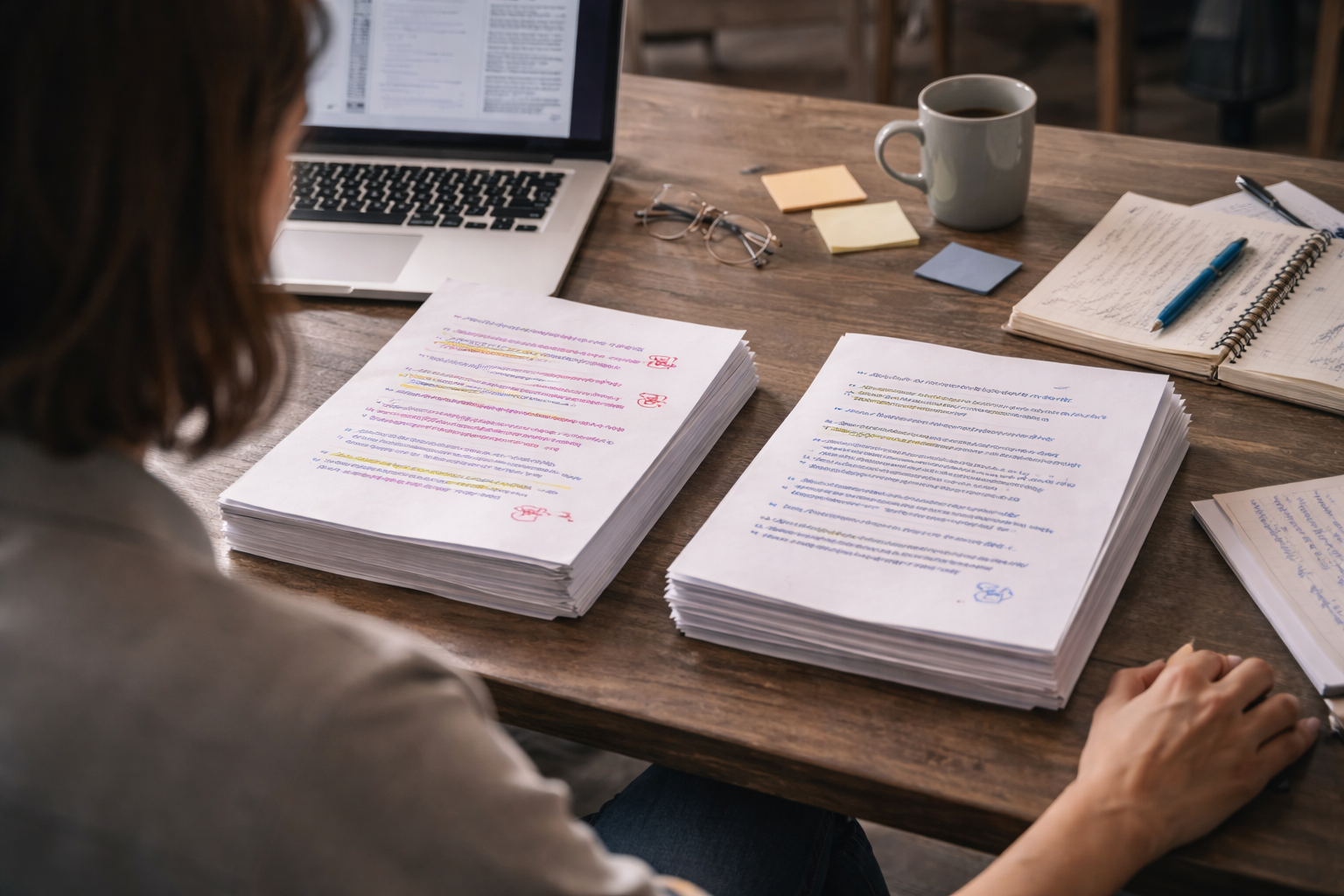
In 2026, rewriting content flagged by Copyleaks requires structural and semantic edits that reduce statistical uniformity rather than simple synonym swaps. Research published in the journal Patterns by Cell Press supports how AI text detection relies on distributional signals in language, reinforcing the need for deeper editorial revision.
How to Rewrite Content Flagged by Copyleaks: 15 Editorial Revisions
You ran your draft through Copyleaks and it came back flagged, even though the ideas are original and the structure is yours. If you’ve seen cases where Copyleaks flags human writing as AI, you know how frustrating and confusing that result can feel.
This usually happens because the writing follows predictable sentence rhythms, safe vocabulary, and overly tidy transitions that resemble machine patterns. Research drawn from Copyleaks AI misclassification data shows that structural similarity often triggers scores more than intent or originality.
The good news is you don’t need to scrap your entire piece to fix it. In this guide, you’ll learn 15 focused editorial revisions you can apply immediately, using techniques similar to those found in the best AI paraphrasers for tone and clarity improvements but executed with deliberate human judgment.
| # | Strategy focus | Practical takeaway |
|---|---|---|
| 1 | Sentence rhythm variation | Break predictable patterns to create more natural pacing. |
| 2 | Structural reshaping | Reorganize sections so ideas unfold less mechanically. |
| 3 | Voice specificity | Replace neutral phrasing with grounded, situational language. |
| 4 | Transition tightening | Remove overly polished connectors that read formulaic. |
| 5 | Paragraph compression | Trim repetitive phrasing to reduce statistical uniformity. |
| 6 | Lexical diversification | Swap generic word choices for precise, context-driven alternatives. |
| 7 | Active voice balance | Introduce natural subject-driven sentences without forcing them. |
| 8 | Idea sequencing shifts | Adjust order of explanation to avoid predictable flows. |
| 9 | Concrete examples | Anchor abstract advice in lived or realistic scenarios. |
| 10 | Intentional imperfection | Allow slight asymmetry in phrasing to reduce algorithmic signals. |
| 11 | Semantic reframing | Rewrite concepts at the idea level rather than swapping words. |
| 12 | Tone recalibration | Align delivery with audience context instead of default neutrality. |
| 13 | Redundancy elimination | Cut echoed clauses that inflate pattern repetition. |
| 14 | Context layering | Add situational nuance to reduce generic framing. |
| 15 | Final detection pass | Recheck after edits to confirm pattern reduction before publishing. |
15 Editorial Revisions to Rewrite Content Flagged by Copyleaks
How to Rewrite Content Flagged by Copyleaks – Strategy #1: Sentence rhythm variation
When you rewrite content flagged by Copyleaks, begin by examining sentence rhythm, because highly uniform sentence length and predictable clause structure frequently resemble machine-generated writing patterns. Instead of allowing every sentence to follow a clean subject-verb-object flow, deliberately vary cadence by combining longer reflective sentences with shorter clarifying ones, while also introducing dependent clauses that feel conversational rather than mechanical. Good execution means reading the passage aloud and adjusting phrasing anywhere the tempo feels overly even or metronomic.
This works because detection systems often evaluate statistical regularity, and uniform rhythm can quietly inflate those signals even when the ideas are original. Imagine a section where every sentence spans roughly twenty words and ends with similar transitional phrasing, which subtly creates algorithmic symmetry that feels polished but artificial. Breaking that symmetry with organic variation preserves clarity while reducing the repetitive linguistic fingerprint that triggered the flag in the first place.
How to Rewrite Content Flagged by Copyleaks – Strategy #2: Structural reshaping
To rewrite content flagged by Copyleaks effectively, look beyond wording and reconsider the structure of the section itself, because paragraph architecture often mirrors common AI drafting templates. Rearranging the order of explanation, embedding a clarifying example earlier, or separating an overloaded paragraph into two distinct idea blocks can significantly alter the statistical profile of the piece. Strong structural reshaping feels intentional rather than chaotic, maintaining logical flow while subtly disrupting formulaic sequencing.
Detection models frequently recognize familiar scaffolding patterns, especially introductions that define, explain, and conclude in nearly identical proportions across sections. If your draft consistently opens with a broad claim, follows with three evenly weighted supporting statements, and closes with a tidy summary, it may read as system-generated even when it is not. Adjusting that architecture, perhaps by starting with context or tension instead of a definition, changes the narrative footprint without sacrificing coherence.
How to Rewrite Content Flagged by Copyleaks – Strategy #3: Voice specificity
Another essential step when you rewrite content flagged by Copyleaks is replacing neutral, generalized phrasing with language grounded in specific context, because overly generic tone frequently resembles automated output. Rather than saying that something improves clarity or increases effectiveness, describe how and under what conditions that improvement appears, weaving in situational nuance that reflects lived reasoning. Effective voice specificity does not require dramatic storytelling, but it does require deliberate detail that signals authentic perspective.
Generic tone tends to compress complexity into broad statements that feel technically correct yet emotionally distant, which is a pattern detection tools may associate with AI drafting. Consider a paragraph that repeats abstract phrases such as optimal results or enhanced performance without clarifying the setting or constraint, since that repetition creates uniform semantic density. Infusing the passage with context, such as audience type, publishing environment, or workflow limitations, reduces that uniformity and adds a distinctly human contour.
How to Rewrite Content Flagged by Copyleaks – Strategy #4: Transition tightening
When you rewrite content flagged by Copyleaks, evaluate your transitions carefully, because overly polished connectors can inadvertently create algorithmic consistency. Phrases such as in conclusion, furthermore, and in addition may be correct, yet repeating them with mechanical regularity reinforces a template-like cadence that detection systems can recognize. Tightening transitions often means removing unnecessary connectors entirely or replacing them with subtler relational cues embedded within the sentence itself.
This adjustment works because human writing frequently moves between ideas with implied logic rather than overt signposting in every paragraph. If each section begins with a formal transitional adverb and follows a similar explanatory pattern, the structure can resemble training data distributions more than spontaneous reasoning. Allowing some transitions to emerge naturally from context, instead of announcing them explicitly, softens the detectable structure without compromising clarity.
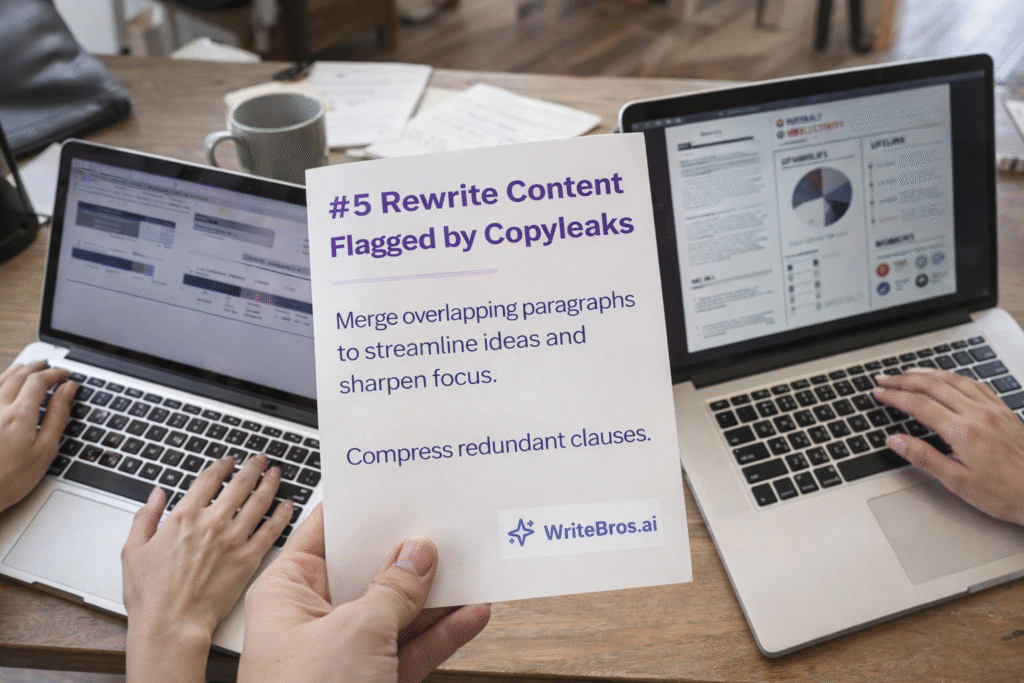
How to Rewrite Content Flagged by Copyleaks – Strategy #5: Paragraph compression
To rewrite content flagged by Copyleaks successfully, review paragraphs for subtle redundancy, because repetition at the clause level can inflate pattern similarity scores. Writers sometimes restate the same concept with minor lexical variation, believing it strengthens emphasis, yet this duplication often creates uniform semantic blocks that resemble automated elaboration. Compressing paragraphs by merging overlapping sentences sharpens intent and reduces repetitive statistical markers.
Detection tools frequently identify repeated thematic structures that appear across adjacent sentences, especially when each one echoes the same core claim with slightly adjusted wording. Imagine a section that defines a concept, restates it with different vocabulary, and then summarizes it again without adding fresh perspective, since that cyclical motion increases similarity density. Cutting that loop and preserving only the most precise formulation creates leaner prose that feels deliberate rather than algorithmically expanded.
How to Rewrite Content Flagged by Copyleaks – Strategy #6: Lexical diversification
When you rewrite content flagged by Copyleaks, examine vocabulary patterns across the entire draft, because repeated reliance on safe, high-frequency words can resemble language model defaults. Instead of merely swapping synonyms randomly, identify clusters of overused terms and replace them with context-driven alternatives that reflect precise intent and audience expectations. Effective lexical diversification preserves meaning while subtly altering the statistical distribution of words across the text.
Detection systems often rely on probability modeling, which means predictable word selection can contribute to elevated AI likelihood scores even in original writing. If multiple paragraphs repeatedly use broad verbs such as improve, enhance, or optimize without variation, the semantic field becomes compressed and formulaic. Thoughtful variation grounded in context, rather than arbitrary synonym replacement, expands that field and produces a more organic linguistic signature.
How to Rewrite Content Flagged by Copyleaks – Strategy #7: Active voice balance
To rewrite content flagged by Copyleaks in a natural way, reassess how frequently you rely on passive constructions, because excessive neutrality can mirror model-generated tone. While passive voice has legitimate uses, especially in technical writing, balancing it with active phrasing introduces agency and clearer subject presence. A strong revision consciously alternates between descriptive object focus and explicit actor-driven sentences that feel intentional.
Highly neutral phrasing can flatten narrative perspective, creating a uniform informational surface that lacks personal orientation. For example, repeated structures such as it is considered or it is believed remove identifiable actors and subtly increase abstract density across the passage. Introducing defined subjects, such as researchers, editors, or teams, breaks that abstraction and aligns the prose more closely with natural human explanation patterns.
How to Rewrite Content Flagged by Copyleaks – Strategy #8: Idea sequencing shifts
When you rewrite content flagged by Copyleaks, reconsider the order in which ideas unfold, because predictable sequencing can mirror common generative templates. Instead of always moving from definition to explanation to example, experiment with opening a section through context or tension before clarifying the concept itself. Thoughtful sequencing changes how the narrative breathes, even when the underlying information remains the same.
Detection tools often recognize recurring progression models that appear across large datasets, especially instructional formats with rigid internal symmetry. If every strategy follows an identical informational arc, the draft may appear statistically patterned rather than dynamically composed. Altering the sequence in selected sections introduces asymmetry that feels intuitive to readers while reducing detectable structural repetition.
How to Rewrite Content Flagged by Copyleaks – Strategy #9: Concrete examples
To rewrite content flagged by Copyleaks with greater authenticity, embed concrete examples that illustrate abstract advice in plausible scenarios. Broad recommendations alone can create conceptual uniformity, whereas situational grounding introduces variability in syntax, vocabulary, and emphasis. Effective examples are woven naturally into explanation rather than isolated as mechanical add-ons.
Abstract writing tends to maintain consistent semantic distance from the reader, which can resemble generalized AI output. Imagine guidance that repeatedly states best practices without anchoring them in workflow realities, editorial constraints, or audience dynamics, since that abstraction narrows expressive range. Adding context-rich examples widens that range and signals experiential reasoning rather than purely synthesized instruction.
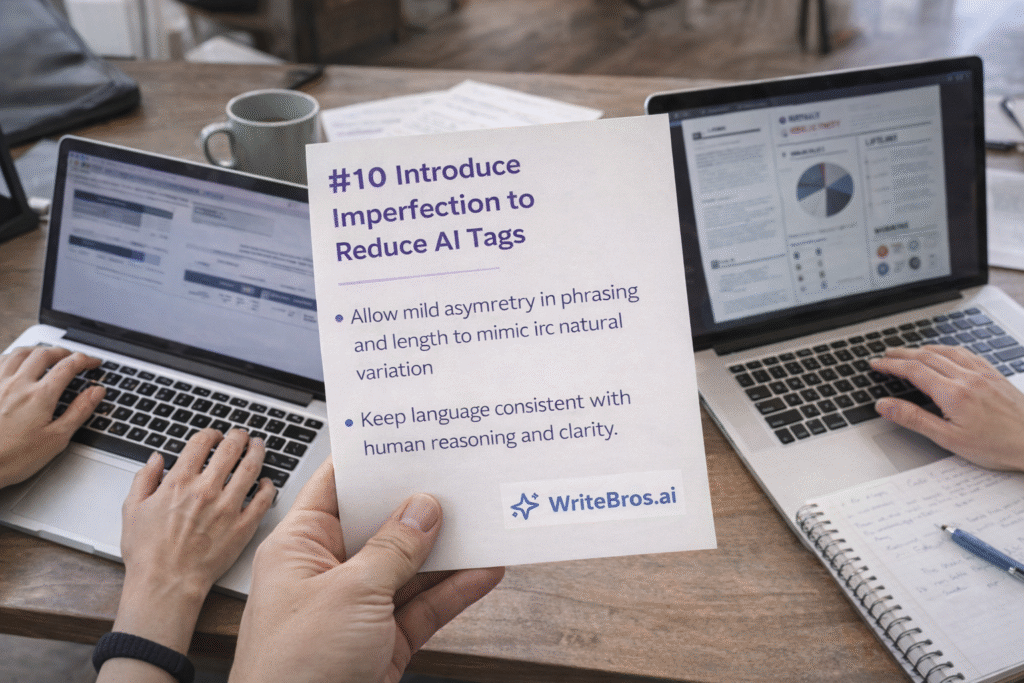
How to Rewrite Content Flagged by Copyleaks – Strategy #10: Intentional imperfection
When you rewrite content flagged by Copyleaks, allow for subtle asymmetry in phrasing, because perfectly balanced sentences and parallel structures can appear algorithmically optimized. Human writing frequently contains minor irregularities, such as uneven clause length or occasional shifts in emphasis, which create organic texture. Introducing controlled imperfection should never reduce clarity, but it can soften overly engineered polish.
Detection systems sometimes interpret excessive symmetry as a signal of generative origin, especially when multiple paragraphs exhibit identical cadence. A draft in which every sentence resolves cleanly and mirrors the structure of its neighbors may read technically refined yet statistically uniform. Relaxing that symmetry in selective areas produces a more natural distribution of linguistic features without compromising professionalism.
How to Rewrite Content Flagged by Copyleaks – Strategy #11: Semantic reframing
To rewrite content flagged by Copyleaks at a deeper level, move beyond surface paraphrasing and reconsider how the idea itself is expressed, because shallow synonym swaps rarely change detection outcomes. Semantic reframing means approaching the concept from a slightly different analytical angle, emphasizing cause instead of effect or process instead of outcome. Effective reframing preserves intent while altering conceptual framing enough to reshape the statistical signature.
Detection tools often evaluate patterns at the phrase and clause level, so cosmetic edits can leave the underlying structure intact. If the paragraph continues to follow the same argumentative progression with similar relational phrases, the algorithmic footprint may remain recognizable. Rearticulating the core logic in a fresh configuration produces genuine transformation rather than superficial variation.
How to Rewrite Content Flagged by Copyleaks – Strategy #12: Tone recalibration
When you rewrite content flagged by Copyleaks, reassess whether the tone aligns with a specific audience rather than defaulting to broad neutrality. Overly balanced tone that avoids perspective can mirror generative training data, whereas calibrated tone reflects situational awareness and reader expectation. Adjusting tone may involve modulating confidence levels, refining nuance, or integrating conditional phrasing that signals thoughtful consideration.
Uniform tone across every section can create a smooth but monotonous reading experience that resembles system output. If each paragraph carries identical certainty and emotional temperature, the statistical pattern becomes evenly distributed. Introducing tonal variation that responds to context, such as caution in complex sections and assertiveness in practical guidance, adds dimensionality and reduces uniformity.
How to Rewrite Content Flagged by Copyleaks – Strategy #13: Redundancy elimination
To rewrite content flagged by Copyleaks effectively, identify and remove echoed clauses that subtly restate the same idea without advancing it. Writers often repeat points in slightly altered language to ensure clarity, yet this can create layered similarity patterns that resemble automated expansion. Eliminating redundancy sharpens focus and decreases repetitive semantic density.
Detection systems can register high overlap in adjacent sentences, especially when each one mirrors the central claim with minor lexical adjustments. A paragraph that cycles through explanation, restatement, and micro-summary may feel thorough but statistically dense. Streamlining that cycle into a single, precise articulation improves readability and alters measurable repetition patterns.
How to Rewrite Content Flagged by Copyleaks – Strategy #14: Context layering
When you rewrite content flagged by Copyleaks, add contextual layers that situate the idea within a defined environment, because decontextualized advice often reads generically. Context layering might include referencing publishing constraints, editorial workflows, or audience behavior that shapes the recommendation. This added dimension diversifies vocabulary and sentence construction organically.
Generic framing tends to rely on universal claims that apply everywhere and nowhere simultaneously, which can resemble large-scale training outputs. If the guidance sounds equally applicable to any scenario without adjustment, it may lack the irregular texture of lived application. Embedding context introduces variability that naturally disrupts uniform linguistic patterns.
How to Rewrite Content Flagged by Copyleaks – Strategy #15: Final detection pass
After you rewrite content flagged by Copyleaks using the previous revisions, conduct a final review that evaluates the draft holistically rather than sentence by sentence. Read through the entire piece to ensure that rhythm, tone, structure, and vocabulary now display organic variation across sections. This comprehensive pass confirms that the adjustments work together rather than appearing isolated.
A final evaluation is necessary because isolated edits may not sufficiently alter the aggregate statistical profile of the document. If multiple sections still follow similar cadence or structural progression, the overall pattern could remain detectable despite localized changes. Assessing the draft as an integrated whole ensures the revisions meaningfully reduce uniformity before publication.
Common mistakes
- Relying exclusively on synonym replacement tools without reconsidering structure often leaves the deeper linguistic patterns intact, because superficial word swaps do not meaningfully alter rhythm, sequencing, or conceptual framing. This mistake happens when writers focus on vocabulary alone, and it backfires because detection systems evaluate broader statistical features beyond individual word choice.
- Overcorrecting the draft with excessive stylistic experimentation can create awkward phrasing and reduced clarity, especially when changes are made without preserving logical flow. Writers sometimes attempt to force irregularity into every sentence, yet this can introduce confusion that undermines credibility while still failing to reduce patterned structure.
- Ignoring paragraph-level symmetry is a frequent oversight, since many drafts maintain identical internal proportions across sections even after minor edits. This happens because structural habits feel natural, yet maintaining uniform scaffolding across multiple strategies can sustain detectable repetition.
- Keeping abstract language throughout the revision process often preserves the original statistical profile of the piece. Writers may believe that technical tone protects authority, yet abstraction without contextual grounding can resemble generalized model output and maintain elevated AI likelihood signals.
- Repeating transitional phrases across multiple sections creates consistent cadence that feels organized but algorithmically uniform. This mistake usually occurs when writers rely on familiar connectors for clarity, and it backfires because repeated structural cues increase measurable similarity.
- Failing to perform a holistic reread after revisions leaves fragmented adjustments scattered across the draft. Without assessing rhythm, tone, and structure collectively, writers may correct isolated issues while preserving overarching uniformity that continues to trigger flags.
Edge cases
In highly technical or academic contexts, certain structural regularities may be necessary to maintain clarity and disciplinary standards. Rewriting in these cases requires careful calibration so that variation does not compromise precision or compliance with formal guidelines.
Similarly, collaborative documents with multiple contributors may exhibit blended stylistic fingerprints that complicate detection outcomes. In those situations, harmonizing tone and structure thoughtfully, rather than amplifying variation indiscriminately, helps maintain coherence while still reducing uniformity.
Supporting tools
- Comprehensive grammar analysis platforms that provide sentence-level diagnostics can help identify passive constructions, repetitive vocabulary, and structural uniformity, offering objective insight into patterns that may not be immediately visible during manual review.
- Readability assessment tools that measure sentence length distribution and complexity variation allow writers to evaluate cadence quantitatively, which supports deliberate rhythm adjustments rather than relying solely on intuition.
- Plagiarism detection platforms with detailed similarity breakdowns can reveal overlapping phrasing clusters, enabling targeted compression and reframing without unnecessary rewriting of unaffected sections.
- Style analysis software that highlights repeated transition phrases or overused terminology assists in lexical diversification, helping reduce repeated semantic fields across adjacent paragraphs.
- Collaborative editing environments with version tracking support structured experimentation, making it easier to test structural reshaping and revert changes that compromise clarity.
- WriteBros.ai provides structured rewriting workflows designed to adjust tone, cadence, and conceptual framing, which can support editorial refinement when paired with deliberate human oversight and contextual judgment.
Ready to Transform Your AI Content?
Try WriteBros.ai and make your AI-generated content truly human.
Conclusion
Rewriting content that has been flagged requires more than cosmetic edits, because detection outcomes often reflect cumulative structural and rhythmic patterns across the entire document. Applying intentional variation in cadence, structure, tone, and conceptual framing creates a draft that reads with greater dimensionality and authenticity.
The goal is not perfection or theatrical complexity, but deliberate editorial judgment that aligns language with human reasoning patterns. Thoughtful revision, grounded in clarity and contextual awareness, ultimately produces work that stands on its own without triggering unnecessary algorithmic suspicion.
Did You Know?
If you want to rewrite content flagged by Copyleaks successfully, focus on paragraph architecture and rhythm before synonym swaps, because evenly sized sections and mirrored sentence structures can preserve the same detection profile.
Let some explanations expand with layered reasoning while others narrow for emphasis, and allow transitions to arise from context instead of repeating formal connectors, since that uneven development more closely mirrors how people revise and refine real drafts.
Ready to Transform Your AI Content?