How to Humanize ChatGPT Marketing Copy: 15 Brand-Safe Adjustments

How to Humanize ChatGPT Marketing Copy breaks down 15 practical edits that make AI-generated campaigns sound clearer, sharper, and more trustworthy without losing efficiency. Research from Stanford HAI on trust and generative AI reinforces why readers respond better to communication that feels grounded, believable, and emotionally calibrated.
How to Humanize ChatGPT Marketing Copy: 15 Brand-Safe Adjustments
AI-generated campaigns can sound polished on the surface while still feeling distant, repetitive, or strangely empty once people actually read them. Many teams trying to humanize AI marketing copy discover that small wording patterns quietly flatten personality and weaken trust.
That usually happens because ChatGPT defaults to safe phrasing, predictable transitions, and overly balanced sentence structures that do not reflect how real brands communicate. Even strong ideas can lose momentum when marketers rely on generic cleanup workflows instead of testing the best platforms for refining ChatGPT output for different audiences and formats.
The good news is that you do not need to rewrite every draft from scratch to make it sound sharper, warmer, and more believable. With the right editing habits and a better understanding of ChatGPT draft cleanup data, it becomes much easier to protect brand voice without slowing down production.
| # | Strategy focus | Practical takeaway |
|---|---|---|
| 1 | Cut generic openings | Remove filler introductions so the message sounds direct, confident, and more naturally written by a real team. |
| 2 | Tighten sentence rhythm | Vary pacing and sentence length to avoid the flat cadence that often exposes AI-generated drafts. |
| 3 | Replace vague adjectives | Use specific descriptions that communicate actual value instead of broad marketing language with little substance. |
| 4 | Add grounded examples | Practical situations make copy feel believable and easier for readers to connect with emotionally. |
| 5 | Reduce perfect symmetry | Small imperfections and uneven phrasing help the writing feel less automated and more conversational. |
| 6 | Keep brand tension intact | Preserve the opinions, quirks, and sharper positioning that make a company voice recognizable. |
| 7 | Simplify transition phrases | Overused transitions make content predictable, so cleaner movement between ideas improves readability. |
| 8 | Use emotional restraint | Dialing back exaggerated excitement helps promotional copy sound more credible and trustworthy. |
| 9 | Rewrite robotic CTAs | Calls to action work better when they sound situational and human instead of scripted. |
| 10 | Protect audience language | Mirroring how customers actually speak keeps messaging aligned with real expectations and intent. |
| 11 | Trim repetitive framing | Removing duplicated ideas creates sharper messaging and prevents readers from mentally checking out. |
| 12 | Reintroduce human judgment | Strategic edits guided by experience help copy sound intentional rather than machine-assembled. |
| 13 | Match platform behavior | Different channels need different tones, pacing, and levels of detail to feel natural. |
| 14 | Leave selective friction | Not every sentence should feel optimized because natural writing usually carries some texture and tension. |
| 15 | Review aloud before publishing | Reading drafts out loud quickly exposes awkward phrasing, artificial rhythm, and empty persuasion tactics. |
15 Brand-Safe Adjustments to Humanize ChatGPT Marketing Copy
How to Humanize ChatGPT Marketing Copy – Strategy #1: Cut generic openings
One of the fastest ways to make AI-generated marketing content sound more believable is to remove the padded introductions that usually appear at the beginning of ChatGPT drafts, especially when those openings rely on broad claims, predictable framing, or overly careful context-setting that delays the real point. Readers tend to notice these patterns immediately because they resemble the same recycled structure appearing across thousands of low-effort blog posts, product pages, and promotional emails circulating online. A stronger opening usually sounds more specific, more grounded in the reader’s actual situation, and more willing to speak directly without excessive explanation or generic reassurance that weakens momentum.
This adjustment works because people naturally trust communication that feels confident and situational rather than overly polished or universally applicable, which is exactly why many strong human writers begin with tension, specificity, or a recognizable problem instead of a perfectly balanced setup. A SaaS company promoting a workflow tool, for example, will usually sound far more credible opening with a frustrating operational bottleneck than with vague claims about innovation, productivity, or business growth that could describe almost any software product on the market. Teams should still avoid becoming overly abrupt or theatrical, because forcing intensity into every introduction can create a different kind of artificial tone that feels equally disconnected from real communication.
How to Humanize ChatGPT Marketing Copy – Strategy #2: Tighten sentence rhythm
ChatGPT-generated copy often reveals itself through overly consistent sentence patterns where every line carries nearly the same length, pacing, and structure, which creates a strangely mechanical reading experience even when the wording itself appears grammatically correct and professionally written. Human communication naturally speeds up, slows down, expands, and contracts depending on the importance of the point being made, the emotional tone of the message, and the level of emphasis required for the audience. Adjusting sentence rhythm therefore becomes less about stylistic decoration and more about recreating the uneven but natural pacing that readers subconsciously associate with real thought and real intent.
This becomes especially important in landing pages, email campaigns, and ad copy where repetitive cadence quietly drains emotional energy from the message before the reader even realizes why the content feels forgettable or difficult to stay engaged with for more than a few paragraphs. A marketer editing AI-generated content might shorten a transition-heavy paragraph, interrupt a predictable sequence with a sharper observation, or combine fragmented thoughts into a more fluid explanation that better reflects how someone would actually speak during a presentation or sales conversation. The goal is not to manufacture chaos or random variation, because excessive inconsistency can feel distracting, but rather to create enough movement that the writing stops sounding machine-calibrated.
How to Humanize ChatGPT Marketing Copy – Strategy #3: Replace vague adjectives
AI-generated marketing copy frequently depends on vague descriptive language such as innovative, seamless, powerful, engaging, or transformative because these words allow the system to sound positive without committing to measurable detail or meaningful explanation that could be challenged by a reader. The problem is that audiences have spent years encountering these exact phrases across websites, advertisements, and product launches, which means the language now registers as filler rather than useful communication that helps someone evaluate value or credibility. Replacing vague adjectives with concrete descriptions immediately improves realism because specificity forces the copy to communicate observable outcomes, actual experiences, or recognizable business situations instead of relying on broad emotional signaling.
A project management platform, for instance, sounds far more convincing describing how teams reduce approval delays during weekly launches than repeatedly calling its dashboard intuitive, efficient, or game-changing without evidence or context explaining why those claims matter operationally. This strategy also improves internal brand consistency because companies naturally sound more distinctive when they describe what they actually do rather than borrowing generic promotional vocabulary that competitors are using in nearly identical ways across their own websites and campaigns. Writers should still avoid turning every sentence into technical documentation, because the purpose of specificity is clarity and trust rather than excessive detail that overwhelms readers or weakens readability.
How to Humanize ChatGPT Marketing Copy – Strategy #4: Add grounded examples
One reason AI-generated marketing content feels emotionally flat is that it often explains ideas in abstract language without anchoring those ideas to realistic situations, recognizable frustrations, or believable moments that readers can immediately picture in their own professional or personal routines. Human writers naturally pull from memory, observation, and lived experience when explaining concepts, which creates subtle contextual texture that makes communication feel more trustworthy and emotionally connected even when the topic itself is technical or operational. Adding grounded examples therefore helps bridge the gap between polished wording and believable communication because readers stop processing the content as theoretical persuasion and begin recognizing situations they have genuinely encountered.
A retail software company discussing inventory forecasting, for example, becomes much more persuasive when it references delayed restocks during seasonal launches instead of speaking only in generalized terms about optimization, operational visibility, or scalable retail performance across channels. These small examples do not need to become lengthy case studies to improve realism, because even brief references to actual workflows, recurring problems, or customer behavior patterns can dramatically change how authentic a paragraph feels during a quick read. The important distinction is that the examples should sound plausible and restrained rather than cinematic or exaggerated, since overly dramatic storytelling can easily undermine the credibility this strategy is supposed to strengthen.
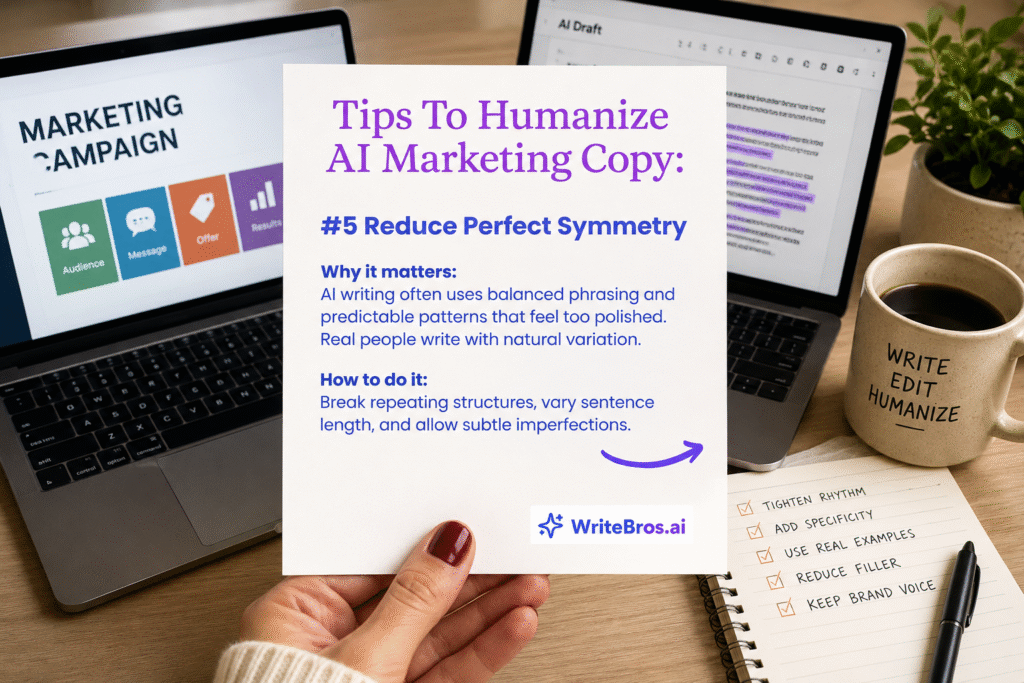
How to Humanize ChatGPT Marketing Copy – Strategy #5: Reduce perfect symmetry
AI writing systems naturally gravitate toward perfectly balanced phrasing where sentence structures mirror one another too cleanly, transitions appear with predictable frequency, and lists follow mathematically tidy patterns that rarely occur in genuine human communication outside of scripted speeches or highly edited corporate statements. Although symmetry can create readability, excessive symmetry quietly makes content feel synthetic because real people usually prioritize clarity, emotion, emphasis, or urgency over maintaining flawless structural consistency across every paragraph and sentence. Intentionally disrupting that balance in subtle ways can therefore make marketing copy sound far more believable without sacrificing professionalism or creating unnecessary messiness within the final draft.
An editor might allow one paragraph to run slightly longer than the next, introduce an unexpected clarification mid-sentence, or break a carefully repeated structure once the rhythm starts feeling too polished and predictable for the subject matter being discussed. This works especially well in founder-led brands, editorial newsletters, and social-first campaigns where audiences expect some personality and natural variation instead of communication that sounds processed through a rigid content-generation framework before publication. The adjustment should remain controlled and deliberate, however, because removing all structure entirely can quickly make the writing feel disorganized rather than human.
How to Humanize ChatGPT Marketing Copy – Strategy #6: Keep brand tension intact
Many AI-generated drafts become weaker during editing because teams unintentionally smooth away the opinions, sharp positioning, and subtle contradictions that originally made the brand voice memorable, particularly when reviewers prioritize safety, neutrality, and broad appeal over recognizable personality. Strong brands usually carry some level of tension in their communication, whether that tension appears through confident disagreement with industry norms, a more skeptical tone toward trends, or a willingness to speak plainly about customer frustrations that competitors avoid discussing directly. Preserving those edges helps marketing copy sound more human because real companies with strong identities rarely communicate like emotionally neutral information systems attempting to offend absolutely nobody.
A productivity brand aimed at burned-out freelancers, for example, might intentionally sound impatient with performative hustle culture instead of presenting every workflow challenge in soft, sanitized language that avoids any emotional friction or clear point of view. Readers often connect more strongly with brands that appear willing to take a position, even if the positioning is subtle, because that confidence suggests there are actual humans behind the messaging rather than automated systems assembling the safest possible version of every paragraph. The key is maintaining strategic tension without drifting into hostility or unnecessary provocation that could distract from the broader message or alienate the intended audience.
How to Humanize ChatGPT Marketing Copy – Strategy #7: Simplify transition phrases
One of the clearest signs of AI-assisted writing is the constant reliance on transition phrases that mechanically guide readers through every point with excessive politeness and predictable sequencing, especially when those transitions appear regardless of whether the underlying ideas actually require formal connection. Human communication usually moves more naturally because people often imply relationships between ideas instead of carefully announcing every shift, clarification, or contrast through obvious structural markers that make the writing feel overly managed. Simplifying transitions therefore improves realism by allowing the content to breathe more naturally while reducing the sense that the draft was generated through a formula designed to maximize coherence scores rather than readability.
A marketer revising AI-generated copy might remove repetitive phrases like furthermore, additionally, in conclusion, or on the other hand and instead allow the paragraph structure or sentence flow to carry the relationship between ideas without unnecessary verbal signposting. This creates a more conversational rhythm that better resembles how experienced professionals speak during meetings, interviews, or presentations where communication usually unfolds through momentum and context rather than constant verbal labeling of every directional change. Writers should still preserve clarity where necessary, because eliminating too many transitions at once can make longer content feel abrupt or difficult to follow.
How to Humanize ChatGPT Marketing Copy – Strategy #8: Use emotional restraint
AI-generated marketing content often overcompensates emotionally because the system assumes enthusiasm, inspiration, and positivity automatically increase persuasive power, which leads to exaggerated phrasing that sounds disconnected from the seriousness or complexity of the reader’s actual situation. Human communication tends to feel more trustworthy when emotion appears measured and proportional to the context, particularly in industries where buyers are making expensive, operationally significant, or professionally risky decisions that require confidence rather than excitement. Using emotional restraint therefore helps copy sound more mature and believable because the messaging stops performing enthusiasm and begins communicating with clearer judgment and more realistic emotional calibration.
A cybersecurity company addressing data compliance concerns, for example, will usually sound more credible acknowledging operational stress and implementation complexity than flooding the page with hyperactive promises about revolutionary transformation or effortless success across every stage of adoption. Readers are generally more persuaded by controlled confidence than exaggerated emotional pressure, especially after years of exposure to inflated marketing language across social platforms, automated email funnels, and aggressively optimized advertising campaigns competing for attention. This does not mean the writing should become cold or detached, because thoughtful warmth and strategic empathy still matter enormously when building trust and maintaining audience engagement.
How to Humanize ChatGPT Marketing Copy – Strategy #9: Rewrite robotic CTAs
Calls to action generated through AI systems frequently sound interchangeable because they rely on generic urgency formulas and broad engagement prompts that could appear at the end of nearly any article, email, or landing page regardless of audience intent or emotional context. Human-written CTAs usually feel more situational because they reflect the exact mindset the reader is likely experiencing after consuming the preceding content, which creates continuity between the conversation and the requested next step instead of introducing a sudden promotional instruction detached from the flow of the page. Rewriting robotic CTAs therefore improves authenticity by making the invitation feel connected to the reader’s current decision-making process rather than mechanically appended for conversion purposes.
A finance platform discussing delayed reporting workflows, for example, might invite readers to compare their current approval process against a live demo instead of ending with a broad command encouraging them to unlock growth or transform operations immediately. This works because the CTA acknowledges the practical issue already discussed throughout the page, which makes the transition toward action feel logical and emotionally coherent instead of aggressively sales-driven. Teams should also resist adding urgency where it does not naturally belong, because artificial countdown language and exaggerated scarcity cues often damage trust more than they improve conversion performance.
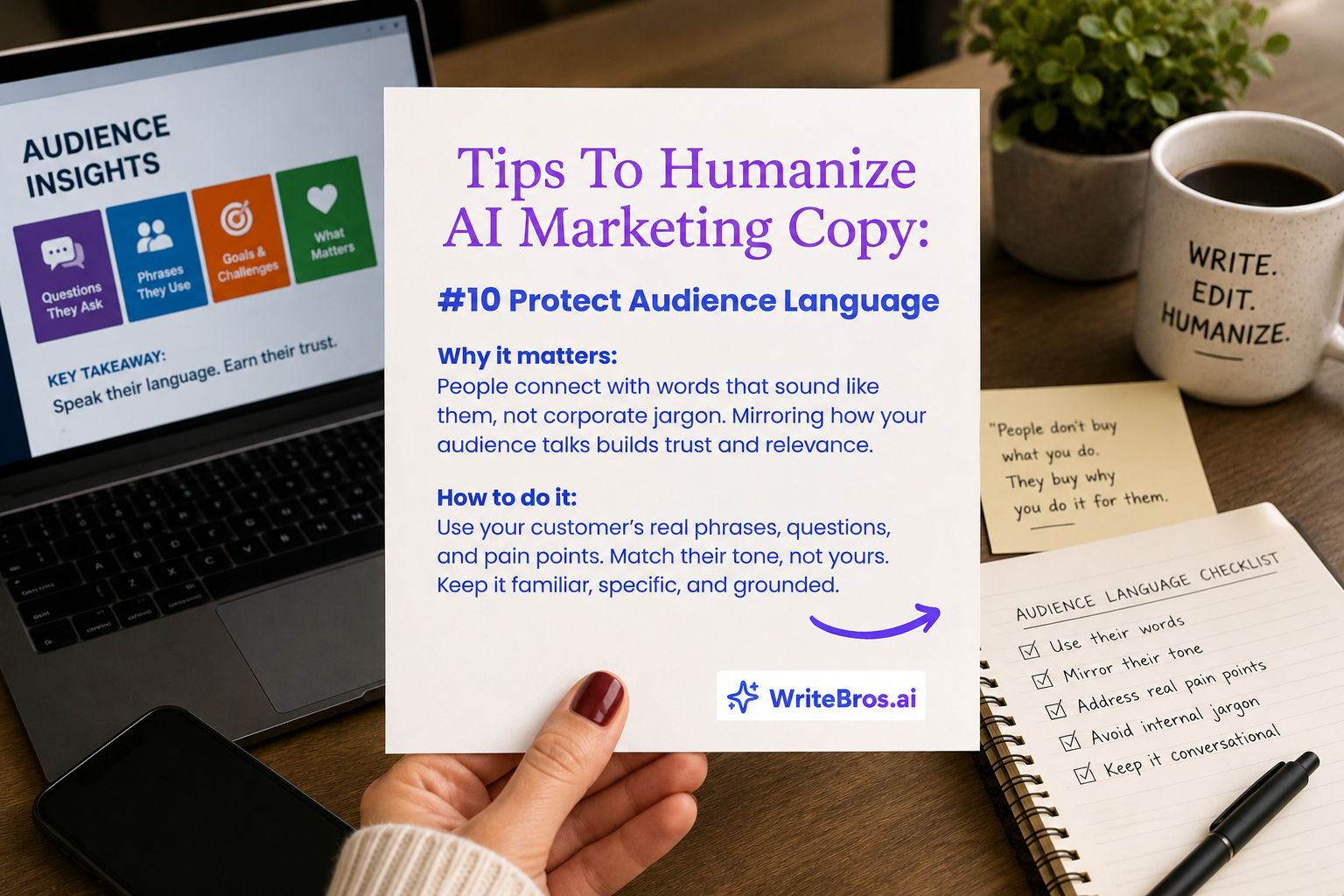
How to Humanize ChatGPT Marketing Copy – Strategy #10: Protect audience language
Marketing copy becomes noticeably more human when it reflects the vocabulary, pacing, and emotional framing that actual customers use while describing their own frustrations, goals, and purchasing decisions instead of relying on internal company jargon or overly generalized corporate terminology. AI systems often default toward polished but generic language because they are trained across enormous datasets containing broad communication patterns rather than the narrower conversational nuances specific audiences use within particular industries, communities, or behavioral contexts. Protecting audience language therefore strengthens realism because readers immediately recognize when a brand appears genuinely familiar with their environment rather than merely simulating customer understanding from a distance.
A recruiting platform aimed at startup founders, for example, may sound far more authentic discussing hiring bottlenecks, delayed candidate responses, and exhausted interview cycles than repeatedly framing every challenge as talent optimization or workforce transformation without grounded language. This adjustment also improves conversion alignment because messaging naturally becomes easier to process when readers encounter phrases already connected to their existing mental models and lived experiences instead of unfamiliar corporate abstractions requiring interpretation. The important balance is maintaining professionalism without stripping away the informal or imperfect phrasing patterns that make customer language feel believable in the first place.
How to Humanize ChatGPT Marketing Copy – Strategy #11: Trim repetitive framing
AI-generated marketing drafts frequently circle the same core idea several times using slightly different wording because the system prioritizes reinforcement and completion rather than exercising strong editorial judgment regarding which points genuinely deserve repetition and which ones simply create unnecessary density. Human writers naturally condense familiar ideas once the audience clearly understands the point, whereas AI systems often continue restating concepts through additional transitions, examples, or summary phrases that quietly slow the reading experience and reduce perceived confidence. Trimming repetitive framing therefore improves realism because concise communication tends to feel more intentional, more experienced, and more respectful of the reader’s attention span.
A B2B software homepage, for instance, becomes significantly stronger when three nearly identical explanations about productivity gains are reduced into one sharper argument supported by a concrete operational example instead of repeated abstract assurances across multiple sections. Readers often interpret unnecessary repetition as insecurity or artificial padding, particularly when the wording changes but the informational value remains essentially unchanged throughout the page or email sequence. Editors should still preserve strategic emphasis where it matters, because removing every repeated concept entirely can sometimes weaken clarity or reduce persuasive momentum in longer-form content.
How to Humanize ChatGPT Marketing Copy – Strategy #12: Reintroduce human judgment
Even highly polished AI-generated content usually lacks the subtle prioritization decisions that experienced marketers make instinctively when evaluating tone, emphasis, pacing, emotional timing, and audience sensitivity across different types of campaigns and communication environments. Human judgment matters because strong marketing is rarely just a matter of grammatical correctness or structural coherence, especially when brands are trying to navigate trust, reputation, emotional nuance, or competitive positioning within crowded and highly skeptical digital spaces. Reintroducing human editorial decisions therefore helps copy sound more authentic because the content begins reflecting intentional choices rather than statistical prediction patterns generated from generalized training data.
An experienced editor might soften a sentence that feels technically accurate but emotionally tone-deaf, remove an unnecessary explanation that weakens authority, or amplify a specific observation because it better reflects how customers actually discuss the problem during sales calls or onboarding conversations. These adjustments often appear small in isolation, yet collectively they create the impression that someone genuinely thought through the message instead of simply approving the first polished draft returned by an AI system. The objective is not to erase every sign of automation completely, because efficiency still matters, but to ensure the final message feels directed by people rather than assembled entirely through pattern completion.
How to Humanize ChatGPT Marketing Copy – Strategy #13: Match platform behavior
Marketing content immediately feels less human when the same tone, structure, and pacing appear unchanged across every channel, especially because audiences behave differently depending on whether they are reading a landing page, scrolling social media, opening an email newsletter, or reviewing long-form educational content. Human communicators naturally adapt their phrasing and emphasis according to environment because expectations change from platform to platform, and audiences subconsciously recognize when messaging ignores those contextual differences entirely. Matching platform behavior therefore improves authenticity because the copy begins reflecting how people actually consume information within each specific digital setting rather than forcing one universal communication style everywhere.
A LinkedIn post aimed at operators and executives, for example, may require more direct framing and professional tension than an onboarding email designed to reassure newly converted users during their first week with a product or service. Similarly, short-form social content often benefits from faster pacing and more conversational movement, whereas educational resources usually need greater explanation depth and smoother narrative transitions to maintain clarity over longer reading sessions. Brands should still preserve a recognizable identity across channels, because adapting too aggressively can make the company voice feel fragmented or strategically inconsistent over time.
How to Humanize ChatGPT Marketing Copy – Strategy #14: Leave selective friction
One surprisingly effective way to make AI-assisted writing feel more believable is to stop over-optimizing every sentence until the draft becomes unnaturally smooth, emotionally neutral, and polished to the point where it no longer resembles realistic human communication patterns. Real people occasionally repeat themselves slightly, interrupt a thought with clarification, or use phrasing that feels a little uneven because natural communication prioritizes meaning, emphasis, and emotional honesty more than perfect structural efficiency. Leaving selective friction inside the writing therefore helps preserve texture and realism, particularly in editorial content, founder messaging, and audience-facing brand communication intended to feel personal rather than mechanically refined.
A founder newsletter discussing operational setbacks, for instance, may feel far more authentic preserving a slightly awkward but emotionally honest sentence than replacing it with an elegantly optimized rewrite that sounds detached from the actual experience being described. Readers often trust communication more when it contains small signs of imperfection because those imperfections imply the content was shaped through real thought rather than aggressively processed through editing systems focused exclusively on fluency and conversion metrics. The balance matters carefully, however, because excessive friction can eventually reduce readability and create confusion instead of strengthening authenticity.
How to Humanize ChatGPT Marketing Copy – Strategy #15: Review aloud before publishing
Reading marketing copy aloud remains one of the most reliable ways to detect AI-generated phrasing because awkward rhythm, repetitive structure, unnatural transitions, and emotionally empty wording become dramatically easier to notice once the text is processed through spoken language instead of silent reading. Human communication is deeply connected to sound and conversational pacing, which means many subtle problems hidden during visual review become immediately obvious when sentences are forced to function as realistic speech patterns rather than polished blocks of on-screen text. Reviewing aloud therefore acts as a practical quality-control filter that helps editors identify where the writing still feels artificial, performative, or disconnected from natural human expression.
A marketing team preparing a webinar landing page, for example, may discover that several polished paragraphs become exhausting or strangely repetitive once someone attempts to read them naturally during rehearsal or collaborative review sessions. This process often exposes unnecessary filler, unnatural emotional emphasis, and transitions that technically make sense but sound overly formal or mechanically staged when spoken in sequence. Teams should also pay attention to breathing rhythm and conversational flow during these reviews, because believable writing usually sounds easier to speak than content generated primarily for structural completeness or algorithmic optimization.
Common mistakes
- Many teams assume humanizing AI-generated marketing copy simply means adding contractions, emojis, or casual phrasing, but those surface-level edits rarely address the deeper structural patterns that make the content sound repetitive, emotionally flat, or mechanically balanced across every paragraph and sentence.
- Another common mistake happens when editors aggressively rewrite every AI-generated line until the draft loses speed, consistency, and operational usefulness, because the goal should be thoughtful refinement rather than destroying the efficiency benefits that made AI-assisted workflows valuable in the first place.
- Some brands remove all personality from their content during legal or approval reviews, which creates polished but emotionally lifeless messaging that technically sounds safe while simultaneously becoming forgettable, interchangeable, and disconnected from the audience’s real frustrations and emotional expectations.
- Writers also frequently overuse exaggerated emotional language in an attempt to make content sound more human, although excessive excitement, theatrical urgency, and inflated promises usually create the opposite effect by making the copy feel forced, artificial, and strategically untrustworthy.
- Many marketers rely too heavily on AI-generated transitions and summaries because the writing initially appears smooth and organized, yet that excessive structural guidance quietly removes the natural pacing variation and implied meaning that real human communication typically contains.
- Another damaging habit involves publishing AI-assisted drafts without reading them aloud, since silent review often misses repetitive rhythm, awkward cadence, and emotionally empty phrasing patterns that become extremely obvious once the content is spoken naturally during final editing.
Edge cases
Some industries require a more controlled communication style, which means aggressively humanizing AI-generated copy can occasionally create unnecessary risk or weaken authority if the messaging becomes too conversational for the audience’s expectations and compliance environment. Legal, healthcare, financial, and enterprise security brands often need tighter wording standards, although those brands still benefit from reducing robotic cadence, repetitive phrasing, and emotionally exaggerated claims that damage credibility during serious purchasing decisions.
There are also situations where slightly polished or structured language actually helps performance, especially in onboarding documentation, technical support flows, or multilingual campaigns where excessive personality may reduce clarity for readers already processing dense operational information. In those cases, the goal should not be maximizing conversational tone at every opportunity, but instead preserving readability and trust while carefully removing the most obvious AI-generated patterns that distract from the core message.
Supporting tools
- Grammarly helps identify awkward sentence construction, repetitive wording, and pacing issues that frequently appear in AI-generated marketing drafts, especially during collaborative editing workflows where multiple reviewers are adjusting tone across landing pages, email campaigns, and customer onboarding materials.
- Hemingway Editor is useful for detecting overly dense structure and unnecessary complexity because it highlights readability friction that often appears after teams repeatedly revise AI-generated paragraphs without maintaining natural pacing or conversational movement across the final version.
- Notion AI can support collaborative draft refinement workflows by helping teams compare alternate phrasings, summarize repeated sections, and organize brand voice observations gathered during editing reviews without forcing writers into rigid content production templates.
- Perplexity is valuable during research-heavy campaigns because it helps marketers quickly validate examples, industry terminology, and operational references that make AI-assisted marketing copy sound more grounded, specific, and connected to real-world audience behavior.
- Google Docs voice typing works surprisingly well for humanization workflows because speaking revised paragraphs aloud naturally introduces more conversational rhythm, imperfect pacing, and realistic clarification patterns than many purely text-based editing approaches generate.
- WriteBros.ai helps marketers refine AI-generated content while preserving stronger emotional nuance, cleaner rhythm, and more recognizable brand personality, particularly during workflows where speed matters but fully robotic phrasing would weaken audience trust and campaign performance.
Ready to Transform Your AI Content?
Try WriteBros.ai and make your AI-generated content truly human.
Conclusion
Humanizing AI-generated marketing copy is rarely about hiding technology completely, because most readers already understand that brands use automation during content production across blogs, emails, landing pages, and advertising campaigns. The real objective is making the final message feel intentional, emotionally calibrated, and grounded enough that audiences focus on the value being communicated instead of becoming distracted by robotic structure, exaggerated enthusiasm, or repetitive phrasing patterns.
Strong marketing communication still depends on judgment, restraint, and audience awareness even when AI tools dramatically accelerate production speed and simplify early drafting workflows for busy teams handling large publishing schedules. Brands that consistently sound trustworthy usually treat AI as a starting point rather than a finished voice, which allows them to preserve personality, maintain strategic clarity, and build stronger long-term relationships through communication that still feels recognizably human.
Did You Know?
AI-generated marketing copy often feels robotic because of repetitive rhythm, vague wording, and overly polished structure rather than obvious grammar mistakes.
Smaller editorial adjustments usually make ChatGPT copy sound more believable than aggressive rewrites that remove natural tone and pacing.
Ready to Transform Your AI Content?