How to Humanize AI Marketing Copy: 15 Brand-Safe Strategies

2026 marketing teams are refining AI outputs to sound more human without losing efficiency, and strategies now focus on tone, clarity, and real context supported by Stanford research on how people judge AI-generated text.
How to Humanize AI Marketing Copy: 15 Brand-Safe Strategies
AI marketing copy can feel polished on the surface but still miss the tone that makes people trust a brand. Many teams run into this gap after realizing what clients expect from agencies using AI is far more nuanced than clean grammar or speed.
This happens because AI tends to default to safe, generic phrasing that avoids risk but also removes personality. Even when using the most trusted AI humanizer tools for marketers, the output can still sound detached without intentional editing.
The goal is not to remove AI from your workflow but to guide it so the final message feels grounded, specific, and aligned with your brand voice. The strategies below show how to refine tone, structure, and detail, while staying aware of broader patterns like AI writing in higher education trends that influence how audiences interpret AI-generated content.
| # | Strategy focus | Practical takeaway |
|---|---|---|
| 1 | Define brand voice clearly | Set specific tone rules so every line sounds consistent and intentional. |
| 2 | Replace vague language | Swap generic phrases with concrete wording that reflects real scenarios. |
| 3 | Layer in real context | Add situational details that make the copy feel grounded and relevant. |
| 4 | Adjust sentence rhythm | Mix short and longer sentences to create a natural reading flow. |
| 5 | Cut filler phrases | Remove unnecessary wording that dilutes clarity and impact. |
| 6 | Use conversational phrasing | Write in a way that mirrors how real people speak and think. |
| 7 | Anchor claims in reality | Support statements with believable examples instead of broad promises. |
| 8 | Refine transitions | Ensure ideas connect smoothly without sounding mechanical. |
| 9 | Match audience expectations | Align tone and detail level with what your readers actually want. |
| 10 | Avoid over-optimization | Keep language natural instead of forcing keywords into every line. |
| 11 | Inject subtle personality | Add small stylistic touches that reflect your brand identity. |
| 12 | Use specific examples | Ground ideas in realistic situations to improve clarity and trust. |
| 13 | Check for tone drift | Review sections to ensure the voice stays consistent throughout. |
| 14 | Simplify structure | Break down complex sentences so the message is easier to follow. |
| 15 | Final human pass | Do a last review to refine nuance, clarity, and emotional tone. |
15 Brand-Safe Strategies to How to Humanize AI Marketing Copy
How to Humanize AI Marketing Copy – Strategy #1: Define brand voice clearly
Start by documenting what your brand actually sounds like when it communicates with customers, including tone, pacing, and the level of formality that feels natural. This gives AI-generated drafts something to align with instead of defaulting to neutral phrasing that lacks identity. Without this reference, even well-written copy can feel disconnected from the rest of your messaging.
In practice, this works because it creates a consistent filter that every sentence must pass through before it gets approved or published. A team working on product pages, for example, can quickly spot when wording feels too stiff or overly generic compared to past campaigns. The only constraint is that your voice guidelines need to be specific enough to guide edits rather than sit unused in a document.
How to Humanize AI Marketing Copy – Strategy #2: Replace vague language
AI tends to produce phrases that sound polished but say very little, which weakens clarity and makes the message feel interchangeable with any brand. Rewriting these sections with specific wording immediately makes the content feel more grounded and intentional. This is especially important when the copy is meant to persuade rather than simply inform.
The impact becomes clear when you compare a generic claim with a version that includes concrete detail, such as naming a real use case or outcome. Readers naturally trust language that feels tied to reality rather than abstract benefits that could apply anywhere. You still need to balance specificity with readability so the message remains easy to follow.
How to Humanize AI Marketing Copy – Strategy #3: Layer in real context
Adding context transforms flat AI output into something that feels connected to actual situations your audience recognizes. This might include referencing timing, environment, or constraints that shape how the message is received. Without these layers, the copy often reads as technically correct but emotionally distant.
This works well because people relate to scenarios more easily than isolated statements, which helps them understand how the message applies to them. A campaign describing a busy workday or a common friction point creates a clearer mental picture than a general promise. The key is to keep context relevant instead of overloading the copy with unnecessary detail.
How to Humanize AI Marketing Copy – Strategy #4: Adjust sentence rhythm
AI-generated writing often falls into predictable sentence patterns that feel repetitive over time, which makes the content harder to stay engaged with. Adjusting the rhythm by varying sentence length and structure creates a more natural flow. This mirrors how people actually communicate when they speak or write without constraints.
In real scenarios, this means breaking up long stretches of similar phrasing and introducing subtle variation to keep the reader moving forward. A landing page with consistent rhythm changes feels easier to read and less mechanical. The challenge is making these adjustments without disrupting clarity or introducing unnecessary complexity.
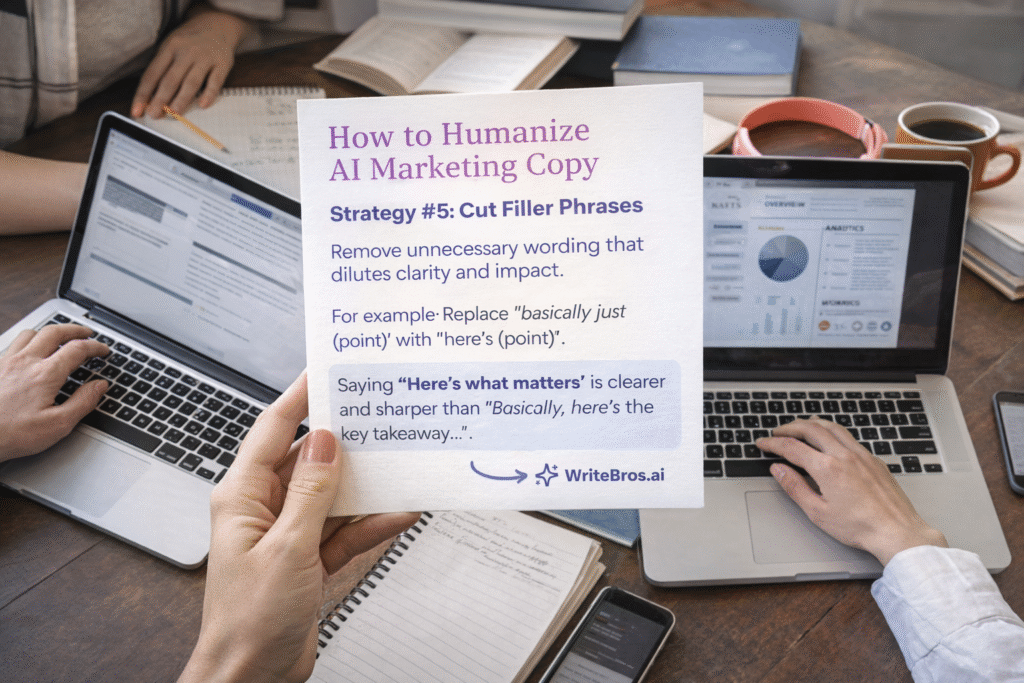
How to Humanize AI Marketing Copy – Strategy #5: Cut filler phrases
Filler language often appears in AI drafts because the model aims to sound complete even when it lacks strong direction. Removing these extra words sharpens the message and makes each sentence carry more weight. This step alone can significantly improve how confident and direct the copy feels.
The benefit becomes obvious when shorter, clearer sentences replace longer ones that repeat the same idea in different ways. Readers can process the message faster and with less effort, which increases engagement. You still need to review carefully so that clarity improves without losing necessary nuance.
How to Humanize AI Marketing Copy – Strategy #6: Use conversational phrasing
Shifting toward conversational language helps the copy feel more approachable and less like it was generated from a template. This involves choosing words and phrasing that reflect how your audience naturally communicates in similar situations. The goal is to remove distance between the brand and the reader.
In practice, this means reading the copy aloud and noticing where it feels stiff or overly formal compared to real conversation. A slight adjustment in wording can make the message feel more relatable without reducing professionalism. You need to maintain balance so the tone stays aligned with your brand identity.
How to Humanize AI Marketing Copy – Strategy #7: Anchor claims in reality
Broad claims can weaken trust because they lack evidence or connection to real outcomes. Anchoring statements in reality makes them easier to believe and more useful to the reader. This can be done through examples, numbers, or specific situations that support the message.
This works because readers tend to evaluate credibility based on how tangible the information feels. A product description that includes a real use case stands out more than one that relies on general benefits. The limitation is ensuring that these details remain accurate and relevant to your audience.
How to Humanize AI Marketing Copy – Strategy #8: Refine transitions
AI often generates sections that feel loosely connected, even when the individual sentences are clear. Improving transitions helps ideas flow logically from one point to the next. This creates a smoother reading experience and keeps the audience engaged.
In real use, refining transitions involves adding subtle connectors that guide the reader through the narrative. A well-structured email or landing page feels cohesive rather than segmented into unrelated parts. Careful editing ensures that these connections enhance clarity instead of adding unnecessary length.
How to Humanize AI Marketing Copy – Strategy #9: Match audience expectations
Understanding what your audience expects allows you to adjust tone, depth, and style accordingly. AI-generated content can miss this alignment if it relies on general patterns instead of specific insights. Matching expectations ensures the message feels relevant and appropriate.
This becomes evident when comparing content written for different audiences, such as beginners versus experienced professionals. Each group responds to different levels of detail and tone. The main challenge is maintaining consistency while adapting to these variations.
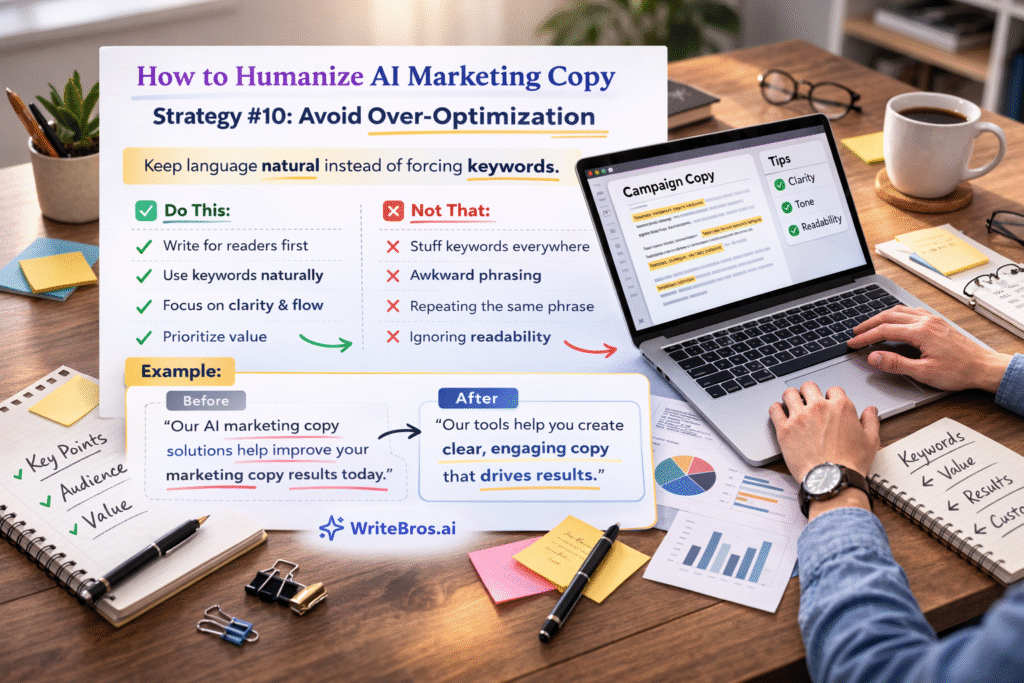
How to Humanize AI Marketing Copy – Strategy #10: Avoid over-optimization
Overloading copy with keywords or forced phrasing can make it feel unnatural and difficult to read. Keeping language balanced helps maintain clarity and flow while still supporting visibility. The focus should remain on the reader rather than algorithm-driven adjustments.
In practice, this means reviewing sections where keywords appear too frequently or disrupt sentence structure. A more natural approach improves both readability and engagement. The constraint is ensuring that optimization goals are still met without compromising tone.
How to Humanize AI Marketing Copy – Strategy #11: Inject subtle personality
Adding personality helps differentiate your copy from generic output that could belong to any brand. This does not require dramatic changes but rather small stylistic choices that reflect your identity. These details make the content feel more intentional and recognizable.
In real scenarios, this might include phrasing choices or tone adjustments that align with your brand voice. Even slight variations can create a more engaging experience for the reader. The key is ensuring that personality enhances clarity instead of distracting from the message.
How to Humanize AI Marketing Copy – Strategy #12: Use specific examples
Examples help translate abstract ideas into something more tangible and easier to understand. AI-generated content often lacks this level of detail unless prompted or edited carefully. Including examples strengthens both clarity and credibility.
This works because readers can visualize how the message applies in real situations. A concrete example provides context that supports the main point. You need to ensure that examples remain relevant and do not introduce unnecessary complexity.
How to Humanize AI Marketing Copy – Strategy #13: Check for tone drift
Long pieces of AI-generated content can gradually shift in tone without clear transitions. Reviewing for tone drift helps maintain consistency from beginning to end. This ensures that the message feels cohesive and aligned with your brand.
In practice, this involves comparing different sections and adjusting any inconsistencies that stand out. A unified tone strengthens trust and improves readability. The challenge is identifying subtle changes that may not be immediately obvious.
How to Humanize AI Marketing Copy – Strategy #14: Simplify structure
Complex sentence structures can make AI-generated copy harder to follow, even when the ideas are clear. Simplifying these structures improves readability and helps the message come across more effectively. This step is especially useful for longer content.
Breaking down sentences into clearer segments allows readers to process information more easily. A streamlined structure also supports better flow across sections. The balance lies in simplifying without removing necessary detail.
How to Humanize AI Marketing Copy – Strategy #15: Final human pass
A final review ensures that all adjustments come together into a cohesive and natural piece of writing. This step allows you to catch issues that may not have been obvious during earlier edits. It also provides an opportunity to refine tone and clarity.
In real use, this often involves reading the content from the perspective of your audience and making small improvements. Even minor adjustments can significantly enhance the overall quality. The key is to approach this step with attention to detail rather than rushing through it.
Common mistakes
- Relying entirely on AI output without reviewing tone or clarity often leads to content that feels generic and disconnected from the brand, which reduces trust and makes it harder for readers to engage meaningfully.
- Keeping vague or overly broad language in place creates confusion because readers cannot clearly understand what is being offered or how it applies to them in real situations.
- Over-editing for keywords can result in awkward phrasing that disrupts flow and makes the content feel forced rather than natural.
- Ignoring audience expectations leads to mismatched tone and detail, which can cause readers to lose interest or misunderstand the message.
- Failing to check for consistency across sections can result in tone drift that weakens the overall impact of the content.
- Adding too much detail without structure can overwhelm readers and reduce clarity, even when the information itself is useful.
Edge cases
Some types of content require a more formal tone, such as legal or compliance materials, where too much conversational phrasing can reduce clarity or accuracy. In these situations, humanizing the copy means improving readability without changing the required structure or terminology.
Another case appears when targeting highly technical audiences who expect precision over personality, which means edits should focus on clarity rather than tone adjustments. The goal is still to reduce friction in reading, but without altering the level of detail or specificity required.
Supporting tools
- Content editing platforms help identify areas where phrasing feels repetitive or unclear, making it easier to refine tone and improve readability during the review process.
- Readability analysis tools highlight sentence complexity and structure, allowing you to simplify sections that may slow down comprehension.
- Collaboration tools enable teams to review and comment on drafts together, which helps maintain consistency and align messaging across different contributors.
- Grammar and style checkers provide a baseline for correctness while still allowing flexibility for tone adjustments that match your brand.
- Audience research tools offer insights into preferences and expectations, which helps guide tone and content decisions during editing.
- WriteBros.ai helps refine AI-generated content so it aligns with your tone, style, and voice while maintaining clarity and consistency across different types of marketing copy.
Ready to Transform Your AI Content?
Try WriteBros.ai and make your AI-generated content truly human.
Conclusion
Humanizing AI marketing copy is less about removing automation and more about shaping it into something that reflects your brand clearly. The strategies outlined here help transform generic drafts into content that feels intentional and aligned with real audience expectations.
Progress comes from consistent refinement rather than perfect execution on the first pass. Focusing on clarity, tone, and relevance ensures that your copy remains effective while still benefiting from the efficiency that AI provides.
Did You Know?
AI marketing copy can appear polished because it follows predictable structure and safe wording patterns. Even so, it often lacks the natural tone and specific detail needed to feel trustworthy and relevant.
Refining tone, adding context, and smoothing sentence flow can improve clarity faster than expected. Small edits help marketing copy feel more human, making it easier to connect with and act on.
Ready to Transform Your AI Content?