Why Perfect Writing Feels Suspicious in 2026
Highlights
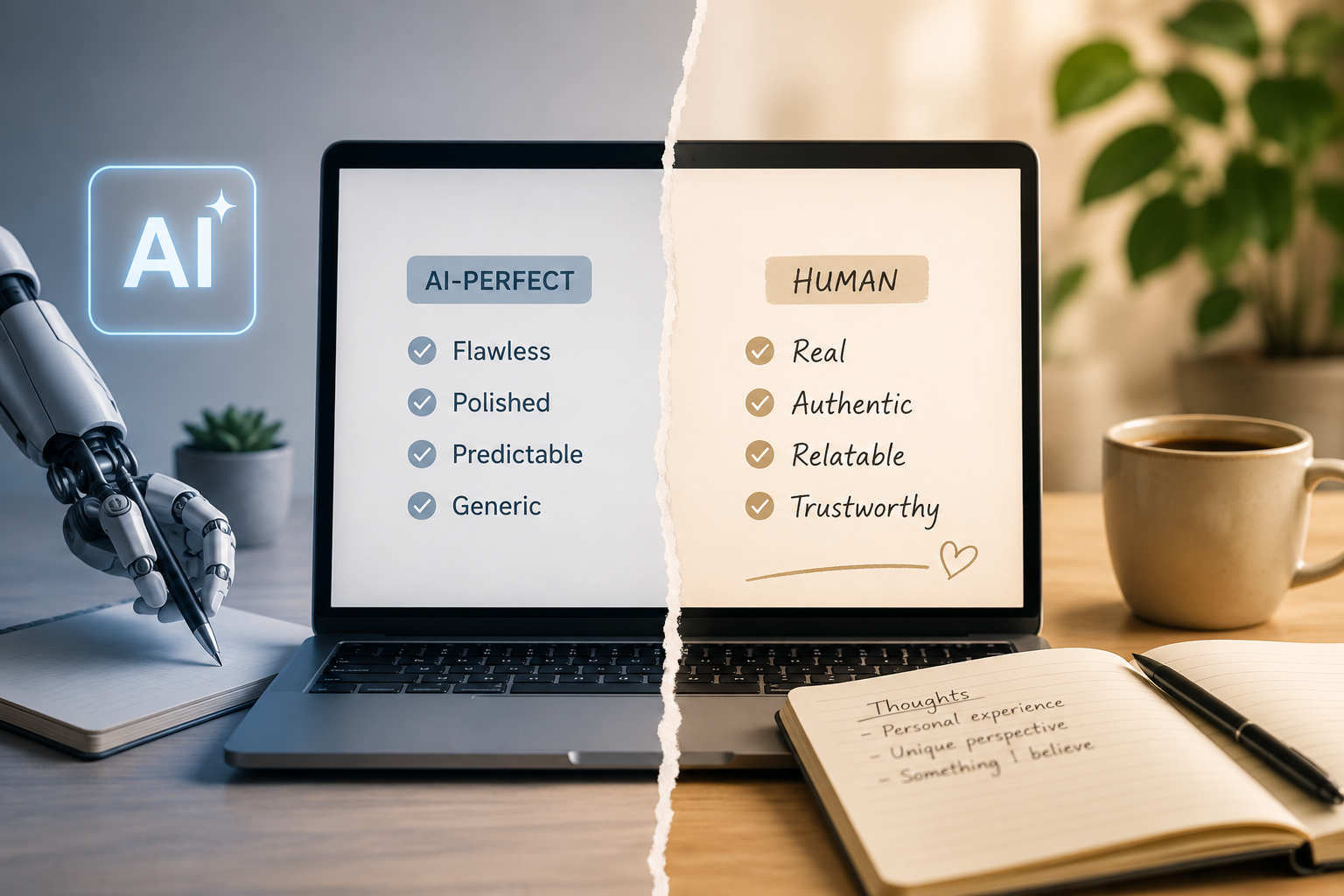
- Perfect writing can sometimes reduce trust.
- Readers now recognize common AI patterns.
- Voice matters more than flawless grammar.
- Believable beats perfect.
- Authenticity is the new advantage.
- WriteBros.ai prioritizes your voice over perfection.
There was a time when flawless writing immediately impressed people.
Perfect grammar. Perfect transitions. Perfect structure. Every sentence polished until it almost sounded effortless.
Today, something strange is happening.
The more perfect a piece of writing feels, the more readers pause and wonder whether a person actually wrote it.
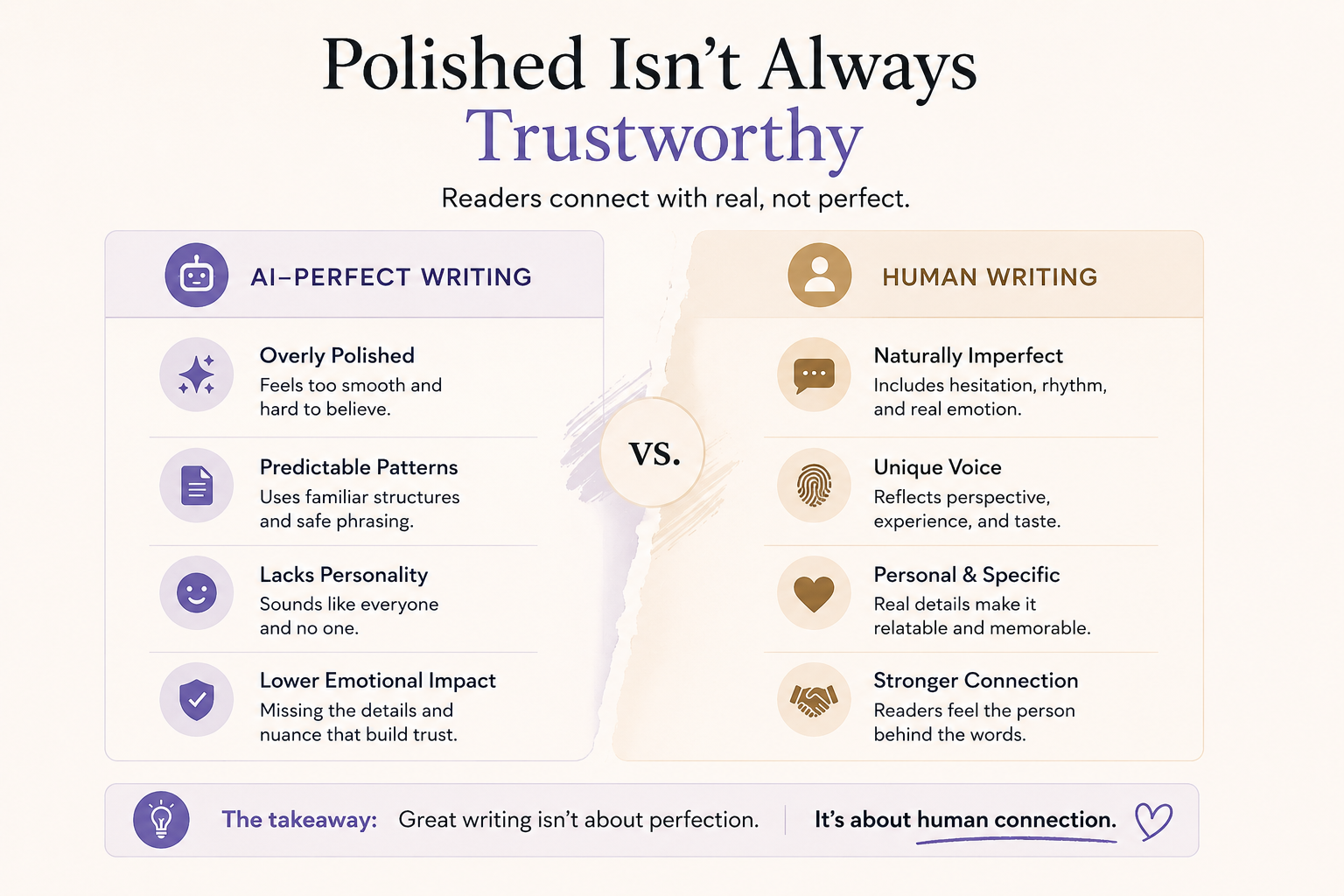
We haven’t lowered our standards for good writing. We’ve simply become familiar with a new kind of perfection. After reading thousands of AI-generated articles, emails, and LinkedIn posts, people have developed an instinct for writing that feels almost too clean.
Why Perfect Writing Is Starting to Feel Suspicious
AI has changed more than how content is created. It is quietly changing how readers judge quality itself. In a world where polished writing is available on demand, authenticity is becoming harder to fake and easier to recognize.
The irony of the AI era is that flawless writing no longer guarantees trust. In some cases, the opposite is beginning to happen. The smoother the writing feels, the more people wonder what, or who, produced it.
We Didn’t Suddenly Become Better Editors. We Became Better Detectors.
Most conversations about AI writing focus on the tools themselves. People debate which model writes better, which prompt produces stronger output, or which platform sounds the most human. But an equally important change has been happening on the other side of the screen.
Readers have changed.
Whether they realize it or not, millions of people have spent the last few years consuming AI-generated emails, blog posts, product descriptions, social media captions, and school assignments. That constant exposure has trained us to notice patterns we never used to notice.
We may not always be able to explain why a paragraph feels artificial, but we often recognize the feeling almost immediately. It’s similar to hearing an unfamiliar accent. You might not identify where it comes from, yet something tells you it doesn’t sound entirely natural.
Polished writing signaled expertise.
Readers usually assumed that smooth structure, consistent tone, and flawless grammar reflected experience, professionalism, and careful editing.
Polished writing raises new questions.
Those same qualities can now make readers wonder whether the text came from a language model before they assume it came from an expert.
The Trust Equation Has Shifted
This doesn’t mean readers prefer sloppy writing. Nobody enjoys confusing sentences or unnecessary mistakes. What has changed is the relationship between perfection and credibility. The two are no longer automatically connected.
Ironically, the occasional awkward sentence, unexpected word choice, or slightly imperfect transition can now make writing feel more believable because those are the kinds of small inconsistencies that naturally appear when humans think while they write instead of generating a polished answer all at once.
For decades, writers tried to eliminate every trace of imperfection. Today, readers are becoming more skeptical of writing that appears to have eliminated every trace of humanity along with it.
It’s Not the Grammar That Gives AI Away. It’s the Predictability.
Ask people what makes AI writing obvious, and many will mention phrases like “delve into,” “in today’s fast-paced world,” or perfectly formatted bullet lists. Those have certainly become clichés, but they’re not the real reason readers become suspicious.
The deeper issue is that AI often removes the tiny irregularities that naturally occur when people think, hesitate, change direction, or become excited while writing. Human writing carries small surprises. AI tends to smooth them away.
In other words, readers aren’t reacting to perfection itself. They’re reacting to writing that feels statistically predictable from beginning to end.
Every sentence feels the same size.
Human writers naturally alternate between short observations, longer explanations, and occasional fragments. AI often settles into an almost mechanical rhythm where every paragraph marches at the same pace.
Every transition feels expected.
Instead of jumping naturally between ideas, AI prefers orderly bridges that make every paragraph feel carefully connected, even when the conversation would benefit from a little spontaneity.
Every opinion feels balanced.
Humans sometimes exaggerate, contradict themselves, or strongly favor one side. AI frequently presents every topic from multiple perspectives, making even passionate subjects feel strangely neutral.
Every conclusion feels complete.
Real people occasionally leave ideas unfinished, invite disagreement, or end on a question. AI often tries to wrap everything up into a satisfying ending, even when life rarely works that neatly.
The Missing Ingredient Isn’t Intelligence. It’s Imperfection.
Think about your favorite author, professor, newsletter writer, or even that friend whose messages always make you smile. Chances are you don’t remember them because they were grammatically flawless. You remember them because they have habits. Certain expressions. A rhythm that’s recognizably theirs.
Those habits aren’t mistakes to be edited away. They’re signatures. They tell readers that a real person with experiences, preferences, and opinions is behind the words. Ironically, many AI systems are trained to eliminate exactly those kinds of inconsistencies in pursuit of better writing.
For decades, writing advice encouraged us to polish away every rough edge. Now those rough edges are becoming one of the clearest signals that a human mind was involved. The future of good writing may not be about sounding more polished. It may be about preserving the imperfections that make a voice unmistakably your own.
Our Brains Don’t Just Read Words. They Judge People Behind the Words.
Writing has never been just about transferring information. Every sentence also carries invisible signals about the person who wrote it. We unconsciously ask questions like: Does this person sound confident? Do they seem genuine? Have they actually experienced what they’re describing?
Those judgments happen almost instantly. Long before we consciously decide whether we trust an article, our brains are already looking for clues that a real human is on the other side of the screen.
That’s why authenticity isn’t created through flawless grammar alone. It’s created through subtle human fingerprints that are difficult to manufacture on demand.
Readers look for individuality.
We naturally expect people to have quirks, favorite expressions, and opinions. When every paragraph feels interchangeable with thousands of others, the sense of personality begins to disappear.
People notice emotional texture.
Human writing speeds up, slows down, becomes playful, frustrated, excited, or reflective. Those emotional shifts make readers feel like they’re following someone’s thoughts rather than consuming manufactured text.
Specificity builds credibility.
Real experiences rarely unfold in perfectly organized paragraphs. Small observations, unexpected details, and imperfect memories often make a story more convincing than polished explanations ever could.
We Don’t Distrust AI Because It’s Artificial. We Distrust It Because It Feels Generic.
This is an important distinction. Most readers aren’t actively trying to catch AI. In fact, many don’t care whether someone used AI as part of the writing process. What they care about is whether the final piece feels like it could have been written by almost anyone.
Generic writing has always struggled to hold attention. AI simply made generic writing dramatically easier to produce. As more of it fills our feeds, inboxes, and search results, readers become increasingly sensitive to anything that lacks an identifiable human perspective.
Ironically, this means that the future of memorable writing may depend less on eliminating imperfections and more on preserving individuality. Readers are no longer impressed by writing that sounds universally polished. They’re drawn to writing that sounds unmistakably like someone.
The question readers are unconsciously asking has changed. It used to be, “Is this well written?” Increasingly, it’s becoming, “Does this sound like a real person who actually has something to say?”
Why Perfect Writing Feels Suspicious: A Simple Experiment Explains Everything
Imagine you ask two different people to describe the exact same sunset they witnessed.
One person talks about how the clouds reminded them of home. Another notices how the sea became unusually calm just before darkness. Neither description is objectively better, but both reveal something about the person observing the moment.
Now imagine asking an AI to describe that same sunset.
Chances are, the result would still be beautiful. The grammar would be excellent. The imagery would be vivid. Yet somehow, it would feel like a sunset that belongs to everyone and no one at the same time.
As the golden sun disappeared beneath the horizon, vibrant shades of orange and pink painted the sky, creating a breathtaking reminder of nature’s timeless beauty.
The sunset wasn’t even the best part. It was the few minutes after it disappeared, when everyone around me suddenly stopped talking without anyone asking them to.
Notice that the second example isn’t more sophisticated. In fact, it’s less descriptive. But it introduces something the first version lacks: an observation that feels personally experienced rather than universally generated.
This is often what readers respond to. Not bigger vocabulary. Not more polished metaphors. Just evidence that someone actually noticed something worth sharing.
The Best Human Writing Doesn’t Try to Impress Everyone
Many AI systems have been trained on an enormous amount of high-quality writing, which means they naturally gravitate toward language that most people will find clear, balanced, and broadly appealing. That’s incredibly useful for many tasks.
But memorable writing rarely aims to satisfy everyone equally. It often reflects one person’s perspective, biases, humor, frustrations, and experiences. Those qualities don’t always make writing objectively better, but they make it recognizable. Readers begin to associate the words with a person instead of simply processing the information.
We rarely remember articles because every sentence was flawless. We remember them because one sentence made us stop, smile, disagree, or think, “Only this person would have written it that way.” That kind of recognition is becoming one of the most valuable qualities a writer can have in the age of AI.
This Isn’t Just a Writing Problem. It’s a Trust Problem.
It would be easy to dismiss all of this as another debate about style. Some people like polished prose. Others prefer something more conversational. But the consequences go beyond taste.
When writing becomes too smooth, it can lose the very thing that gives it weight: the sense that someone meant it.
A perfectly composed apology may sound less sincere than a clumsy one. A beautifully structured personal story may feel less vulnerable than a paragraph that struggles to say what happened. Even a thoughtful opinion can lose force when every sentence seems designed to be agreeable.
The problem is not that polish is dishonest. The problem is that polish can sometimes remove the evidence of effort, uncertainty, and emotional risk that makes a message believable.
Emotion begins to sound processed.
Birthday notes, apologies, condolences, and difficult conversations can feel strangely distant when every word is too elegant. Readers may understand the message while still wondering whether the sender truly felt it.
Good writing no longer proves good thinking.
A polished essay once suggested that a student had wrestled with an idea. Now the surface quality of the writing may reveal very little about whether the person understood, questioned, or even read what appears on the page.
Everyone starts sounding professionally acceptable.
Bios, captions, newsletters, and posts become clearer but less distinct. The result is a strange sameness where thousands of people appear articulate while fewer of them sound recognizable.
Technical quality can hide emotional emptiness.
Stories may have strong pacing, essays may have clean arguments, and poems may contain vivid imagery. Yet none of those qualities guarantee that the work carries a perspective worth remembering.
When Everyone Can Sound Impressive, Impressive Stops Meaning Much
AI has made competent writing widely available. That is a real improvement. People who once struggled to organize their thoughts can now communicate more clearly. Non-native English speakers can express ideas with greater confidence. Writers can move past awkward phrasing without spending hours on a single paragraph.
But abundance changes value.
Once clean grammar and polished structure become available to nearly everyone, they stop functioning as rare signals of skill. Readers begin searching for something harder to generate: conviction, specificity, taste, lived experience, and a point of view that risks being disliked.
That may be the larger cultural shift behind our suspicion. We are not becoming hostile to good writing. We are learning that good writing and meaningful writing are no longer the same thing.
The challenge now is not choosing between polished writing and human writing. It is learning how to improve clarity without sanding away the hesitation, specificity, and personality that tell readers a real person had something at stake.
Maybe AI Should Stop Chasing Perfect Writing.
If perfect writing is becoming easier to generate, perhaps that’s no longer the right benchmark. The next generation of AI shouldn’t be measured by how polished it can make every sentence. It should be measured by how well it understands what deserves to remain untouched.
That’s a philosophy we’re beginning to see from a small number of editing-first platforms. Instead of treating every paragraph as something that needs to be rewritten, they focus on helping writers sound more like themselves, only clearer.
A Different Editing Philosophy
Strong sentences are left alone instead of being unnecessarily replaced with different wording simply to look “AI improved.”
Instead of forcing every paragraph into the same cadence, it aims to preserve the natural pacing that already makes your writing recognizable.
Expressions, opinions, and stylistic habits aren’t automatically treated as flaws. They remain part of the finished piece whenever they strengthen your voice.
Better editing isn’t always about changing more words. Sometimes the smartest edit is knowing exactly which sentences deserve to stay exactly as they are.
The objective isn’t flawless prose. It’s writing that still sounds believable after it’s been improved.
Rather than pursuing perfectly polished output, the platform is designed around a different question: How can AI make this piece stronger without making it sound like someone else wrote it? As readers become increasingly sensitive to generic AI writing, that distinction may matter far more than another perfectly rewritten paragraph.
The Future Won’t Reward the Best Writing. It Will Reward the Most Believable Writing.
AI has permanently changed what good writing looks like. Not because machines suddenly became creative, but because they made polished language incredibly common. When something becomes abundant, it naturally loses some of its ability to impress.
That doesn’t mean great writing is becoming less important. If anything, it’s becoming more valuable. The difference is that readers are beginning to judge it differently. They no longer stop at asking whether a piece is clear, grammatical, or well structured. They’re asking something much more personal.
Does this sound like someone?
In many ways, that’s encouraging. It reminds us that writing has never been about arranging words into their most technically correct form. It has always been about sharing perspective, experience, emotion, and ideas with another human being.
AI can help us communicate those ideas more clearly. It can shorten the distance between what we mean and what we write. But it shouldn’t erase the small imperfections, unexpected observations, and personal rhythms that make those ideas feel like they belong to us.
Perhaps that’s the real lesson of the AI era.
The goal was never to make every writer sound perfect.
It was to make every writer easier to understand without making them harder to recognize.
As AI continues to improve, the tools that stand the test of time may not be the ones that produce the most polished paragraphs. They may be the ones that know when to stop editing, leave a sentence untouched, and allow the writer’s voice to remain unmistakably human.
Frequently Asked Questions
AI has changed what readers expect from good writing. These frequently asked questions explain why perfectly polished content is sometimes becoming less trustworthy, and why preserving a human voice is becoming increasingly valuable.
Why does perfect writing sometimes feel suspicious today?
Readers have spent years consuming AI-generated articles, emails, and social media posts. As a result, many people have subconsciously learned to recognize writing that feels overly polished, predictable, or emotionally neutral. Perfect writing is no longer an automatic signal of authenticity.
Can people actually tell when writing was generated by AI?
Not always. Most readers cannot reliably identify AI-generated content with certainty. However, they often notice when writing lacks individuality, emotional texture, or personal perspective. That instinct can influence how trustworthy a piece feels, even if they never mention AI explicitly.
Does this mean AI writing is bad?
Not at all. AI is exceptionally useful for brainstorming, outlining, drafting, summarizing, and improving clarity. The issue is not AI itself. The challenge is relying on AI to produce content that sounds universally polished without adding the writer’s own perspective and personality.
What makes writing feel genuinely human?
Human writing often contains subtle imperfections, unexpected observations, distinctive phrasing, and emotional nuance. These characteristics create the feeling that a real person experienced, questioned, or believed what they are writing rather than simply assembling well-structured sentences.
Should writers intentionally make mistakes to sound human?
No. Authentic writing is not about adding grammatical errors or awkward wording. It is about preserving your natural voice, opinions, rhythm, and perspective while still communicating clearly. Readers value authenticity, not carelessness.
How can AI improve writing without making it sound artificial?
The most effective AI editing focuses on clarity, readability, and flow while respecting the writer’s original style. Instead of rewriting everything, it strengthens weaker sections and leaves naturally strong passages untouched whenever possible.
Why are more AI editing tools focusing on voice preservation?
As AI-generated content becomes increasingly common, sounding unique becomes more valuable. Many modern editing tools are shifting away from maximizing polish and toward helping writers maintain consistency, personality, and authenticity throughout their work.
How does WriteBros.ai approach AI editing differently?
WriteBros.ai is designed around the idea that stronger writing does not always mean more rewriting. Rather than chasing perfect prose, it focuses on improving clarity, readability, and flow while preserving the writer’s voice, pacing, and stylistic choices whenever possible.