Writing With AI Is Easy Now. Here Are 5 Ways to Make the Result Your Own
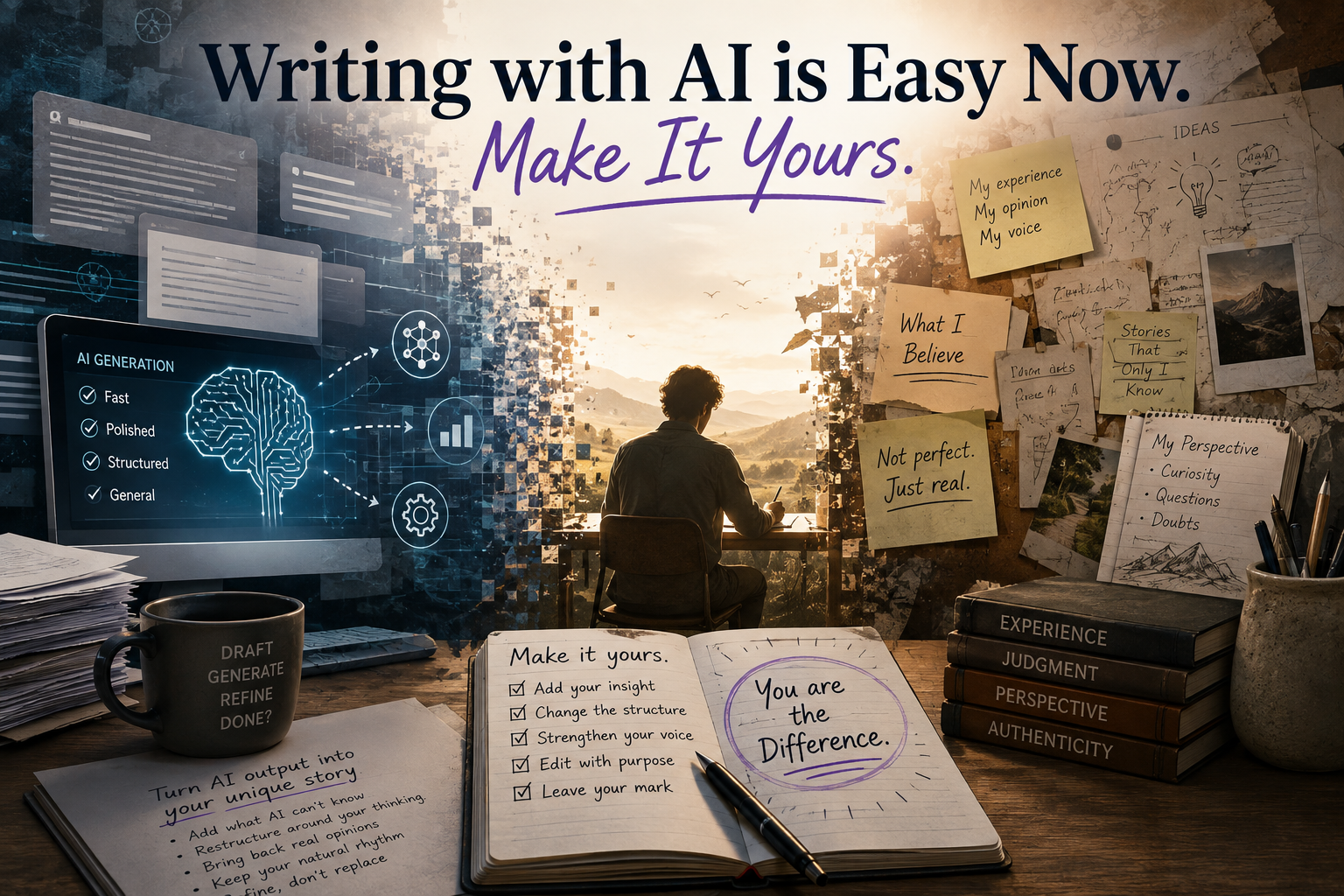
Highlights
- AI makes drafting easy. Distinctiveness still takes work.
- Add experiences AI could never have known.
- Restructure the draft around your thinking.
- Put your real opinions back into the writing.
- Edit for your natural rhythm, not maximum polish.
- Use AI humanizers as a refinement layer after generation.
The next AI writing problem
AI solved one of writing’s oldest problems almost overnight: getting something onto the page. Now we’re running into a much stranger one. The words are there, the grammar works, the argument makes sense, but the finished draft could have belonged to almost anyone.
Writing With AI Is Easy Now. Here Are 5 Ways to Make the Result Your Own.
Not long ago, using AI for writing felt like a productivity trick. You opened ChatGPT, Claude, or Gemini, described what you needed, and watched a blank document become a reasonably competent draft in seconds. Compared with staring at a blinking cursor for half an hour, it felt almost unfair.
That advantage hasn’t disappeared. AI is still remarkably useful for getting ideas moving, untangling rough thoughts, building outlines, and producing the first version of something you might otherwise have spent hours starting.
But the novelty has worn off, and that has exposed a different problem. Getting AI to write something good is becoming much easier than getting it to write something that feels specifically yours.
You can see it when you reread a draft and can’t point to anything technically wrong with it. The introduction is polished. The transitions behave themselves. Every argument arrives exactly where you expect it to. There might even be a clever line or two.
And yet you have the strange feeling that if your name disappeared from the top, nobody who knows your work would immediately know you wrote it.
That’s a much more interesting problem than robotic AI writing. Modern models are increasingly capable of producing text that sounds fluent, conversational, persuasive, and even emotionally aware. The issue isn’t always that AI sounds like a machine anymore. Sometimes it sounds perfectly human while sounding like no particular human at all.
So perhaps the next skill in AI-assisted writing isn’t learning another elaborate prompt formula. It’s learning how to take a useful machine-generated draft and put enough of yourself back into it that the convenience doesn’t come at the expense of identity.
Fortunately, that doesn’t require throwing away AI-generated drafts and starting over manually. A few deliberate changes can dramatically alter who a piece seems to belong to. They involve adding information AI couldn’t know, challenging the structure it gives you, restoring your opinions, editing according to your natural rhythm, and using refinement tools more selectively.
AI can give you the words. The more important question now is what you do afterward to make those words unmistakably yours.
Good AI Writing Can Still Feel Like It Belongs to Nobody
The strange thing about modern AI writing is that the problem is no longer obvious badness.
A lot of it is genuinely good. It can be clear, logical, grammatically strong, persuasive, and surprisingly pleasant to read. If you compare today’s output with the stiff machine-generated text people were laughing at a few years ago, the improvement is enormous.
But better writing has created a subtler weakness. The more models optimize toward language that works for the widest possible range of people, the easier it becomes for the final result to feel broadly acceptable without feeling personally owned.
That is why the most revealing question after generating a draft is not simply, Is this good? A better question is, What in this piece could only have come from me?
The structure is almost too sensible.
AI tends to organize ideas into neat progressions. An introduction frames the issue, the middle explains it, and the conclusion resolves it. The structure works, but it can feel interchangeable because the same logic appears across thousands of unrelated topics.
The examples sound plausible instead of lived.
AI is very good at inventing examples that illustrate a point. What it cannot automatically provide is the odd little detail that comes from actually being there, making the mistake, testing the idea, or noticing something most people would overlook.
The opinions rarely risk much.
Unless pushed otherwise, AI often prefers positions that are reasonable, balanced, and difficult to object to. That makes the writing useful, but it can also remove the friction that tells readers a real person has genuinely chosen a side.
The rhythm settles into a recognizable cadence.
Sentences become evenly polished, paragraph lengths feel similar, and transitions arrive exactly where expected. Nothing is wrong with the prose, but there are fewer surprises that reveal how the writer naturally thinks.
The ending closes the argument a little too perfectly.
AI likes completion. It often summarizes the lesson, balances the final thought, and leaves the reader with a clean takeaway. Human writers are more likely to leave a tension unresolved, admit uncertainty, or finish on the detail they personally cannot stop thinking about.
The Problem Isn’t That AI Sounds Robotic. It’s That It Defaults Toward Consensus.
This is why simply asking AI to sound more human does not always solve the problem. A model can add contractions, shorten sentences, loosen the tone, or sprinkle in conversational phrases and still leave the underlying writing identity almost unchanged.
Surface naturalness and personal voice are not the same thing.
A draft begins to feel like yours when it contains choices the model would not have made by default. A strange example. A sharper opinion. A different order of ideas. A sentence you would phrase one way even though another version might technically sound smoother.
That is where ownership comes back into the process.
The goal of the next five steps is not to make AI writing less polished for the sake of it. It is to reintroduce the decisions, experiences, and stylistic preferences that turn a competent draft into something another person could recognize as yours.
Add Something the AI Could Never Have Known
One of the fastest ways to make an AI-generated draft feel like yours is surprisingly simple: give it information it could not have produced without you.
AI has access to enormous amounts of language and general knowledge. Ask for advice about freelancing, studying, marketing, travel, productivity, or almost anything else, and it can assemble a convincing explanation from patterns it has learned. What it does not automatically have is your Tuesday afternoon, your failed experiment, your weird observation, or the thing a client said that completely changed how you approached a problem.
Those details matter because personal writing does not become personal through pronouns alone. Adding “I think” to an otherwise generic paragraph does very little. What creates ownership is information that exists because you noticed, experienced, tested, or believed something yourself.
Working remotely can improve productivity by reducing commuting time and giving employees greater flexibility over their schedules. However, maintaining clear boundaries between work and personal life is important to avoid burnout.
I thought removing the commute would automatically give me more free time. Instead, I started opening my laptop earlier and closing it later. The strangest part of working from home wasn’t distraction. It was realizing that without a train to catch or an office to leave, my workday had stopped having a natural ending.
The second version isn’t stronger because it uses better vocabulary. It is stronger because the observation has an owner. Someone had to experience that small contradiction before it could appear on the page.
Look for Details That Don’t Exist in the Prompt
When an AI draft feels generic, I would not immediately ask the model to rewrite it. First, scan the piece for places where you can contribute information that wasn’t available when the draft was generated.
You don’t need a dramatic life story. In fact, smaller details often work better because they feel less manufactured. A sentence about what surprised you during a project can contribute more personality than three paragraphs explaining your professional background.
A small pattern, contradiction, behavior, or detail that caught your attention when other people might have ignored it.
An assumption that failed, an approach you abandoned, or an opinion you changed after seeing what happened in practice.
A result from your own work, experiment, comparison, workflow, or experience that adds evidence beyond general advice.
A conversation, customer reaction, classroom moment, colleague observation, or comment that changed how you understood the topic.
This is especially useful because you don’t need to replace the entire AI-generated draft. The model can still handle the connective tissue, explanations, and organization. Your job is to identify the places where generic competence isn’t enough and inject information that gives the writing a point of origin.
Even one or two details can change how an entire section feels. Suddenly, the reader isn’t consuming another explanation of remote work, marketing, productivity, or whatever the topic happens to be. They’re hearing your version of it.
Before rewriting a paragraph because it sounds too much like AI, ask whether the real problem is simpler: perhaps the paragraph contains nothing the AI needed you to know in the first place.
Stop Accepting AI’s Default Structure
Most people personalize AI writing sentence by sentence. They replace a few words, shorten an awkward phrase, remove an obvious cliché, and perhaps rewrite the introduction. Then they leave everything else exactly where the AI put it.
That’s easy to overlook because structure doesn’t immediately announce itself as AI-generated. But it may be one of the biggest reasons different AI-assisted articles can feel strangely similar even when they’re written about completely different subjects.
AI is exceptionally good at organizing information into a logical sequence. Give it a topic and you’ll often get some variation of the same architecture: introduce the problem, explain why it matters, break the solution into tidy sections, summarize the lessons, then finish with an encouraging conclusion.
There is nothing inherently wrong with that structure. The problem begins when you accept it automatically.
The argument behaves exactly as expected.
- Introduce the topic
- Explain the problem
- Provide background
- List the solutions
- Discuss the benefits
- Summarize everything
The argument follows what you find interesting.
- Open with the surprising result
- Explain what you expected instead
- Show where that assumption failed
- Introduce the larger idea
- Explore the unresolved tradeoff
- End on the detail that still bothers you
Both structures can communicate the same underlying information. But the second tells us much more about the person arranging it. The writer has decided what deserves emphasis, what can wait, and what should remain unresolved.
That’s an important part of voice that often gets reduced to vocabulary. Your writing style isn’t only how you construct sentences. It’s also the order in which you choose to reveal your thoughts.
Move the Furniture Before You Repaint the Walls
Before spending twenty minutes polishing AI-generated sentences, zoom out and look at the draft as a whole. Ask whether you would genuinely have explained the subject in that order if the AI hadn’t suggested the structure first.
Sometimes the best personalization happens without rewriting a single sentence. You simply move the strongest paragraph to the beginning, combine two repetitive sections, delete a heading that doesn’t deserve its own section, or allow an example to appear before the explanation instead of after it.
AI often saves the most interesting insight until the argument has been carefully established. Human writers frequently do the opposite. If one observation made you want to write the piece, consider putting it much earlier.
Not every article needs background, benefits, challenges, best practices, and a conclusion. If a section adds nothing distinctive, its neatness isn’t a good enough reason to keep it.
AI likes balance. Your interests probably aren’t balanced. If one point deserves 500 words and another needs only three sentences, allowing that imbalance can make the piece feel much more intentional.
Some ideas are genuinely complicated. You don’t have to manufacture a neat answer simply because the draft expects one. Admitting that a tradeoff remains unresolved can sometimes be more useful than forcing a conclusion.
This doesn’t mean deliberately making an article disorganized. Structure still matters. The difference is between structure that emerged from your thinking and structure you inherited because a language model happened to generate it first.
Once you start moving sections around, something interesting happens. You also begin rewriting differently because each paragraph now has a different job. The article gradually stops feeling like an AI draft you’ve edited and starts feeling like an argument you’ve constructed using AI as raw material.
Rearranging an AI draft according to what you find important, surprising, or unresolved can create more individuality than swapping dozens of words ever will.
Put Your Opinions Back In
AI is very good at helping us say things nobody could reasonably disagree with. That is useful when the goal is explanation. It becomes much less useful when the goal is writing worth remembering.
Ask an AI model about remote work, social media, productivity, education, marketing, or almost any debatable subject and it will often gravitate toward sensible middle ground. There are benefits. There are drawbacks. Context matters. Different approaches work for different people. The conclusion is balanced enough that almost everybody can nod along.
The problem is that agreement is not the same thing as identity. If every uncomfortable edge gets softened during generation and editing, the final draft may become more defensible while becoming less recognizably yours.
Your opinion is not noise that needs editing out. Sometimes it’s the entire reason the article deserves to exist.
This doesn’t mean turning every article into a hot take. Strong opinions can be subtle. You might think a popular recommendation is overrated, prefer an unfashionable approach, disagree with one part of an otherwise useful idea, or believe that everyone is paying attention to the wrong problem.
Those judgments are valuable because they reveal how you process information. Two people can know exactly the same facts and still write completely different articles because they disagree about which facts matter most.
Watch What Happens When the Writer Takes a Position
AI can improve workplace productivity by automating repetitive tasks and helping employees complete routine work more efficiently. However, businesses should balance automation with human oversight to ensure quality and maintain appropriate decision-making processes.
I think businesses are measuring the wrong side of AI productivity. Saving an employee ten minutes on a task is useful, but the more interesting question is what happens to those ten minutes afterward. If they’re simply filled with another automated task, we’ve increased output without necessarily making anyone’s work better.
The second paragraph isn’t more personal because it says “I think.” Remove those two words and the viewpoint remains. What makes it distinctive is the judgment being made: the usual productivity metric may be measuring the wrong thing.
That’s the kind of contribution worth looking for when reviewing an AI-generated draft. Instead of only checking grammar and factual accuracy, look for paragraphs where the model has presented a reasonable consensus and ask whether you genuinely agree with it.
Find the Places Where You Have Something at Stake
A useful editing exercise is to stop at every major claim and decide what your own relationship to it is. You don’t need to manufacture disagreement. You simply need to notice where your experience, priorities, or judgment differ from the neutral version AI produced.
Sometimes AI weakens an argument by surrounding a useful point with so many qualifications that the point itself almost disappears.
The gap between conventional advice and lived experience is often where the most interesting writing begins.
A single reservation can reveal more personality than an entire paragraph of generic confidence. Look for claims that need your own caveat rather than AI’s standard disclaimer.
Changed opinions are especially valuable because they contain history. They show the reader not only what you believe now, but how you arrived there.
If your private advice would be sharper, simpler, or more skeptical than the article, the draft may be filtering out too much of your real judgment.
There is another benefit to putting opinions back into AI-assisted writing: it gives the model something better to work with. Once your position is clear, AI can help organize the evidence, challenge the argument, identify weak assumptions, or suggest counterpoints without inventing the viewpoint itself.
In other words, you don’t have to choose between using AI and having an opinion. The better division of labor is often to let AI help develop the argument while making sure the argument still belongs to you.
“Make this more opinionated” can produce stronger language, but stronger language isn’t necessarily your opinion. Decide what you believe first. Then use AI to help you express it more clearly without sanding away the parts that make the position yours.
Edit for Your Rhythm, Not Just Better Grammar
There is a point in editing where making a sentence technically better can make the writing feel less like you.
AI is particularly good at smoothing things out. It can repair grammar, remove repetition, improve transitions, replace awkward wording, and make sentences flow more conventionally. Used carefully, that is incredibly useful. Used automatically, it can flatten the little habits that make one person’s writing different from another’s.
This is where voice becomes harder to define because it isn’t limited to vocabulary. Voice also lives in rhythm. It appears in how long you let a thought run before stopping, where you break a paragraph, which words you naturally reach for, how often you use contractions, and whether you occasionally prefer a blunt sentence over a beautifully balanced one.
Two versions of the same idea can be equally correct and still feel as though they were written by completely different people.
The increasing accessibility of artificial intelligence has significantly reduced the time required to create written content. However, writers should remain mindful of preserving their individual voice, as excessive reliance on automated refinement can result in content that feels polished but impersonal.
AI made writing faster. Much faster. But I’ve noticed that the more I let it polish every sentence, the less interested I am in the finished piece. Nothing is obviously wrong with it. That’s almost the problem. Somewhere between the first draft and the fifth improvement, I can stop hearing myself in it.
The second version isn’t grammatically superior. It isn’t trying to be. Its advantage is that the pacing itself communicates something. The short interruption after the first sentence, the repeated idea, and the slightly less formal wording create a rhythm that feels chosen rather than optimized.
This is also why asking AI to “improve” an entire article can sometimes produce disappointing results even when every individual sentence gets cleaner. Improvement is subjective. If the system interprets improvement as maximum smoothness, it may remove the variation you would have kept on purpose.
Learn Which Imperfections Are Part of Your Style
Not every irregularity needs fixing. There is a meaningful difference between an error that makes writing harder to understand and a stylistic choice that makes the writing sound like someone.
The trick is figuring out which habits belong to you. Reading several pieces you’ve written without AI can help because certain patterns usually repeat without you deliberately planning them.
Some writers build long, layered sentences and then interrupt them with something short. Others prefer compact sentences throughout. Don’t let AI normalize that variation unless it genuinely improves readability.
Paragraph length affects how a piece sounds in the reader’s head. If you naturally isolate an important thought instead of burying it inside a large paragraph, that spacing is part of your writing rhythm too.
A more sophisticated synonym is not automatically an improvement. If you would normally say “use” instead of “utilize,” there is little value in allowing an editing model to make the sentence sound more formal than you are.
Deliberate repetition can create emphasis and rhythm. Automated editing often removes it because repetition looks inefficient on the page, even when it sounds completely natural when read aloud.
If you naturally write with contractions, conversational transitions, or occasional fragments, forcing every sentence into formal written English can make your work technically pristine and personally unfamiliar.
The Read-Aloud Test Is Still Surprisingly Useful
One of the simplest ways to catch this is to read an AI-edited paragraph aloud. Not because spoken and written language should be identical, but because your ear often recognizes foreign rhythm faster than your eyes do.
You’ll notice the sentence you would never say that way. The transition that feels too polished. The word that looks impressive but feels ridiculous coming out of your mouth. You may even stumble over a perfectly grammatical sentence because its pacing isn’t how you naturally assemble thoughts.
Would I still choose this sentence if nobody told me the AI version was “better”?
If the answer is no, change it back. Editing should improve communication without forcing every sentence toward the same definition of polished writing.
This doesn’t mean preserving bad grammar for the sake of authenticity. Errors that confuse readers, weaken credibility, or distort meaning should still be fixed. The point is to stop treating every unconventional choice as an error simply because an AI system can produce a smoother alternative.
Once you start editing this way, the goal changes. You’re no longer asking whether the draft can become more polished. You’re asking whether every improvement still sounds compatible with the person whose name will eventually appear above it.
Keep the rhythm, vocabulary, pauses, and stylistic choices that make the writing recognizable. AI should help remove friction for the reader without removing the writer along with it.
Use an AI Humanizer as the Editing Layer
The first four approaches have something in common: they require you to stay involved. You add the experience, rearrange the argument, restore your opinions, and decide which parts of your natural rhythm deserve to survive the edit.
That’s exactly how it should work. But there is also a practical limit to how much manual rewriting most people want to do every time they use AI. If generating a draft takes two minutes and making it sound like you takes another hour, some of the convenience disappears.
This is where an AI humanizer can make more sense as an editing tool than as an AI disguise. Instead of treating humanization as a final trick for making machine-written text appear human, it can become a refinement layer between the initial AI draft and your final review.
The useful question isn’t “Can this make AI text look human?” It’s “Can this get the draft closer to how I would have written it myself?”
Think of Humanization as the Step After Generation
You don’t necessarily need to replace ChatGPT, Claude, Gemini, or whichever model already works for you. Those tools are extremely good at producing the raw material. The opportunity is in improving what happens next.
Use your preferred AI model to develop the idea, outline, or first draft quickly.
Refine generic phrasing, repetitive rhythm, stiff transitions, and patterns that don’t fit your voice.
Add your experiences, opinions, structural choices, examples, and final editorial judgment.
The order matters. A humanizer cannot know which personal story you forgot to include or which argument you genuinely disagree with. What it can do is reduce some of the repetitive cleanup between a generic AI draft and a version you would be comfortable putting your name on.
The strongest tools therefore shouldn’t be judged by how aggressively they rewrite. In many cases, restraint is more useful. If a sentence already works and sounds natural, changing it simply for the sake of producing a different sentence can make the draft worse.
What a Good AI Humanizer Should Preserve
Humanization should remove generic patterns without removing you.
A more natural sentence isn’t useful if it subtly changes the point you were trying to make.
Refinement shouldn’t soften every strong position into something safer and more generic.
Not everything needs rewriting. Good editing includes knowing when a sentence is already doing its job.
Sentence length, paragraph pacing, contractions, repetition, and stylistic variation can all contribute to recognizable voice.
The finished draft should feel more natural without becoming so polished that every distinctive edge disappears.
Where WriteBros.ai Fits
This is also the point in the workflow where a tool like WriteBros.ai makes sense. You don’t need it to replace the AI model that helped you develop the draft. The more useful role is downstream, when the ideas are already there but the language still carries too much of the model’s default style.
The interesting part of this approach is that the target doesn’t have to be “perfect” writing. It can be writing that feels more compatible with the person publishing it.
That means paying attention to voice, rhythm, meaning preservation, paragraph-level refinement, and the places where rewriting less can produce a better result than rewriting everything.
That’s also a healthier way to think about the AI humanizer category generally. If the only goal is changing enough words to produce a dramatically different version, the technology isn’t doing much more than sophisticated paraphrasing.
Humanization becomes more interesting when the objective is editorial alignment: taking something AI helped create and moving it closer to the way a particular person communicates.
You should still perform the final review yourself. Check the facts. Restore anything that was flattened. Put back an unusual phrase you liked. Add the example the software couldn’t possibly know. An AI humanizer can shorten the distance between generated and personal, but you still decide where that distance ends.
The best AI humanizer shouldn’t make readers wonder which machine wrote the draft. Ideally, it should make the machine matter less because the person behind the writing is easier to hear.
Don’t Stop Using AI. Give It Something to Sound Like.
There is an easy but unhelpful conclusion we could draw from all of this: AI is making writing generic, so the answer must be to use less AI.
I don’t think that’s where this is heading.
AI has removed a huge amount of mechanical friction from writing. It can help you escape the blank page, organize scattered thoughts, explore different arguments, simplify difficult explanations, and turn a rough idea into something workable before you’ve had time to overthink the first sentence.
Giving that up simply to prove that every word came directly from you misses the larger opportunity. The better challenge is learning how to use all that speed without outsourcing the decisions that make the writing yours.
And those decisions happen at several different levels. They aren’t limited to replacing a few phrases that sound like AI.
Experiences, observations, failures, conversations, and specific details give the writing information that could only have come through you.
Don’t automatically accept the order AI gives you. Decide what deserves to appear first, what needs more space, and what doesn’t deserve a section at all.
Let AI help develop an argument without allowing reasonable consensus to replace what you genuinely believe about the subject.
Preserve the sentence lengths, vocabulary, pauses, repetition, and stylistic choices that make your writing recognizable instead of optimizing everything toward maximum smoothness.
Let technology handle some of the repetitive cleanup, but treat humanization as a way to move a generic draft closer to your voice rather than simply making AI harder to recognize.
Put together, these changes suggest a different future for AI-assisted writing. The value of AI may become less about whether it can produce a polished article from a single prompt. We already know it can do that. The more interesting question is how much control we retain over what happens between that first generation and the version everyone else eventually reads.
That matters even more as the underlying models improve. When almost anyone can generate fluent, organized, competent prose, fluency itself stops being much of a differentiator. The things that remain difficult to reproduce are judgment, taste, lived experience, unusual observations, genuine preferences, and all the small stylistic decisions accumulated over years of communicating.
Maybe the future of writing with AI isn’t about becoming better at getting machines to produce finished work. Maybe it’s about becoming better at recognizing where the machine’s contribution should end and ours should begin.
So use the fast draft. Let AI help with the awkward paragraph. Ask it for alternatives when you’re stuck. Use editing and humanization tools when they save you from repetitive work.
Then interfere with the result.
Move something. Delete something. Put back the sentence an editor might consider slightly imperfect. Add the detail nobody else could have supplied. Disagree with the sensible conclusion. Keep the phrase that sounds like you even when another version looks cleaner on the page.
The easier writing becomes to generate, the more valuable those choices may become.
The goal isn’t to prove AI wasn’t involved. It’s to make sure you still are.
Frequently Asked Questions
Writing with AI is easy. Making the finished piece feel unmistakably yours takes more deliberate work. These questions cover how writers can keep the speed of AI without surrendering the experiences, opinions, rhythm, and decisions that give writing an identity.
How can I make AI-generated writing sound more like me?
Start by adding information the AI could not have known on its own, such as personal experiences, observations, examples, failures, or opinions. Then reconsider the structure and edit the language around your natural sentence rhythm rather than simply asking AI to make the entire draft sound more human.
Why does AI-generated writing often sound generic?
AI models are very good at producing clear, logical, broadly acceptable writing. That strength can also create predictable structures, balanced arguments, familiar transitions, and polished phrasing. Without additional input from the writer, different AI-generated pieces can therefore share a similar rhythm even when the topics are completely different.
Do I need to rewrite an entire AI draft to make it my own?
No. Often the highest-impact changes happen at specific points. Moving sections, replacing a generic example with something you experienced, strengthening an opinion, changing paragraph breaks, or rewriting a few overly polished passages can alter the character of a draft without starting over.
Why should I change the structure of an AI-generated draft?
Structure is part of writing style. AI often organizes information into highly logical and balanced sequences, but that may not reflect how you would naturally develop an argument. Reordering ideas around what you find surprising, important, questionable, or unresolved gives the finished piece more individual direction.
Should I add stronger opinions to AI-generated content?
Only when those opinions genuinely belong to you. The goal is not to manufacture controversy or ask AI to make a paragraph more opinionated. Instead, look for places where the generated draft is more neutral than your real position and restore the judgment, skepticism, preference, or disagreement that was missing.
Does making AI writing sound human mean making it less polished?
Not necessarily. Clear grammar and strong editing still matter. The difference is that polish should not erase natural sentence variation, distinctive vocabulary, deliberate repetition, conversational phrasing, or unusual pacing. The goal is readable writing with character, not imperfection for its own sake.
Can an AI humanizer help make AI writing feel more personal?
Yes, particularly when it is used as an editing layer rather than a replacement for the writer. A good AI humanizer can reduce repetitive phrasing, stiff transitions, predictable rhythms, and other generic AI patterns, while the writer remains responsible for personal experiences, opinions, examples, factual accuracy, and final judgment.
Where does WriteBros.ai fit into this process?
WriteBros.ai fits between AI generation and the writer’s final review. Instead of treating humanization as a race toward perfectly rewritten prose, it can be used to refine generic AI patterns while preserving meaning, rhythm, voice, and parts of the original draft that already work.