ZeroGPT AI Detector Review: How Well Does It Detect AI Writing in 2026?

Highlights
- ZeroGPT delivers instant AI probability scores.
- Highlights sentences that resemble AI-generated writing.
- Simple interface makes quick checks easy.
- Mixed human-AI drafts often produce moderate scores.
- Best used as a fast preliminary detection step.
Visibility is what makes ZeroGPT stand out among AI detection tools. The platform gained traction quickly because it presents its results in a very direct way, highlighting sentences it believes were generated by AI and assigning an overall probability score that suggests how much of the text might be artificial.
That clarity is also what makes the tool interesting to evaluate. ZeroGPT claims it can detect writing produced by models like ChatGPT, GPT-4, and other large language systems, but users frequently report mixed results, especially when the text has been edited or partially rewritten by a human.
This ZeroGPT AI Detector review examines how well the tool actually identifies AI writing in 2026. We look at how its scoring behaves across different types of content, where it performs reliably, and why some results may appear confident even when the writing sits in a gray area between human and AI assistance.
ZeroGPT AI Detector Review
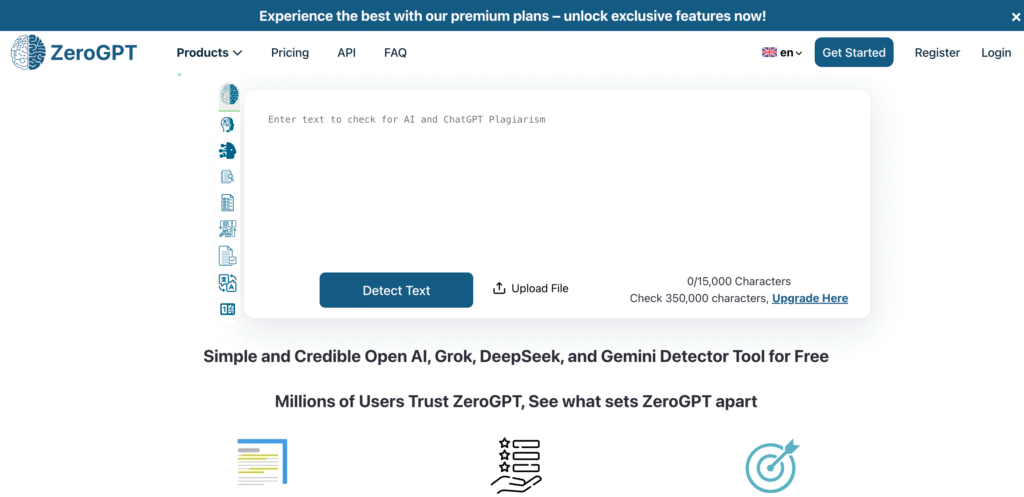
Screenshot via ZeroGPT
What Is ZeroGPT AI Detector?
ZeroGPT AI Detector is a web-based AI detection tool built to estimate how much of a piece of writing may have been generated by artificial intelligence. Instead of focusing on a single probability score, the platform breaks the text into sentences and highlights segments it believes resemble AI-generated language.
The tool became popular because of its simple workflow. Users paste text into the interface, and ZeroGPT quickly produces a percentage score that indicates the likelihood that the content was produced by models such as ChatGPT or other large language systems.
ZeroGPT also provides a visual explanation of its results. Sentences flagged as potential AI writing are marked directly in the output, allowing readers to see which parts of the text triggered the detector’s analysis rather than only receiving a single overall verdict.
This approach makes the system easy to interpret, but it can also lead to debate. Structured writing, consistent tone, or carefully edited passages sometimes receive elevated AI scores, which raises questions about how the tool distinguishes between refined human writing and synthetic language patterns.
In practice, ZeroGPT functions as a quick screening tool rather than a final authority. Its analysis is designed to highlight passages that resemble AI writing patterns, leaving users to decide whether those signals reflect genuine automation or simply well-organized human text.
How ZeroGPT AI Detector Works
ZeroGPT AI Detector analyzes text by estimating how closely its language patterns resemble those produced by large language models. Instead of examining authorship directly, the system evaluates the probability that certain sentences follow statistical patterns common in AI-generated writing.
The analysis is performed at both the sentence and document level. When text is submitted, ZeroGPT scans individual sentences and assigns likelihood signals based on predictability, phrasing consistency, and the type of word combinations that frequently appear in machine-generated content.
These signals are then aggregated into a single overall score that represents the estimated percentage of AI-generated text in the submission. Alongside that score, the platform highlights specific sentences it believes resemble AI output, allowing users to see where the detection signals originate.
ZeroGPT’s model focuses heavily on linguistic predictability. Writing that maintains a consistent rhythm, balanced sentence structure, or uniform phrasing across multiple paragraphs can sometimes resemble the patterns produced by generative models.
Because of this, the tool occasionally interprets highly polished or carefully edited writing as partially AI-generated. In those situations, ZeroGPT is responding to statistical regularity rather than confirming the true origin of the text.
ZeroGPT AI Detector Accuracy Testing Results in 2026
ZeroGPT AI Detector performs most confidently when the input text falls clearly into one category. Fully AI-generated passages are often flagged with high probability scores, while informal or uneven human writing tends to produce lower AI estimates.
During testing, the tool behaved like a pattern classifier rather than a strict threshold filter. It evaluates the language flow across sentences and then produces an overall percentage that reflects how strongly those patterns resemble AI-generated writing.
The sentence-highlight feature plays an important role in this process. Sections with balanced structure, predictable phrasing, or consistent tone can receive elevated AI indicators, even when the broader document contains human revisions.
This means ZeroGPT is effective at identifying obvious AI output, but mixed authorship can blur the results. Text that started as AI and was later edited by a person may still trigger moderate AI scores because some of the original language patterns remain.
In 2026, this overlap has become more common. As writers edit AI drafts or refine them for clarity, the resulting text can resemble both human and machine styles, which explains why ZeroGPT sometimes reports partial AI probability instead of a clear verdict.
Human-Written Content Test
When tested with clearly human-written material, ZeroGPT AI Detector generally produced low AI probability scores when the writing contained natural variation. Sentences with uneven length, informal transitions, and slight stylistic shifts tend to register as more human because they break the predictable patterns language models often produce.
Scores sometimes rise when human writing becomes highly structured or editorially polished. Academic essays, professional reports, and optimized web content occasionally triggered moderate AI indicators because the phrasing remained consistent across multiple paragraphs.
In these situations, ZeroGPT appears to react to linguistic predictability rather than authorship itself. Carefully edited writing can reduce randomness in sentence flow, which increases the chance that the tool interprets the structure as partially AI-like.
AI-Generated Content Test
When tested on fully AI-generated passages, ZeroGPT typically produced high AI probability scores. Text created directly by large language models often contains balanced sentence construction, consistent tone, and predictable phrasing patterns that detection systems are trained to recognize.
The detector became more confident as the sample length increased. Longer passages gave the system more data to evaluate, which allowed recurring language patterns to influence the overall probability score.
Short samples occasionally produced mixed outcomes, but once the text reached several paragraphs, ZeroGPT usually identified strong signals associated with AI-generated writing.
AI-Edited or Hybrid Content Test
Hybrid content created by editing AI-generated drafts produced the most varied results during testing. Some sections appeared human to the detector after revision, while other sentences still triggered AI probability indicators because elements of the original structure remained.
Transitions, summaries, and balanced paragraph structures were more likely to carry residual AI signals. Even when word choices were changed, the underlying sentence rhythm sometimes continued to resemble model-generated phrasing.
By 2026, this type of mixed authorship has become common across academic and professional writing. In these cases, ZeroGPT’s results are better interpreted as pattern signals rather than definitive proof of who originally wrote the text.
Strengths, Weaknesses, and Limitations of ZeroGPT AI Detector
Strengths
ZeroGPT AI Detector performs best as a quick screening tool that highlights sections of text likely to resemble AI-generated language. Its interface is simple, the results are immediate, and the sentence-level analysis helps users see exactly where the system detects potential AI signals.
• Highlights individual sentences that appear AI-generated
• Provides a clear overall AI probability percentage
• Easy to use with no technical setup required
• Produces fast results even for longer passages
• Works well for identifying obvious AI-generated text
• Helpful for quick preliminary checks before deeper review
Limitations and Weaknesses
ZeroGPT’s results become less predictable when writing falls between fully human and fully AI-generated categories. Edited AI drafts, structured essays, and highly polished prose can produce mixed signals because the tool focuses on statistical language patterns rather than writing intent.
• Human-edited AI drafts may still trigger partial AI scores
• Structured academic writing can resemble AI language patterns
• Short samples often produce unstable results
• The probability score does not always explain why text was flagged
• Highly polished writing may increase AI likelihood readings
• Scores indicate pattern similarity rather than confirmed authorship
ZeroGPT provides useful signals about how text resembles AI-generated writing. However, its results are best interpreted as indicators of linguistic patterns rather than definitive judgments about who wrote the content.
Why ZeroGPT’s Percentage Scores Can Be Misleading
ZeroGPT AI Detector presents its findings through a single, highly visible number: the percentage of text it believes may be AI-generated. That format is simple and intuitive, but it also creates the impression that the result reflects a precise measurement rather than a probabilistic estimate.
The score is not calculated the way many readers assume. ZeroGPT analyzes patterns across sentences and aggregates signals that resemble AI-generated language. The final percentage represents how strongly those signals appear across the text, not how much of the content was actually produced by a machine.
This distinction becomes noticeable when writing sits between human and AI categories. Edited AI drafts, structured essays, and standardized professional writing can accumulate enough predictable language patterns to raise the score, even when the text has been heavily revised by a person.
The sentence highlighting feature reinforces this effect. Because individual sentences are flagged based on statistical similarity to AI output, a few predictable passages can influence the perceived reliability of the entire document’s score.
In practice, the percentage should be interpreted as a pattern indicator rather than a literal measurement. ZeroGPT is describing how closely the writing resembles AI-generated language, not calculating the exact portion of text created by artificial intelligence.
Understanding this distinction helps users interpret results more carefully. The number itself can appear authoritative, but the underlying analysis is probabilistic, reflecting similarities in language structure rather than definitive evidence of origin.
ZeroGPT AI Pricing and Value Analysis
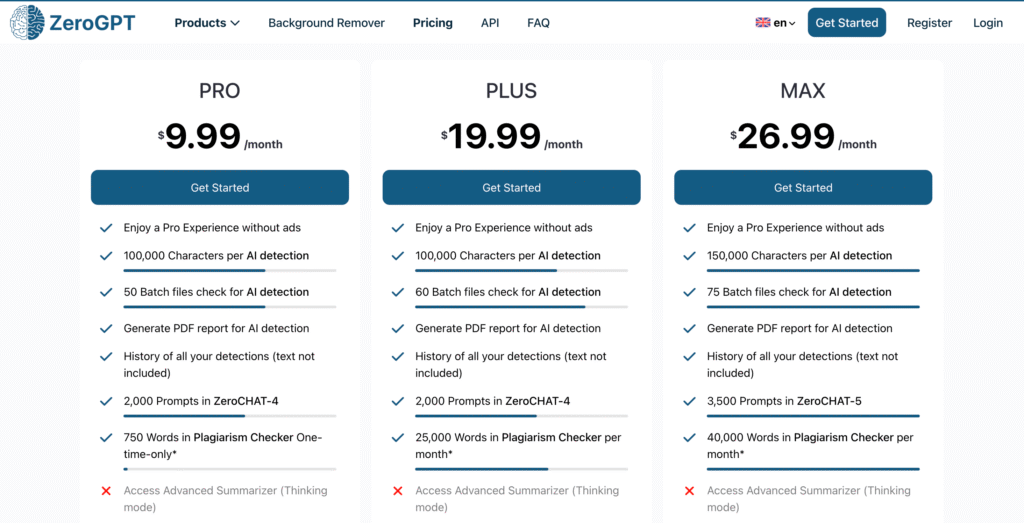
ZeroGPT AI Detector takes a noticeably different approach to pricing compared with many enterprise-focused detection tools. The platform is widely known for offering free access to its core detection feature, which allows users to paste text and receive an AI probability score without creating an account.
That accessibility explains much of the tool’s popularity. Students, educators, and casual users often turn to ZeroGPT because it provides immediate results without requiring subscriptions or complex onboarding. The experience is designed for quick checks rather than structured review workflows.
Premium tiers exist primarily to expand usage limits and add supporting features. These may include higher character allowances, document uploads, and tools that help users process larger volumes of text more efficiently.
For individual writers, the pricing model feels aligned with exploratory use. People can test content, verify sections of writing, or run occasional checks without committing to a paid service.
Where the paid plans become more relevant is in higher-volume scenarios. Teachers reviewing multiple assignments, editors screening submissions, or teams auditing content pipelines benefit from the larger processing limits and more consistent access.
In that sense, ZeroGPT functions less as a formal compliance tool and more as a widely accessible checkpoint. Its pricing reflects a tool built for convenience and scale rather than strict institutional enforcement.
Use Cases: Who Should Use Pangram AI Detector
Use Cases: Who Should Use ZeroGPT AI Detector
ZeroGPT AI Detector works best as a quick verification tool rather than a formal enforcement system. Its interface is simple, the results appear instantly, and the sentence-level highlights help users understand which parts of a document resemble AI-generated language.
- ✓ Students who want a quick way to check whether their essays might trigger AI detection before submitting assignments
- ✓ Educators running a preliminary scan on written work before deciding whether deeper investigation is needed
- ✓ Freelance writers reviewing drafts to see if highly structured sections resemble AI-generated language
- ✓ Content teams performing quick checks on blog posts, articles, or marketing copy before publication
- ✓ Editors evaluating submissions and wanting a fast signal about passages that may appear AI-written
- ✓ Anyone comparing different AI detectors to understand how various tools interpret AI-like writing patterns
Final Verdict: Is ZeroGPT AI Detector Worth Using in 2026?
ZeroGPT AI Detector is worth using when the goal is quick insight rather than strict enforcement. Its main strength lies in accessibility. Anyone can paste text and receive a probability score within seconds, which makes the tool appealing for fast checks before deeper review.
The platform works best as an early signal in a writing workflow. Students reviewing essays, editors scanning submissions, and creators evaluating drafts can quickly see whether sections of text resemble AI-generated language patterns.
The limitation is that the results require interpretation. ZeroGPT’s percentage score reflects statistical similarity to AI writing, not definitive proof of authorship, which means highly polished human writing or edited AI drafts can still produce moderate detection readings.
That is also why many writers now clean up AI-assisted drafts before they ever reach a detector. Tools like WriteBros.ai help smooth robotic phrasing, loosen overly predictable structure, and make the writing sound more natural before it is checked in tools like ZeroGPT.
In 2026, ZeroGPT fits best as a fast screening layer, not the only authority in the process. Used alongside a stronger rewriting and refinement step, it becomes much more useful.
Ready to Transform Your AI Content?
Try WriteBros.ai and make your AI-generated content truly human.
Frequently Asked Questions (FAQs)
Does ZeroGPT AI Detector prove that text was written by AI?
Why do ZeroGPT results sometimes show partial AI percentages?
Can human writing be flagged as AI by ZeroGPT?
How should ZeroGPT AI Detector be used in a writing workflow?
Conclusion
ZeroGPT AI Detector stands out because of its simplicity and accessibility. Instead of presenting complex analysis, it delivers a fast probability score and highlights sentences that resemble AI-generated language, which makes the tool easy for anyone to understand and use.
That simplicity also shapes how the results should be interpreted. ZeroGPT is not designed to investigate writing history or determine authorship. It measures how closely the structure and phrasing of a passage resemble the patterns commonly produced by large language models.
In 2026, that distinction becomes more important as AI-assisted writing continues to grow. Many drafts now pass through editing, rewriting, and polishing stages, which means human and AI language patterns often overlap.
ZeroGPT works best as an early checkpoint rather than a final verdict. Combined with thoughtful editing and refinement earlier in the workflow, it can help writers identify AI-like patterns while still preserving natural voice and variation.

Disclaimer. This article reflects independent testing and publicly available information at the time of writing. WriteBros.ai is not affiliated with ZeroGPT or any other tools mentioned. AI detection systems, scoring models, and accuracy may change as language models and detection technologies evolve. This content is provided for informational purposes only and should not be interpreted as legal, academic, or disciplinary guidance.