How to Avoid Turnitin AI Detection: 15 Academic Writing Strategies

Turnitin AI detection evaluates linguistic predictability and structural regularity across entire submissions, not just wording. Research published in the Nature Scientific Reports study on AI-generated text detection shows classifiers rely on statistical patterns, reinforcing why structural revision and nuanced argumentation matter.
How to Avoid Turnitin AI Detection: 15 Academic Writing Strategies
If you’re using AI tools to draft assignments, you may worry that your work will get flagged before it’s even graded. Figuring out how to avoid Turnitin AI detection can feel confusing, especially when common AI writing patterns that trigger detection are not always obvious at first glance.
Many students assume small edits are enough, but detection systems look at structure, predictability, and linguistic consistency rather than just wording. That’s why simply running text through tools like the most reliable AI humanizer tools for Copyleaks scores does not guarantee your draft will pass unnoticed.
The good news is that there are clear, practical ways to revise AI-assisted writing so it reads as genuinely human and academically sound. In this guide, you’ll learn 15 focused strategies grounded in how detection systems work, including insights drawn from data like the Copyleaks AI false positive percentage and similar reporting trends.
| # | Strategy focus | Practical takeaway |
|---|---|---|
| 1 | Structural variation | Break predictable paragraph and sentence flow so the writing feels less formulaic. |
| 2 | Personalized framing | Add context and perspective that reflect your own academic voice and reasoning. |
| 3 | Controlled unpredictability | Adjust rhythm and phrasing so the text avoids overly consistent patterns. |
| 4 | Source integration depth | Blend citations into analysis rather than stacking them mechanically. |
| 5 | Argument refinement | Strengthen logical progression so ideas build naturally from one point to the next. |
| 6 | Sentence length balance | Mix short and long sentences to avoid uniform pacing across the draft. |
| 7 | Specific examples | Use concrete illustrations that connect theory to realistic scenarios. |
| 8 | Natural transitions | Replace rigid connectors with smoother, context-driven shifts between ideas. |
| 9 | Concept expansion | Deepen explanations instead of relying on surface-level summaries. |
| 10 | Terminology precision | Choose discipline-appropriate language that aligns with your field of study. |
| 11 | Draft layering | Revise in multiple passes to refine clarity, nuance, and tone. |
| 12 | Evidence commentary | Explain why each citation matters rather than letting quotes stand alone. |
| 13 | Voice alignment | Ensure tone matches academic expectations and remains consistent throughout. |
| 14 | Critical nuance | Introduce counterpoints and subtle distinctions to strengthen authenticity. |
| 15 | Final pattern audit | Review the full draft for repetitive structures and overly clean phrasing before submission. |
15 Academic Writing Strategies to How to Avoid Turnitin AI Detection
How to Avoid Turnitin AI Detection – Strategy #1: Structural variation
To reduce detection risk, you need to move away from predictable five-paragraph rhythms and uniform sentence constructions that many AI systems default to when generating essays. That means intentionally varying how you open paragraphs, how you transition between claims, and how you balance exposition with analysis so the structure feels developed rather than mechanically assembled. When you revise, look for repeated sentence openings, evenly sized paragraphs, or identical argument sequences, then reshape them into a more organic progression that mirrors how real students draft and rethink ideas.
This works because detection systems evaluate statistical regularity across an entire document rather than focusing only on individual sentences. If every paragraph follows the same length and internal logic pattern, the writing can appear algorithmically optimized instead of cognitively developed. A realistic adjustment might involve combining two short analytical paragraphs into one layered discussion while splitting a longer explanatory section into two uneven parts, creating natural variation that reflects authentic drafting behavior.
How to Avoid Turnitin AI Detection – Strategy #2: Personalized framing
Even in formal academic writing, there are subtle ways to embed individualized framing that reflect how you interpret a prompt and prioritize evidence. This could include clarifying why a specific theory feels more persuasive within the context of your course discussions or explaining how you are defining a key concept before applying it to your argument. These small framing decisions create a sense of intellectual ownership, which makes the text feel less like a generalized response and more like a student engaging directly with the assignment.
Detection tools often flag text that sounds broadly applicable to any prompt because AI systems generate answers that maximize general relevance. When you anchor your analysis in course language, assignment wording, or a unique angle that aligns with your professor’s expectations, the writing reflects situational awareness rather than generic fluency. For example, referencing how a particular reading was debated in class and then weaving that interpretation into your thesis introduces contextual specificity that algorithms struggle to replicate convincingly.
How to Avoid Turnitin AI Detection – Strategy #3: Controlled unpredictability
AI-generated writing frequently displays a smooth, highly consistent rhythm that lacks the subtle irregularities common in human drafting. Introducing controlled unpredictability means adjusting sentence cadence, occasionally using longer compound structures followed by more concise analytical clarifications, and varying how evidence is introduced across sections. When done carefully, this produces a textured flow that feels thoughtful rather than optimized for statistical uniformity.
The key is balance, because randomness without purpose can weaken clarity and coherence. Instead of inserting abrupt changes, you might lengthen a sentence to incorporate layered reasoning and then follow it with a reflective statement that refines your claim. This interplay between elaboration and refinement mirrors authentic cognitive processing, which makes the document appear less machine-smoothed and more academically constructed.
How to Avoid Turnitin AI Detection – Strategy #4: Source integration depth
Many AI-assisted drafts present sources in a clean but shallow way, introducing a citation and summarizing it before moving on without deeper interpretation. To strengthen authenticity, you should embed sources into your reasoning by comparing them, questioning their assumptions, or connecting them directly to your thesis in extended analytical sequences. This layered integration shows intellectual engagement rather than surface-level paraphrasing.
Detection systems can identify formulaic citation patterns, especially when every paragraph follows the same summarize-quote-explain sequence. A more natural method involves weaving evidence into your own sentences and allowing commentary to unfold gradually rather than appearing in rigid blocks. For instance, you might reference a study’s conclusion mid-sentence and then unpack its implications across the next two sentences, creating continuity that reflects genuine academic thought.
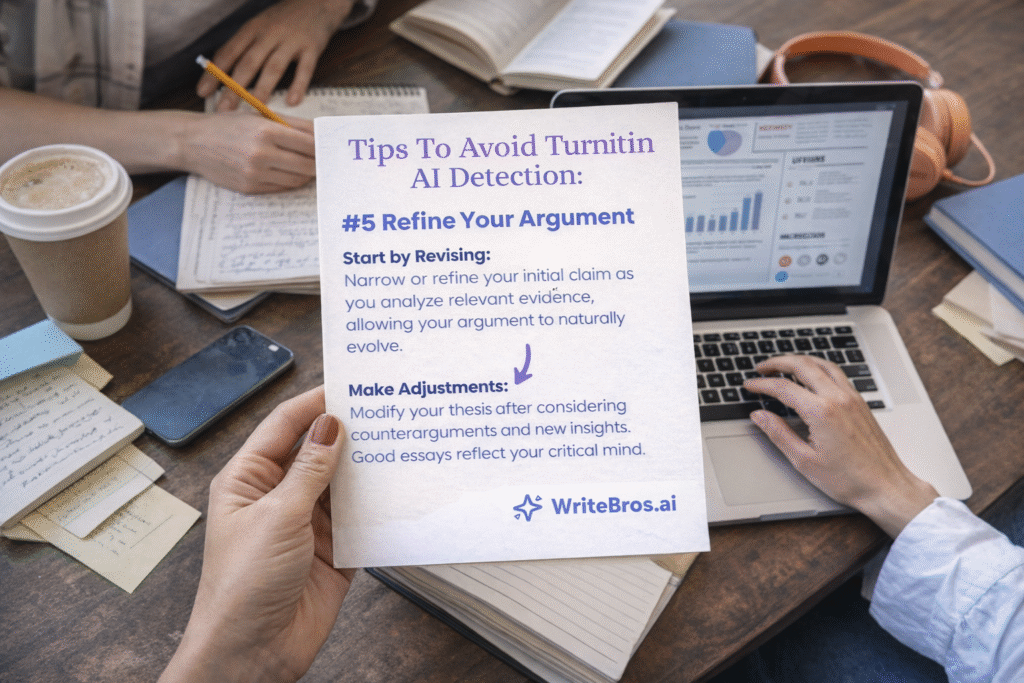
How to Avoid Turnitin AI Detection – Strategy #5: Argument refinement
Strong academic writing evolves across the page rather than presenting a perfectly polished thesis that never changes shape. As you revise, allow your claims to narrow, expand, or become more nuanced in response to the evidence you discuss, making the progression visible in subtle wording adjustments. This gradual refinement signals intellectual development, which contrasts with the static clarity typical of AI-generated responses.
Detection models often assess whether an argument appears overly symmetrical or consistently resolved from start to finish. When your essay shows moments of reconsideration, clarification, or layered distinction, it reads as the product of analytical thinking unfolding in real time. You might begin with a broad claim, then qualify it after examining counterevidence, and finally refine it again in your conclusion, demonstrating depth rather than algorithmic neatness.
How to Avoid Turnitin AI Detection – Strategy #6: Sentence length balance
AI systems frequently produce sentences that fall within a narrow word-count range, creating an even and polished rhythm that feels efficient but slightly artificial over extended passages. Intentionally balancing longer analytical sentences with shorter clarifications introduces a more human cadence that mirrors natural drafting habits. As you edit, read your work aloud and notice whether the pacing feels uniform, then adjust sections so the flow alternates in a way that reflects genuine cognitive variation.
This technique works because detection models often evaluate sentence-level predictability across an entire submission. If your writing consistently adheres to the same syntactic density, it may appear statistically optimized rather than organically composed. A thoughtful revision might involve expanding a brief explanatory sentence into a layered analysis and then following it with a concise conclusion, creating contrast that feels authentic without sacrificing clarity.
How to Avoid Turnitin AI Detection – Strategy #7: Specific examples
Generalized explanations are a hallmark of AI-generated text, since models aim to provide broadly applicable answers. Strengthening your essay with precise, context-driven examples that align with your field of study demonstrates a level of engagement that exceeds generic commentary. Whether you are referencing a detailed case study, a localized policy outcome, or a nuanced classroom discussion, specificity adds texture and credibility to your argument.
Detection systems can struggle to differentiate between fluent but generic writing and deeply contextualized academic reasoning. When your analysis incorporates distinct examples that connect directly to your thesis, the text reflects lived academic experience rather than algorithmic generalization. For instance, citing a specific experiment’s methodology and explaining why its design matters to your claim creates intellectual depth that feels distinctly human.
How to Avoid Turnitin AI Detection – Strategy #8: Natural transitions
AI drafts often rely on predictable transition phrases that neatly signal each new section of analysis. Replacing rigid connectors with context-driven transitions that emerge from the logic of your argument makes the progression feel less mechanical. Instead of formulaic phrases, allow the concluding idea of one paragraph to organically introduce the next concept, creating continuity without overt signaling.
This approach mirrors how experienced writers think through arguments, letting ideas evolve rather than announcing every structural move. Detection tools may flag overused transitional patterns that appear with statistical regularity in machine-generated text. When your essay flows through thematic continuity rather than repetitive connectors, the overall structure appears reflective and intentionally developed.
How to Avoid Turnitin AI Detection – Strategy #9: Concept expansion
AI responses frequently summarize complex ideas efficiently but without sustained depth. Expanding on key concepts by unpacking definitions, implications, and theoretical tensions adds layers that reflect academic engagement. Instead of briefly defining a term and moving forward, pause to explore its dimensions and clarify how it interacts with your broader argument.
Detection systems may identify overly concise explanations as a signal of model-generated efficiency. When you extend your discussion to address nuances or potential ambiguities, the writing demonstrates reflective thought rather than streamlined output. For example, exploring how a theory has evolved over time and why that evolution matters to your thesis introduces analytical richness that feels human.
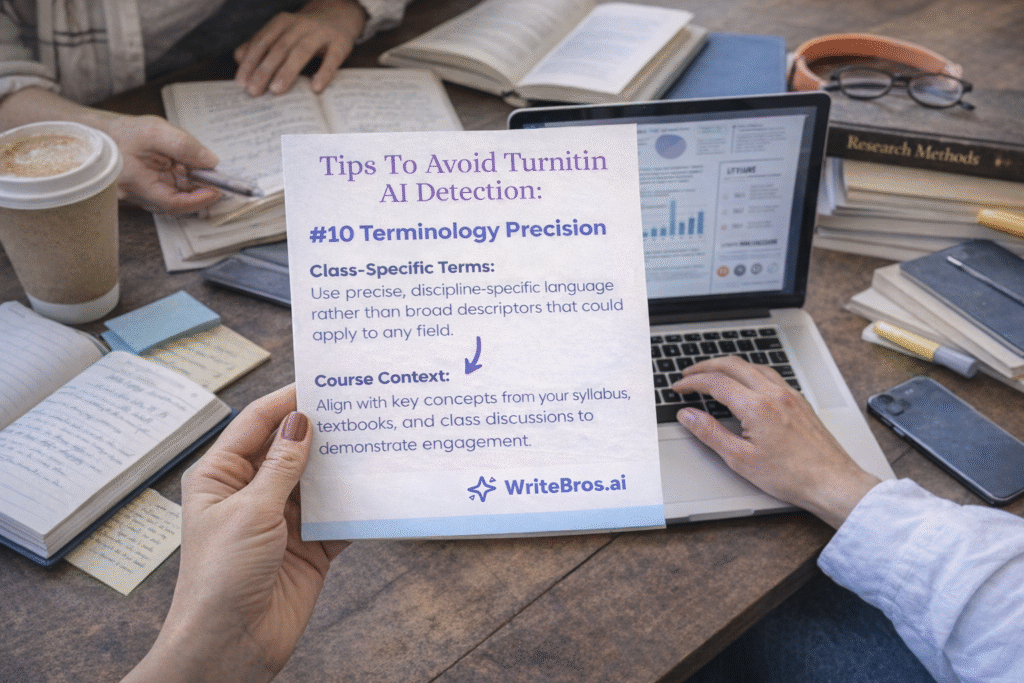
How to Avoid Turnitin AI Detection – Strategy #10: Terminology precision
Using discipline-specific language accurately and thoughtfully strengthens credibility while reducing generic tone. Instead of relying on broad descriptors, integrate terminology that aligns with scholarly conversations in your subject area. Precision signals familiarity with the field and demonstrates that you are engaging with established frameworks rather than producing surface-level commentary.
AI-generated drafts sometimes employ correct but overly universal vocabulary that could apply across multiple disciplines. Refining terminology to match your specific course context reduces that generalized feel. For instance, selecting the exact methodological term used in your textbook and clarifying its application to your case study anchors the essay in authentic academic practice.
How to Avoid Turnitin AI Detection – Strategy #11: Draft layering
Authentic academic writing usually evolves through multiple drafts, each introducing adjustments in clarity, nuance, and emphasis. Simulating this layered process means revisiting your text several times with different revision goals, such as strengthening analysis in one pass and refining tone in another. This incremental refinement produces subtle inconsistencies and improvements that resemble genuine development rather than single-pass generation.
Detection systems often analyze coherence patterns that appear unusually consistent from start to finish. When your essay reflects iterative editing, including small shifts in phrasing or emphasis, it conveys a realistic drafting trajectory. For example, refining your introduction after completing the body paragraphs can naturally alter its tone, creating alignment that feels thoughtfully revised rather than automatically generated.
How to Avoid Turnitin AI Detection – Strategy #12: Evidence commentary
Quotations and citations should function as catalysts for your reasoning rather than decorative additions. After presenting evidence, extend your commentary to clarify its relevance, limitations, and broader implications for your thesis. This deeper engagement ensures that your voice remains central and that the essay reflects interpretive judgment rather than mechanical summary.
AI-generated text may include evidence but often moves quickly past it without sustained critique. By elaborating on why a source matters and how it interacts with competing perspectives, you demonstrate evaluative thinking. This sustained commentary introduces complexity that aligns with human academic reasoning patterns.
How to Avoid Turnitin AI Detection – Strategy #13: Voice alignment
Maintaining a consistent yet flexible academic voice throughout your essay reinforces authenticity. Your tone should reflect the expectations of your discipline while allowing for subtle variation in emphasis and explanation across sections. Reviewing your draft for abrupt tonal uniformity can help you introduce slight shifts that mirror natural human expression.
Detection systems may register perfectly even tone as a potential marker of automated generation. Introducing nuanced modulation, such as slightly more analytical intensity in complex sections and clearer exposition in foundational ones, creates dynamic balance. This alignment between tone and content reflects conscious authorship rather than algorithmic smoothing.
How to Avoid Turnitin AI Detection – Strategy #14: Critical nuance
Human academic writing often acknowledges uncertainty, tension, or competing interpretations within a topic. Introducing measured counterpoints and carefully qualifying your claims demonstrates intellectual maturity and reflective thinking. Rather than presenting arguments as absolute, allow space for complexity and conditional reasoning.
AI-generated essays frequently resolve issues too cleanly, minimizing ambiguity in favor of clarity. By recognizing limitations or contrasting viewpoints, you add texture that signals genuine engagement with the subject. This nuanced handling of complexity helps your writing reflect analytical depth rather than simplified synthesis.
How to Avoid Turnitin AI Detection – Strategy #15: Final pattern audit
Before submitting your work, conduct a holistic review focused on patterns rather than isolated sentences. Look for repeated phrasing, symmetrical paragraph lengths, or overly polished transitions that might indicate algorithmic consistency. Adjust these areas thoughtfully to introduce organic variation while preserving clarity.
This comprehensive audit ensures that your revisions align with natural writing habits instead of statistical regularity. Detection tools evaluate the document as a whole, so small repetitive signals can accumulate into a recognizable pattern. A careful final review allows you to refine rhythm, tone, and structure so the essay reflects authentic academic effort.
Common mistakes
- Relying solely on light paraphrasing tools without restructuring the argument often leaves the underlying patterns unchanged, which means the essay may still display predictable rhythm, symmetrical paragraph structure, and uniform phrasing that detection systems can recognize.
- Submitting a first AI draft without multiple revision passes reduces opportunities to introduce nuance and variation, increasing the likelihood that the writing retains the smooth but statistically consistent features common in generated text.
- Overcorrecting by inserting random complexity or awkward phrasing can weaken clarity and create unnatural flow, which may raise separate concerns about coherence and academic quality even if detection risk decreases slightly.
- Ignoring citation depth and relying on surface-level summaries limits analytical engagement, making the essay appear formulaic and insufficiently reflective of independent critical thinking.
- Maintaining identical paragraph lengths throughout the essay creates visual and structural symmetry that appears optimized rather than organically composed over time.
- Failing to align terminology with course-specific language can produce a generic tone that feels disconnected from classroom discussions, increasing the impression of broad algorithmic generation.
Edge cases
In some situations, highly technical or formula-driven assignments may naturally produce consistent structure and terminology, which can resemble algorithmic patterns even when the work is entirely original. In these cases, the focus should be on deepening explanation and clarifying reasoning rather than artificially disrupting clarity, since authenticity emerges from thoughtful elaboration rather than forced irregularity.
Additionally, shorter assignments provide less space to introduce variation, making it important to prioritize depth within limited paragraphs instead of spreading ideas thinly. Concentrated analysis, careful terminology use, and contextual framing can still demonstrate genuine authorship even in concise submissions.
Supporting tools
- Draft comparison software that highlights sentence-level similarity across revisions can help you identify repetitive phrasing patterns before submission, allowing you to refine structure and tone intentionally.
- Academic grammar checkers with readability analytics provide insight into sentence length distribution and syntactic density, helping you assess whether your writing appears overly uniform.
- Citation management platforms assist in integrating and organizing sources more organically, reducing the likelihood of formulaic summarize-and-move-on citation patterns.
- Plagiarism detection previews, when available, offer a broader perspective on structural signals and textual consistency, supporting more informed revisions.
- Course-specific writing guides ensure terminology and formatting align with disciplinary expectations, strengthening contextual authenticity.
- WriteBros.ai can assist with layered rewriting and stylistic refinement, helping introduce natural variation while maintaining academic coherence.
Ready to Transform Your AI Content?
Try WriteBros.ai and make your AI-generated content truly human.
Conclusion
Learning how to avoid Turnitin AI detection requires more than surface-level editing and quick paraphrasing adjustments. It involves understanding how detection systems evaluate structural regularity, linguistic predictability, and argument development across an entire document, then revising with deliberate variation and intellectual depth.
The goal is not to disguise writing but to ensure that your work genuinely reflects your analytical process and academic voice. When your essay shows thoughtful progression, nuanced reasoning, and contextual awareness, it reads as the product of engaged scholarship rather than automated generation.
Did You Know?
If you are implementing How to Avoid Turnitin AI Detection, begin with structural recalibration rather than surface-level paraphrasing, because mirrored paragraph lengths and uniform sentence density can preserve the same statistical signature even when wording appears different at a glance.
Allow certain analytical sections to expand with layered clarification while others compress for emphasis, vary how claims are introduced and refined, and reduce repetitive sentence openings that follow identical syntactic frames, since organic irregularity more closely reflects authentic student drafting than evenly optimized structure.
Ready to Transform Your AI Content?