How to Clean Up ChatGPT Drafts Before Publishing: 15 Professional Editing Moves
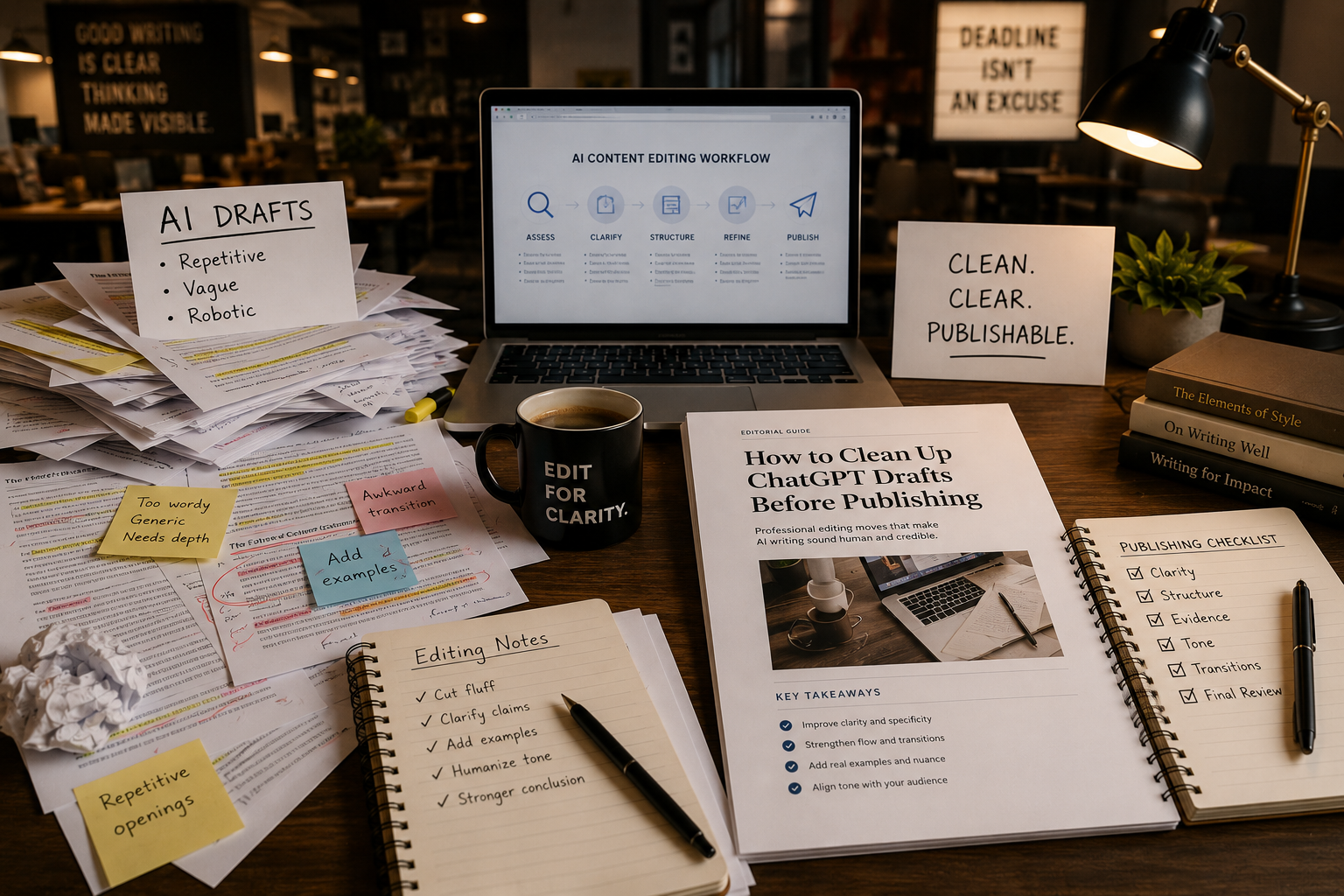
How to Clean Up ChatGPT Drafts Before Publishing without making your content sound robotic, bloated, or over-edited. Research from Elsevier research on identifying AI-generated writing found that even experts struggle to distinguish polished AI text from human writing, which makes careful editing and structural cleanup far more important before publication.
How to Clean Up ChatGPT Drafts Before Publishing: 15 Professional Editing Moves
Most ChatGPT drafts sound polished at first glance, but the problems become obvious once you read them closely. Repetitive phrasing, flat transitions, and stiff explanations can quickly make content feel artificial, especially when you are trying to fix unnatural AI writing before publishing.
Many of these issues happen because AI models default to safe sentence structures and predictable wording patterns. That is why experienced teams rely on structured revision workflows and insights from leading editors for ChatGPT draft cleanup instead of publishing raw outputs too quickly.
This guide breaks down the editing moves that make AI-assisted writing feel sharper, cleaner, and more human without rewriting every paragraph from scratch. You will learn how professional editors tighten flow, improve clarity, and apply practical lessons pulled from current ChatGPT essay editing trends that are shaping modern publishing workflows.
| # | Strategy focus | Practical takeaway |
|---|---|---|
| 1 | Read for rhythm | Spot robotic pacing and repetitive sentence flow before deeper revisions begin. |
| 2 | Cut inflated wording | Remove padded phrases that make explanations feel longer without adding clarity. |
| 3 | Strengthen openings | Rewrite weak introductions so paragraphs feel intentional from the first sentence. |
| 4 | Fix repetitive structure | Break predictable sentence patterns that quietly expose AI-generated writing. |
| 5 | Improve transitions | Create smoother movement between ideas so the draft feels naturally developed. |
| 6 | Add real specificity | Replace generic statements with grounded examples and sharper contextual detail. |
| 7 | Trim artificial certainty | Reduce overly confident language that can make the writing sound unnatural. |
| 8 | Refine paragraph balance | Adjust paragraph length and density to improve readability across the entire piece. |
| 9 | Humanize tone shifts | Keep the voice consistent instead of swinging between formal and conversational styles. |
| 10 | Clarify vague claims | Tighten unclear ideas so readers immediately understand the point being made. |
| 11 | Preserve original intent | Edit aggressively without stripping away the purpose or personality of the draft. |
| 12 | Audit keyword placement | Keep optimization natural instead of forcing repeated phrases into every section. |
| 13 | Check emotional realism | Make reactions, opinions, and observations feel believable rather than manufactured. |
| 14 | Polish final formatting | Clean up spacing, hierarchy, and readability issues before publication goes live. |
| 15 | Review like an editor | Use a final editorial pass to catch hidden issues missed during earlier revisions. |
15 Professional Editing Moves to Clean Up ChatGPT Drafts Before Publishing
How to Clean Up ChatGPT Drafts Before Publishing – Strategy #1: Read for rhythm
One of the fastest ways to identify weak AI writing is to read the entire draft slowly and pay attention to rhythm rather than grammar alone, because ChatGPT often produces sentences that technically make sense while still sounding mechanically balanced in ways real people rarely speak or write. You should listen for repeated sentence lengths, overused transitions, and paragraphs that move at the exact same pace from beginning to end without any natural variation. Strong editing at this stage is less about rewriting individual words and more about noticing whether the draft breathes naturally when ideas become more detailed, emotional, or conversational.
This works well because most readers detect artificial writing subconsciously through pacing before they consciously identify specific wording problems, which means rhythm issues quietly damage trust even when the content itself remains accurate and informative. A marketing article discussing customer retention, for example, may repeatedly open sentences with identical structures that slowly make the draft feel stiff even if the information is useful and logically organized. When you deliberately vary sentence movement and adjust pacing around important ideas, the draft begins to sound more human because the flow mirrors natural communication patterns rather than predictive language outputs.
How to Clean Up ChatGPT Drafts Before Publishing – Strategy #2: Cut inflated wording
ChatGPT frequently expands simple ideas into overly padded explanations because the model tends to prioritize completeness and smoothness over efficiency, which often results in drafts that sound polished while still feeling exhausting to read from beginning to end. During cleanup, you should actively remove phrases that repeat the same idea in slightly different ways or sentences that introduce concepts without adding meaningful clarification afterward. Good editing here focuses on tightening the relationship between each sentence so the reader feels steady forward movement instead of constant explanation loops.
This matters because inflated wording quietly weakens authority and makes readers question whether the writer truly understands the subject deeply enough to explain it directly and confidently without unnecessary filler. A product description, for instance, may spend three sentences slowly explaining a feature that could have been communicated more clearly in one grounded and practical observation tied to actual user experience. Once those extra layers disappear, the draft immediately feels sharper and more intentional because the strongest ideas finally receive space to stand on their own.
How to Clean Up ChatGPT Drafts Before Publishing – Strategy #3: Strengthen openings
Many AI-generated paragraphs begin with soft introductory language that delays the actual point, because ChatGPT naturally leans toward cautious framing instead of direct positioning when it generates informational or editorial content at scale. You should revise paragraph openings so they immediately establish what the section is discussing and why the information matters before gradually expanding into supporting detail or context afterward. Readers become more engaged when paragraphs begin with a clear direction instead of drifting through generalized setup language that feels interchangeable with dozens of other articles online.
This editing move becomes especially important in long-form publishing because weak openings create the impression that the article lacks confidence, even when the research and insights underneath remain useful and well developed. A business strategy section that starts with vague statements about modern companies changing rapidly will usually feel forgettable compared to an opening that directly identifies a real operational challenge or measurable trend affecting decision-making. Once openings become more specific and purposeful, the entire draft gains momentum because readers no longer need to wait for the content to finally reveal its point.
How to Clean Up ChatGPT Drafts Before Publishing – Strategy #4: Fix repetitive structure
AI writing becomes noticeably artificial when sentence construction repeats too consistently across multiple paragraphs, because ChatGPT often falls into predictable formatting habits that make every explanation feel mechanically assembled instead of naturally developed through thought and experience. While editing, you should look for repeated openings, identical clause patterns, and sequences where every sentence follows the same rhythm and structural balance from beginning to end. Changing structure does not mean forcing random variation, because the goal is simply to recreate the uneven and adaptive pacing found in genuine human communication.
This works because readers naturally expect writing to shift shape depending on emotion, complexity, and emphasis, while AI-generated content often maintains the same predictable cadence regardless of what the paragraph is trying to communicate. A lifestyle article may repeatedly use explanatory openings followed by identical supporting examples, which slowly creates a synthetic reading experience even when the wording itself appears clean and grammatically correct. Once you intentionally vary structure through pacing, sentence arrangement, and emphasis placement, the content begins to feel less algorithmic and far more believable to readers.
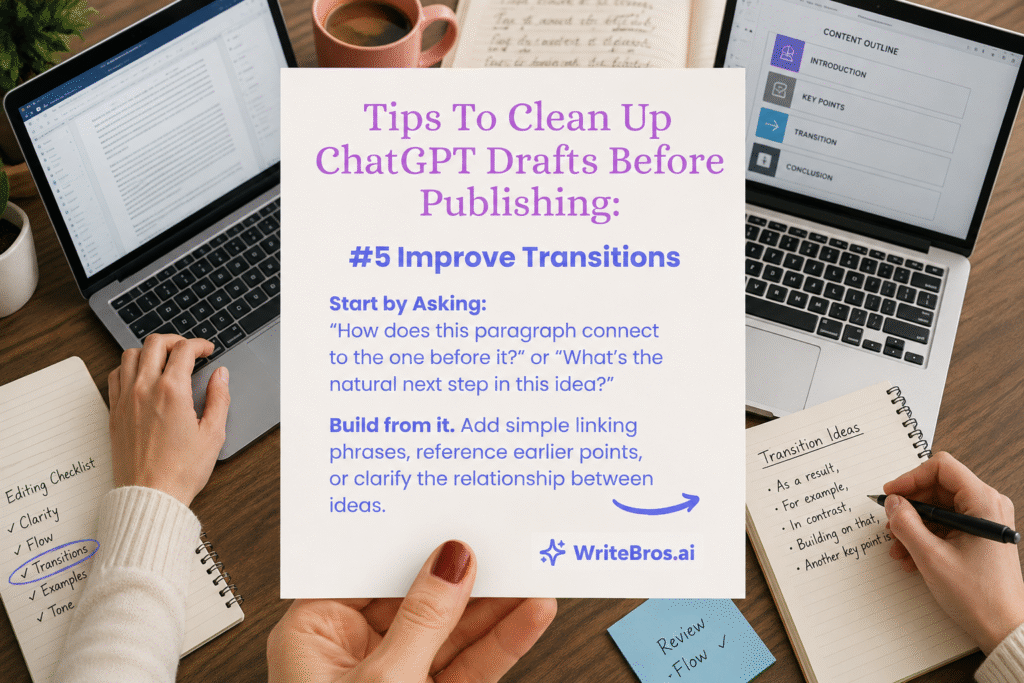
How to Clean Up ChatGPT Drafts Before Publishing – Strategy #5: Improve transitions
One of the clearest signs of unfinished AI writing is abrupt movement between ideas, because ChatGPT often generates paragraphs that are individually coherent while still lacking meaningful connective tissue between sections of the broader draft. Strong editing should focus on making transitions feel motivated and logical so each paragraph naturally evolves from the previous discussion instead of sounding like isolated responses stitched together afterward. This usually requires adding contextual framing, clarifying cause-and-effect relationships, or subtly referencing earlier points so the narrative flow feels intentional across the entire piece.
Readers respond well to smooth transitions because they reduce cognitive friction and create the feeling that a knowledgeable person carefully guided the discussion rather than rapidly assembling disconnected explanations from separate prompts or outputs. An article about AI editing tools, for example, may jump suddenly from workflow efficiency into brand voice preservation without explaining how those concepts directly affect one another during real publishing situations. Once transitions become more deliberate and contextualized, the draft feels more trustworthy because the progression of ideas reflects actual human reasoning instead of fragmented content generation.
How to Clean Up ChatGPT Drafts Before Publishing – Strategy #6: Add real specificity
Generic language is one of the biggest reasons AI drafts feel forgettable, because ChatGPT often defaults to broad explanations that sound universally acceptable while avoiding the small details that make writing feel grounded and genuinely informed by experience. During editing, you should replace vague statements with realistic observations, practical scenarios, and contextual examples that clearly demonstrate how an idea functions in real situations rather than abstract theory alone. Specificity gives readers something concrete to visualize, which immediately increases credibility and emotional engagement throughout the draft.
This becomes especially valuable in competitive content environments where readers are constantly exposed to nearly identical AI-generated summaries that recycle the same generalized advice without adding meaningful texture or differentiation. A publishing workflow article that references actual editing frustrations, client feedback patterns, or revision bottlenecks will naturally feel more convincing than one that only discusses productivity and optimization in broad marketing language. Once details become more tangible and situation-based, the content starts feeling authored by someone who has genuinely worked through the challenges being described.
How to Clean Up ChatGPT Drafts Before Publishing – Strategy #7: Trim artificial certainty
ChatGPT often presents information with excessive confidence because the model is designed to generate fluent and authoritative phrasing even when nuance, uncertainty, or contextual limitation would sound more realistic to experienced readers. Good editing requires softening statements that feel unnaturally absolute, especially when discussing creative processes, audience reactions, or performance outcomes that naturally vary depending on industry, timing, or execution quality. Human writing usually contains measured phrasing and subtle acknowledgment of complexity, which makes the overall voice feel more thoughtful and trustworthy.
This matters because overly certain language creates distance between the writer and the audience, particularly when readers already understand that publishing, branding, and communication outcomes rarely follow rigid formulas in practice. A content strategy guide that claims a single framework always increases engagement will sound less believable than one explaining the conditions where the strategy performs well and the limitations editors should monitor carefully. Once certainty becomes more balanced and realistic, the draft gains credibility because readers feel they are receiving informed guidance instead of automated overstatement.
How to Clean Up ChatGPT Drafts Before Publishing – Strategy #8: Refine paragraph balance
AI-generated drafts frequently produce paragraphs that feel awkwardly dense or strangely thin because ChatGPT focuses heavily on semantic completion without always recognizing how visual pacing affects readability and reader retention across long-form content. Editing for paragraph balance means adjusting size, flow, and idea distribution so each section feels manageable without becoming fragmented or repetitive as the article develops across multiple sections. Readers should feel guided through the material steadily instead of encountering intimidating walls of text followed immediately by underdeveloped one-sentence paragraphs.
This editing move works well because visual structure strongly influences perceived clarity, especially in digital publishing environments where people scan aggressively before deciding whether an article deserves sustained attention. A technical guide discussing AI cleanup workflows may contain useful insights that still feel exhausting because every explanation appears inside oversized paragraphs with little pacing variation or visual relief between concepts. Once paragraphs become more evenly shaped and strategically paced, the article feels easier to navigate and substantially more professional without changing the actual information itself.
How to Clean Up ChatGPT Drafts Before Publishing – Strategy #9: Humanize tone shifts
Many ChatGPT drafts quietly alternate between overly formal language and casual conversational phrasing because AI systems struggle to maintain emotional consistency across longer outputs that combine informational, persuasive, and explanatory content within the same piece. While editing, you should monitor whether the voice remains stable from section to section instead of suddenly sounding corporate, academic, or artificially friendly depending on the topic being discussed at that moment. Readers respond best when tone evolves naturally according to context while still feeling connected to a recognizable editorial personality throughout the article.
This becomes particularly important for brands and publishers trying to establish a distinct voice, because inconsistent tone makes the content feel assembled from disconnected templates rather than intentionally written for a specific audience or publication style. A startup blog post may begin with practical operational advice before abruptly shifting into exaggerated motivational language that feels disconnected from the grounded tone established earlier in the draft. Once tone transitions become smoother and more intentional, the writing feels more emotionally coherent and significantly more believable to readers.
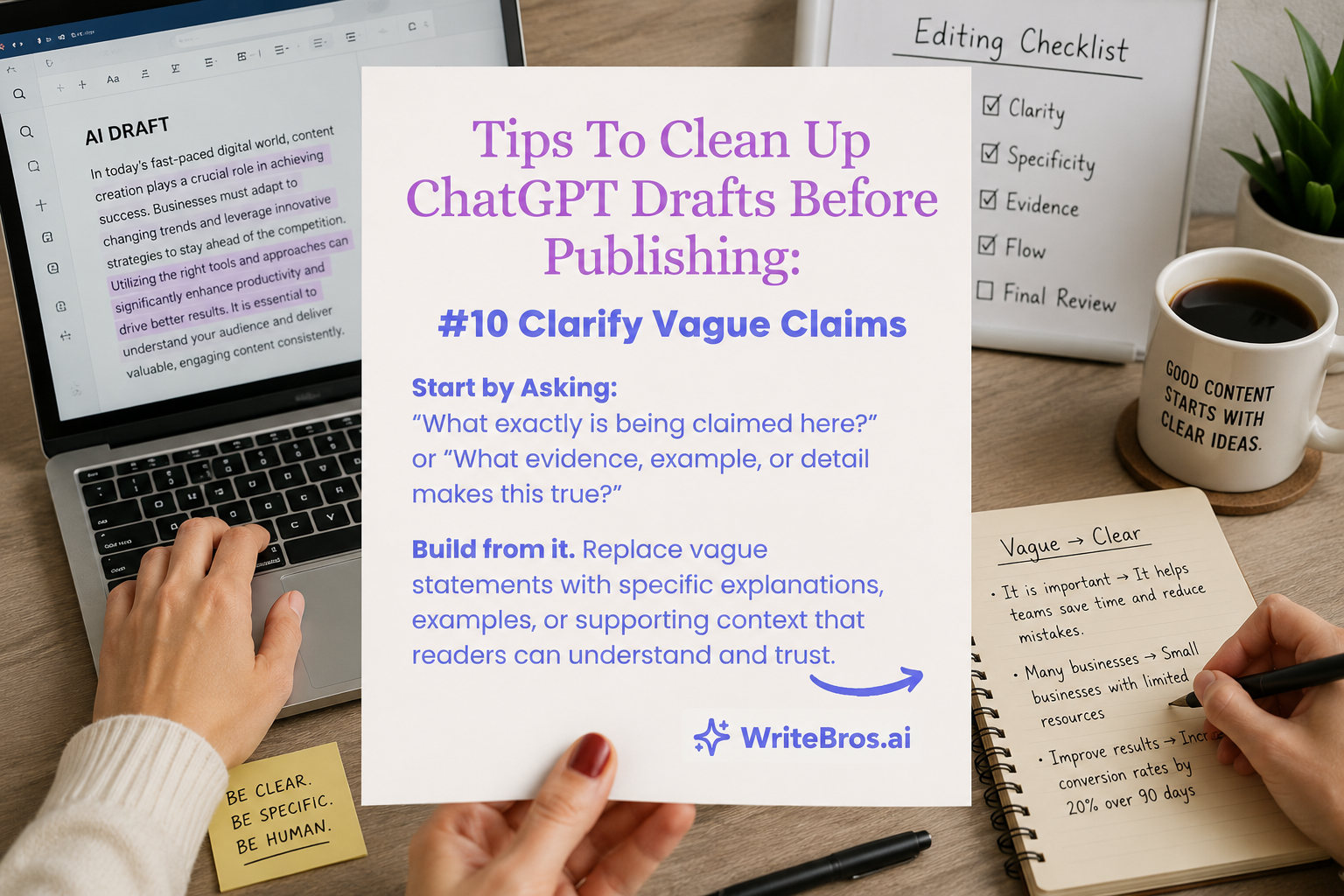
How to Clean Up ChatGPT Drafts Before Publishing – Strategy #10: Clarify vague claims
AI writing often includes statements that sound persuasive initially but become unclear once readers pause to examine what is actually being communicated beneath the polished surface-level phrasing. Strong editing requires slowing down and asking whether each major claim explains something concrete, measurable, or actionable rather than relying on broad language that sounds impressive without delivering meaningful insight afterward. You should actively challenge ambiguous phrases and replace them with clearer reasoning, direct explanation, or grounded examples that immediately strengthen reader understanding.
This works because vague claims create frustration over time, particularly for experienced readers who expect practical clarity rather than generalized commentary repeated across countless AI-generated articles competing for attention online. A business operations draft might mention improving efficiency and strengthening engagement repeatedly without ever clarifying what actions actually changed, what metrics improved, or why the adjustment mattered operationally. Once unclear claims become more precise and evidence-oriented, the content feels substantially more authoritative because readers can finally connect abstract language to real-world application.
How to Clean Up ChatGPT Drafts Before Publishing – Strategy #11: Preserve original intent
One common editing mistake is over-correcting AI drafts until they lose the original purpose, emotional direction, or practical value that made the initial output useful in the first place. Effective cleanup should strengthen clarity and authenticity without stripping away the draft’s central message, because excessive rewriting can easily turn a functional piece into something overly polished but emotionally disconnected from the intended audience. Editors should focus on refining expression rather than replacing every sentence simply because it sounds AI-assisted during the first review pass.
This balance matters because readers respond more strongly to writing that feels purposeful and coherent than to writing that sounds technically perfect but emotionally empty after endless revisions. A founder story, for example, may contain awkward phrasing that still communicates genuine frustration or excitement more effectively than a heavily rewritten version that sounds emotionally neutral and overly managed. Once editors learn to preserve intent while improving execution, drafts retain their personality and become much more engaging without feeling artificially manufactured.
How to Clean Up ChatGPT Drafts Before Publishing – Strategy #12: Audit keyword placement
SEO-focused ChatGPT drafts often become repetitive because keywords are inserted mechanically throughout the article without considering how real people naturally speak, explain ideas, or transition between related concepts during longer discussions. Editing should involve checking whether important phrases appear organically within the flow of the content instead of repeating at predictable intervals that quietly weaken readability and expose the article as optimization-first writing. Good keyword integration supports clarity and topical relevance without making readers feel trapped inside repetitive search-engine language.
This becomes increasingly important as search engines and readers both become better at identifying overly engineered content that prioritizes rankings while sacrificing conversational realism and editorial quality. A guide discussing AI editing tools may repeat identical keyword phrasing in every heading and paragraph even though related terminology or contextual variation would sound substantially more natural and engaging to actual readers. Once keyword placement becomes smoother and less formulaic, the article feels more professional because optimization finally supports the reading experience instead of interrupting it.
How to Clean Up ChatGPT Drafts Before Publishing – Strategy #13: Check emotional realism
AI-generated writing frequently struggles with emotional authenticity because ChatGPT tends to simulate reactions and observations through generalized language patterns rather than nuanced understanding of how people naturally express frustration, uncertainty, excitement, or hesitation in real situations. Editing for emotional realism means examining whether the tone feels believable within the context of the discussion instead of sounding exaggerated, emotionally flat, or oddly disconnected from the stakes being described. Readers notice emotional inconsistency quickly, especially when personal stories or persuasive arguments feel emotionally staged rather than genuinely observed.
This matters because emotional realism strongly influences trust, particularly in editorial, educational, and brand-focused content where audience connection depends on believable communication rather than purely informational accuracy alone. A customer experience article describing burnout or operational stress may feel artificial if every reaction sounds overly polished and motivational instead of reflecting the messier language people naturally use under pressure. Once emotional details become more grounded and context-aware, the writing feels substantially more human because readers recognize familiar emotional patterns within the narrative.
How to Clean Up ChatGPT Drafts Before Publishing – Strategy #14: Polish final formatting
Even well-edited drafts can still feel unfinished when formatting remains inconsistent, because readers unconsciously associate clean visual presentation with professionalism, credibility, and editorial care before they fully process the quality of the writing itself. Final cleanup should include reviewing spacing, heading hierarchy, paragraph breaks, punctuation consistency, and readability across both desktop and mobile viewing environments where visual flow strongly affects engagement. Formatting may appear secondary compared to content quality, but poor presentation quietly damages trust regardless of how insightful the writing becomes after revision.
This editing stage works because visual clarity reduces friction and helps readers focus entirely on the ideas being communicated rather than becoming distracted by structural inconsistency or awkward presentation choices throughout the article. A polished long-form guide can still feel amateurish if headings lack hierarchy, sections feel visually crowded, or sentence spacing shifts unpredictably from one part of the draft to another. Once formatting becomes cleaner and more intentional, the content feels substantially more refined because the reading experience finally aligns with the quality of the underlying ideas.
How to Clean Up ChatGPT Drafts Before Publishing – Strategy #15: Review like an editor
The final review should happen with a completely different mindset from the earlier editing passes, because the goal is no longer improving isolated sentences but evaluating whether the entire draft functions cohesively as a finished and publishable piece. You should read the article as an editor would by questioning clarity, pacing, emotional consistency, structural flow, and audience value instead of focusing exclusively on grammar or sentence-level refinement. This broader perspective often reveals hidden weaknesses that remain invisible during smaller revision stages focused on isolated paragraphs or wording adjustments.
This approach works because strong publishing decisions depend on overall reader experience rather than individual line edits, especially when content must compete against thousands of polished articles generated and revised through increasingly similar AI-assisted workflows. A draft may contain clean grammar and useful information while still failing because the structure feels repetitive, the tone lacks personality, or the argument never builds meaningful momentum toward the conclusion. Once you begin reviewing with editorial distance instead of sentence-level attachment, the draft becomes easier to strengthen strategically before publication.
Common mistakes
- Many editors aggressively rewrite every sentence that sounds slightly artificial, which usually happens because they assume heavy rewriting automatically improves authenticity, but this often removes useful structure and clarity while replacing functional writing with unnecessarily overworked revisions that feel equally unnatural in a different way.
- Some publishers focus entirely on grammar correction while ignoring rhythm, pacing, and emotional consistency, largely because those issues are harder to measure quickly, even though readers often react more negatively to awkward flow and repetitive tone than to small grammatical imperfections.
- Another common mistake is leaving generic examples untouched because the draft technically explains the topic correctly, even though broad and context-free explanations quietly weaken authority and make the content feel indistinguishable from thousands of similar AI-generated articles online.
- Writers frequently overuse keywords during cleanup because they fear reducing search visibility, but repetitive optimization language usually damages readability and makes the article sound engineered primarily for algorithms rather than designed for real human understanding and engagement.
- Many teams skip the final read-through after making structural edits because they assume earlier revisions already solved the biggest issues, although major pacing problems and disconnected transitions often appear only after the full draft is reviewed continuously from beginning to end.
- Some editors mistakenly remove all conversational phrasing in an attempt to sound more professional, which typically creates emotionally flat content that feels detached and overly corporate even when the original draft contained moments of personality worth preserving carefully.
Edge cases
Some ChatGPT drafts require a lighter editing approach because highly technical, legal, or documentation-focused writing naturally depends on precision and consistency more than conversational rhythm or emotional nuance. In those cases, aggressively humanizing every sentence can accidentally reduce clarity, alter terminology, or weaken compliance language that readers actually expect to remain structured and formal throughout the piece.
There are also situations where the draft intentionally needs a polished and restrained tone, particularly in enterprise publishing, investor communication, or educational material designed for broad international audiences. The goal in those cases is not making the content sound casual or highly personal, but making sure the structure, pacing, and clarity feel deliberate enough that readers trust the writing without becoming distracted by obvious AI-generated patterns.
Supporting tools
- Grammarly works well for identifying sentence clutter, repetitive wording, and readability inconsistencies during late-stage cleanup, although the strongest results usually come from selectively accepting suggestions instead of automatically applying every recommendation generated by the system.
- Hemingway Editor helps surface overly dense paragraphs and difficult sentence structures that commonly appear in AI-generated drafts, making it useful for improving pacing and readability before the content reaches final editorial review stages.
- Google Docs remains practical for collaborative cleanup because comment threads, suggestion mode, and version tracking make it easier for editors and writers to refine AI-assisted drafts together without losing earlier revisions or contextual feedback.
- Notion can organize multi-stage editing workflows effectively, especially for content teams managing large publishing calendars where drafts move through separate stages involving AI generation, structural editing, tone cleanup, and final formatting review.
- Originality.ai is often used to evaluate whether heavily templated phrasing or repetitive structures still remain inside the draft after revisions, particularly when publishers want an additional review layer before public release.
- WriteBros.ai helps refine AI-assisted writing by improving tone consistency, smoothing repetitive phrasing, and making generated drafts feel more natural without requiring editors to completely rebuild the content manually from the beginning.
Ready to Transform Your AI Content?
Try WriteBros.ai and make your AI-generated content truly human.
Conclusion
Cleaning up ChatGPT drafts before publishing is ultimately less about hiding AI involvement and more about making sure the writing communicates ideas with clarity, rhythm, and believable human intent. Strong editing transforms generated text from something technically functional into something readers can trust, follow comfortably, and connect with naturally across the full reading experience.
Perfect writing is rarely the goal, especially in fast-moving publishing environments where speed and iteration matter alongside quality and consistency. What matters more is whether the final draft feels purposeful, emotionally grounded, and thoughtful enough that readers stay focused on the message itself instead of becoming distracted by predictable AI writing patterns.
Did You Know?
ChatGPT drafts often sound artificial because of repetitive rhythm, generic examples, and overly polished sentence balance rather than obvious grammar problems.
Smaller editing adjustments usually make AI-assisted writing feel more human than aggressive rewrites that remove natural pacing and clarity.
Ready to Transform Your AI Content?