How to Edit AI-Generated Website Copy for Conversions: 15 CRO-Focused Fixes
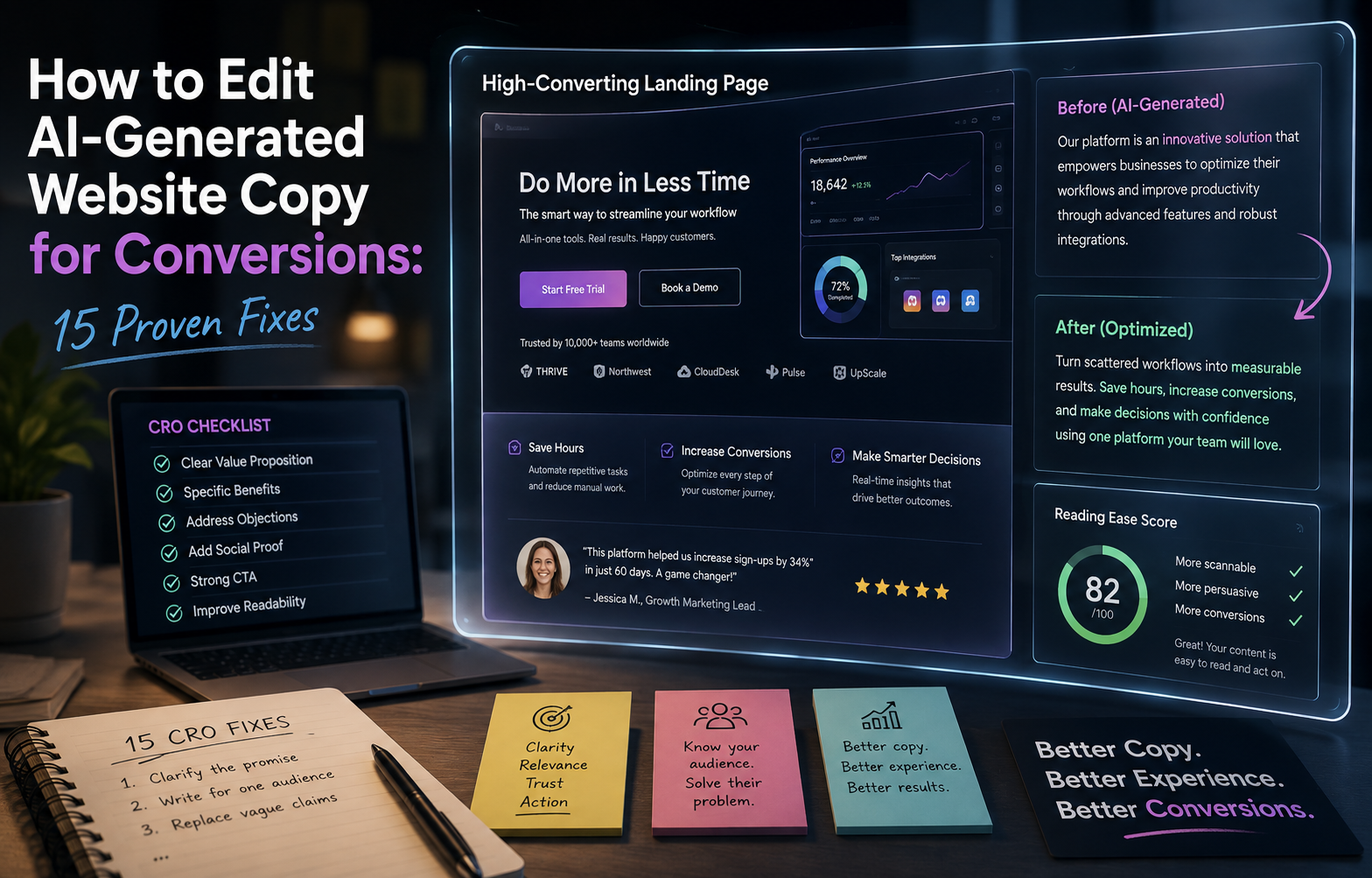
Editing AI-generated website copy for conversions means sharpening the promise, removing vague claims, adding proof, and guiding each next step. Stanford’s web credibility research shows that clear, verifiable information strengthens user trust online.
How to Edit AI-Generated Website Copy for Conversions: 15 CRO-Focused Fixes
AI can produce website copy quickly, but speed often comes at the cost of persuasion, clarity, and trust. If your pages attract visitors without convincing them to act, learning how to rewrite AI landing pages for higher conversions can reveal why generic messaging quietly hurts performance.
Many AI drafts rely on broad claims, repetitive wording, and predictable structures that make brands blend together instead of standing out. Reviewing examples of top AI humanizers for client deliverables also shows why thoughtful editing matters more than simply generating another version of the same copy.
The good news is that you rarely need to rewrite everything from scratch to improve conversion rates. These practical fixes will help you strengthen every section while keeping your messaging aligned with the insights found in AI brand consistency statistics so your website feels more credible, consistent, and convincing.
| # | Strategy focus | Practical takeaway |
|---|---|---|
| 1 | Clarify the primary promise | Lead with one compelling benefit so visitors immediately understand the value being offered. |
| 2 | Write for one audience | Narrow your messaging to a specific reader instead of trying to appeal to everyone. |
| 3 | Replace vague claims | Support statements with concrete outcomes, examples, or measurable details that build credibility. |
| 4 | Strengthen headlines | Create headings that communicate a clear benefit before asking visitors to keep reading. |
| 5 | Improve readability | Break dense sections into shorter, easier-to-scan copy that supports faster decision-making. |
| 6 | Reduce repetitive language | Eliminate recurring phrases so every sentence contributes fresh information. |
| 7 | Add authentic personality | Introduce a consistent human tone that reflects your brand without sounding exaggerated. |
| 8 | Highlight customer outcomes | Focus on what people gain instead of listing product features without context. |
| 9 | Strengthen calls to action | Use action-oriented language that naturally encourages the next step. |
| 10 | Address objections early | Reduce hesitation by answering common concerns before visitors leave the page. |
| 11 | Support trust signals | Integrate proof elements where readers expect reassurance during the buying journey. |
| 12 | Create smoother flow | Ensure each section naturally leads into the next without abrupt topic changes. |
| 13 | Remove unnecessary filler | Cut sentences that delay the main message or repeat ideas already established. |
| 14 | Match visitor intent | Align messaging with the expectations that brought people to the page in the first place. |
| 15 | Review before publishing | Finish with a deliberate editorial pass to catch weak wording, inconsistencies, and missed opportunities. |
15 CRO-Focused Fixes to Edit AI-Generated Website Copy for Conversions
How to Edit AI-Generated Website Copy for Conversions – Strategy #1: Clarify the Promise
Start by identifying the single most important outcome the page is promising, because AI-generated drafts often bury the real value beneath broad language, secondary benefits, and generic claims that sound polished without giving visitors a clear reason to keep reading. Apply this fix whenever the opening section feels technically correct but still leaves you unsure what the offer changes for the customer. Strong execution means expressing one relevant result in specific, audience-centered language that a visitor can understand within a few seconds.
This approach works because people evaluate unfamiliar pages quickly, and a focused promise reduces the mental effort required to decide whether the offer deserves further attention. For example, instead of saying that a platform helps teams improve productivity through intelligent workflows, explain that it helps marketing teams turn rough campaign briefs into approved drafts without repeatedly chasing feedback across separate tools. Keep the promise realistic, however, because an exaggerated benefit may attract attention initially while weakening trust once the remaining copy fails to support it.
How to Edit AI-Generated Website Copy for Conversions – Strategy #2: Narrow the Audience
Rewrite the draft as though it were speaking to one clearly defined buyer, since AI tools frequently produce inclusive language that attempts to address founders, marketers, agencies, freelancers, and enterprise teams within the same paragraph. Use this strategy when the copy mentions several audiences without showing a deep understanding of any one group’s priorities, pressures, or working environment. Effective editing should make the intended reader feel recognized through relevant situations, familiar terminology, and outcomes that match the decision they are currently trying to make.
Narrower copy tends to convert because relevance creates attention, while broad messaging forces visitors to translate generic statements into their own circumstances before they can see the offer’s value. A project management page aimed at creative agencies, for instance, might discuss client approvals, revision rounds, and delayed asset handoffs rather than relying on a universal promise to streamline collaboration. Avoid narrowing the language so aggressively that qualified secondary buyers feel excluded, especially when the product genuinely serves several segments through different pages or use cases.
How to Edit AI-Generated Website Copy for Conversions – Strategy #3: Replace Vague Claims
Review every sentence containing words such as powerful, seamless, innovative, efficient, or game-changing, then replace those abstractions with details that show what the product does, how the experience changes, or what the customer can reasonably expect. This fix is especially useful when the draft sounds impressive during a quick read but becomes difficult to explain in practical terms. Good revision turns unsupported praise into observable information, allowing visitors to evaluate the offer rather than asking them to accept the brand’s opinion.
Concrete language improves persuasion because buyers are more likely to trust claims they can picture, verify, or connect to a familiar problem in their own work. Instead of describing an analytics dashboard as seamless and powerful, explain that it brings campaign spend, lead volume, and conversion data into one view so managers can spot underperforming channels before the next reporting meeting. Be careful not to manufacture precision by adding invented numbers, customer outcomes, or performance claims that have not been documented and approved.
How to Edit AI-Generated Website Copy for Conversions – Strategy #4: Strengthen the Headline
Rewrite the main headline so it communicates a meaningful benefit, establishes relevance, and creates enough curiosity to support the next line, because AI-generated headlines often rely on clever phrasing or category labels that say very little about the actual offer. Apply this strategy when the headline could appear on almost any competitor’s website without needing significant changes. A useful headline should tell the right visitor what becomes easier, faster, safer, clearer, or more achievable after choosing the product.
Headlines carry disproportionate weight because many visitors decide whether to continue based on the first visible message, particularly when they arrive from search results, advertisements, or referrals with limited context. A bookkeeping service might replace Smarter Financial Solutions for Modern Businesses with Keep Your Books Accurate Without Spending Every Weekend Catching Up, which immediately connects the service to a recognizable frustration. Avoid stuffing every feature, audience, and differentiator into one line, since excessive detail can make the headline difficult to process and weaken its emotional focus.
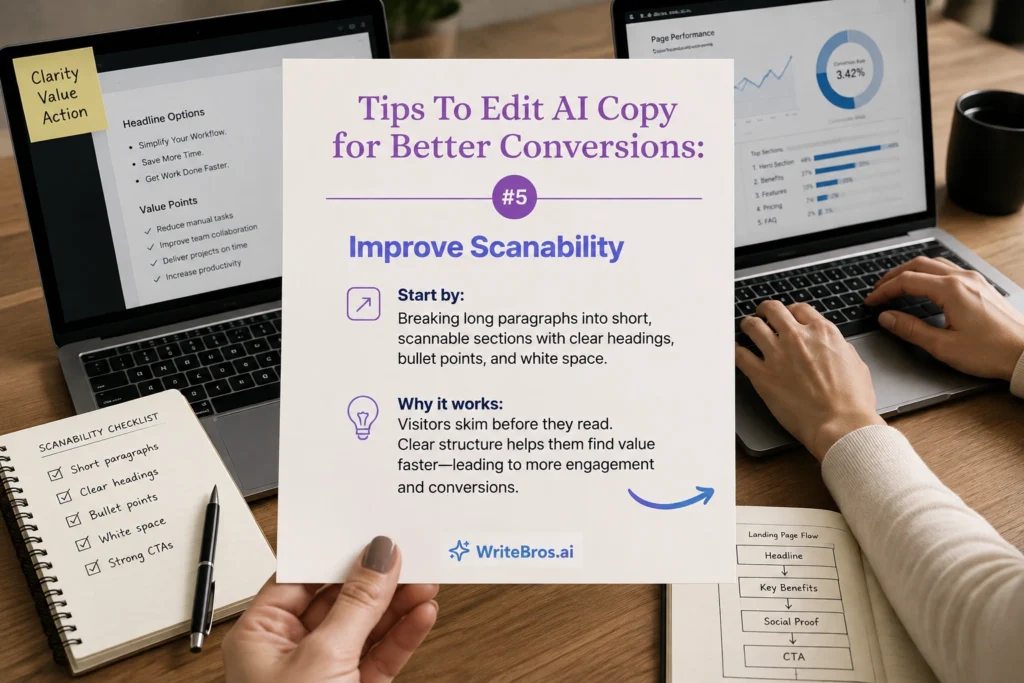
How to Edit AI-Generated Website Copy for Conversions – Strategy #5: Improve Scanability
Restructure dense AI-generated passages into shorter sections with descriptive headings, purposeful sentence breaks, and a clear visual hierarchy, because website visitors rarely read every line in the order the draft presents it. Use this fix when important benefits, objections, or proof points are hidden inside long paragraphs that require sustained attention. Good editing allows someone to skim the page and still understand the offer, the core advantages, the evidence supporting it, and the next action available.
Scanability supports conversion because visitors often move between sections while comparing options, confirming details, or looking for reassurance about a particular concern before making a decision. For example, a software pricing page can separate implementation, support, billing, and cancellation information rather than combining everything into one polished but exhausting block of prose. Do not reduce every paragraph to isolated fragments, however, because excessive compression can make the page feel abrupt, shallow, and disconnected from the complexity of the customer’s decision.
How to Edit AI-Generated Website Copy for Conversions – Strategy #6: Remove Repetition
Read the draft for repeated benefits, sentence structures, transitions, and descriptive words, then consolidate overlapping ideas so each section contributes something new to the visitor’s understanding of the offer. This strategy matters because generative tools often restate the same promise in slightly different language, creating the impression of depth without adding useful information. Strong editing preserves the clearest version of each idea while using the remaining space to introduce proof, context, distinctions, or practical details that move the decision forward.
Removing repetition improves momentum because visitors are less likely to disengage when every section answers a different question or adds a fresh reason to trust the offer. A homepage that mentions saving time in the hero, feature overview, benefits section, and final call to action could instead use later sections to explain where time is saved and which tasks no longer require manual handling. Keep intentional repetition when it reinforces a central message at important decision points, but make sure the surrounding wording and purpose genuinely change.
How to Edit AI-Generated Website Copy for Conversions – Strategy #7: Add Brand Personality
Adjust the draft’s vocabulary, rhythm, examples, and level of formality so the copy sounds like a recognizable brand rather than a neutral assistant summarizing familiar marketing language. Apply this strategy after the core meaning is accurate, since personality should strengthen clarity instead of disguising weak positioning beneath jokes, slang, or decorative phrasing. Good execution creates consistency across headlines, explanations, buttons, and reassurance copy while preserving the natural variations required by different stages of the customer journey.
A distinct voice supports conversion because familiarity and coherence make the company feel more intentional, credible, and easier to remember when buyers compare similar options. For instance, a financial platform serving cautious small-business owners may use calm, direct explanations and avoid the exaggerated excitement that would feel more appropriate for a consumer lifestyle product. Avoid forcing personality into legal information, error messages, or high-stakes claims where precision and reassurance matter more than entertainment, and never imitate a competitor’s tone so closely that the brand loses its own identity.
How to Edit AI-Generated Website Copy for Conversions – Strategy #8: Lead with Outcomes
Translate feature-heavy sentences into customer outcomes by explaining what each capability allows the buyer to accomplish, avoid, understand, or improve in a real working situation. Use this fix when the draft lists dashboards, automations, templates, integrations, or technical functions without clarifying why those details matter to the intended audience. Effective editing keeps necessary product information while connecting every major feature to a meaningful consequence that supports the visitor’s priorities and decision criteria.
Outcome-led copy performs well because customers rarely purchase features in isolation; they purchase the progress, convenience, confidence, or reduced risk those features are expected to create. A scheduling tool should not stop at mentioning automated reminders, for example, when it can explain that reminders reduce missed appointments without requiring staff to send individual follow-ups throughout the day. Avoid overstating outcomes that depend heavily on customer behavior, setup quality, market conditions, or other variables outside the product’s control, and qualify those claims when necessary.
How to Edit AI-Generated Website Copy for Conversions – Strategy #9: Refine Calls to Action
Replace generic button labels and surrounding instructions with calls to action that describe the next step clearly, reduce uncertainty, and match the visitor’s level of commitment at that point on the page. Apply this strategy when buttons repeatedly say Learn More, Submit, or Get Started without explaining what happens after the click. Strong calls to action combine a specific action with nearby context about time, cost, access, or expectations so visitors feel informed rather than pressured.
Clear calls to action increase response because hesitation often comes from uncertainty about the process rather than a lack of interest in the offer itself. A consultation page might use Book a 20-Minute Fit Call and explain that no preparation is required, which gives the visitor a concrete picture of the next step. Avoid promising a frictionless or instant experience when the following form is lengthy, requires payment details, or triggers a sales conversation, because mismatched expectations can increase abandonment and reduce trust.
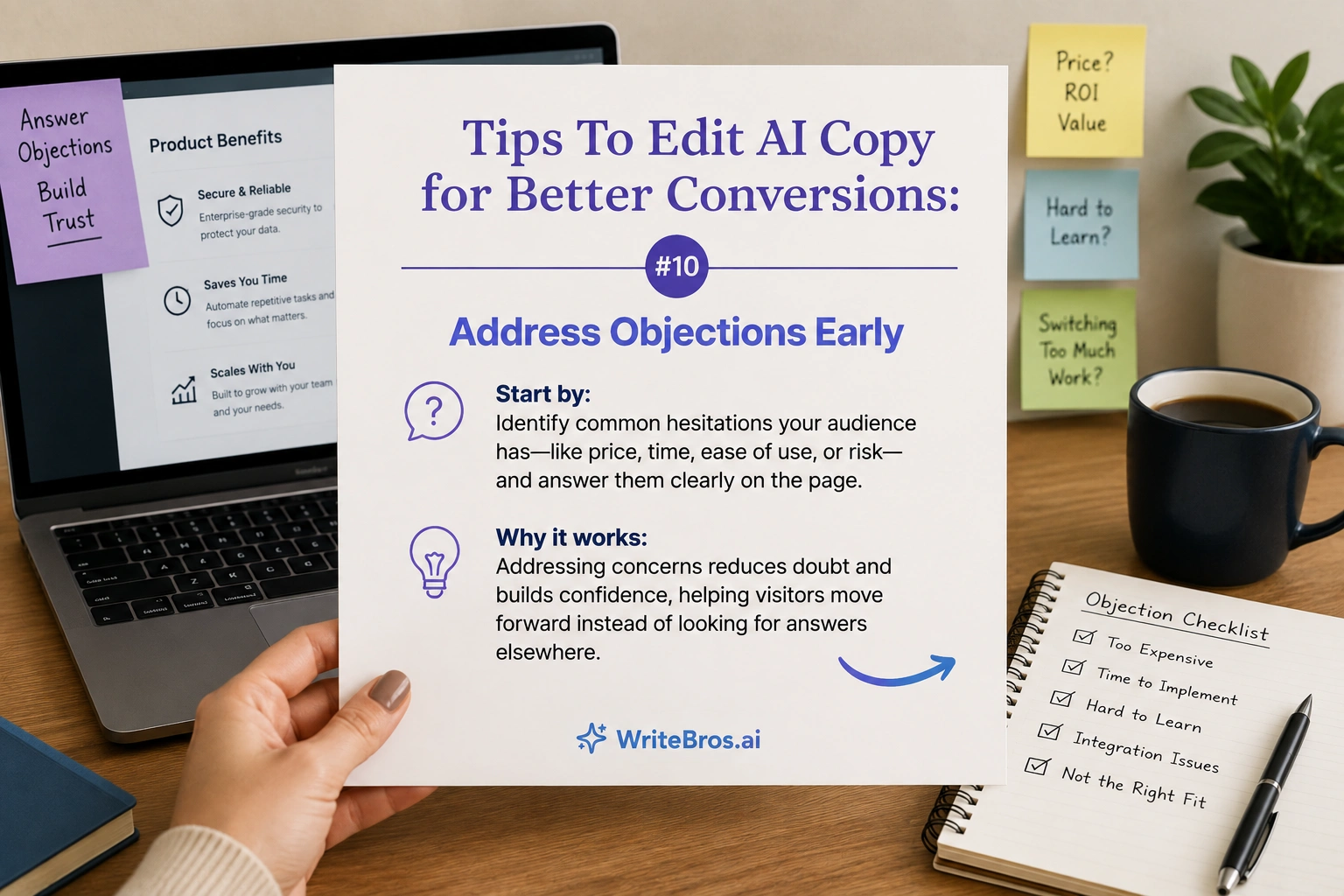
How to Edit AI-Generated Website Copy for Conversions – Strategy #10: Address Objections
Identify the concerns most likely to delay the purchase, such as price, setup effort, migration risk, learning time, contract terms, or uncertainty about results, then answer them directly within the sections where they naturally arise. Use this fix when the draft presents benefits confidently but ignores the practical reasons a qualified visitor might still hesitate. Effective objection handling acknowledges the concern without becoming defensive, offers relevant context or evidence, and gives the reader enough information to continue evaluating the offer.
This strategy works because unanswered objections do not disappear simply because the page avoids mentioning them; instead, visitors often assume the missing information confirms their concern. A software provider serving established teams might explain that migration begins with a structured data review and phased rollout rather than claiming that switching is effortless for everyone. Do not introduce obscure fears that most customers would never consider, and avoid dismissive language that makes reasonable concerns sound uninformed, exaggerated, or inconvenient to the company.
How to Edit AI-Generated Website Copy for Conversions – Strategy #11: Add Credible Proof
Strengthen important claims with evidence such as customer results, testimonials, product demonstrations, independently verified ratings, process details, or relevant operational facts that help visitors judge whether the promise is believable. Apply this strategy wherever the draft asks the reader to trust a benefit that would normally require reassurance before purchase. Good proof is specific enough to be meaningful, closely connected to the claim it supports, and presented with enough context to avoid creating a misleading impression.
Proof improves conversion because buyers naturally look for signs that the offer has worked beyond the company’s own marketing narrative, especially when the decision involves cost, disruption, or professional risk. A client quote describing how approval time dropped after consolidating feedback is more persuasive beside a collaboration benefit than on an unrelated testimonial carousel near the footer. Avoid anonymous praise, unsupported percentages, outdated logos, and results presented without relevant conditions, because weak evidence can create more skepticism than no evidence at all.
How to Edit AI-Generated Website Copy for Conversions – Strategy #12: Improve Section Flow
Reorder the page so each section answers the next logical question in the visitor’s mind, moving from relevance and value toward explanation, proof, objection handling, and action without unnecessary detours. Use this strategy when individual sections appear well written but the page feels fragmented, repetitive, or strangely paced when read from top to bottom. Effective flow creates clear transitions that show why the next idea matters, allowing the argument to build rather than presenting disconnected blocks of marketing copy.
Logical sequencing supports conversion because visitors gain confidence gradually, and each unanswered question can interrupt that progression before they reach the final decision point. A service page may first establish the problem, then explain the approach, show who it is for, provide proof, outline the process, and only afterward present pricing or booking options. Avoid assuming every visitor follows the same path, however, so use descriptive headings and accessible navigation that allow returning or highly informed buyers to jump directly to the information they need.
How to Edit AI-Generated Website Copy for Conversions – Strategy #13: Cut Empty Filler
Delete introductory padding, obvious statements, redundant transitions, and broad observations that delay the useful message, particularly when the draft spends several sentences describing a familiar industry challenge before saying anything distinctive. Apply this fix whenever a paragraph could lose its first sentence without changing the reader’s understanding. Strong editing respects the visitor’s time by reaching the relevant point quickly while preserving enough context to make the message coherent, credible, and easy to follow.
Removing filler improves persuasion because concise pages feel more confident, whereas excessive explanation can suggest that the offer lacks a clear advantage or that the writer is avoiding specifics. A cybersecurity company does not need several lines explaining that digital threats are evolving rapidly before describing how its monitoring process identifies unusual account behavior. Keep context when the audience genuinely needs education, especially for unfamiliar or technical offers, but ensure every sentence contributes meaning rather than merely making the page appear comprehensive.
How to Edit AI-Generated Website Copy for Conversions – Strategy #14: Match Search Intent
Compare the page copy with the promise made by the search result, advertisement, social post, email, or referral source that brought the visitor there, then revise any mismatch in topic, specificity, or expected next step. Use this strategy when traffic appears relevant but engagement or conversion remains weak, because the page may answer a broader or different question than the visitor intended. Good alignment confirms immediately that the visitor has reached the right place and continues delivering information consistent with the original source.
Intent matching improves conversion because people become cautious when a destination page changes the subject, introduces an unexpected offer, or hides the information implied by the link they clicked. Someone searching for pricing should not land on a page dominated by brand storytelling before seeing actual costs, plan differences, or a clear explanation of how pricing is determined. Avoid copying promotional language mechanically from every traffic source, but preserve the central promise and adjust the page when different audiences require genuinely different landing experiences.
How to Edit AI-Generated Website Copy for Conversions – Strategy #15: Run a Final Review
Complete a deliberate review that checks factual accuracy, voice consistency, logical flow, claim support, button language, mobile readability, and alignment between the copy and the actual customer experience before the page is published. Apply this strategy after major revisions are complete, since isolated edits can introduce contradictions, repeated ideas, or transitions that no longer make sense. A strong final review considers the page as one connected decision journey rather than treating every sentence as an independent writing problem.
This final pass matters because conversion weaknesses often appear between sections, where promises, proof, instructions, and calls to action fail to support one another even though each element seems acceptable alone. For example, a page may promise immediate access in the hero while later explaining that account approval takes two business days, creating an avoidable trust problem. Review the page on both desktop and mobile, involve someone unfamiliar with the draft when possible, and prioritize meaningful clarity over endless stylistic polishing that delays publication without improving the visitor’s decision.
Common mistakes
- Editing only for grammar is a common mistake because a draft can be perfectly correct while still failing to communicate a persuasive promise, answer objections, or guide the visitor toward a decision. This happens when teams treat AI output as finished strategy rather than raw material, and it backfires because cleaner sentences cannot compensate for weak positioning.
- Keeping every AI-generated idea often happens because the draft appears comprehensive and removing sections can feel like losing useful work. In practice, this creates repetitive pages with diluted priorities, and visitors struggle to identify which benefit matters most because the copy gives equal weight to every feature, audience, and possible use case.
- Adding urgency without evidence usually comes from copying familiar conversion patterns such as limited availability, expiring access, or immediate action language. When the urgency is artificial or disconnected from a real constraint, visitors may feel manipulated, which weakens trust and can make an otherwise credible offer appear less reliable.
- Overloading the hero section happens when teams try to explain the audience, problem, product, differentiator, proof, pricing, and process before the visitor scrolls. The result is usually a crowded opening that increases cognitive load, making it harder for readers to understand the central promise or decide which element deserves attention first.
- Using invented precision is especially risky because AI tools can produce plausible statistics, timelines, customer outcomes, and performance claims even when no verified source exists. Publishing those details may create short-term persuasiveness, but it exposes the company to reputational, legal, and customer-trust problems when the claim cannot be substantiated.
- Forcing an overly casual voice often happens when editors interpret human-sounding copy as slang-heavy, humorous, or conversational in every section. This approach can feel unnatural for regulated, technical, expensive, or high-risk purchases, and it may reduce credibility when visitors need reassurance, precision, and professional competence more than personality.
- Changing copy without checking the wider experience creates problems when the revised promise no longer matches the form, pricing model, onboarding process, or product itself. This mistake backfires because visitors may convert based on one expectation and immediately encounter another, increasing abandonment, complaints, refund requests, and distrust.
Edge cases
Not every page should follow the same conversion structure, particularly when the audience already understands the offer, the purchase requires extensive research, or the primary goal is education rather than immediate action. A technical product page may need more detail before introducing a call to action, while a returning-customer page may work better with direct access to pricing, documentation, or account tools instead of a long persuasive narrative.
Brand constraints, legal requirements, and market expectations may also limit how far you can simplify claims or personalize the tone, especially in healthcare, finance, insurance, and enterprise procurement. In those situations, the goal is not to imitate aggressive consumer landing pages but to make required information clearer, better organized, and more relevant without weakening accuracy. Conversion-focused editing should support an informed decision, even when that decision takes time.
Supporting tools
- Analytics platforms help you identify where visitors leave, which traffic sources convert, and whether specific pages attract the right audience. Use these patterns to form editing hypotheses, while remembering that the data shows what happened rather than explaining the exact reason behind every behavior.
- Heatmaps and session recordings reveal how people scroll, where they pause, and which page elements receive attention or confusion. They are most useful when reviewed across several sessions, because one unusual visitor journey should not determine a major copy or layout decision.
- User-testing platforms allow representative participants to explain what they believe the page offers, who it is for, and what they expect to happen next. Their observations can uncover unclear promises and hidden objections that internal teams overlook because they already understand the product.
- A/B testing tools help compare meaningful variations in headlines, offers, calls to action, proof placement, and page structure. Test one clear hypothesis at a time, ensure the sample is large enough to support interpretation, and avoid treating minor short-term fluctuations as decisive evidence.
- Readability and grammar tools can identify dense sentences, repeated wording, passive constructions, and mechanical errors that make website copy harder to process. Use their suggestions selectively, because automatic simplification can remove necessary nuance, weaken brand voice, or create unnatural phrasing.
- Customer research materials, including sales-call notes, support tickets, reviews, surveys, and onboarding feedback, provide the language buyers use when describing their problems and desired outcomes. These sources are often more valuable than generic copy templates because they reveal real concerns, expectations, and decision criteria.
- WriteBros.ai can help reshape AI-generated drafts so the language better matches an established voice, sounds less formulaic, and remains consistent across different website sections. It should support a deliberate editorial process rather than replace factual review, customer research, and conversion judgment.
Ready to Transform Your AI Content?
Try WriteBros.ai and make your AI-generated content truly human.
Conclusion
Editing AI-generated website copy for conversions is not mainly about making every sentence sound more polished. The deeper goal is to help visitors understand the offer, recognize its relevance, trust the claims supporting it, and move through the page without unnecessary confusion. When each section answers a meaningful question and contributes to a coherent decision journey, the copy becomes more persuasive because it respects how real people evaluate unfamiliar products, services, and brands.
That process does not require perfect wording or endless optimization before a page can be published. It requires intentional choices about what to emphasize, what to remove, where to add evidence, and how to align the message with the experience that follows. Review performance after launch, learn from customer behavior, and continue improving the copy with care, because sustained clarity usually creates more value than dramatic revisions made without a clear reason.
Did You Know?
Many website visitors decide whether a page feels trustworthy within moments, making clarity, specificity, and believable messaging just as important as attractive design.
Stanford Web Credibility Research found that clear, credible website content plays an important role in how people evaluate online trustworthiness. Editing AI-generated website copy to remove vague claims, strengthen proof, and clarify value can therefore support stronger visitor confidence throughout the conversion journey.
Ready to Transform Your AI Content?